23 Avant-Garde Updo Techniques That Push Boundaries
Forget everything you know about the classic chignon or the tidy ballerina bun. The world of hairstyling is undergoing a radical transformation, moving from the realm of mere aesthetics into the territory of high art and architectural innovation. Avant-garde updos are no longer just about containing hair; they are about deconstructing form, challenging symmetry, and making a profound statement.
This exploration is for the bold, the visionary, and the rule-breakers. Whether you’re a stylist seeking inspiration, a fashion enthusiast, or simply someone captivated by the intersection of craft and concept, these 23 boundary-pushing techniques will redefine what you consider possible atop the human head. We delve into methods that incorporate unexpected materials, defy gravity, and draw inspiration from surrealism, geometry, and beyond.
The Philosophy of Avant-Garde Hair
Before we dissect the techniques, it’s crucial to understand the mindset. Avant-garde hair is conceptual first, practical second. It asks questions: What if hair could mimic molten metal? What does “structure” mean when applied to organic fibers? Can a hairstyle evoke an emotion or critique a social norm? This approach liberates the stylist from functionality, allowing hair to become a sculptural medium as versatile as clay or paint.
The techniques you’ll find here often blur the line between hairdressing, millinery, and sculpture. They require a mastery of foundational skills—pin placement, tension, sectioning—only to then willfully break those rules. The goal is not beauty in a traditional sense, but impact, narrative, and innovation.
Techniques 1-8: Architectural & Geometric Foundations
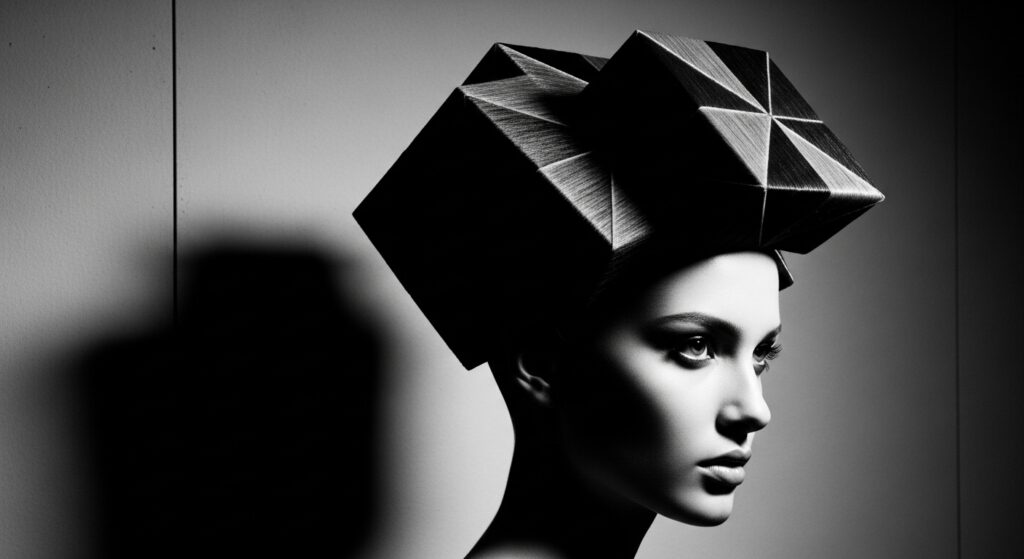
This first set of techniques treats hair as a building material, focusing on clean lines, unexpected shapes, and structural integrity that seems to defy physics.
- The Cantilevered Knot: Inspired by modernist architecture, this technique uses a combination of tightly wound hair and hidden supports (like lightweight wires or mesh) to create sections that extend horizontally or diagonally away from the head, appearing unsupported.
- Geometric Cage Weaving: Thin, rigid sections of hair are woven over a pre-formed geometric wire or acrylic frame, creating a cage-like structure around a more traditional updo or even empty space.
- Fractured Plane Bun: The classic bun is sliced, segmented, and pulled apart. Using strong-hold lacquer and precise pinning, the silhouette of the bun is broken into distinct, separated geometric planes.
- Modular Interlocking: Hair is pre-styled into multiple identical geometric shapes (cubes, rods, discs) using gel and molds. These modules are then interlocked or stacked onto the head via pins and adhesive, forming a larger, complex structure.
- Negative Space Doughnut: A large, precise circle is shaved or tightly braided against the scalp, creating a “hole.” The remaining hair is pulled up and styled to accentuate this deliberate negative space, making it a central feature.
- Asymmetrical Tension Weaving: Braids or twists are pulled with extreme, uneven tension from various anchor points on the scalp, creating a dynamic, strained look with lines that converge off-center.
- The Helical Spire: Hair is wound around a tall, thin conical form to create a dramatic, corkscrew-like spiral that towers upward. The finish can be smooth or intentionally textured to show the winding pattern.
- Floating Orbital: Using clear monofilament or ultra-fine wire, a section of hair is styled into a smooth orb or ring that appears to float an inch away from the main updo, connected only by invisible threads.
Techniques 9-15: Organic & Surrealist Expressions
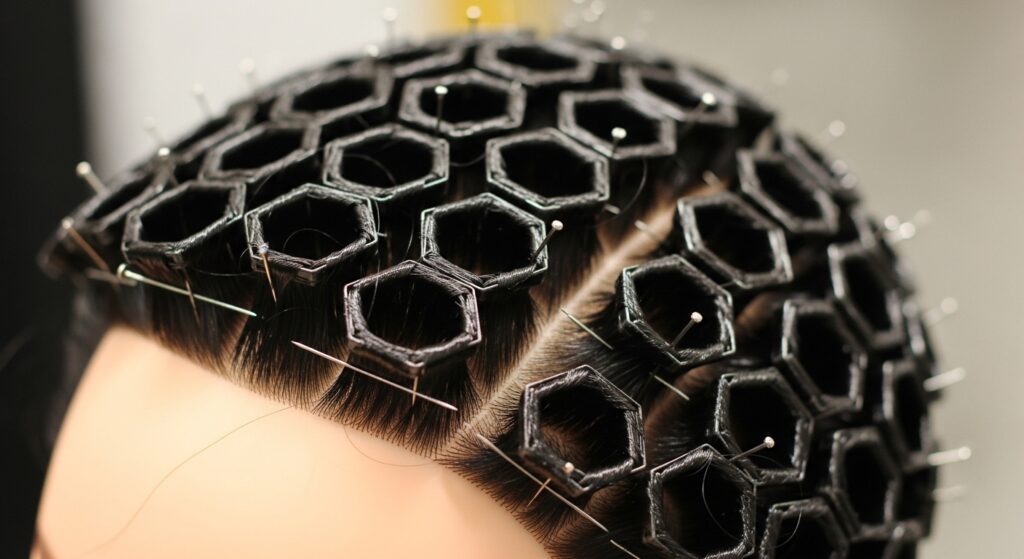
Here, we abandon straight lines for forms found in nature and the subconscious. These techniques embrace texture, fluidity, and the bizarre.
- Mycelial Network Wefting: Mimicking the root-like structure of fungi, fine, wispy wefts of hair are pulled out from a central updo and attached to the skin or scalp in a delicate, spreading web pattern using safe, temporary adhesive.
- Liquid Metal Draping: Hair is saturated with high-shine gel or metallic spray, then draped and folded like molten silver or gold, creating soft, heavy-looking metallic folds and pools rather than defined shapes.
- Petrified Coral Cluster: Backcombing, extreme texturizing spray, and saltwater texturizer are used to create a stiff, brittle-looking mass. The hair is then shaped into porous, branching forms resembling coral and bleached or dyed in chalky, weathered tones.
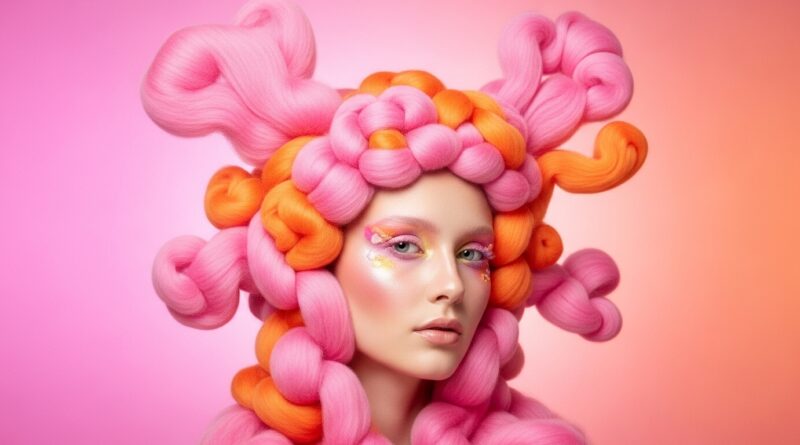
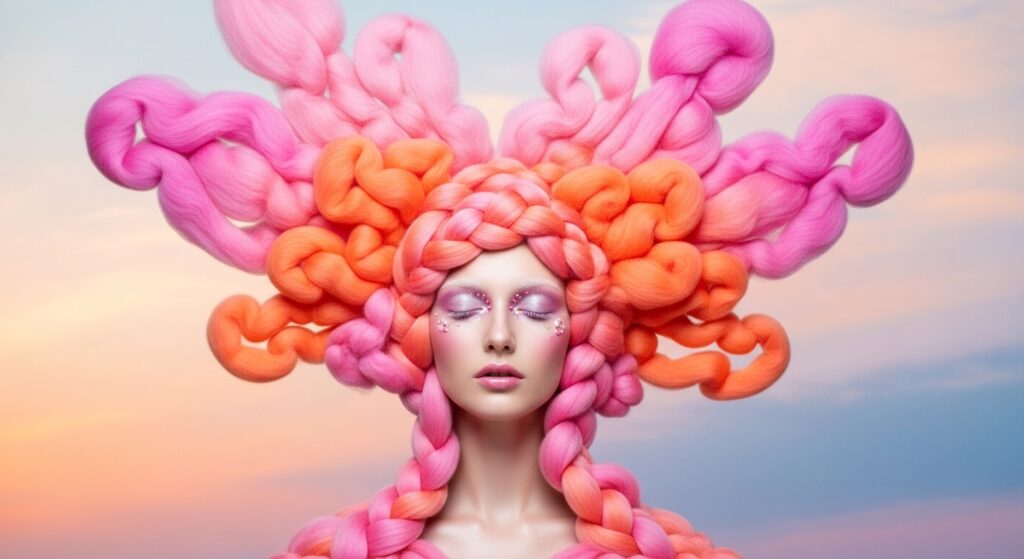
- Biomorphic Fusion: The hair is blended with non-hair materials like dyed wool roving, silk threads, or thin latex strips, then felted or twisted together to create a new, hybrid “fiber” that is styled into soft, alien, organic shapes.
- The Deconstructed Nest: A loose, chaotic updo built from intentionally frayed rope braids, escaped strands, and incorporated found objects (feathers, thin twigs), celebrating controlled chaos and imperfection.
- Kinetic Tendrils: Select strands are treated with a lightweight, flexible glue or clear gel to hold a specific curl or wave pattern. These strands are attached to thin, flexible wires that allow them to move independently with the model’s motion, creating a living, responsive sculpture.
- Faux Topiary Sculpting: Hair is treated as hedge material. Using templates and shears, it is cut and shaped into precise topiary forms—spirals, pom-poms, animal shapes—over a tightly pinned base.
Techniques 16-23: Conceptual & Mixed-Media Breakthroughs
The most extreme frontier, where hair converges with technology, fashion design, and social commentary. These are often one-of-a-kind art pieces.
- Optical Fiber Integration: Thin, flexible LED fiber optics are braided into the hair. The ends of the fibers are scattered throughout the updo, creating a constellation of tiny pinpricks of light that can be programmed to pulse or change color.
- Textural Juxtaposition: The scalp is divided into zones, each treated with a completely different technique to create a “sample book” effect: one section polished straight, one section in giant dreadlocks, one section crimped, one section shaved and stenciled.
- Garment Integration: The updo is not an endpoint but a starting point. Hair is woven directly into the collar of a garment, becomes the tassels on a sleeve, or flows seamlessly into a knitted neckpiece, erasing the boundary between hair and clothing.
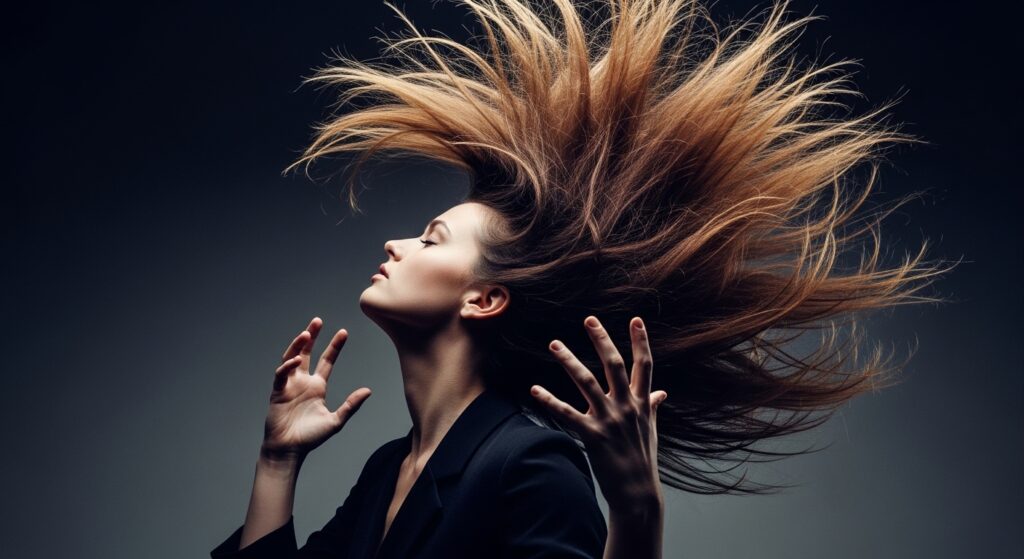
- Frozen Moment: Using a mix of water-soluble glue and clear resin spray, hair is styled to look as if it’s caught in a sudden gust of wind or a splash of water, frozen in dynamic, mid-air movement.
- Data Stream Braids: Braids are woven with strips of translucent vinyl or mylar printed with binary code, circuit diagrams, or glitch art, commenting on the digital age and the fusion of the biological and technological.
- Reflective Surface Tiling: Small, lightweight mirror or chrome acrylic tiles are secured onto a flat, pinned base of hair, creating a fragmented, disco-ball-like helmet that reflects and distorts the environment.
- The Erased Center: The entire crown of the head is left completely smooth and bare (via slicking or a bald cap), while all the hair from the sides and back is pulled up and styled to frame this void, challenging the expectation that an updo must cover the crown.
- Chromatographic Drip Technique: Hair is pre-lightened in sections. As the final updo is constructed, highly saturated, water-based dyes are carefully applied to the top. Gravity pulls the dye down through the updo, creating unique, bleeding, painterly effects that are different every time.
Embracing the Edge of Hairstyling
The 23 avant-garde updo techniques outlined here are more than just instructions; they are a provocation to imagine. They demonstrate that the future of hairstyling lies in interdisciplinary thinking, where a stylist must also be part sculptor, part engineer, and part poet.
While these looks may seem destined only for runway shows or editorial spreads, their true value lies in the trickle-down of innovation. A single element—a new way of securing hair, an unexpected textural contrast, the bold use of negative space—can inspire more wearable, yet still groundbreaking, styles for the adventurous client.
The boundary of what hair can be is elastic and ever-expanding. We encourage you to use these concepts as a springboard. Experiment, hybridize, and question. The next avant-garde technique, the one that pushes the boundary even further, is waiting to be invented in your hands.