Sweat, Set, Go: Hairstyles for Gym and Workouts That Won’t Fall Apart Mid-Set
Hairstyles for gym and workouts need to do a different job from everyday hairstyles. They must survive sweat, jumping, lying on a bench, a headband, a cap or a helmet, and still look decent when you walk out of the class. A style that looks perfect in the mirror but falls apart in the first set is not a gym style.
In this guide, you will find 30 hairstyles for gym and workouts that are chosen for grip, not just looks: braids that lock hair down, buns that stay flat on a mat, ponytails that do not slide, and short styles that stay out of your eyes. Each one tells you who should avoid it, how long it takes, and exactly how to style it.
Pick by your workout first, then by your hair length. A spin class, a lifting session and a yoga flow do not need the same style, and the quick-picks guide below will help you match the style to the session before you start braiding.
Gym Hair at a Glance
- Best all-round hold: Double French braids, cornrows and the French braid crown bun.
- Fastest styles: Pineapple puff, claw clip twist, short crop with a grip headband.
- Best for cardio: High bubble ponytail, bubble braid pigtails, space buns.
- Best for lifting and mat work: Low braided bun, twisted low bun, slicked low ponytail.
- Best for helmets: Helmet-friendly low braid, low ponytail with a headband.
- Best for short hair: Short crop with a grip headband, chin bob with a headband and pins.
Why Regular Styles Fail During Workouts
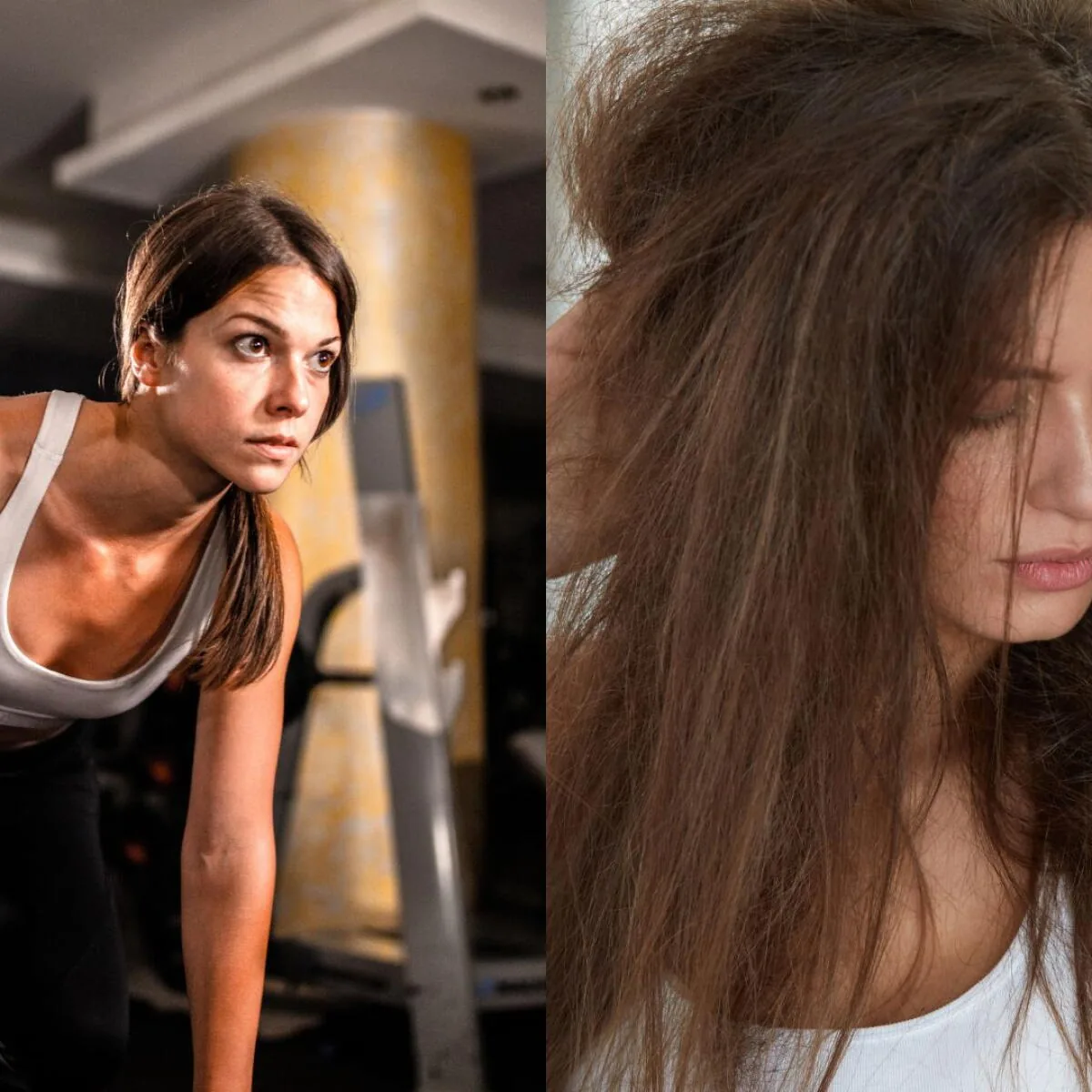
Regular styles fail in the gym for three predictable reasons. First, sweat loosens grip: elastics slide, gel softens and pins lose their hold. Second, movement pulls in directions a normal style was never tested for, from burpees to bench presses. Third, gear gets in the way, whether that is a headband, a cap, headphones or a helmet pressing on a bun.
The fix is not more product. It is a style with more anchor points: braids, twists, wraps and a second elastic all spread the load, so one slipping point does not undo the whole style.
Sweat-Proof Basics: Grip, Tension and Fabric
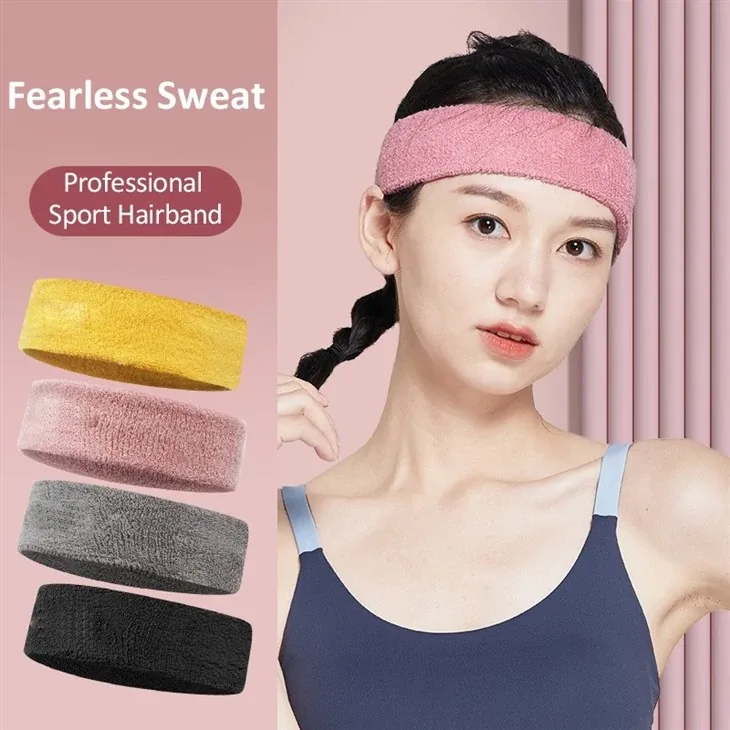
Grip comes first. Use snag-free elastics, add a second elastic for high ponytails, and choose bobby pins that match your hair colour and thickness. Tension should be firm but comfortable: a style that hurts at the start will hurt more after 30 sweaty minutes.
Fabric matters too. Cotton headbands absorb sweat but can slip, while silicone-grip bands stay put. Satin scrunchies are gentler on curls and textured hair than tight rubber elastics, and a lightweight scarf can add grip without adding much heat.
Quick Picks by Workout Type
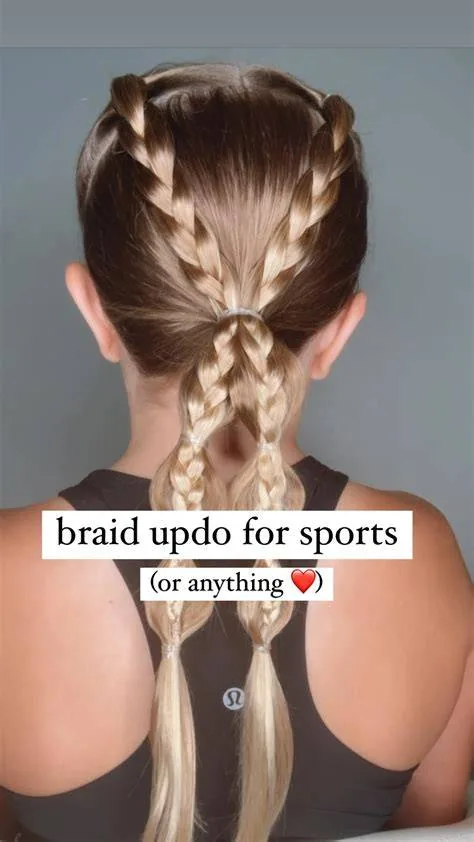
- Running and cardio: High bubble ponytail, double French braids, braided pigtail buns.
- Lifting: Slicked low ponytail, low braided bun, undercut ponytail.
- Yoga and Pilates: Twisted low bun, half-up top knot, claw clip twist updo.
- Dance and classes: Space buns, bubble braid pigtails, ponytail braid.
- Cycling and spin: Helmet-friendly low braid, low ponytail with a headband, cornrows.
- Boxing and HIIT: Double French braids, cornrows, French braid crown bun.
1. High Bubble Ponytail
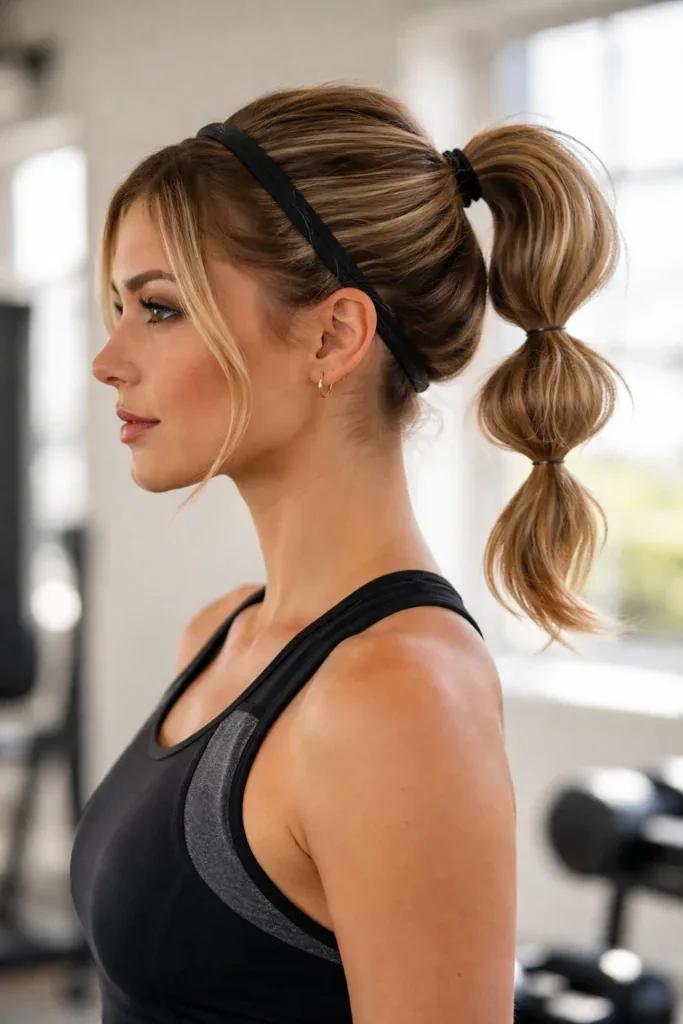
A high bubble ponytail turns a basic ponytail into a locked-in gym style. Small elastics spaced down the length stop the ponytail from whipping around during cardio, while the high placement keeps hair off your neck and shoulders.
Who should avoid it: Anyone with very short hair, or a sore scalp that cannot handle a tight high ponytail.
Cost/time: free at home; 5 to 8 minutes.
Styling steps:
- Brush hair up high and secure it with a strong elastic.
- Add a second elastic for extra hold if you are jumping or running.
- Place small elastics every few inches down the ponytail.
- Gently pull each section sideways to form soft bubbles.
2. Double French Braids

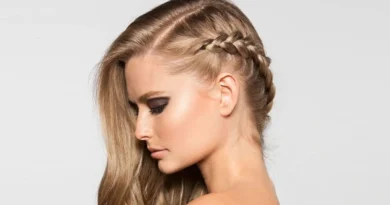
Double French braids are the classic sweat-proof gym hairstyle for a reason. They keep every layer close to the scalp, so nothing falls into your face during burpees, boxing or a long run.
Who should avoid it: Anyone with a very tender scalp, fresh braids-related breakage, or hair too short to braid to the nape.
Cost/time: free at home; 10 to 15 minutes, or $25 to $60 at a salon.
Styling steps:
- Part hair cleanly down the middle.
- French braid each side from the hairline to the nape.
- Continue as a regular three-strand braid to the ends.
- Secure with small elastics and tuck the ends under if needed.
3. Slicked-Back High Bun
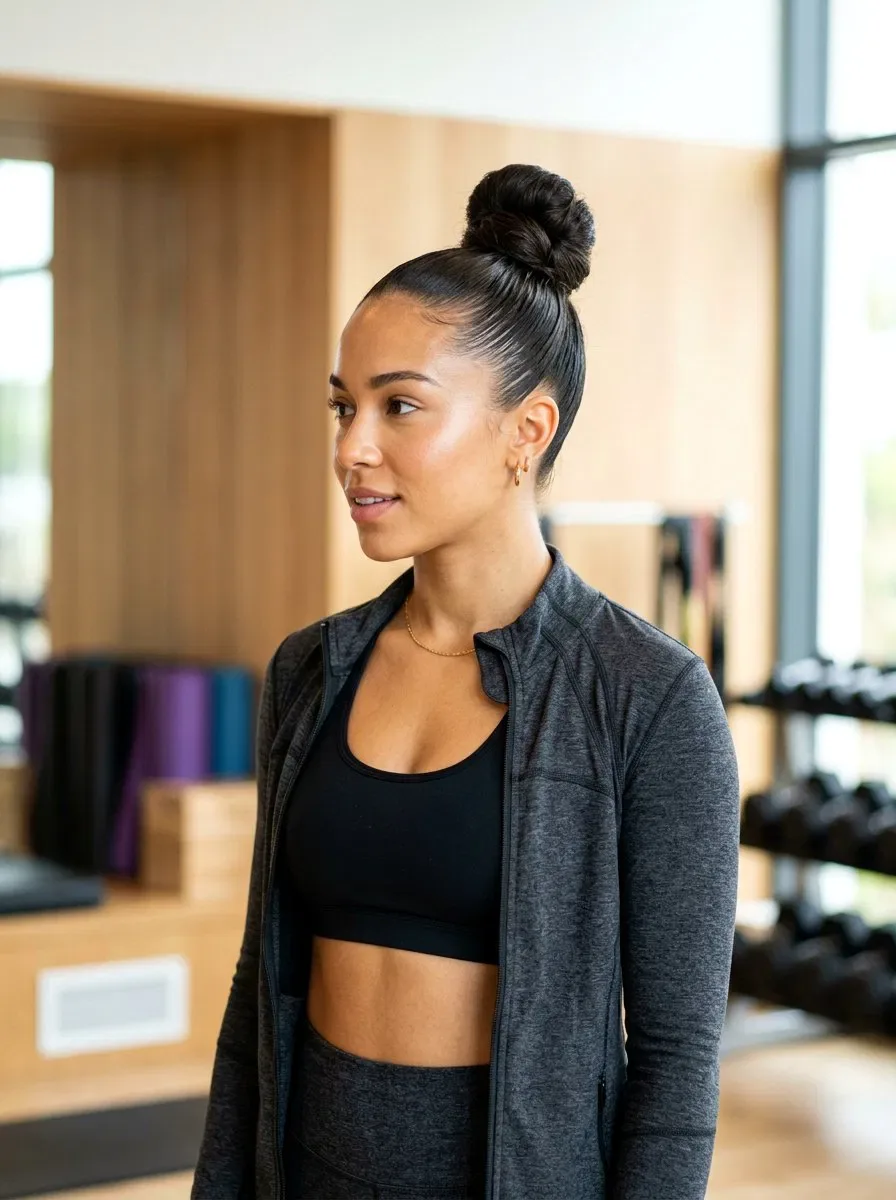
A slicked-back high bun is the no-nonsense choice for hot, sweaty sessions. Gel and a brush smooth flyaways flat, and the bun sits high enough that it will not bounce against your neck.
Who should avoid it: Anyone who dislikes a tight, pulled-back feel, or who has a sensitive hairline.
Cost/time: free at home; 5 minutes.
Styling steps:
- Brush hair up with gel or edge control.
- Twist the ponytail around its base.
- Pin the bun firmly with bobby pins.
- Smooth flyaways and add a light-hold spray.
4. Low Braided Bun
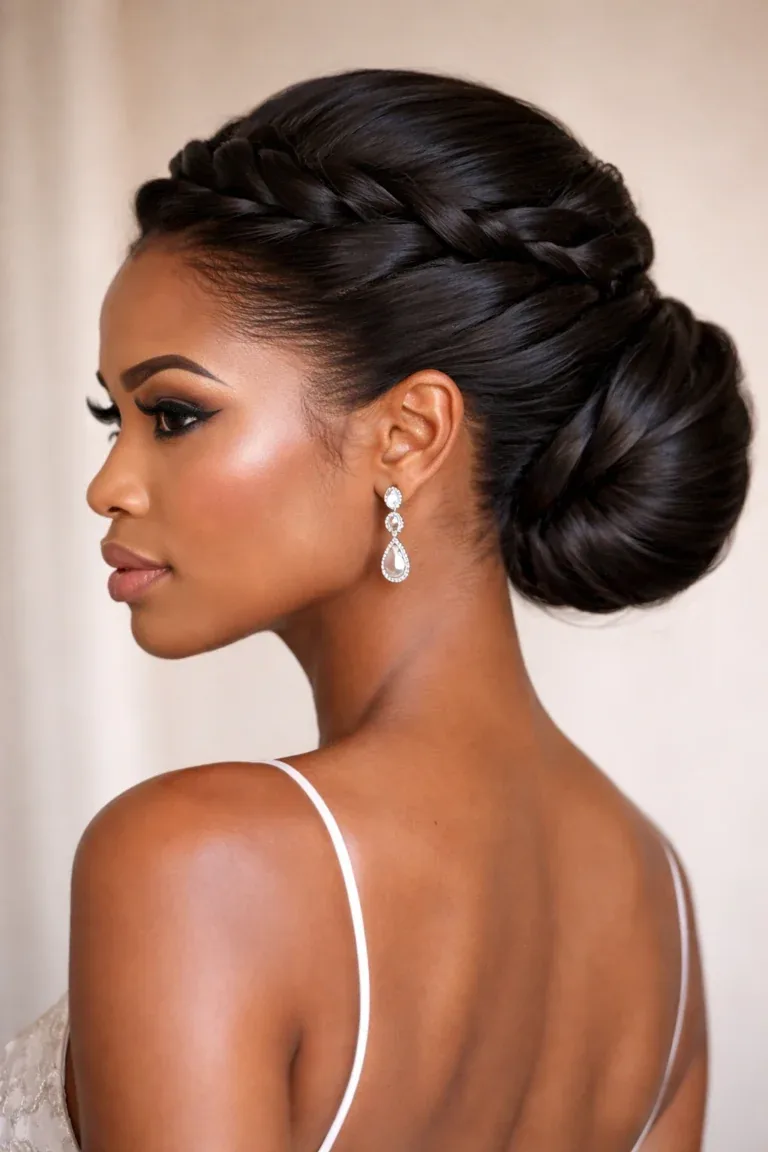
A low braided bun combines the security of a braid with the neatness of a bun. It sits at the nape, so it works well under a cap, a hood or a bench-press headrest.
Who should avoid it: Anyone with very short hair that cannot reach a low bun, or a stiff neck that dislikes weight at the nape.
Cost/time: free at home; 8 to 12 minutes.
Styling steps:
- Braid hair loosely from the crown or into a low ponytail first.
- Coil the braid around its base at the nape.
- Pin all the way around the bun.
- Tuck in loose ends and smooth the hairline.
5. Bubble Braid Pigtails
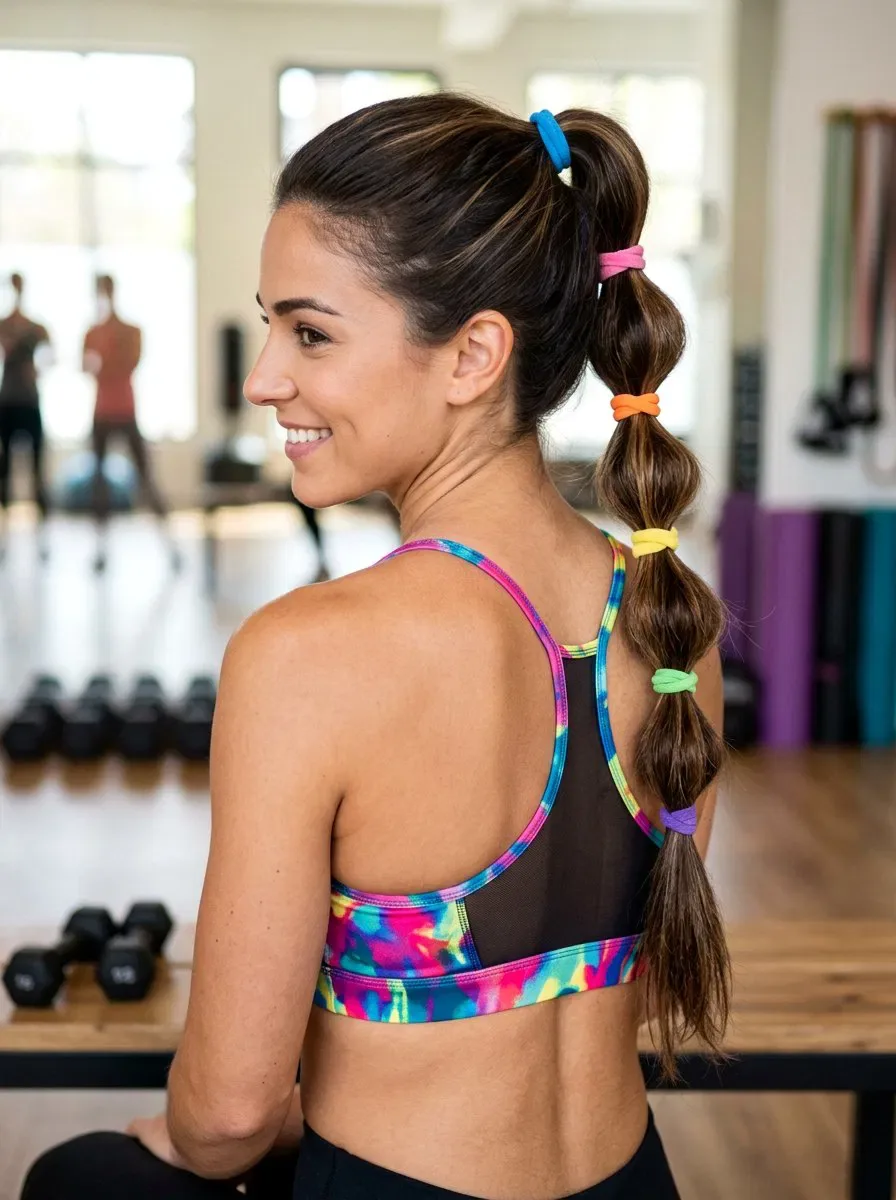
Bubble braid pigtails split the weight of your hair in two, which helps during long cardio sessions. Each side stays balanced, and the bubbles stop the ends from tangling as much as loose pigtails.
Who should avoid it: Anyone with very fine hair that slips out of small elastics easily, unless you use grip elastics.
Cost/time: free at home; 8 to 12 minutes.
Styling steps:
- Part hair down the middle into two ponytails.
- Add small elastics spaced down each ponytail.
- Puff each section gently for volume.
- Secure the ends and check both sides feel even.
6. Dutch Braid into Low Ponytail
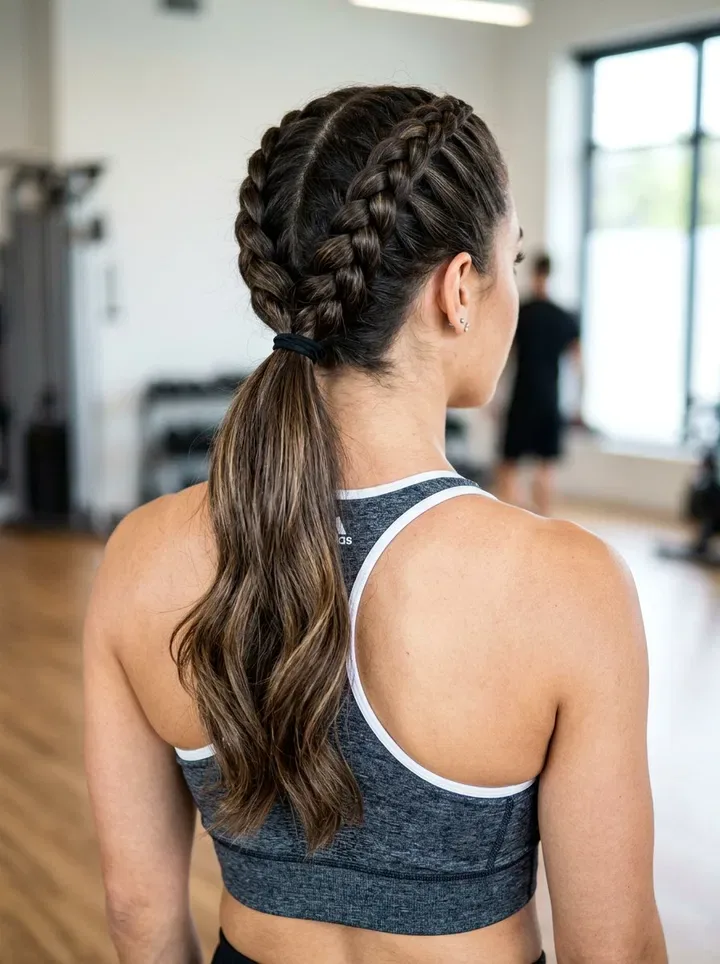
A Dutch braid that finishes as a low ponytail keeps the front completely secure while leaving the ends free to move. It is ideal for classes where you lie on your back, because there is no bulky bun to press into the mat.
Who should avoid it: Anyone who cannot braid yet, or who finds raised braids uncomfortable under a headband.
Cost/time: free at home; 8 to 12 minutes.
Styling steps:
- Start a Dutch braid at the hairline, adding hair as you go.
- Braid to the nape, then stop adding new hair.
- Gather the rest into a low ponytail.
- Wrap a small strand around the elastic to finish.
7. Fishtail Ponytail
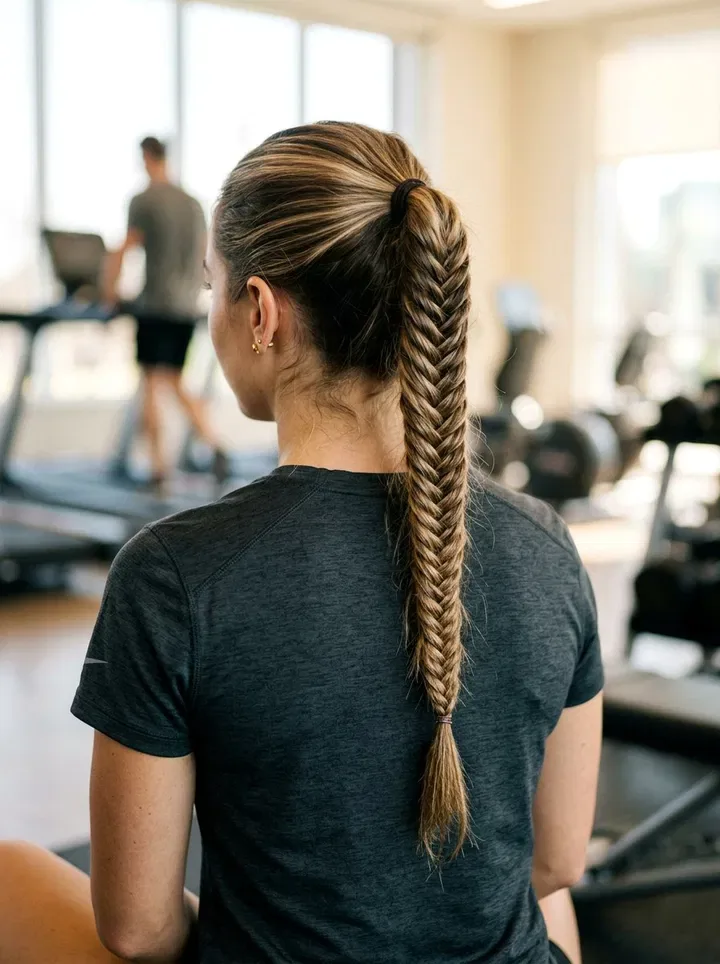
A fishtail ponytail looks detailed but holds up well once it is secured. The woven pattern grips itself, so it frays less than a loose ponytail during a workout.
Who should avoid it: Anyone in a rush, since a neat fishtail takes longer than a plain ponytail.
Cost/time: free at home; 10 to 15 minutes.
Styling steps:
- Secure hair in a ponytail at your chosen height.
- Split the ponytail into two sections.
- Cross small pieces from each side to the opposite section.
- Repeat to the ends and secure with an elastic.
8. Top Knot with Wide Headband
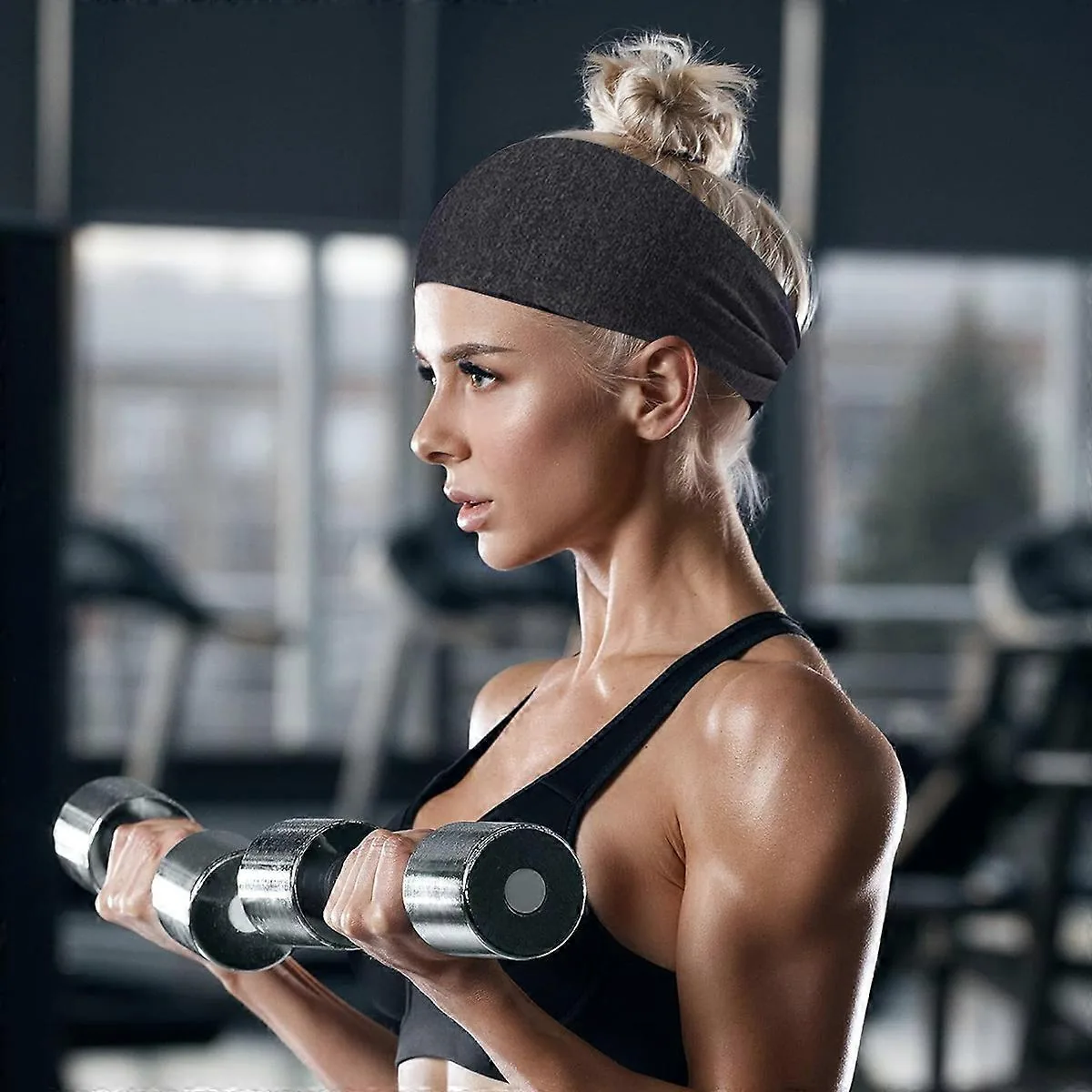
A top knot with a wide headband is built for sweat. The knot keeps hair up and away, while the wide band absorbs sweat and stops short layers from sliding forward.
Who should avoid it: Anyone with a heavy, very long bun that pulls during jumping, or a headband that slips on fine hair.
Cost/time: free at home; 4 to 6 minutes, plus the cost of a headband.
Styling steps:
- Gather hair into a high ponytail.
- Twist and wrap it into a knot, then pin it.
- Slide a wide, non-slip headband behind the hairline.
- Tuck stray pieces under the band.
9. Twisted Low Bun
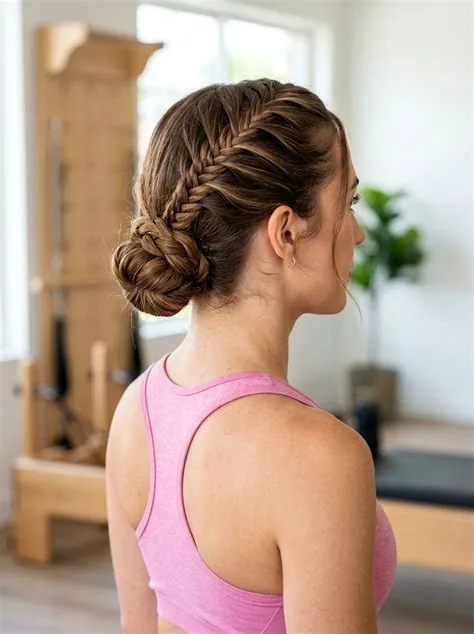
A twisted low bun is faster than a braid and kinder on the scalp than a tight slicked bun. Two twists coiled at the nape stay flat, so this style is comfortable for floor work and stretching.
Who should avoid it: Anyone with very layered hair that escapes twists easily, unless you pin generously.
Cost/time: free at home; 5 to 8 minutes.
Styling steps:
- Part hair and divide it into two sections.
- Twist each section away from the face.
- Cross the twists at the nape and coil them into a bun.
- Pin firmly and smooth the part.
10. Single Side Braid
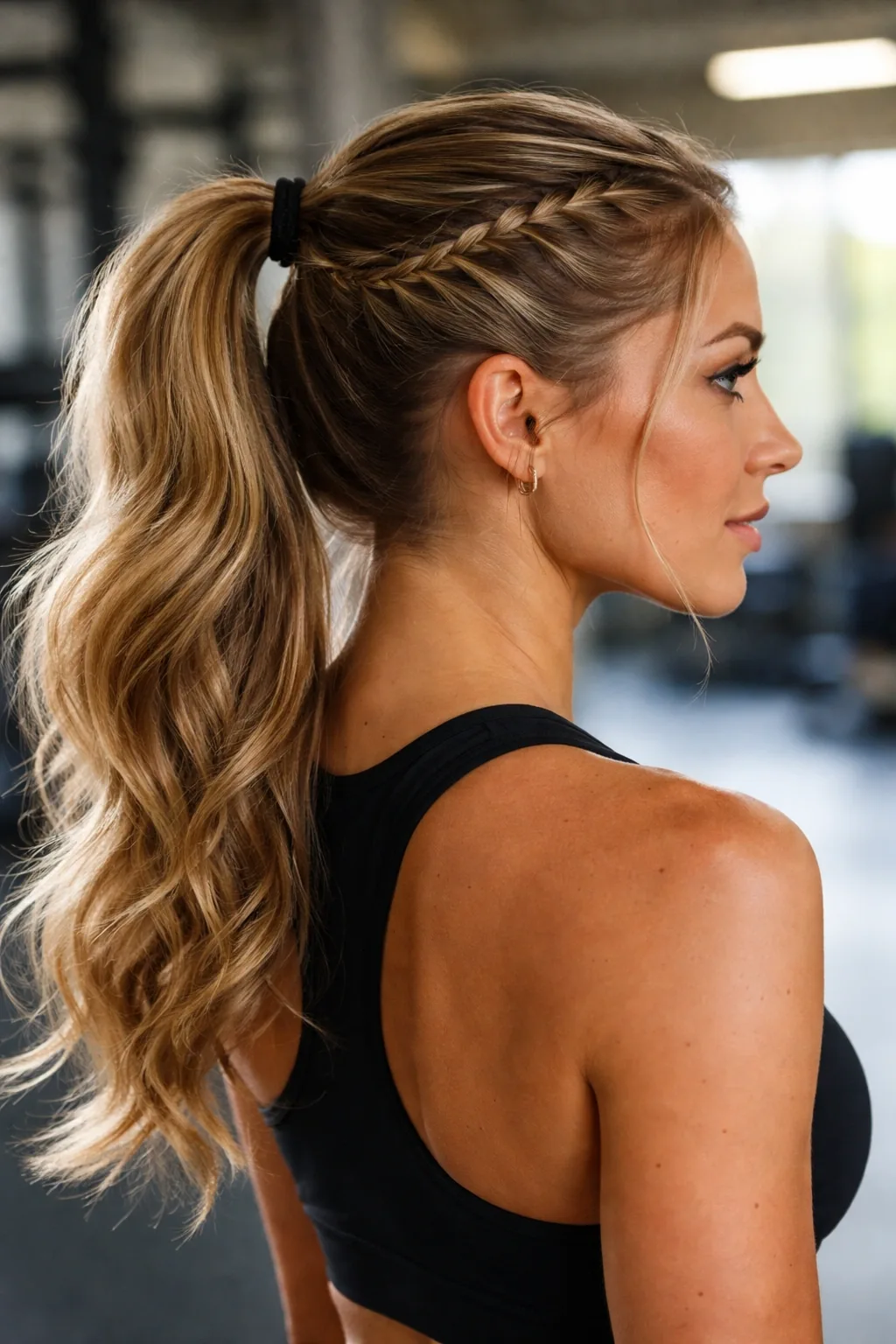
A single side braid keeps hair over one shoulder and out of your way without a tight scalp pull. It is a good middle ground for medium hair that is too short for double braids but too long to leave loose.
Who should avoid it: Anyone doing lots of rolling or floor work, where a side braid can end up underneath you.
Cost/time: free at home; 5 to 8 minutes.
Styling steps:
- Sweep all hair to one side.
- Braid loosely from behind the ear to the ends.
- Pancake the braid slightly for grip.
- Secure with an elastic and a pin at the top if needed.
11. Cornrows for Training
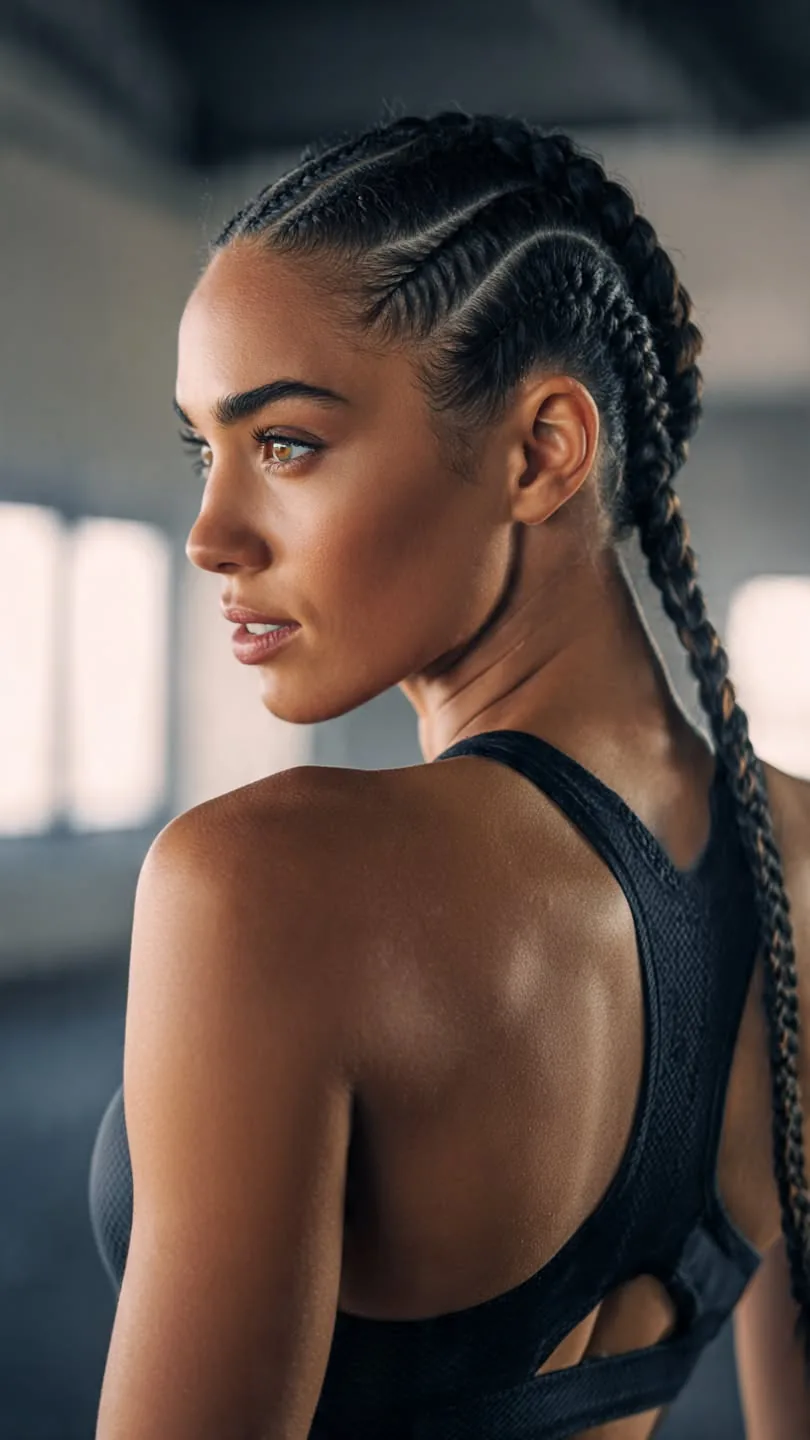
Cornrows are one of the most durable gym hairstyles, lasting through many sessions with little daily restyling. They lie flat, need no daily heat, and stay secure under caps and helmets.
Who should avoid it: Anyone who wants a same-day, low-commitment style, or who has a tender scalp after tight braiding.
Cost/time: $60 to $150 at a salon depending on size and length; 1 to 3 hours to install, then minutes a day.
Styling steps:
- Wash and detangle hair before braiding.
- Part hair into neat, even rows.
- Braid each row close to the scalp to the ends.
- Oil the scalp lightly and cover with a scarf at night.
12. Rope Twist Pigtails
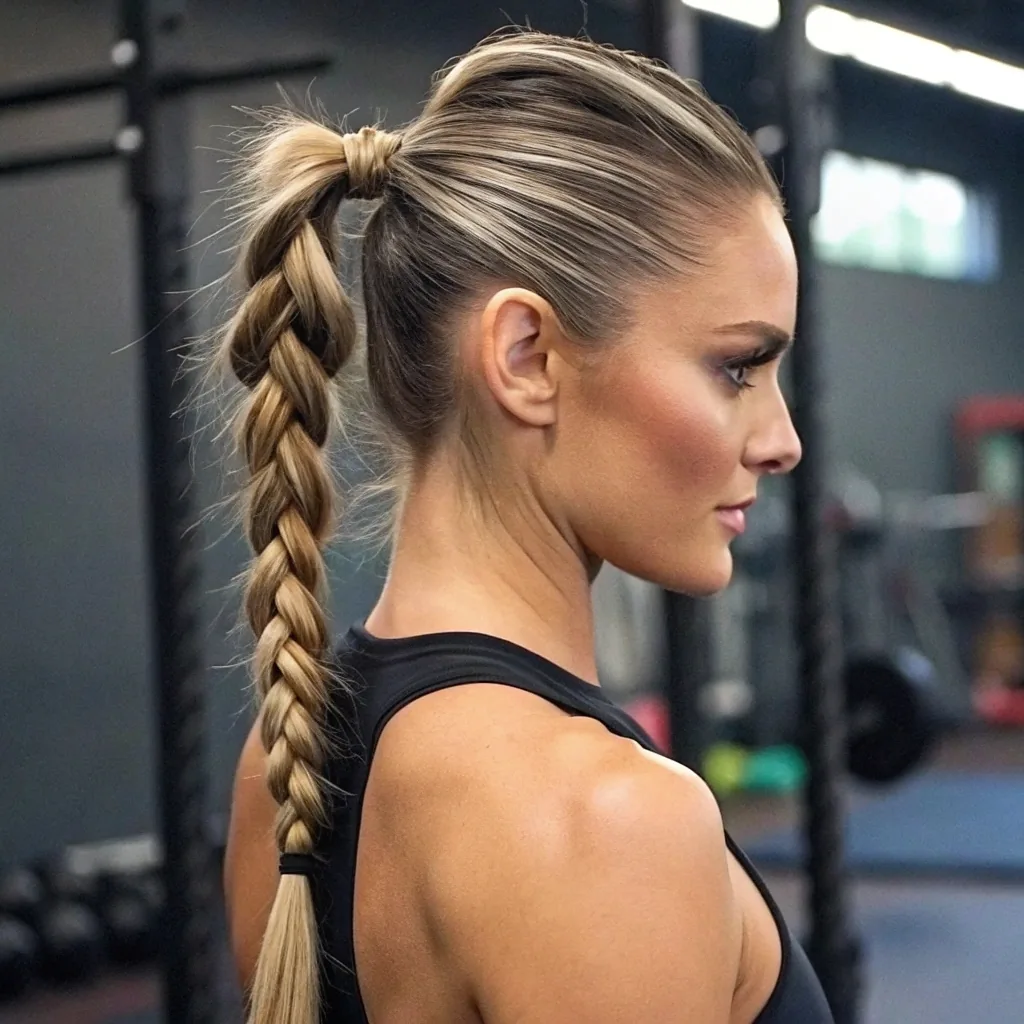
Rope twist pigtails are quicker than French braids and still hold well. Twisting two strands together creates natural grip, so the style survives cardio better than loose pigtails.
Who should avoid it: Anyone with very slippery, freshly washed hair, unless you add texture spray first.
Cost/time: free at home; 8 to 12 minutes.
Styling steps:
- Part hair down the middle.
- Split each side into two strands.
- Twist each strand one way, then twist them together the other way.
- Secure the ends and repeat on the other side.
13. High Ponytail with Braided Wrap
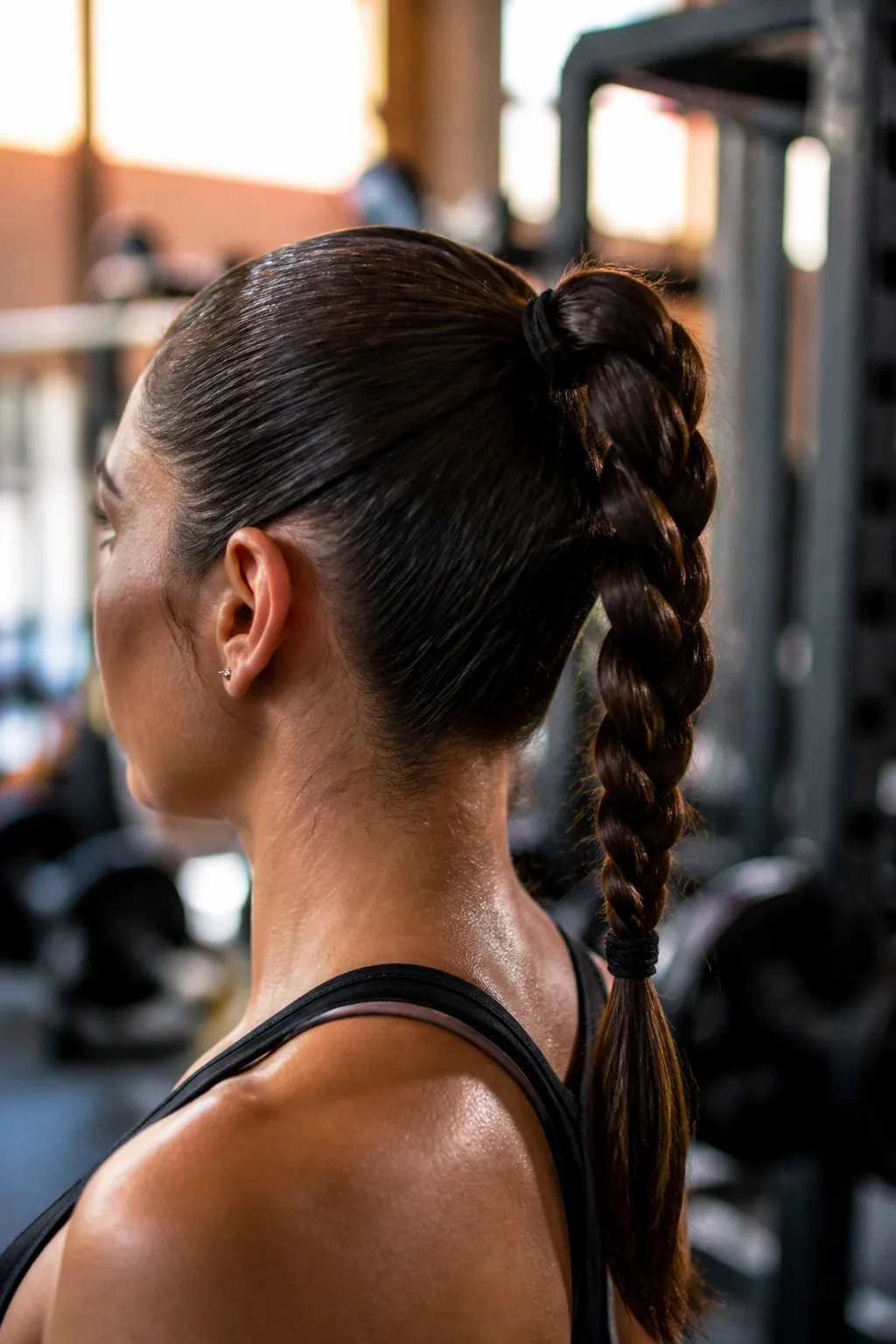
This style hides the elastic and adds grip at the same time. A thin braid wrapped around the base stops the ponytail from sliding down, which is the most common ponytail failure in the gym.
Who should avoid it: Anyone with very short hair that cannot spare a wrap strand.
Cost/time: free at home; 6 to 10 minutes.
Styling steps:
- Secure a high ponytail with a strong elastic.
- Take a thin strand from underneath the ponytail.
- Braid that strand and wrap it around the base.
- Pin the braid end underneath the ponytail.
14. Half-Up Top Knot
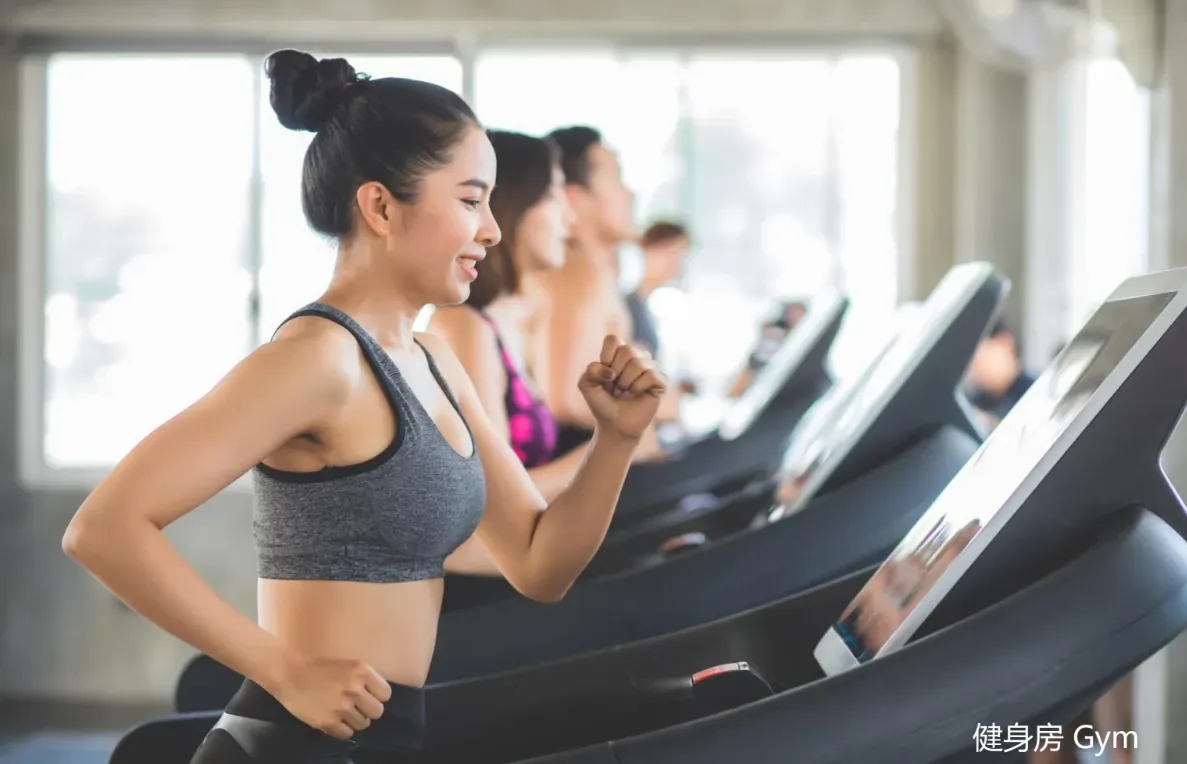
A half-up top knot lifts the front layers off your face while leaving the back free. It suits medium hair and lower-impact workouts such as yoga, Pilates and walking.
Who should avoid it: Anyone doing high-impact training, where loose back hair will still bounce and tangle.
Cost/time: free at home; 3 to 5 minutes.
Styling steps:
- Section off the top half of your hair.
- Twist that section into a small knot on top.
- Pin the knot and leave the rest loose.
- Smooth the front with a little gel if needed.
15. Low Ponytail with Headband
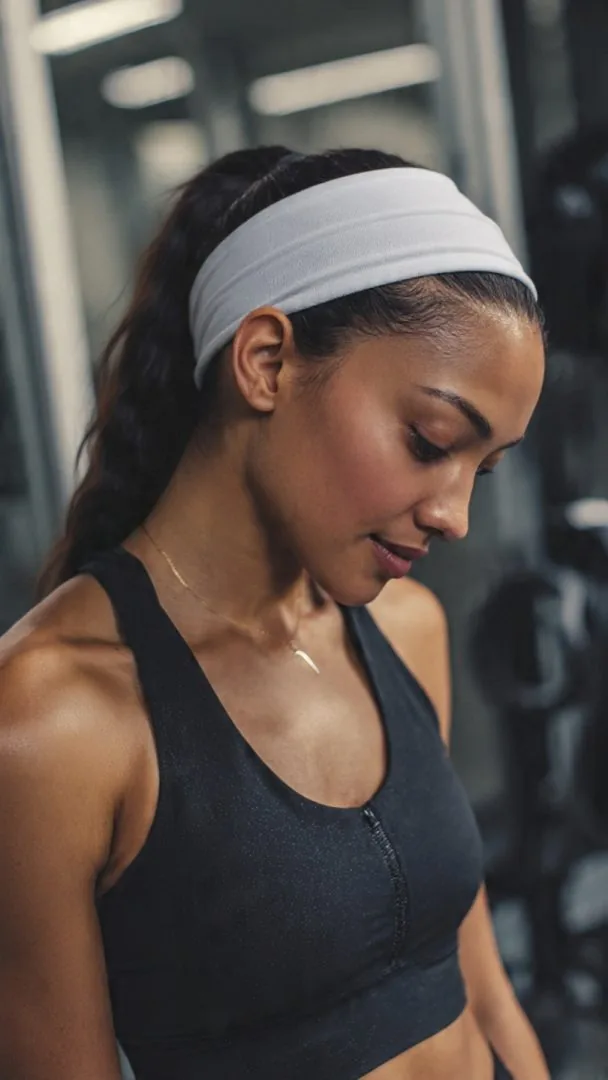
A low ponytail with a headband is the simplest helmet- and bench-friendly style. The low placement avoids pressure points, and the headband handles sweat and baby hairs.
Who should avoid it: Anyone with very short layers that still fall out around the face, unless you add clips.
Cost/time: free at home; 3 minutes, plus a headband.
Styling steps:
- Brush hair back into a low ponytail.
- Secure it at the nape with a snag-free elastic.
- Place a non-slip headband behind the hairline.
- Clip any short layers back.
16. Space Buns
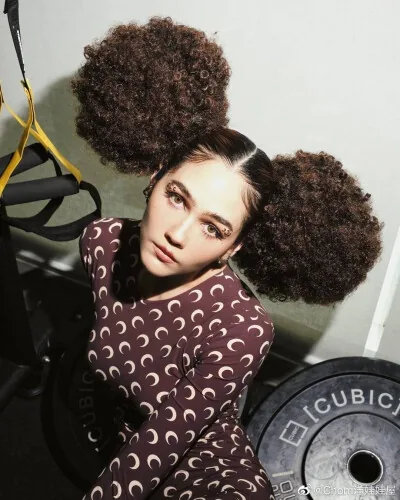
Space buns split hair into two high buns that stay clear of the neck. They are light, balanced and fun, and they work well for dance cardio and classes where a single heavy bun would bounce.
Who should avoid it: Anyone with a sore scalp, or anyone wearing a hood that would squash high buns.
Cost/time: free at home; 6 to 10 minutes.
Styling steps:
- Part hair down the middle.
- Make a high ponytail on each side.
- Twist each ponytail into a bun and pin it.
- Check both buns feel even and secure.
17. Braided Headband Ponytail

A braid worn across the hairline acts like a built-in headband, keeping the front secure without extra gear. The rest of the hair goes into a ponytail, so this style is self-contained.
Who should avoid it: Anyone with very short front layers that cannot form a braid across the forehead.
Cost/time: free at home; 8 to 12 minutes.
Styling steps:
- Take a section from one side of the hairline.
- Braid it across the forehead toward the other side.
- Pin the braid end behind the opposite ear.
- Gather the remaining hair into a ponytail.
18. Slicked Low Ponytail
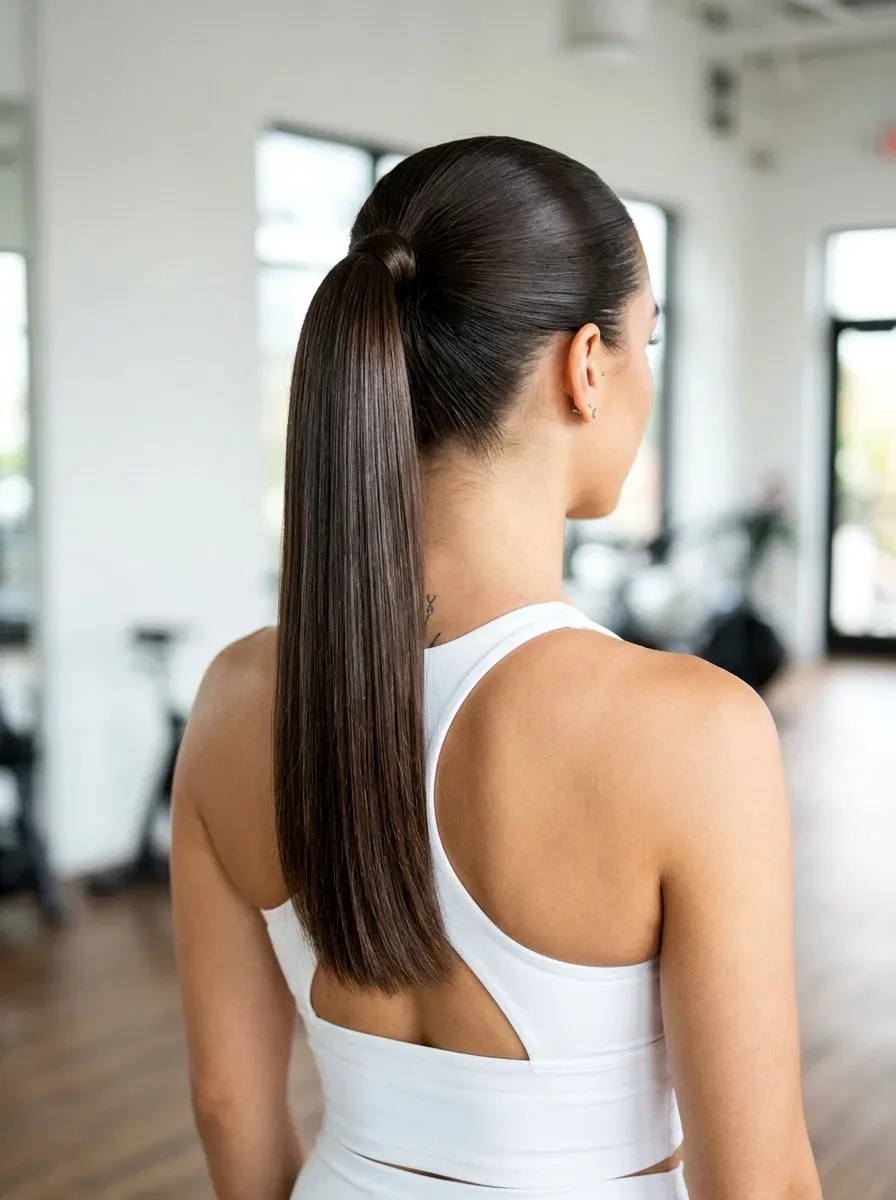
A slicked low ponytail is the polished gym style for lifting and mat work. Gel keeps everything flat, and the low position means nothing presses into your head when you lie back.
Who should avoid it: Anyone who dislikes gel or a wet-look finish, or who has a very dry scalp.
Cost/time: free at home; 4 to 6 minutes.
Styling steps:
- Apply gel to damp or dry hair.
- Brush hair straight back to the nape.
- Secure with a strong elastic.
- Smooth flyaways with a brush and a little more gel.
19. Pineapple Puff for Curls
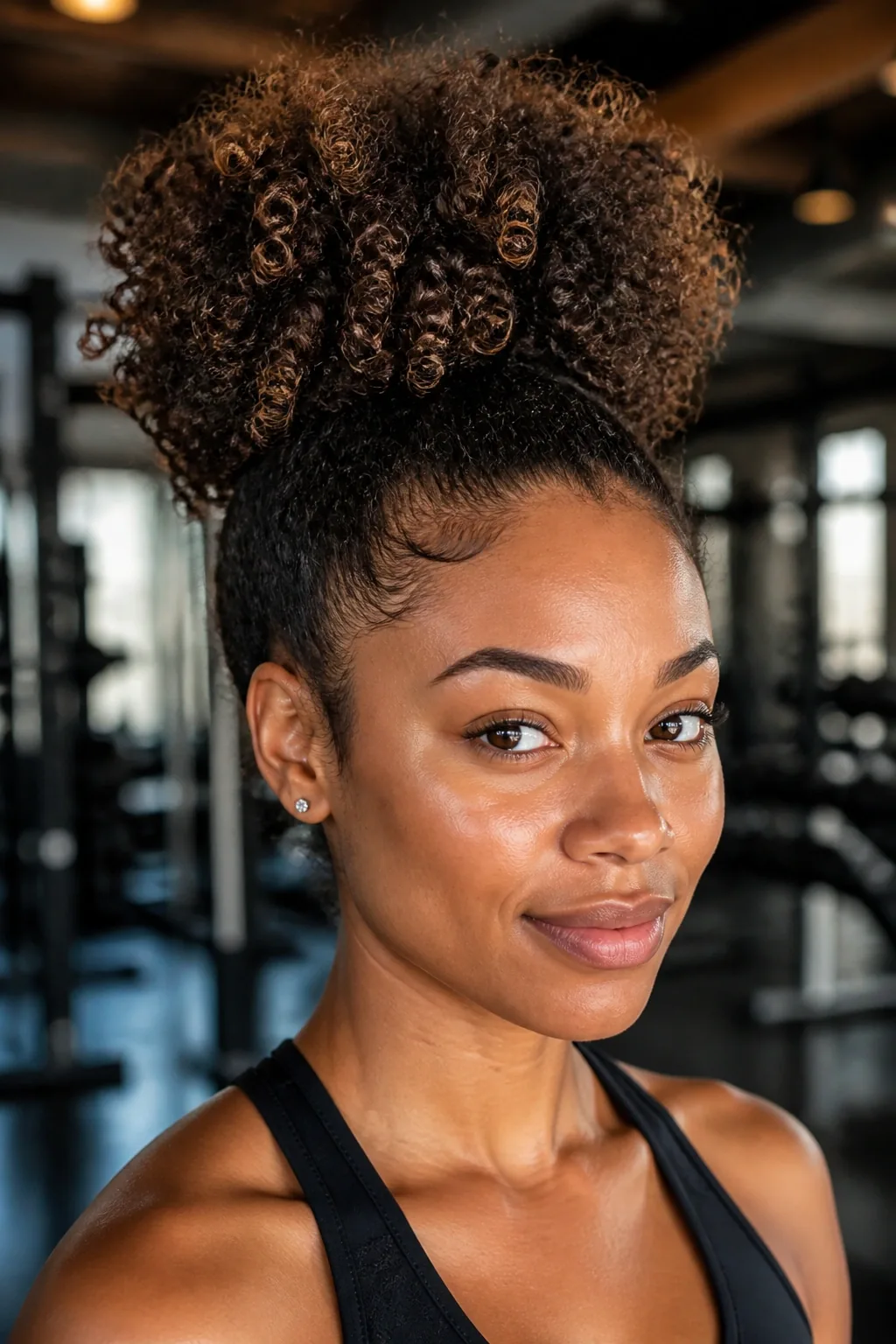
The pineapple puff gathers curls loosely on top of the head, protecting the curl pattern while keeping hair off the face. It is the go-to gym style for curly hair that should not be brushed out.
Who should avoid it: Anyone with very short curls that cannot gather on top, or anyone who needs a fully flat style for a helmet.
Cost/time: free at home; 2 to 4 minutes.
Styling steps:
- Flip your head forward and gather curls loosely on top.
- Secure with a satin scrunchie, not a tight elastic.
- Leave the curls loose and full, not pulled flat.
- Add a headband for extra sweat control if needed.
20. Claw Clip Twist Updo
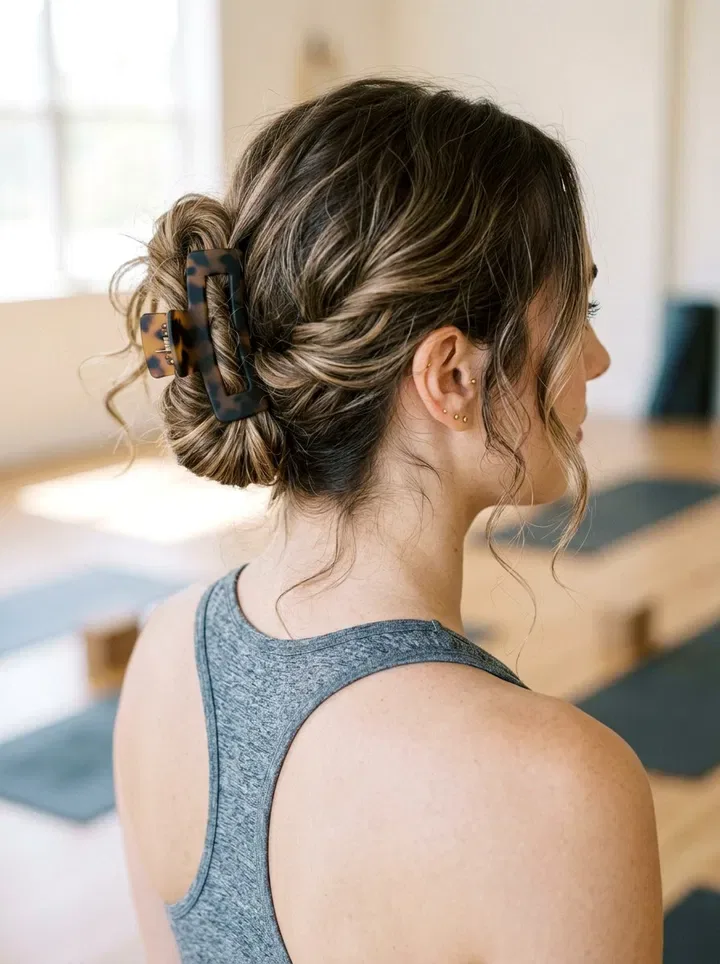
A claw clip twist is the fastest low-effort gym updo for medium to long hair. One twist and one clip hold the hair up, and it comes down easily for a post-workout wash.
Who should avoid it: Anyone doing inverted or high-impact moves, where a hard clip can press or slip.
Cost/time: free at home; 2 minutes, plus a claw clip.
Styling steps:
- Gather hair at the back and twist it upward.
- Fold the twist against the head.
- Clamp a large claw clip over the twist.
- Tuck in the ends and check the clip feels firm.
21. French Braid Crown Bun

A French braid worked around the head and finished in a bun keeps every strand locked in. It is one of the most secure styles for long sessions, dance and outdoor training.
Who should avoid it: Anyone short on time, since a crown braid takes practice and patience.
Cost/time: free at home; 15 to 20 minutes, or $40 to $80 at a salon.
Styling steps:
- Start a French braid at one side of the hairline.
- Work around the head, adding hair as you go.
- Continue the braid to the ends when you complete the circle.
- Coil the tail into a bun and pin it.
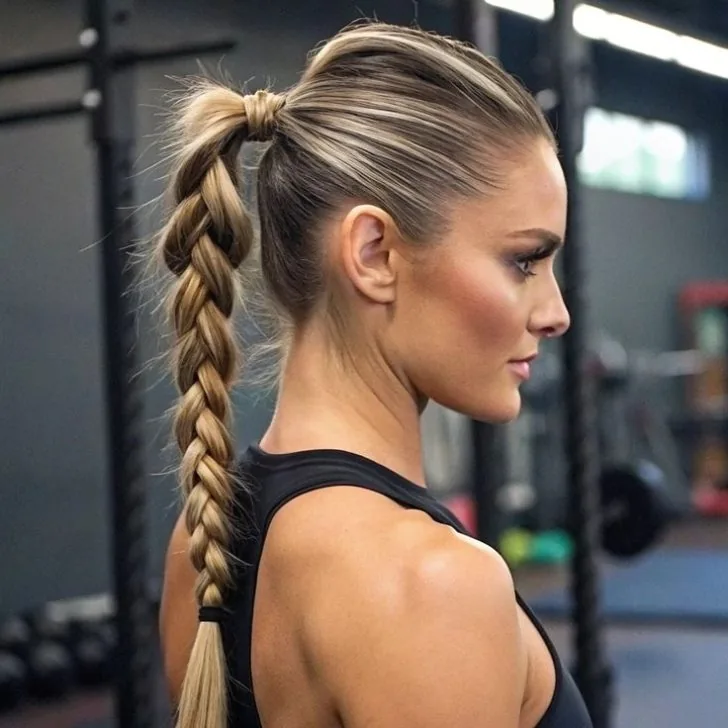
22. Ponytail Braid
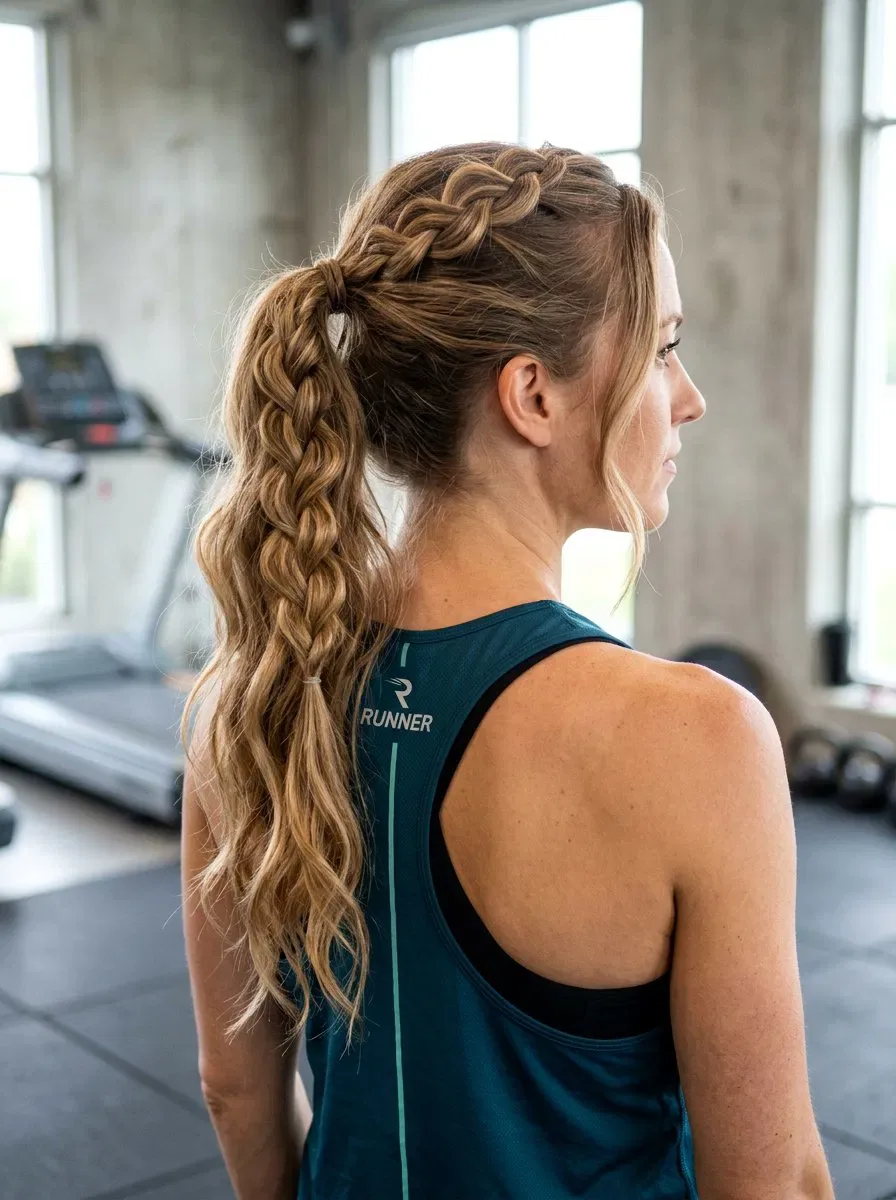
A single braid from a high ponytail is simple, strong and tangle-resistant. It keeps long hair in one controlled rope instead of a swinging ponytail.
Who should avoid it: Anyone with layers that stick out of a braid, unless you smooth them with gel first.
Cost/time: free at home; 5 to 8 minutes.
Styling steps:
- Secure hair in a high ponytail.
- Braid the ponytail in three strands to the ends.
- Secure with a small elastic.
- Smooth the top with gel for a neat finish.
23. Low Twisted Pigtails
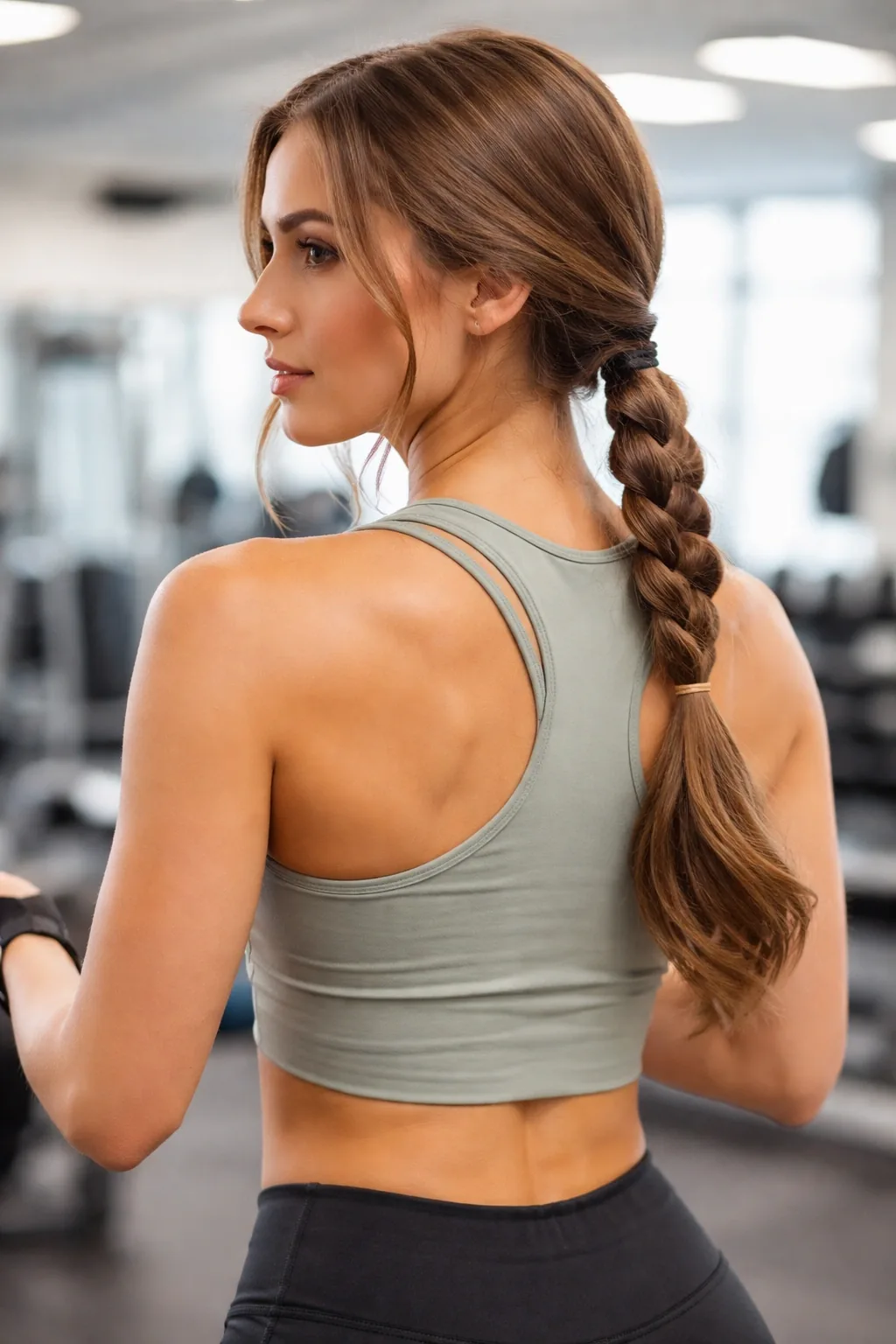
Low twisted pigtails keep hair divided, low and out of the way, making them comfortable under a hood or for back exercises. Twists are gentler on the scalp than tight braids.
Who should avoid it: Anyone with very thick hair that makes low pigtails heavy, unless you use strong elastics.
Cost/time: free at home; 6 to 10 minutes.
Styling steps:
- Part hair down the middle.
- Twist each side from the nape downward.
- Secure each twist with an elastic.
- Pin the tops flat if they lift.
24. Short Crop with Grip Headband
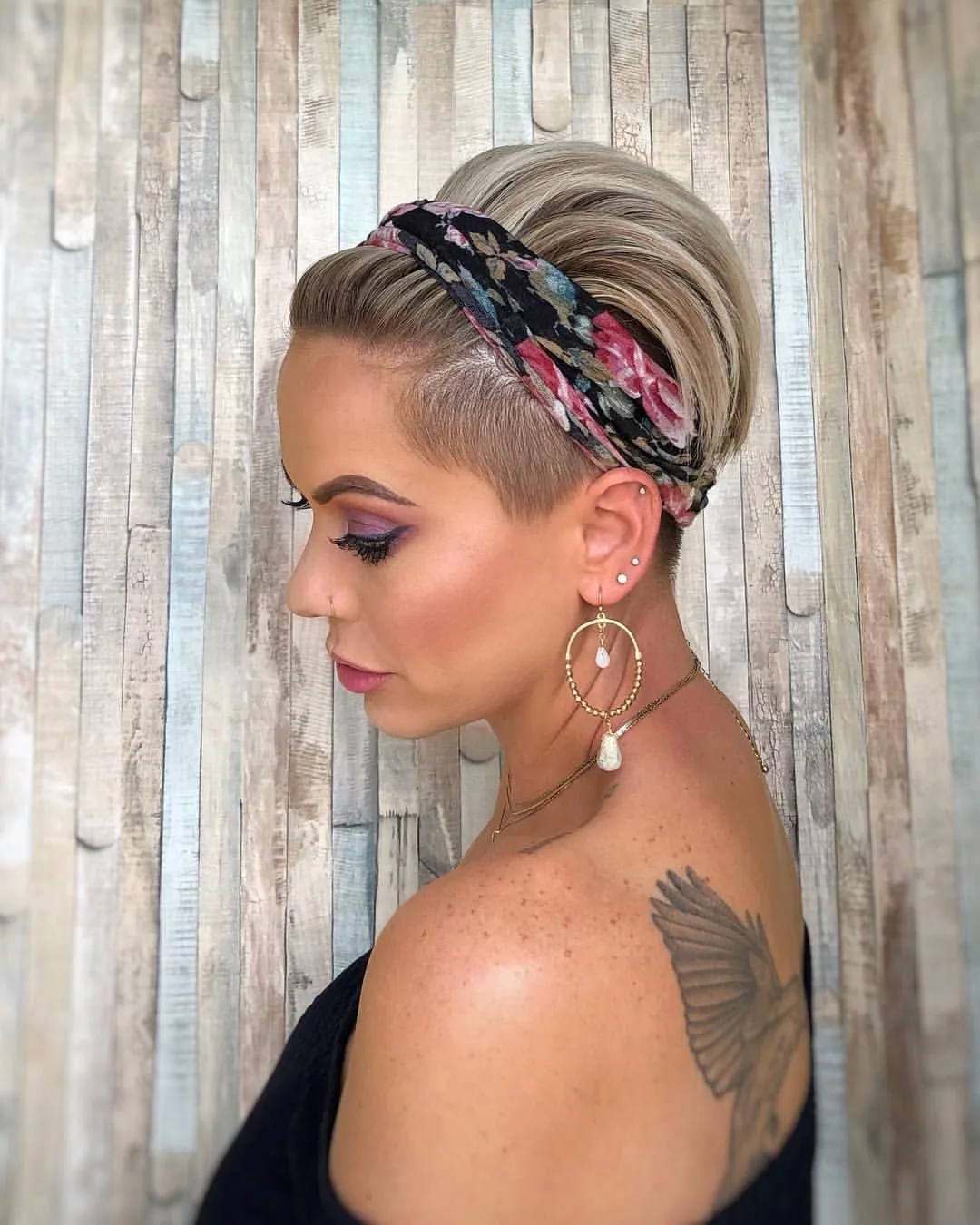
A short crop needs little styling, but sweat can still push it into your eyes. A grip headband solves that in seconds and keeps the style looking intentional.
Who should avoid it: Anyone whose headband slips on very fine hair, unless it has silicone grip strips.
Cost/time: free at home; 1 minute, plus a grip headband.
Styling steps:
- Style the crop as usual with a little texture product.
- Place a grip headband just behind the hairline.
- Push the front layers slightly back or to the side.
- Carry a spare band for very sweaty sessions.
25. Chin Bob with Headband and Pins
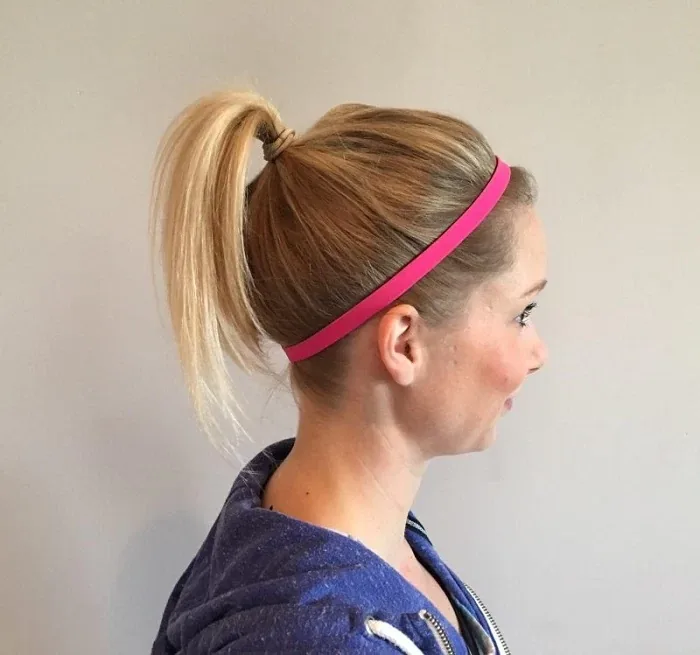
A chin-length bob can be gym-ready with a headband and a few pins. The headband holds the front, and pins keep the sides from falling forward during floor work.
Who should avoid it: Anyone with a bob that is still growing out unevenly, where pins may not hold every layer.
Cost/time: free at home; 3 to 5 minutes.
Styling steps:
- Place a non-slip headband behind the hairline.
- Tuck the sides behind the ears.
- Pin each side flat with two bobby pins.
- Spray lightly so the pins stay put.
26. Braided Pigtail Buns
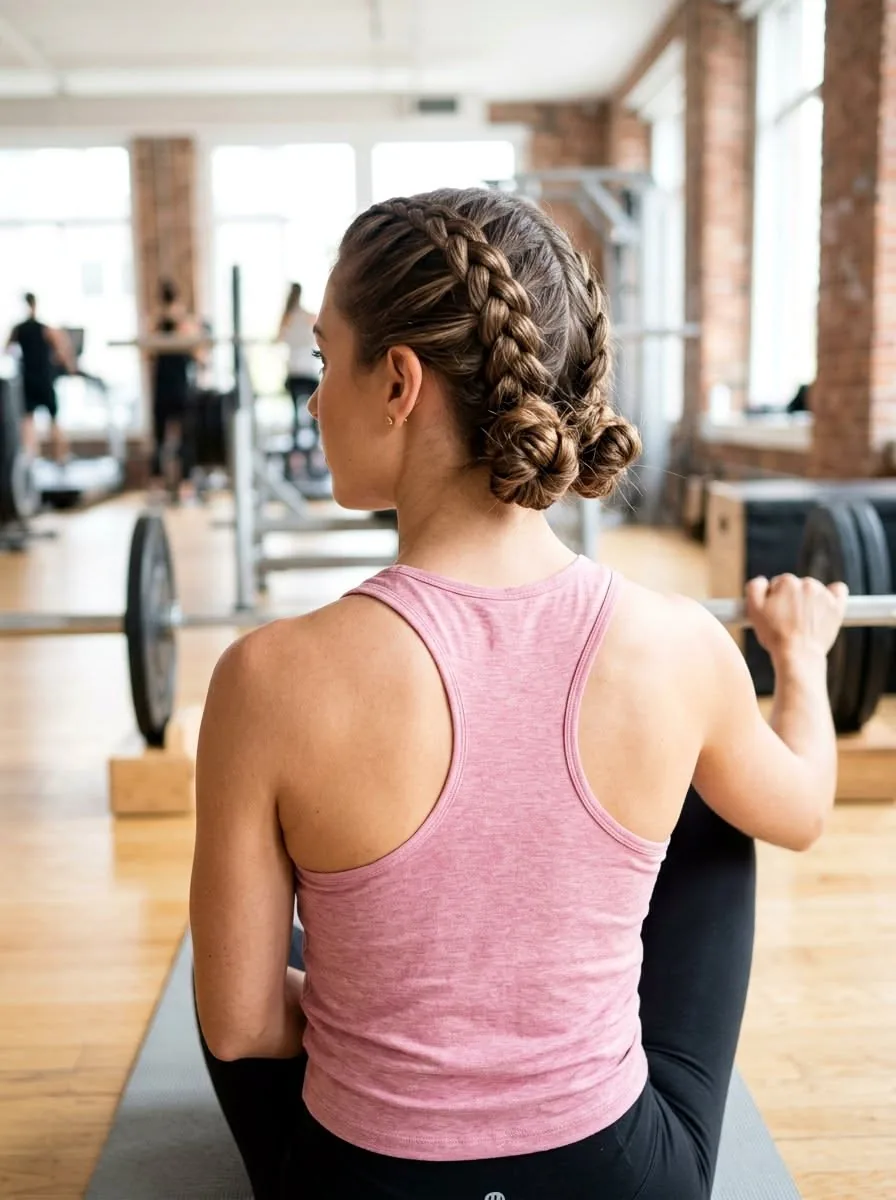
Braided pigtail buns combine two secure techniques: braids first, then buns. They stay put through dance, boxing and long runs, and they distribute weight evenly.
Who should avoid it: Anyone in a hurry, since braiding and then coiling both sides takes time.
Cost/time: free at home; 12 to 18 minutes.
Styling steps:
- Part hair down the middle.
- Braid each side to the ends.
- Coil each braid into a bun at the back or sides.
- Pin both buns firmly.
27. Scarf-Wrapped Low Bun
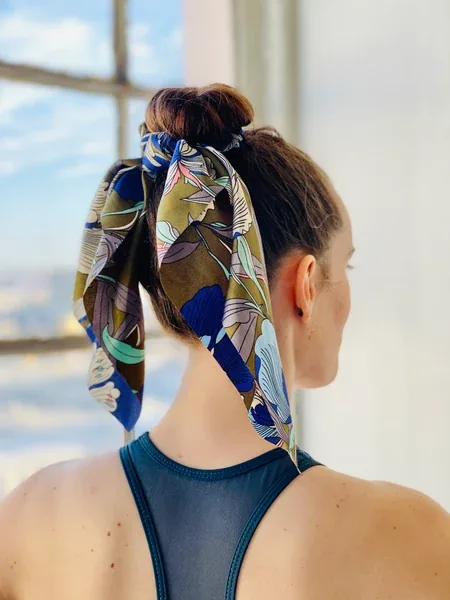
A sport scarf wrapped around a low bun adds grip, absorbs sweat and protects hair from friction. It is a good choice for outdoor training and for anyone who wants extra coverage.
Who should avoid it: Anyone who overheats easily, since an extra layer adds warmth.
Cost/time: free at home; 6 to 9 minutes, plus a lightweight scarf.
Styling steps:
- Make a low bun and pin it.
- Fold a lightweight scarf into a band.
- Wrap it around the hairline and knot it at the nape or side.
- Tuck the scarf ends in so nothing dangles.
28. Undercut Ponytail
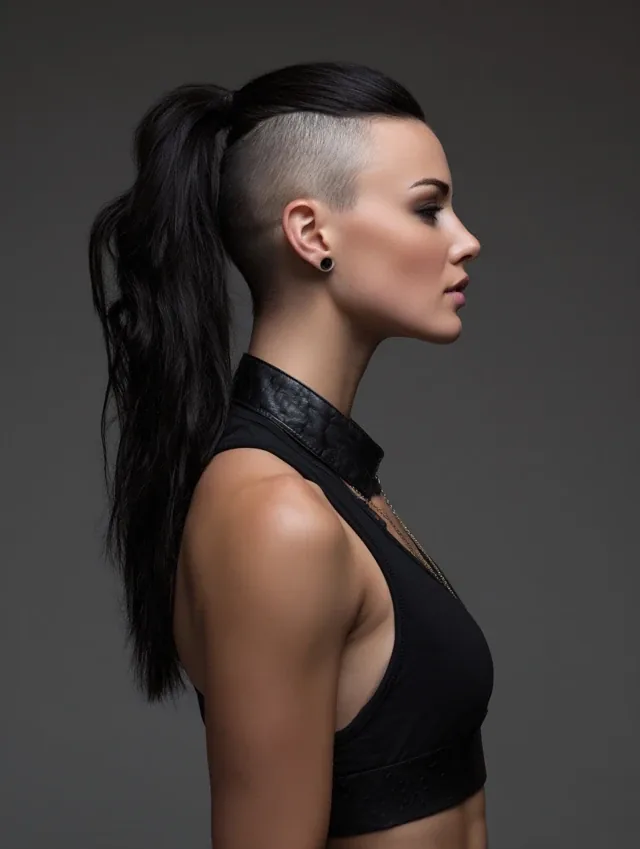
An undercut removes bulk at the sides and nape, so a ponytail feels lighter and dries faster after training. It is a cut choice as much as a style, and it suits anyone who trains daily.
Who should avoid it: Anyone who wants to grow hair out evenly soon, since an undercut takes time to grow back.
Cost/time: $30 to $70 for the undercut cut; styling itself is free at home in 3 minutes.
Styling steps:
- Keep the undercut area trimmed as your stylist advised.
- Gather the longer top hair into a ponytail.
- Secure with a strong elastic.
- Smooth the top and let the undercut keep the nape cool.
29. Helmet-Friendly Low Braid
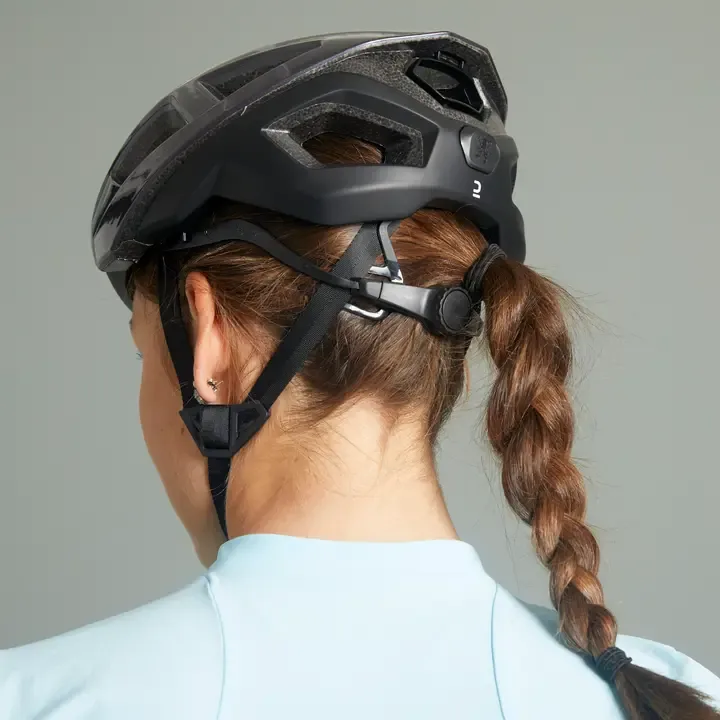
A helmet-friendly low braid sits flat under a cycling or spin helmet and comes out as a single rope at the back. Nothing bulky sits where the helmet straps or padding need to sit.
Who should avoid it: Anyone who needs a high style for another reason, since this style is deliberately low and flat.
Cost/time: free at home; 5 to 8 minutes.
Styling steps:
- Part hair and smooth it flat.
- Braid low at the nape, keeping tension even.
- Secure the braid below helmet-strap height.
- Put the helmet on and check the straps sit flat.
30. Two-Strand Twist Bun
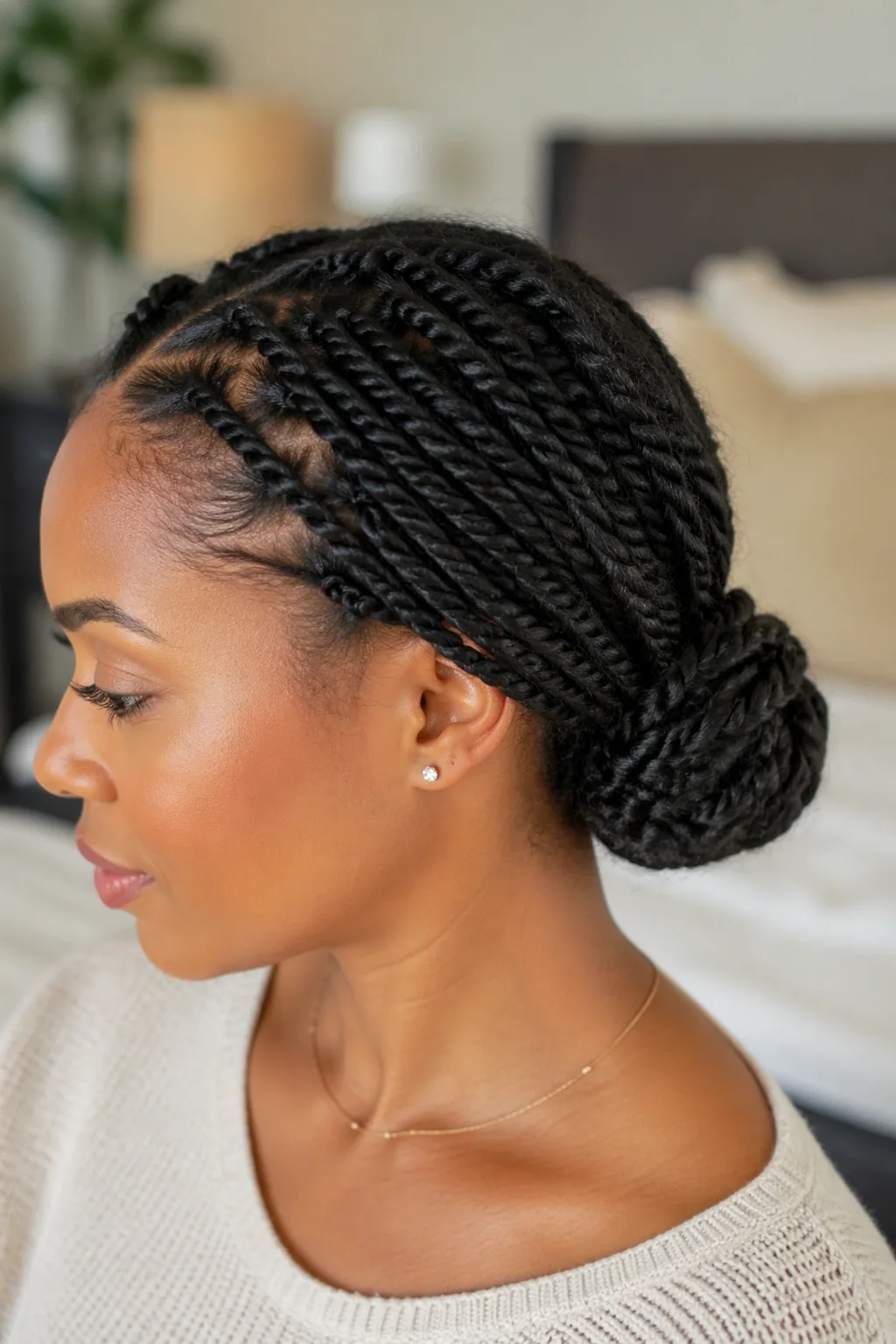
A two-strand twist bun is a protective, low-tension gym style that works well for textured hair. Twists hold without tight pulling, and the bun keeps the ends tucked away from sweat and friction.
Who should avoid it: Anyone with very fine hair that unravels from twists easily, unless you twist on slightly damp hair with cream.
Cost/time: free at home; 10 to 15 minutes.
Styling steps:
- Apply twist cream to damp, detangled hair.
- Divide hair into sections and twist each in two strands.
- Gather the twists into a low or mid bun.
- Pin the bun and cover it with a scarf at night to reuse it.
Protective Styles for Training
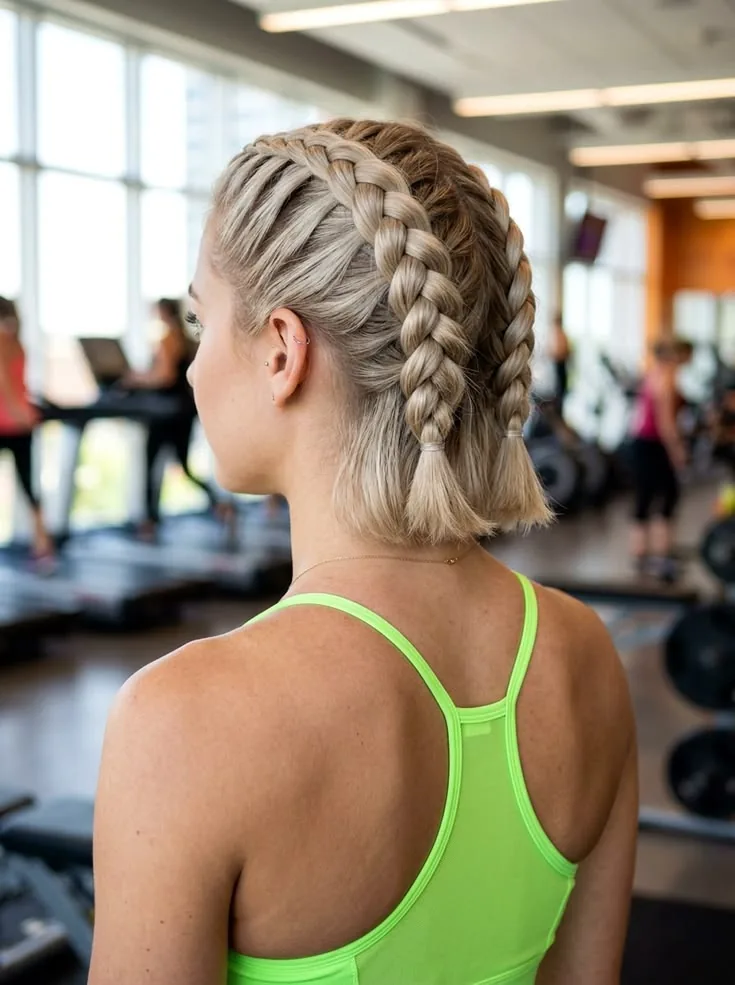
Protective styles for training keep the ends tucked away and reduce daily manipulation. Cornrows, two-strand twist buns, braided buns and scarf-wrapped buns all protect hair from sweat, friction and repeated restyling.
They still need care. Rinse sweat out regularly, oil the scalp lightly, and do not keep a tight style in for too long. If you feel pulling, headaches or bumps along the hairline, loosen the style or take it out.
Post-Workout Hair Rescue
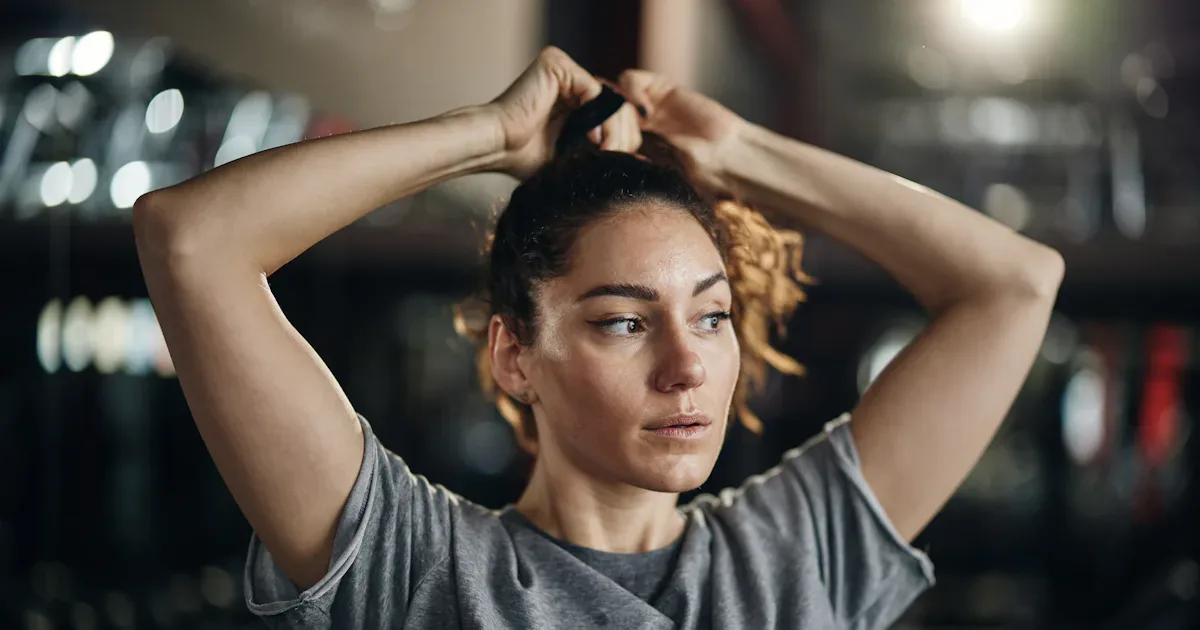
After a workout, let hair cool before you restyle it. Blot sweat with a microfibre towel, use dry shampoo only at the roots if you are short on time, and avoid brushing curls dry. A quick rinse is better than piling more product on sweaty hair.
If you train daily, wash on a schedule that suits your scalp rather than washing aggressively after every session. Co-washing, a scalp rinse or a simple water rinse can be enough between full washes.
A Gym Bag Hair Kit
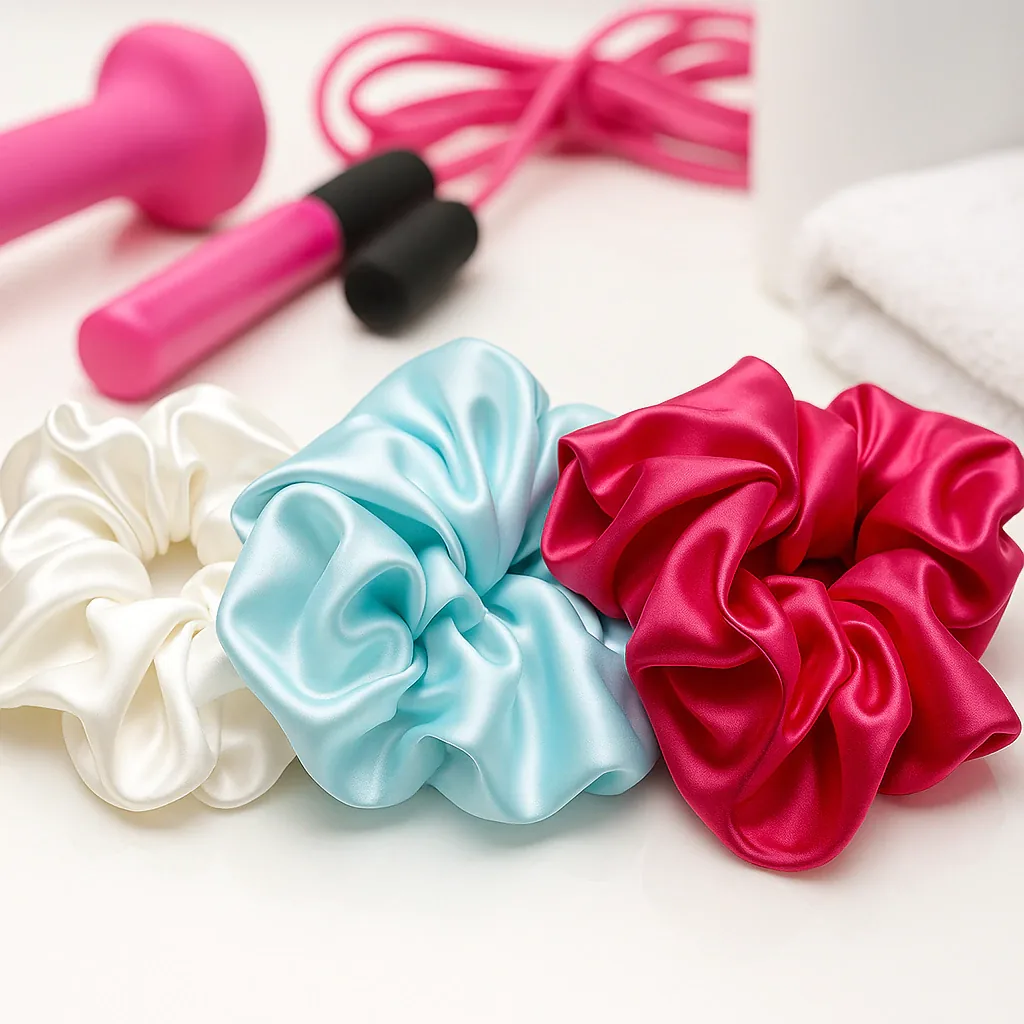
- Two strong, snag-free elastics and two small elastics.
- A pack of bobby pins in your hair colour.
- One non-slip headband and one satin scrunchie.
- A small claw clip for medium and long hair.
- A travel gel or edge control and a mini brush.
- Dry shampoo, a microfibre towel and a spare scrunchie.
What to Ask Your Stylist for a Workout-Friendly Cut
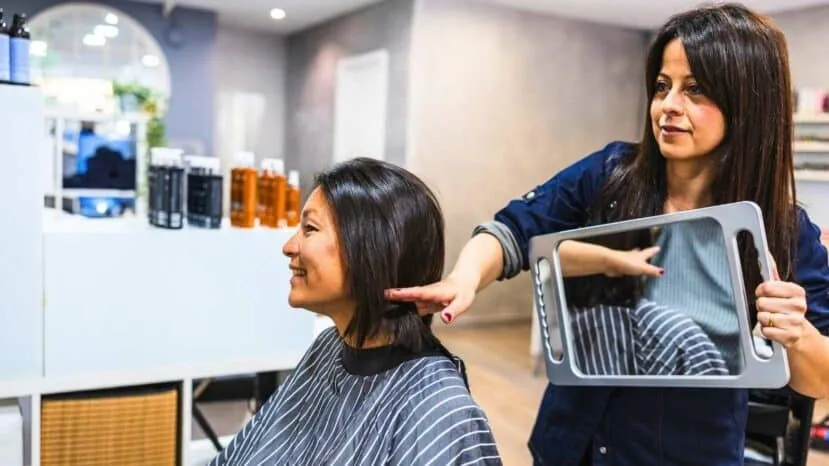
Tell your stylist how you train before you talk about length. Mention helmets, caps, headbands, how often you wash, and whether you wear your hair up most days. That changes where layers should sit and whether a blunt edge will fall into your face.
Ask for layers that can be tucked into a braid or bun, a nape that sits comfortably under a helmet, and a fringe length that can be pinned or banded back. If you are considering an undercut, ask how it will grow out and how often it needs trimming.
What is the best hairstyle for gym workouts?
Double French braids are the best all-round gym hairstyle, because they keep every layer close to the scalp and stay secure through cardio, lifting and classes.
If braids are not your style, a high bubble ponytail or a slicked bun will also hold well, as long as you use a strong elastic and a second anchor point such as pins or a wrap.
How do I stop my ponytail falling out at the gym?
Use two elastics, wrap a braid around the base, and start with slightly textured rather than freshly washed, slippery hair.
A ponytail usually slides because all the weight hangs from one elastic. Adding a second elastic, a braid wrap or a few pins spreads that load and stops the slow slide down.
What hairstyle stays in place for running?
High bubble ponytails, double French braids and braided pigtail buns stay in place best for running.
Running adds bounce and sweat, so you need a style with several anchor points. Loose ponytails and unpinned buns tend to bounce apart within the first few minutes.
Can I wear my hair down to the gym?
You can wear hair down for gentle walking or stretching, but it is not practical for most gym workouts.
Loose hair traps sweat, tangles during cardio, falls into your face during floor work, and can get caught in equipment. A half-up style is a safer compromise for low-impact sessions.
What is the best gym hairstyle for curly hair?
The pineapple puff is the best gym hairstyle for curly hair, because it lifts curls loosely on top without brushing out the curl pattern.
Use a satin scrunchie rather than a tight elastic, add a headband for sweat, and avoid restyling curls while they are dry after your session.
What gym hairstyle works under a helmet?
A low braid or a low ponytail works best under a helmet, because both sit flat and leave room for straps and padding.
High buns and top knots push a helmet forward or create pressure points. Keep the style low, flat and centred at the nape.
How do I keep sweat out of my hair at the gym?
A wide, non-slip headband is the simplest way to keep sweat out of your hairline during a workout.
Headbands absorb sweat before it reaches your hair, and braids or a slicked style stop sweaty strands from sticking to your face. Rinse or blot hair after training rather than adding more product on top of sweat.
Are braids good for gym workouts?
Yes, braids are one of the best gym hairstyles, because they lock hair down in sections and resist sweat, movement and wind.
French, Dutch, fishtail and cornrow braids all work, with cornrows lasting longest. Loose, undone braids will still fray, so secure the ends well.
What should I put in my gym bag for my hair?
Pack strong elastics, bobby pins, a non-slip headband, a claw clip, travel gel and dry shampoo.
That small kit covers most gym hair emergencies: a slipping ponytail, loose layers, a broken elastic or a post-workout refresh before you head home.
How often should I wash my hair if I work out every day?
Wash when your scalp needs it, not automatically after every session, and rinse sweat out between full washes.
Daily aggressive washing can dry hair and irritate the scalp. A water rinse, co-wash or dry shampoo at the roots is often enough on lighter training days.
Conclusion
The best hairstyle for gym and workouts is the one that stays put through your actual session, not just in the mirror. Start with your workout type, choose a style with more than one anchor point, and keep a small hair kit in your gym bag for the days it slips.
Try one braid, one bun and one ponytail from this guide over your next three sessions. You will quickly learn which style survives your training, and that style becomes your reliable, sweat-proof go-to.