Softening a Receding Hairline: 33 Hairstyles That Frame Your Face Beautifully
A receding hairline is far more common in women than most people realise — and far less talked about. It can show up as temples that have crept a little higher, a parting that looks wider than it used to, a widow’s peak that has become more pronounced, or a hairline that simply does not sit where it did at twenty. Hormones, genetics, stress, tight hairstyles, and the years after pregnancy or menopause can all play a part. And because almost every conversation about hair loss is aimed at men, many women quietly assume their only options are to hide it or to live with it. Neither is true.
The truth is that a haircut is the fastest, kindest fix there is. The right fringe, the right part, a little volume exactly where you need it — and the hairline stops being the first thing anyone notices, because the eye is drawn to the shape of the cut instead. This guide has 33 hairstyles for women with a receding hairline, grouped by the coverage strategy that makes each one work: soft fringe families that blur the hairline, side-part styles that camouflage the temples, volume at the crown that rebalances the face, textured pixies that make a higher hairline look deliberate, and updos that draw the eye upward. Eight guides cover how a receding hairline works, how to choose a part for your pattern, which cuts to avoid, and when a stylist — or a doctor — is the better call. Every style notes who it suits, how to style it, and what to ask for, so you can walk into the salon knowing exactly what you want.
How a Receding Hairline Works in Women — and Why It Is Not Just a Men’s Problem
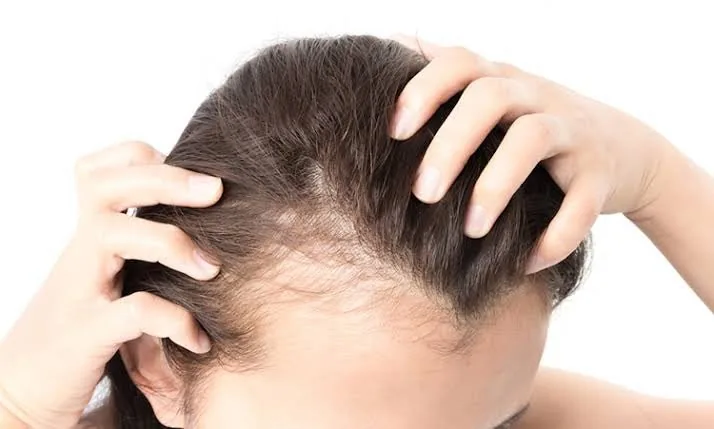
A receding hairline in women usually looks different from the classic male pattern, which is why it is so often missed — even by the woman herself. Instead of a clean M-shape, many women see the temples thinning first, so the corners of the hairline creep back a little each year, or the parting gradually widens, or the hairline as a whole moves up a centimetre or two while the hair behind it stays thick. The causes are familiar ones: genetics, hormonal shifts around menopause or after pregnancy, thyroid issues, iron deficiency, stress, and years of tight ponytails and braids that pull at the same spot. The hair is not necessarily falling out in clumps; often it is miniaturising — each new hair growing back a little finer and shorter than the one before it, until it stops covering the scalp the way it used to.
That is why a haircut works so well as a first step. You cannot change the hairline overnight, but you can change what the eye sees, and that is a styling problem with a styling solution. A fringe covers the hairline directly, a side part moves the hair over the thinnest spot, volume at the crown rebalances a face that has grown longer-looking, and texture creates the illusion of density where the hair has thinned. None of this is about hiding in shame — it is about choosing a cut that flatters the hair you have now, the way you would choose a cut that flatters your face shape. And if the recession is sudden, patchy, or paired with itching, scaling or shedding in handfuls, skip the salon first and see a doctor or dermatologist, because some causes are treatable and the sooner they are caught, the better the outcome.
The Three Coverage Rules — Fringe, Part and Volume
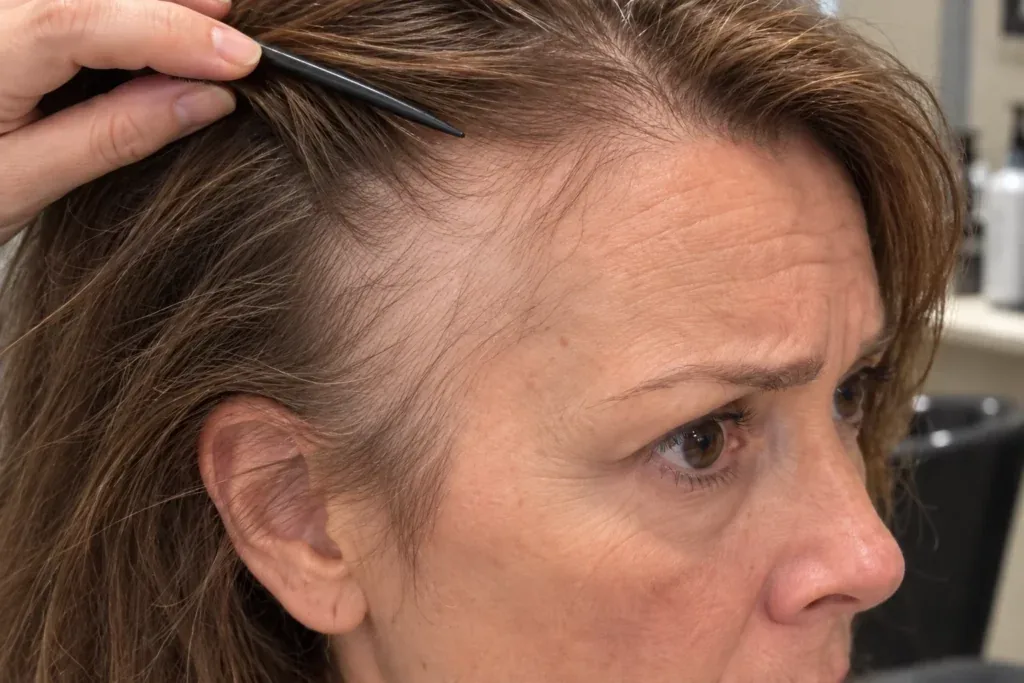
Every hairstyle in this guide works by one or more of three simple rules, and understanding them will help you judge any haircut, not just these thirty-three. Rule one is fringe: anything that falls across the forehead — a curtain bang, a wispy fringe, a side-swept sweep — breaks up the line of the hairline, so the eye reads softness instead of recession. Rule two is the part: where you part your hair decides where the hair lies thickest and where it lies thinnest, and moving the part a few centimetres can cover a temple entirely. Rule three is volume: lift at the roots and the crown draws the eye upward and outward, away from the hairline, and makes the hair look denser overall — which is why so many of the best receding-hairline styles are built around layers, texture and a good blow-dry.
The most flattering styles usually combine two of the three rules at once — a side part plus a curtain bang, for example, or a textured pixie plus crown volume. What rarely works is a style that fights all three rules at once: hair pulled straight back with no fringe, a centre part on a wide parting, and flat roots. That combination puts the hairline on full display and gives the eye nowhere else to go. The good news is that you do not need all three rules to win — one strong one, done well, is often enough. If you love your long hair, keep it and add a side-swept fringe. If you hate fringe, skip it and build volume instead. And if you are trying a new style, give it two weeks before you judge it; a fringe needs a few days to settle, and a new part needs a few washes before it stops fighting you.
Matching the Cut to Your Hairline Pattern — Temples, Widow’s Peak or Diffuse Thinning
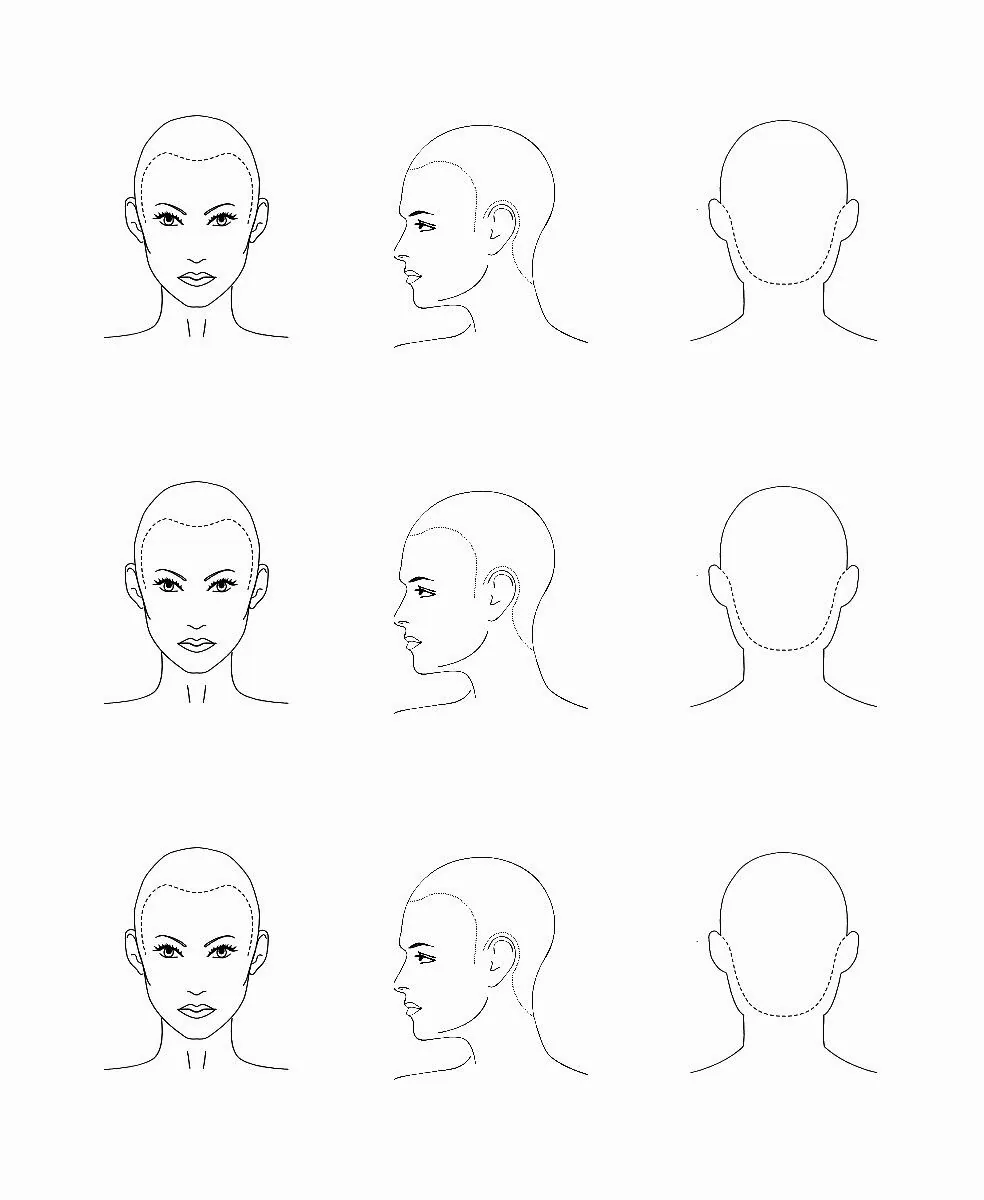
Not all receding hairlines are the same, and the cut that flatters one pattern can flatter another one badly — so the first step is to know which pattern you have. Temple recession is the most common: the corners of the hairline move back, leaving the centre of the forehead more or less where it was. A widow’s peak is a pointed centre that becomes more pronounced as the hair on either side thins. A high hairline is an even, all-over recession that simply makes the forehead look longer. And diffuse thinning is the trickiest, because the hairline itself may barely move while the hair behind it thins, so the parting widens and the scalp shows through under bright light.
For temple recession, side-part styles and side-swept fringes are the heroes, because they sweep hair across the exact spot that has thinned. For a widow’s peak, a curtain bang or a centre-parted fringe works beautifully, because the peak becomes a feature the fringe is built around rather than a flaw to hide. For a high hairline, volume at the crown and a soft fringe shorten the forehead visually, and short, textured cuts often look more deliberate than long, flat ones. For diffuse thinning, layers and texture are everything — a blunt, one-length cut shows the scalp, while a layered cut with movement creates the illusion of fullness. Take a photo of your hairline in natural light, straight on and from each side, before your salon appointment; it will help your stylist see what you see, and it gives you a baseline to compare against in three months.
Bangs and Fringes — the Fastest Fix, and How to Grow One Out Gracefully
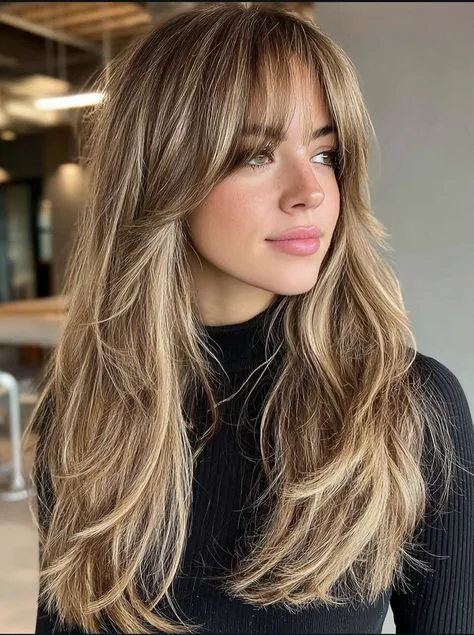
A fringe is the single fastest way to soften a receding hairline, and it is also the cut most women are most nervous about — usually because of a bad fringe memory from childhood, or the fear of being stuck with one. Here is the reassuring part: a modern fringe for a receding hairline is not the heavy, blunt fringe of the past. The best versions are light, piecey and long at the sides: curtain bangs that part in the middle and blend into the lengths, a wispy fringe that lets a little forehead show through, or a side-swept fringe that can be pushed to either side. They all cover the hairline without looking like they are trying to, and they all grow out gracefully, which is the part most people forget to plan for.
Growing a fringe out is simple if the fringe was cut well in the first place. A curtain bang grows into face-framing layers, a side-swept fringe grows into a longer sweep, and a wispy fringe grows into a soft, piecey front section — none of them has an awkward stage that lasts more than a week or two. Ask your stylist to cut the fringe dry, or at least to check it dry, because wet hair shrinks as it dries and a fringe cut too short when wet will be shorter still when dry. And if you are still unsure, start with the longest version — a curtain bang that reaches the cheekbones — and have it shortened at your next appointment. A fringe is a low-risk experiment with a high reward, and it is the one change in this guide that you will notice the same day.
Styling Products That Create Density — Fibres, Root Sprays and the Right Brush
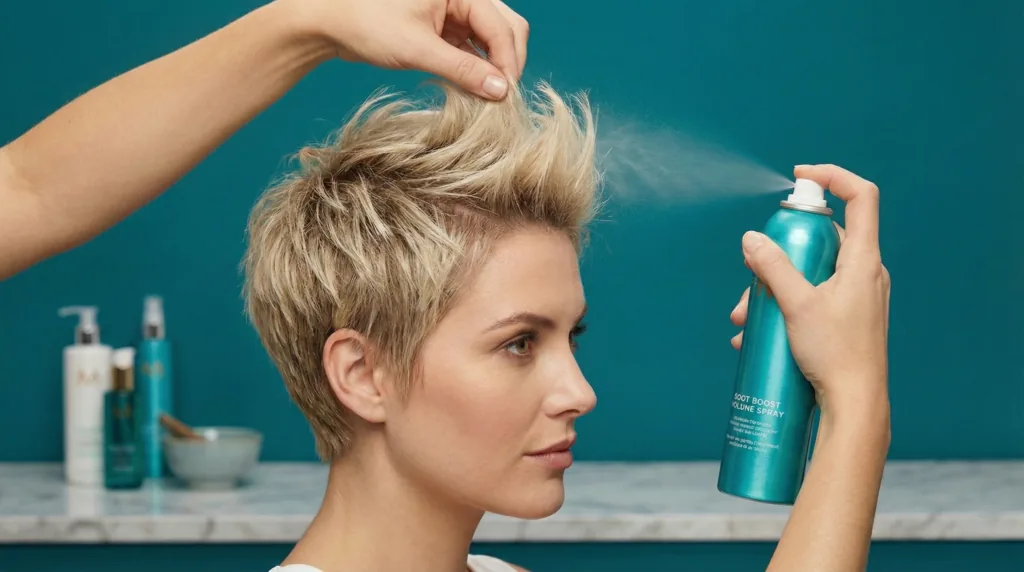
A good cut does most of the work, but the right products can add the finishing ten percent that makes a receding hairline disappear in photographs and under bright light. Hair fibres — the tiny keratin or cotton fibres that cling to existing hair — are the most dramatic option: shaken or sprayed onto a thinning temple or a wide parting, they make the hair look instantly thicker, and they wash out with shampoo. Root-lifting sprays and volumising mousses work differently: applied to damp roots and blow-dried upward, they give the hair at the crown and the temples the lift that stops it lying flat against the scalp. A little dry shampoo at the roots on day two does the same thing, adding grip and texture where flat hair would show the scalp.
The tools matter as much as the products. A round brush, used to blow-dry the fringe and the front sections forward and to the side, is what makes a curtain bang fall the way it should. A fine-tooth comb is for smoothing, not for parting — a tail comb gives you a cleaner part line, and a part that is slightly zigzagged rather than razor-straight hides a wide parting far better than a perfect line does. What to avoid: heavy oils and smoothing serums applied near the roots, which make thin hair look thinner by clumping it together, and strong-hold gels pulled straight back, which expose the hairline and make the temples look even barer. Keep the heavy products on the lengths and the light, volumising ones at the roots, and your cut will look like it does in the salon for far longer.
Cuts and Habits to Avoid — What Makes a Receding Hairline Look Worse
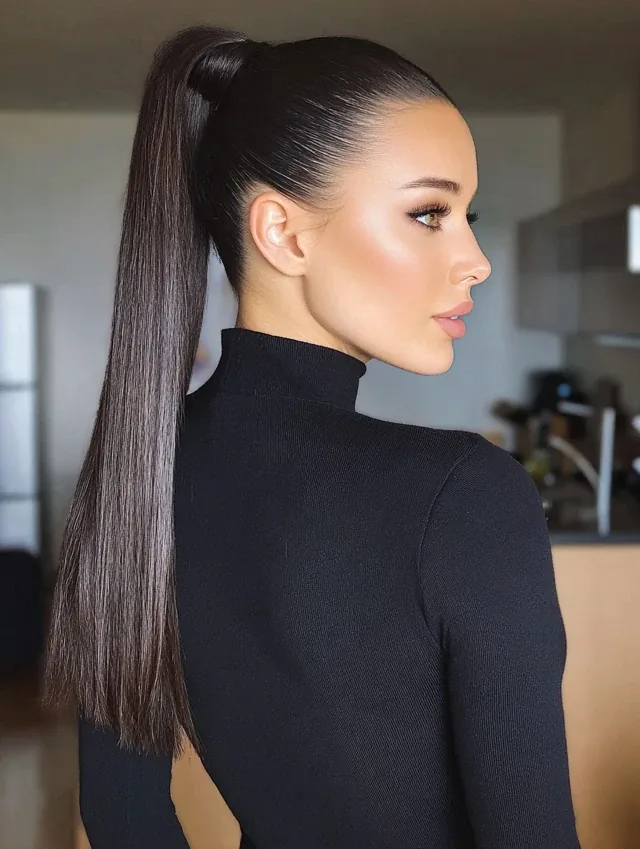
Knowing what to avoid is as useful as knowing what to choose, because a few common styles actively make a receding hairline look worse. The biggest offender is the tight, slicked-back ponytail or bun: it pulls the hair away from the temples, puts tension on the exact hairs that are already fragile, and frames the hairline with a hard, bare line. Worn every day, it can also cause traction alopecia — hair loss caused by pulling — which makes the problem worse over time. The same goes for tight braids, cornrows pulled drum-tight, and extensions attached close to the hairline. If you love an updo, choose a loose, soft one with face-framing pieces instead, and give your hairline regular days off from any tension at all.
Other things to skip: a centre part with flat, straight, one-length hair, which puts the widest parting and the thinnest temples on display at the same time; very long, very straight hair with no layers, which drags the eye downward and makes the top of the head look flat and sparse; and a super-short buzz or a shaved side on the same side as your recession, which removes the very hair you would use to cover it. Blunt, heavy fringes cut straight across can also backfire if your hair is fine, because they can look thin and stringy and draw attention to exactly what you wanted to soften. None of this means you can never wear a ponytail or a centre part again — it means those styles need the softening tricks in this guide, a loose finish, a little volume, or a few face-framing pieces, to work for you rather than against you.
Colour Tricks That Make Hair Look Thicker — Root Shadow, Highlights and Low-Lights
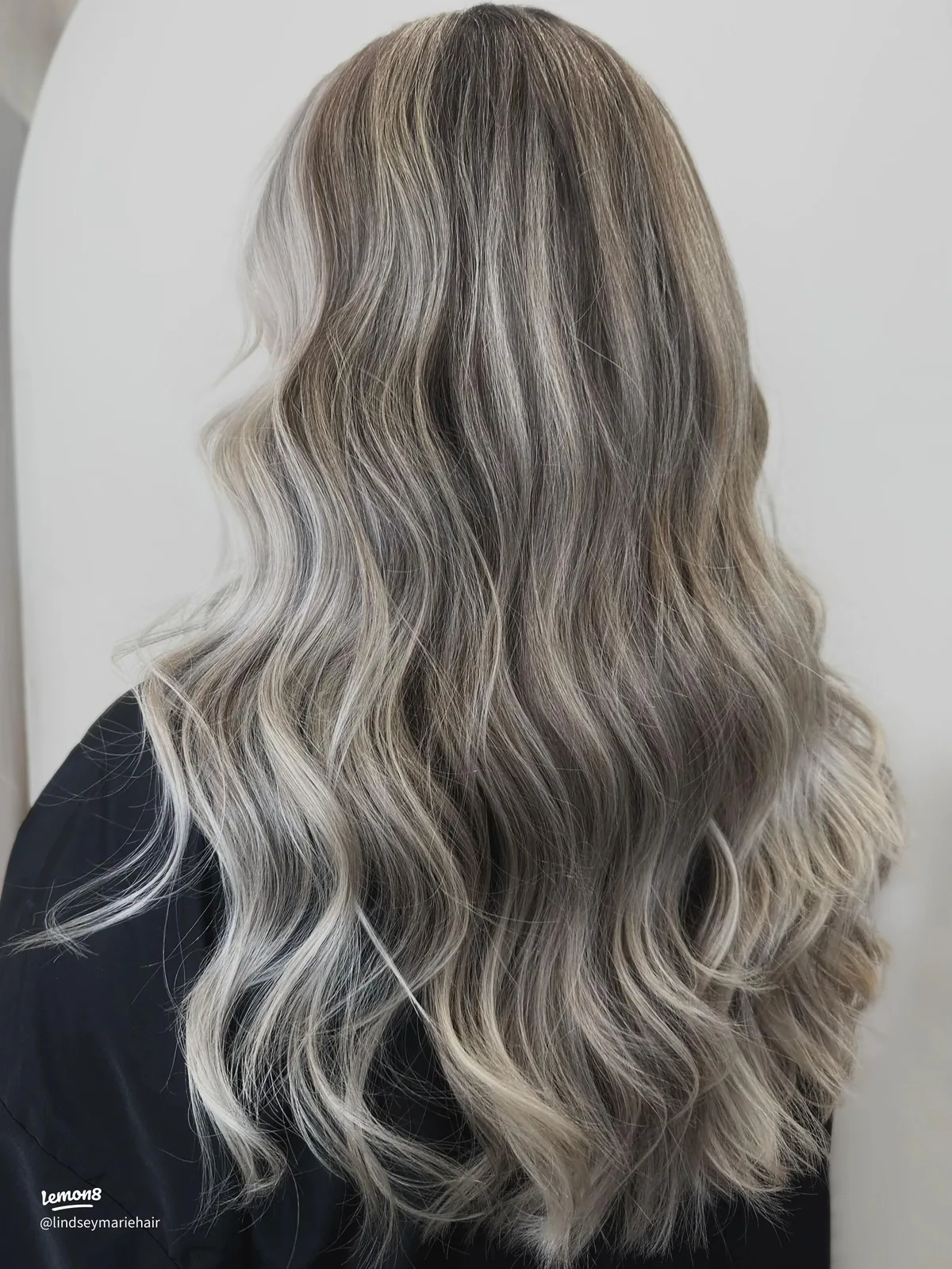
Colour is the quiet partner of a good cut, and a clever colourist can make thinning hair look noticeably denser without adding a single strand. The most useful trick is a root shadow or root smudge: a slightly darker shade blended into the roots at the hairline and the parting, which makes the scalp less visible by reducing the contrast between hair and skin. On dark hair, this means going a shade or two darker at the roots; on blonde hair, it means a soft, shadowed root rather than a stark, bright one. The second trick is dimension: fine, single-process colour can make hair look flat and thin, while a mix of highlights and lowlights creates depth, and depth reads as thickness.
A few practical rules: keep the lightest pieces around the face, where they catch the light and draw the eye to your features rather than your hairline, and keep the darkest pieces underneath, where they create a shadow that makes the top layers look fuller. Avoid a harsh, high-contrast blonde that shows every millimetre of scalp at the temples, and be wary of very dark, solid colour on very fine hair, which can make the hairline look like a drawn line. If you colour at home, a root touch-up spray or powder in your shade is a quick fix for a special occasion — it fills in a temple or a parting in seconds and washes out at the next shampoo. Colour will not regrow hair, but it is one of the cheapest ways to make the hair you have look like more of it.
Talking to Your Stylist — and When to See a Doctor Instead
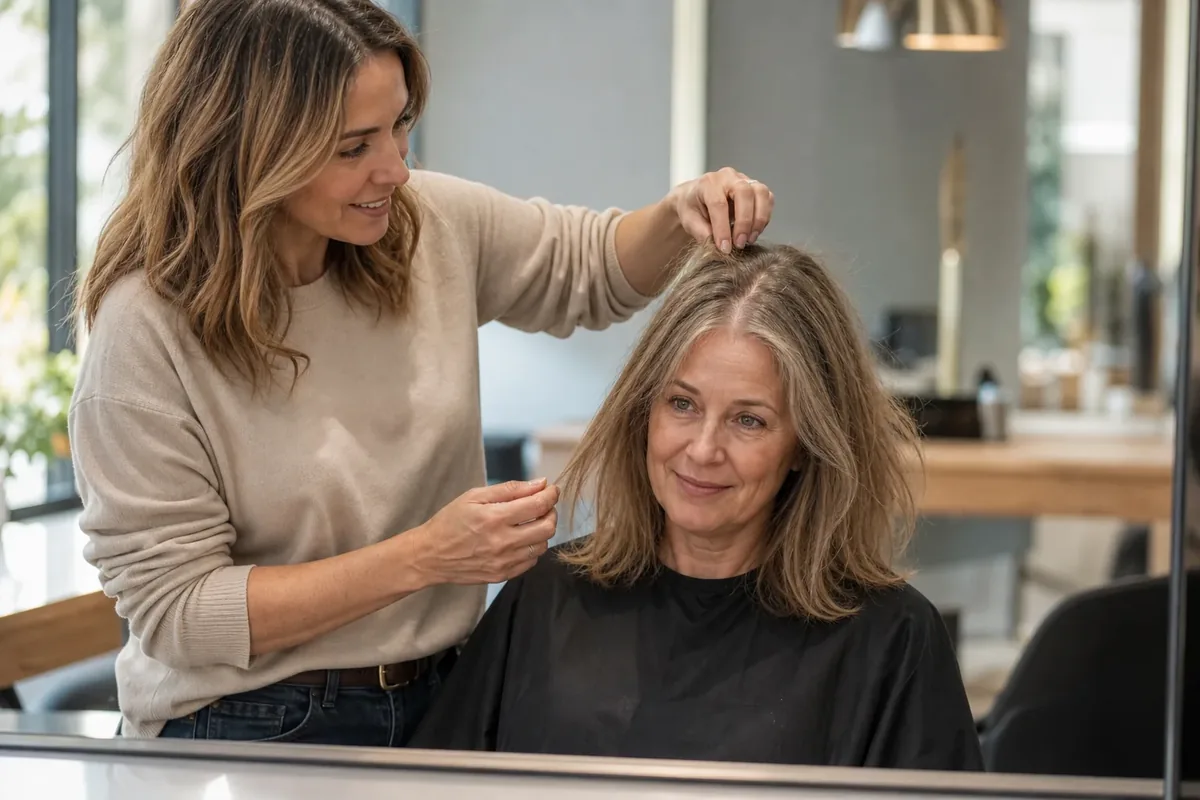
The most important ten minutes of your next haircut happen before the scissors come out, and they are the consultation. Bring photos — not just of the style you want, but of your own hairline in natural light, taken straight on and from both sides — and tell your stylist, plainly, that your hairline is receding and that covering it matters to you. A good stylist will not be surprised; they see it every week. Ask them to cut the fringe dry, to show you how to blow-dry the front sections, and to tell you honestly how the style will look on day three, not just on day one. If a stylist dismisses the concern or insists on a style that exposes the hairline, find another stylist — this is your hair, and you are allowed to be specific about it.
There is also a point at which the salon is not the right room. See a doctor or a dermatologist if the recession started suddenly, if it is patchy rather than gradual, if you are losing handfuls of hair, if the scalp is itchy, sore or scaly, or if the thinning came with other changes such as irregular periods, acne, fatigue or weight changes. Blood tests for iron, thyroid function and vitamin D are a common first step, and treatments from topical minoxidil to addressing the underlying cause exist and work best when started early. A haircut is a wonderful, immediate fix, and it is also a perfectly good long-term strategy — but it is not a substitute for medical advice when your body is telling you something has changed. Get the check, then get the cut, and enjoy both.
1. Curtain Bangs That Melt Into the Lengths

Curtain bangs are the single most recommended style for a receding hairline, and for good reason: they part in the middle, fall softly on either side of the face, and blur the hairline without ever looking like a cover-up. The fringe is longest at the sides, where it blends into the rest of the hair, and shortest in the centre, so it frames the forehead rather than hiding it. On a receding hairline, that soft, parted curtain does two jobs at once — it covers the temples, where recession usually starts, and it draws the eye to the cheekbones and the eyes. It works on straight, wavy and curly hair, on long hair and on a bob, and it is the fringe that grows out most gracefully of all.
Best for: temple recession, a widow’s peak, and anyone trying a fringe for the first time. How to style: blow-dry the fringe forward with a round brush, then sweep each side outward and away from the face so it opens like a curtain. What to ask your stylist: for a curtain bang that starts at the cheekbones, cut dry, with the centre a little shorter than the sides. Time: 5 minutes a day once it is cut. Quick verdict: the safest, softest first step — if you only try one style from this guide, make it this one.
2. The Wispy Fringe That Lets a Little Forehead Show
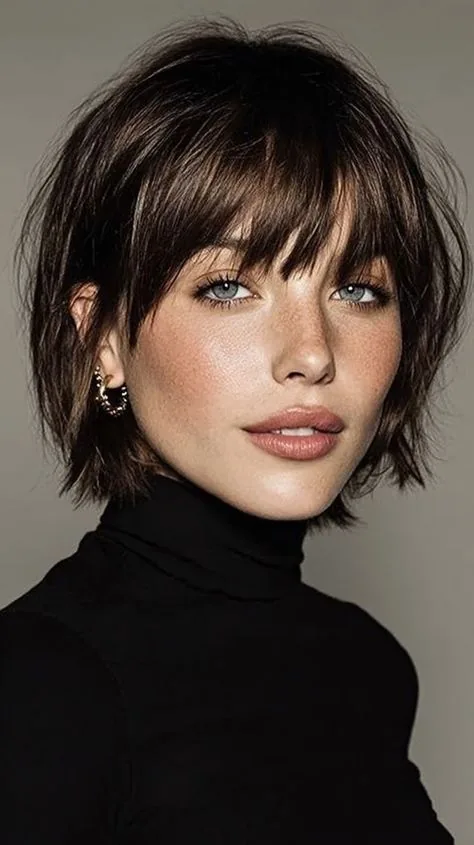
A wispy fringe is the answer for women who want the coverage of a fringe without the weight of one. The hair is cut light and piecey, with gaps that let a little forehead show through, so the fringe reads as softness rather than as a wall of hair. On a receding hairline that matters, because a heavy, solid fringe can look thin and stringy on fine hair and draw attention to exactly what you wanted to soften — while a wispy fringe, by being deliberately light, looks intentional and airy. It pairs beautifully with long layers, with a bob, and with wavy hair, where the pieces fall naturally into soft, separated strands.
Pros: light, low-maintenance, flattering on fine hair, and very forgiving as it grows out. Cons: it covers less than a fuller fringe, so it suits mild to moderate recession better than a deeply receded hairline. Common mistake: cutting it too short — a wispy fringe should reach the eyebrows, not sit halfway up the forehead. Maintenance: a quick blow-dry with a round brush, or a few minutes with a flat iron to bend the pieces. Who should avoid it: anyone who wants full, solid coverage, or whose hair is very curly, where a wispy fringe can shrink up unpredictably. Time: 3 to 5 minutes a day.
3. Side-Swept Fringe — the Classic Temple Cover
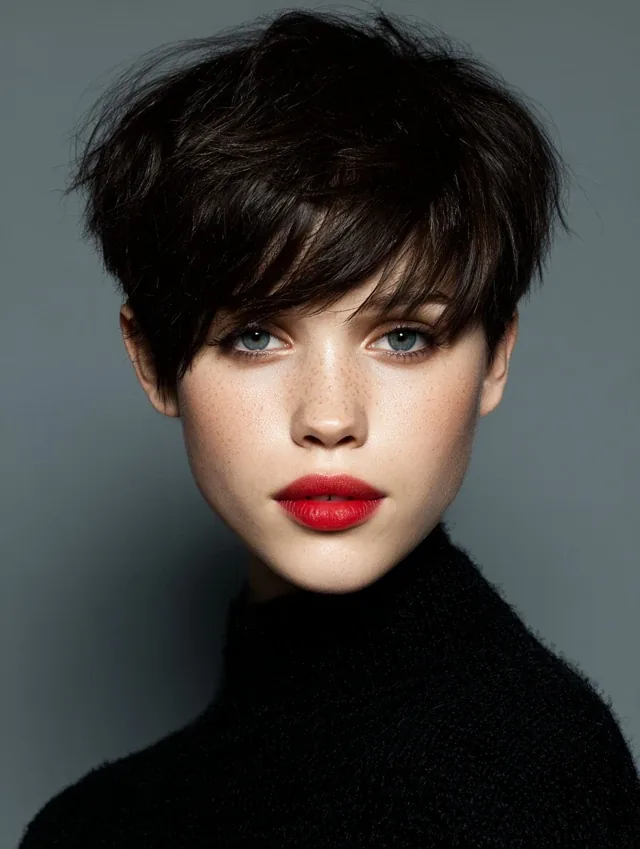
The side-swept fringe is the oldest trick in the book for a receding hairline, and it is still one of the best. The fringe is cut long and swept across the forehead from a deep side part, so it falls diagonally over the temple that has thinned most — the exact spot you want to cover. The diagonal line is flattering on almost every face shape, it softens a high forehead, and it gives the whole hairstyle movement, so the eye follows the sweep instead of stopping at the hairline. It works on every hair length, from a pixie to waist-length hair, and it is the easiest fringe to style, because you are simply blow-drying it in the direction it already wants to go.
Best for: temple recession on one side, round and square faces, and anyone who wants maximum coverage from a single change. How to style: part the hair deeply on the fuller side, blow-dry the fringe across the forehead with a round brush, and set it with a light spray. What to ask your stylist: for the fringe to reach the cheekbone at its longest point, and for the part to sit on the side with the fuller temple. Time: 5 minutes a day. Quick verdict: the workhorse of this guide — simple, reliable, and flattering on almost everyone.
4. A Blunt Fringe, Done Softly
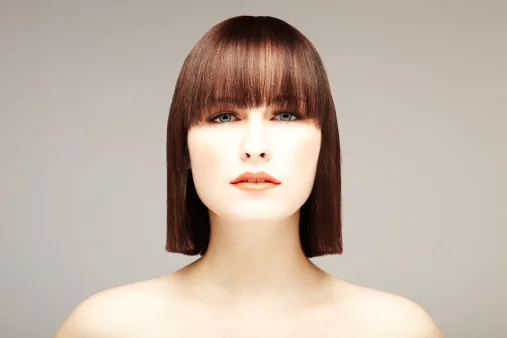
A blunt fringe can be a wonderful choice for a receding hairline — as long as it is done softly. The version that works is not the heavy, ruler-straight fringe of the past, but a fringe that is cut blunt at the ends and then softened with a little point-cutting, so it has texture and movement rather than a hard, solid edge. The coverage is complete: the whole hairline disappears behind the fringe, and the forehead is shortened visually, which is flattering if your hairline has moved up evenly. It suits thick hair best, where the fringe has enough density to look full, and it pairs beautifully with a bob or a lob, where the straight line of the fringe echoes the clean line of the cut.
Pros: full coverage, a strong, polished look, and a shorter-looking forehead. Cons: it needs regular trims every three to four weeks, and it can look thin on very fine hair. Common mistake: cutting it too thick — taking too much hair into the fringe leaves the rest of the hair looking thin. Maintenance: trims, plus a quick blow-dry or flat-iron pass each morning. Who should avoid it: women with very fine or very curly hair, where a blunt fringe can shrink, separate, or look sparse. Time: 5 to 10 minutes a day, plus a trim every month.
5. Feathered Fringe for Fine, Thinning Hair
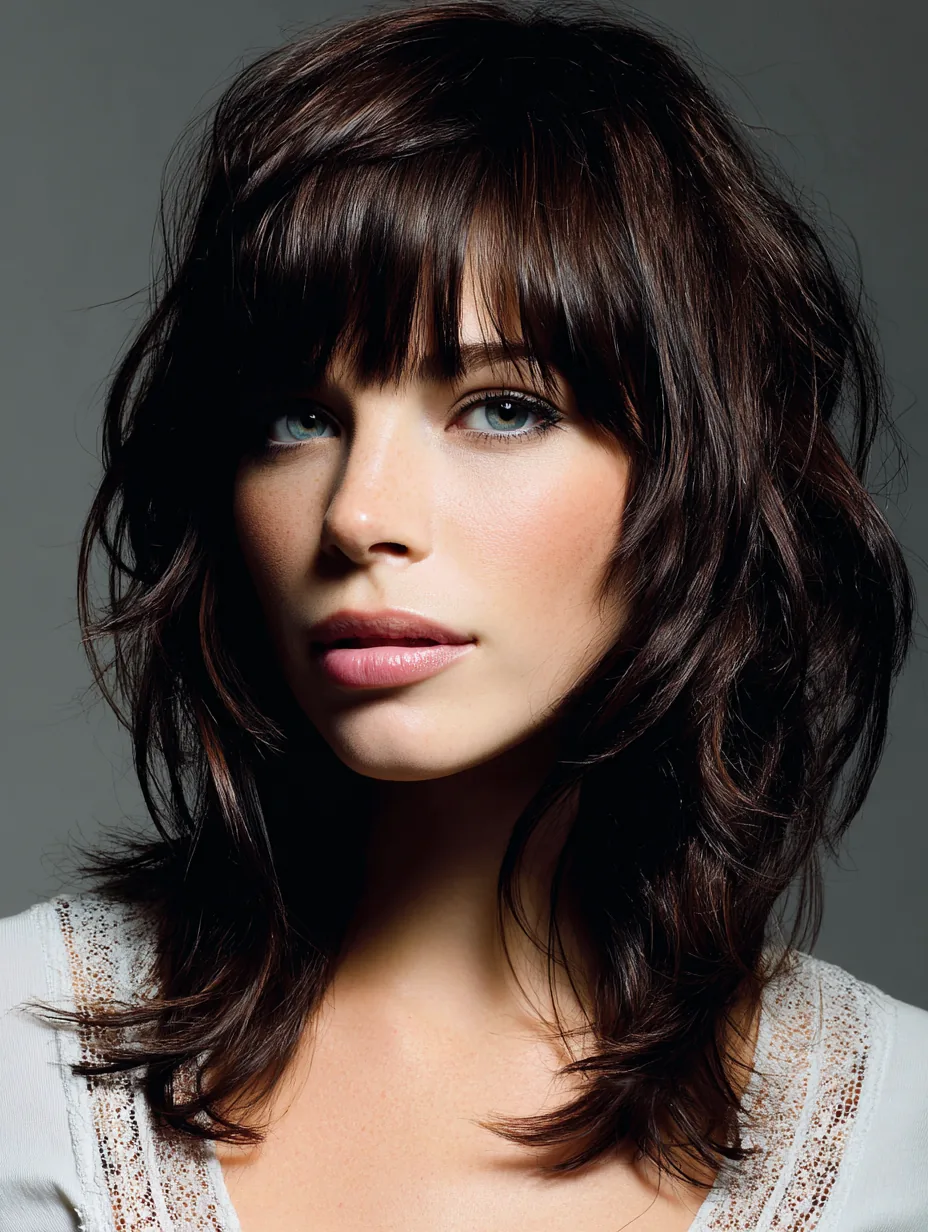
A feathered fringe is cut in soft, tapered layers, so the ends are light and airy rather than blunt — and that lightness is exactly what fine, thinning hair needs. Where a blunt fringe can look sparse on fine hair, a feathered fringe looks deliberately textured, and the feathered ends create movement that distracts from any sparseness at the hairline. It is the fringe for women whose hair is thinning overall, not just at the temples, because it adds the illusion of fullness without demanding density the hair does not have. It works on short and medium lengths, and it is especially pretty on wavy hair, where the feathered pieces fall into soft, natural bends.
Best for: fine hair, diffuse thinning, and women over 50. How to style: blow-dry with a round brush, rolling the ends under slightly, and finish with a texturising spray rather than a heavy serum. What to ask your stylist: for a feathered, layered fringe that reaches the eyebrows, cut with a razor or point-cutting for softness. Time: 5 minutes a day. Quick verdict: the kindest fringe for fine hair — light, textured, and forgiving.
6. Long, Face-Framing Layers That Start at the Cheekbones
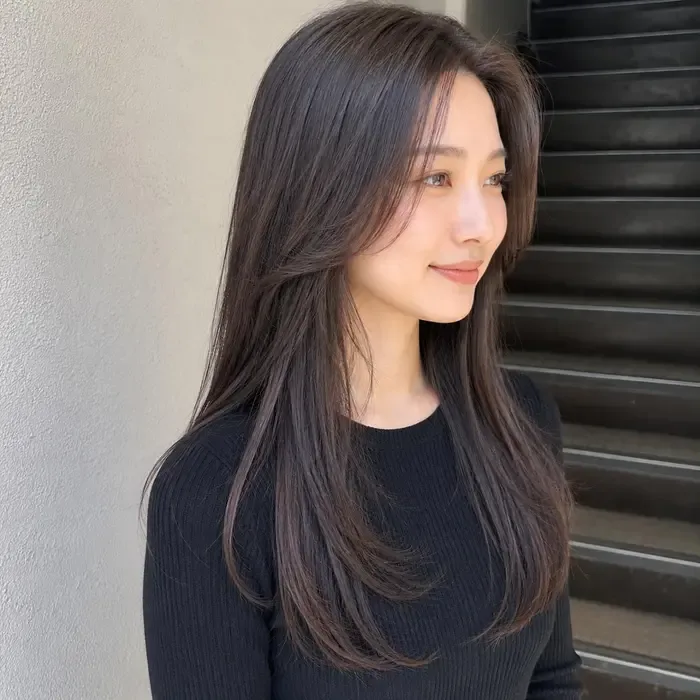
Long, face-framing layers are the no-fringe answer to a receding hairline: the front layers start at the cheekbones and fall forward, so they sweep across the temples and soften the corners of the hairline without a single bang being cut. It is the perfect style if you love your long hair and do not want a fringe, because the layers do the covering work while the length stays exactly as it is. The layers also add movement and body to long hair, which can otherwise hang flat and drag the eye downward — and movement is one of the three coverage rules, because it gives the eye somewhere to go besides the hairline.
Pros: no fringe commitment, keeps your length, and grows out seamlessly. Cons: it covers less than a real fringe, so it suits mild recession best. Common mistake: cutting the front layers too short, which makes them flip out instead of falling forward — they should reach at least the cheekbones. Maintenance: a round-brush blow-dry to curve the layers toward the face, or a few passes with a large-barrel iron. Time: 10 minutes a day. Quick verdict: the fringe for women who do not want a fringe — soft, long, and completely commitment-free.
7. The Micro Fringe — Bold, Deliberate and Surprisingly Flattering

A micro fringe — the short, above-the-eyebrow fringe sometimes called baby bangs — sounds like the last thing a woman with a receding hairline should try, and that is exactly why it works. By cutting the fringe deliberately short, it turns the hairline from something to hide into a style statement: the eye reads the short, graphic fringe as a choice, not as a cover-up, and a receding temple simply disappears into the geometry of the cut. It is bold, it is fashionable, and it looks extraordinary with a pixie, a bob, or a shag. It is not for everyone, and it is not a subtle style — but if you have the confidence for it, it is one of the most flattering choices in this guide.
Best for: confident women, thick hair, and a high or uneven hairline that you would rather own than hide. How to style: blow-dry the fringe straight down with a small round brush, and keep it slightly piecey rather than perfectly smooth. What to ask your stylist: for the fringe to sit about a centimetre above the eyebrows, cut dry, and to check it against your hairline before committing. Time: 3 minutes a day. Quick verdict: the bold move — not a disguise, a declaration, and a surprisingly good one.
8. Bottleneck Bangs — the 70s Fringe That Flatters Everyone
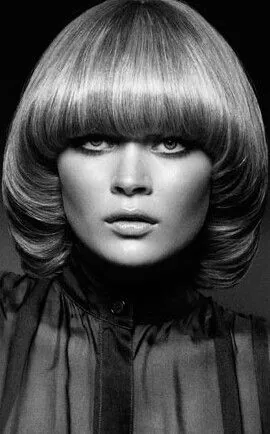
Bottleneck bangs are the 1970s fringe that has come roaring back, and they are tailor-made for a receding hairline. The fringe is narrow and short in the centre — like the neck of a bottle — and longer and wider at the sides, where it blends into face-framing layers. That shape does two useful things: the short centre opens up the middle of the forehead, so the style does not look heavy, and the long sides cover the temples, where recession actually happens. The result is a fringe that looks relaxed and a little bit retro, that works on straight and wavy hair, and that flatters round, oval and square faces alike.
Pros: covers the temples, opens the centre, and grows out into curtain bangs. Cons: it needs a stylist who knows the shape — a bad bottleneck bang is just an uneven fringe. Common mistake: cutting the centre too wide, which turns it into an ordinary blunt fringe. Maintenance: a round-brush blow-dry, or a quick pass with a straightener to bend the sides outward. Who should avoid it: anyone who wants a very neat, polished look, because bottleneck bangs are deliberately a little undone. Time: 5 minutes a day. Quick verdict: the retro fringe that earns its comeback — clever shape, easy wear, and temples covered.
9. The Deep Side Part Bob
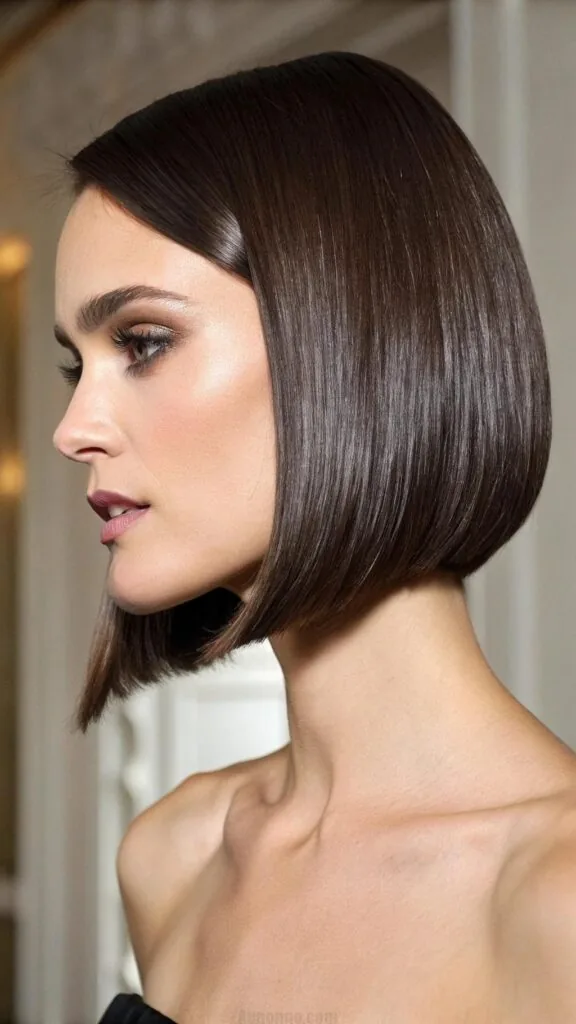
A deep side part bob is the haircut equivalent of a magic trick: move the part two or three inches off centre, and the hair that used to lie flat on one side now sweeps across the forehead in a heavy, glossy fall that covers the thinner temple completely. The bob itself is clean and classic — chin-length or just below, with a slight graduation at the back — and the deep part gives it drama, volume on one side, and a diagonal line that flatters almost every face shape. It is the style for women who want a short cut that still feels polished, and for anyone whose recession is worse on one side than the other, because the part can be placed to cover the weaker side.
Best for: one-sided temple recession, round and square faces, and fine to medium hair. How to style: part the hair deeply while it is damp, blow-dry the heavy side over with a round brush, and tuck the lighter side behind the ear for contrast. What to ask your stylist: for the part to sit two to three inches off centre, and for the bob to be cut slightly longer on the heavy side. Time: 10 minutes a day. Quick verdict: one part, one sweep, and the temple is gone — the simplest camouflage in this guide.
10. Side-Swept Pixie with a Long Top
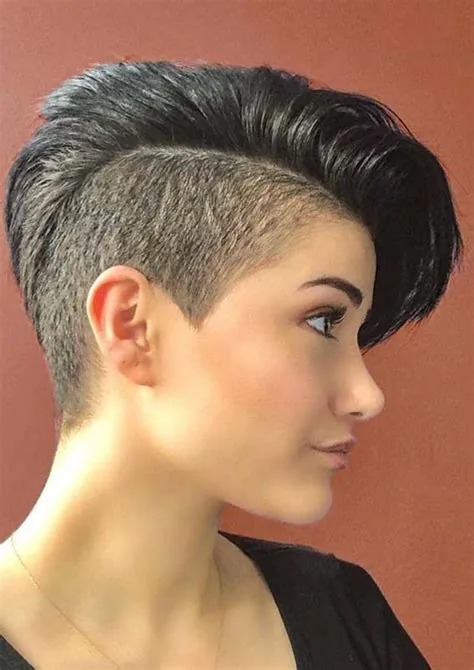
A side-swept pixie with a long top is the short cut that does the most covering work: the top is left long enough to sweep across the forehead, so it falls over the temples and the hairline in a soft, textured wave, while the sides and back are kept short and neat. The contrast is the point — the short sides make the long, sweeping top look deliberate and styled, and the sweep itself does the job of a fringe without ever being cut as one. It is a confident, modern cut, and it is especially flattering on women with strong cheekbones, because the sweep frames the face while the short sides show it off.
Pros: maximum coverage in a short cut, low maintenance, and a style that looks intentional rather than apologetic. Cons: it needs a trim every four to five weeks to keep the shape. Common mistake: cutting the top too short — it needs to reach at least the eyebrows when swept across, or it will not cover the temples. Maintenance: a little styling cream or pomade, worked through the top and swept to the side. Who should avoid it: anyone who wants to keep their length, or who is not ready for a short cut. Time: 5 minutes a day.
11. The Side-Part Lob with Soft Waves
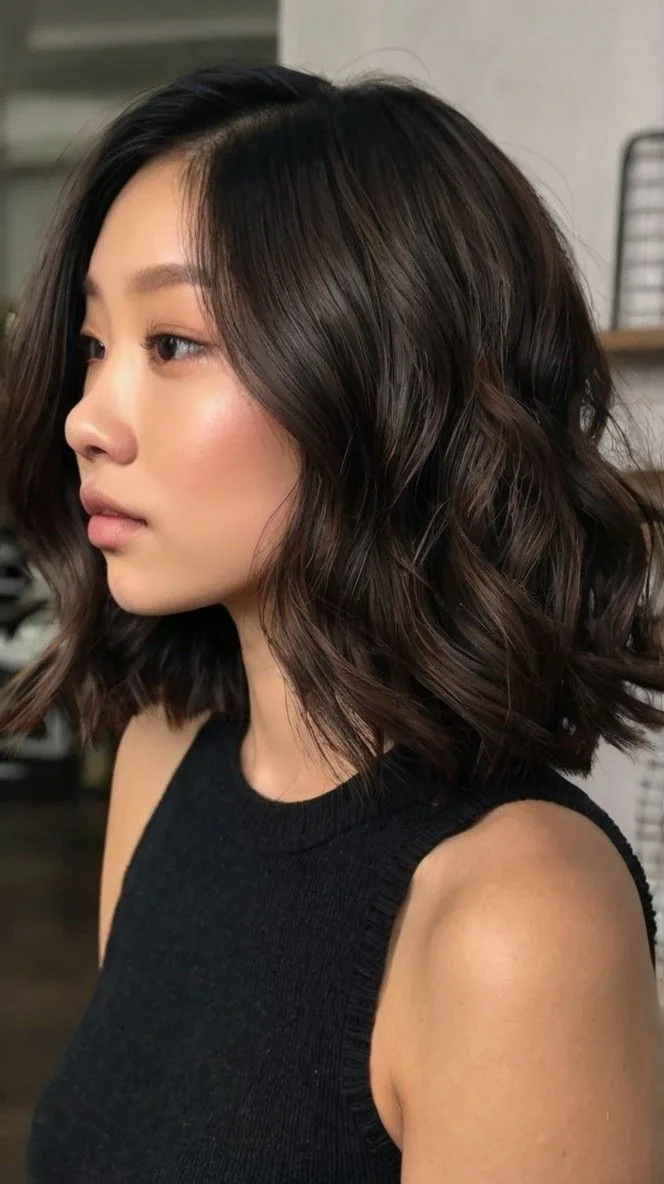
The side-part lob with soft waves is the most wearable style in this guide — the one that looks good on almost everyone, in almost every situation. The lob falls to the collarbone, the part is moved to one side, and the hair is waved in large, soft bends, so the whole style has movement, volume and a diagonal sweep across the forehead. The waves are doing quiet work here: they create the illusion of density, they keep the hair from lying flat against the scalp, and they make the side part look like a styling choice rather than a cover-up. It is the style for work, for weekends, for weddings, and for women who want one cut that does everything.
Best for: mild to moderate recession, all face shapes, and medium to thick hair. How to style: part to one side, curl large sections away from the face with a large-barrel iron, and brush the waves out gently for softness. What to ask your stylist: for a lob that hits the collarbone, with long layers through the lengths and a side part. Time: 15 to 20 minutes a day. Quick verdict: the does-everything cut — soft, flattering, and impossible to get wrong.
12. The Asymmetric Bob — Longer on One Side
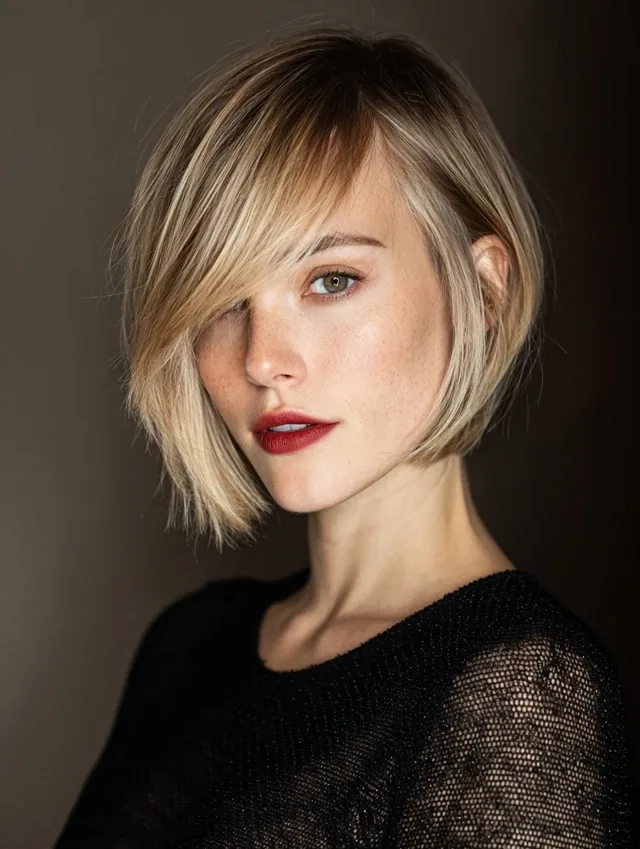
An asymmetric bob is cut longer on one side than the other, and that asymmetry is a gift for a receding hairline. The longer side sweeps across the forehead and covers the temple, while the shorter side keeps the cut looking sharp and modern — and because the two sides are deliberately different, nobody reads the longer side as a cover-up; they read it as the design. It is a bold, fashionable cut, and it works best on straight or slightly wavy hair, where the clean line of the bob is visible. It is also one of the few short cuts that can cover a temple completely while still looking like a statement rather than a compromise.
Pros: strong coverage on one side, a striking, modern silhouette, and a cut that photographs beautifully. Cons: it needs regular trims to keep the asymmetry crisp, and it is not a subtle style. Common mistake: making the difference between the sides too small — it should be obvious, at least an inch or two, or it just looks like a mistake. Maintenance: a flat iron or a round-brush blow-dry to keep the line clean. Who should avoid it: anyone who wants a symmetrical, classic look, or whose recession is even on both sides. Time: 10 minutes a day.
13. Side-Swept Long Layers for Long Hair Lovers
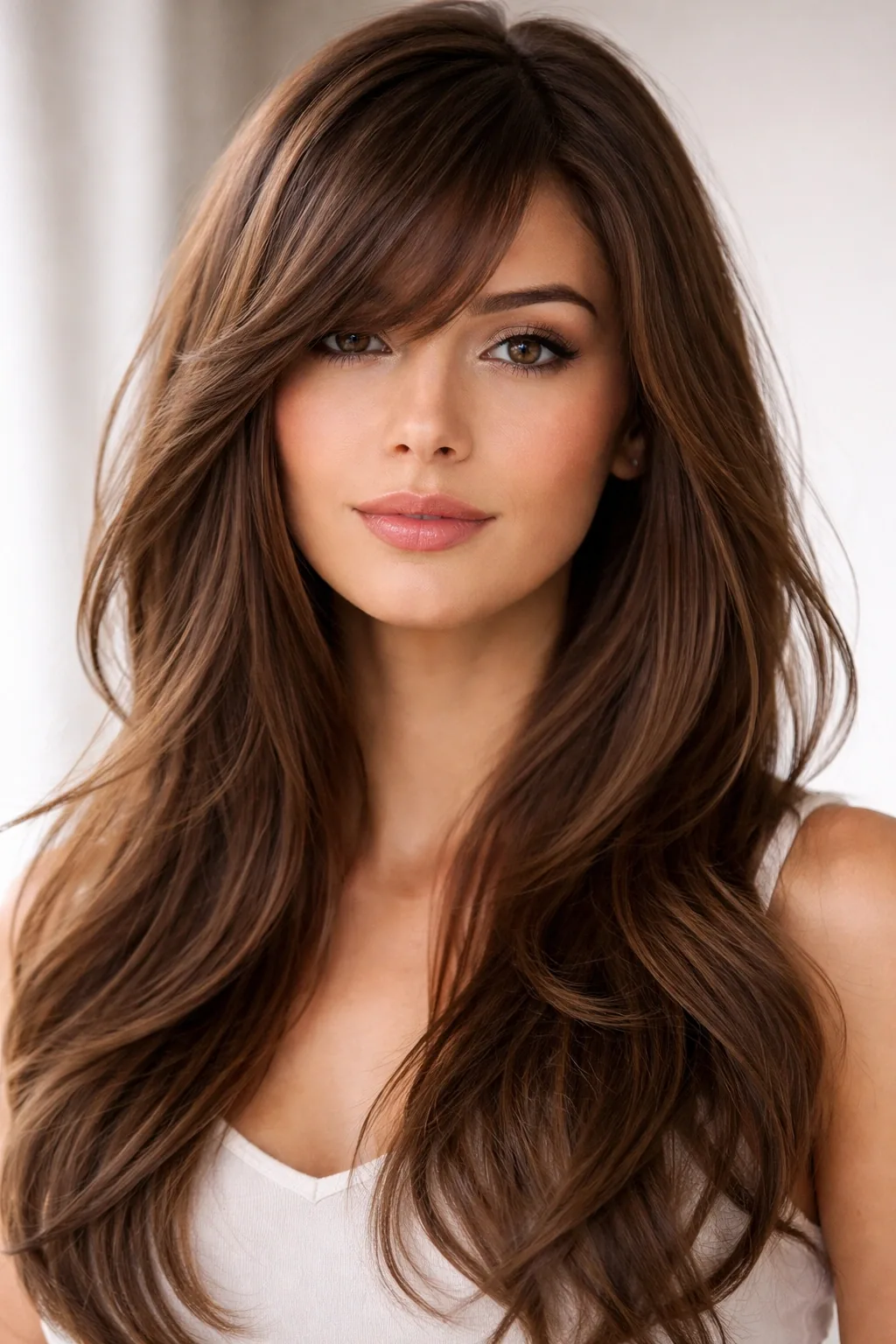
If you love your long hair and do not want to cut it short, side-swept long layers are the answer. The hair stays long, but the front layers are cut to sweep across the forehead from a deep side part, so they fall over the temples and soften the hairline while the length flows down the back. The layers through the lengths add movement and stop the hair from hanging flat and heavy, which is the other problem long, straight hair has on a receding hairline — it drags the eye down and makes the top of the head look sparse. This is the style for women who have always had long hair, who are not ready for a fringe, and who want their hairline softened without giving up a single inch of length.
Best for: long hair, mild temple recession, and women who will not cut a fringe. How to style: part deeply to one side, blow-dry the front layers across the forehead with a round brush, and add a few soft waves through the lengths. What to ask your stylist: for face-framing layers that start at the cheekbones, cut to fall forward over the temples. Time: 15 minutes a day. Quick verdict: keep the length, fix the hairline — the best of both worlds.
14. The Side Part with Root Lift and Volume
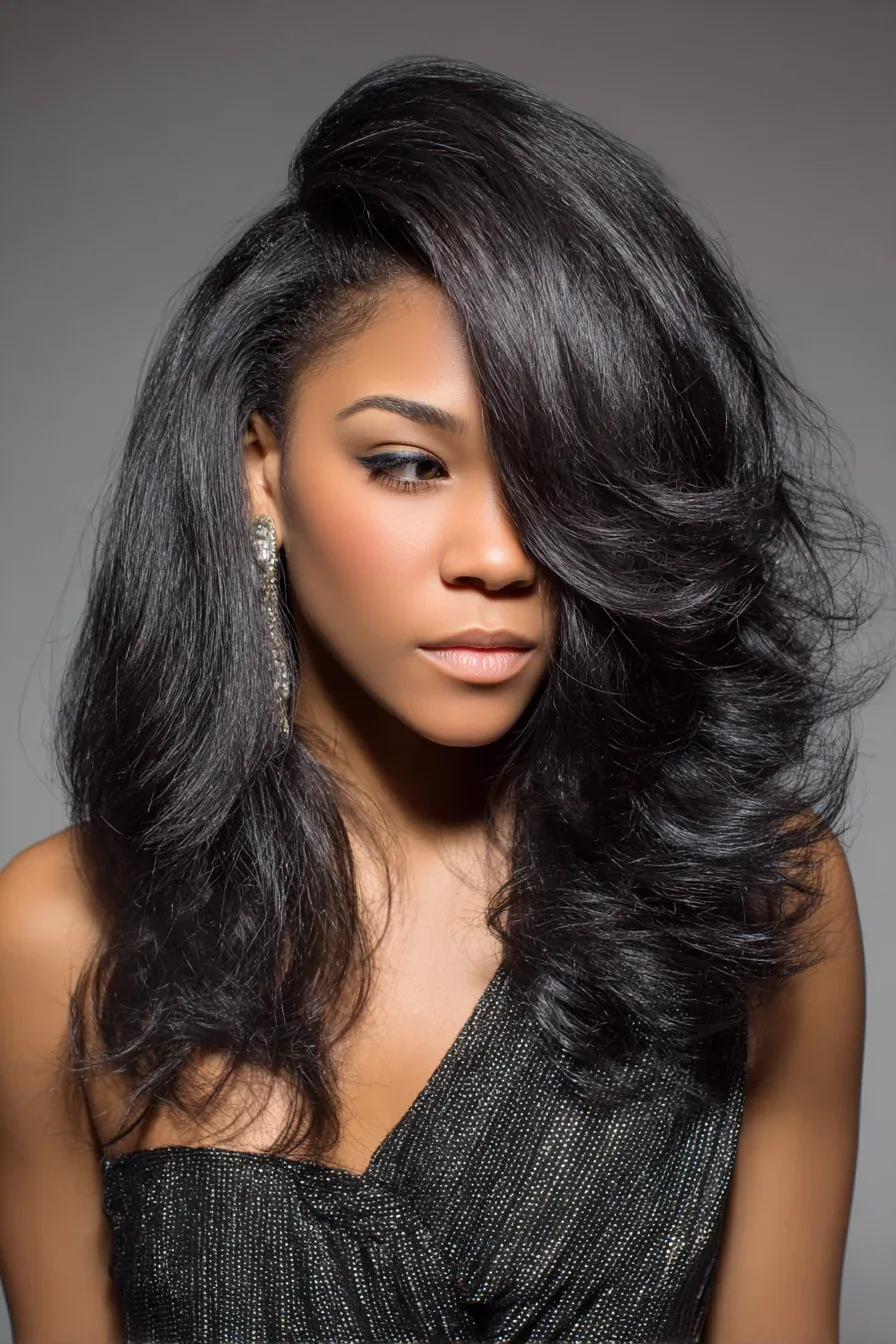
A side part with root lift is a styling technique as much as a haircut, and it is one of the most effective tricks for a receding hairline. The hair is parted to one side, and the roots on the heavy side are blow-dried upward and away from the scalp, so the hair stands up and over the temples instead of lying flat against them. The lift creates the illusion of density — the hair looks thicker because it is standing up rather than lying down — and it gives the whole style a polished, voluminous finish. It works on any length, from a bob to long hair, and it is the technique to ask your stylist to teach you, because once you can do it at home, it transforms every cut you already have.
Pros: works on any length, no cutting required, and an instant visual difference. Cons: it needs a blow-dry, so it takes a few extra minutes each morning. Common mistake: using too much product at the roots, which weighs the lift down — a golf-ball of mousse or a few sprays of root lift is enough. Maintenance: a round brush, a hairdryer, and a light-hold spray. Time: 10 to 15 minutes a day. Quick verdict: the technique, not the cut — learn this blow-dry and your current hairstyle will look better tomorrow.
15. The Layered Bob with Crown Volume
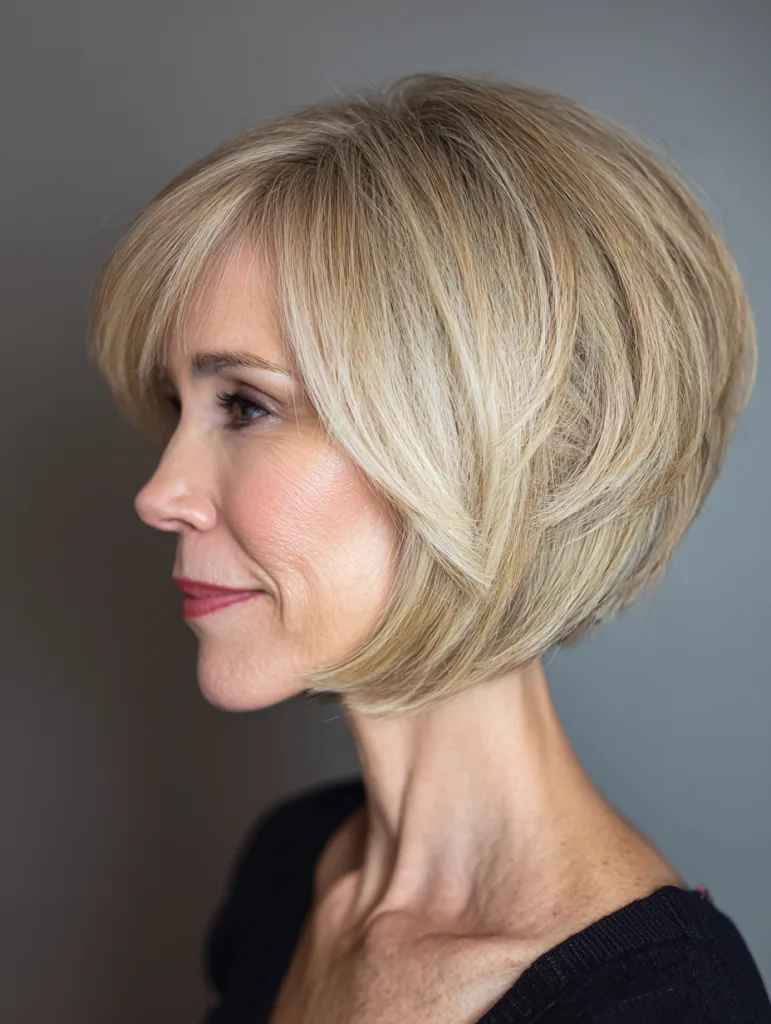
A layered bob with crown volume is built on the third coverage rule: lift the crown, and the eye goes up, not to the hairline. The bob is cut in layers that stack at the back and the crown, so the hair has height and fullness exactly where a receding hairline has made the face look longer. The front is kept soft — a side part, a few face-framing pieces — so the temples are covered too, but the real work is the volume: it rebalances the whole face, it makes the hair look denser, and it gives the style a youthful, bouncy energy that a flat, one-length bob never has. It is the bob for women who want their hair to look like more of it.
Best for: a high hairline, a long-looking forehead, and fine to medium hair. How to style: blow-dry the crown with a round brush, lifting the roots upward, and finish with a texturising spray at the roots. What to ask your stylist: for stacked layers at the crown, a side part, and a bob that hits the jaw or just below. Time: 10 to 15 minutes a day. Quick verdict: volume where it counts — the crown does the work, and the hairline fades into the background.
16. The Shag with Curtain Bangs
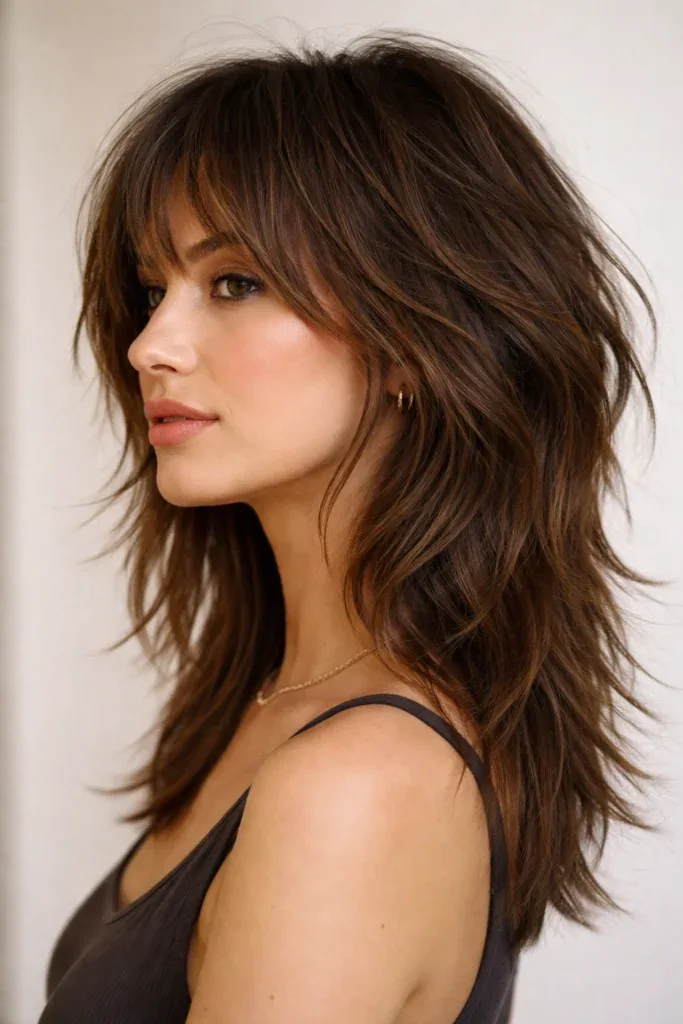
The shag with curtain bangs is the coolest style in this guide, and one of the most effective. The shag is all layers — short at the crown, longer at the sides, with texture through the whole cut — so the hair has volume, movement and a deliberately messy finish that makes it look thicker than it is. The curtain bangs fall across the temples, the layers at the crown give height, and the texture everywhere else distracts from any thinness. It is a style that looks like it took no effort at all, which is exactly the point: the messiness is the camouflage, and it works on straight, wavy and curly hair alike.
Pros: huge volume and texture, excellent coverage, and a style that looks better the messier it gets. Cons: it needs a stylist who understands layers — a bad shag is just a bad haircut. Common mistake: cutting the layers too short at the crown, which can make the top look sparse instead of full. Maintenance: a texturising spray and a rough blow-dry, or air-drying with a little product. Who should avoid it: anyone who wants a neat, polished look, because a shag is deliberately undone. Time: 5 to 10 minutes a day.
17. The Wolf Cut with a Soft Fringe
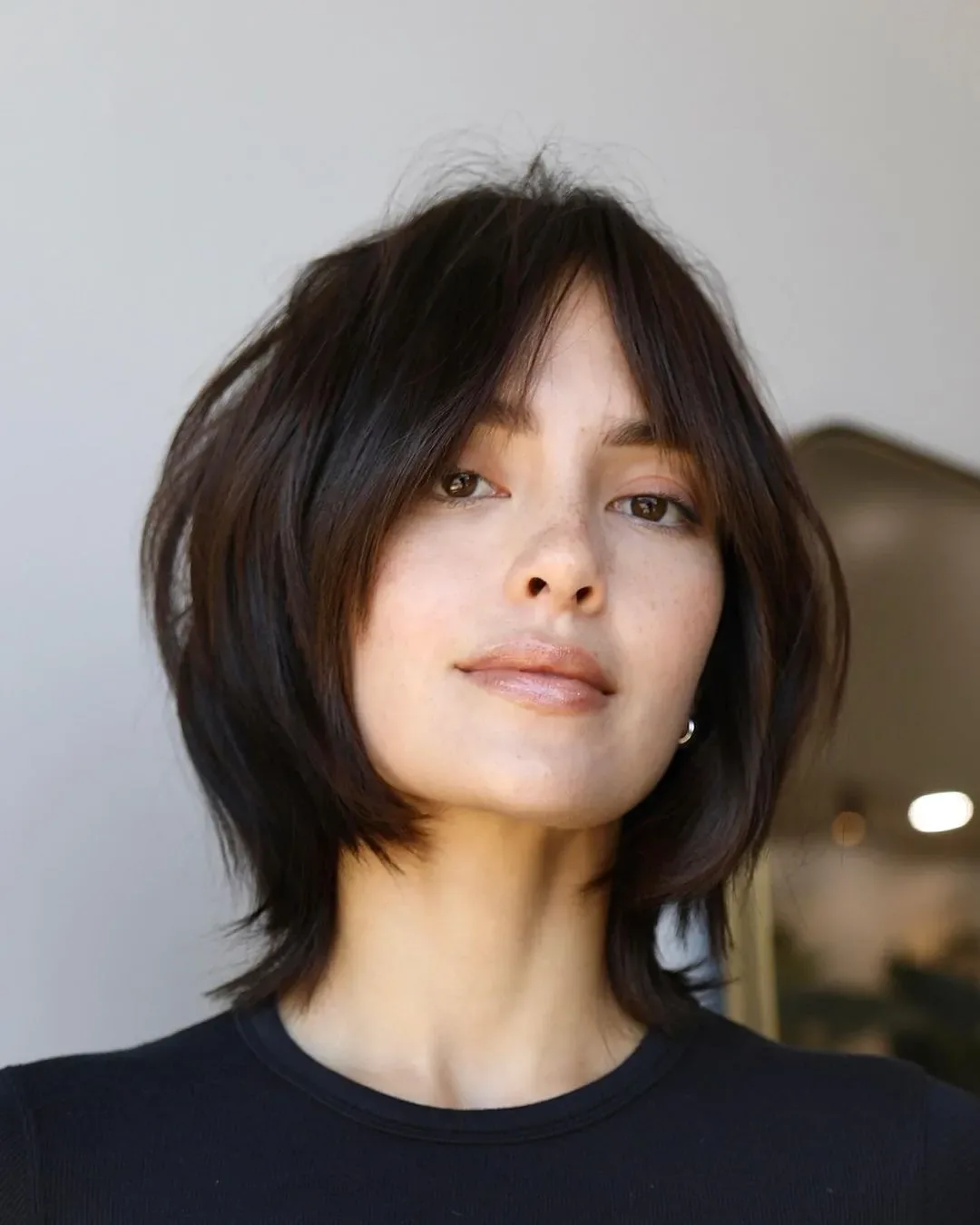
The wolf cut — a shag with a mullet’s attitude, short and choppy at the top and longer at the back — is a bold choice for a receding hairline, and it works because it breaks every rule that makes recession visible. The top is short and textured, so it stands up and covers the hairline rather than lying flat against it; the soft fringe falls across the forehead; and the longer lengths at the back give the style drama and movement. It is a young, edgy cut, and it is not for everyone — but if you like the shag and want something with more edge, the wolf cut is the shag’s wilder sister, and it covers a hairline just as well.
Best for: confident women, thick or wavy hair, and a high hairline. How to style: rough-dry with a texturising spray, and let the fringe fall naturally across the forehead. What to ask your stylist: for a soft fringe, heavy texture at the crown, and longer lengths at the back. Time: 5 minutes a day. Quick verdict: the edgy option — bold, textured, and surprisingly good at hiding a hairline.
18. The Textured Lob with Choppy Ends
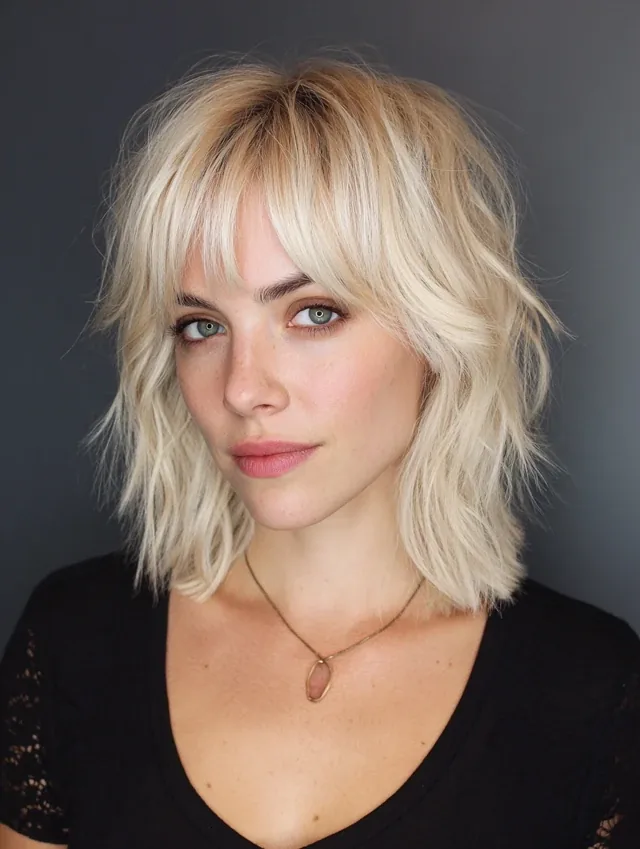
A textured lob with choppy ends is the lob for women who find a classic lob a little too neat. The cut falls to the collarbone, but the ends are point-cut into soft, choppy pieces, and the layers through the lengths are textured rather than smooth — so the whole style has movement, air, and a lived-in feel. On a receding hairline, that texture is doing real work: it creates the illusion of fullness, it stops the hair from lying flat against the scalp, and it gives the eye movement to follow instead of a bare hairline to stare at. Paired with a side part and a few face-framing pieces, it is one of the most flattering medium-length styles there is.
Pros: movement, fullness, and a modern, effortless finish. Cons: it can look messy if the texture is overdone, and it needs a trim every six to eight weeks. Common mistake: over-texturising fine hair, which can make it look thinner instead of fuller — texture should add air, not remove weight. Maintenance: a sea-salt spray or a texturising cream, scrunched through the lengths. Time: 10 minutes a day. Quick verdict: the lob, loosened up — texture that flatters, movement that distracts, and a hairline that stops being the story.
19. The Root-Lift Blowout — Big, Bouncy and Deliberate
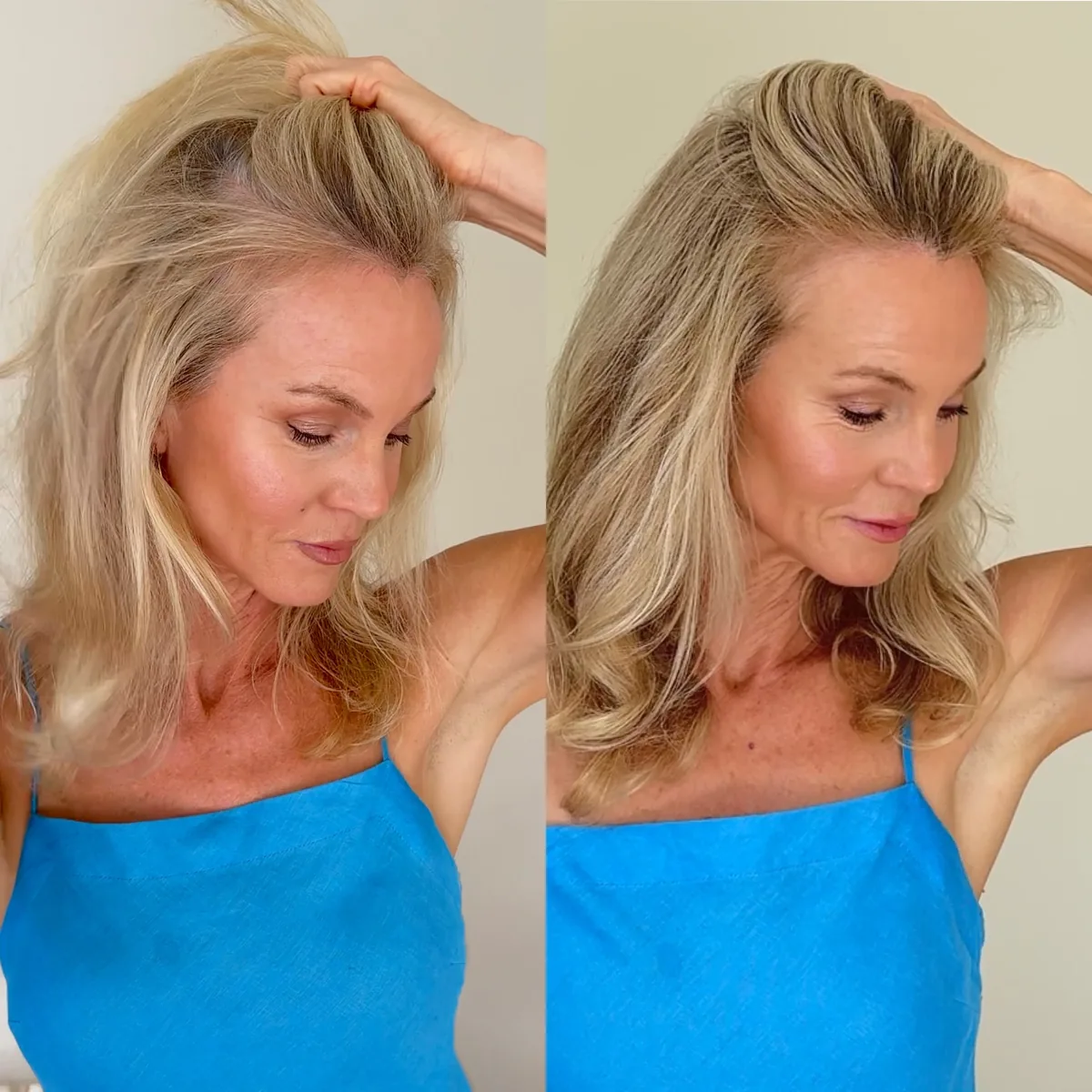
A root-lift blowout is a styling choice rather than a cut, and it is the most glamorous way to handle a receding hairline on medium to long hair. The hair is blow-dried with a large round brush, lifting the roots up and away from the scalp, so the whole style has height, bounce and a polished, salon finish. The volume at the crown shortens the forehead visually, the lift at the temples covers the thinnest spots, and the big, bouncy finish draws the eye to the shape of the hair rather than the line of the hairline. It is the style for a special occasion, a date night, or any day when you want your hair to look like it just left the salon — because, with a little practice, it can.
Best for: medium to long hair, a high hairline, and special occasions. How to style: apply root-lifting spray to damp roots, blow-dry in sections with a large round brush, lifting upward, and finish with a light-hold spray. What to ask your stylist: to show you the blow-dry technique, and for long layers that support the volume. Time: 20 to 30 minutes a day. Quick verdict: the glamour option — it takes time, but the volume is worth every minute.
20. Curly Volume — Let Your Curls Do the Covering
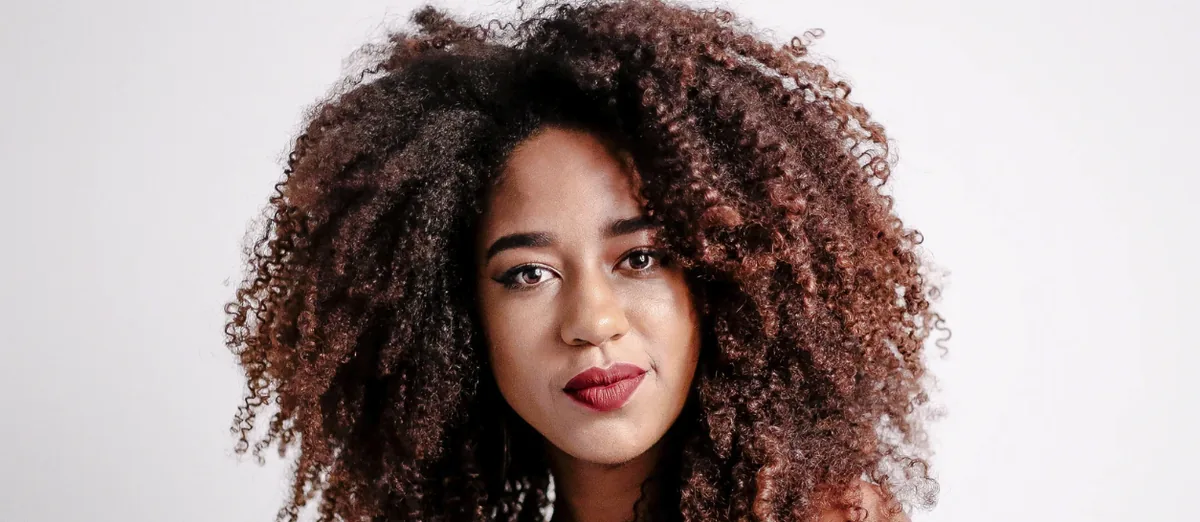
If your hair is naturally curly, you already have the best camouflage there is: curls create volume, texture and fullness all on their own, and they cover a hairline without any extra effort. The trick is to work with the curls rather than fighting them — a curly cut with layers that let the curls spring up at the crown and fall forward at the temples will cover a receding hairline beautifully, while a straightened, flat style will expose it. A curly bob, a curly shag, or long curly layers with a curly fringe are all wonderful choices, and the volume that curls give you for free is the volume that straight hair has to be blow-dried into existence.
Pros: natural volume, natural texture, and a style that covers the hairline without trying. Cons: curly hair needs the right cut — layers cut wrong can make curls spring up too short. Common mistake: blow-drying curls straight, which removes the very volume that was doing the covering. Maintenance: a curl cream or a light gel, diffused or air-dried, and a regular trim to keep the shape. Who should avoid it: nobody with curly hair — this is your advantage, use it. Time: 10 to 15 minutes a day. Quick verdict: the free lunch — if you have curls, let them work for you.
21. The Textured Pixie with a Long Fringe
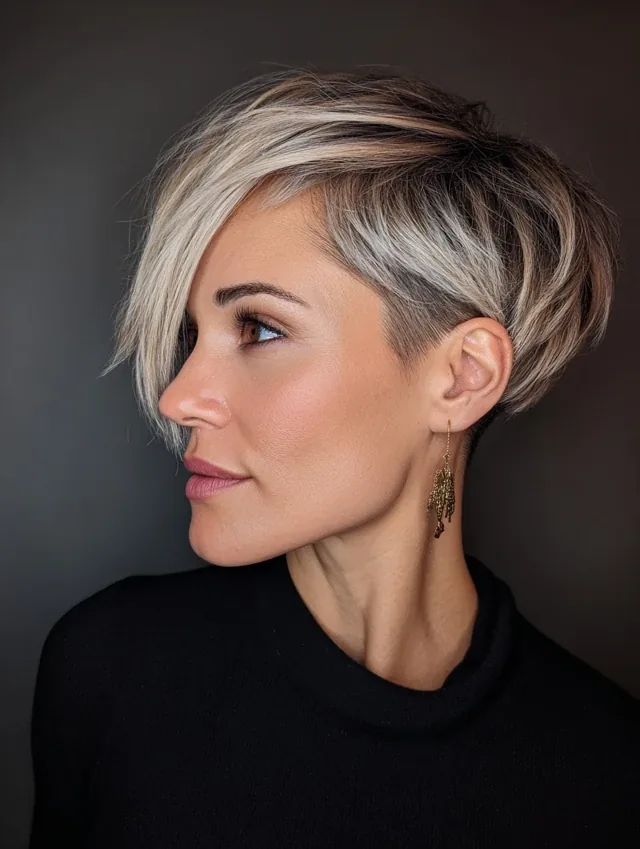
A textured pixie with a long fringe is the short cut that covers the most hairline: the back and sides are kept short and neat, while the top is left long and textured, so it can be swept across the forehead in a soft, piecey fall that covers the temples and the hairline completely. The texture is the key — the top is cut in choppy, separated pieces rather than a solid sheet, so it looks like more hair than it is, and the sweep gives the style movement and direction. It is a confident, chic cut, and it is especially flattering on women with strong features, because the short sides and the sweeping top frame the face beautifully.
Best for: a high hairline, temple recession, and women ready for a short cut. How to style: work a little styling cream or pomade through the top, and sweep it across the forehead with your fingers. What to ask your stylist: for a long, textured top that reaches the eyebrows when swept forward, and short, tapered sides. Time: 5 minutes a day. Quick verdict: the short cut that covers the most — bold, chic, and remarkably flattering.
22. The Choppy Pixie — Short, Piecey and Full of Attitude
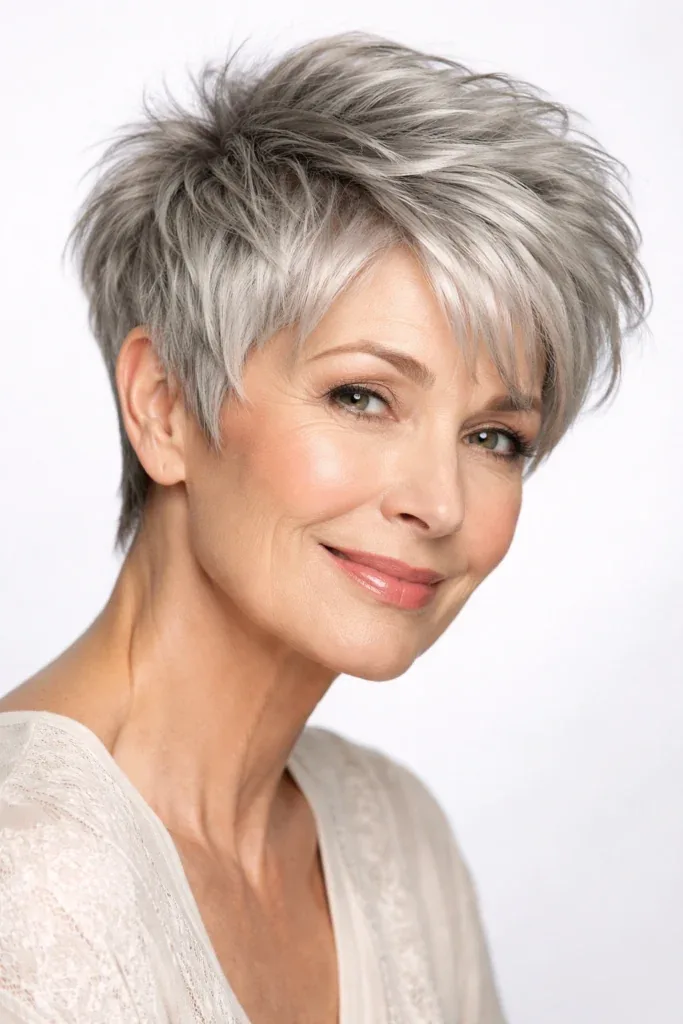
A choppy pixie is cut in short, piecey layers all over, so the whole style has texture, movement and a deliberately undone finish. On a receding hairline, that choppiness is the camouflage: the separated pieces fall in different directions, so the eye reads texture instead of a hairline, and the short, textured top stands up and away from the scalp instead of lying flat against it. It is a low-maintenance, high-attitude cut, and it suits women who want a short style that looks styled without any real styling — a little product, a quick tousle, and you are done.
Pros: very low maintenance, great texture, and a style that looks intentional. Cons: it needs a trim every four to five weeks, and it is not for anyone who wants to keep their length. Common mistake: cutting it too uniform — a choppy pixie needs pieces of different lengths, or it just looks like a short, flat cut. Maintenance: a texturising paste or a styling cream, worked through with your fingers. Time: 3 to 5 minutes a day. Quick verdict: the wash-and-go cover-up — short, choppy, and full of character.
23. The Pixie Bob — the Best of Both Lengths
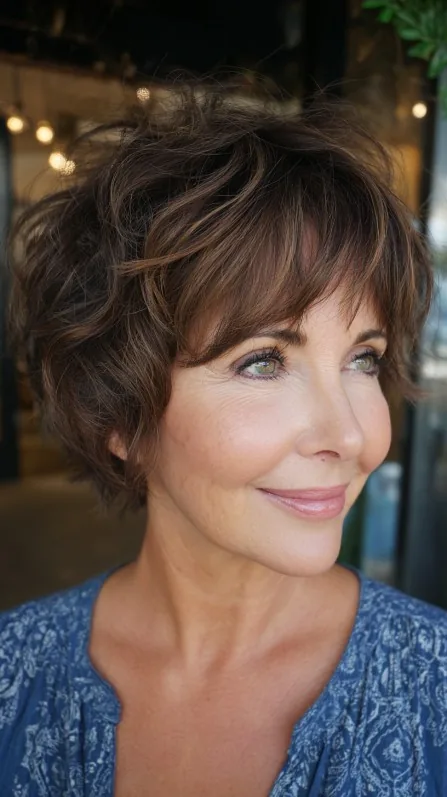
A pixie bob — sometimes called a bixie — is the middle ground between a pixie and a bob: longer than a pixie, shorter than a bob, with a soft, textured finish that flatters almost everyone. The length is the point: it is long enough to sweep across the forehead and cover the temples, and short enough to have volume and lift at the crown, so it uses two coverage rules at once. It is the cut for women who want to go short but are not ready for a full pixie, and for anyone whose hair is thinning, because the shorter length makes the hair look thicker — long, thin hair shows its thinness, while short, textured hair hides it.
Best for: fine hair, a high hairline, and women going short for the first time. How to style: blow-dry with a round brush for volume, or rough-dry with a texturising spray for a messier finish. What to ask your stylist: for a pixie bob that hits the jaw or just above, with a long, textured top. Time: 10 minutes a day. Quick verdict: the gentle way to go short — length where you need it, volume where it counts.
24. The Curly Pixie — Curls That Cover and Lift
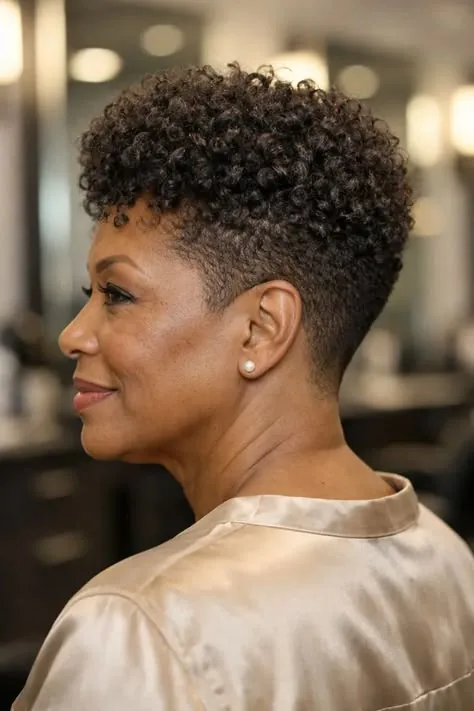
A curly pixie is a gift for women with curly hair and a receding hairline, because the curls do the covering work all on their own. The cut is short at the back and sides, longer and curlier on top, so the curls spring up and forward, covering the temples and the hairline in a soft, textured fall. The volume that curls give you for free is the volume that straight hair has to be styled into existence, and the texture of the curls means the eye never settles on the hairline — it follows the curls instead. It is a joyful, low-maintenance cut, and it looks wonderful on women of every age.
Pros: natural volume, natural coverage, and a style that needs almost no styling. Cons: it needs a stylist who knows how to cut curly hair — never cut curls straight and dry without understanding the spring. Common mistake: cutting the top too short, so the curls spring up above the hairline instead of falling over it. Maintenance: a curl cream, a diffuser or air-drying, and a trim every six weeks. Time: 5 to 10 minutes a day. Quick verdict: curls, but make it a pixie — the easiest coverage in this guide.
25. The Grown-Out Pixie — Soft, Longer and Effortlessly Flattering
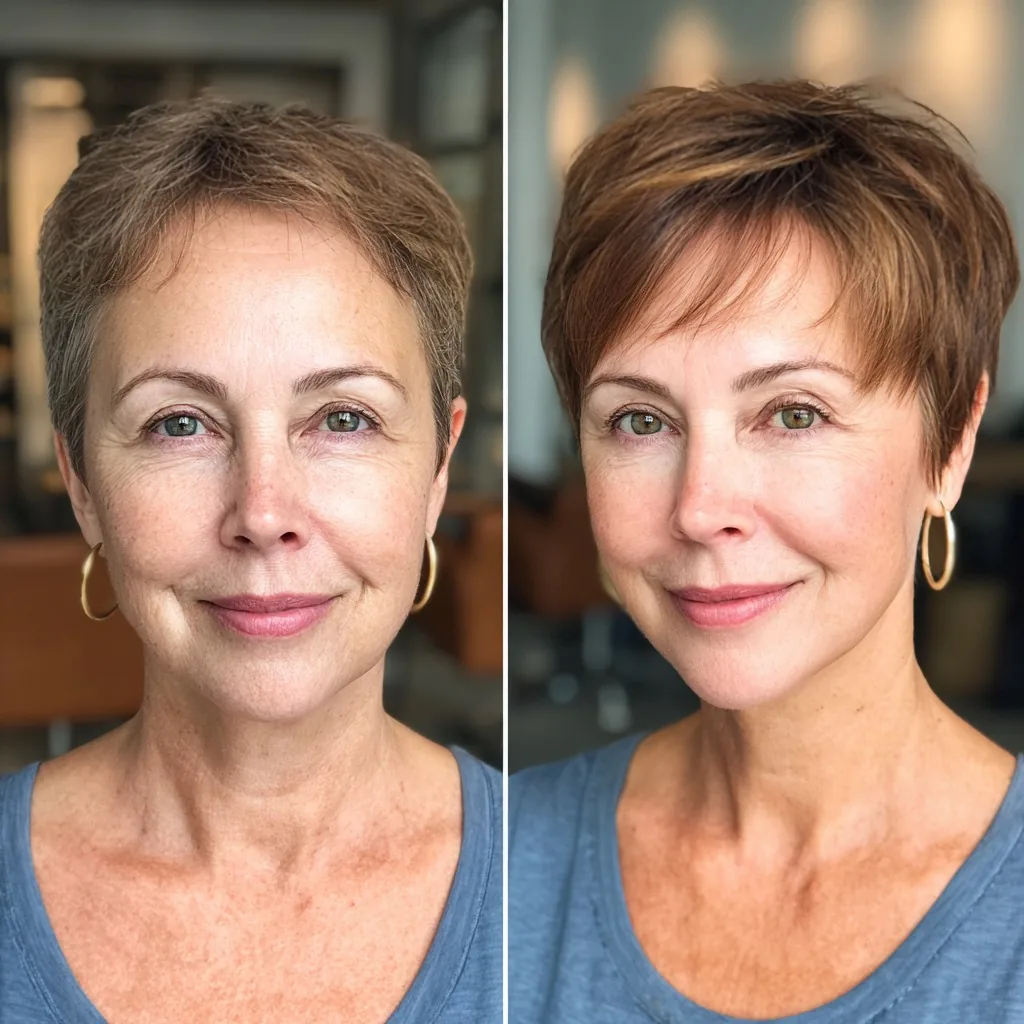
A grown-out pixie is a pixie that has been allowed to grow for a few months, so the top is longer, softer and more versatile — and it is one of the most flattering styles for a receding hairline, because the longer top can be swept, parted, or pushed forward in a dozen different ways. The length gives you options: sweep it to the side to cover a temple, push it forward as a soft fringe, or part it in the middle as a curtain bang. It is the style for women who have had a pixie and are growing it out, and for anyone who wants a short cut with the styling flexibility of a longer one.
Best for: women growing out a pixie, and anyone who wants a short cut with options. How to style: use a little styling cream and sweep the top in the direction that covers your weaker temple. What to ask your stylist: to keep the top long and textured while the back and sides are kept neat, so the grow-out stays intentional. Time: 5 minutes a day. Quick verdict: the pixie, grown up — longer, softer, and more versatile than the day it was cut.
26. The Undercut Pixie with a Sweeping Top
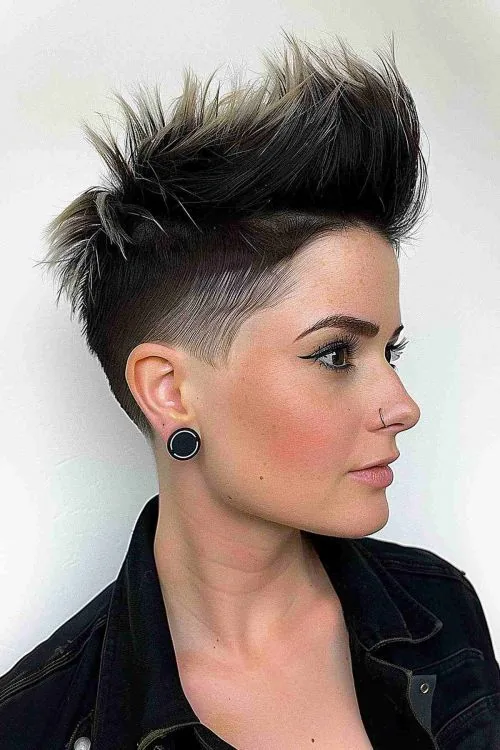
An undercut pixie with a sweeping top is the boldest short cut in this guide: the sides and back are cut very short or shaved, while the top is left long and swept across the forehead in a dramatic, glossy fall. The contrast is striking — the short sides make the long top look even longer and fuller, and the sweep covers the temples and the hairline completely. It is an edgy, fashionable cut, and it is not for everyone, but if you like a statement hairstyle, it is one of the most effective cover-ups there is, because the long, sweeping top is the whole style, and the hairline simply disappears underneath it.
Pros: dramatic coverage, a striking silhouette, and a style that turns heads. Cons: it needs regular trims to keep the undercut sharp, and it is a bold look. Common mistake: cutting the top too short — it needs to reach at least the cheekbones when swept across, or it will not cover the temples. Maintenance: a styling cream or a pomade, and a trim every three to four weeks. Who should avoid it: anyone who wants a subtle, classic look. Time: 5 to 10 minutes a day. Quick verdict: the statement cut — bold, dramatic, and the hairline is the last thing anyone notices.
27. The High Ponytail with a Soft Fringe
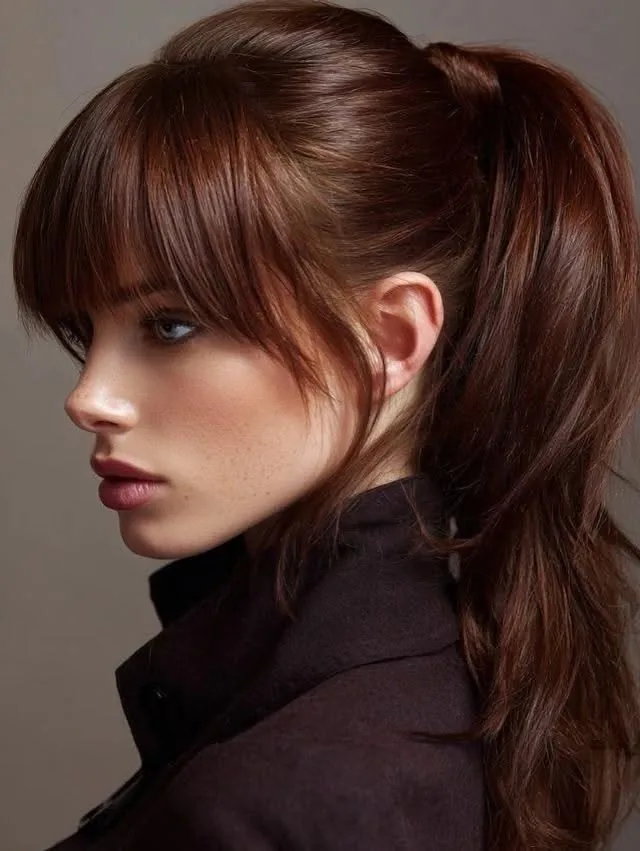
A high ponytail is usually on the avoid list for a receding hairline — but add a soft fringe, and it becomes one of the best updos in this guide. The fringe covers the hairline, the high ponytail draws the eye upward, and the height of the ponytail gives the whole style lift and energy. The key is to keep the ponytail loose rather than scraped back: pull it up with your fingers, not a brush, leave a little softness at the temples, and let the fringe fall naturally across the forehead. The result is a ponytail that looks youthful and polished, not severe — and a hairline that is covered by the fringe, not exposed by the pull.
Best for: a high hairline, temple recession, and anyone who loves a ponytail. How to style: cut or sweep a soft fringe across the forehead, gather the hair loosely at the crown, and wrap a strand of hair around the elastic for a polished finish. What to ask your stylist: for a fringe that works with a ponytail — a curtain bang or a side-swept fringe is ideal. Time: 5 to 10 minutes. Quick verdict: the ponytail, redeemed — a fringe changes everything, and the height does the rest.
28. The Top Knot with Face-Framing Pieces
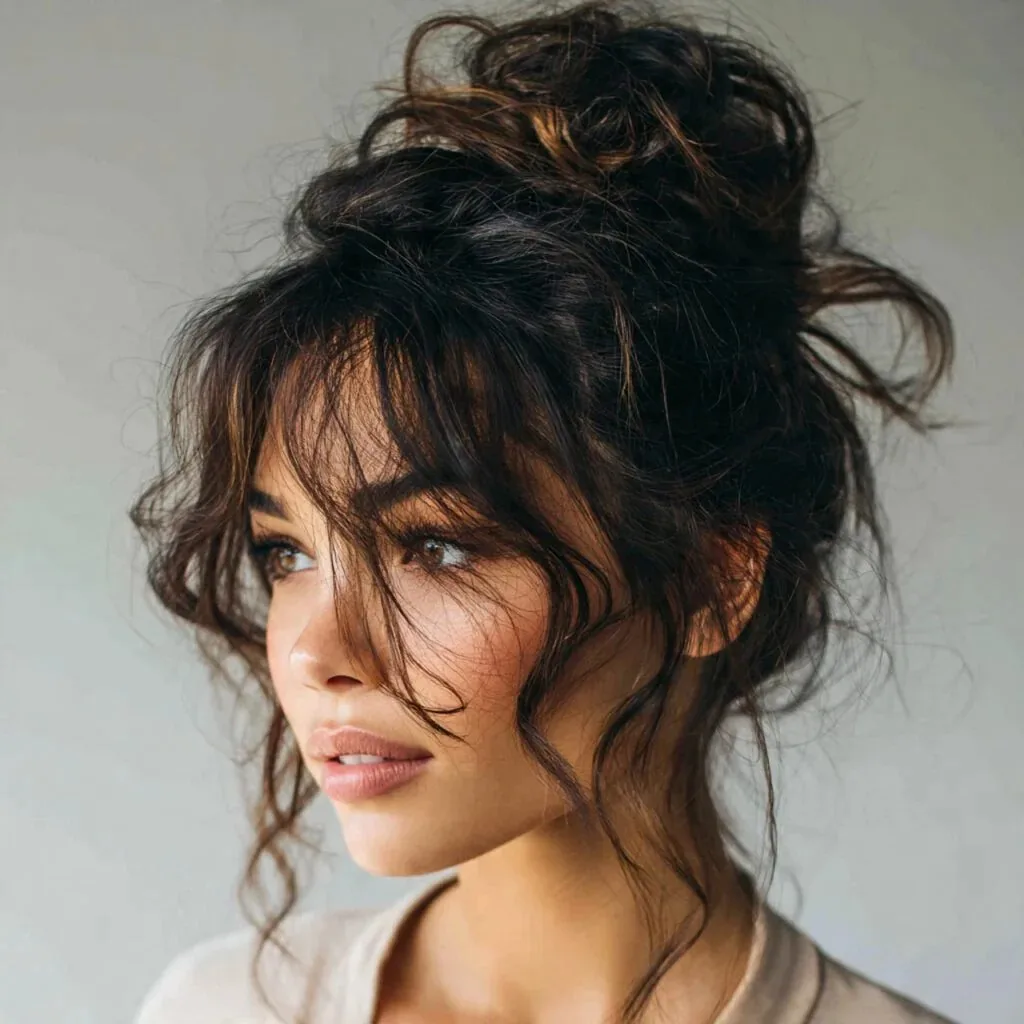
A top knot with face-framing pieces is the updo that does the most covering work: the knot sits high on the head, drawing the eye up and away from the hairline, while two soft pieces are left out at the front to fall across the temples and soften the corners of the forehead. The knot itself adds height, which shortens the forehead visually, and the loose pieces do the job of a fringe without any cutting. It is the updo for a busy day, a workout, or a casual evening — and it is the one to choose when you want your hair up and your hairline covered at the same time.
Pros: fast, practical, and flattering, with height and coverage in one style. Cons: a tight top knot can pull at the hairline, so keep it loose. Common mistake: scraping the hair back too tightly — the knot should be soft, with visible texture at the front. Maintenance: none beyond a few pins and a light spray. Time: 5 minutes. Quick verdict: the five-minute updo that covers and lifts — loose is the whole secret.
29. The Half-Up Style with Crown Volume
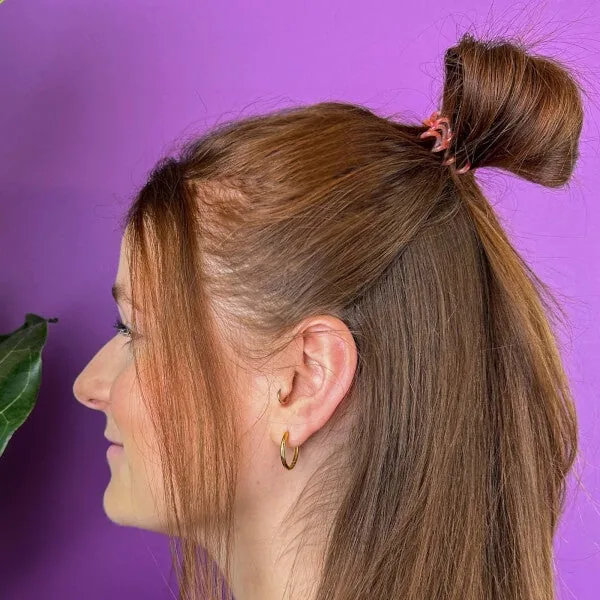
A half-up style with crown volume is the best of both worlds for a receding hairline: the top half is gathered and pinned at the crown, which gives the style height and draws the eye upward, while the rest of the hair falls loose, with face-framing pieces softening the temples. The volume at the crown is doing the work — it rebalances a face that a receding hairline has made look longer, and it makes the hair look fuller — while the loose lengths keep the style soft and romantic. It is the style for a wedding, a date night, or any evening when you want your hair up and down at the same time.
Best for: medium to long hair, a high hairline, and special occasions. How to style: backcomb the crown lightly, gather the top section and pin it at the crown, and leave two soft pieces out at the front. What to ask your stylist: for a half-up style with volume at the crown, not a flat, scraped-back one. Time: 15 minutes. Quick verdict: up and down, covered and lifted — the half-up does it all.
30. The Messy Bun with Curtain Bangs
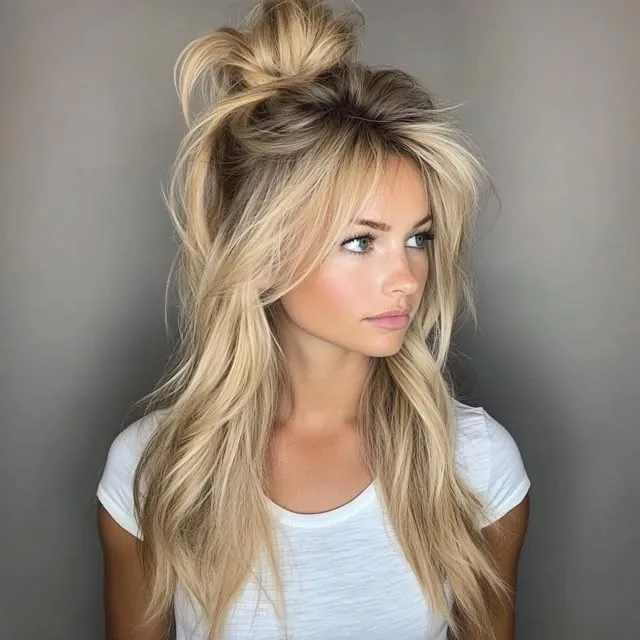
A messy bun with curtain bangs is the everyday updo that covers a receding hairline without trying. The bun sits loosely at the back or the top of the head, the curtain bangs fall across the temples, and a few loose pieces soften the whole look — so the hairline is covered by the bangs, the eye is drawn to the height of the bun, and the messiness makes the whole thing look effortless. It is the updo for a school run, a coffee, a work-from-home day, or any ordinary day when you want your hair up and your face open, and it takes about two minutes.
Pros: fast, comfortable, and flattering, with the bangs doing the covering. Cons: a messy bun can look too casual for a formal event. Common mistake: pulling the bun too tight, which exposes the hairline and defeats the purpose — keep it loose, and let the bangs do their job. Maintenance: none; if a piece falls out, tuck it back in. Time: 2 to 5 minutes. Quick verdict: the everyday updo — two minutes, one bun, and the hairline is covered.
31. The Braided Crown That Frames the Face
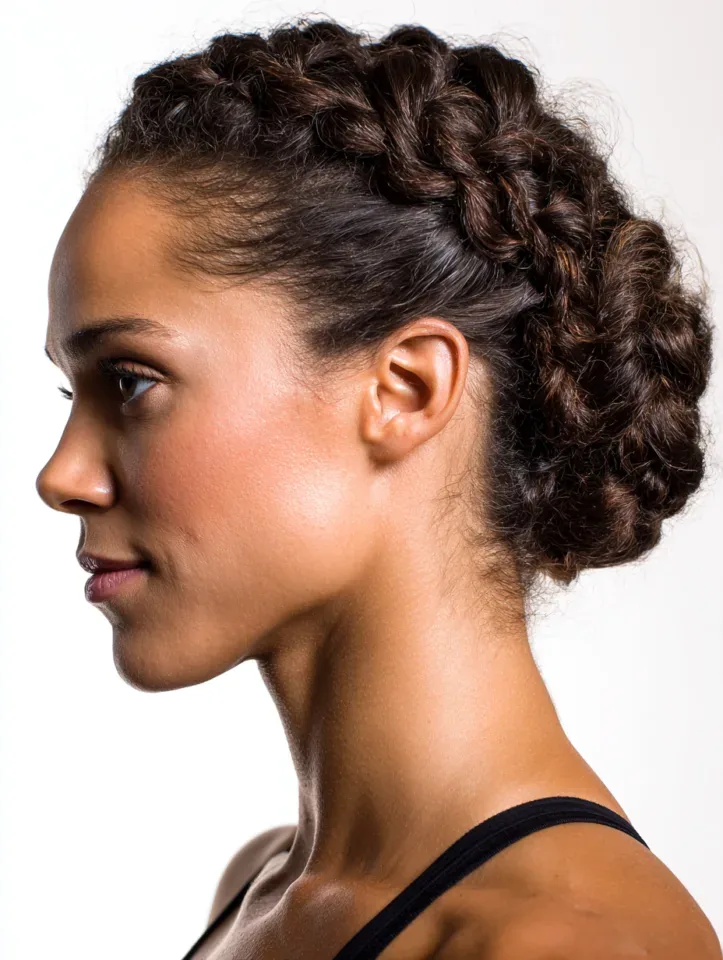
A braided crown — a braid worked around the head like a halo — is a beautiful updo for a receding hairline, because the braid itself sits exactly where the hairline is, framing the face with texture instead of exposing the hairline. The braid covers the temples, the hair is gathered up and away from the neck, and the whole style has a romantic, almost regal quality that suits weddings, festivals and summer evenings. It works best on medium to long hair, and it is a wonderful style for women who love braids but want an updo rather than a braid worn down.
Best for: long hair, weddings, and a high or uneven hairline. How to style: braid the front section loosely from one side to the other, pin it across the crown, and gather the rest of the hair into a low bun or a soft twist. What to ask your stylist: for a loose, soft braid, pulled apart slightly for fullness, that sits along the hairline. Time: 20 to 30 minutes. Quick verdict: the romantic cover-up — a braid that frames the face and hides the hairline in the same motion.
32. The Low Bun with a Deep Side Sweep
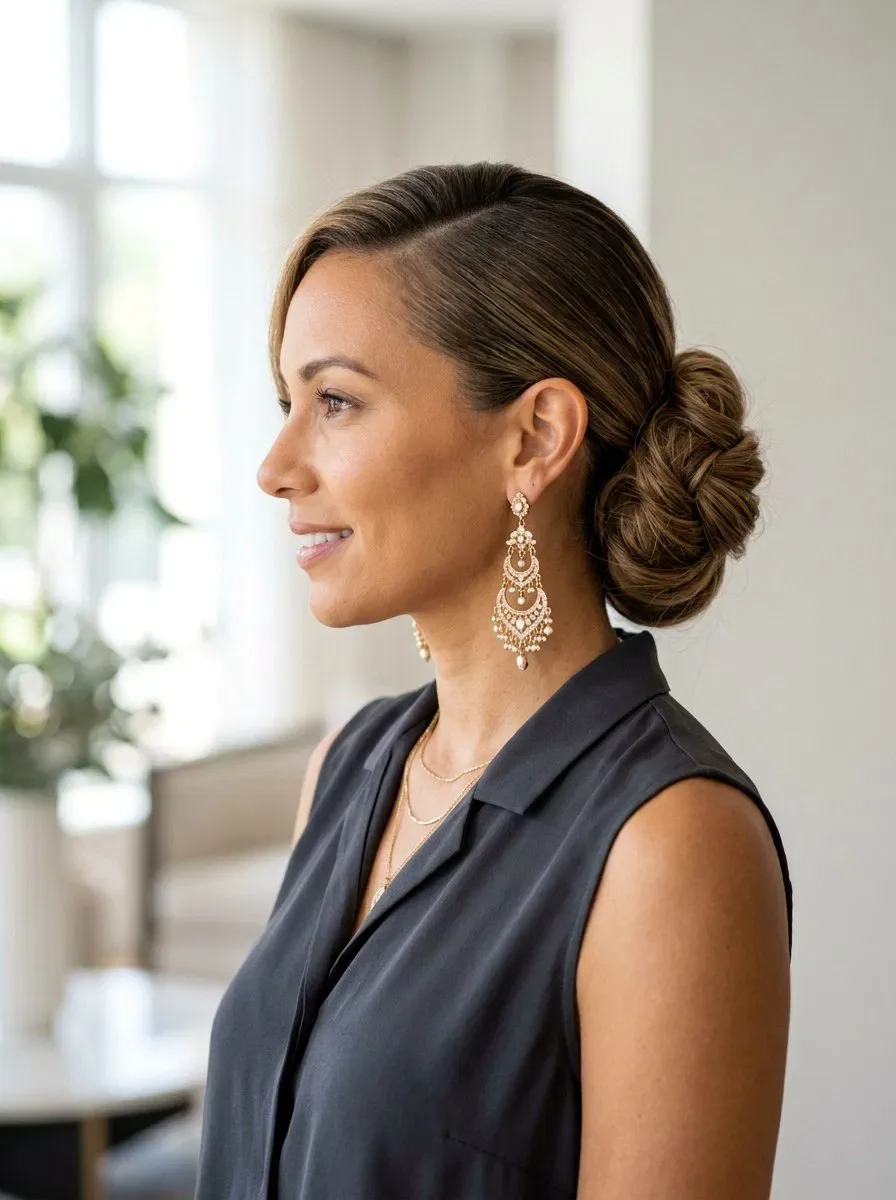
A low bun with a deep side sweep is the most elegant updo in this guide, and one of the most effective. The hair is parted deeply to one side, swept across the forehead in a heavy, glossy fall that covers the thinner temple, and then gathered into a low, soft bun at the nape. The sweep does the covering, the bun does the elegance, and the whole style has a polished, old-Hollywood quality that suits a wedding, a formal dinner, or any evening when you want to look like you made an effort. It is also a comfortable updo to wear all day, because the weight of the hair sits low and the pins are not pulling at the crown.
Pros: elegant, comfortable, and excellent coverage from the side sweep. Cons: it takes a little time to get the sweep right, and it needs a few pins to hold. Common mistake: parting the hair in the centre, which exposes both temples — the deep side part is the whole point. Maintenance: a light spray and a check of the sweep once during the evening. Time: 15 to 20 minutes. Quick verdict: the elegant updo — a sweep, a bun, and a hairline that is nowhere to be seen.
33. The Soft Updo with Loose Tendrils
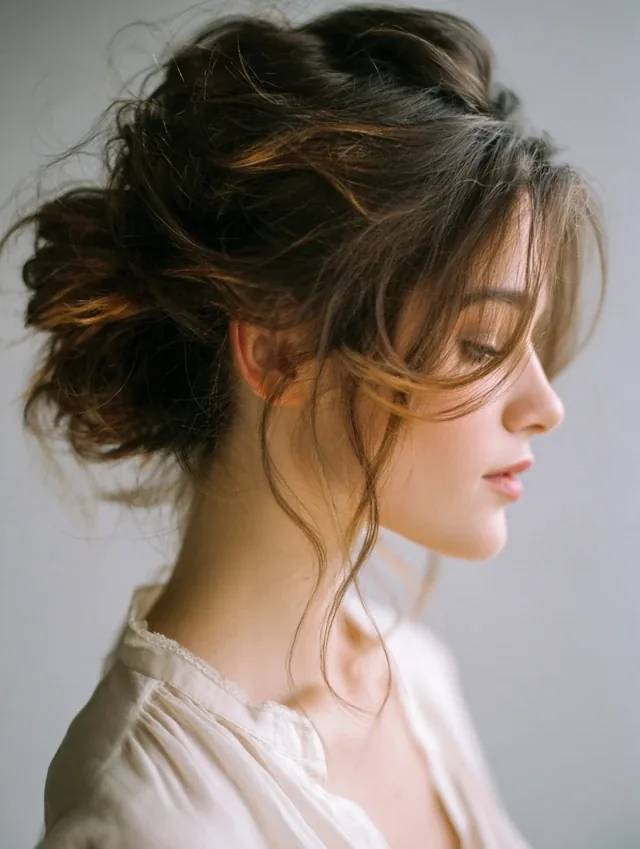
A soft updo with loose tendrils is the most romantic style in this guide, and the most forgiving. The hair is gathered loosely — into a low bun, a soft twist, or a relaxed knot — and several tendrils are left out around the face, falling softly across the temples and the cheekbones. The tendrils do the covering work, the loose updo gives the style height and softness, and the overall effect is effortless and romantic rather than severe. It is the updo for a wedding, a date night, or any evening when you want to look beautiful without looking like you tried too hard — and it is the style that flatters almost every face, because the tendrils soften everything they touch.
Best for: weddings, romantic occasions, and anyone who finds tight updos harsh. How to style: gather the hair loosely, pin it into a soft bun or twist, and pull out a few tendrils at the temples and the nape — then curl them lightly. What to ask your stylist: for a soft, loose updo with tendrils left out, not a scraped-back one. Time: 20 minutes. Quick verdict: the romantic finish — loose, soft, and flattering, and the tendrils cover the temples while they are at it.
What is the best hairstyle for a woman with a receding hairline?
The best hairstyle for a woman with a receding hairline is one that uses fringe, a side part or crown volume to soften the hairline — curtain bangs, a side-swept fringe, a deep side part bob, or a textured pixie are all excellent choices. The right one depends on your hairline pattern: side-swept styles cover temple recession, curtain bangs suit a widow’s peak, and volume at the crown flatters a high hairline. A good stylist can help you choose based on your hair type and face shape.
Do bangs help hide a receding hairline?
Yes, bangs are the fastest and most effective way to soften a receding hairline, because they cover the hairline directly. Curtain bangs, a wispy fringe, a side-swept fringe or bottleneck bangs all work well, and the best versions are light and piecey rather than heavy and blunt. A fringe cut dry, starting long at the cheekbones, is the lowest-risk way to try one — and it grows out gracefully into face-framing layers.
What hairstyles should women with a receding hairline avoid?
Women with a receding hairline should avoid tight, slicked-back ponytails and buns, which expose the hairline and pull at fragile hairs, as well as a centre part with flat, straight, one-length hair, which puts a wide parting and thin temples on display at the same time. Very long, very straight hair with no layers also makes the top of the head look flat and sparse. Loose, soft versions of these styles — with a fringe, a side part or some volume — work far better.
Can a receding hairline in women grow back?
A receding hairline in women can sometimes improve if the cause is treatable — for example, iron deficiency, thyroid problems, stress, or tight hairstyles causing traction alopecia — but genetic and hormonal recession usually does not reverse on its own. Treatments such as topical minoxidil can slow further loss and sometimes regrow fine hair, and they work best when started early. If your hairline is receding quickly, see a doctor or dermatologist to find the cause before choosing a treatment.
Is a pixie cut good for a receding hairline?
Yes, a pixie cut can be excellent for a receding hairline, especially a textured pixie with a long fringe that sweeps across the forehead and covers the temples. The short length makes hair look thicker, the texture creates the illusion of density, and the sweeping top does the job of a fringe without being cut as one. A pixie bob or a grown-out pixie offers the same benefits with a little more length and styling flexibility.
Does a side part help a receding hairline?
Yes, a side part helps a receding hairline because it moves the hair over the thinner temple, covering the spot that has receded most. A deep side part works best — part the hair two or three inches off centre, on the side with the fuller temple, so the heavy side sweeps across the forehead. Pairing a side part with a side-swept fringe or face-framing layers gives even more coverage.
How can I make my hairline look fuller without a haircut?
To make a hairline look fuller without a haircut, use a root-lifting spray or volumising mousse and blow-dry the roots upward, try hair fibres on thinning temples or a wide parting, and use a root touch-up powder or spray in your shade for special occasions. A slightly zigzagged part hides a wide parting better than a straight one, and a root shadow — a slightly darker shade at the roots — reduces the contrast between hair and scalp so the scalp shows less.
What is the best haircut for a high hairline in women?
The best haircut for a high hairline in women is one that shortens the forehead visually — a soft fringe or curtain bangs, volume at the crown, or a short textured cut such as a pixie bob or a layered bob with crown volume. These styles all draw the eye upward or cover the top of the forehead, so the hairline stops being the first thing anyone notices. Avoid long, flat, centre-parted styles, which make a high forehead look even longer.
Can tight hairstyles cause a receding hairline?
Yes, tight hairstyles can cause a receding hairline — a condition called traction alopecia — when the same spot is pulled repeatedly over months or years. Tight ponytails, buns, braids and extensions attached close to the hairline are the usual culprits, and the hairline at the temples is usually affected first. The good news is that traction alopecia is often reversible if the pulling stops early, so switch to loose styles, vary your part, and give your hairline regular days off from any tension.
When should I see a doctor about a receding hairline?
See a doctor or dermatologist about a receding hairline if it started suddenly, is patchy rather than gradual, comes with itching, soreness or scaling on the scalp, or is paired with other changes such as irregular periods, acne, fatigue or weight changes. A doctor can check for iron deficiency, thyroid problems and vitamin D, and can discuss treatments such as topical minoxidil. Early treatment works best, so do not wait for the recession to become severe before getting it checked.
Conclusion
A receding hairline is not a reason to hide your hair, and it is certainly not a reason to stop enjoying it. It is a change in the hair you have, and like any change, it asks for a cut that fits the hair you have now — a fringe that softens the forehead, a part that covers the temple, volume that lifts the crown, or a short, textured cut that makes a higher hairline look like a choice. The thirty-three styles in this guide are not disguises. They are good haircuts, chosen for the way they flatter a face, and the fact that they also soften a hairline is simply what a good haircut does.
Start with the easiest change: a curtain bang, a deeper side part, or a blow-dry with a little root lift, and see how it feels for two weeks. Then, if you want more, talk to your stylist — bring photos of your own hairline, tell them plainly what bothers you, and let them help you choose. And if the recession came on suddenly, or it came with other changes in your body, see a doctor first. A haircut is the fastest fix there is, and it is a wonderful one — but the best version of it is the one you choose with all the information in hand.