Elegant at 80 and Beyond: 31 Hairstyles That Are Easy, Flattering and Full of Life
At 80 and beyond, a good hairstyle is not about looking younger — it is about looking like yourself, on a good day, with as little fuss as possible. The best cuts at this age do three quiet jobs at once: they are light on the head, easy to wash and style at home, and flattering to the face you have now, silver hair and all. A short bob that falls into place after a towel-dry, a soft pixie that needs no pinning, a gentle perm that gives thin hair some body — these are the styles that earn their place, not because they hide age, but because they suit real life.
This guide gathers 31 hairstyles for women over 80, organised the way you would actually choose one: first the wash-and-go cuts that ask almost nothing of you, then soft perms and curls, silver and white styles that make grey hair glow, short bobs and pixies, gentle updos that never pull, styles that sit happily with glasses, and finally low-maintenance colour that grows out gracefully. Eight short guides cover the practical side — how hair changes after 80, how to add volume to fine hair without harsh teasing, how to keep silver bright, and what to ask for at the salon. Every style notes how much upkeep it needs, how comfortable it feels, and who it suits best, so you can pick one that fits your hair, your hands, and your week.
What Changes About Hair After 80 — and What Stays the Same

Hair keeps changing throughout life, and by 80 the changes are usually easy to spot: most hair is finer and thinner than it was at 50, it may grow more slowly, and the colour has often settled into silver, white, or a soft salt-and-pepper. The texture changes too — hair can feel drier, a little wirier, or softer and more flyaway, sometimes all in the same head. None of this is a problem to fix. It is simply the material a good cut works with, and the best styles at this age are the ones designed for finer, lighter hair rather than fighting it.
What stays the same matters just as much. Your face shape, your natural parting, whether your hair has a wave or a kink — those are still yours, and a cut that respects them will always look better than one that ignores them. Thinner hair also has an advantage people forget: it is light, it dries fast, and it holds a soft curl or a gentle wave with very little effort. The styles in this guide are built around those strengths, not around pretending the hair is still thick. And if a style you loved at 60 still makes you smile, keep it — the only rule that matters is that the cut suits the hair you have today.
Choosing a Cut That Is Easy to Live With
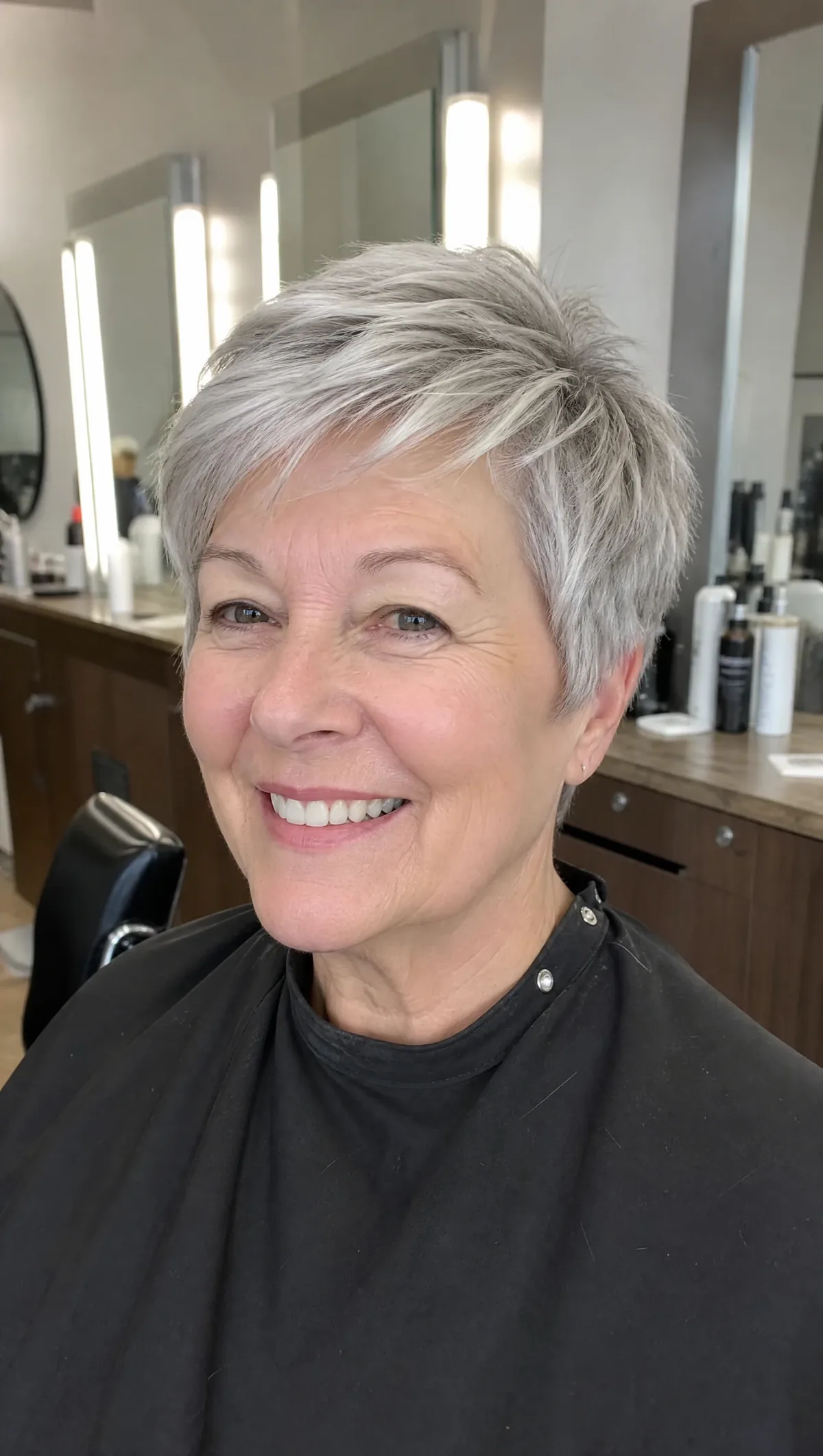
The most important question about any hairstyle after 80 is not how it looks in the salon chair — it is how it looks on a Tuesday morning, styled by you, in ten minutes, with the tools you actually own. A good everyday cut should fall back into shape after a wash with little more than a towel, a brush, and perhaps a dab of styling cream. If a style needs a round brush, a hot iron, and twenty minutes every morning, it will spend most of its life looking untidy, however beautiful it was on day one.
When you talk to your stylist, ask three practical questions: how long will this take me to style at home, how often will I need to come back to keep the shape, and will it still look tidy when it grows out a little? Short and medium cuts usually win on all three counts, because they grow out more gracefully and take less time to wash and dry. Weight matters too — long, heavy hair can pull at the scalp and tire the neck, while a lighter cut feels comfortable all day. Comfort is not a compromise; it is part of what makes a hairstyle good.
Working with Thinner, Finer Hair
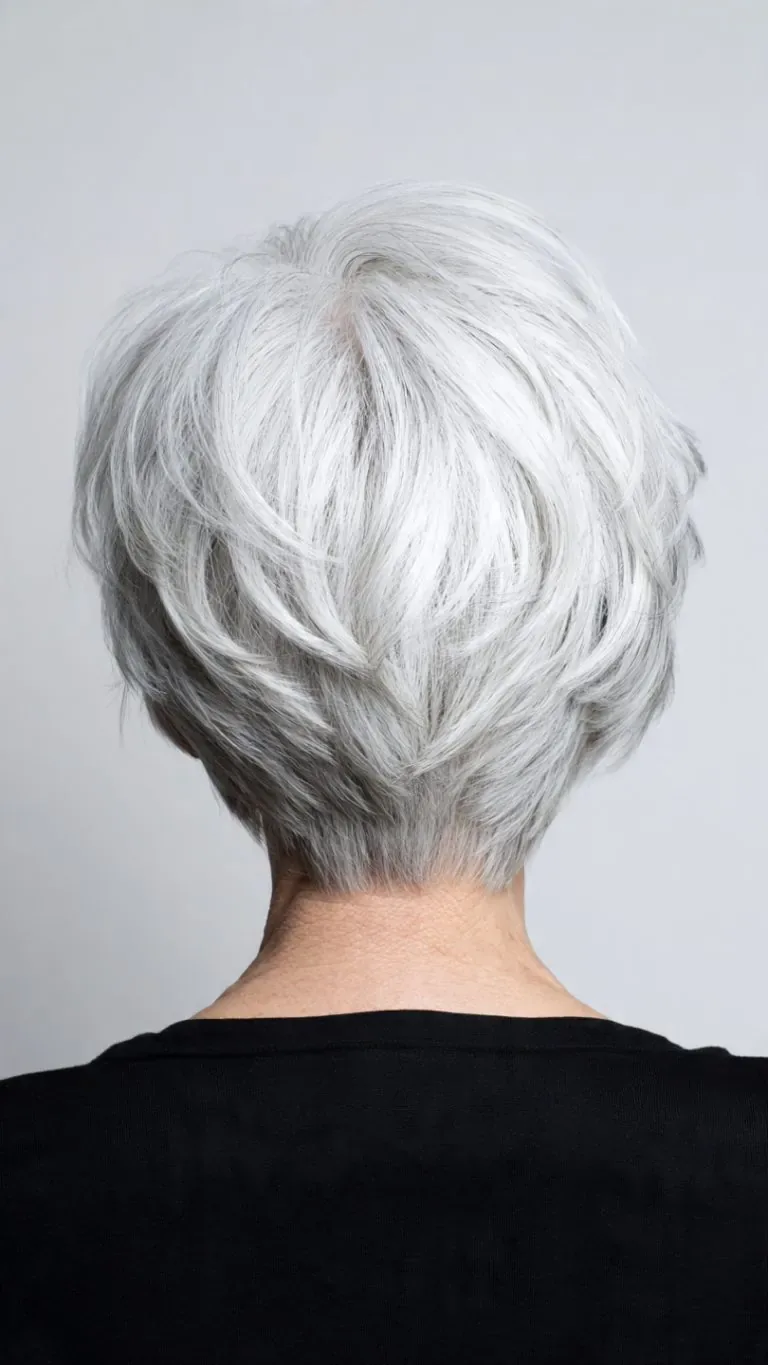
Thin, fine hair is the most common hair type after 80, and it responds best to a light touch. The goal is soft volume — hair that looks fuller without being teased into a stiff helmet. Short layers are the simplest way to get there: they remove weight from the ends so the hair lifts at the roots instead of lying flat. A side part helps too, because it creates natural lift on the heavier side, and a little texturising spray or a light mousse, worked through damp hair, gives fine strands something to hold on to.
What to avoid is just as important. Heavy conditioners and thick styling creams can weigh fine hair down, and over-brushing can flatten the very lift you are trying to create. Backcombing, if you use it at all, should be gentle and only at the crown — hard teasing damages fine hair and is difficult to brush out. A soft perm is another honest option for fine hair: it adds body through the whole head so the style holds its shape between washes. The common mistake is cutting thin hair too long in the hope that length will make it look fuller — it usually does the opposite, pulling the hair flat. Shorter, with layers, almost always looks fuller.
Silver, White and Grey: Keeping the Colour Bright
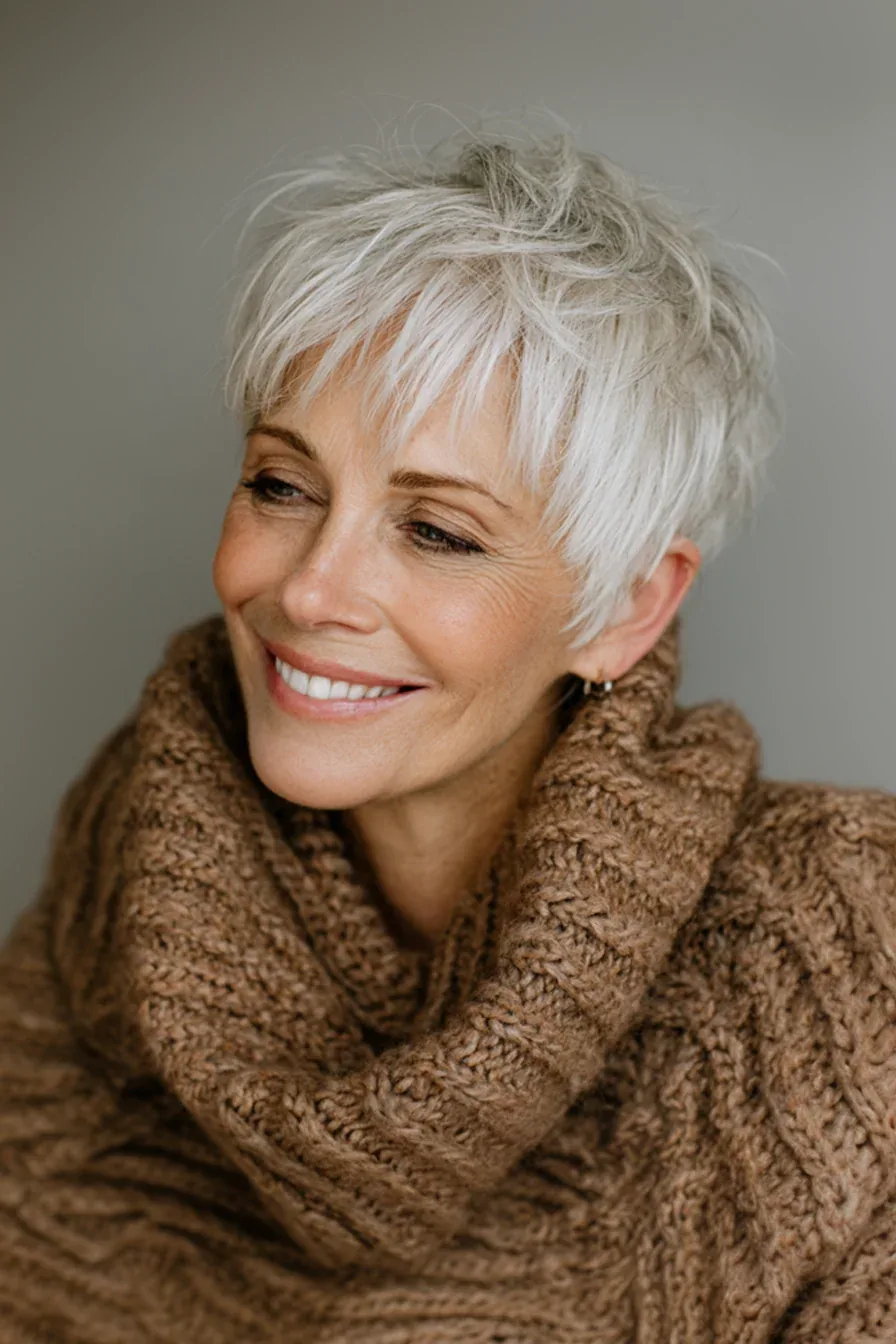
Silver and white hair can be strikingly beautiful — and it can also turn dull or yellowish if it is not looked after. The yellowing usually comes from the sun, from heat styling, or from minerals in tap water, and it builds up slowly enough that you may not notice it until someone takes a photograph. The simplest fix is a purple or silver shampoo used once a week: it neutralises the yellow tones and leaves the silver bright and clean. Use it sparingly, though — used too often, it can leave a faint lilac tint.
A good cut helps the colour too. Blunt ends can make silver hair look heavy and dull, while soft layers let the light through and show off the different tones in the hair — white at the front, silver at the sides, a little grey still mixed in. If your hair has yellowed badly, ask your stylist about a gentle toner at the salon; it takes ten minutes and washes out gradually. And keep the sun in mind: a hat on a bright day protects silver hair just as it protects skin. Bright silver is not about expensive products — it is a weekly shampoo, a good cut, and a little shade.
Glasses, Hearing Aids and Hair: Making Them All Sit Happily Together

Many women over 80 wear glasses, and some wear hearing aids, and a hairstyle that ignores them will fight you every day. The main trouble spots are the same: hair that falls over the arms of your glasses, tucking that pushes a hearing aid out of place, and bulk behind the ears that makes both feel crowded. The fix is usually simple — a cut that is shorter and neater around the ears, with soft layers that sit above the glasses frame rather than across it.
Tell your stylist about your glasses and hearing aids before the cut starts, and wear your glasses to the appointment so the length can be checked against the frames. A side part or a soft sweep across the forehead often works better than a straight fringe, which can compete with the top of the frames. Behind the ears, ask for the hair to be tapered rather than bulky, so there is room for the arms of the glasses and the hearing aid to sit flat. Small adjustments like these make the difference between a style that looks good in the mirror and one that feels good all day long.
A Simple Wash-and-Go Weekly Routine

A wash-and-go routine is the backbone of most of the styles in this guide, and it does not need to be complicated. Wash two or three times a week with a gentle shampoo — daily washing is rarely necessary and can dry out older hair. Use a light conditioner only on the ends, rinse well, and towel-dry gently rather than rubbing hard, which tangles fine hair. While the hair is still damp, work a pea-sized amount of light mousse or styling cream through it with your fingers, then let it dry naturally or use a hairdryer on a low, warm setting.
Once dry, a quick brush-through and a fingertip tidy is usually enough. Keep a small spray bottle of water by the mirror: a light mist in the morning revives a style that has flattened overnight, without a full wash. Set aside one longer session a week — a wash, a gentle comb-through, and a check of the shape in the back with a hand mirror — and the style will hold its own between salon visits. The whole routine takes ten minutes on a wash day and two minutes on the other days. That is the point: a hairstyle should fit your week, not run it.
At the Salon: What to Ask, How Often, and What It Costs

A salon visit after 80 should be comfortable and unhurried, and a good stylist will welcome the questions. Before the cut, say how you style your hair at home and how much time you want to spend on it — that one sentence saves more disappointment than any photograph. Bring a picture if you have one, but also say what you do not want: no heavy pinning, nothing that needs daily heat styling, nothing that pulls. Ask how often the cut needs a trim to keep its shape — most short cuts need a tidy-up every five to seven weeks — and ask the price before the scissors come out, including any colour or perm, so there are no surprises.
If standing for a long time is tiring, ask for a chair with arms and a break halfway through; most salons are happy to offer one. If the salon is noisy or rushed, it may be worth finding a quieter one, or booking the first appointment of the day when things are calmer. Some stylists offer home visits for clients who find travel difficult — it is always worth asking. And remember that you are the customer: if a style does not feel right when you get home, a good salon will adjust it for free within a week. Say so, politely, and give them the chance.
When a Style Stops Working: Signs It Is Time for a Change
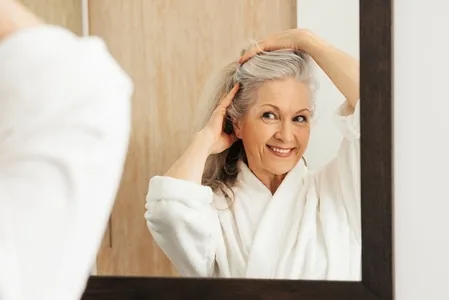
Every hairstyle has a season, and the signs that yours has ended are usually gentle rather than dramatic. The style takes longer and longer to look right in the morning, the ends look thin or straggly no matter how you brush them, or the shape collapses by lunchtime even though it held all day a year ago. Sometimes the hair itself has changed — it has thinned further, gone whiter, or lost the wave that used to hold a style up — and the cut has not changed with it. None of this means you did anything wrong; it means the hair has moved on and the cut should too.
A change does not have to be a big one. Shortening a bob by an inch, adding a soft layer, or switching from a side part to a sweep can be enough to make the same style work again. If you are unsure, ask your stylist for a small change first and see how it feels for a month. The other sign worth listening to is your own feeling: if you catch your reflection and think the style looks tired, or if you have stopped enjoying the morning routine, that is reason enough to try something new. The styles in this guide are a good place to start — pick one that sounds easy, and give it a try.
1. The Classic Short Silver Bob

The classic short silver bob is the style most women picture when they think of elegant hair at 80: a neat, chin-length cut with a soft curve under, worn in bright silver or white, that frames the face without hiding it. The ends sit just below the ear or at the jaw, the shape is clean and simple, and the silver does the decorating — no colour, no fuss, just a good cut and a healthy shine. It suits almost every face shape, it works with glasses, and it looks as good with a cardigan as it does with a dress for a family lunch.
Best for: women who want one reliable style that always looks tidy. How to style: towel-dry, work a little light mousse through damp hair, and blow-dry with a brush, turning the ends under — or simply let it dry naturally for a softer finish. What to ask your stylist: for a chin-length bob with a soft under-curve, and for the back to be shaped so it does not stick out. Maintenance: a trim every five to six weeks keeps the shape. Quick verdict: the dependable classic — simple, flattering, and always appropriate.
2. A Soft Layered Pixie
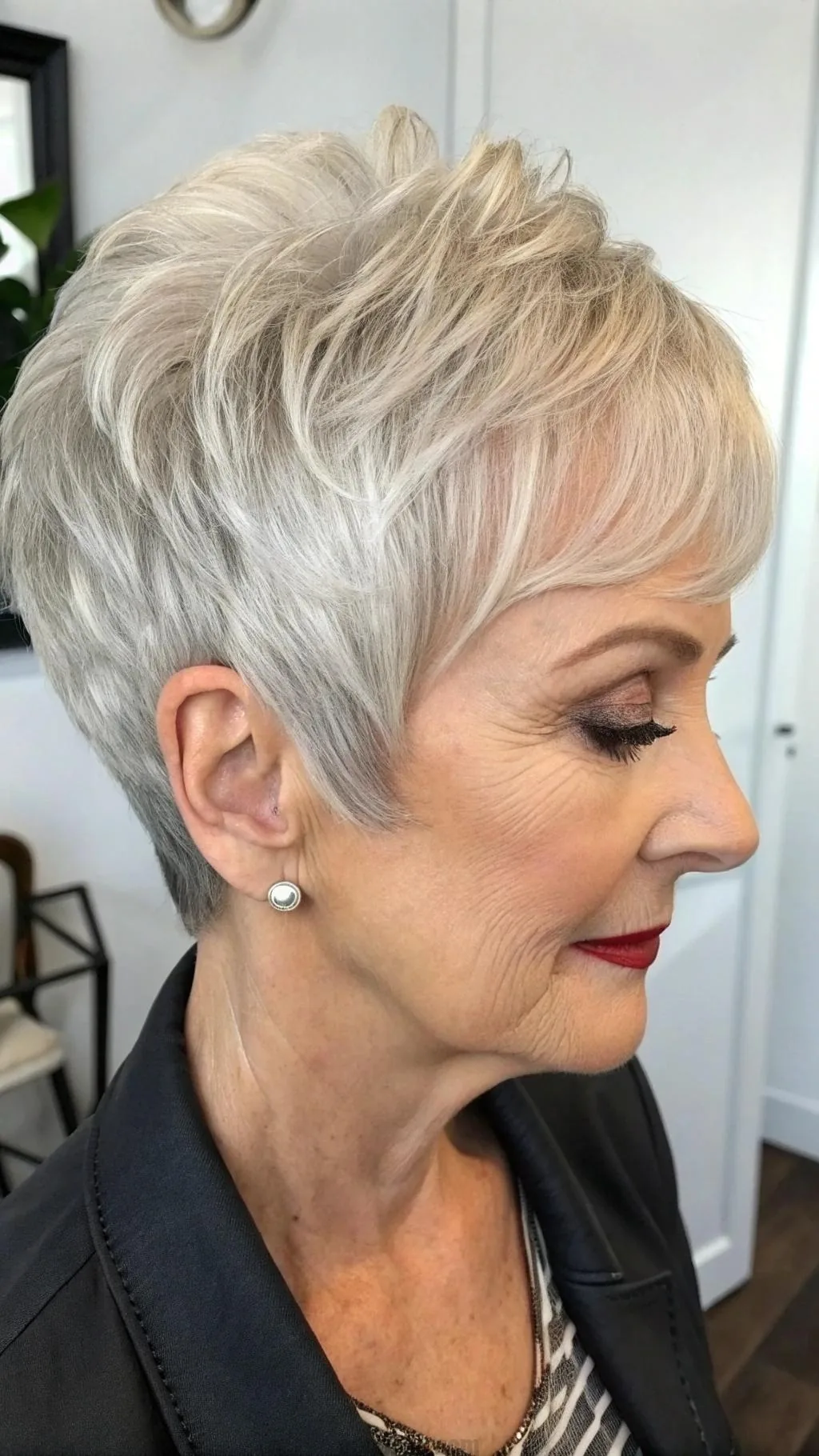
A soft layered pixie is the lightest cut in this guide, and for many women over 80 it is the most freeing. The hair is cut short all over, with soft layers on top that give it movement, and the whole style weighs almost nothing — no pulling, no pinning, no heavy hair to manage. It dries in minutes, it needs no brushwork to look finished, and it shows off earrings, a necklace, or a good pair of glasses beautifully. The softness is the point: this is not a severe, spiky pixie, but a gentle one with rounded edges and a feminine shape.
Quick verdict: if you want the easiest hair of your life, start here. Maintenance is minimal — a wash, a little styling cream, and a finger-comb is enough most days. The cut grows out gracefully too, because the layers blend as they lengthen. Comfort notes: nothing pulls, nothing pins, and there is no weight on the neck. Who should avoid it: anyone who loves the feeling of longer hair around the face, or who is not ready for a very short cut — try a short bob first, and move to the pixie when you are sure.
3. The Wash-and-Go Crop
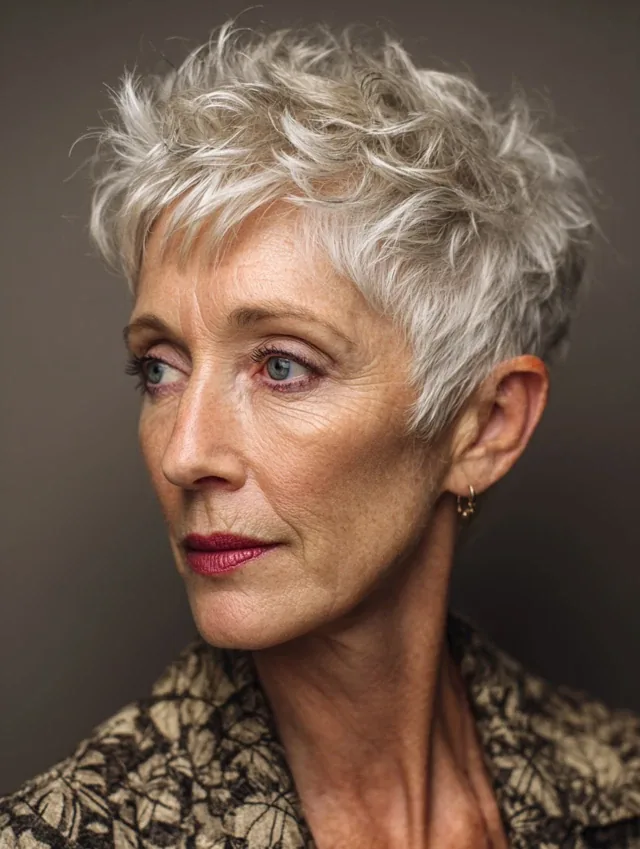
The wash-and-go crop is exactly what it sounds like: a short, even cut that you wash, towel-dry, and leave alone. There is no blow-drying, no round brush, and no styling product beyond a drop of cream if the ends feel dry. It is the style for women who have better things to do than spend half an hour on their hair, and for anyone whose hands or shoulders make brushwork tiring. The cut is usually kept a little longer on top than at the sides, so it still has a shape, but the shape is in the cut, not in the styling.
Pros: the fastest morning routine of any style here, and the cheapest to maintain. Cons: it is a plain style, so it relies on a good cut and healthy, bright hair to look its best — a dull crop can look unfinished. Common mistake: cutting it too short all over, which can look severe; keep a little length on top for softness. Maintenance: a trim every four to five weeks, and a weekly purple shampoo if the silver starts to yellow. Quick verdict: the honest, no-fuss choice — wash it, dry it, and get on with your day.
4. A Feathered Short Cut
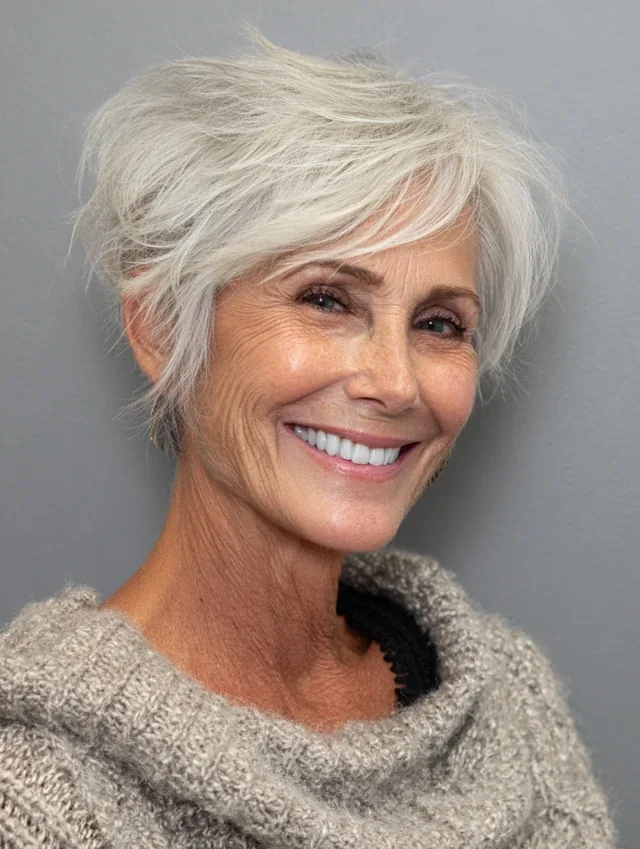
A feathered short cut takes the wash-and-go crop and adds softness: the ends are cut in fine, feathered layers that fall lightly around the face and the ears, instead of sitting in one blunt line. The feathering makes thin hair look fuller, because the layered ends catch the light and move when you do, and it softens the outline of the face in a way a blunt cut cannot. It is a gentle, feminine style that has been popular for decades for a good reason — it flatters without demanding attention, and it suits women who like their hair to look soft rather than sharp.
Best for: fine or thin hair that needs the illusion of fullness. How to style: a little mousse on damp hair, a quick blow-dry with your fingers, and a brush-through — the feathered ends will fall into place on their own. What to ask your stylist: for feathered ends around the face and ears, and for the top to be kept light rather than heavy. Maintenance: a trim every five to six weeks. Who should avoid it: anyone with very curly hair, where feathering can make the ends frizz — a blunt short cut holds curls better.
5. A Chin-Length Bob with Soft Layers

A chin-length bob with soft layers is the middle ground between a short crop and longer hair: it is long enough to feel like a bob, short enough to be easy, and the layers give it movement that a one-length bob lacks. The layers also take weight out of the ends, which helps thin hair lift at the roots instead of lying flat, and they make the style more forgiving as it grows out — a layered bob still looks intentional two weeks after a trim, where a blunt bob starts to look heavy. It is a good choice for women who are shortening their hair gradually rather than all at once.
Best for: women moving from longer hair to short, and anyone who wants a bob with movement. How to style: blow-dry with a round brush for a smooth finish, or let it dry naturally and tuck one side behind the ear. What to ask your stylist: for layers through the ends only, keeping the length at the chin, and for a soft side part. Maintenance: a trim every six weeks, and a light conditioner on the ends only. Quick verdict: the gentle step down in length — familiar, flattering, and easy to live with.
6. A Gentle Perm for Soft Curls
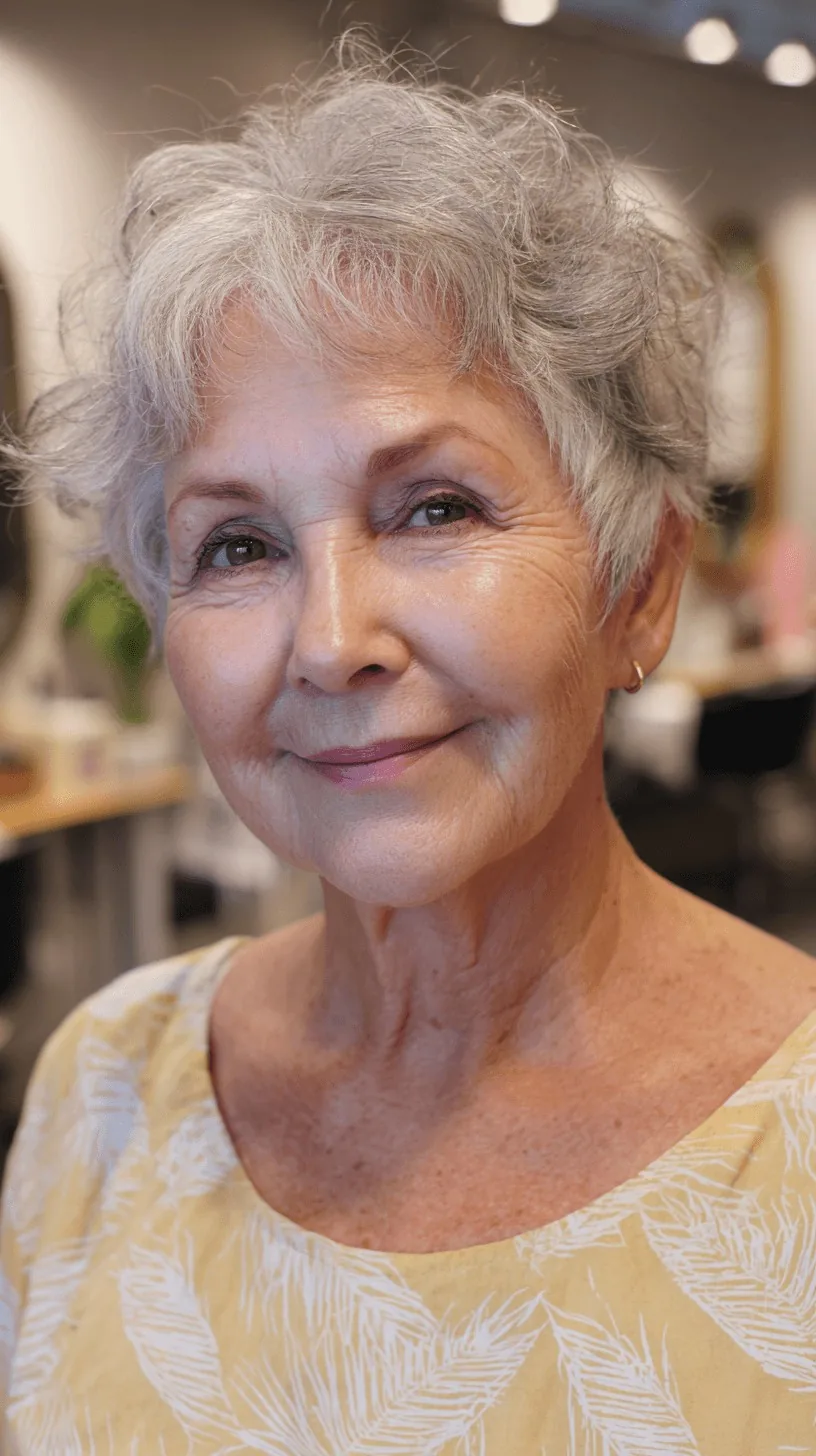
A gentle perm is the oldest trick in the book for thin hair, and it still works: a soft, modern perm adds body and curl through the whole head, so the hair holds its shape between washes and needs very little styling. The modern version is nothing like the tight, frizzy perms of decades ago — the curls are large and loose, the solution is gentler, and the result looks like natural wavy hair rather than a chemical treatment. For women whose hair has gone straight and flat with age, a perm can feel like getting their hair back.
Pros: lasting body, very little daily styling, and a style that holds for months. Cons: a perm is a chemical treatment, so it needs a patch test first, and it can dry the hair if it is done too often. Common mistake: asking for tight curls — large, soft rollers give a far more natural result. Maintenance: a perm every three to four months, a moisturising conditioner, and no heat styling on top of it. Who should avoid it: anyone with very fragile or damaged hair, or a sensitive scalp — ask your stylist honestly, and take their advice.
7. A Short Curly Crop

A short curly crop is the natural companion to a gentle perm, or the right cut if your hair still has its own curl. The hair is kept short and shaped so the curls sit in a neat, rounded silhouette, with the length on top just long enough for the curls to form. It is a joyful style — the curls give it life and movement, and it looks good from every angle without any effort. It also suits women who have always had curly hair and are tired of fighting it straight; at 80, letting the curls do what they want is a perfectly good plan.
Best for: naturally curly hair, or hair with a fresh soft perm. How to style: scrunch a little curl cream through damp hair and let it dry naturally — a diffuser on a low setting helps on cold days. What to ask your stylist: for the curls to be cut dry, or at least shaped with the curl pattern in mind, so the shape holds as it dries. Maintenance: a trim every six weeks, and a weekly deep condition to keep the curls soft. Comfort notes: light, cool, and nothing to pin.
8. Loose Silver Waves
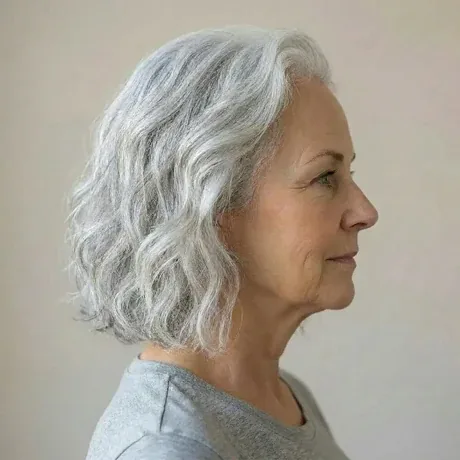
Loose silver waves are for women who still have a little length and a natural wave — or a soft perm — and want to show it off. The hair falls to the shoulders or just above, in soft, open waves that move when you walk, and the silver catches the light in a way straight hair never quite does. It is a romantic, feminine style, and it suits a woman who likes her hair to feel like hair — present, visible, and a little bit lovely — rather than tucked away in a neat crop.
Quick verdict: the prettiest longer style in this guide, if your hair can hold a wave. Maintenance is moderate: a wash, a little mousse, and a scrunch or a loose blow-dry is enough, but the waves need a trim every six weeks or the ends start to look thin. Who should avoid it: anyone whose hair has gone very fine and straight, where waves fall out within the hour — a shorter cut will hold its shape better. Comfort notes: the weight is light at shoulder length, but if it pulls at the neck, shorten it to a bob and keep the wave.
9. A Roller-Set Curl, the Old-Fashioned Way
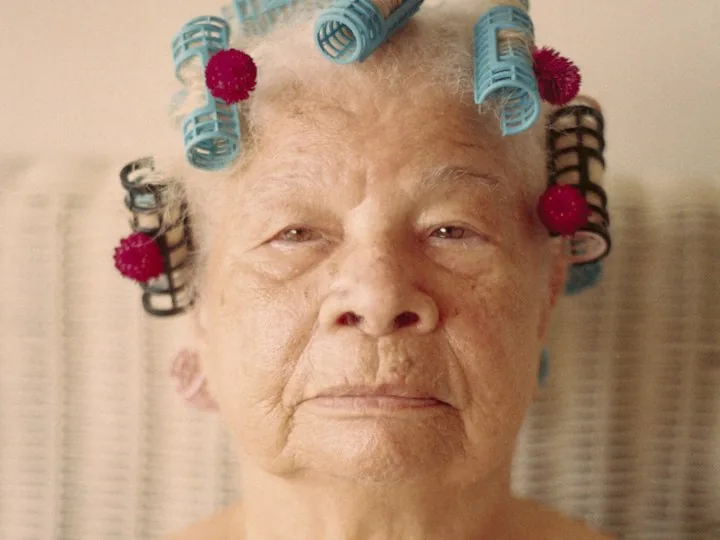
The roller set is the hairstyle many women over 80 grew up with, and it still has real advantages: large rollers give soft, even curls with body and shine, without the heat damage of a curling iron, and the style lasts for days. You can do it at home with foam rollers worn for an hour or overnight, or have it done at the salon as a weekly set. The result is a polished, put-together look — the kind of hair that used to be the standard for a Sunday lunch or a family photograph — and for many women it is simply the style they have always worn, and still love.
Pros: long-lasting curls, no daily heat styling, and a beautifully polished finish. Cons: it takes time to set, and sleeping in rollers is not comfortable for everyone. Common mistake: using rollers that are too small, which gives tight curls instead of soft waves — large rollers are the secret. Maintenance: a set once a week, a silk scarf at night to keep the curls, and a gentle brush-through in the morning. Quick verdict: the classic weekly set — slower to do, but it lasts, and it feels like coming home.
10. A Bright White Pixie
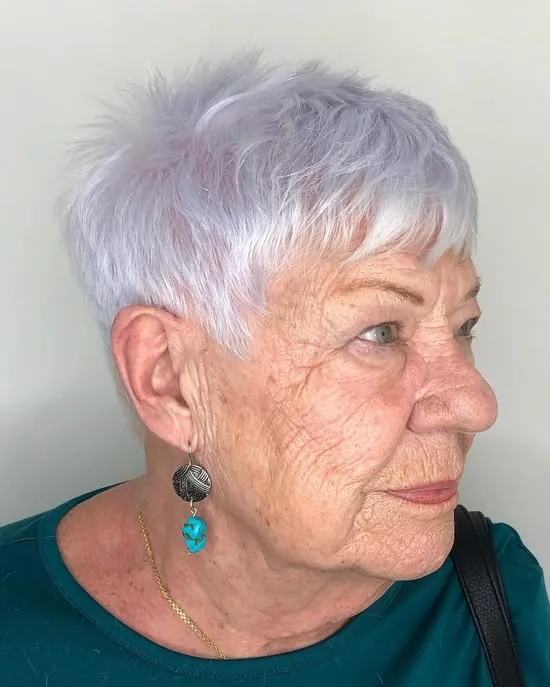
A bright white pixie is a statement in the best sense: very short, very clean, and very white, worn with confidence. The cut is short all over with a little length on top for texture, and the whiteness of the hair becomes the feature — it frames the face like a halo and looks striking against any skin tone. It is also one of the easiest styles to keep bright, because there is so little hair that a weekly purple shampoo works evenly and quickly. This is the style for a woman who has embraced her white hair completely and wants a cut that shows it off.
Best for: fully white hair and women who love a short, bold cut. How to style: a drop of styling cream, a finger-comb, and you are done — this is a two-minute style. What to ask your stylist: for a pixie with soft, textured ends rather than a blunt finish, so the white looks soft rather than stark. Maintenance: a trim every four weeks, and purple shampoo once a week to keep the white bright. Quick verdict: short, white, and striking — the boldest easy style here.
11. A Silver Shag
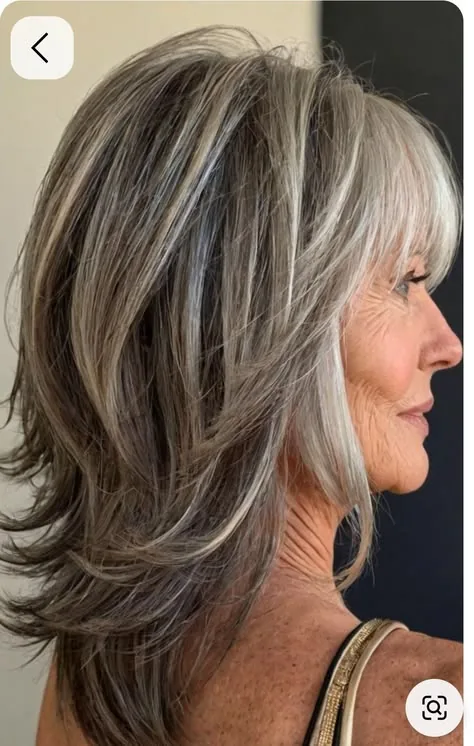
A silver shag is a layered, textured cut with lots of movement — shorter on top, longer layers through the sides and back, and feathered ends that flick out rather than curling under. It suits silver hair beautifully, because the layers show off the different tones in the hair: white at the crown, silver at the sides, a little grey still mixed through. The shag is also wonderfully forgiving: it is meant to look a little tousled, so a bad hair day just looks like the style. For women who find a neat bob too severe, the shag is the relaxed alternative.
Pros: lots of movement, very forgiving, and it grows out gracefully. Cons: it needs a stylist who understands layering — a badly cut shag can look scruffy rather than textured. Common mistake: cutting the layers too short on top, which can make thin hair look sparse. Maintenance: a trim every six to seven weeks, and a little texturising spray on damp hair. Who should avoid it: anyone who prefers a neat, polished finish — the shag is deliberately a little wild.
12. A Salt-and-Pepper Bob
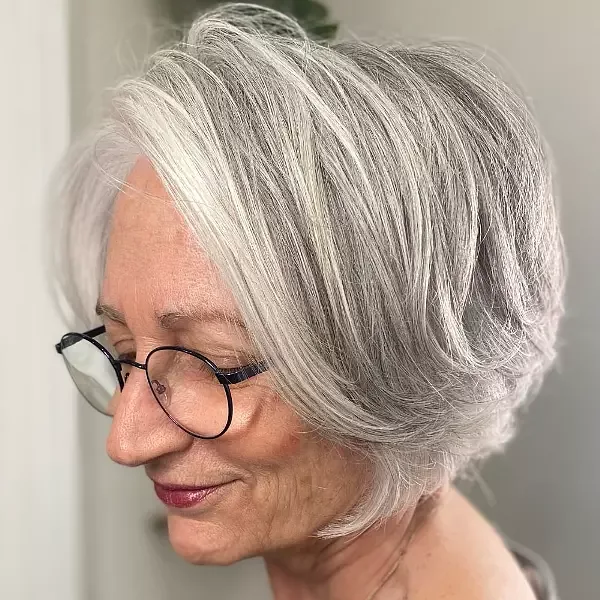
Not every woman over 80 is fully silver — many still have a beautiful mix of grey, silver, and darker hair, and a salt-and-pepper bob shows that mix at its best. The cut is a simple, neat bob, chin-length or a little shorter, and the colour is left exactly as it is: no dye, no blending, just the natural mix. The different tones give the hair a depth that a single colour cannot match, and the bob’s clean shape keeps it looking deliberate rather than unfinished. It is a good choice for women whose hair is still darkening in places, or who simply like their natural colour.
Best for: women with a natural mix of grey and darker hair. How to style: the same easy routine as any bob — mousse, a quick blow-dry, and a brush-through. What to ask your stylist: for a clean bob shape that lets the colour show, and for no thinning at the ends, which can make the mix look patchy. Maintenance: a trim every six weeks. Quick verdict: let nature do the colouring — the mix is the feature, and the bob is the frame.
13. Soft White Curls
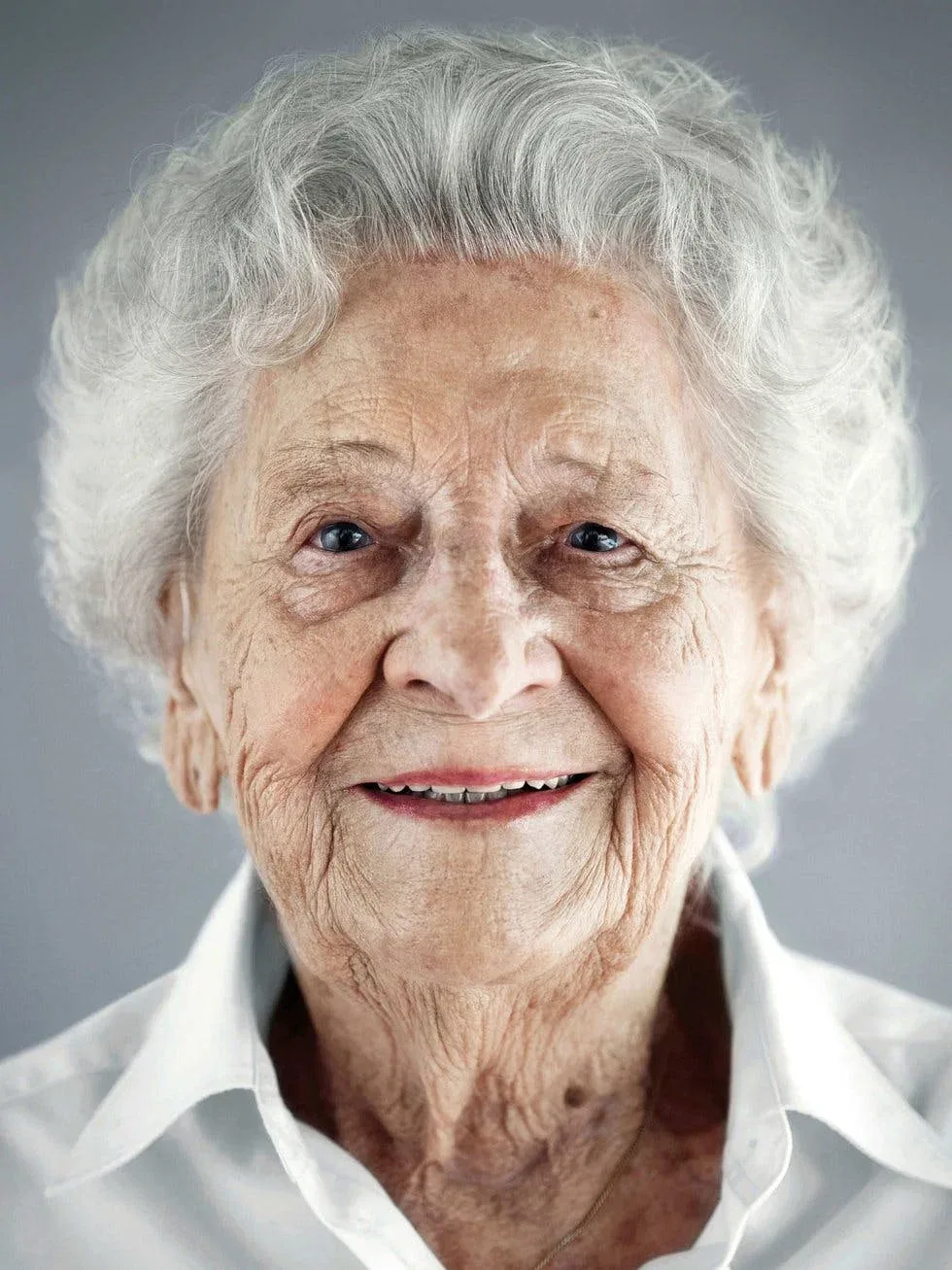
Soft white curls are a gentle, feminine style for women whose hair still curls — naturally, or with a soft perm — and has gone white. The curls are kept loose and open, the length is short to medium, and the white colour makes the curls look soft and cloud-like rather than sharp. It is a warm, approachable style, and it suits women who like their hair to look soft and touchable. The key is keeping the curls moisturised, because white hair can be drier than pigmented hair, and dry curls frizz where soft curls shine.
Best for: naturally curly white hair, or a soft perm on white hair. How to style: curl cream on damp hair, let it dry naturally, and do not brush the curls out — a wide-tooth comb is enough. What to ask your stylist: for a cut that follows the curl pattern, and for a moisturising treatment at the salon every few months. Maintenance: a weekly deep condition, and a trim every six weeks. Comfort notes: light and cool, with nothing pinned or pulled.
14. A Silver Lob — the Longer Bob
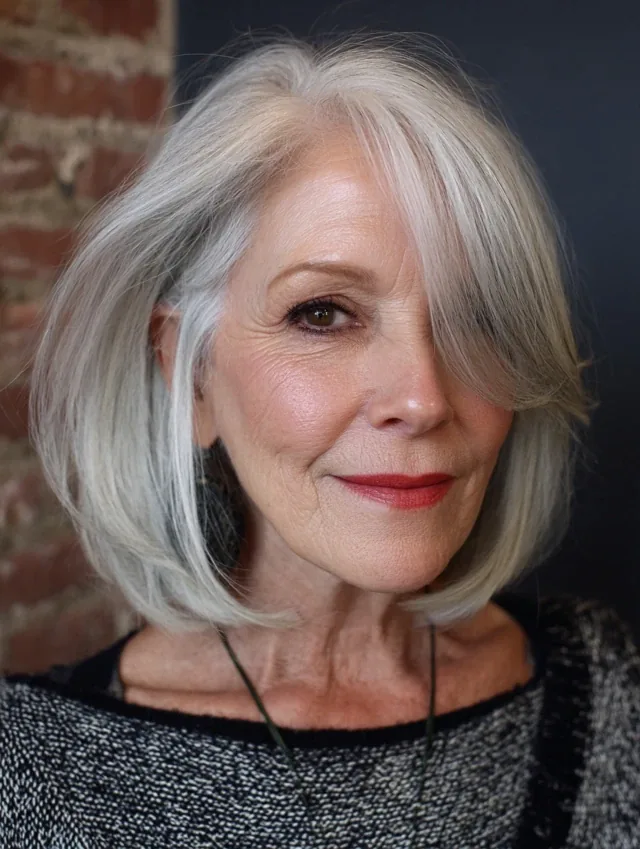
A silver lob — a long bob that sits at the collarbone — is the longest style in this guide, and the right choice for a woman who is not ready to go short. The length gives the hair weight, which helps it hang smoothly, and the silver colour looks wonderful at this length, falling in a soft, shining curtain. It is still an easy style: the lob can be tucked behind the ears, tied back loosely for cooking or gardening, and worn down for everything else. The trade-off is a little more washing and drying time, and a little more weight on the neck.
Quick verdict: the longest easy style here — keep it if you love length, shorten it if it tires you. Maintenance is moderate: a wash, a blow-dry or a natural dry, and a trim every seven weeks. Who should avoid it: anyone whose hair has thinned a lot at the ends, where a lob can look straggly — a chin-length bob will look fuller. Comfort notes: if the length pulls at the neck by the end of the day, tie it back loosely with a soft scrunchie, never a tight elastic.
15. A Textured Pixie with a Side Sweep
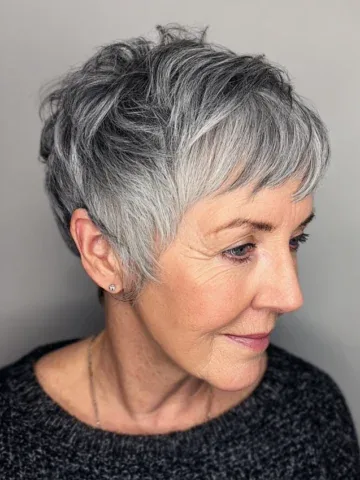
A textured pixie with a side sweep is a pixie with a little more personality: the top is kept longer than the sides and swept across the forehead, which softens the face and gives the style a shape that a very short crop lacks. The sweep also creates natural volume on one side, which is flattering for fine hair, and it gives you something to play with — the sweep can be worn neat for a formal occasion or tousled for everyday. It is a stylish, modern pixie, and it suits women who like their hair short but not severe.
Best for: women who want a pixie with softness and movement. How to style: a little styling cream on damp hair, sweep the top across with your fingers, and let it dry — a quick blow-dry gives more lift. What to ask your stylist: for the top to be kept long enough to sweep, and for the sides to be tapered rather than shaved. Maintenance: a trim every four to five weeks. Quick verdict: the pixie with a fringe — short, stylish, and softer than a crop.
16. A Short Bob with a Soft Fringe
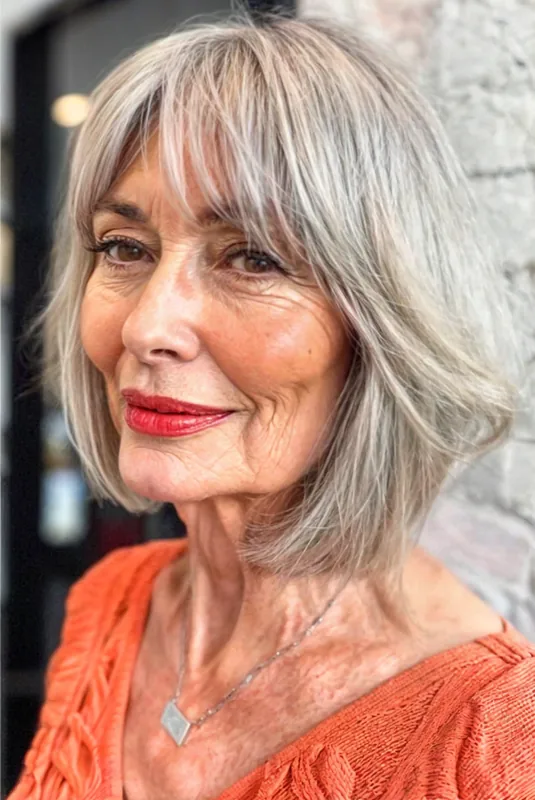
A short bob with a soft fringe is a kind face-framer: the fringe is cut long and wispy, falling across the forehead in soft pieces rather than a straight, heavy line, and the bob sits at the chin or just above. The fringe softens the forehead, the bob frames the jaw, and the whole style feels gentle and approachable. It is a good choice for women who have always liked a fringe but found a blunt one too heavy, and for anyone who wants a little coverage on the forehead without hiding the face.
Pros: softens the forehead, frames the face, and looks friendly rather than severe. Cons: a fringe needs trimming every three to four weeks or it falls into the eyes — ask your stylist to show you how to trim it safely at home, or book quick fringe trims between cuts. Common mistake: cutting the fringe too short and too straight, which looks harsh on older skin. Maintenance: a light mousse and a quick blow-dry with a brush. Who should avoid it: anyone who wears glasses with a high frame, where the fringe and the frames can crowd each other.
17. An Ear-Length Bob
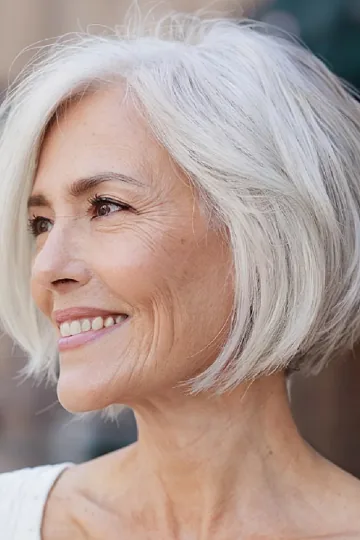
An ear-length bob is the shortest bob in this guide, and one of the neatest: the hair ends just at the ear, the shape is rounded and tidy, and there is nothing to tuck, pin, or manage. It is a wonderfully practical cut — it dries in minutes, it never gets in the way, and it looks the same at the end of the day as it did in the morning. It also suits women with a smaller frame, where a longer bob can overwhelm the face, and it pairs beautifully with earrings, which show fully at this length.
Best for: women who want the shortest possible bob, and anyone who finds longer hair tiring. How to style: towel-dry, a little cream, and a brush-through — that is the whole routine. What to ask your stylist: for a rounded shape that follows the head, and for the back to be tapered so it does not stick out. Maintenance: a trim every four to five weeks. Comfort notes: the lightest bob here, with no weight on the neck at all.
18. A Tapered Pixie
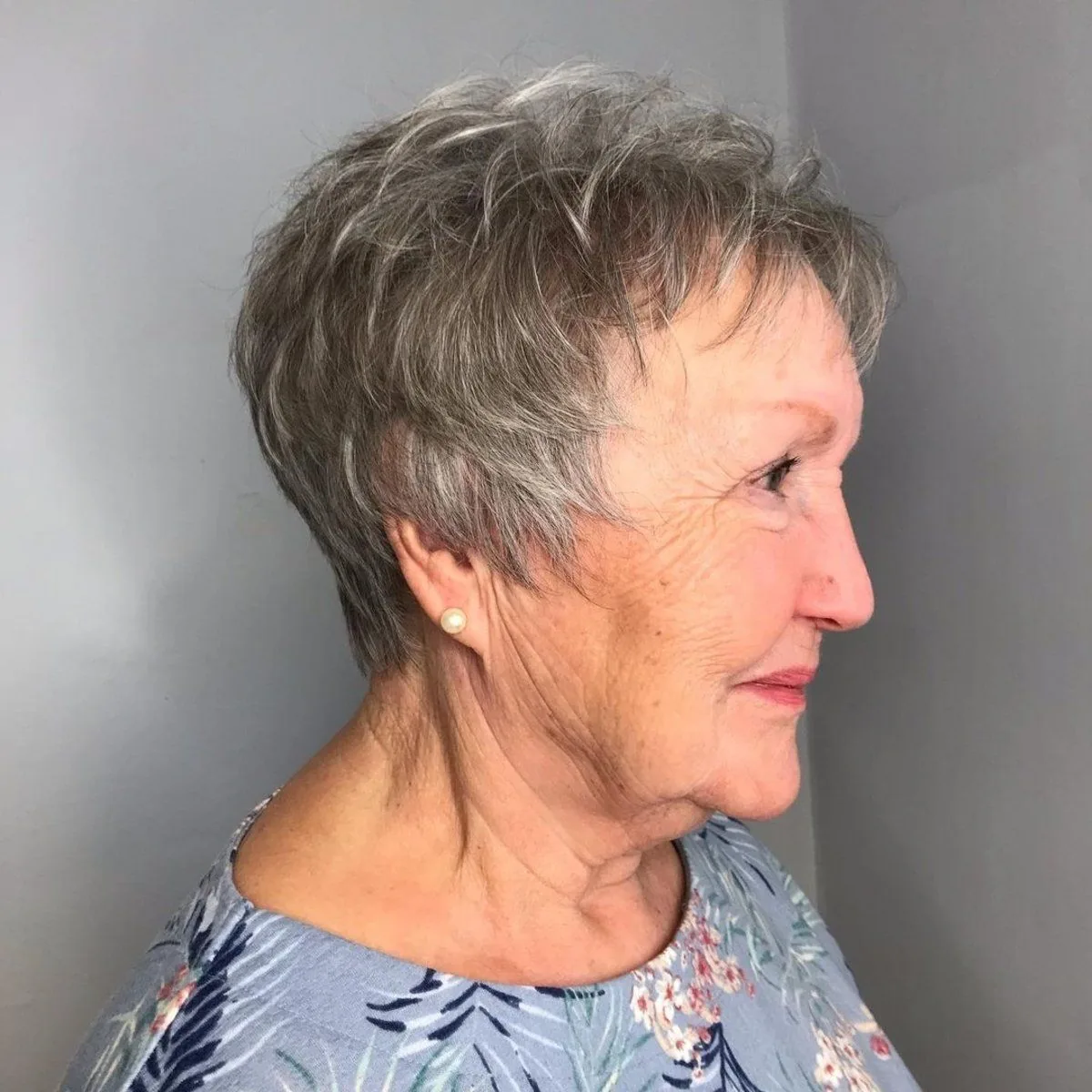
A tapered pixie is cut shorter at the back and sides, tapering neatly into the neck, with a little more length on top. The taper is what makes it look polished: the neckline is clean, the shape is tidy, and the style holds its outline as it grows out. It is a smart, tailored cut — the hair equivalent of a well-fitted jacket — and it suits women who like their hair to look neat and intentional without spending time on it. It also works very well with glasses, because there is no bulk behind the ears to fight the frames.
Quick verdict: the neatest short cut here. Maintenance is simple: a wash, a little cream, and a comb-through. The taper needs a trim every four weeks to stay sharp, but the cut is so easy to wear that most women find the trade-off worth it. Who should avoid it: anyone who dislikes the feeling of very short hair at the nape — a soft layered pixie keeps a little more length there. Comfort notes: cool in summer, light all year, and nothing to pin.
19. A Curly Bob

A curly bob is a chin-length bob cut for curly hair, with the shape following the curls rather than fighting them. The layers are cut so the curls sit in a rounded, even shape, and the length is kept short enough that the curls bounce rather than dragging down. It is a happy, lively style — the curls give it movement and personality, and it looks good with almost no styling beyond curl cream and a natural dry. For women whose hair has kept its curl into their 80s, this is often the most flattering cut of all.
Best for: naturally curly hair at any level of curl. How to style: curl cream on damp hair, scrunch gently, and let it dry naturally. What to ask your stylist: for a cut that is shaped with the curls dry, so the length is judged on the finished curl, not on wet, stretched hair. Maintenance: a trim every six weeks, and a weekly deep condition. Common mistake: cutting a curly bob too short when wet — curls spring up as they dry, so always leave extra length.
20. A Low Loose Bun

A low loose bun is the gentlest updo in this guide: the hair is gathered low at the nape, twisted loosely, and pinned with two or three pins — no pulling, no tight elastic, no heavy pinning. It keeps the hair off the neck on a warm day, it looks tidy for a family gathering, and it takes two minutes. The looseness is deliberate: a tight bun pulls at the scalp and gives a headache, while a loose bun sits comfortably all day and can be taken down without a struggle. It works best on hair that reaches at least the shoulders.
Best for: warm days, family occasions, and anyone who wants their hair up without the effort. How to style: gather the hair low, twist it loosely, coil it into a soft bun, and secure it with large pins or a soft scrunchie — never a tight elastic. What to ask your stylist: only if the bun will not hold — a few long layers can make it slip, and a stylist can adjust the cut. Maintenance: none beyond the pins. Comfort notes: if it pulls at all, loosen it — a bun should never hurt.
21. A Soft French Twist, Done Gently
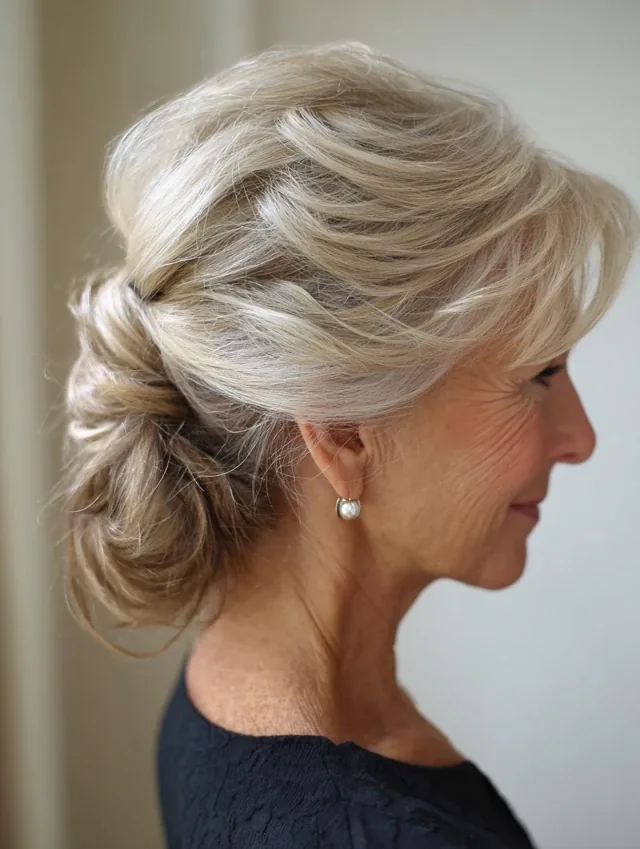
A soft French twist, done gently, is the classic updo without the severity: the hair is gathered low, folded up loosely, and pinned with a few large pins, with soft pieces left out around the face. The twist sits low rather than tall, the finish is soft rather than sculpted, and the whole style takes ten minutes. It is the updo for a wedding or a special lunch, and it looks elegant without ever feeling stiff. The key word is gentle — a twist that pulls is a twist that will be taken down before dessert.
Pros: elegant, comfortable, and it shows off a necklace or an open neckline. Cons: it needs hair past the shoulders, and it takes a little practice — do a trial run before the event. Common mistake: pinning too tightly in the hope it will last longer; a comfortable twist with enough pins lasts just as long. Maintenance: a few spare pins in your bag. Who should avoid it: anyone with very short or very fine hair, where the twist will not hold — a low bun is the easier choice.
22. A Half-Up Style with a Clip

A half-up style with a clip is the easiest updo of all: the top half of the hair is gathered back and held with a single pretty clip, while the rest falls loose. It keeps the hair out of the face, it shows off a favourite clip or barrette, and it takes about a minute. It is a good choice for women with shoulder-length hair who like it down but want it out of the way for eating, reading, or a walk. Choose a clip that is light and easy to open — a heavy clip will slide, and a fiddly one will stay in the drawer.
Best for: shoulder-length hair and anyone who wants hair up in under a minute. How to style: gather the top section, twist it once, and clip it at the back of the crown. What to ask your stylist: for the top layers to be long enough to gather — if they are too short, they will slip out of the clip. Maintenance: none. Quick verdict: the one-minute updo — a clip, a twist, and done.
23. A Low Chignon with Loose Pieces

A low chignon with loose pieces is a soft, romantic updo for a special occasion: the hair is gathered low at the nape and coiled into a loose knot, with a few soft pieces left out around the face and the ears. It looks polished without looking formal, and it suits a dressy lunch, a wedding, or a family photograph. The loose pieces are what make it work for older women — they soften the face, hide nothing, and make the style feel relaxed rather than severe. A chignon is also a kind style for thinning hair, because the loose coil looks full even when the hair is fine.
Best for: weddings, christenings, and family photographs. How to style: gather the hair low, twist it loosely, coil it into a soft knot, and pin it with large pins — then pull out two soft pieces at the front. What to ask your stylist: for a trial run before a big event, and for the pins to be large and comfortable. Maintenance: a few spare pins in your bag. Comfort notes: keep it loose, keep it low, and take it down as soon as you get home.
24. A Side-Swept Pixie for Glasses Wearers
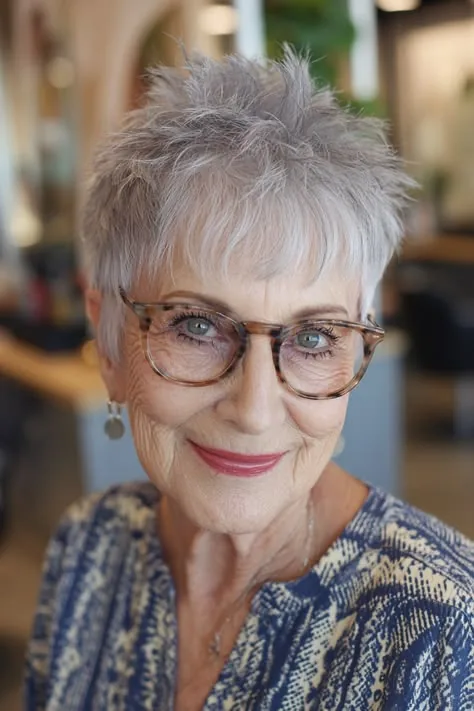
A side-swept pixie is one of the best cuts for women who wear glasses, because everything about it works with the frames rather than against them. The hair is short and tapered behind the ears, so there is no bulk pushing the arms of the glasses out of place, and the top sweeps across the forehead in a soft line that sits above the frames instead of competing with them. The result is a face that looks open and balanced — glasses, hair, and smile all visible, none of them fighting for attention.
Best for: anyone who wears glasses every day. How to style: sweep the top across with your fingers and a little cream, and wear your glasses to the salon so the length can be checked against the frames. What to ask your stylist: for a taper behind the ears and a sweep that clears the top of your frames. Maintenance: a trim every four to five weeks. Quick verdict: the glasses-friendly pixie — short at the ears, soft on top, and nothing in the way.
25. A Bob with a Side Part for Glasses

A bob with a side part is a classic for glasses wearers because the side part does two useful jobs: it creates lift on one side, which balances the horizontal line of the frames, and it keeps the hair away from the arms of the glasses on the heavier side. The bob itself is chin-length, with the ends turning softly under, and the overall effect is neat, balanced, and easy. It is a good choice for women who like a bob but have found that a centre part and glasses can make the face look very symmetrical and a little stern.
Best for: daily glasses wearers who like a bob. How to style: part the hair on your preferred side while it is damp, blow-dry the ends under, and tuck the shorter side behind the ear if you like. What to ask your stylist: for the side part to be set on the side that suits your face, and for the length to clear the bottom of your frames. Maintenance: a trim every six weeks. Comfort notes: if the bob catches on the glasses arms, ask for the sides to be thinned slightly behind the ears.
26. Soft Layers That Sit Above the Frames
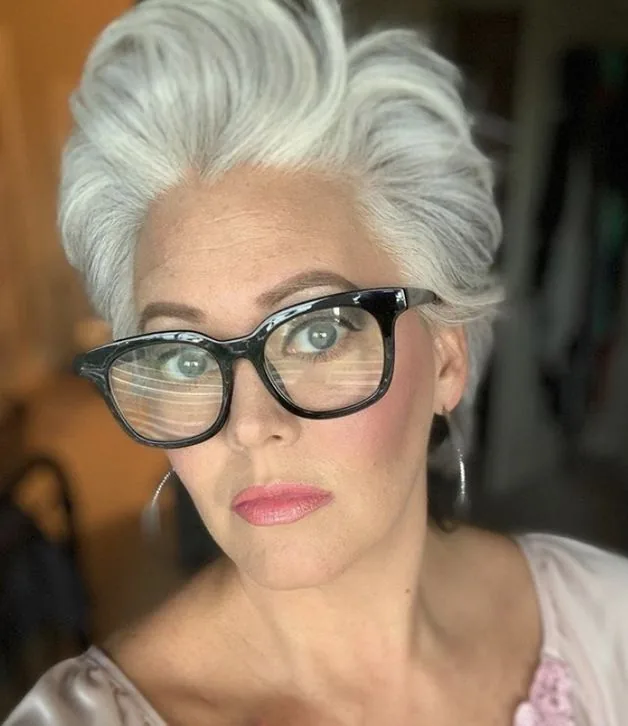
Soft layers that sit above the frames are less a single cut than a principle, and it is one worth asking for by name: the layers around the face should end above the top of your glasses, not across them. When layers fall across the frames, they tangle, they smudge the lenses, and they make the face look busy; when they sit just above, the face looks open and the glasses become part of the look. This works with a bob, a pixie, or a short shag — the cut matters less than the length of the face-framing layers.
Quick verdict: a small detail that makes a daily difference. Maintenance is the same as the underlying cut, with one extra check: at every trim, put your glasses on and ask the stylist to check the layers against the frames. Who should avoid it: nobody — it is an adjustment, not a style, and it improves almost any cut for a glasses wearer. Comfort notes: less hair on the lenses means less cleaning, less pushing the glasses up, and less irritation by the end of the day.
27. Silver Blending: Letting Colour Grow Out Gracefully
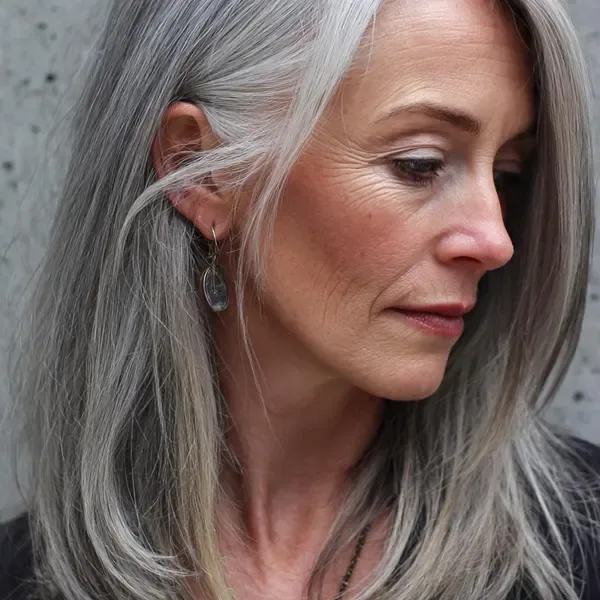
Silver blending is the kindest way to stop dyeing your hair: instead of growing out a hard line of roots, your stylist adds soft silver and grey highlights through the dyed hair, so the natural silver blends in gradually over a few months. The result is a soft, dimensional colour with no obvious regrowth line, and after two or three blending sessions most women can stop colouring altogether. It is a patient approach, but it is far kinder than a sudden chop or months of visible roots, and it suits women who have dyed their hair for years and are ready to let the silver take over.
Pros: no harsh regrowth line, and a gentle path to natural silver. Cons: it takes two or three salon visits, and it costs more than a single dye job — ask for the full price in advance. Common mistake: expecting it to be finished in one visit; blending is a gradual process. Maintenance: a purple shampoo once a week, and a blending top-up every eight to ten weeks until the transition is complete. Quick verdict: the graceful exit from hair dye — slow, soft, and worth it.
28. Soft Highlights to Brighten Silver
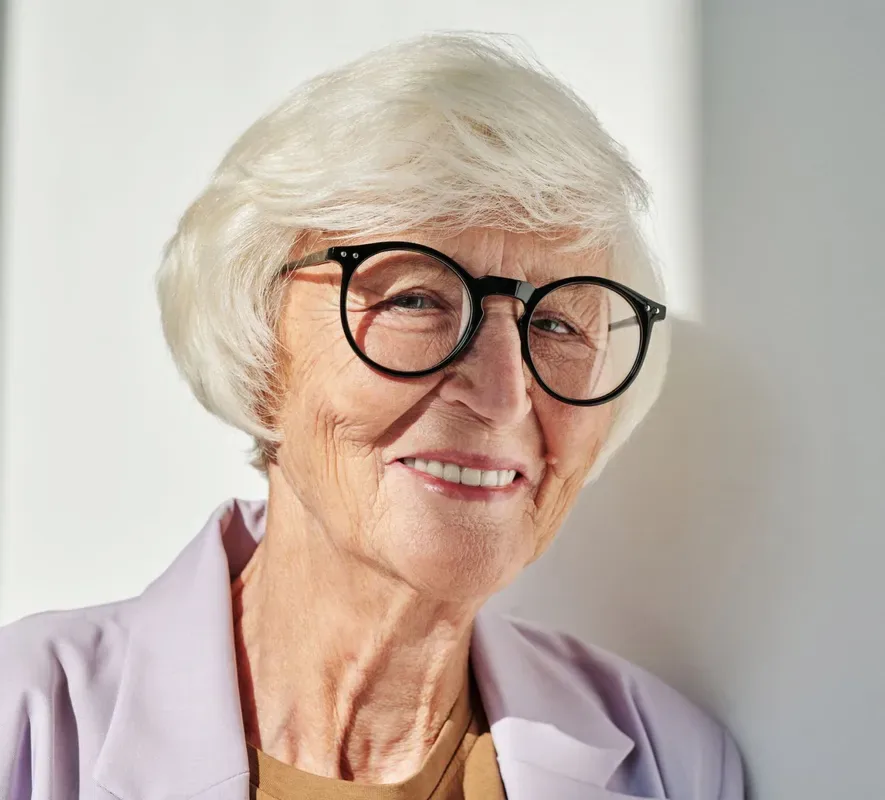
Soft highlights are a light touch of colour — a few fine, pale strands woven through silver hair — that brighten the whole head without looking dyed. They work by adding contrast: the highlights catch the light, the silver underneath looks deeper by comparison, and the hair looks fuller and more dimensional. Unlike a full colour, highlights grow out softly, with no hard line at the roots, and they only need refreshing every two to three months. They are a good choice for women whose silver has gone a little flat or dull, and who want a lift without a commitment.
Best for: silver hair that looks dull or flat in photographs. How to style: no special styling — the highlights show in any cut, but they look best with layers. What to ask your stylist: for fine, soft highlights in a tone close to your natural silver, not a strong blonde. Maintenance: a highlight top-up every ten to twelve weeks, and a purple shampoo once a week. Who should avoid it: anyone with very fragile hair, where even gentle highlighting can cause breakage — ask your stylist honestly.
29. A Gentle Toner for Yellowing Silver
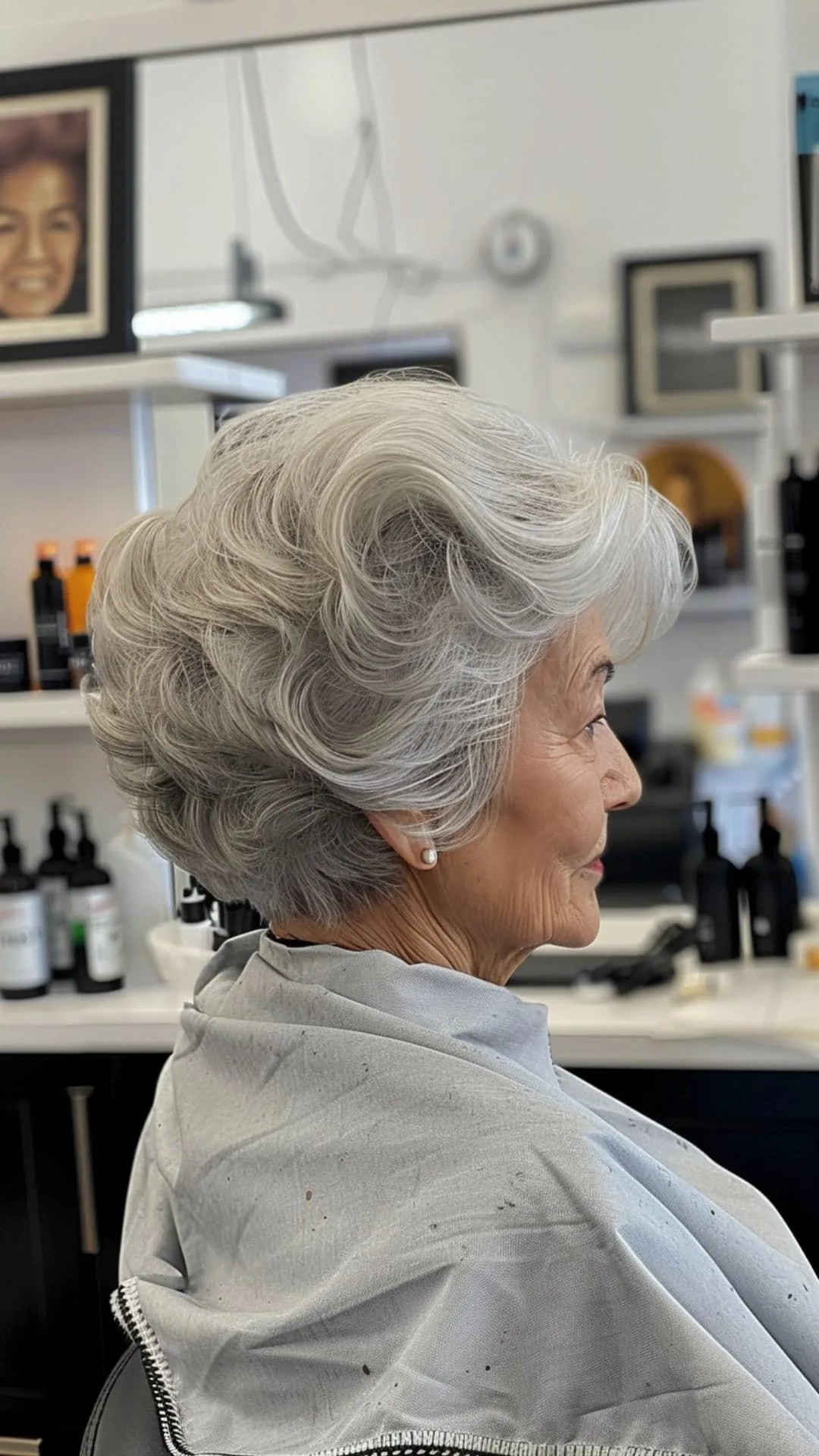
A gentle toner is a ten-minute salon treatment that takes the yellow out of silver hair and leaves it bright, clean, and cool-toned. It is not a dye — it is a sheer, semi-permanent colour that sits on the surface of the hair and washes out gradually over a few weeks. If your silver has yellowed from the sun or from tap water, a toner is the fastest fix there is, and it is far gentler than a full colour. Many women have a toner with every second or third haircut, and keep a purple shampoo at home in between.
Pros: fast, gentle, and immediately visible. Cons: it washes out, so it needs repeating every four to six weeks to stay bright. Common mistake: using a purple shampoo every day instead of once a week, which can leave a lilac tint — the toner and the shampoo work best together, each in moderation. Maintenance: a toner at the salon every month or so, and purple shampoo once a week at home. Quick verdict: the quick brightener — ten minutes in the salon, and your silver looks like itself again.
30. Root-Free Colour That Grows Out Softly
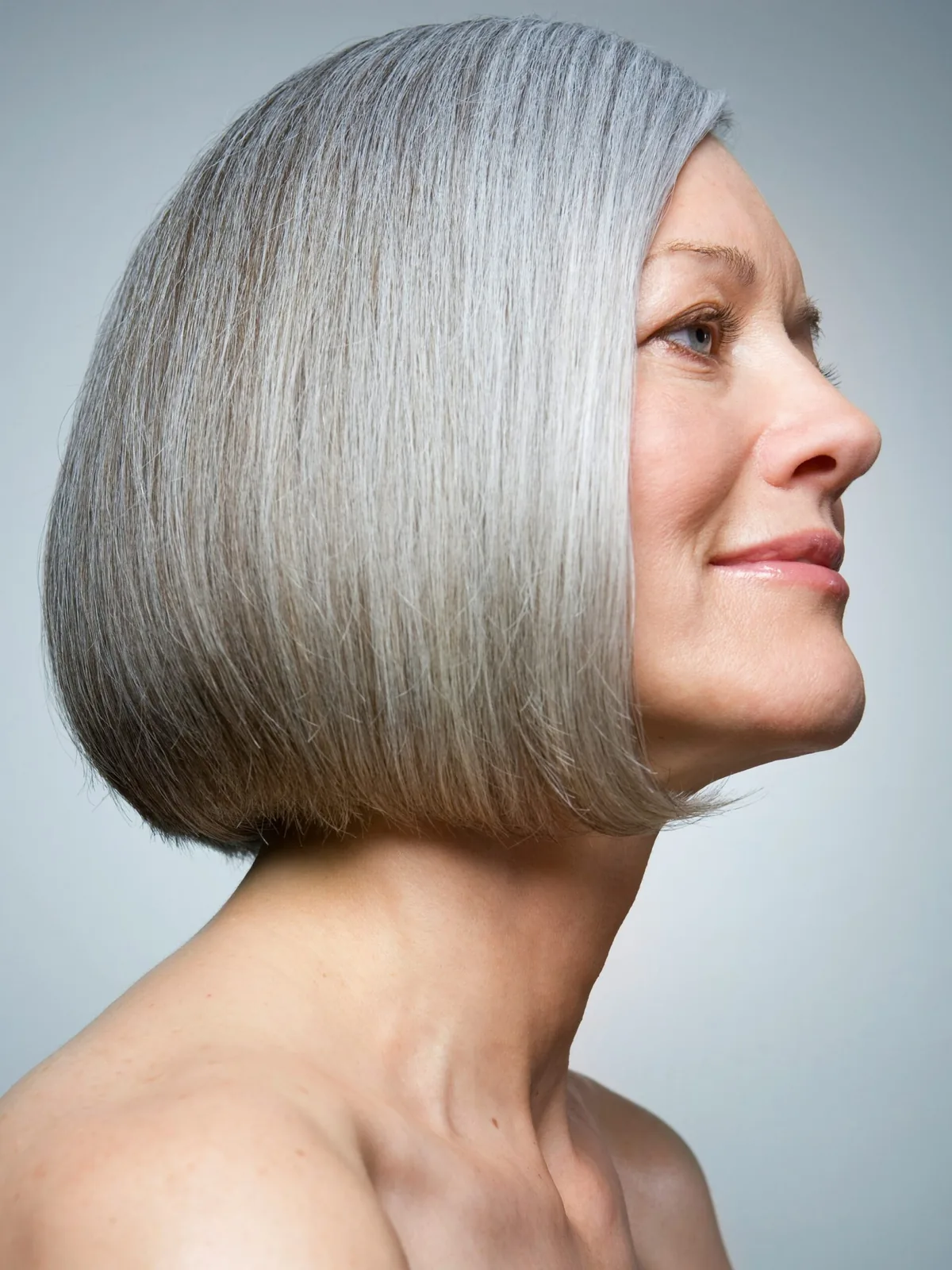
Root-free colour is colour applied in a way that never leaves a hard line at the roots — soft, hand-painted colour through the lengths, or a colour that is close to your natural shade, so the regrowth blends in rather than standing out. For women over 80 who still enjoy a little colour, it is the low-maintenance way to have it: the colour looks good on day one, and it still looks good six weeks later, because there is no obvious root line to betray it. It suits women whose natural colour is still partly there, and who want to soften the grey rather than cover it completely.
Best for: women who want a little colour without the upkeep of a root touch-up. How to style: any cut works, but layers show the colour best. What to ask your stylist: for a colour close to your natural shade, applied softly through the lengths, and for an honest answer about how it will grow out. Maintenance: a refresh every ten to twelve weeks, rather than every four. Who should avoid it: anyone who wants a dramatic colour change — root-free colour is deliberately subtle.
31. The No-Colour Option: Embracing Natural White

The no-colour option is the simplest choice of all: no dye, no highlights, no toner beyond a weekly purple shampoo, just your natural white or silver hair, worn with pride. It costs nothing, it needs no salon visits beyond a cut, and it looks wonderful — white hair has a brightness and a character that no dye can copy. Many women who stop colouring find they like their natural hair more than they expected, and that the compliments start coming from people who had never seen it. The only upkeep is keeping it bright, which is a weekly shampoo and a hat in strong sun.
Quick verdict: the easiest colour decision there is — none at all. Maintenance is minimal: a purple shampoo once a week, a good cut, and a little sun protection. Who should avoid it: nobody — but if you have dyed your hair for decades, give yourself a few months to get used to the change before deciding, and consider silver blending to ease the transition. Comfort notes: no chemicals on the scalp, no waiting for colour to process, and no appointments beyond a haircut. Your hair, exactly as it is, is enough.
What is the best hairstyle for a woman over 80?
The best hairstyle for a woman over 80 is usually a short, easy cut — a soft pixie, a chin-length bob, or a wash-and-go crop — because it is light, quick to style, and flattering to thinner, finer hair. The right choice depends on your hair type, whether you wear glasses, and how much time you want to spend styling it, but a short cut with soft layers suits most women in this age group.
What hairstyles are easiest for older women with thin hair?
The easiest hairstyles for thin hair after 80 are short layered cuts, such as a feathered short cut, a soft layered pixie, or a chin-length bob with soft layers. Short layers remove weight so the hair lifts at the roots, and a little mousse or a gentle perm adds body without daily effort. Avoid long, one-length hair, which pulls thin hair flat.
Should women over 80 have short hair?
Women over 80 do not have to have short hair, but short hair is usually easier and more flattering at this age, because it is lighter, dries faster, and looks fuller on thinner hair. A chin-length bob or a silver lob is a good middle ground if you are not ready for a pixie, and a low bun or a soft twist can keep longer hair tidy. The choice is yours — short is practical, not compulsory.
How do I keep silver hair from turning yellow?
To keep silver hair from turning yellow, use a purple or silver shampoo once a week, protect your hair from strong sun with a hat, and ask your stylist for a gentle toner if the yellowing is already noticeable. Avoid washing with very hot water and limit heat styling, both of which can dull silver hair over time.
What is a good hairstyle for an 80-year-old woman with glasses?
A good hairstyle for an 80-year-old woman with glasses is a short cut that is tapered behind the ears, such as a side-swept pixie or a bob with a side part, with face-framing layers that sit above the frames rather than across them. Wear your glasses to the salon so your stylist can check the length against the frames.
How often should a woman over 80 get a haircut?
A woman over 80 should usually get a haircut every five to seven weeks for a short cut, or every seven to eight weeks for a bob or lob, to keep the shape tidy. A fringe may need a trim every three to four weeks. If the cut grows out gracefully, you can stretch the gap — ask your stylist how your particular cut behaves as it grows.
Is a perm a good idea for women over 80?
A gentle perm can be a good idea for women over 80 with thin, straight hair, because it adds lasting body and soft curls that need very little daily styling. Ask for large, loose rollers rather than tight curls, have a patch test first, and avoid perms if your hair is very fragile or your scalp is sensitive — your stylist can advise honestly.
Can women over 80 wear their hair long?
Yes, women over 80 can wear their hair long if it is healthy and they enjoy it — a silver lob or a low bun are good longer options. Long hair needs more washing and drying time and can pull at the neck, so many women prefer a bob or shorter cut for comfort. If long hair feels heavy or looks thin at the ends, a shorter cut will usually look fuller.
What is the lowest maintenance hairstyle for an older woman?
The lowest maintenance hairstyle for an older woman is a wash-and-go crop or a soft layered pixie: wash it, towel-dry it, add a drop of styling cream if needed, and leave it alone. A short cut like this needs a trim every four to five weeks but almost no daily styling, and it dries in minutes.
How can I add volume to fine hair at 80?
To add volume to fine hair at 80, ask for short layers, use a light mousse or texturising spray on damp hair, part your hair on the side for natural lift, and blow-dry with your fingers rather than a brush. A gentle perm is another option for lasting body. Avoid heavy conditioners and thick styling creams, which weigh fine hair down.
Conclusion
At 80 and beyond, the best hairstyle is the one that fits your life: light on the head, quick in the morning, comfortable all day, and flattering to the hair and the face you have now. Whether that is a wash-and-go crop, a bright white pixie, a soft silver bob, or a gentle perm, the right cut should make your week easier, not harder — and it should make you smile when you catch your reflection, not sigh.
Take this guide to your stylist, point to the styles that appeal to you, and say how you live with your hair — how much time you want to spend on it, whether you wear glasses, and what you do not want. A good stylist will take it from there. Your silver hair, your face, and your eighty-plus years are not things to hide. They are the material of a good hairstyle, and the right cut will show them at their best.