Medium Hair, Big Day: 41 Wedding Hairstyles That Prove You Don’t Need Long Hair to Look Bridal
Medium hair is the wedding guest list’s best-kept secret — and the bride’s, too. Shoulder-length hair, grazing the collarbone or just past it, is long enough for a real updo, a proper braid and soft, full curls, but short enough that nothing pulls, slips or weighs you down by the first dance. You do not need waist-length hair to look bridal. You need a style that understands what medium hair does well: it holds a curl, it pins securely, it frames the face without hiding it, and it works beautifully under a veil.
This guide gathers 41 wedding hairstyles for medium hair, organised by style family so you can find your mood fast: romantic updos, half-up styles, braided details, vintage waves, sleek modern looks, boho and garden wedding styles, and looks built around veils and accessories. Eight guides cover the practical side — what counts as medium hair, when to book your trial, how veils attach, whether you need extensions, how to make a style last from the ceremony to the last dance, and what to ask your stylist. Every style notes its hold time, its veil compatibility and who it suits best, so you can walk down the aisle confident that your hair will still look like you — only more so — in the last photograph of the night.
Why Medium Hair Is the Sweet Spot for a Wedding Day
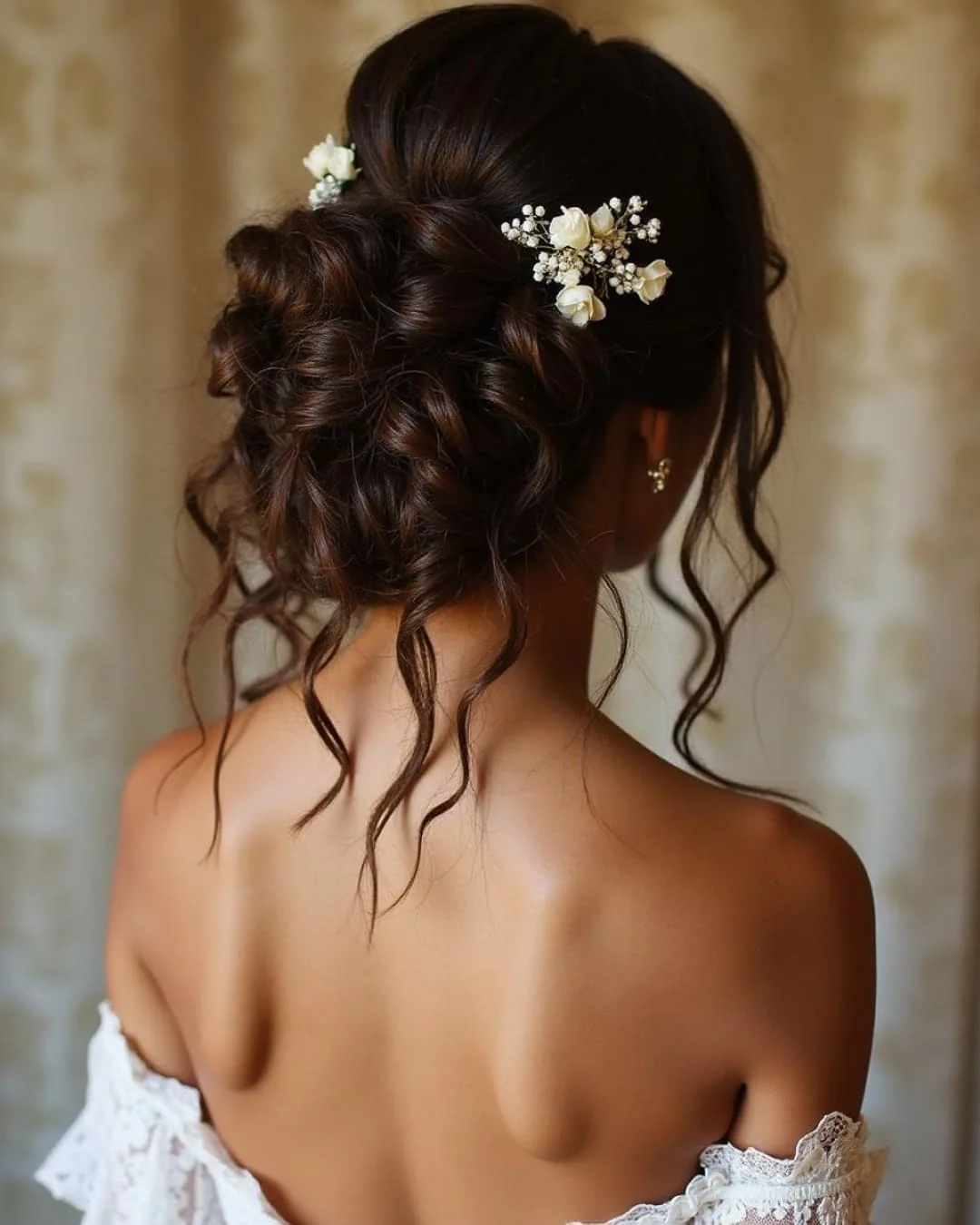
Medium hair — roughly shoulder-length to just past the shoulders — sits in the sweet spot for bridal styling. It is long enough to gather into a low bun, fold into a twist or braid into a crown, and short enough that an updo does not need a forest of pins to stay up. A medium-length updo is lighter on the head than a long-hair one, so it rarely gives you a headache by dinner, and the ends tuck in cleanly instead of poking out of the roll. Curls hold better too: there is less weight pulling them straight, so soft waves set in the morning are still there for the evening photographs.
The other advantage is honesty. Medium hair looks like your hair. A bride with shoulder-length hair who pins it into a soft low bun or wears it half-up with waves still looks like herself in the photographs — just the most polished version of herself. If your hair is between a bob and long layers, you are in medium territory, and almost every style in this guide was designed with exactly your length in mind. The only styles that need extra help are the very tall, very full updos, and even those can be built with a little padding or a few clip-in pieces, which the extensions guide below covers.
Your Hair Trial: When to Book It and What to Bring

Book your hair trial four to six weeks before the wedding, when your dress has arrived and your veil and accessories are in hand. Any earlier and you may still be changing your mind about the dress; any later and there is no time to fix a style that does not work. Bring the veil, the hairpiece, the earrings and a photograph of your dress — especially the neckline and the back, because the back of your dress decides whether your hair goes up or down. Wear a top with a similar neckline to your dress, and arrive with day-old hair, because that is what your stylist will be working with on the day.
At the trial, ask your stylist to photograph the style from the front, the side and the back, and to show you how it looks with the veil on and off. Wear it for the rest of the day: does it feel comfortable after four hours? Does it survive a car ride? Can you turn your head without a pin digging in? If anything feels heavy, tight or itchy, say so — a trial is the time to speak up, not to be polite. Book a second, shorter trial only if you change the style completely; a small tweak, like moving the part or loosening a tendril, can be agreed by message and confirmed on the morning itself.
Veils and Medium Hair: How They Actually Attach

A veil attaches to medium hair more easily than most brides expect, because shoulder-length hair gives a veil comb plenty to grip. The comb slides into the hair just above or below the main style — above a low bun, into the crown of a half-up style, or at the base of an updo — and two crossed bobby pins lock it in place. The key is building a small anchor: a little backcombing, a twist or a braid where the comb sits gives it something to hold onto, and a veil comb with teeth, rather than a flat clip, will stay put through a ceremony, a hug line and a windy photograph session.
The veil style matters as much as the attachment. A fingertip veil suits almost every medium-hair style and lifts off easily for the reception. A cathedral veil needs a secure anchor and a stylist who checks it twice, because its weight pulls. A birdcage veil or a blusher sits at the front and works best with a smooth, sleek style or a low bun, not with loose, textured hair it can tangle in. Tell your stylist which veil you have at the trial, and practise taking it off: on the day, the veil comes out before the first dance, and you want the hairstyle underneath to still look finished, not flattened.
Extensions and Padding: Do You Need Them?
Most medium-hair brides do not need extensions. Shoulder-length hair makes a full low bun, a textured updo and a proper braid on its own, and the styles in this guide were chosen because they work at this length without extra hair. But there are two good reasons to consider a little help: if you want a very full, tall updo that needs more bulk than your hair has, or if you want long, flowing waves down your back and your hair only reaches your shoulders. In both cases, a few clip-in wefts — not a full head — are usually enough, and they are far easier to wear than a full set.
If you do use extensions, buy them in your exact colour and have your stylist cut them to blend before the wedding; uncut clip-ins are the fastest way to spot a bride wearing extra hair. A hair doughnut or a small padding insert is the cheaper, lighter alternative for updos: it sits inside the bun and gives it shape and fullness without any extra hair showing. Try either option at the trial, not on the morning, and wear it for a few hours to check the weight. The honest test is the photographs: if the style looks full and natural without help, skip the extras and save the money for something you will actually notice.
Making It Last: From the Ceremony to the Last Dance
A wedding hairstyle has to survive about twelve hours, a ceremony, a hundred hugs, a meal, a dance floor and possibly heat, humidity or wind. The styles that last are the ones built in layers: texture spray at the roots, each section set with hairspray as it is styled, and pins placed in pairs that cross each other so they lock. An updo lasts longer than hair worn down, and a style built on day-old hair lasts longer than one built on freshly washed hair, because day-old hair has grip. If your wedding is outdoors in summer, tell your stylist — she will use a stronger hold and a humidity-resistant spray, and she may suggest an updo over loose waves.
Pack a small touch-up kit and give it to your maid of honour: four bobby pins in your hair colour, a travel hairspray, a small comb and a couple of clear elastics. That is all you need. Check the style once after the ceremony, when the veil comes off, and once before the first dance — two quick checks, not constant fussing. The biggest threat to a wedding hairstyle is not the dancing, it is the well-meaning relative who keeps smoothing it down or tucking a piece behind your ear. Ask your stylist to show your maid of honour exactly where the pins are, so any fix goes in the right place and does not pull the style apart.
Matching Your Hairstyle to Your Dress Neckline
The neckline of your dress is the best guide to your hairstyle, because the hair and the dress share the same few inches of you. A strapless or sweetheart neckline leaves the shoulders bare, so almost anything works — an updo shows off the neckline, and loose waves soften it. A high neckline or a halter needs the hair up and off the neck, or the hair and the fabric will fight each other all day. An open back is made for an updo: it is a shame to cover a beautiful back with hair. An off-the-shoulder dress pairs beautifully with a low bun or a half-up style that sits below the shoulder line.
The rule of thumb is balance. A detailed, beaded or lace bodice calls for simpler hair, so the dress stays the star. A plain, clean-lined dress can carry a more detailed hairstyle — a braided crown, a sculpted twist, a statement accessory. A long-sleeved dress suits an updo, because the sleeves and loose hair together can feel heavy. Bring a photograph of your dress to the trial and let your stylist see the neckline and the back before she suggests anything. The right hairstyle does not compete with the dress; it finishes it.
What to Ask Your Stylist Before the Big Day
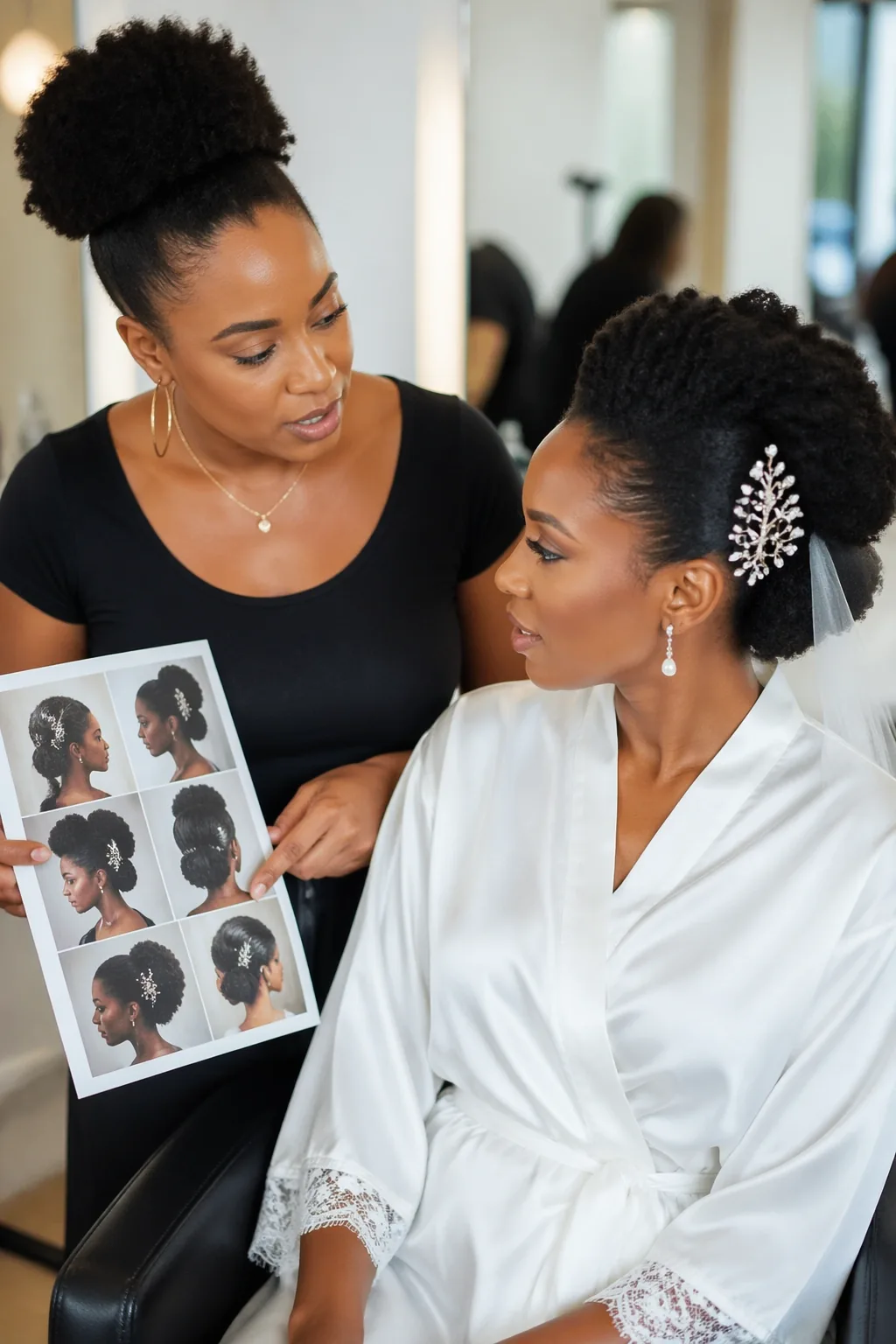
The hair trial is a consultation, not just a rehearsal, so arrive with questions. Ask how long the style will take on the morning — and whether that time includes the veil and the accessories. Ask how many pins it needs, and whether it will feel heavy after six hours. Ask what happens if it rains, if it is humid, or if you cry: will the style hold, and what is the backup plan? Ask whether the style works with your hair’s natural texture, or whether it needs a blow-dry, curls or straightening first, because that changes the morning schedule. And ask what you should do the night before — wash it, or leave it?
Also ask the practical questions brides forget. Will the stylist come to you, or do you go to the salon? How many bridesmaids can she do, and in what order? What time should the mothers arrive? What does she need from you — a chair with a mirror, an outlet, good light? And what is her fee for a touch-up visit between the ceremony and the reception, if you want one? Write the answers down. A good stylist will love these questions, because they mean the morning will run smoothly — and a smooth morning is the best wedding gift you can give yourself.
The Morning-Of Timeline and Your Touch-Up Kit
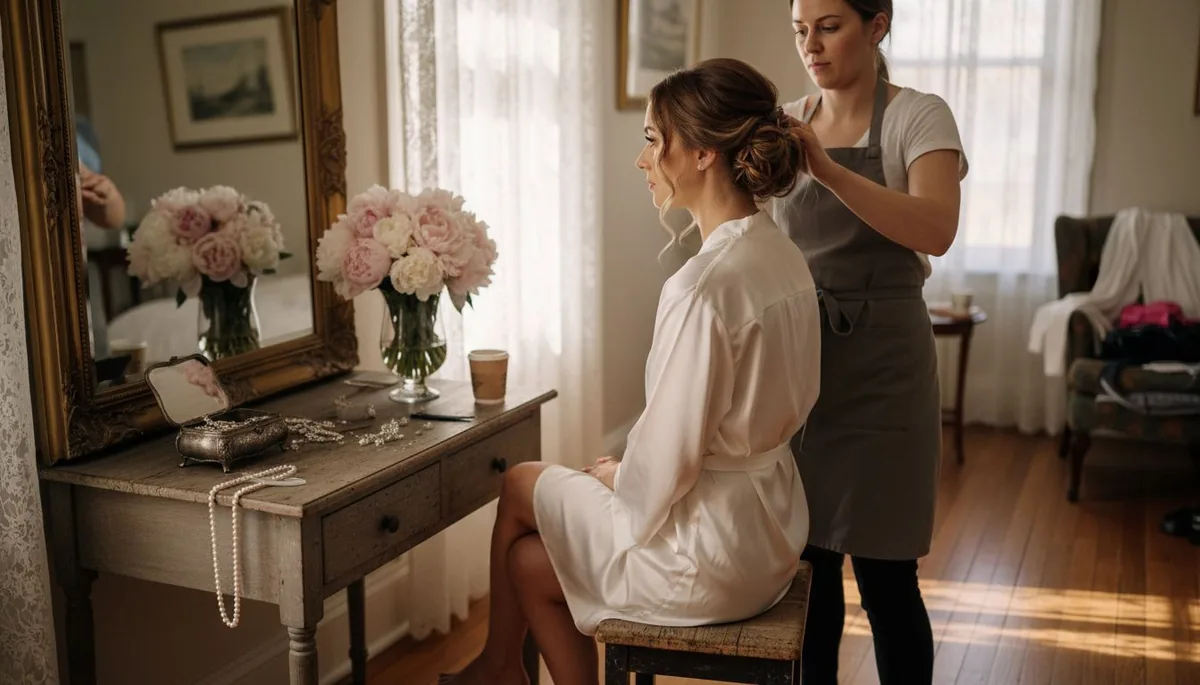
On the wedding morning, hair usually takes 45 minutes to an hour for the bride and 30 to 40 minutes per bridesmaid, so work backwards from the time you need to be dressed. The bride generally goes last among the bridal party, so her style is the freshest for the photographs — but she should not go so last that she is rushed. Eat breakfast before hair starts, not during it, and wear a button-down shirt or a robe that comes off without pulling over your head. Keep the room cool and the music on: a calm, unhurried morning shows in the photographs.
Before the stylist leaves, do three checks together: the front in the mirror, the back in a hand mirror, and the style with the veil on and then off. Ask her to show your maid of honour where the pins sit and how to fix a loose piece. Then hand over the touch-up kit — four bobby pins, a travel hairspray, a small comb and two clear elastics — and let the stylist go. Your hair is done. From here on, the only job is to enjoy it: dance, hug people, laugh, and let the style do what it was built to do, which is to hold, quietly, in the background, while you have the best day of your life.
1. The Classic Low Chignon
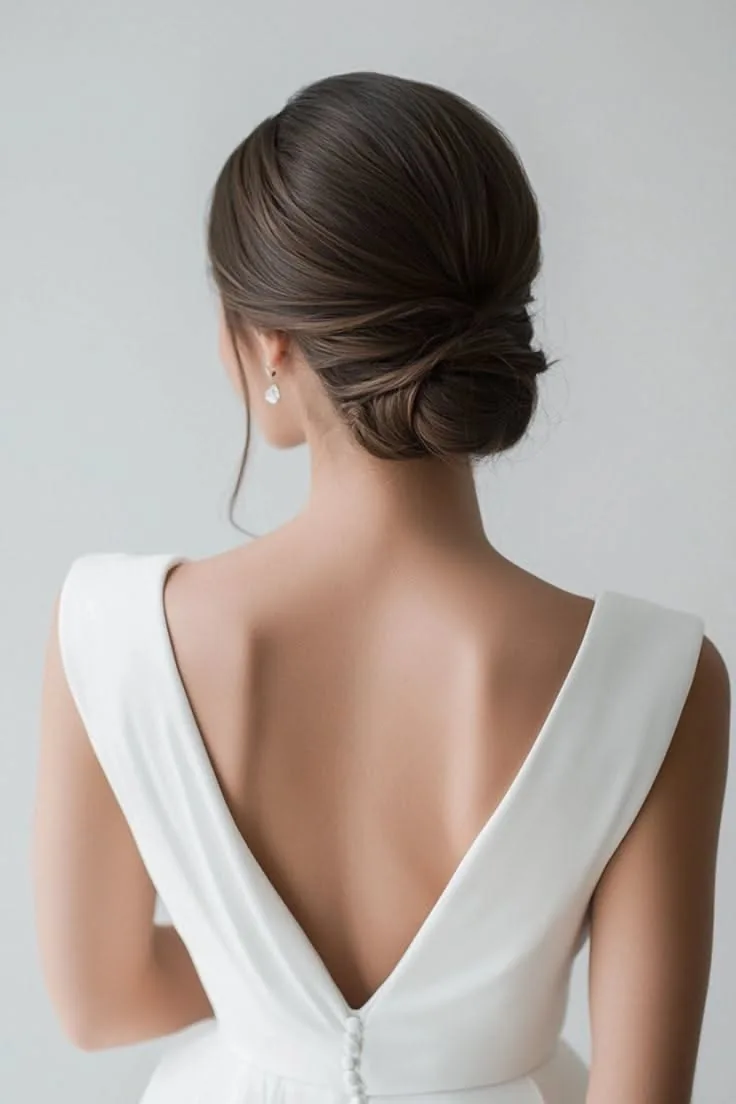
The classic low chignon is the wedding updo that never goes out of style, and medium hair wears it beautifully. The hair is gathered low at the nape, coiled into a neat, soft knot, and pinned so the silhouette is smooth and understated. There is nothing fussy about it: the beauty is in the clean line it makes, the way it shows off the neck and shoulders, and the way it sits perfectly under a veil. It suits a strapless dress, a high-necked dress, a church ceremony or a registry office — it is the updo that goes with everything, and the one your grandmother will recognise and love.
Best for: every dress neckline, every venue, and every bride who wants timeless over trendy. How to style: blow-dry smooth, gather low, twist the length into a coil and pin it flat against the nape, leaving a soft, slightly rounded shape rather than a tight ball. What to ask your stylist: for the chignon to sit at the nape, not high on the head, and for the finish to be smooth with a few soft pieces at the face. Veil compatibility: excellent — a fingertip or cathedral veil comb slides in just above the knot. Hold time: all day, easily. Quick verdict: if you can only pick one wedding updo, pick this one.
2. A Soft Romantic Updo with Loose Tendrils
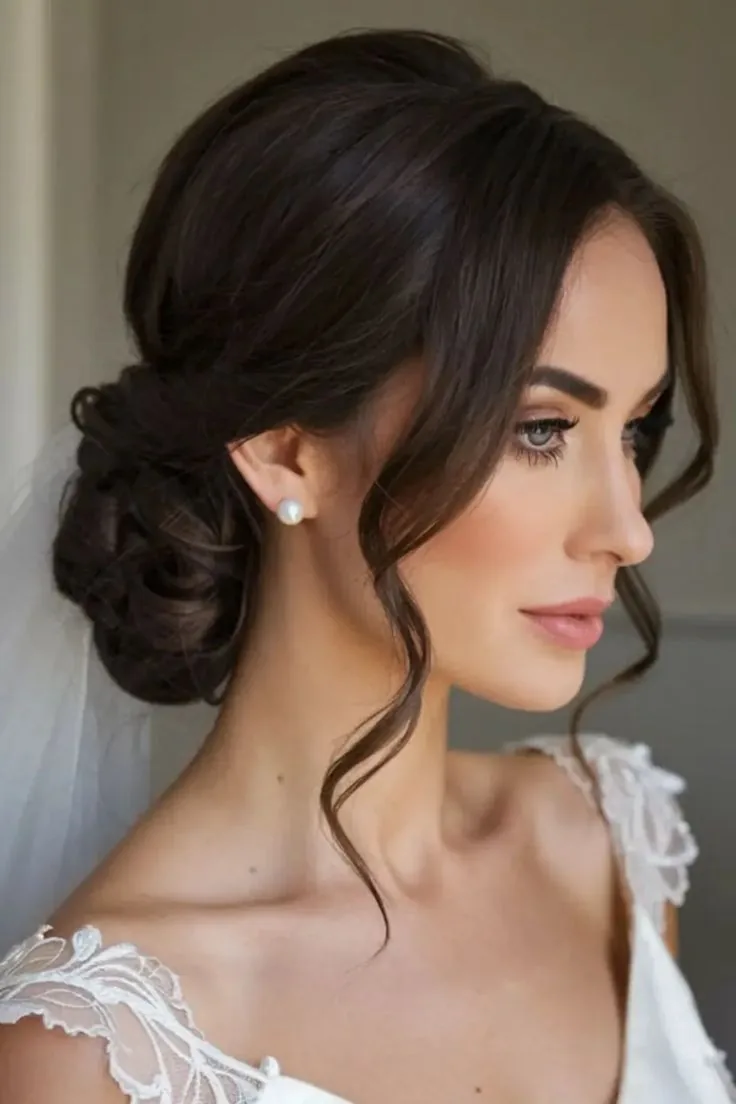
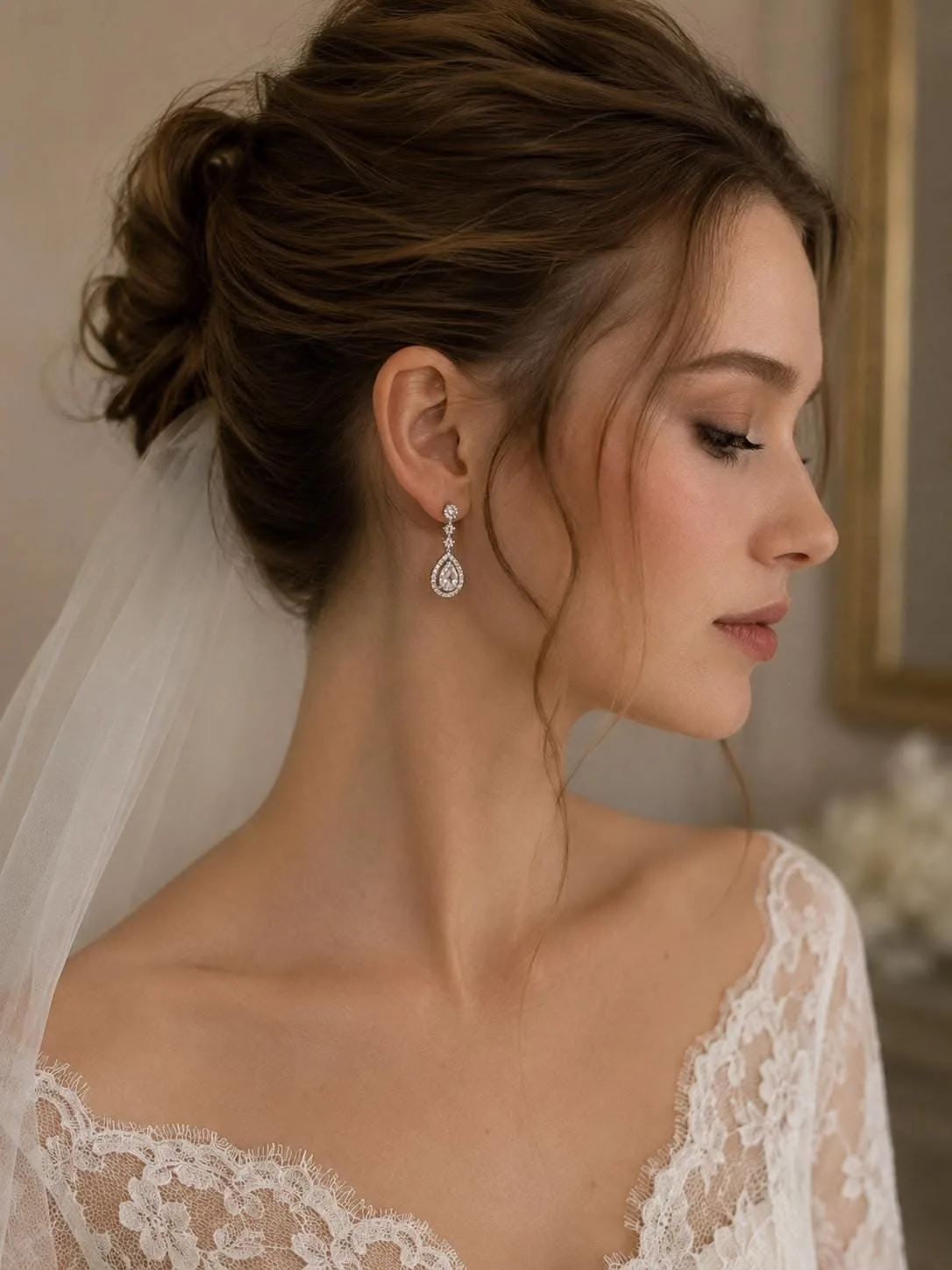
A soft romantic updo is the low chignon’s dreamier sister: the hair is gathered loosely, the bun is pulled apart for softness, and two tendrils are left out to curl gently along the cheekbones. It looks like you spent an hour on it and like you barely tried at the same time, which is exactly the point. This is the updo for a garden wedding, a summer ceremony, a flowing dress and a bride who wants to look romantic rather than formal. The tendrils do the softening, the loose bun does the elegance, and the whole style photographs like a painting.
Pros: romantic, flattering on every face shape, and comfortable all day. Cons: the tendrils can drop in humidity, so it needs a light spray and a backup pin. Hold time: 8 to 10 hours with a good set. Veil compatibility: very good — the veil comb sits above the bun and the tendrils frame the face underneath it. Extension notes: none needed; medium hair makes a full, soft bun on its own. Quick verdict: the most romantic updo in this guide — soft, pretty, and made for photographs.
3. The Twisted Low Bun

The twisted low bun takes the classic chignon and gives it texture: the hair is divided into two or three sections, each twisted like a rope, and the ropes are coiled together into a low bun. The result is a knot with a beautiful, rope-like surface that catches the light and looks far more detailed than a plain bun. It is the updo for a bride who loves the classic shape but wants a little more craft in it, and for a dress with clean lines that can carry a more interesting hairstyle. It also holds exceptionally well, because the twisting creates natural grip.
Best for: modern dresses, minimalist venues, and medium hair with a little natural texture. How to style: divide the gathered hair into two sections, twist each in the same direction, coil the ropes together at the nape and pin along the seam. What to ask your stylist: for the ropes to stay visible on the outside of the bun, not hidden inside it. Veil compatibility: excellent — the veil comb anchors into the twisted texture. Hold time: all day; the rope texture locks the pins in. Quick verdict: a classic shape with a clever twist — literally.
4. A Textured Messy Updo That Still Looks Bridal
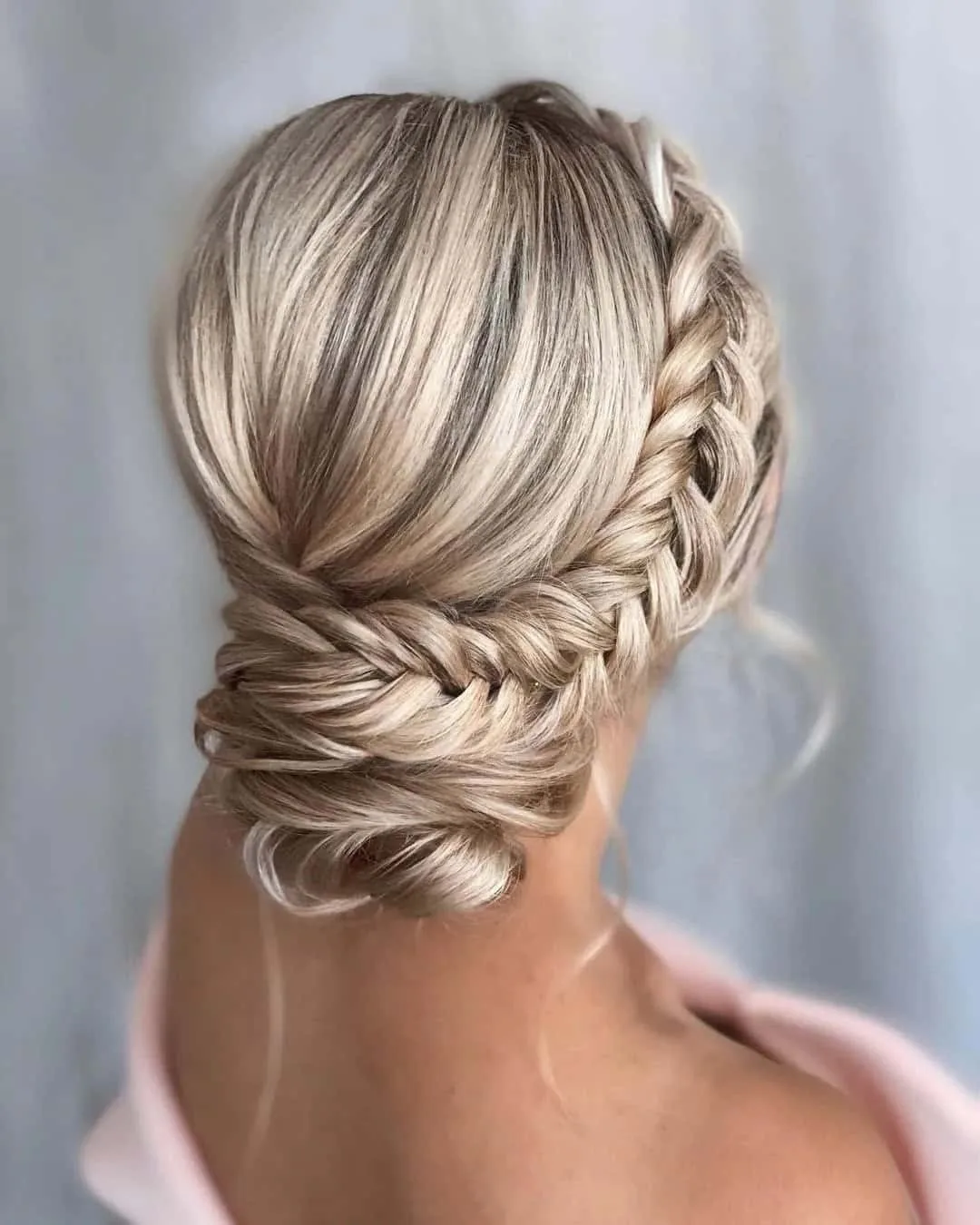
A textured messy updo is the modern bride’s answer to the stiff, sprayed-up wedding hair of the past. The hair is given texture first, gathered loosely, and pinned into a soft, slightly undone bun with pieces pulled out for fullness. It looks effortless, but it is carefully built: the messiness is placed, not accidental, and the pins are hidden in the texture. This is the updo for a relaxed wedding, a barn or garden venue, a boho dress — and for a bride who wants to look like herself, only softer and prettier.
Pros: comfortable, forgiving, and very flattering in photographs. Cons: it will not survive a very humid day as well as a sleek bun, and it needs a stylist who understands the difference between messy and unfinished. Common mistake: making the bun too loose from the start — the texture comes from pulling it apart after pinning, not from a weak foundation. Hold time: 8 hours with a flexible-hold spray. Veil compatibility: good with a fingertip veil; skip a heavy cathedral veil, which fights the loose texture. Quick verdict: the updo for brides who hate updos — soft, modern, and entirely wearable.
5. The Low Knot with a Centre Part

The low knot with a centre part is the most editorial look in this guide: the hair is parted precisely down the middle, smoothed flat on both sides, and gathered into a small, neat knot at the nape. It is clean, modern and quietly dramatic — the kind of hairstyle that looks like it belongs in a fashion magazine and on a real bride at the same time. It suits a minimalist dress, a modern venue, and a bride who loves a sharp, confident look. The centre part is the key: it frames the face symmetrically and gives the whole style its polish.
Best for: minimalist and modern dresses, and oval or heart-shaped faces. How to style: part the hair dead centre while damp, blow-dry smooth with a flat brush, gather low and coil into a small, tight knot. What to ask your stylist: for the part to be razor-straight and the sides to be completely smooth, with no flyaways. Veil compatibility: very good — the veil comb sits neatly above the knot. Extension notes: none needed; this style is about sleekness, not volume. Quick verdict: the most modern updo here — simple, sharp, and unforgettable.
6. A Sculpted French Twist for Medium Hair
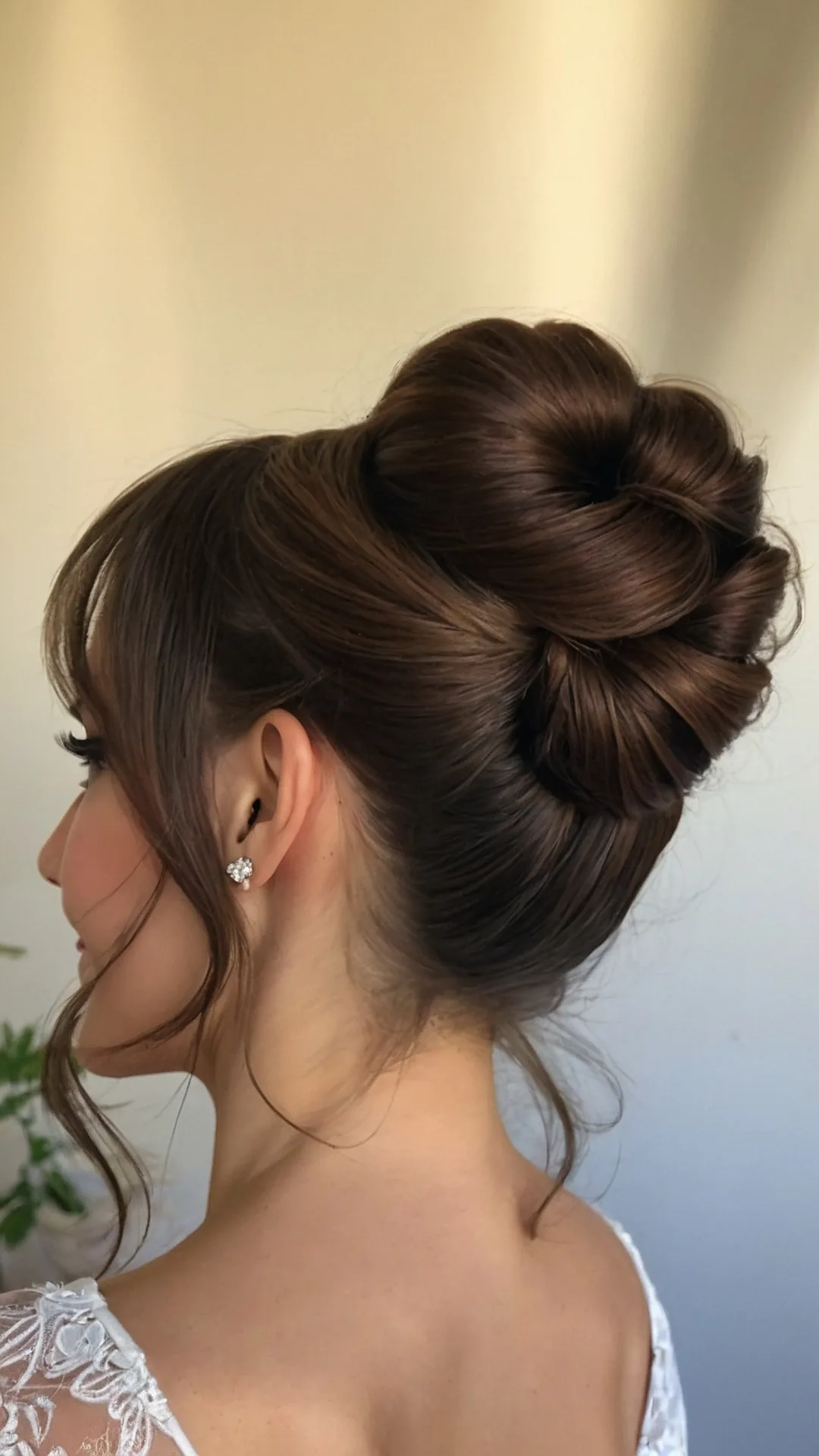
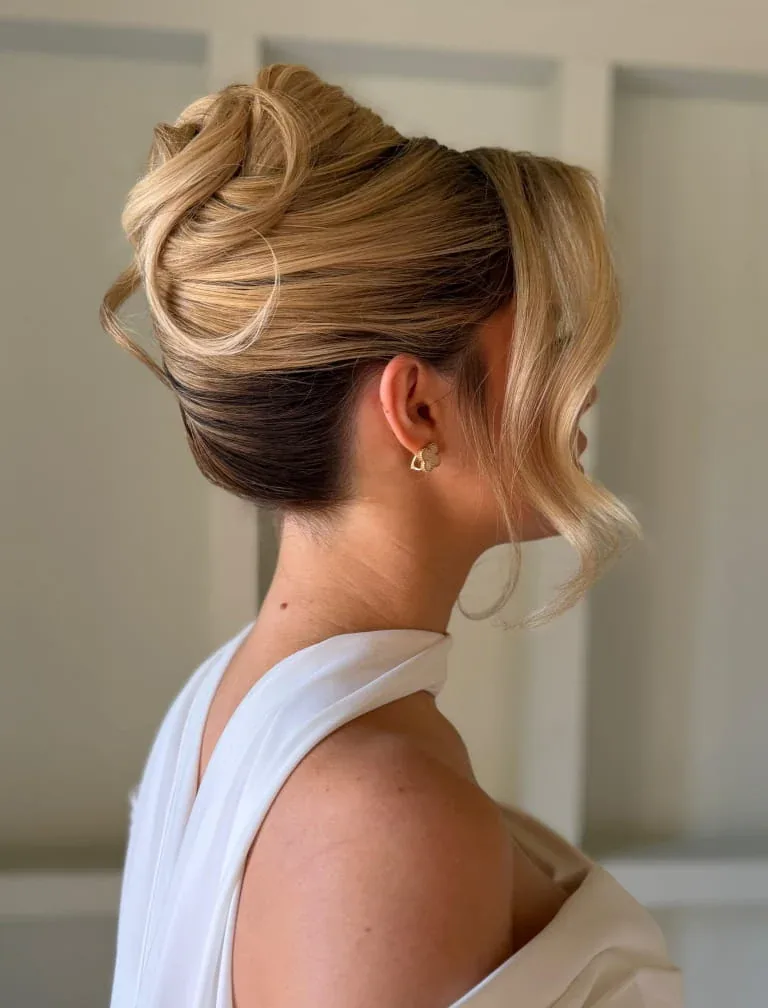
A French twist is usually thought of as a long-hair style, but medium hair makes a neat, compact twist that sits beautifully at the back of the head. The hair is gathered low, folded up and pinned into a vertical roll — and because medium hair is not too heavy, the roll stays put without a struggle. It is the most elegant updo in this guide, and the one that shows off the neckline and the back of the dress best. This is the twist for a formal wedding, a black-tie evening, or a bride who wants to look like she stepped out of another era.
Pros: unmatched elegance, excellent hold, and a silhouette that makes any dress look more expensive. Cons: it takes 30 to 40 minutes and is best done by a stylist, not attempted at home. Common mistake: trying to make the roll taller than medium hair allows — a medium twist should sit at mid-height, and forcing it higher leaves the ends poking out. Hold time: all day with U-pins. Veil compatibility: excellent — the veil comb slides into the top of the roll. Who should avoid it: brides who want a relaxed, loose feel; this twist is polished, not undone. Quick verdict: the showstopper updo — formal, sculpted, and worth every pin.
7. The Elegant Rolled Updo
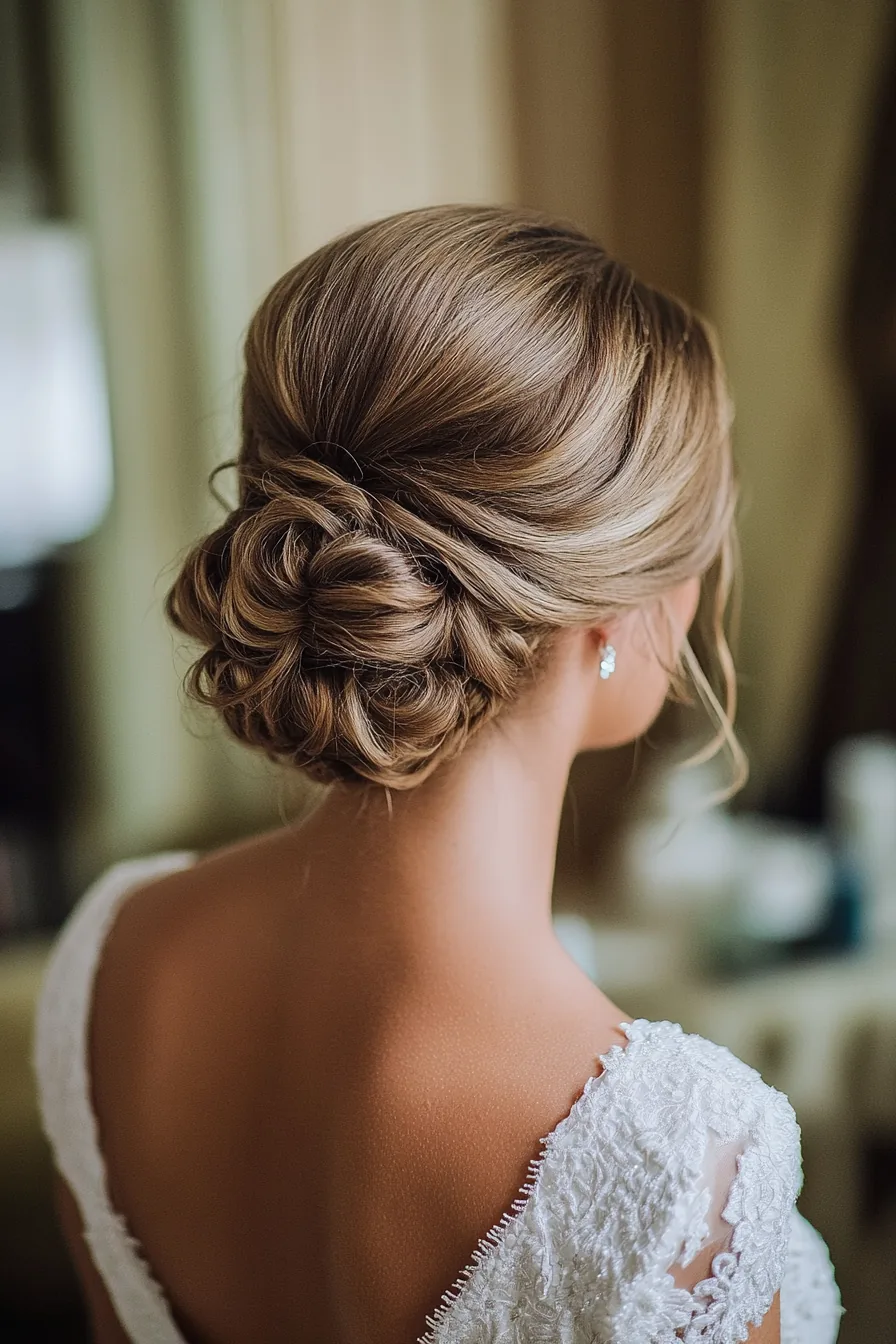
The elegant rolled updo is a softer cousin of the French twist: the hair is rolled upward in a gentle curve rather than folded into a sharp vertical line, so the result is a smooth, rounded roll that sits low and looks romantic rather than severe. It is the updo for a bride who loves the idea of a twist but wants something gentler, and for a vintage-inspired dress that calls for a soft, 1940s silhouette. The roll catches the light beautifully in photographs, and it is one of the most comfortable updos to wear, because the weight sits low.
Best for: vintage dresses, formal ceremonies, and brides who want elegance without stiffness. How to style: smooth the hair, roll it upward from the nape in one gentle curve, and pin along the seam with U-pins. What to ask your stylist: for a soft, rounded roll, not a sharp twist, and for a smooth finish with no flyaways. Veil compatibility: excellent — the veil comb anchors into the top of the roll. Hold time: 10 to 12 hours. Quick verdict: the gentle twist — all the elegance, none of the severity.
8. Half-Up, Half-Down with Soft Curls
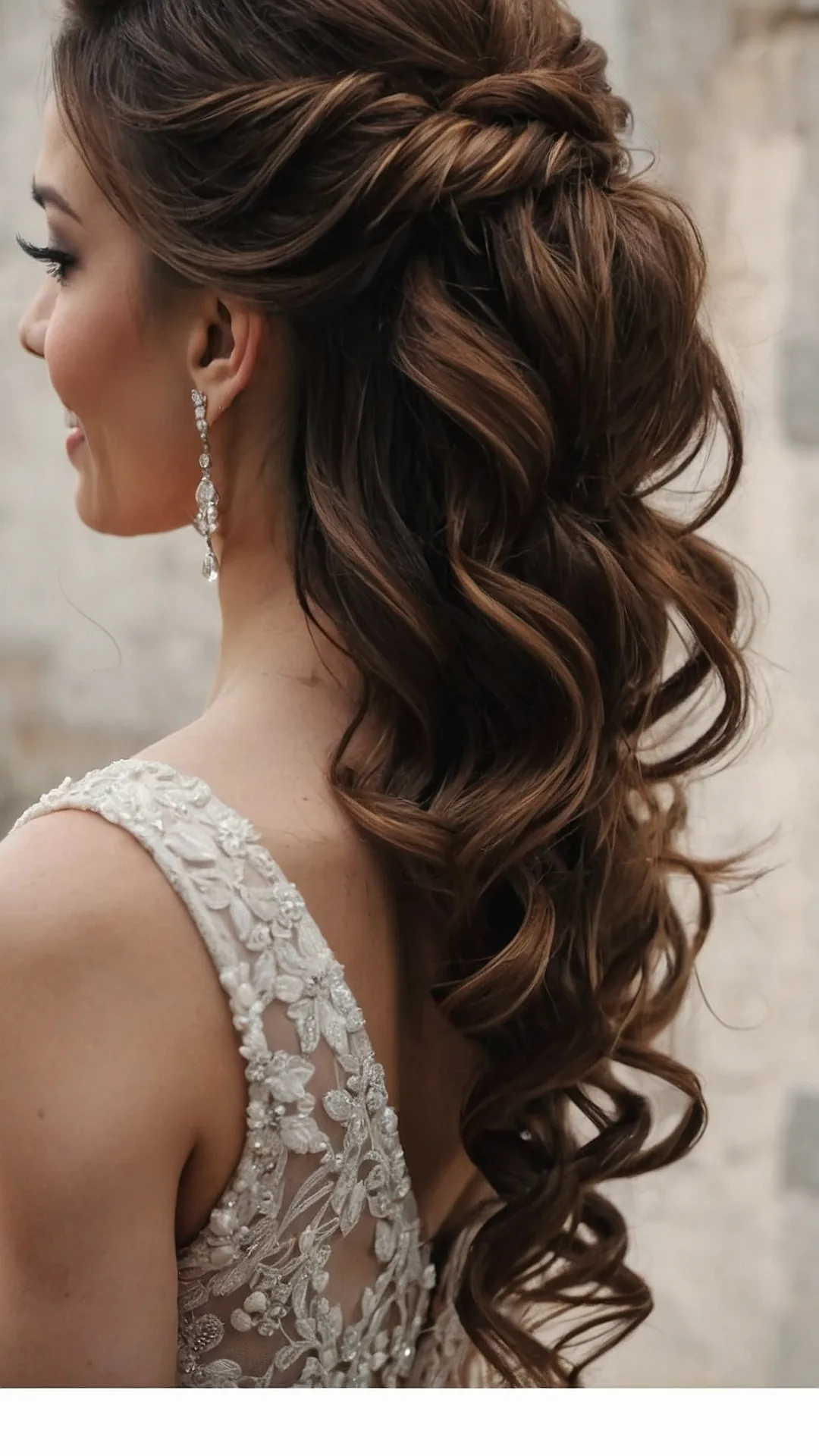
Half-up, half-down with soft curls is the most popular wedding hairstyle for medium hair, and it is easy to see why. The top half is lifted and pinned at the crown, which opens up the face and shows off the earrings, while the rest falls in soft, full curls over the shoulders. It gives you the best of both worlds: the polish of an updo and the romance of wearing your hair down. It suits almost every dress, every face shape and every venue, and it is the style most brides picture when they first imagine their wedding hair.
Best for: first-time brides, strapless and sweetheart necklines, and medium hair that holds a curl well. How to style: curl the hair in large sections first, let the curls cool, then gather the top half and pin it at the crown with the curls falling free below. What to ask your stylist: for the top section to be lifted, not flat, and for the curls to be brushed out softly so they look like waves, not ringlets. Veil compatibility: very good — the veil comb slides into the pinned section. Hold time: 8 to 10 hours; the curls will soften but not drop completely. Quick verdict: the classic bridal compromise that is not a compromise at all.
9. The Half-Up Twisted Crown

The half-up twisted crown takes the top sections of hair from each side, twists them toward the back, and joins them at the crown — like a crown made of your own hair. It is romantic, a little bit bohemian, and wonderfully flattering, because the twists lift the hair away from the face and create a pretty detail at the back. The rest of the hair falls loose in waves or curls. This is the style for a garden wedding, a summer ceremony, or a bride who wants something more interesting than a plain half-up but less formal than a full updo.
Pros: romantic, lightweight, and easy to wear all day. Cons: the twists can loosen in humidity, so they need to be pinned well and sprayed. Common mistake: twisting the sections too tightly, which makes the crown look severe — keep the twists soft and pull them apart slightly for fullness. Hold time: 8 hours. Veil compatibility: good — the veil comb sits just below the joined twists. Extension notes: none needed. Quick verdict: a crown you grew yourself — pretty, romantic, and surprisingly simple.
10. Half-Up with Face-Framing Layers

A half-up style with face-framing layers is the most flattering half-up for most faces, because the layers do the softening. The top half is pinned back, and the layered pieces around the face are left out to fall softly along the cheekbones and jawline, curling gently at the ends. The result is a style that frames the face in every photograph while keeping the hair off the shoulders. It is the half-up for brides with layers in their cut, and for anyone who worries that pinned-back hair makes their face look bare.
Best for: round, square and heart-shaped faces, and layered medium cuts. How to style: leave the front layers out, pin the top section back at the crown, then curl the loose layers lightly so they fall along the face. What to ask your stylist: for the layers to start at the cheekbone, not shorter, and for the pinned section to have a little lift. Veil compatibility: very good. Hold time: 8 to 10 hours. Quick verdict: the half-up that flatters everyone — the layers make all the difference.
11. Half-Up with Volume at the Crown
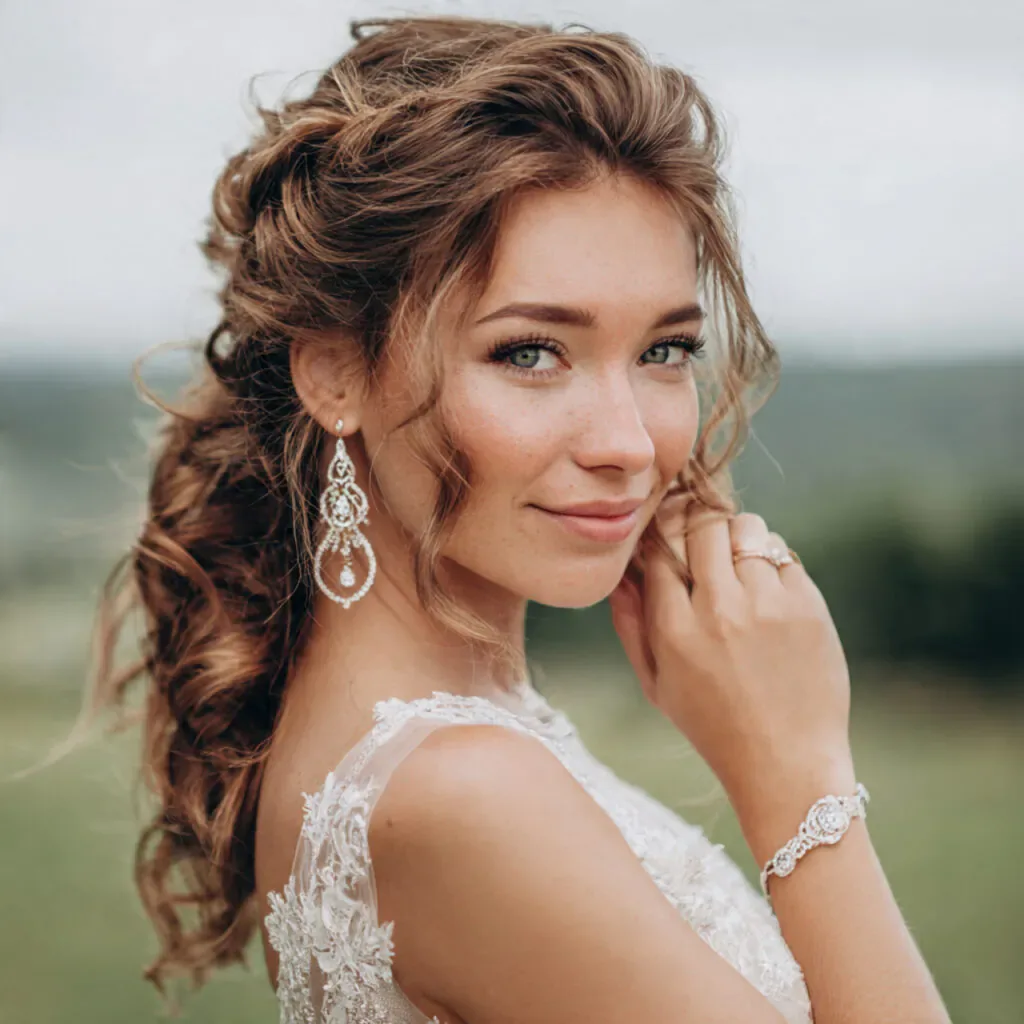
Half-up with volume at the crown is the half-up for brides who want height and presence. The crown is backcombed lightly and smoothed over, so the top of the head has a soft, lifted shape, and the rest of the hair falls in waves below. The volume lengthens the face, balances a full skirt, and gives the style a glamorous, old-Hollywood feeling without going full beehive. It suits a formal wedding, a ballgown, and a bride who wants her hair to have real presence in the photographs.
Pros: glamorous, lengthening, and excellent in photographs. Cons: the backcombing needs to be brushed out gently at the end of the night, and the style can feel heavy if the volume is overdone. Common mistake: backcombing too aggressively, which creates a hard pouf instead of a soft lift — the volume should look like height, not a bump. Hold time: 10 hours. Veil compatibility: good — the veil comb sits behind the volume, not on top of it. Quick verdict: a little lift, a lot of glamour — the crown volume turns a simple half-up into a statement.
12. The Half-Up Braided Crown
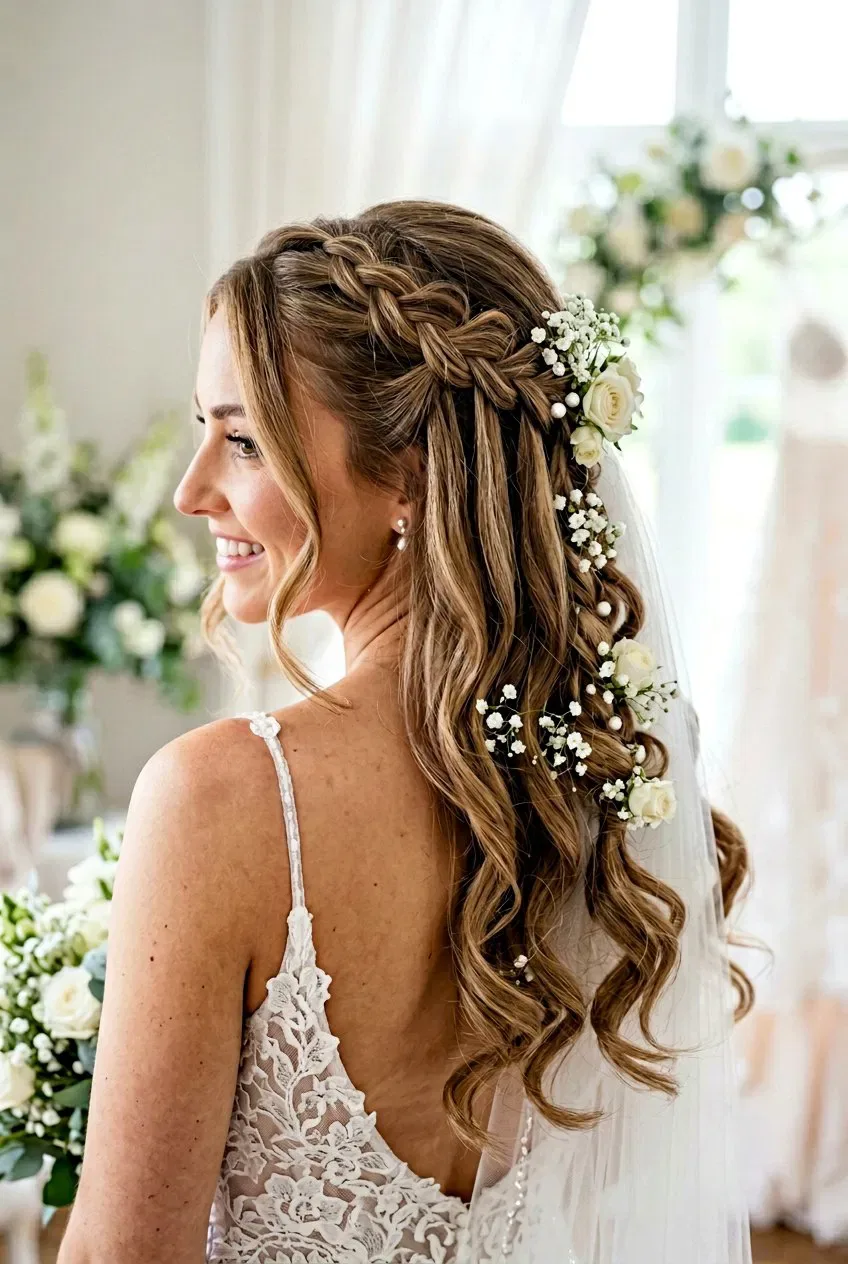
The half-up braided crown braids the hair from each side of the head and joins the two braids at the back, forming a crown that sits above loose waves. It is the most romantic half-up in this guide, and the one that looks most like a fairy tale — which is exactly why brides love it. The braids add texture and detail that photographs beautifully, and the loose hair underneath keeps the style soft and wearable. This is the crown for a garden wedding, a woodland ceremony, or a bride who has always loved braids.
Best for: outdoor weddings, boho dresses, and naturally wavy hair. How to style: braid each side loosely from the temple, pull the braids apart gently for fullness, join them at the back with pins, and curl the loose lengths in soft waves. What to ask your stylist: for the braids to be soft and full, not tight, and for a few wisps to be left out around the face. Veil compatibility: good with a fingertip veil worn below the crown. Extension notes: none needed. Hold time: 8 hours. Quick verdict: the fairy-tale half-up — a braided crown, loose waves, and a bride who looks like she walked out of a storybook.
13. Half-Up with Loose Waves and a Clip

Half-up with loose waves and a clip is the fastest way to make a half-up style feel finished: the top section is pinned back, the lengths are waved loosely, and a single beautiful clip — pearls, crystals or a gold barrette — sits where the hair is pinned. The clip is the jewellery of the hairstyle, so choose it well, and let it do the work. This is the style for a bride who loves accessories, for a wedding guest turned bride who wants her hair to look considered without a complicated updo, and for a relaxed ceremony where elegance should feel effortless.
Best for: brides who love hair accessories, and relaxed or modern weddings. How to style: wave the hair loosely, pin the top section back with hidden pins, then slide the clip in at the base of the pinned section so it sits on top of the hair. What to ask your stylist: for the clip to be the focal point, so the pinned section stays small and neat. Veil compatibility: good — the veil comb sits above the clip, or the clip replaces the veil for the reception. Hold time: 8 to 10 hours. Quick verdict: one clip, one pin, one beautiful half-up — the simplest style here, and one of the prettiest.
14. A Loose Side Braid into a Low Bun
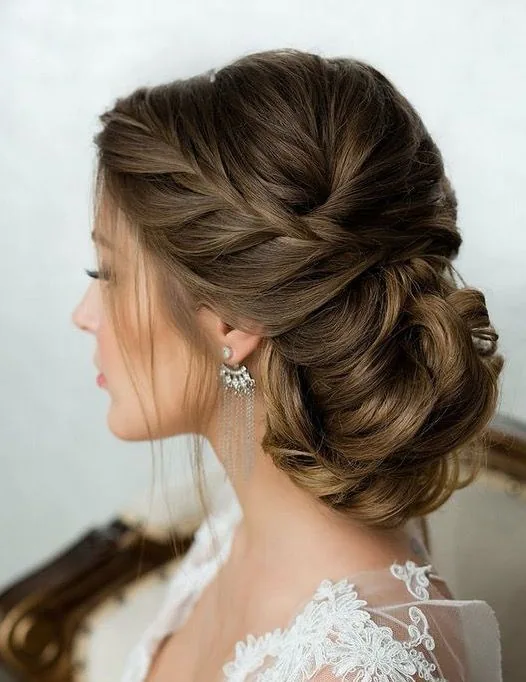
A loose side braid into a low bun is two styles in one: a soft braid worked from one side of the head, which flows into a low bun at the nape. The braid gives the style a beautiful, detailed texture across the crown, and the bun gives it the elegant finish at the back — so the hairstyle looks intricate from the front and polished from behind. It is the braid for a bride who wants detail without a full braided updo, and it holds exceptionally well, because the braid anchors the hair section by section before the bun even begins.
Best for: formal weddings, detailed dresses, and medium hair that braids easily. How to style: braid loosely from one side, pull the braid apart for fullness, gather the remaining hair with the braid’s tail, and coil it into a low bun. What to ask your stylist: for the braid to be soft and full, and for the bun to sit low so the braid is the star. Veil compatibility: excellent — the veil comb slides in above the bun. Hold time: all day. Quick verdict: the most detailed bun here — a braid and a bun, each making the other look better.
15. The Dutch Braid Crown into an Updo
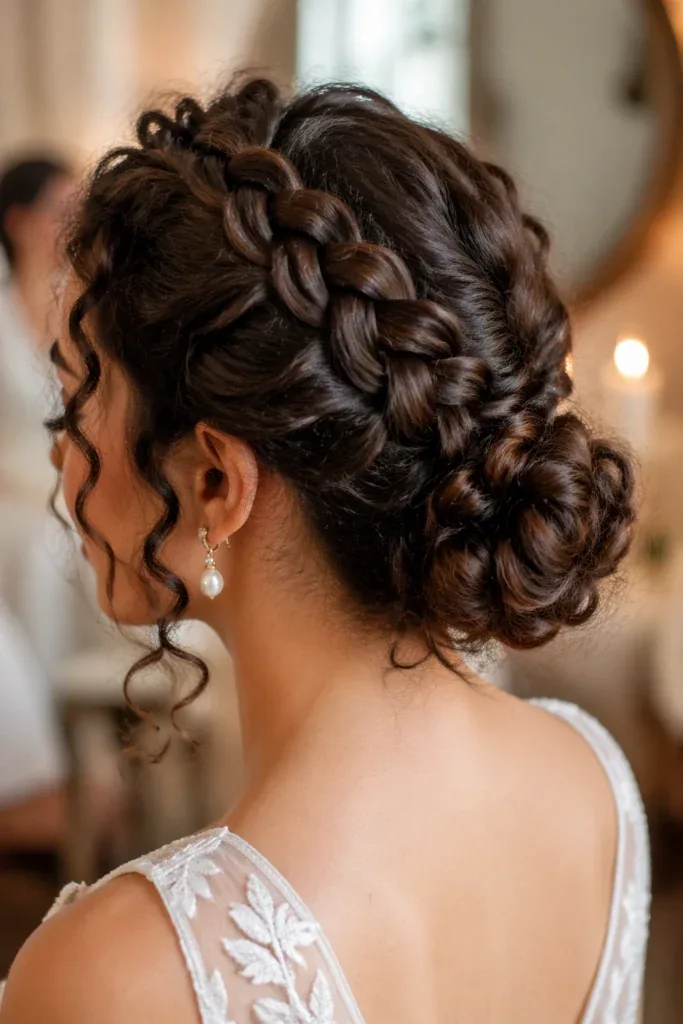
The Dutch braid crown into an updo braids the hair along the hairline — the braid sitting on top of the hair rather than woven into it, so it stands out in relief — and then gathers everything into a low updo at the back. The crown braid frames the face like a headband made of hair, and the updo keeps everything secure. It is a striking, unusual style, and the one that gets the most compliments in photographs, because the braid is visible from the front, the side and the back. This is the style for a bride who wants her hair to be a talking point.
Pros: a beautiful, unusual detail that photographs wonderfully from every angle. Cons: it takes 40 to 50 minutes and needs a stylist who braids well. Common mistake: braiding too tightly, which pulls at the hairline and gives you a headache — a crown braid should be soft, with a little give. Hold time: all day. Veil compatibility: good — the veil comb sits behind the crown braid. Who should avoid it: brides with very fine hair, where the braid can look thin; pull it apart gently for fullness, or choose a softer braid. Quick verdict: the crown braid — dramatic, detailed, and unforgettable.
16. A Fishtail Braid Low Bun
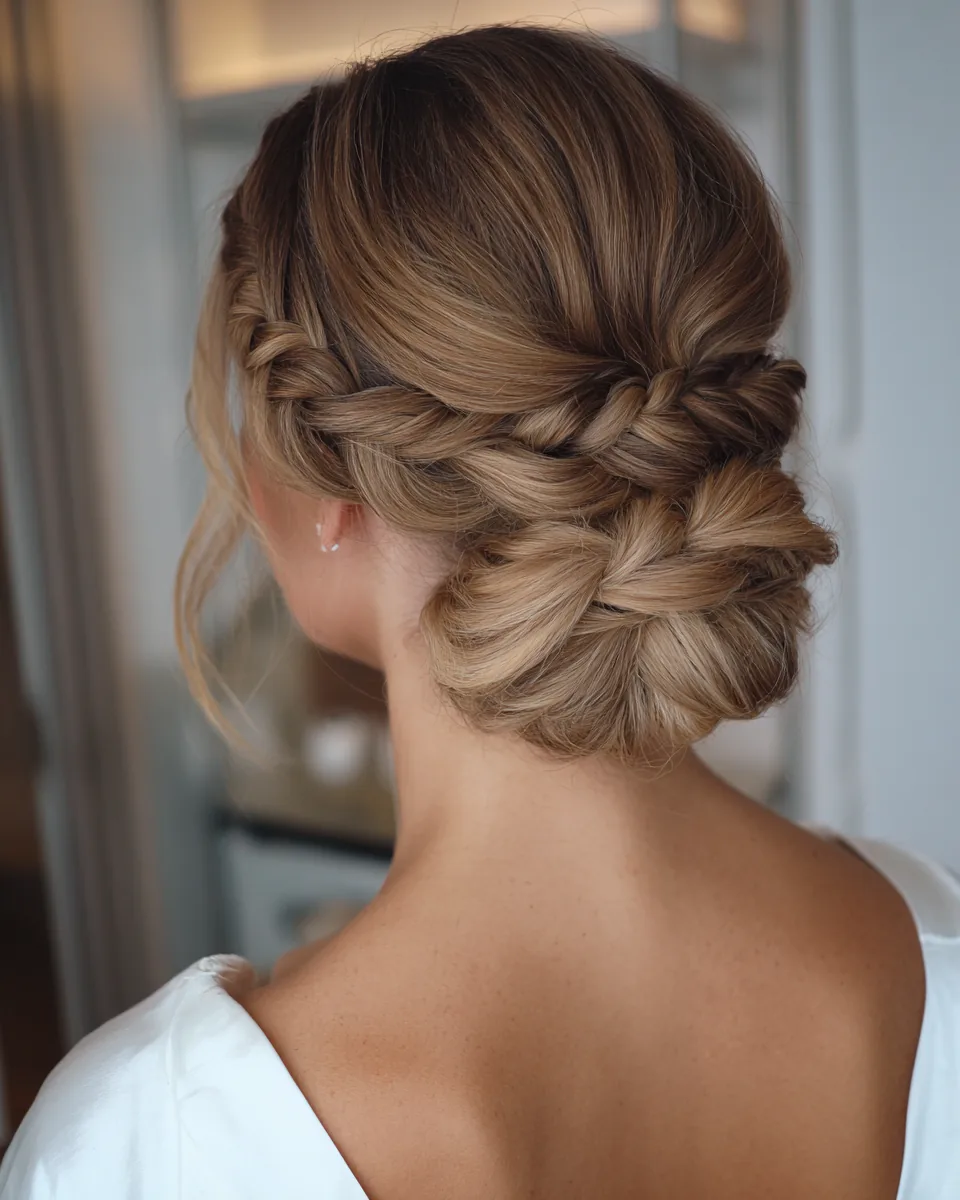
A fishtail braid low bun weaves a fishtail — made from two sections instead of three, so it looks finer and more detailed than an ordinary braid — into a low bun at the nape. The fishtail texture gives the bun a delicate, intricate surface that catches the light, and the contrast between the fine braid and the smooth bun is lovely. This is the bun for a bride who loves braids but finds a full braided updo too much, and for a dress with clean lines that can carry a more detailed hairstyle.
Best for: modern dresses, garden weddings, and medium hair with some length to braid. How to style: fishtail the gathered hair loosely, pull the braid apart gently for fullness, then coil it into a low bun and pin along the seam. What to ask your stylist: for the fishtail to run visibly around the outside of the bun, not hidden inside it. Veil compatibility: excellent. Hold time: all day. Extension notes: none needed for the bun; a few clip-ins can lengthen the fishtail if you want it longer. Quick verdict: a small braid, a big effect — the fishtail turns a simple bun into a conversation piece.
17. The Braided Low Chignon

The braided low chignon braids the hair first — a simple three-strand braid down the back — and then coils the braid itself into a low chignon. The result is a knot with a beautiful braided texture running through it, like a rope coiled into a bun. It is more interesting than a plain chignon and more secure, too, because the braid holds the hair together before the pins even go in. This is the chignon for a bride who wants a classic shape with a little more craft, and for a textured or lace dress that pairs well with a detailed hairstyle.
Pros: secure, detailed, and wonderfully photogenic from the back. Cons: it needs enough length to braid and coil, so very short medium hair may need a little padding. Common mistake: braiding too tightly, which makes the chignon look small and hard — keep the braid loose and pull it apart for fullness before coiling. Hold time: all day. Veil compatibility: excellent. Quick verdict: the chignon, braided — a classic shape, a clever texture, and a knot that will not move.
18. The Milkmaid Braid for Medium Hair
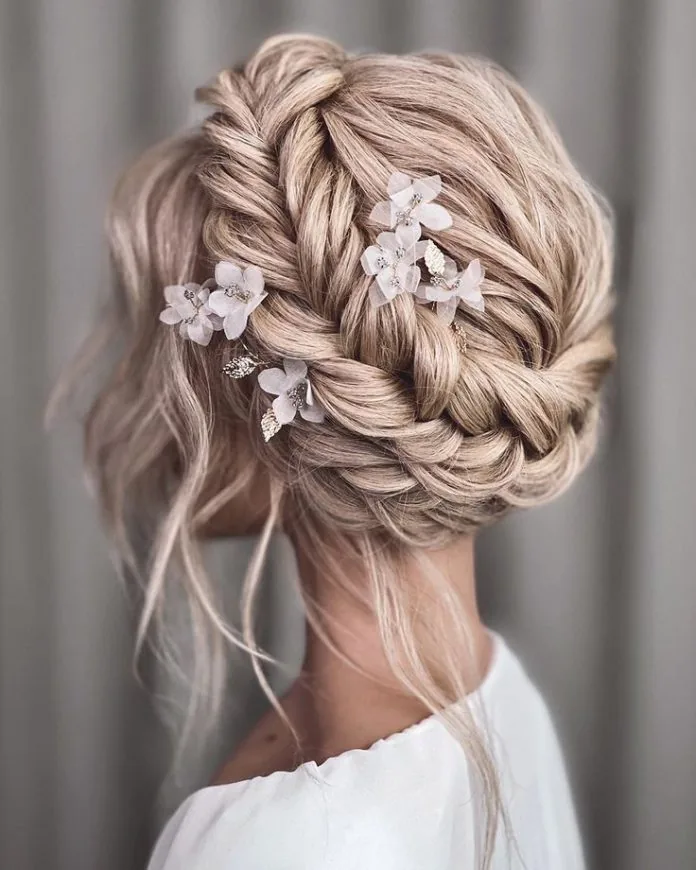
The milkmaid braid — two braids wrapped over the top of the head like a crown — is the most romantic braided style in this guide, and medium hair wears it well. The braids sit high, framing the face, and the rest of the hair is tucked away, so the style is cool, secure and completely out of the way for a summer wedding. It suits a boho dress, a garden ceremony, and a bride who wants to look like a painting. It also holds better than almost any other style here, because the braids anchor each other.
Best for: summer weddings, boho dresses, and hot weather. How to style: braid two sections from behind each ear, pull them apart for fullness, cross them over the top of the head and pin the ends underneath. What to ask your stylist: for the braids to sit softly, with a few wisps at the face, not pulled tight against the scalp. Veil compatibility: tricky — a veil comb can sit behind the braids, but many brides skip the veil with this style and wear flowers instead. Hold time: all day, easily. Quick verdict: the most secure style in this guide — braids that hold, a crown that stays, and a bride who can dance without a worry.
19. A Braid-and-Twist Hybrid Updo
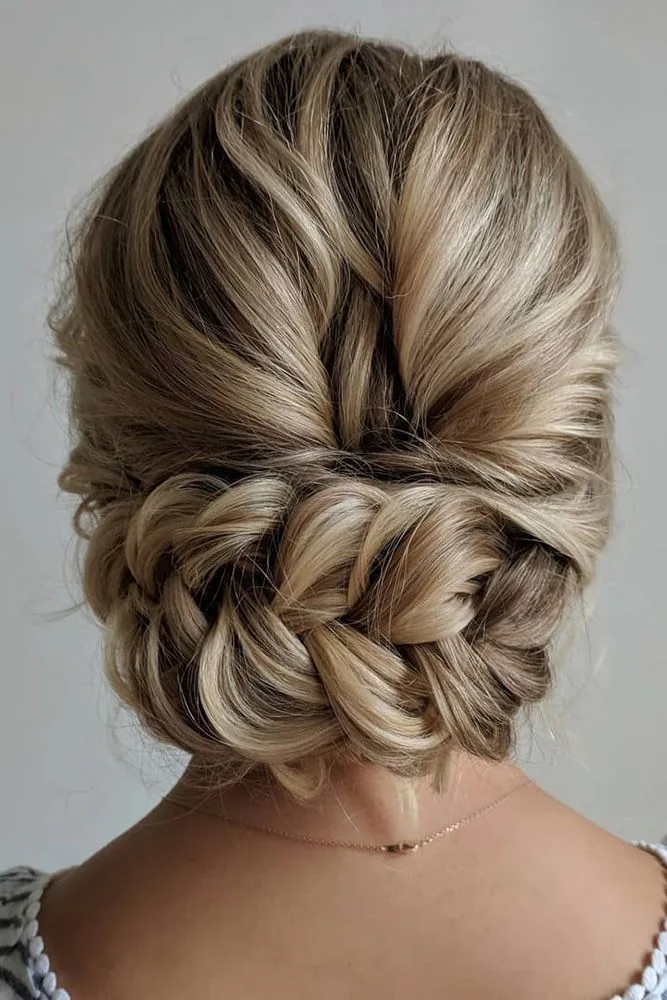
The braid-and-twist hybrid updo combines a small braid on one side with a soft twist on the other, meeting in a low bun at the back. It is the best of both techniques: the braid gives detail and texture, the twist gives smoothness and shape, and the bun gives the whole style its finish. It is a little bit boho and a little bit classic, which makes it perfect for a bride who cannot decide between the two — and for a wedding that is itself a mix of formal and relaxed. No two hybrids look alike, which is part of the charm.
Pros: unique, detailed, and flattering from every angle. Cons: it takes a stylist who is comfortable with both braiding and twisting, and it needs 35 to 45 minutes. Common mistake: making one side much bigger than the other — the braid and the twist should balance. Hold time: all day. Veil compatibility: very good. Extension notes: none needed. Quick verdict: the hybrid — a braid, a twist and a bun, all in one style, and none of them competing.
20. Old Hollywood Waves at Shoulder Length
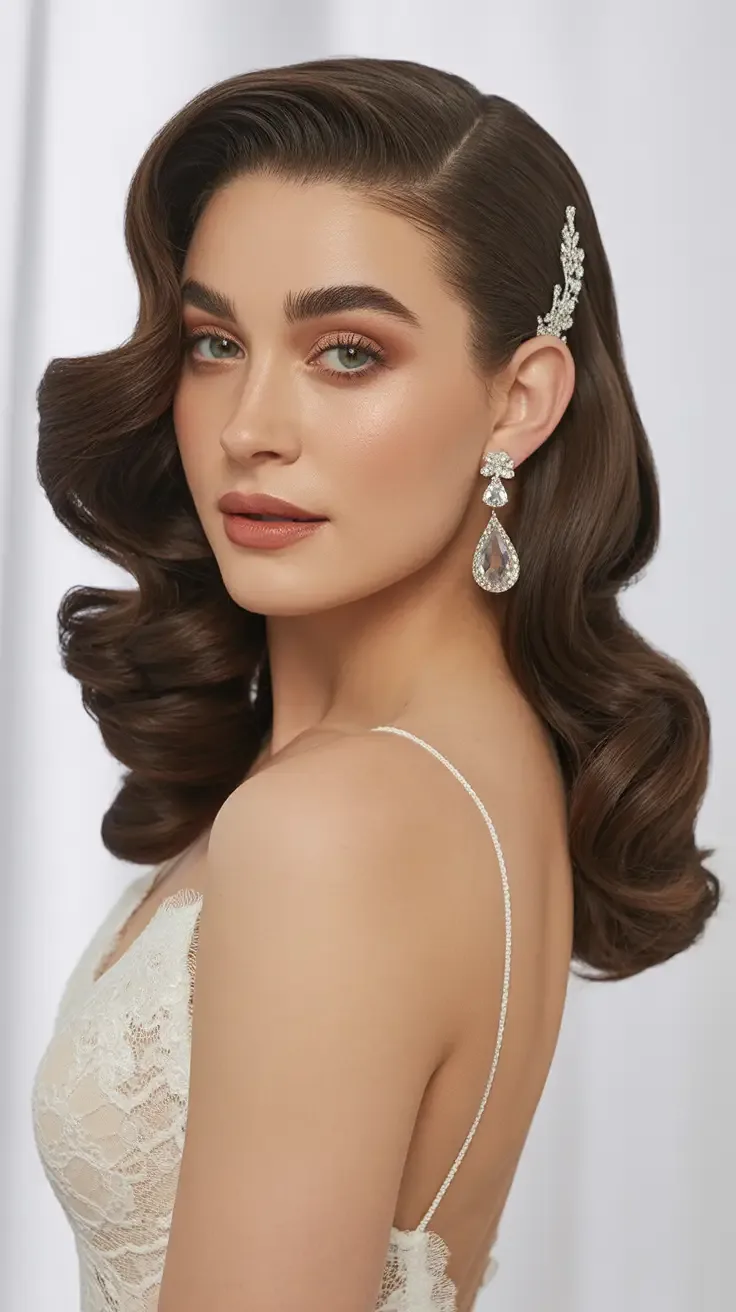
Old Hollywood waves at shoulder length are the most glamorous style in this guide: deep, glossy, sculpted waves that fall in a single, polished sheet on one side. The waves are set with a large-barrel iron, brushed out into smooth, uniform curves, and set with a strong-hold spray. It is the hairstyle of the golden age of cinema, and it suits a formal wedding, a long gown and a bride who wants to look like a film star. Medium hair is actually ideal for this look, because the waves do not have too much weight pulling them straight.
Best for: formal weddings, long gowns, and side-parted styles. How to style: curl all the hair in the same direction with a large barrel, let the curls cool completely, brush them out into waves with a soft brush, and set with spray. What to ask your stylist: for the waves to be brushed into one smooth sheet, not left as separate curls, and for a deep side part. Veil compatibility: fair — a fingertip veil works, but a heavy veil will flatten the waves; many brides wear this style without a veil. Hold time: 8 to 10 hours with a strong set. Quick verdict: pure glamour — the most cinematic style here, and the one that photographs like a movie still.
21. Vintage Finger Waves on a Lob
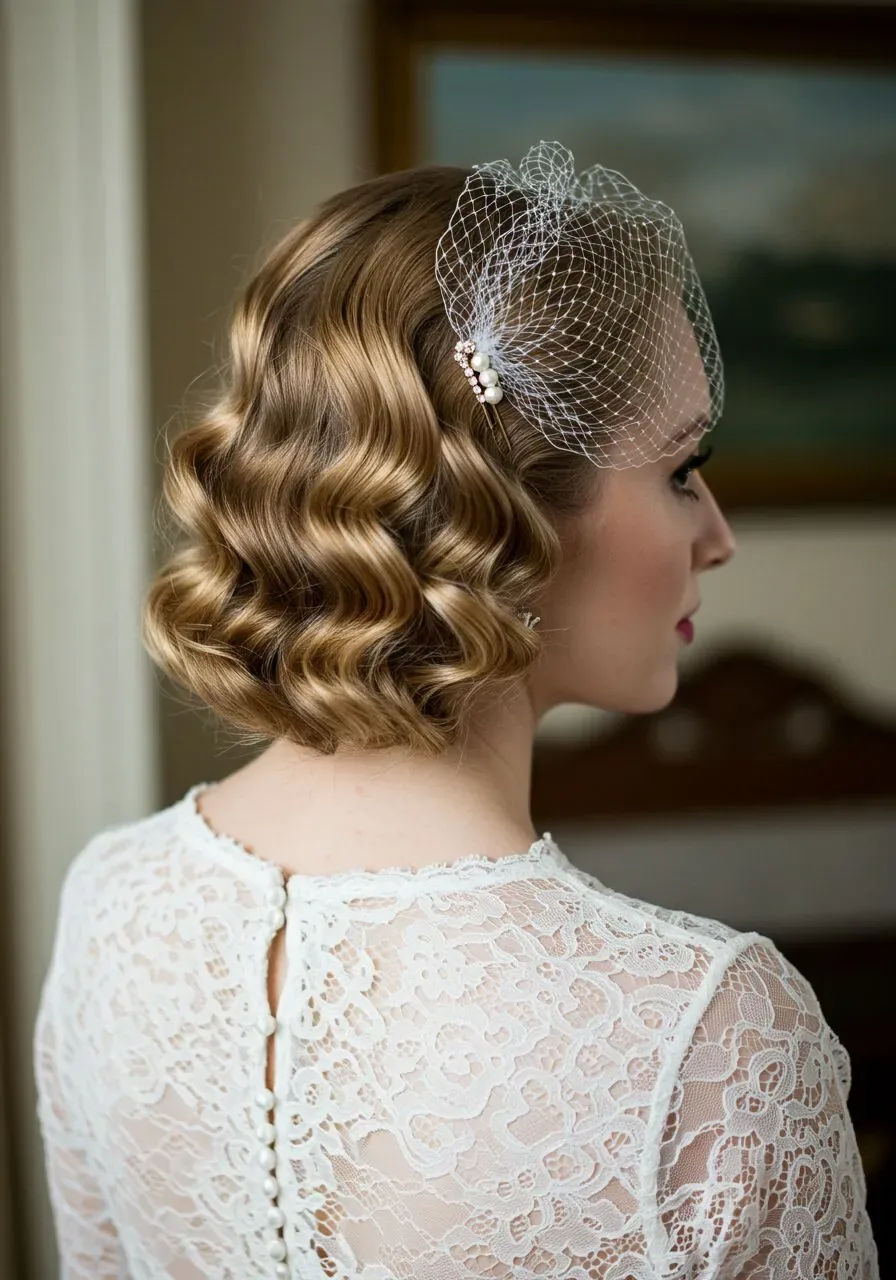
Vintage finger waves on a lob are the 1920s, worn soft for a modern wedding. The waves are sculpted close to the head in smooth, S-shaped curves, giving the style a sculpted, jewel-like finish that is completely different from loose, modern waves. It suits a vintage-inspired dress, a Gatsby-themed wedding, and a bride who loves the 1920s and wants her hair to be part of the theme. It is also one of the most secure styles here, because the waves are set close to the head and do not move.
Pros: a true vintage statement, excellent hold, and a style nobody else will have. Cons: it takes a skilled stylist and 45 minutes or more, and it is not a style to attempt at home. Common mistake: confusing finger waves with loose curls — finger waves are sculpted flat against the head, and they need setting lotion and clips, not just a curling iron. Hold time: all day. Veil compatibility: good with a birdcage veil, which suits the era perfectly. Who should avoid it: brides who want soft, touchable hair; finger waves are sculpted, not loose. Quick verdict: the 1920s, done properly — sculpted, striking, and unforgettable.
22. Retro Victory Rolls for Medium Hair

Retro victory rolls are the 1940s, worn for a wedding: two soft rolls of hair swept up and pinned on either side of the head, with the rest of the hair waved or pinned into a low bun. They are playful, glamorous and unmistakably vintage, and they suit a tea-length dress, a 1940s-themed wedding, or a bride who wants her hair to be the talking point of the day. Medium hair makes excellent victory rolls, because the rolls are compact and the hair is easy to shape.
Best for: vintage-themed weddings, tea-length dresses, and confident brides. How to style: section the front hair, roll each section upward and inward, pin the rolls in place, and style the remaining hair in waves or a low bun. What to ask your stylist: for the rolls to be soft and even, not too high or too tight, and for the back to be finished neatly. Veil compatibility: fair — a small birdcage veil works; a long veil fights the rolls. Hold time: all day with plenty of pins. Quick verdict: the most fun style here — victory rolls are a party on your head, and they photograph brilliantly.
23. A 1950s Pin-Curl Set for the Bride
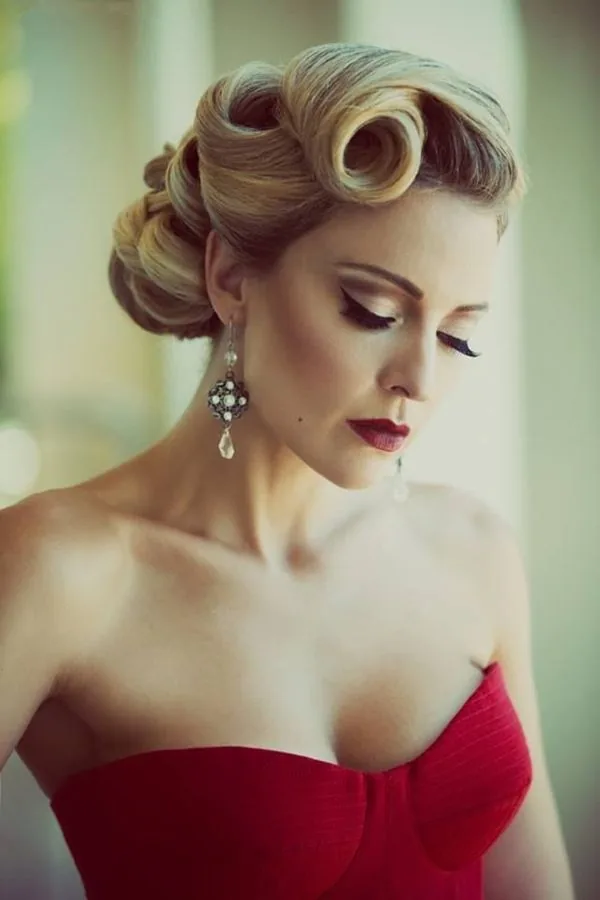
A 1950s pin-curl set gives medium hair soft, bouncy, perfectly formed curls that hold all day — the kind of curls that look like they were set in a salon in 1955, because they were, in spirit. The hair is set in pin curls, left to cool, and brushed out into soft, voluminous waves with a smooth, polished finish. It suits a vintage dress, a full-skirted gown, and a bride who wants her hair to look finished and feminine rather than undone. It is also one of the longest-lasting curly styles, because the curls are set, not just ironed.
Pros: curls that last all day, a polished vintage finish, and excellent volume. Cons: the set takes an hour or more, so it needs to be done early on the morning. Common mistake: brushing the curls out too aggressively, which turns them into frizz — brush gently, with a soft brush, and stop while they still look like curls. Hold time: 12 hours. Veil compatibility: good with a fingertip veil. Extension notes: none needed; the set creates its own volume. Quick verdict: the set-and-forget curls — an hour in the morning, perfect waves all day.
24. Glamorous Side-Swept Waves

Glamorous side-swept waves sweep all the hair to one side in a deep, glossy wave, falling over one shoulder. It is the red-carpet look, worn for a wedding: dramatic, elegant, and wonderfully photogenic, because the sweep creates a long, beautiful line from the part to the shoulder. It suits a one-shoulder dress, a strapless gown, and a bride who wants her hair to be part of the drama of the day. Medium hair sweeps beautifully, because there is enough length to fall over the shoulder and not so much that it pulls the style down.
Best for: one-shoulder and strapless dresses, and formal evening weddings. How to style: part deeply on one side, curl the hair away from the face, brush the waves to one side, and pin the lighter side flat behind the ear. What to ask your stylist: for the sweep to be set with a clip while it cools, so it holds its curve. Veil compatibility: fair — wear the veil for the ceremony and remove it for the reception, when the sweep is the star. Hold time: 8 hours. Quick verdict: the red-carpet sweep — one side, one wave, and a whole lot of glamour.
25. Soft Vintage Curls with Volume
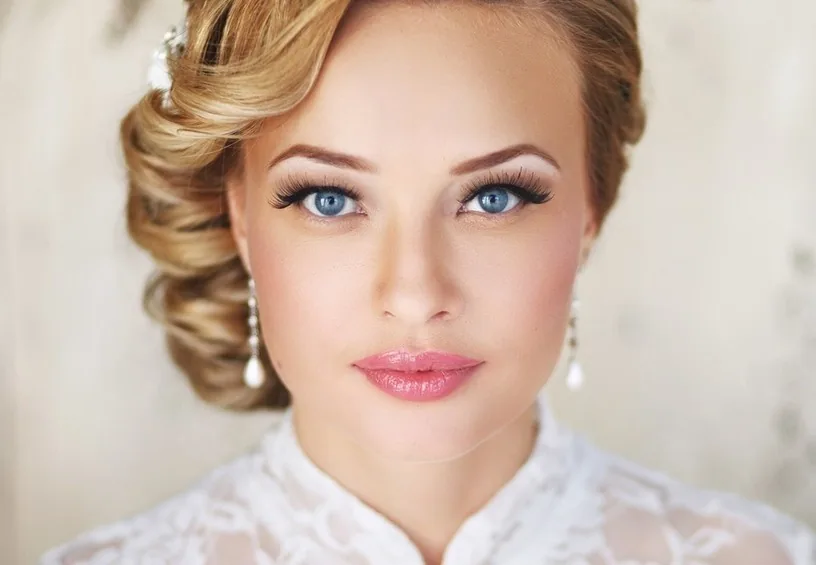
Soft vintage curls with volume are the gentler version of the pin-curl set: the hair is curled in large sections, brushed out into soft, full waves, and given volume at the roots, so the whole style has a soft, cloud-like fullness. It is the curls for a bride who loves vintage hair but wants it soft and touchable, not sculpted. It suits a full-skirted dress, a romantic venue, and a bride with naturally wavy hair, because the curls are already half there.
Pros: soft, romantic, and very flattering in photographs. Cons: the volume can drop in humidity, so it needs a good root spray. Common mistake: curling the hair too tightly, which makes ringlets instead of soft waves — use a large barrel and brush the curls out. Hold time: 8 to 10 hours. Veil compatibility: good with a fingertip veil. Quick verdict: vintage, softened — all the romance of the 1950s, with hair you can actually touch.
26. The Sleek Bridal Low Ponytail
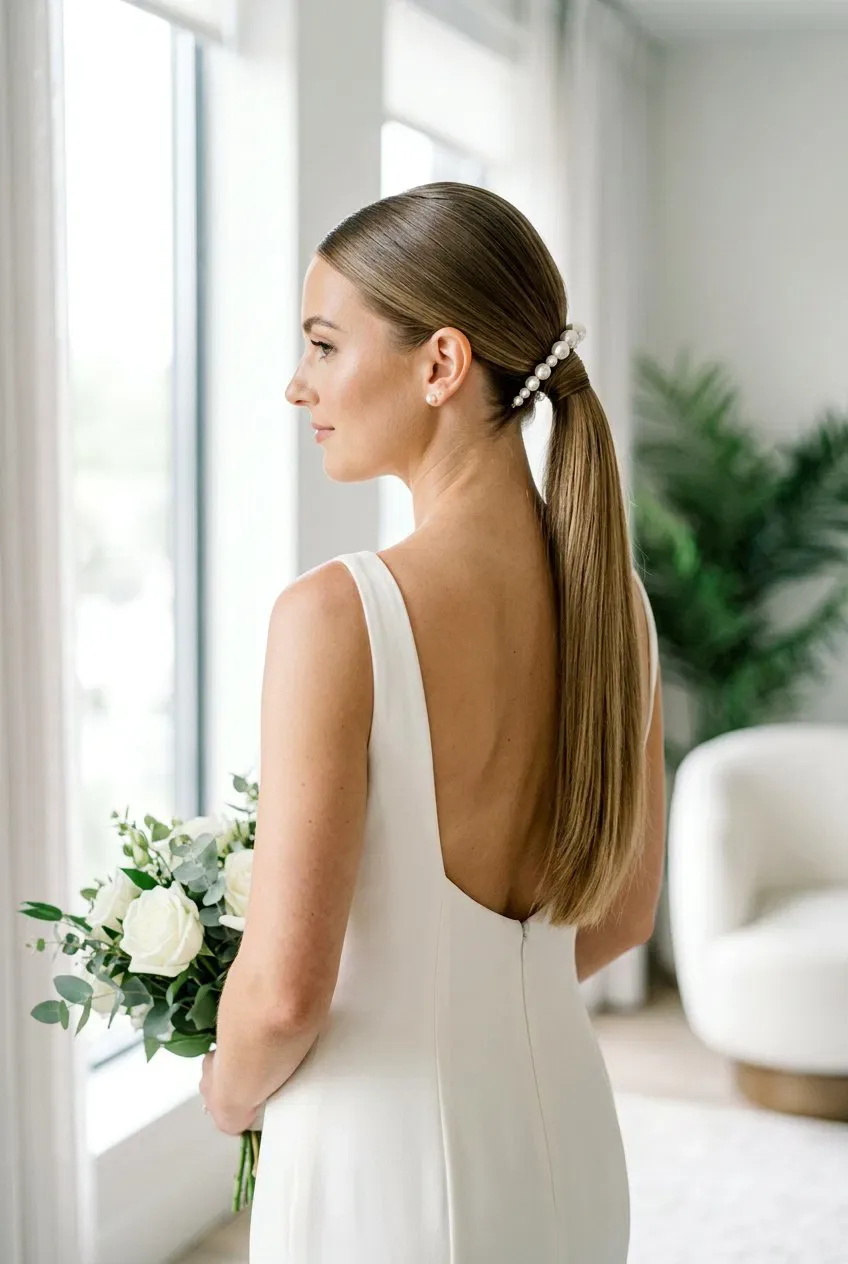
The sleek bridal low ponytail is the most modern look in this guide: the hair is smoothed flat, gathered low at the nape, and tied with a section of hair wrapped around the elastic so no band shows. It is clean, confident and quietly expensive — the hairstyle equivalent of a perfectly tailored suit. It suits a modern dress, a city wedding, and a bride who loves minimalism. It also photographs beautifully, because the clean line of the ponytail contrasts with the softness of the dress.
Best for: modern and minimalist dresses, city weddings, and straight or blow-dried hair. How to style: blow-dry the hair dead straight, smooth it with a serum, gather low, secure with an elastic, and wrap a section of hair around the band. What to ask your stylist: for the finish to be completely smooth, with no flyaways, and for the ponytail to sit at the nape, not high. Veil compatibility: very good — the veil comb slides in above the ponytail. Hold time: all day. Extension notes: none needed. Quick verdict: the most modern style here — simple, sharp, and completely confident.
27. A Sleek Centre-Part Low Bun
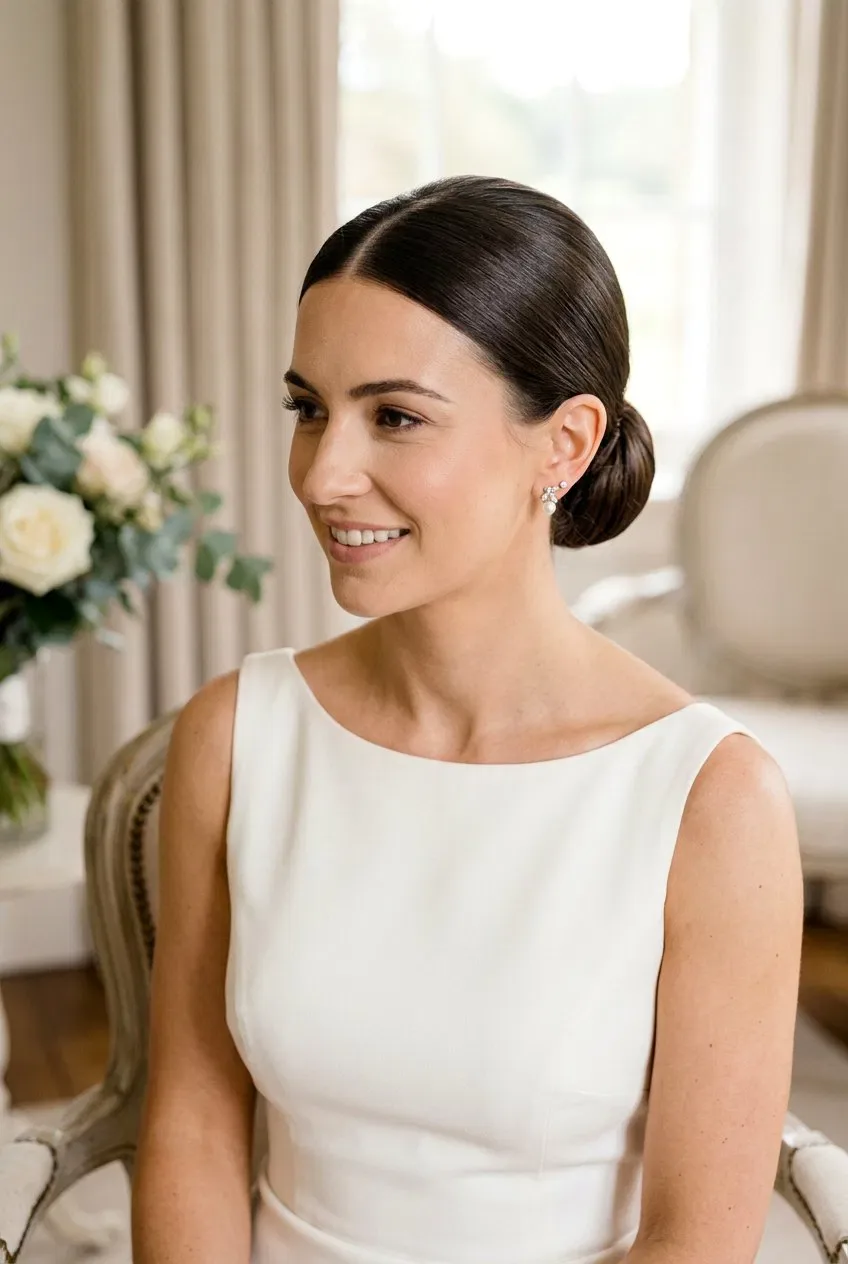
A sleek centre-part low bun is the low knot’s even more polished sister: the hair is parted precisely down the middle, smoothed flat on both sides with not a strand out of place, and gathered into a small, neat bun at the nape. It is the hairstyle for a bride who loves clean lines and quiet luxury, and for a dress that is itself clean and architectural. The centre part frames the face symmetrically, and the smooth finish makes the whole look feel deliberate and expensive.
Pros: elegant, modern, and excellent in photographs. Cons: it shows every flyaway, so it needs a perfect blow-dry and a good smoothing product. Common mistake: skipping the smoothing serum, which leaves the sides fluffy instead of flat. Hold time: all day. Veil compatibility: excellent. Who should avoid it: brides with very curly or frizzy hair that will not stay smooth — a softer style will be happier. Quick verdict: quiet luxury, worn in your hair — the most polished bun in this guide.
28. The Polished Straight Lob with a Veil
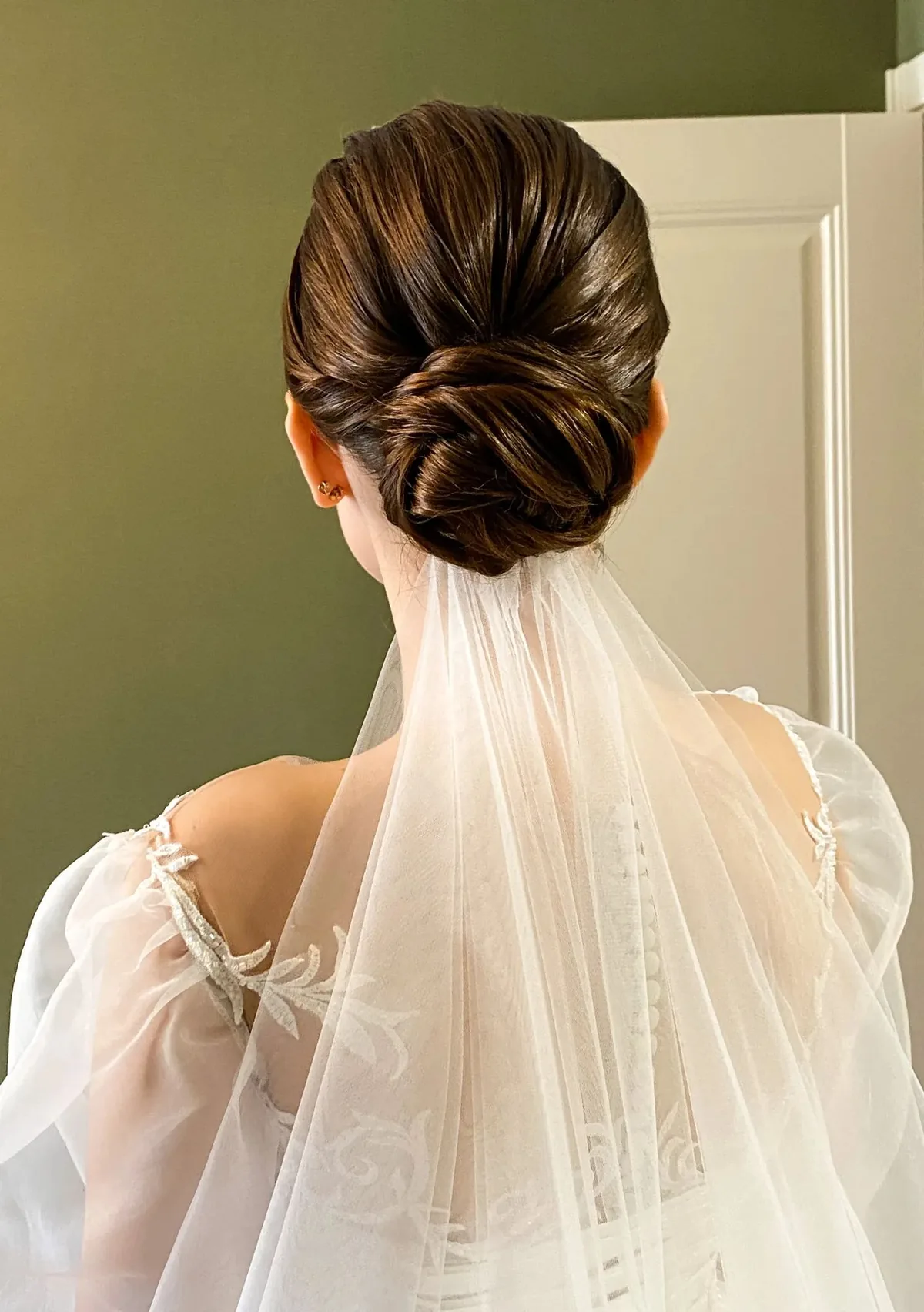
The polished straight lob with a veil is the simplest style in this guide — and sometimes the simplest is the bravest. The hair is blow-dried dead straight, with a smooth, glossy finish and a clean, blunt cut, and the veil does the rest. It suits a bride with a beautiful lob who does not want to hide it under an updo, and a modern dress that pairs well with clean, straight hair. The veil adds the bridal drama; the hair adds the polish.
Best for: brides with a sharp lob, modern dresses, and short ceremonies. How to style: blow-dry straight with a flat brush, finish with a smoothing serum, and let the veil comb sit just behind the crown. What to ask your stylist: for the ends to be perfectly even, and for a shine spray to finish. Veil compatibility: excellent — this style is built around the veil. Hold time: 6 to 8 hours; straight hair can drop in humidity. Quick verdict: the brave simple choice — a beautiful cut, a beautiful veil, and nothing to hide behind.
29. The Modern Minimal Twist
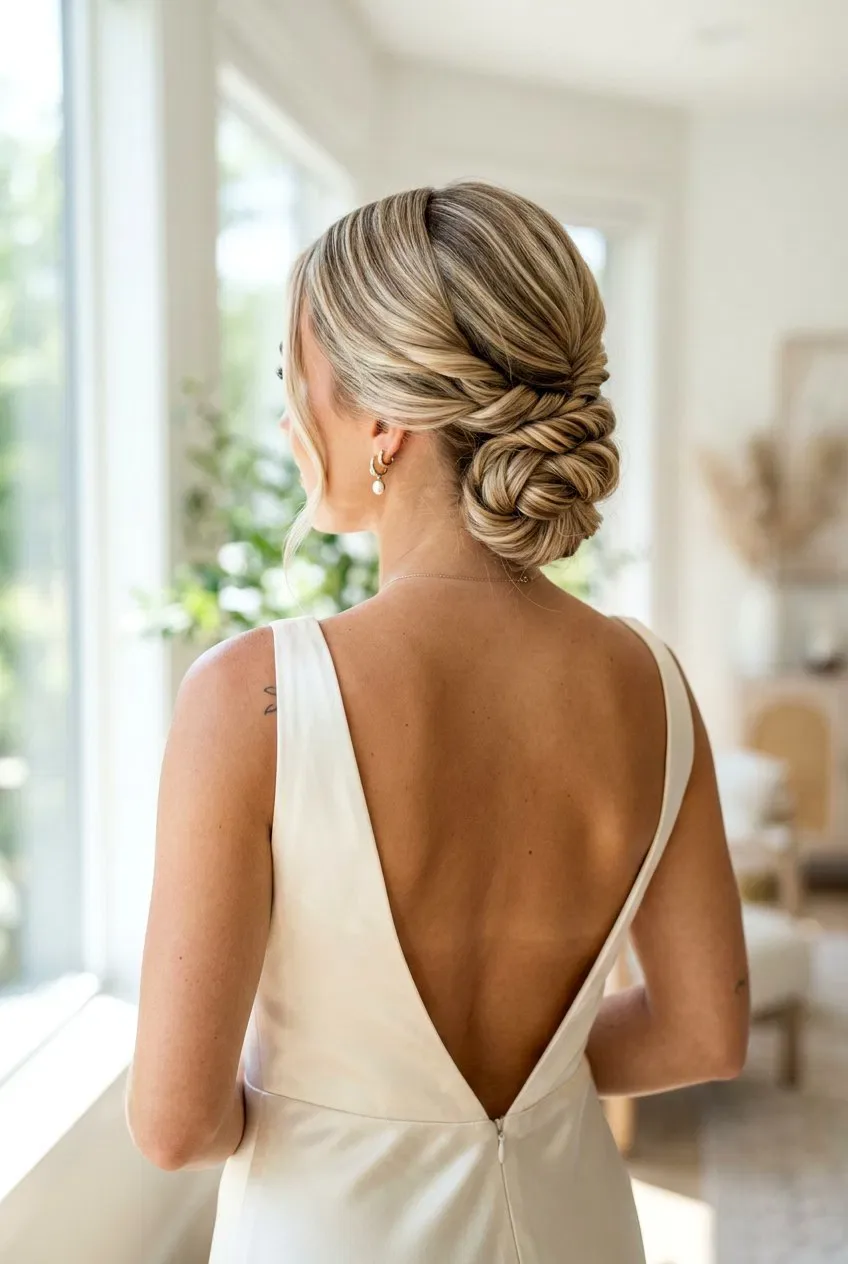
The modern minimal twist is a small, neat twist at the back of the head, worn with the rest of the hair smooth and straight — a detail, not a full updo. It is the twist for a bride who loves the French twist but wants something lighter and more modern, and for a dress with clean lines that should not compete with complicated hair. The twist adds just enough interest to the back view, and it photographs as a pretty, sculpted detail.
Pros: modern, lightweight, and quick to style. Cons: it is a subtle style, so it suits a confident bride who does not need her hair to make a statement. Common mistake: making the twist too big, which turns it into a full updo — keep it small and neat. Hold time: all day. Veil compatibility: very good. Quick verdict: minimal, but not plain — a small twist that says a lot.
30. A Sleek Side Part with Shine
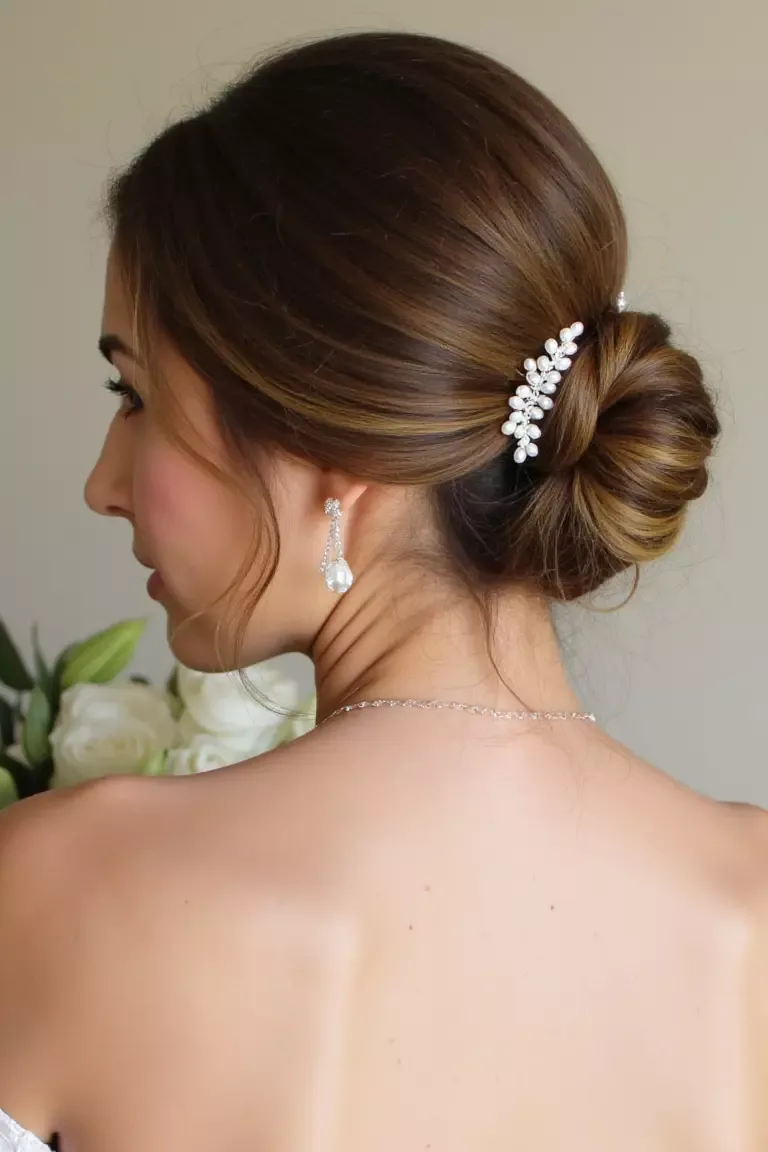
A sleek side part with shine is the polished, glossy style for a bride who loves a deep side part and a mirror-like finish. The hair is parted deeply, smoothed flat, and finished with a shine spray so it reflects the light. It suits a formal wedding, a satin dress, and a bride who wants her hair to look expensive. The side part adds drama, the shine adds glamour, and the whole style is over in twenty minutes.
Best for: formal weddings, satin dresses, and straight hair. How to style: part deeply while damp, blow-dry smooth, and finish with a shine spray and a light-hold hairspray. What to ask your stylist: for the part to sit two or three inches off centre, and for the sweep to be smooth, not fluffy. Veil compatibility: good — the veil comb sits behind the part. Hold time: 8 hours. Extension notes: none needed. Quick verdict: shine, parted to the side — the simplest glamour in this guide.
31. A Chic Low Bun with a Middle Part and Pearl Pins
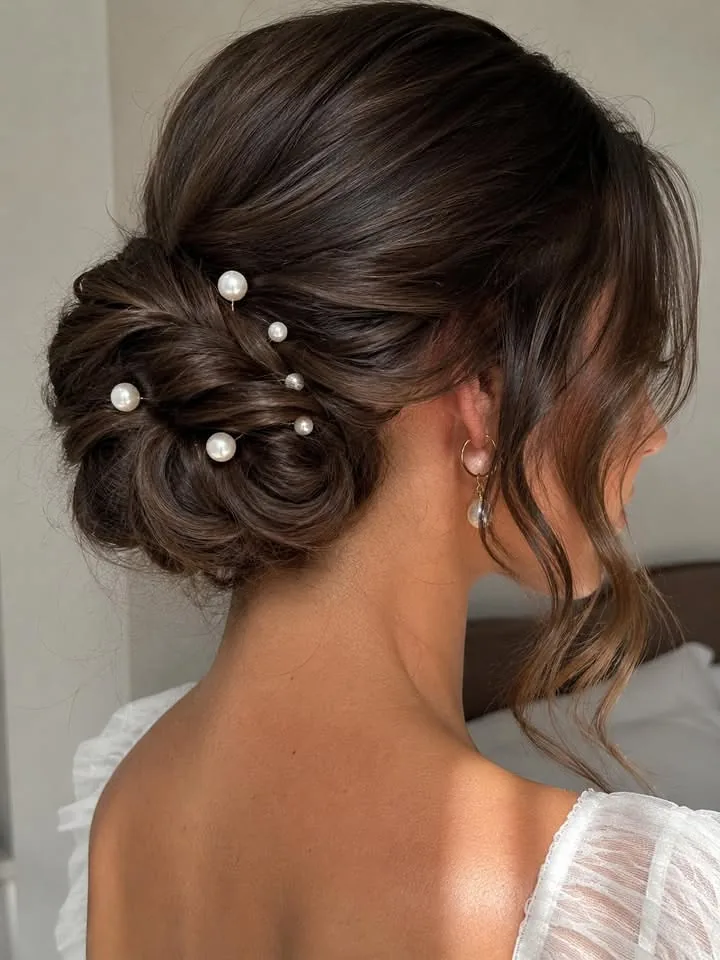
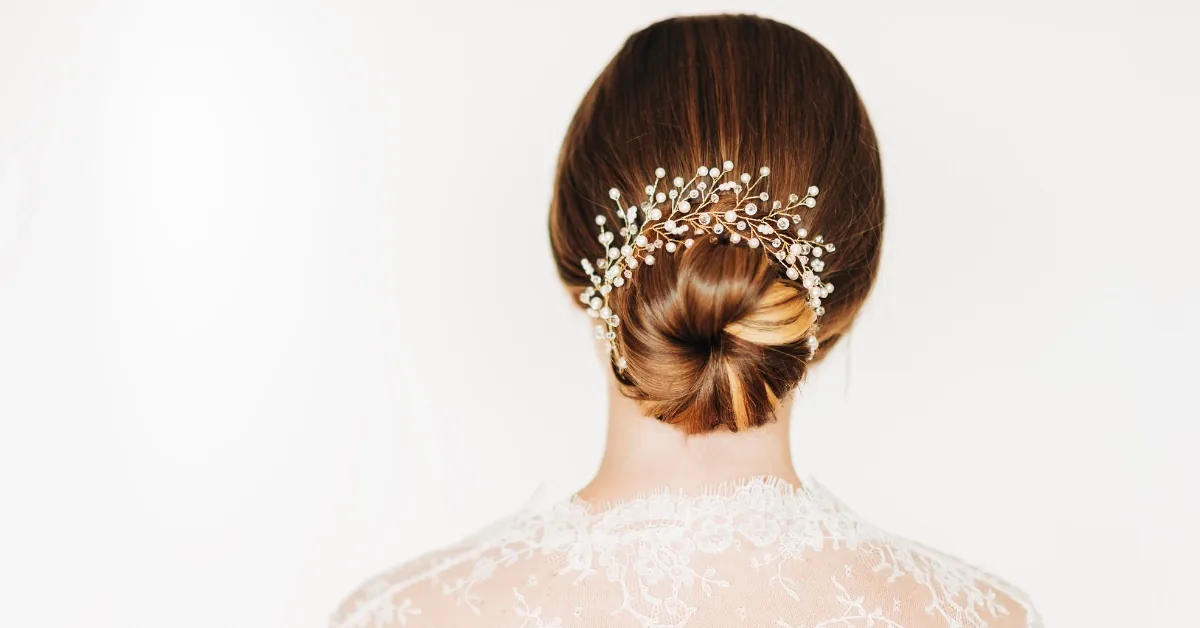
A chic low bun with a middle part and pearl pins is the low bun, dressed up: the hair is parted down the middle, smoothed into a neat low bun, and finished with two or three pearl pins clustered on one side. The pearls are the jewellery, and they turn a simple bun into a bridal hairstyle. It suits a classic dress, a pearl necklace, and a bride who loves traditional bridal details without wanting a tiara. It is also one of the easiest styles to do well, because the pins hide any small imperfections.
Best for: classic dresses, pearl jewellery, and traditional ceremonies. How to style: part down the middle, smooth the hair into a low bun, and cluster the pearl pins on one side of the bun. What to ask your stylist: for the pins to be secured with hidden bobby pins, so they do not slide. Veil compatibility: excellent — the veil comb sits above the bun and the pearls peek out below it. Hold time: all day. Quick verdict: pearls, parted and pinned — a simple bun, made bridal with three small pins.
32. Boho Loose Waves with a Flower Crown

Boho loose waves with a flower crown are the festival bride’s dream: the hair is waved loosely and left to fall naturally, and a crown of fresh flowers — baby’s breath, small roses, eucalyptus — sits on top like a halo. It suits a garden wedding, a festival, a beach ceremony, and a bride who wants to look like a woodland queen. Medium hair is perfect for this, because the waves are loose and the crown sits securely on hair that is not too heavy.
Best for: outdoor weddings, boho dresses, and summer ceremonies. How to style: wave the hair loosely with a large barrel, brush the waves out softly, and place the flower crown so it sits just behind the hairline. What to ask your stylist: for the crown to be pinned in three places, so it does not slide, and for the flowers to be fresh, not silk, if you want them to photograph well. Veil compatibility: skip the veil — the crown is the headpiece here. Hold time: 6 to 8 hours; the waves will loosen, which suits the style. Extension notes: none needed. Quick verdict: the flower crown — loose waves, fresh flowers, and a bride who looks like summer itself.
33. A Garden Wedding Textured Half-Up
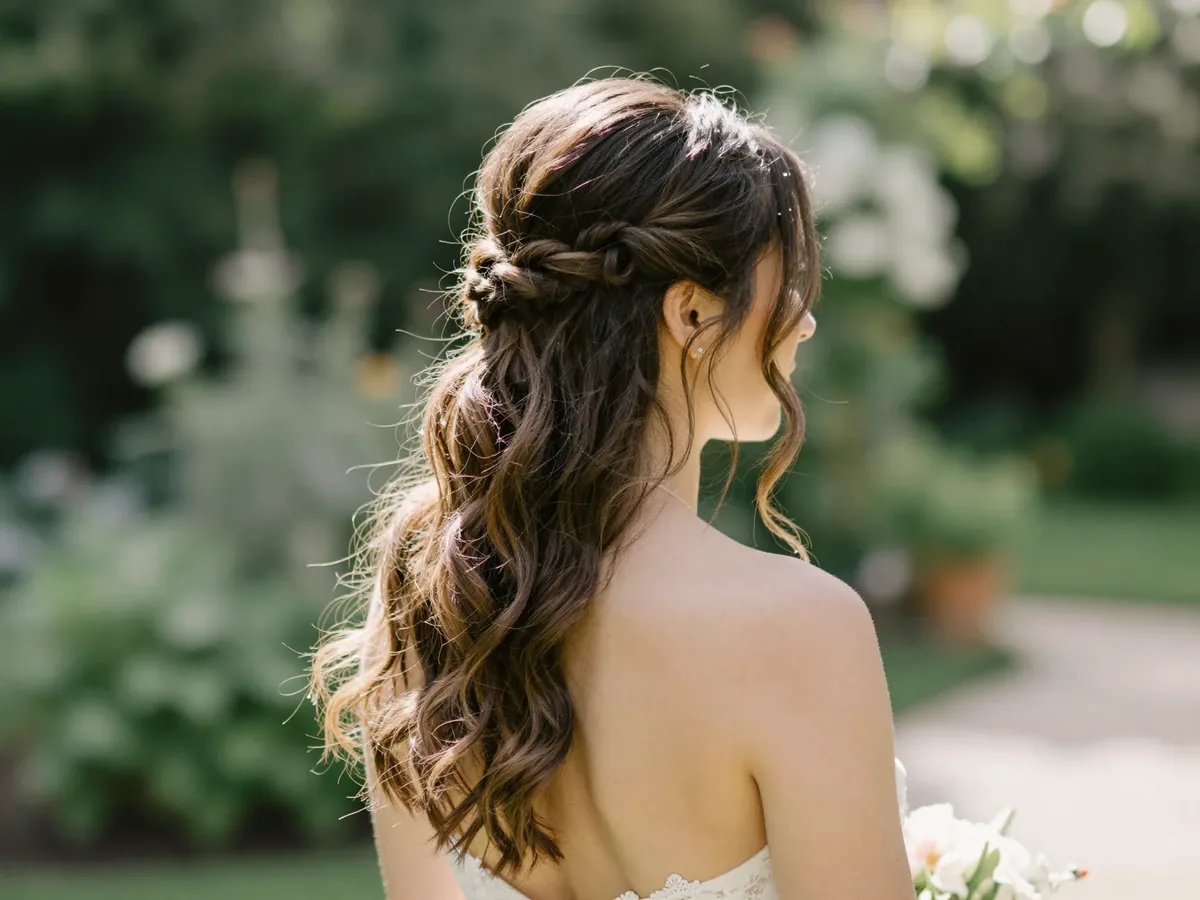
A garden wedding textured half-up is the half-up for the outdoors: the top half is gathered loosely and pinned with texture, the rest falls in soft, tousled waves, and a few pieces are left out to move in the breeze. It looks like the garden made it, which is exactly the point. It suits a garden party, a countryside wedding, and a dress with a flowing skirt. It is also one of the most forgiving styles, because the texture hides any unevenness and the breeze only makes it prettier.
Pros: romantic, relaxed, and very forgiving. Cons: it will not survive a very windy day unchanged — but the wind is part of the charm. Common mistake: over-styling it — a garden half-up should look like it happened, not like it was constructed. Hold time: 8 hours. Veil compatibility: good with a fingertip veil. Quick verdict: the garden half-up — textured, tousled, and made for the outdoors.
34. A Loose Braided Boho Updo
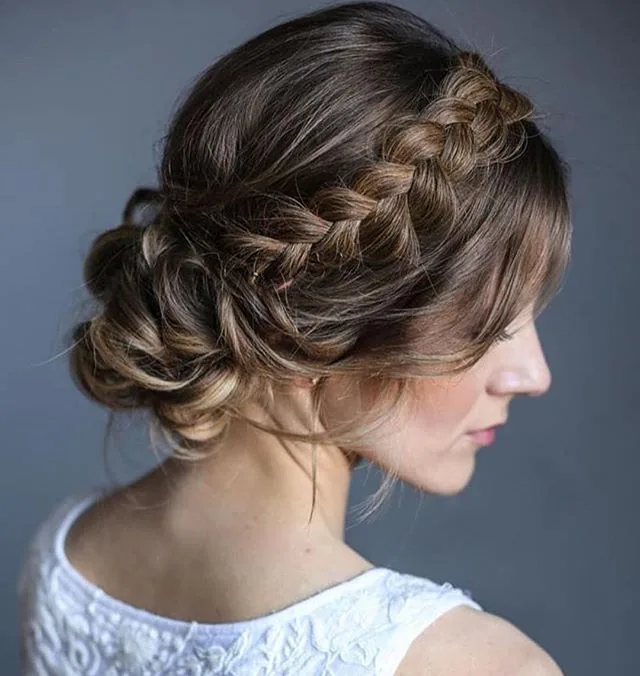
A loose braided boho updo braids the hair loosely — a soft braid from each side, joined at the back — and pins the rest into a relaxed, textured bun. The braids give it structure, the loose bun gives it softness, and the whole style has the easy, undone feeling that boho brides love. It suits a festival wedding, a barn venue, and a dress with lace or crochet details. It is also secure, because the braids anchor the bun.
Best for: boho and festival weddings, lace dresses, and naturally wavy hair. How to style: braid each side loosely, join the braids at the back, gather the remaining hair into a loose bun, and pull out a few pieces for softness. What to ask your stylist: for the braids to be soft and full, and for the bun to be loose, not tight. Veil compatibility: good with a fingertip veil. Hold time: 8 to 10 hours. Quick verdict: braids and a bun, loosened — the boho updo that holds all day and looks like it took five minutes.
35. Relaxed Beach Wedding Waves

Relaxed beach wedding waves are the waves for a seaside ceremony: the hair is waved loosely with a salt spray, brushed out into soft, tousled texture, and left to move. It looks like you spent the morning by the sea, which, if you are getting married on a beach, you probably did. It suits a beach wedding, a destination ceremony, and a simple, flowing dress. It is the least formal style in this guide, and the most honest — it does not pretend to be anything other than beautiful, wind-blown hair.
Pros: effortless, comfortable, and perfect for the beach. Cons: the waves will loosen in sea air, so they need a strong salt spray and a light-hold hairspray. Common mistake: curling the hair too neatly — beach waves should be uneven, with some pieces straighter than others. Hold time: 6 to 8 hours. Veil compatibility: skip the veil, or wear a short blusher that will not blow away. Extension notes: none needed. Quick verdict: the beach waves — salt, sun, and hair that moves with the wind.
36. A Boho Low Bun with Greenery

A boho low bun with greenery is the low bun, gone wild in the best way: the hair is gathered into a loose, textured bun at the nape, and sprigs of greenery — eucalyptus, olive leaves, ruscus — are tucked into the bun like a small bouquet. It suits a garden wedding, a woodland ceremony, and a bride whose bouquet is greenery rather than flowers. The greenery is the accessory, and it costs almost nothing, which is part of its charm.
Best for: garden and woodland weddings, and greenery bouquets. How to style: gather the hair into a loose, textured bun, pull out a few pieces for softness, and tuck the greenery into the bun with hidden pins. What to ask your stylist: for the greenery to be fresh and wired, so it does not wilt, and for it to be pinned in at least two places. Veil compatibility: good — the veil comb sits above the bun and the greenery peeks out below it. Hold time: 8 hours. Quick verdict: a bun and a bouquet, in one — greenery in your hair, and a style that smells like a garden.
37. A Veil with a Low Bun
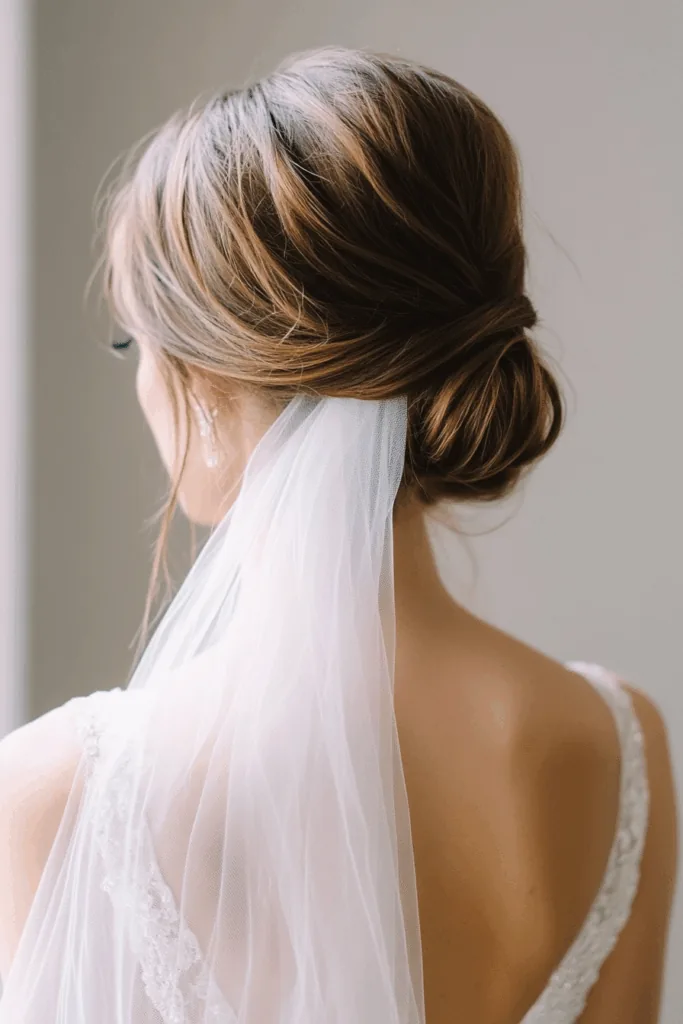
A veil with a low bun is the classic bridal combination, and medium hair wears it perfectly. The bun sits low at the nape, the veil comb slides in just above it, and the veil falls in a soft sheet down the back — framing the bun, not hiding it. It suits a cathedral, a church, a formal venue, and a bride who has always dreamed of a veil. The low bun is the anchor that makes the veil work: without it, the comb has nothing to hold onto.
Best for: formal ceremonies, cathedral veils, and traditional brides. How to style: build a low, slightly textured bun so the veil comb has grip, slide the comb in above the bun, and lock it with two crossed bobby pins. What to ask your stylist: for the veil to be tried on at the trial, and for the bun to be built with a little backcombing where the comb sits. Veil compatibility: the whole point of this style — excellent. Hold time: all day. Quick verdict: the classic — a low bun, a long veil, and a bride who looks like a bride.
38. A Veil with a Half-Up Style
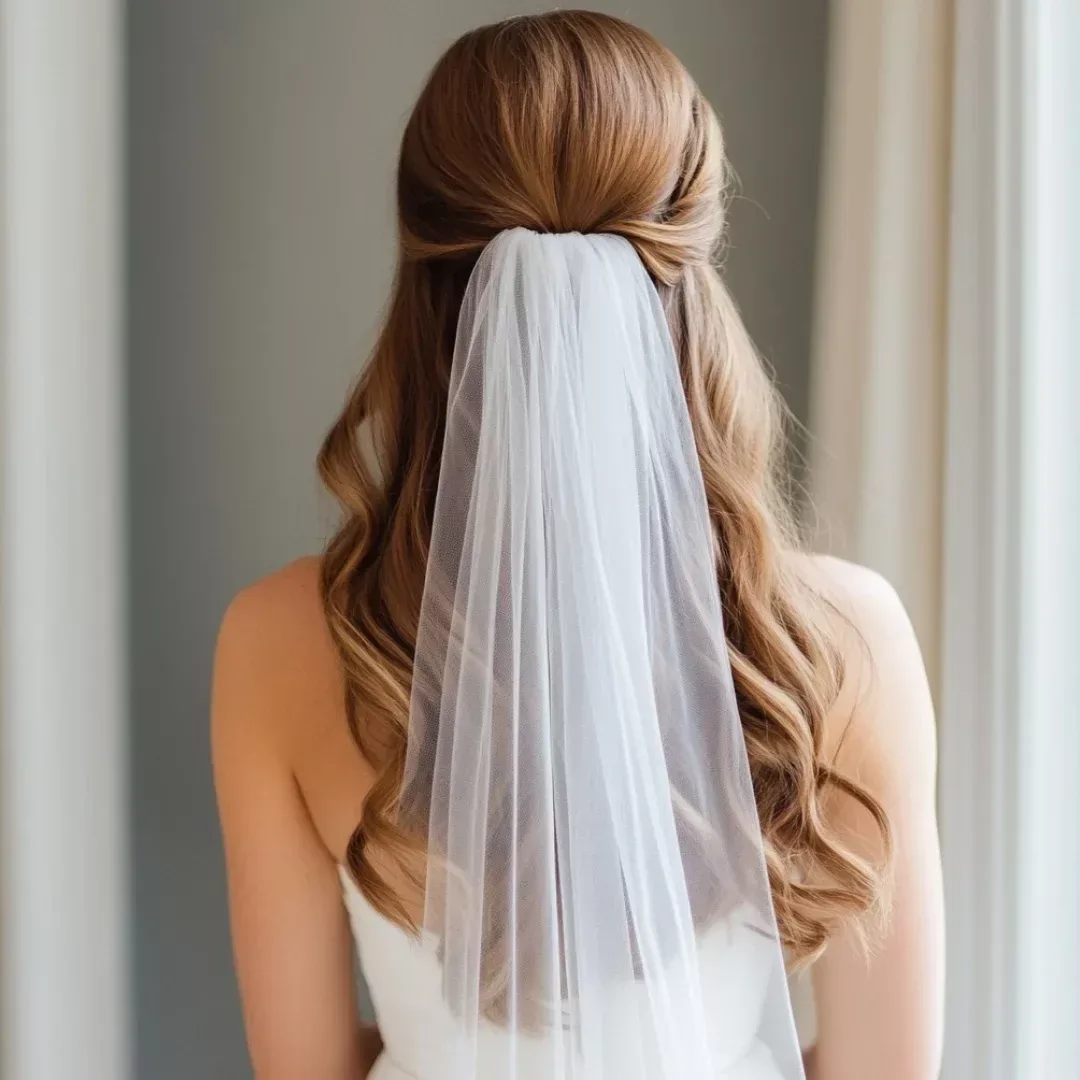
A veil with a half-up style is the veil for a bride who wants to wear her hair down and still wear a veil. The top half is pinned back at the crown, the veil comb slides into the pinned section, and the rest of the hair falls in waves below the veil. It suits a romantic wedding, a soft dress, and a bride who loves her hair down but loves a veil too. The pinned section is the anchor — without it, the veil would slide straight off loose hair.
Pros: the best of both worlds — hair down, veil on. Cons: the veil can flatten the waves underneath it, so the waves need to be set firmly. Common mistake: pinning the top section too flat, which leaves the veil comb nothing to grip — give the pinned section a little lift and texture. Hold time: 8 to 10 hours. Veil compatibility: excellent with a fingertip veil; a cathedral veil needs a stronger anchor. Quick verdict: hair down, veil on — the half-up makes the veil possible, and the veil makes the half-up bridal.
39. Pearl Hairpins and a Medium Updo
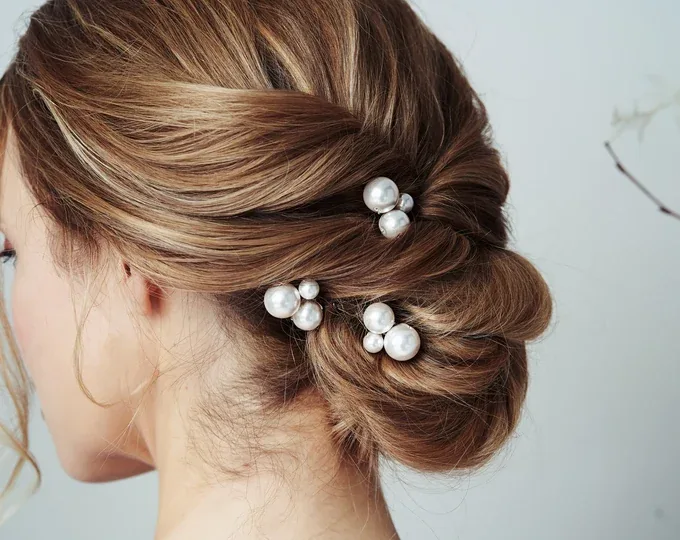
Pearl hairpins and a medium updo are the simplest way to make an updo feel bridal: the hair is gathered into a soft low bun or a loose twist, and three or four pearl pins are clustered along the seam or scattered through the bun like dewdrops. The pearls catch the light in photographs and give the style a finished, jewelled feeling without the weight of a tiara. It suits a classic dress, a pearl necklace, and a bride who loves traditional details.
Best for: classic dresses, pearl jewellery, and low buns. How to style: build a soft low bun, then cluster the pearl pins on one side of the bun, securing each with a hidden bobby pin. What to ask your stylist: for the pins to be placed asymmetrically — a cluster on one side looks more modern than a row across the top. Veil compatibility: excellent — the veil comb sits above the bun and the pearls peek out below it. Hold time: all day. Extension notes: none needed. Quick verdict: pearls in your hair — a simple updo, made bridal with four small pins.
40. A Statement Hair Vine with Loose Curls
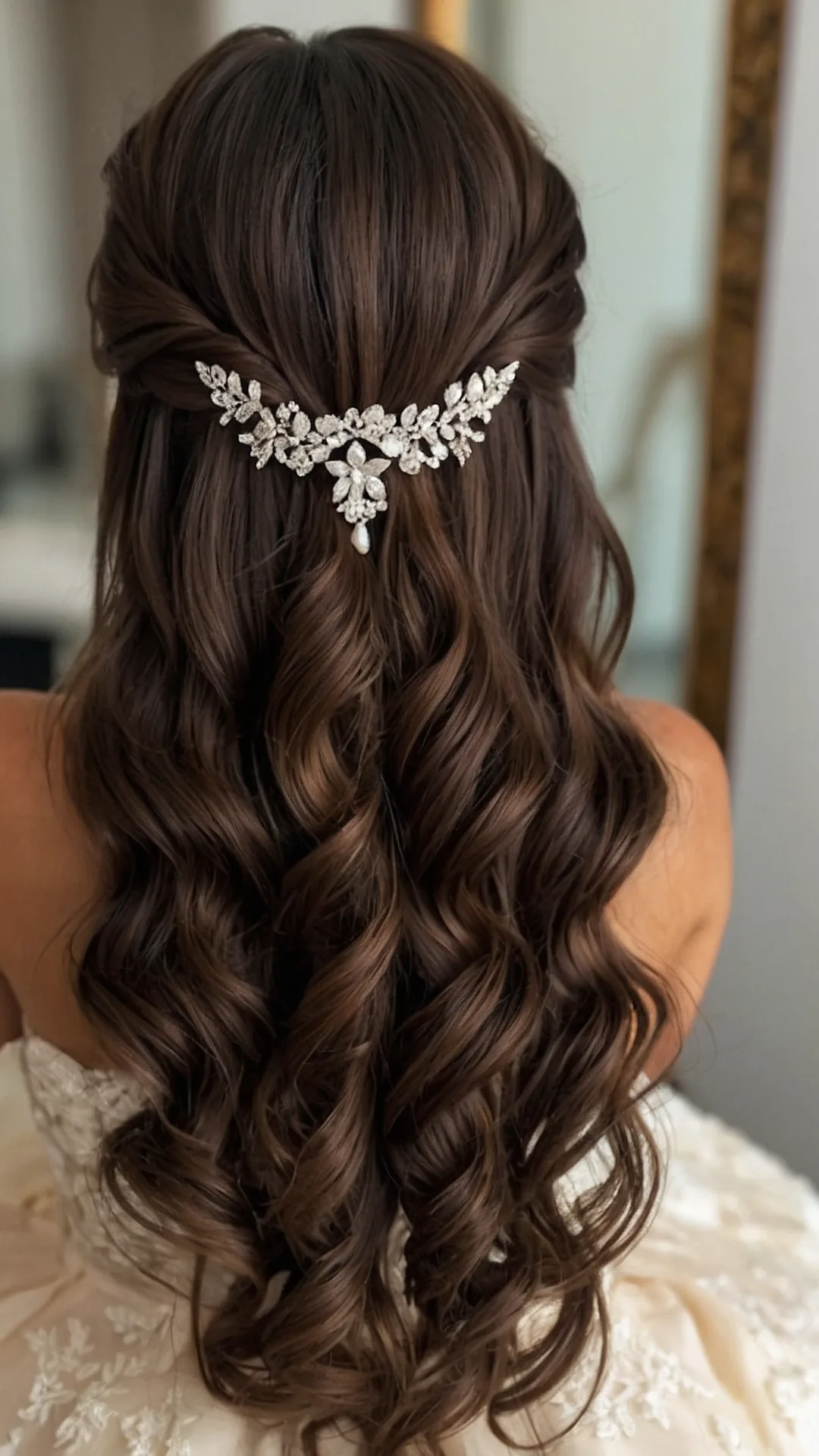
A statement hair vine with loose curls is the headpiece for a bride who wants drama without a tiara: a flexible vine of crystals, pearls or leaves that winds through loose, soft curls, catching the light as you move. The curls are the base — soft, full, and brushed out — and the vine is the jewellery, woven through the hair rather than sitting on top of it. It suits a romantic wedding, a sparkling dress, and a bride who wants her hair to be part of the sparkle.
Pros: dramatic, flexible, and easy to wear. Cons: the vine needs to be pinned in several places, or it will slide. Common mistake: placing the vine too far forward, where it looks like a headband — it should sit back, woven through the curls. Hold time: 8 hours. Veil compatibility: fair — wear the veil for the ceremony and the vine for the reception, or choose one or the other. Quick verdict: a vine, not a tiara — sparkle woven through your curls, and a style that moves with you.
41. A Tiara with a Medium Hair Updo

A tiara with a medium hair updo is the fairy-tale ending to this guide: the hair is gathered into a polished low bun or a soft twist, and a tiara sits at the front, just behind the hairline, like a crown. It suits a formal wedding, a ballgown, and a bride who has always wanted to wear a tiara — and on your wedding day, you can. The updo is the foundation that makes the tiara work: it gives the tiara something to sit on, and it keeps the whole style balanced.
Best for: formal weddings, ballgowns, and brides who love a tiara. How to style: build a smooth, polished updo with a little lift at the crown, place the tiara just behind the hairline, and secure it with pins through the loops at each end. What to ask your stylist: for the tiara to be tried on at the trial, and for the updo to have enough height to balance it. Veil compatibility: excellent — the veil comb sits behind the tiara. Hold time: all day. Quick verdict: the crown — a polished updo, a tiara, and a bride who looks like royalty, because today, she is.
What are the best wedding hairstyles for medium hair?
The best wedding hairstyles for medium hair are low chignons, soft romantic updos, half-up styles with curls, braided crowns, vintage waves and sleek low buns — all of which work at shoulder length without extensions. Medium hair holds curls well, pins securely and works beautifully under a veil, so you have more options than you think. Choose an updo for a formal wedding or a hot day, and a half-up style or loose waves for a relaxed or garden wedding.
Can you wear your hair down for a wedding with medium hair?
Yes, you can wear your hair down for a wedding with medium hair — soft curls, old Hollywood waves or loose beach waves all look beautiful at shoulder length. The key is setting the curls properly so they last, and adding a little volume at the crown so the style photographs well. If you wear your hair down, skip a long veil, which can flatten the waves, and choose a short blusher or no veil instead.
Do I need extensions for a wedding updo with medium hair?
Most brides with medium hair do not need extensions for a wedding updo — shoulder-length hair makes a full low bun, a textured updo and a proper braid on its own. You only need extra hair if you want a very tall, very full updo or long flowing waves down your back. A few clip-in wefts or a small hair doughnut inside the bun is usually enough, and both should be tried at your hair trial, not on the morning.
How do you attach a veil to medium hair?
To attach a veil to medium hair, slide the veil comb into the hair just above or below your main style — above a low bun, into the crown of a half-up style, or at the base of an updo — and lock it with two crossed bobby pins. Build a small anchor where the comb sits, with a little backcombing, a twist or a braid, so the comb has something to grip. A veil comb with teeth holds far better than a flat clip.
How long does a wedding hairstyle last on medium hair?
A wedding hairstyle on medium hair should last 8 to 12 hours if it is built properly — updos last longest, loose waves soften over the day but rarely drop completely. The style lasts best on day-old hair with texture spray, with each section set with hairspray as it is styled, and with pins placed in pairs that cross each other. Pack four bobby pins and a travel hairspray in a touch-up kit for two quick checks: after the ceremony and before the first dance.
Should I wear my medium hair up or down for my wedding?
Wear your hair up if your wedding is formal, outdoors in summer, or if your dress has an open back or a high neckline — an updo keeps you cool, shows off the dress, and lasts longest. Wear it down or half-up if your wedding is relaxed, your dress is soft and flowing, or you simply feel more like yourself with your hair down. The right choice is the one that matches your dress, your venue and how you want to feel — not what anyone else expects.
What wedding hairstyles suit a shoulder-length bob?
A shoulder-length bob suits low buns, half-up twists, braided crowns, vintage waves, sleek straight styles with a veil, and small French twists — all of which work at bob length. Add texture spray before styling, because it gives the pins something to grip, and keep the updo low and compact, where the hair has enough length to fold. A decorative comb or a few pearl pins at the top of the style also help, because they cover the seam where the shorter ends are tucked.
Can medium hair hold a bridal updo all day?
Yes, medium hair holds a bridal updo all day — often better than long hair, because there is less weight pulling the style down. The keys are day-old hair, texture spray at the roots, pins placed in pairs, and hairspray applied section by section as the style is built. A low bun or a French twist on medium hair will comfortably survive a ceremony, a meal and a dance floor, and it rarely gives you a headache by the end of the night.
What should I bring to my wedding hair trial?
Bring your veil, your hairpiece or tiara, your earrings, and a photograph of your dress — especially the neckline and the back. Wear a top with a similar neckline to your dress, arrive with day-old hair, and bring a list of questions: how long will the style take, how will it hold in humidity, and what should you do the night before? Ask your stylist to photograph the style from the front, the side and the back, with the veil on and off.
How far in advance should I book my wedding hair trial?
Book your wedding hair trial four to six weeks before the wedding, when your dress has arrived and your veil and accessories are in hand. That leaves time to fix a style that does not work, but not so much time that you change your mind about the dress. If you change the style completely after the trial, book a second, shorter trial; a small tweak, like moving the part or loosening a tendril, can be agreed by message and confirmed on the morning itself.
Conclusion
Medium hair does not need to apologise for itself on a wedding day. It holds a curl, it pins securely, it frames your face without hiding it, and it works under a veil — and the 41 styles in this guide prove it, from the classic low chignon to the flower crown, the French twist to the beach waves. The best wedding hairstyle for medium hair is not the one that makes your hair look longest. It is the one that matches your dress, your venue and the way you want to feel when you walk down the aisle.
Start with the dress, not the hair. Look at the neckline and the back, think about the venue and the weather, and then pick the family that fits — romantic, half-up, braided, vintage, sleek, boho, or veiled. Book the trial, bring the veil, wear the style for a day, and listen to what your hair tells you. On the morning itself, trust the stylist, trust the pins, and then forget about your hair entirely. It will hold. You have a wedding to enjoy.