Dancing All Night Without a Hair Out of Place: Hairstyles for a School Dance That Hold, Shine and Photograph Beautifully
A school dance is the rare night when your hair has to do three jobs at once: look amazing in the mirror at home, survive two hours of actual dancing, and still look good in the photos your friends will post the next morning. Most hairstyles for a school dance fail at the second job. They look perfect at 7 p.m. and start sliding, frizzing or falling flat by the first slow song — and that is before the gym gets warm and the dancing gets serious.
That is why this guide starts with the plan, not the pretty pictures. Before you pick a style, you need to know your school’s dress-code rules, how much hold your hair really needs, and what your dress and corsage will do to an updo. Get those three things right and almost any style on this list will work. Skip them and even the prettiest hairstyle can turn into a night of tucking, re-pinning and hiding from the camera.
Below you will find eight short guides on the practical side — dress codes, dancing-proof hold, photo-ready hair, the night-before timeline and the little clutch kit that saves the evening — followed by 34 hairstyles for a school dance, for short, medium, long, straight, wavy and curly hair. Every style tells you who it suits, how to style it, what can go wrong, and what to ask for if someone else is doing your hair. Pick the one that feels like you, try it once before the night, and then forget about your hair and enjoy the dance.
Check the Dress Code Before You Pick a Style
Some schools have rules about hair for formal dances, and finding out on the night is the worst possible time. A few dances ban hats, coloured hair spray or anything that covers your face, and some semi-formal events ask for hair to be tied back for safety during dancing. Ask a teacher or check the dance notice a week before, not the morning of.
The dress code also covers your dress, and your dress decides your hair. A high neckline or a heavy beaded bodice pairs better with hair swept up, so the detail of the dress stays visible. A simple strapless or sweetheart dress leaves room for hair down, because there is nothing to compete with. If you are wearing a corsage on your wrist, your hair is free; if it pins to your dress, keep hair away from that shoulder so it does not snag.
Quick verdict: check the rules, then let the dress lead. Five minutes of checking now saves an awkward fix in the school bathroom later.
How to Make Your Hair Survive Hours of Dancing
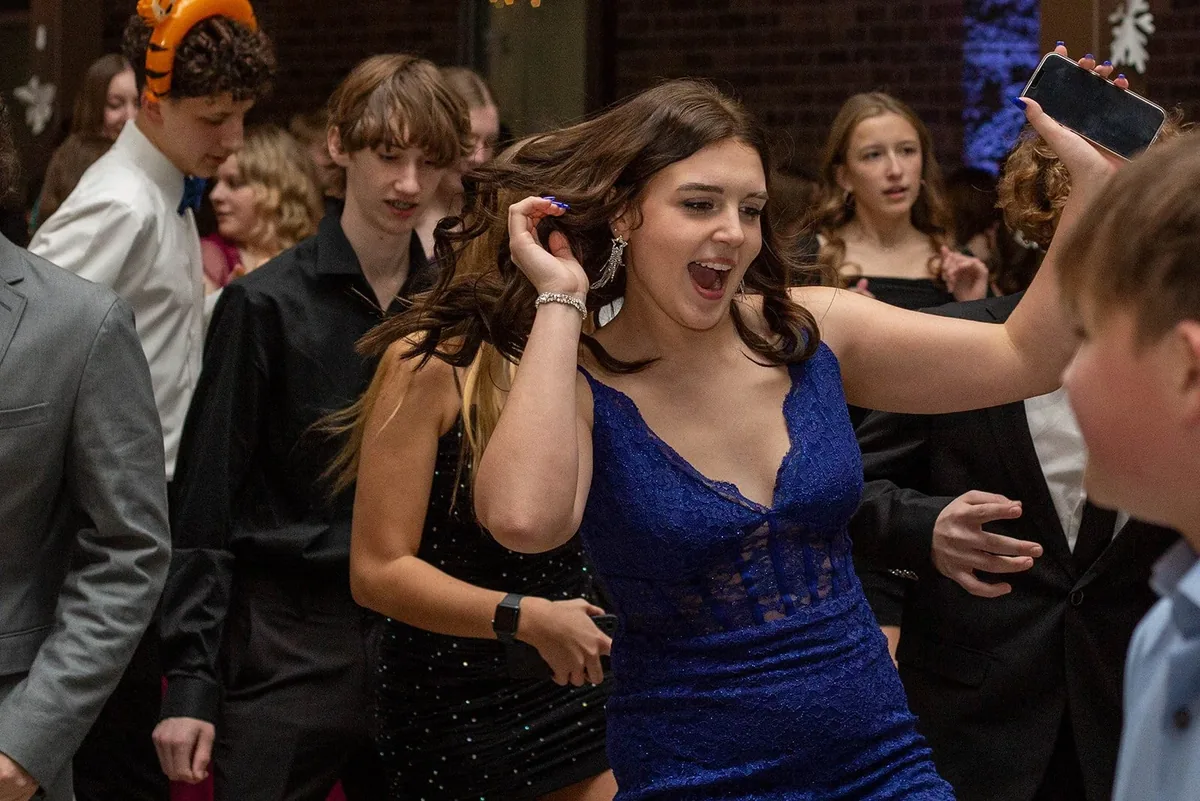
Dancing is the real test of any school dance hairstyle, and the gym is warm, the music is loud and you will be moving for hours. The styles that survive are the ones with hidden support: pins placed in a cross, elastics wrapped twice, and a braid or twist doing the structural work instead of hairspray alone. Hairspray helps, but it cannot hold a style that has nothing anchoring it.
How to style it to last: start with hair that is not freshly washed — day-old hair grips better. Add a little dry shampoo or texturising spray at the roots, build the style, then pin every section in two places, not one. Finish with a flexible-hold spray, then a light mist of strong-hold spray only on the outside. Test it the way you will actually wear it: dance around your room for ten minutes and see what moves.
Common mistake: using a whole can of extra-strong spray on soft, clean hair. It looks stiff in photos, flakes by midnight, and still slips, because spray cannot grip slippery hair. Texture first, pins second, spray last.
Matching Your Hair to Your Dress, Neckline and Corsage
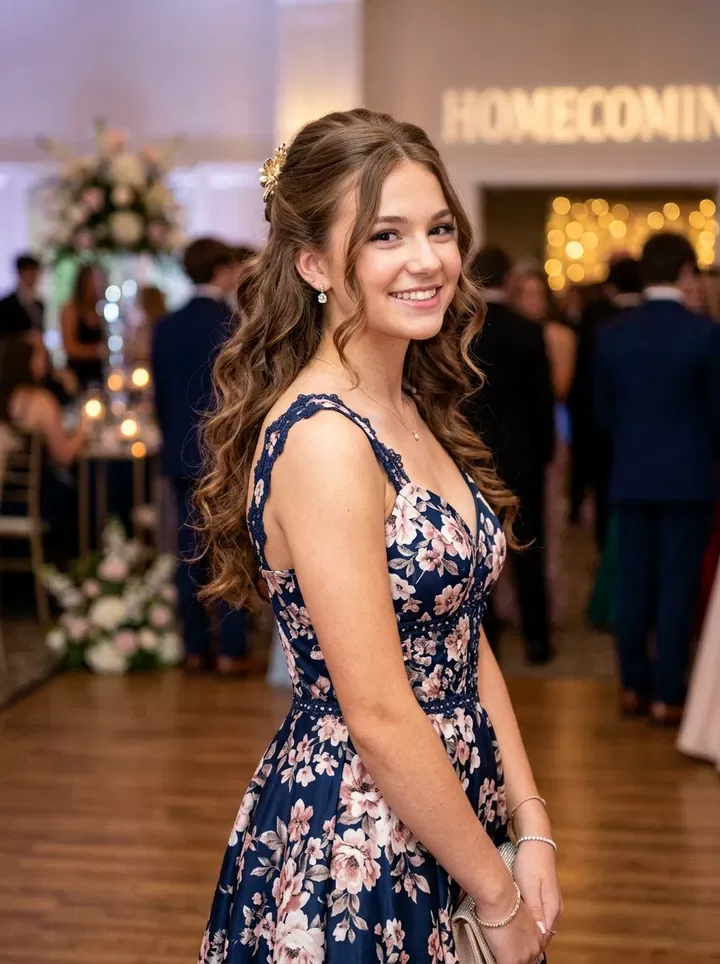
Your hair and your dress are one outfit, so they should be planned together. An updo shows off a detailed back, an open back, a high neckline or statement earrings. Hair down softens a simple dress and fills the space above a strapless neckline. A one-shoulder dress looks best with hair swept to the opposite side, so the bare shoulder stays clean and the hair does not hide the strap.
Think about your corsage too. A wrist corsage leaves your hair completely free. A pinned corsage sits on your dress, usually on the left, so keep loose hair and long tendrils away from that side or they will catch on the flowers every time you move. If you are wearing a statement necklace, an updo keeps it visible; a choker works with almost any style.
Best for: anyone who has already chosen their dress — match the hair to the dress, not the other way round. If you are still choosing, pick the dress first and the hairstyle second.
Hair That Photographs Well: Candids, Group Shots and Selfies
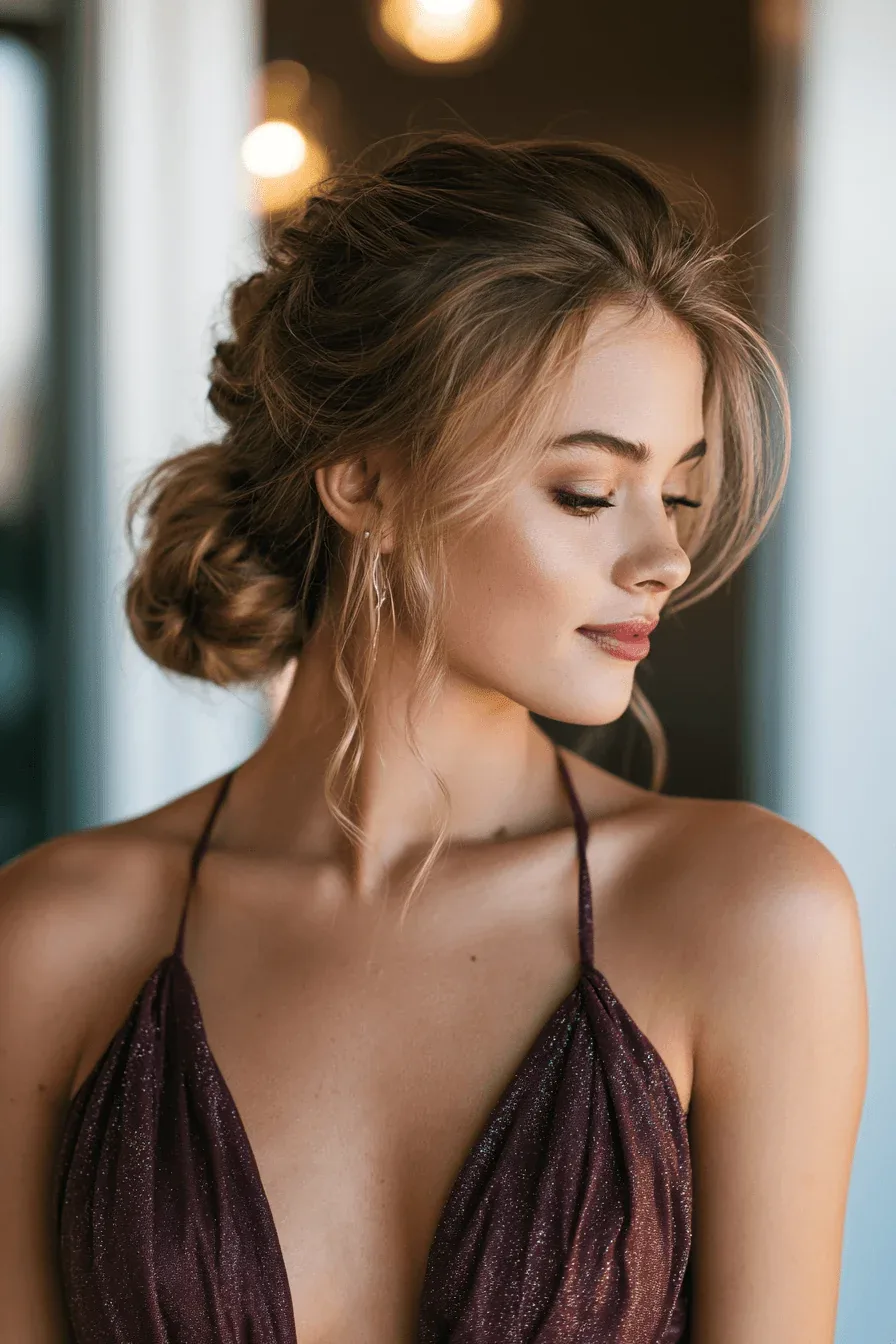
School dance photos are taken in bad light, from odd angles, and usually without warning — so your hair needs to read well from the front, the side and the back. Styles with a clear shape, like a defined bun, a smooth ponytail or a side-swept wave, photograph far better than styles that only look good from one angle in the mirror. Before the night, take photos of your trial style from three sides, with and without flash.
Shine helps on camera, but too much product looks greasy under a flash. A tiny drop of shine serum on the ends, not the roots, is enough. And if your hair is very dark, a few face-framing pieces catch the light and stop your hair becoming one dark shape in group photos. For very fair hair, a little texture spray stops it looking flat and washed out.
What to ask a stylist: “Can you check this from the back and the side, not just the front?” A style that is only finished at the front will disappoint you in every candid photo.
The Night-Before Timeline: Wash, Trial Run and Sleep
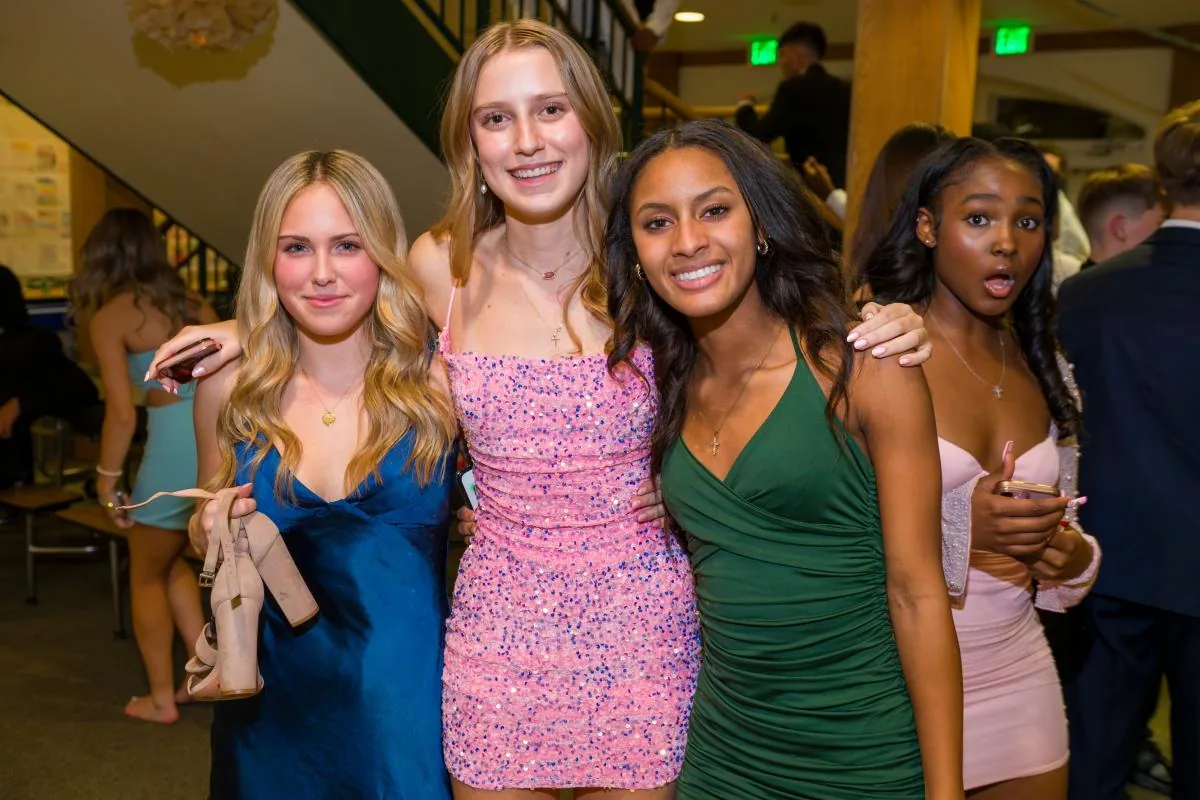
The best school dance hair starts the night before, not an hour before you leave. Wash your hair the evening before the dance, not the morning of it. Freshly washed hair is slippery and refuses to hold pins, braids and curls; hair washed the night before has just enough grip to hold a style all evening. If your hair gets oily fast, wash it the night before and use a little dry shampoo at the roots in the morning.
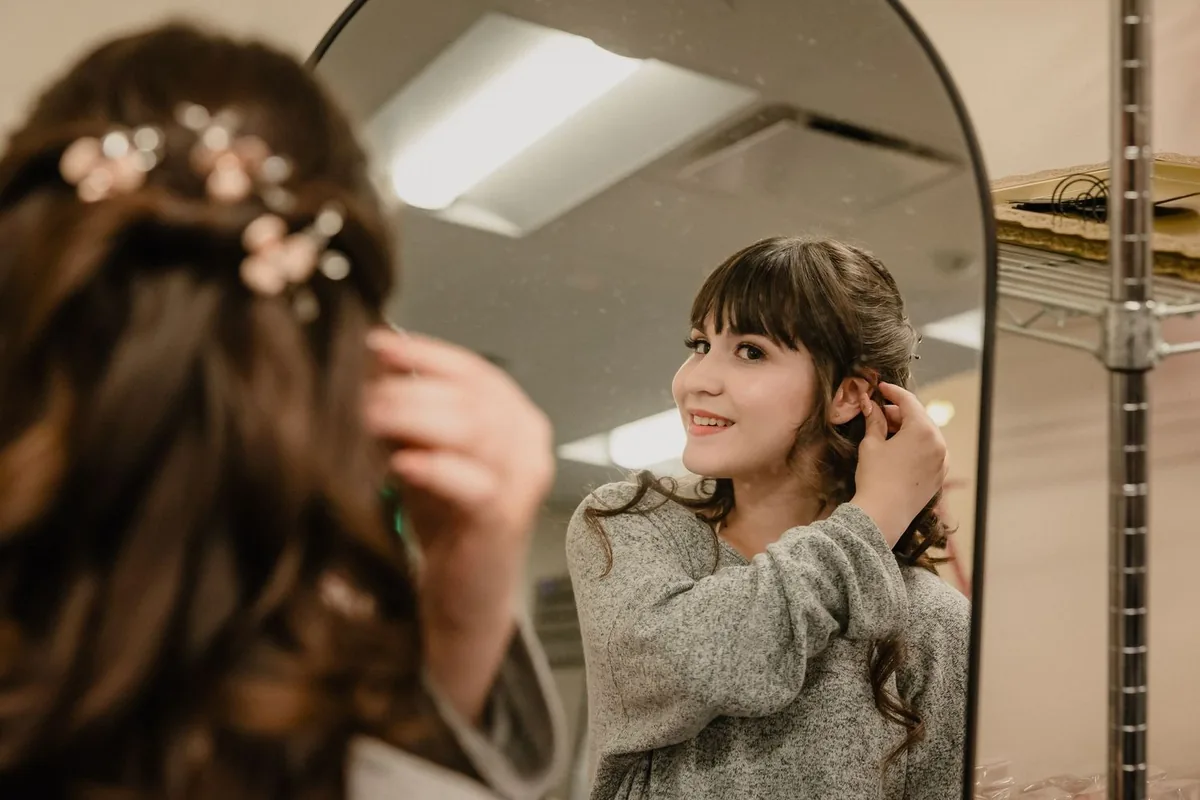
Do a full trial run at least two days before the dance, wearing the dress if you can. Time yourself, take photos, and dance around for ten minutes to test the hold. If anything slips, you still have time to change the style or buy different pins. On the night itself, give yourself at least an hour for hair — rushing is how buns go lopsided and curls go half-finished.
Maintenance: sleep on a silk or satin pillowcase after washing, and do not go to bed with wet hair. A loose braid overnight gives soft waves in the morning and keeps the hair from tangling while you sleep.
The Tiny Clutch Kit: Quick Fixes for Mid-Dance Emergencies
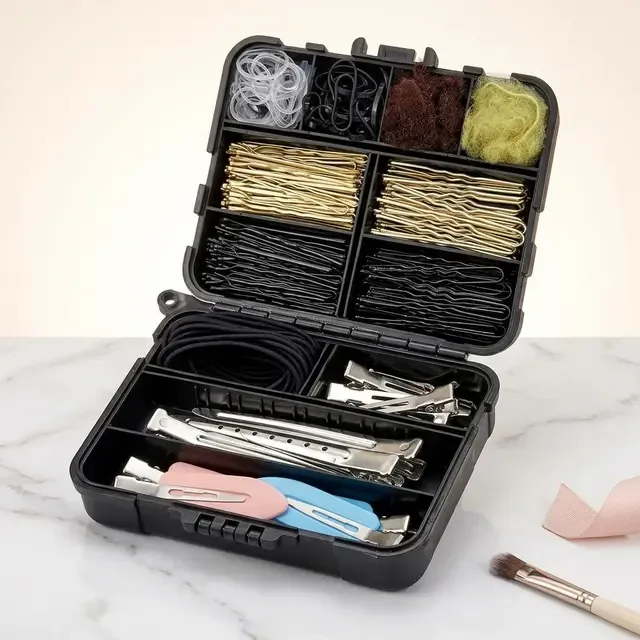
No hairstyle is completely dance-proof, so pack a tiny repair kit and stop worrying about it. You need four things: two bobby pins that match your hair colour, one spare hair tie, a couple of tissues, and a mini hairspray or a travel-size dry shampoo. That is it. Everything fits in a small clutch or a friend’s bag, and you will probably never need it — but knowing it is there is the whole point.
How to use it: if a tendril falls, pin it back loosely rather than yanking it into place. If a curl drops, twist it around your finger, pin it for five minutes, then let it fall again — the heat from your scalp resets the shape. If your roots go flat, a quick puff of dry shampoo and a shake at the roots brings the volume back in seconds.
Common mistake: bringing a brush. A brush dragged through styled hair breaks up curls, pulls out pins and creates frizz. Fingers and pins only, once you are at the dance.
Hair by Length: Where to Start for Short, Medium and Long Hair
Your hair length decides your starting point, not your options. Short hair shines at a school dance with texture, volume and one strong detail — a deep side part, a sweep of finger waves, or a sparkly clip. You do not need length to look formal; you need polish, and short hair photographs beautifully because every detail is visible.
Medium hair is the most flexible length for a dance. It is long enough for a low bun, a half-up style or soft waves, and short enough that an updo will actually hold without sliding down under its own weight. Long hair gives you the most choice, but it is also the heaviest — an updo needs more pins, and hair worn down needs more curl and more spray to last the night.
Who should avoid what: if your hair is very fine, skip heavy, long styles that pull flat by midnight. If your hair is very thick, skip tight, high buns that give you a headache by the second song. Work with your hair’s weight, not against it.
What to Ask Your Stylist — or the Friend Helping You
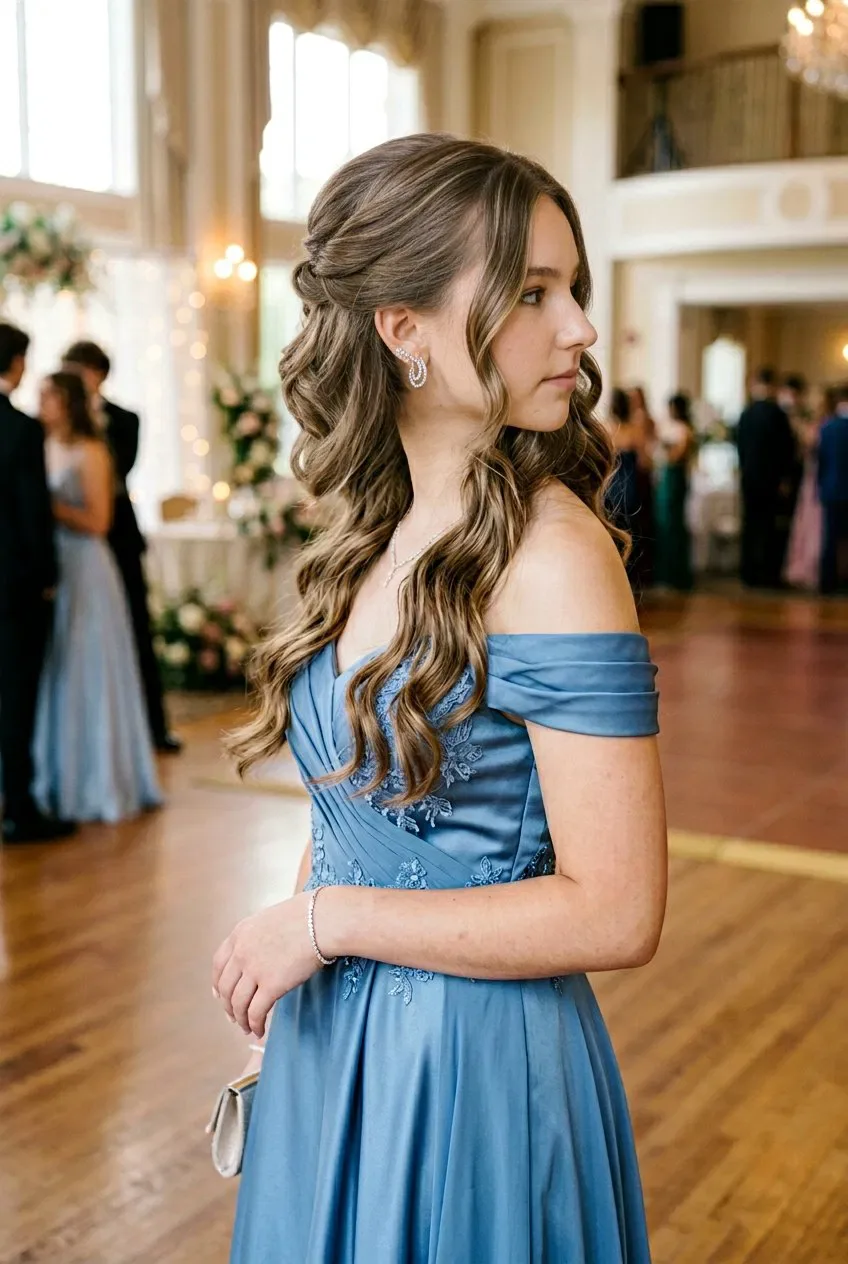
If someone else is doing your hair, clear instructions make the difference between the style you imagined and the style you get. Bring two or three photos of the exact style, from the front and the back, and show your dress at the same time. Tell them how long the dance lasts, that you will be dancing, and whether you need the style to survive photos, dinner and a warm gym.
Ask three questions before they start: how long will it take, what will it cost, and what do I need to do to keep it in? A style that takes ninety minutes and needs hourly fixing is not the right style for a school night. Ask them to show you how to re-pin it yourself, and take a photo of the back when they finish so you can check it later.
Cost and time: a simple salon updo usually takes 30 to 45 minutes; a braided or curled formal style can take an hour or more. Doing it at home with a friend costs nothing but takes longer, so start early and do a trial run first.
1. Classic Low Chignon
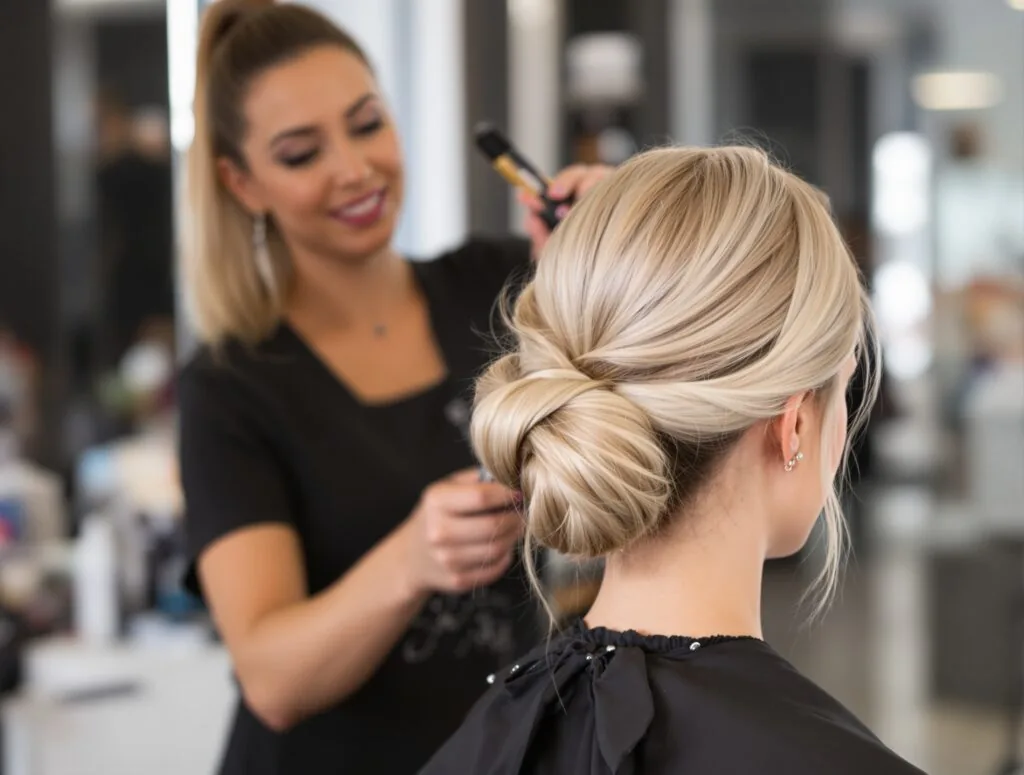
The classic low chignon is the safest elegant choice for a school dance, and it suits almost every dress. Hair is smoothed back and twisted into a neat knot at the nape of the neck, low enough to show off earrings and a necklace, and secure enough to survive hours of dancing. It reads as grown-up without trying too hard, which is exactly right for a school event.
Best for: medium to long hair, straight or wavy, and anyone wearing a dress with a detailed back or a statement necklace. It also works beautifully with a corsage, because nothing hangs near the flowers.
How to style: smooth the hair back with a light serum, gather it low, twist it into a knot and pin it in a cross shape so it cannot rotate. Leave two thin tendrils at the front if you want a softer look, and finish with a flexible-hold spray.
2. Romantic Loose Low Bun
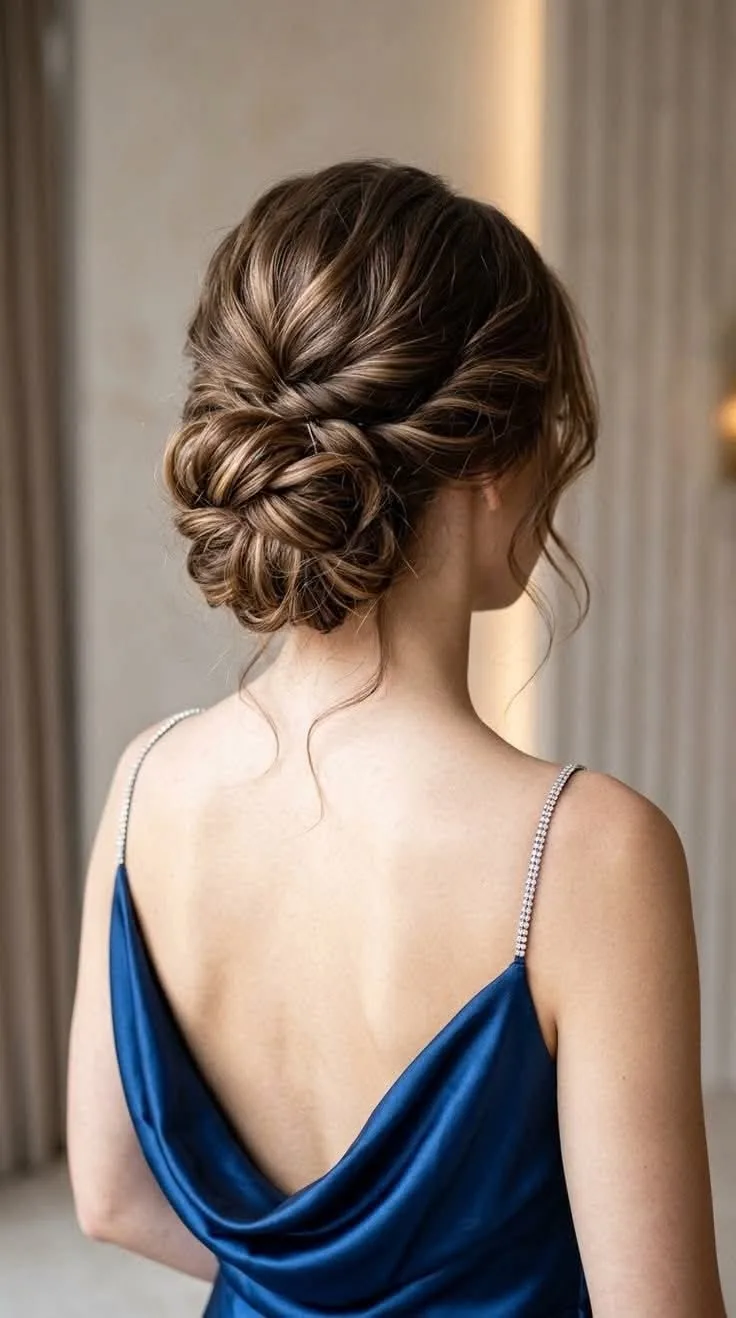
The romantic loose low bun is the softer sister of the classic chignon, and it is the one to choose if a tight updo makes you feel too severe. The bun sits low and a little loose, with soft pieces pulled out around the face and at the nape, so it looks like it happened naturally — even though it is pinned in four places and is not going anywhere.
Pros: forgiving, comfortable for hours, and flattering on round and square faces because the soft pieces break up the shape. Cons: it needs texture to hold, so very fine, slippery hair may need dry shampoo at the roots first.
How to style: curl the ends loosely before you start, gather the hair low without pulling it tight, twist and pin, then gently pull out a few pieces around the face. Mist with spray and leave it alone — the more you touch it, the faster it falls.
3. High Sleek Ponytail
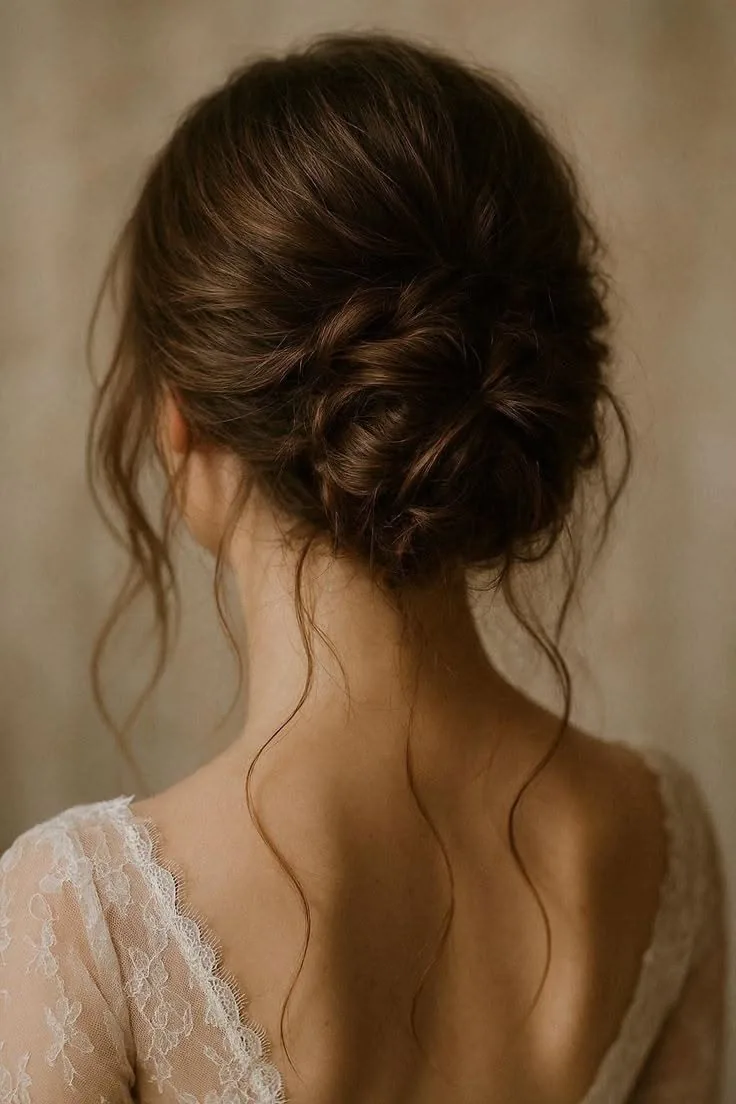
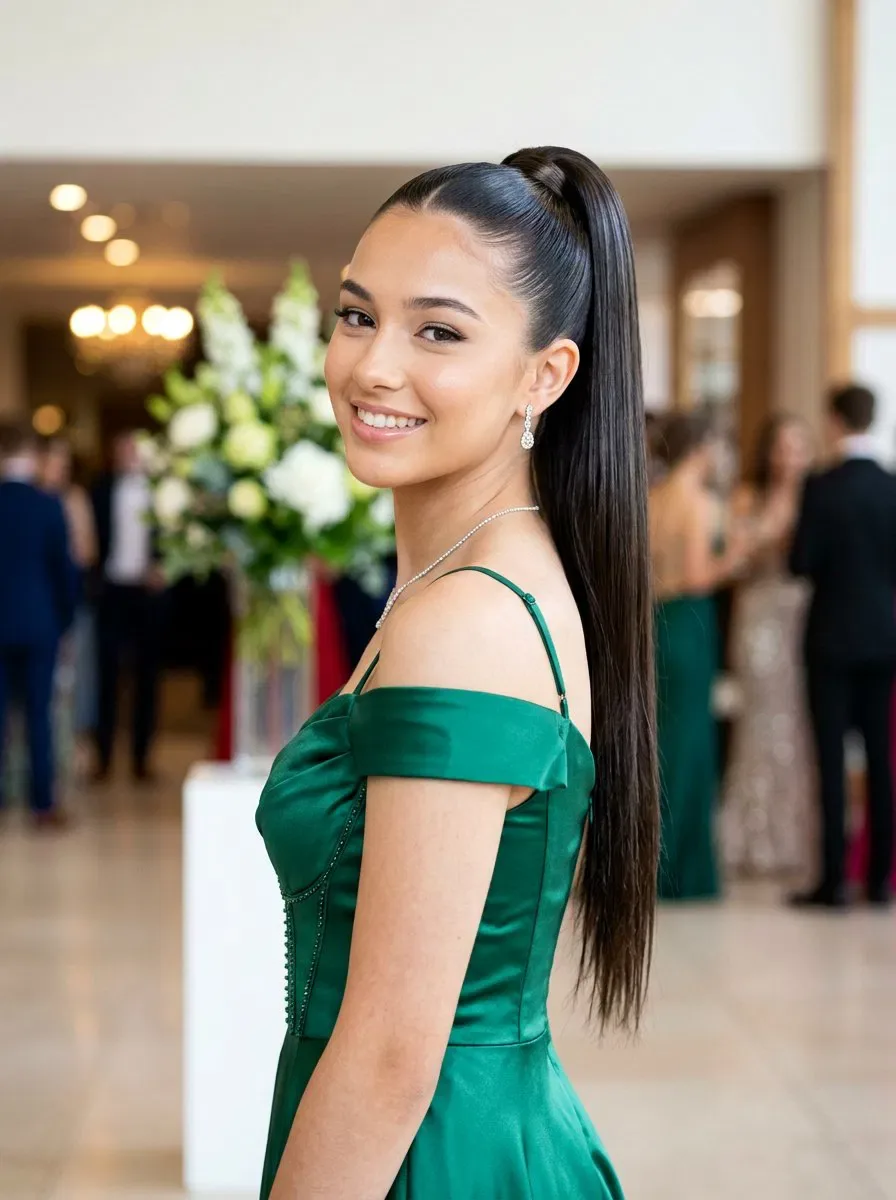
A high sleek ponytail is the dance-floor champion: nothing falls in your face, nothing needs re-pinning, and it looks sharp in every photo. It also makes you look taller and shows off your dress, your earrings and your shoulders. The trick is the finish — it has to be genuinely smooth, not just pulled back, or it reads as a gym ponytail instead of a dance ponytail.
Best for: long, straight or wavy hair, and anyone who plans to dance hard. It suits oval and heart-shaped faces especially well.
How to style: blow-dry the hair smooth, brush it up high while your head is tipped back slightly, secure it with a strong elastic, then wrap a thin strand of hair around the base and pin it underneath. Add shine serum to the tail and a little spray at the hairline.
4. Curly High Ponytail
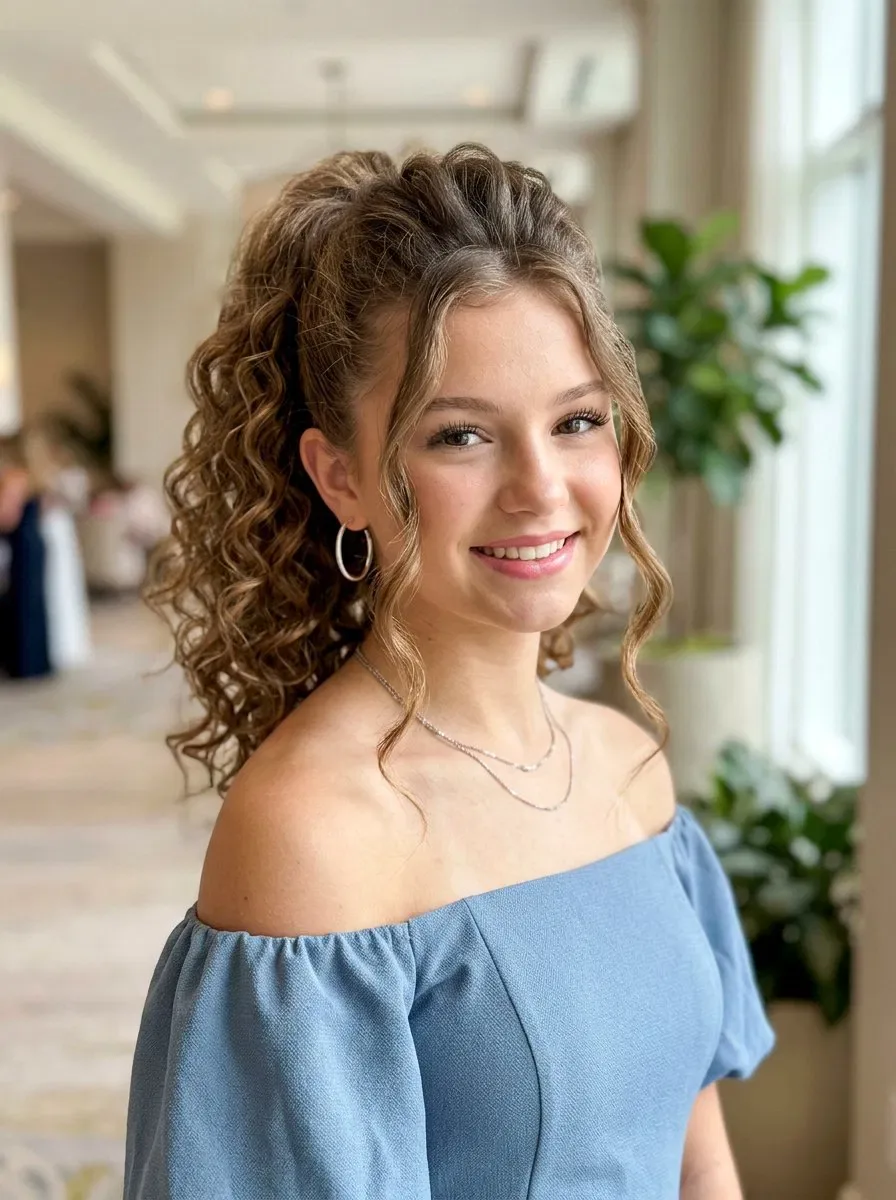
A curly high ponytail turns your natural curls into the feature of the whole outfit, and it is one of the best dancing styles there is. The curls bounce when you move instead of falling flat, and the height keeps them off your neck and shoulders, which matters in a warm gym. It looks joyful and confident, and it photographs beautifully.
How to style: define the curls first with a curl cream, then gather the hair high and secure it with a snag-free elastic. Fluff the curls at the top for volume, and pin back any pieces that fall across your eyes. A little gel at the edges keeps the hairline smooth without flattening the curls.
Watch out for: pulling the ponytail too tight. It will ache by the second hour, so secure it firmly but not painfully, and use two elastics crossed if your hair is heavy.
5. Half-Up Twisted Crown
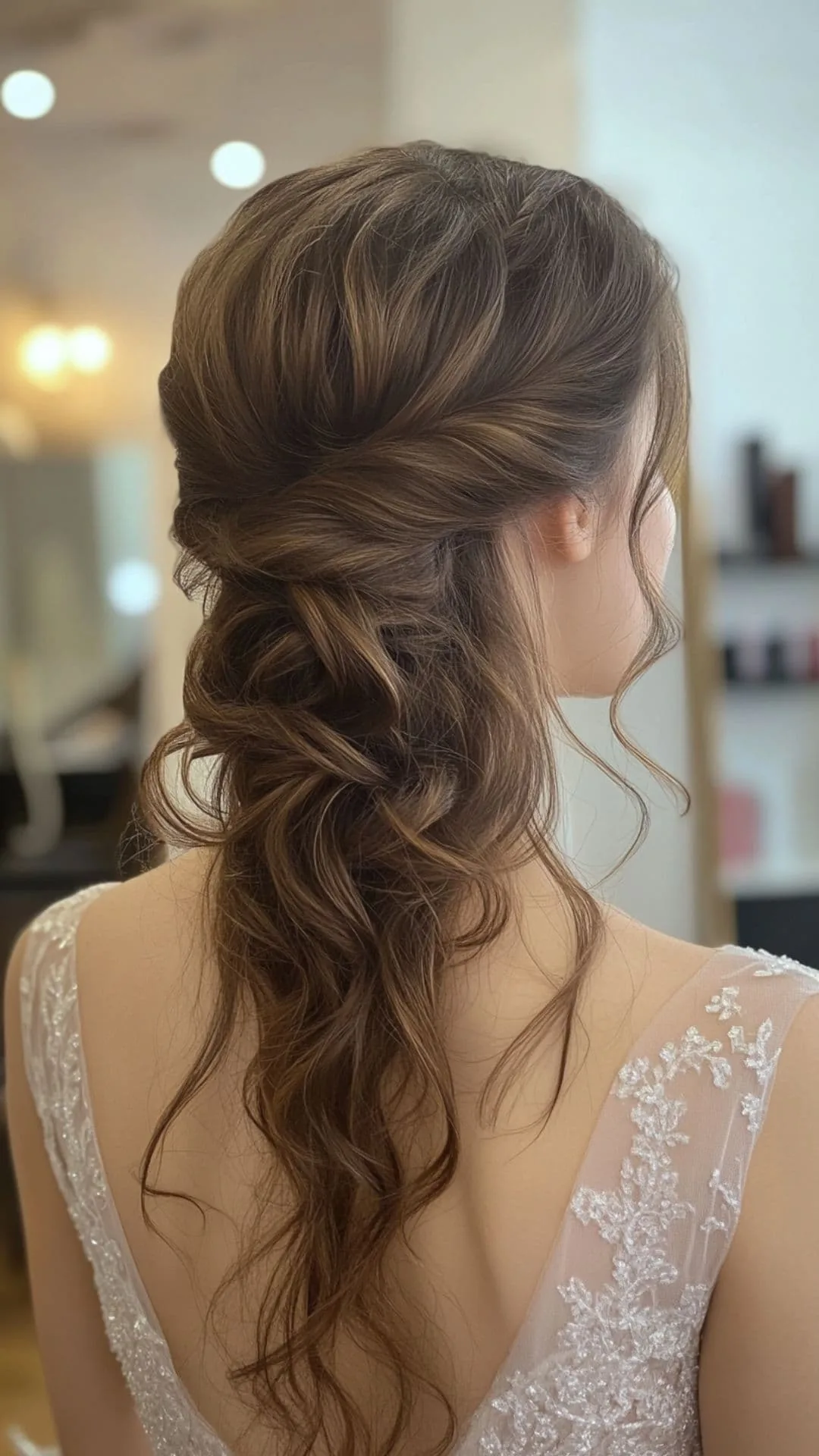
The half-up twisted crown is the perfect middle ground for a school dance: hair up out of your face, hair down over your shoulders, and a pretty detail that looks far more complicated than it is. Two sections are twisted back from the temples and pinned together at the crown, making a soft coronet that holds the front while the rest falls free.
Best for: medium to long hair, wavy or straight, and anyone who cannot decide between up and down. It works with almost every dress and every neckline.
What to ask a stylist: ask for the twists to be pinned in a cross, not a single pin, and for the back to be left soft rather than pulled flat. If you are doing it yourself, twist each side away from your face and cross the pins so they lock.
6. Half-Up Bubble Braid
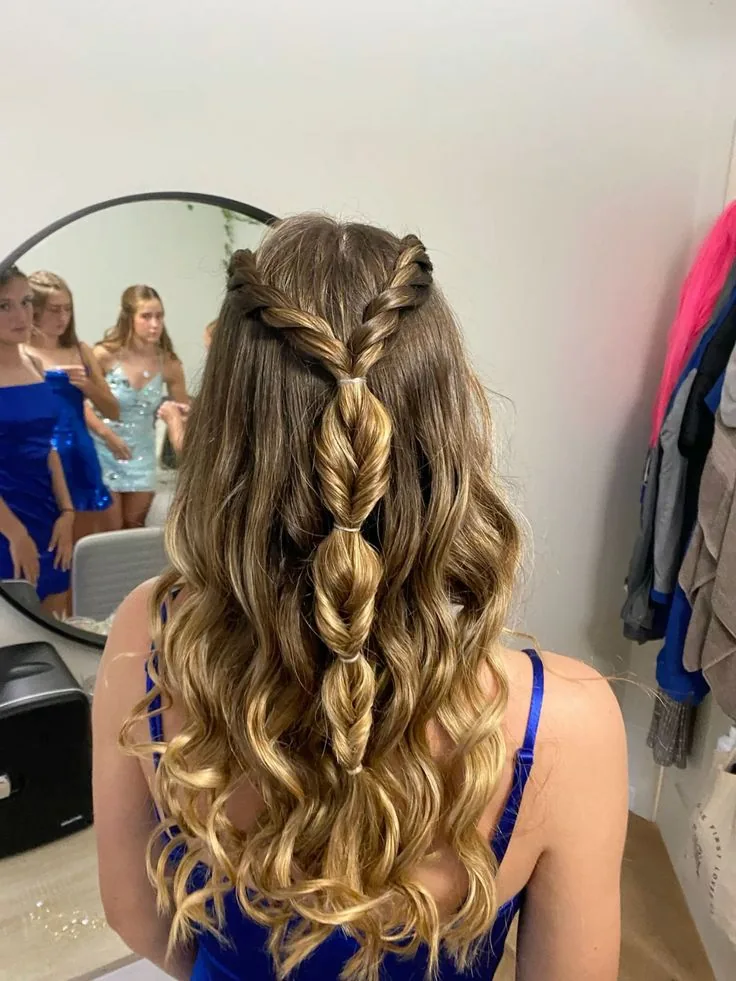
The half-up bubble braid is fun, modern and surprisingly secure, which makes it a great school dance choice. The top half of the hair is gathered and sectioned into soft “bubbles” with small elastics, while the rest falls loose. It looks playful in photos and it genuinely holds, because every bubble is anchored separately.
Pros: no braiding skill needed, holds through dancing, and looks great from the back. Cons: it suits a fun, modern dress better than a very formal gown, and it needs a few minutes of pancaking to look full rather than stringy.
How to style: gather the top half, add elastics every few centimetres, then gently pull each section wider to make the bubbles. Finish the rest of the hair with loose waves so the two halves blend together.
7. Soft Hollywood Waves
Soft Hollywood waves are the most glamorous way to wear your hair down at a school dance, and they never go out of fashion. Big, smooth, brushed-out waves fall over one shoulder, catch the light in photos, and move beautifully when you dance. They look expensive without needing an updo, which is why they appear at every formal event.
Best for: long hair, especially thick hair that holds a curl. Fine hair can work too, but it needs texture spray and a strong-hold finish, or the waves will drop within an hour.
How to style: curl all the hair in the same direction with a large barrel, let the curls cool completely, then brush them out gently into waves. Set with a light spray, and carry a couple of pins in case a front section needs tucking back later.
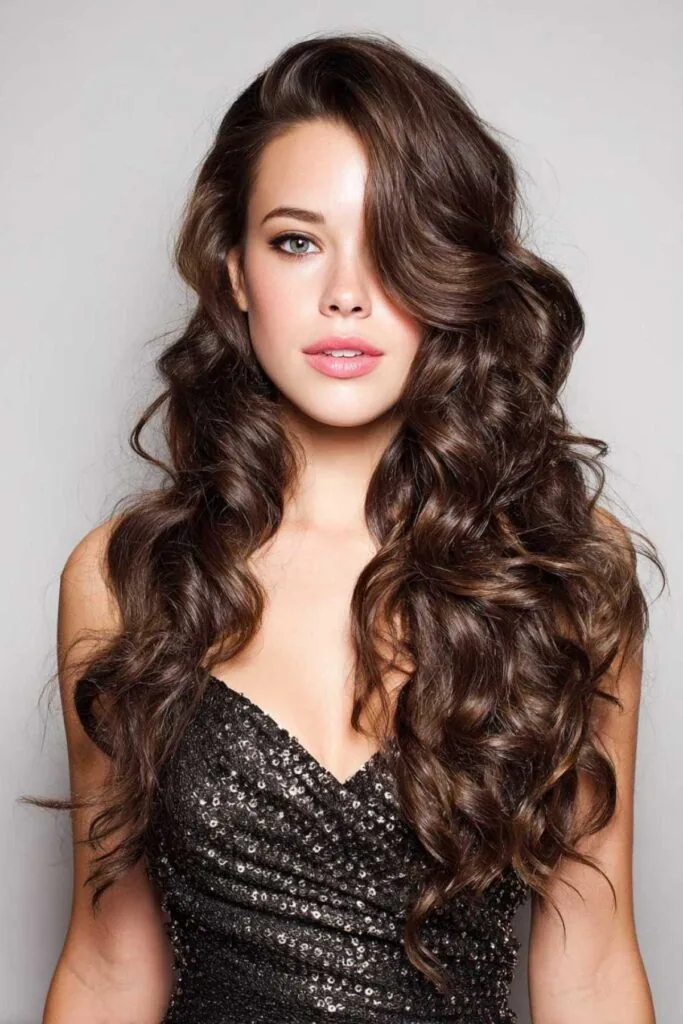
8. Old Hollywood Side-Swept Waves
Old Hollywood side-swept waves are the most dramatic hair-down option for a school dance: a deep side part, sculpted waves swept to one side, and a bare shoulder on the other. It is a red-carpet look scaled down for a school gym, and it is made for one-shoulder and strapless dresses, where the empty side balances the sweep of hair.
Who should avoid it: anyone who hates fussing with their hair. One side is heavy and will creep across your face while you dance, so you will need to tuck it back more than once.
How to style: part the hair deeply to one side, curl with a medium barrel, brush into waves, and pin the lighter side flat behind your ear with two crossed pins. A strong-hold spray on the swept side is not optional.
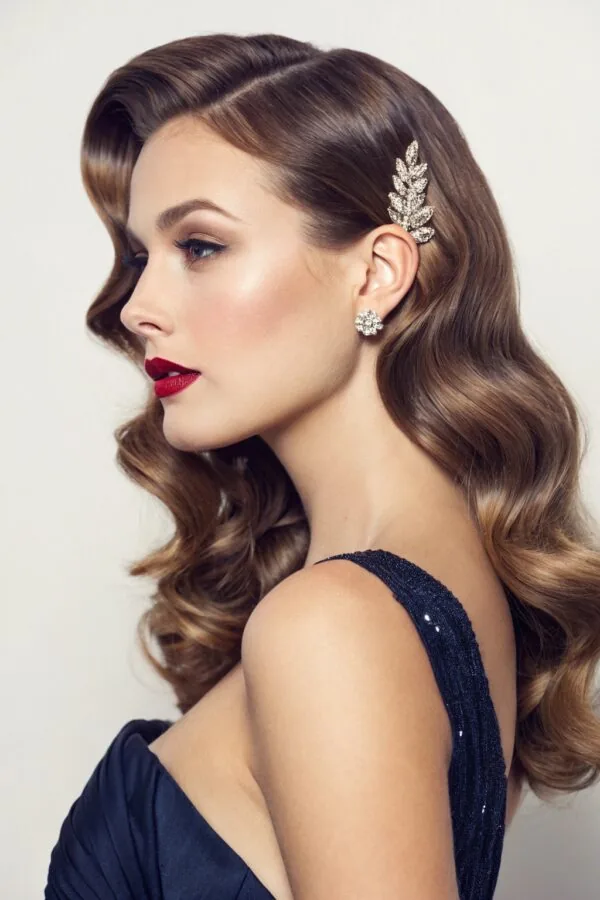
9. Loose Beachy Waves
Loose beachy waves are the relaxed choice for a school dance, and they suit a semi-formal dance better than a very formal one. The waves are undone, a little messy and completely comfortable — you can dance, laugh and take photos without thinking about your hair at all. They also hide a multitude of sins, including hair that would not hold a curl properly.
Best for: medium to long hair, naturally wavy hair, and anyone whose dress is simple. The hair is the texture in the outfit, so keep jewellery simple.
How to style: curl random sections in alternating directions, leave the ends straight, and shake the hair out with your fingers. A salt or texture spray gives the waves grip, and a light spray keeps them from going flat by midnight.
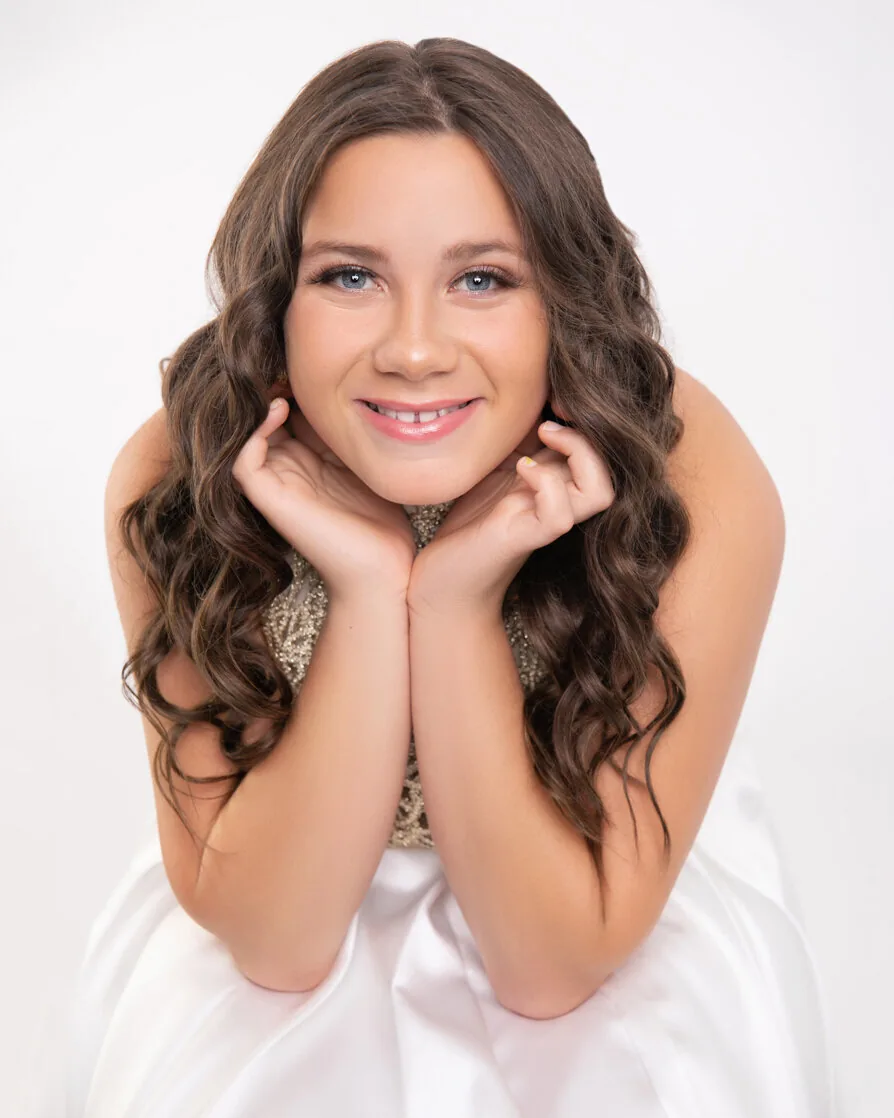
10. Sleek Straight Hair With a Centre Part
Sleek straight hair with a centre part is the simplest look on this list, and when it is done well it is also one of the most striking. Glassy, smooth hair with a sharp part frames the face symmetrically and makes earrings and makeup the stars. It is the right choice if your dress is detailed and your hair should stay quiet.
Common mistake: skipping heat protection or straightening damp hair. Both cause frizz that shows up badly in flash photos, and frizz is almost impossible to fix once you are at the dance.
How to style: blow-dry the hair smooth, straighten in small sections, and finish with a tiny amount of shine serum on the lengths only. Tuck one side behind your ear if you want a little asymmetry, and carry a spare pin for the wind on the way in.
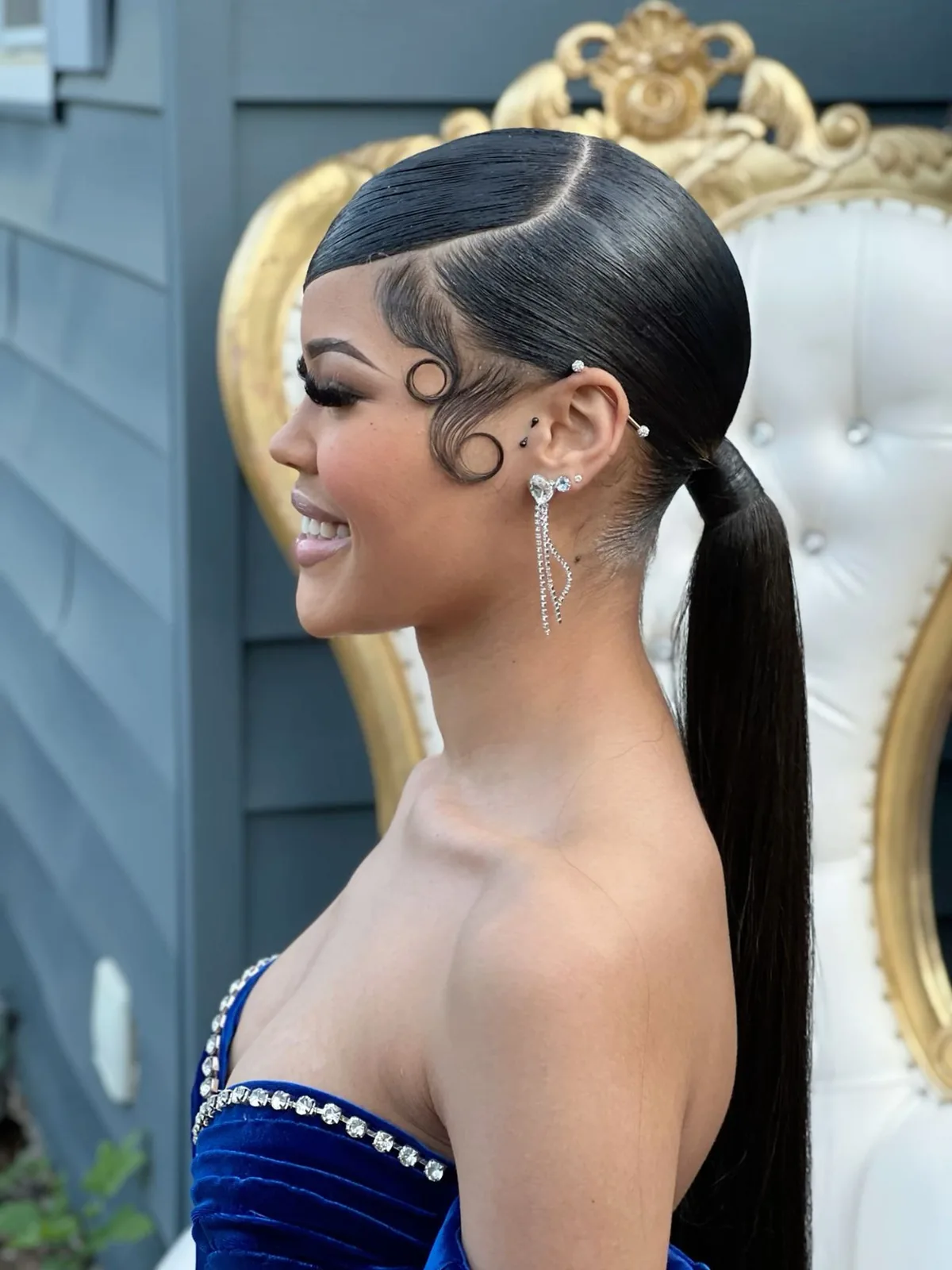
11. Voluminous Blowout Curls
Voluminous blowout curls give you the big, bouncy hair that fills a room, and they are a natural fit for a school dance. The curls are soft, not tight, so they move when you dance and look full from every angle. This is the style to choose if you want your hair to be the main event and your dress to play a supporting role.
Best for: medium to long hair with some natural body. Very fine hair can still work, but it needs a volumising mousse at the roots and a cool shot from the dryer to set the lift.
Cost and time: a salon blowout takes 30 to 45 minutes and usually lasts the evening. At home, use a round brush and a dryer, curl the hair in sections, and let everything cool before you brush it out.
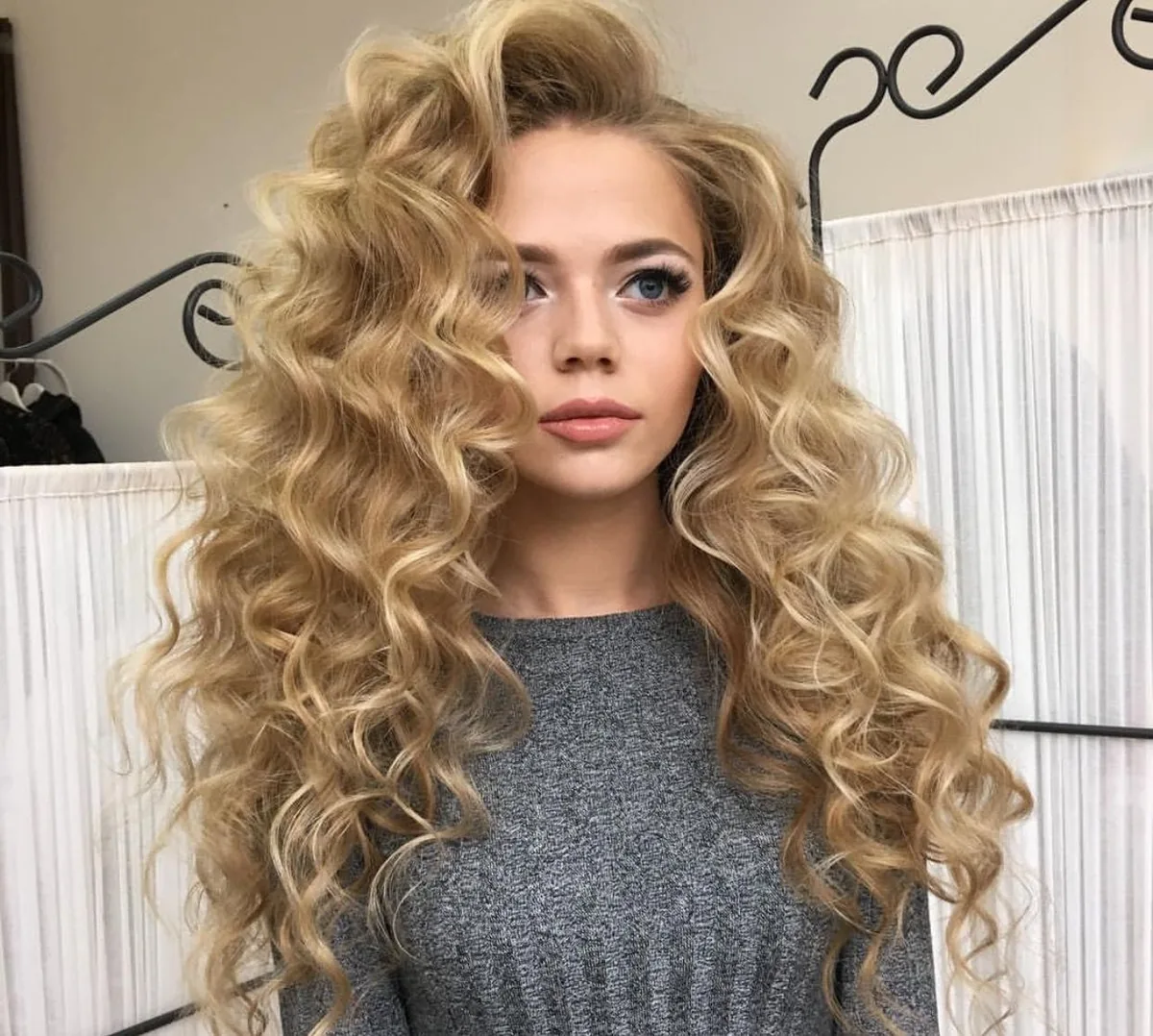
12. The French Twist
The French twist is the most elegant updo on this list and the one that looks most at home with a formal gown. Hair is swept up and folded into a vertical roll at the back of the head, pinned invisibly, with a smooth, sculpted front. It is timeless, it photographs like a portrait, and it does not move once it is pinned.
Best for: medium to long hair, straight or slightly wavy, and formal or black-tie school dances. It suits long necks and statement earrings beautifully.
What to ask a stylist: ask for a modern, slightly soft twist rather than a severe one, with a little volume at the crown. A very tight twist can look ageing on a teenager; a softer version looks fresh and current.
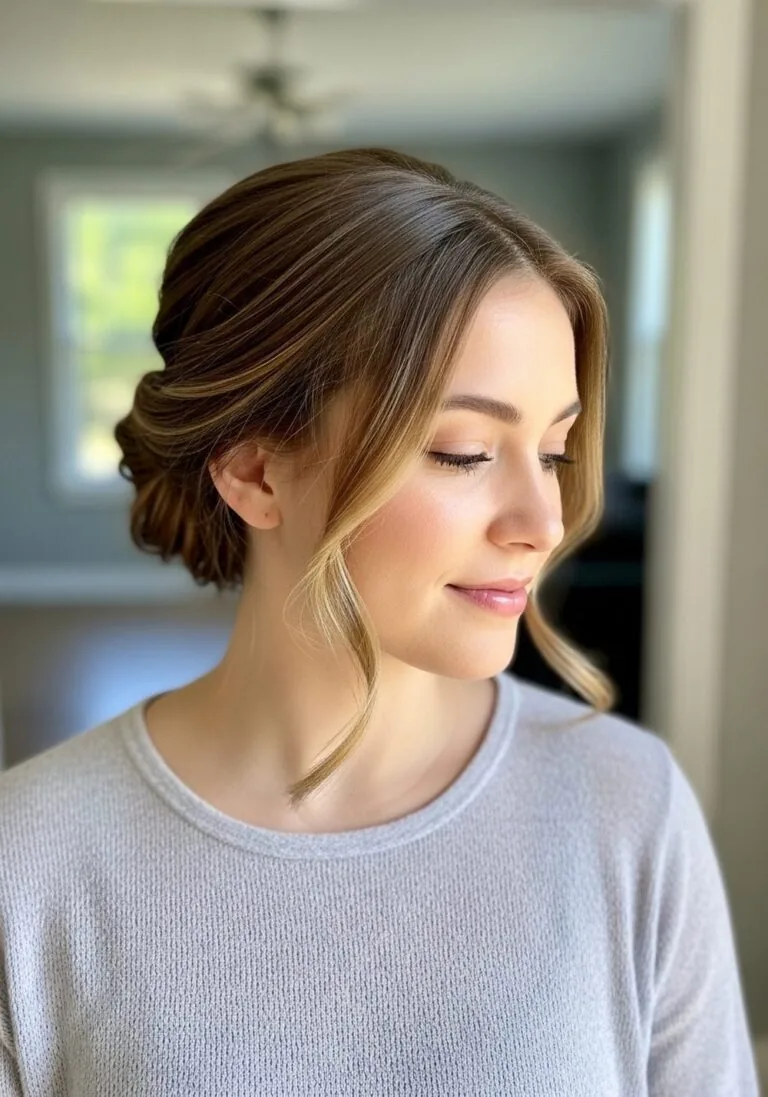
13. Braided Crown
A braided crown wraps a braid around the head like a headband made of your own hair, and it is one of the prettiest school dance styles for long hair. It keeps every strand out of your face while you dance, it looks intricate in photos, and it suits romantic, boho and classic dresses alike.
Pros: extremely secure, comfortable, and great for thick hair. Cons: it needs length — hair that barely reaches the shoulders will not wrap all the way around, and the braid can look thin on very fine hair.
How to style: part the hair in the middle, braid each side from the front to the back, then cross the braids over the top and pin them flat. Pull the braids gently wider to make them look fuller, and finish with spray.
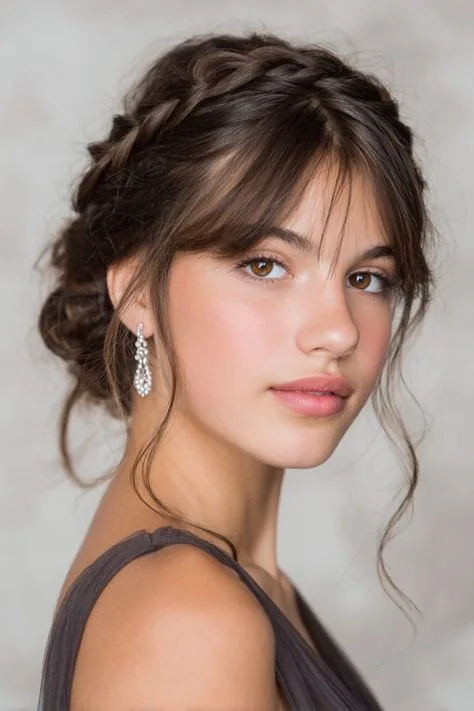
14. Dutch Braid Into a Low Bun
A Dutch braid that flows into a low bun gives you the best of two worlds: the interesting, textured braid at the front and the neat, secure bun at the back. It is one of the most dance-proof styles on this list, because the braid itself holds the hair in place, and it looks far more complicated than it actually is.
Best for: medium to long hair, and anyone who wants an updo that will not budge. It is also a good choice if your hair is layered, because the braid catches the shorter pieces that usually escape.
How to style: Dutch-braid from the hairline back on one or both sides, gather everything low, twist into a bun and pin. Leave the braid slightly loose and pulled wide for a soft, romantic finish.
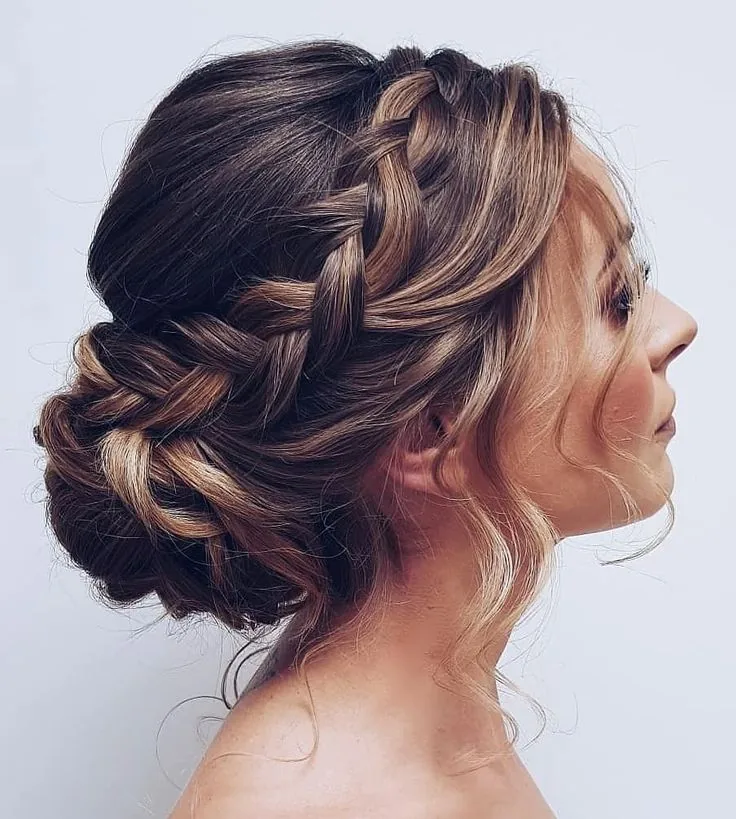
15. Fishtail Braid Ponytail
A fishtail braid ponytail is detailed, textured and a little bit boho, and it turns a simple ponytail into a real dance hairstyle. The fishtail texture catches the light in photos, the ponytail keeps everything off your neck, and the whole thing holds up to hours of dancing without a single re-pin.
How to style: gather the hair into a low or mid ponytail, split it into two sections, and fishtail-braid down the length, crossing small pieces from each side to the other. Secure the end, then gently pull the braid wider for fullness.
Quick verdict: easy to learn, hard to ruin, and one of the most complimented styles at any school dance. Practice it once the day before so your fingers know the rhythm.
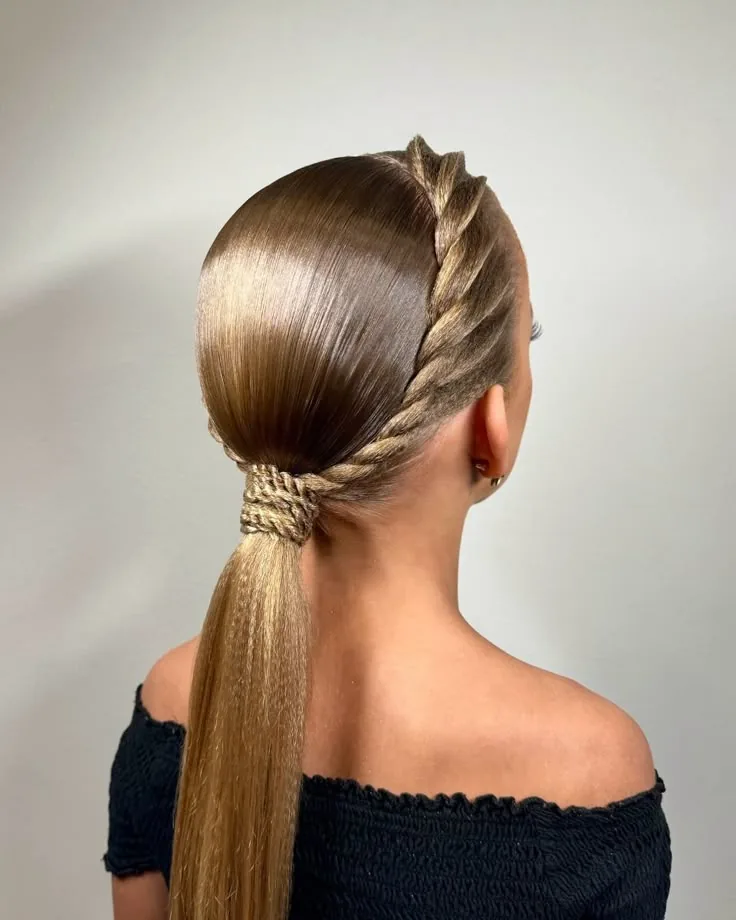
16. Messy Textured Bun
The messy textured bun is the relaxed, modern updo that works when a polished bun feels too stiff for a school dance. It sits a little loose, a little undone, with texture and volume instead of a smooth shell, and it looks better as the night goes on — which is a rare and useful quality when you will be dancing for hours.
Best for: medium to long hair with natural texture, and anyone who wants an updo without the formality. It suits casual and semi-formal dances best.
Common mistake: making it too messy. A bun that is genuinely falling apart at 8 p.m. will be gone by 10 p.m. Build it on a secure base, pin it twice, and then loosen only the surface.
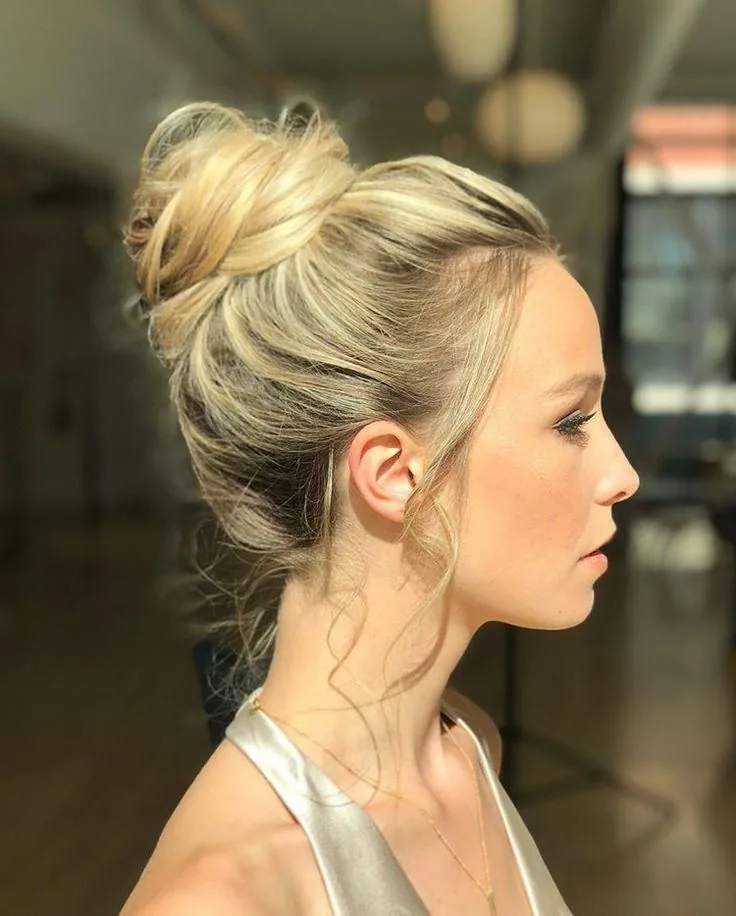
17. Low Side Bun With Face-Framing Tendrils
A low side bun with face-framing tendrils is soft, romantic and very photogenic, and it is the right choice if you want an updo that still feels gentle. The bun sits to one side at the nape, the tendrils soften the face, and the asymmetry makes the whole look more interesting than a centred bun.
Best for: a one-shoulder dress — put the bun on the opposite side to the bare shoulder for balance. It also suits round faces, because the tendrils lengthen the face.
How to style: sweep the hair to one side, twist it into a low bun and pin it firmly, then pull out two thin tendrils at the front and curl them lightly. Keep the tendrils thin; thick pieces will fall across your eyes while you dance.
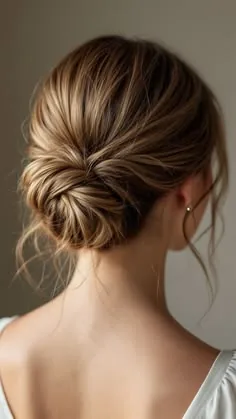
18. High Ballerina Bun
The high ballerina bun is clean, classic and completely out of your way, which is why dancers have worn it for a century. It sits at the crown, smooth and round, shows off your neck and shoulders, and does not move no matter how much you dance. It is the most reliable updo on this list.
Best for: long hair, and anyone with a dress that has a high neckline or a detailed bodice. It also makes you look taller in group photos.
Watch out for: the headache factor. A bun pulled too tight at the crown will ache after an hour. Secure it firmly with pins rather than yanking it tight with an elastic, and use a doughnut form if your hair is fine and needs the shape.
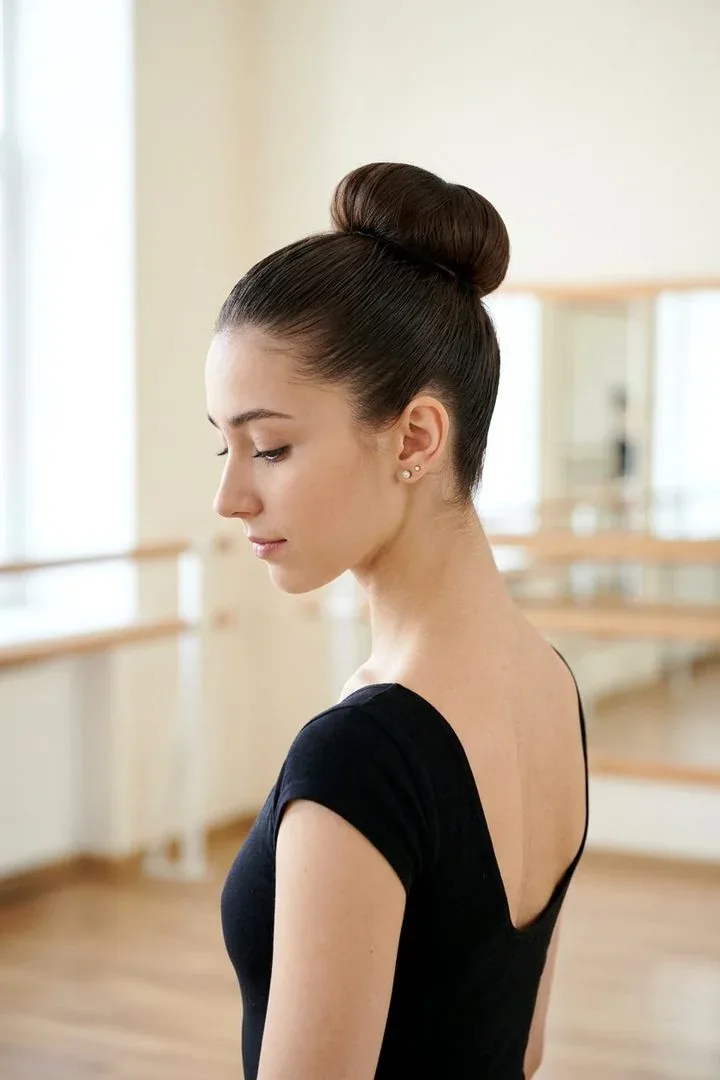
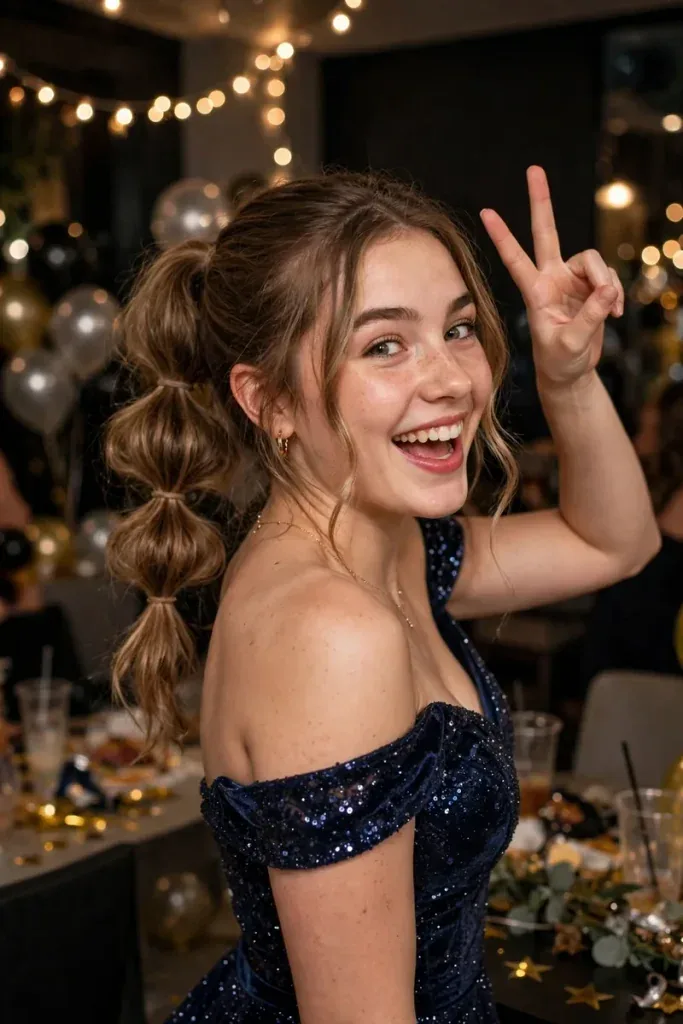
19. Bubble Ponytail
The bubble ponytail is the fun, modern ponytail that looks like it belongs at a party, and a school dance is exactly that. Small elastics divide the ponytail into soft, rounded bubbles, giving it shape and movement that a plain ponytail never has. It is playful in photos and practical on the dance floor.
Pros: holds brilliantly, needs no braiding skill, and works on medium and long hair. Cons: it is a bold, modern look, so it suits a fun dress better than a traditional gown.
How to style: make a high or mid ponytail, add elastics every few centimetres down the length, and gently pull each section wider to form the bubbles. Wrap a strand of hair around the top elastic to hide it.
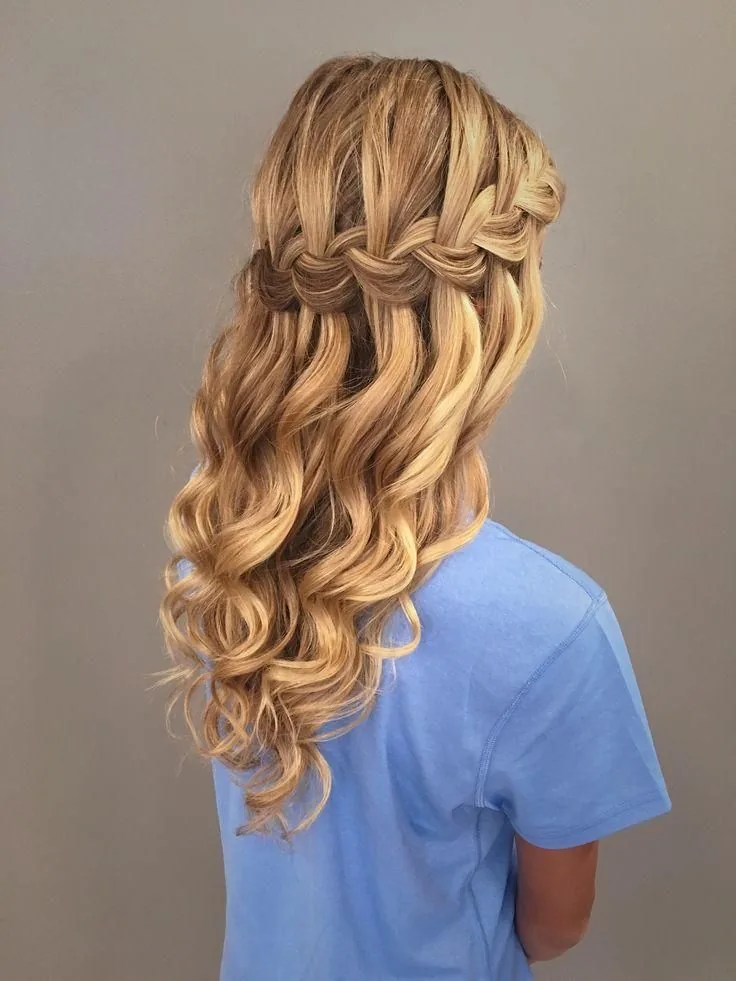
20. Waterfall Braid Half-Up
The waterfall braid half-up is one of the prettiest ways to wear your hair half up at a school dance. A braid runs across the back of the head, letting strands fall through it like a waterfall, while the rest of the hair falls loose below. It looks delicate and detailed, and it photographs beautifully from the back.
Best for: long, wavy or straight hair, and anyone who wants a romantic detail without a full updo. It works with almost any dress.
How to style: braid across the back, dropping the bottom strand each time and picking up a new one, then secure the end with a pin hidden under the hair. Curl the loose lengths softly so the “waterfall” strands blend in.
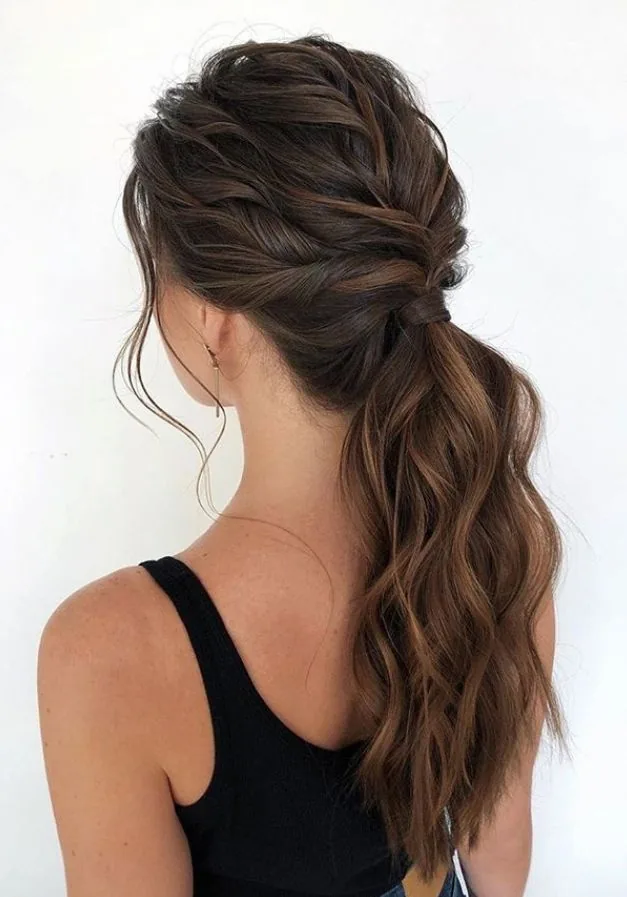
21. Twisted Side Ponytail
The twisted side ponytail is soft, romantic and easy — a ponytail worn over one shoulder, with the hair twisted rather than braided for a smoother, more elegant finish. It keeps your hair out of the way while you dance, shows off your earrings on the bare side, and looks lovely in photos from the front.
Best for: medium to long hair, and a one-shoulder or strapless dress. Put the ponytail on the side opposite the dress strap for balance.
How to style: sweep the hair to one side, twist two sections around each other, and secure low over the shoulder. Curl the ends for softness, and pin the twist flat at the back so it does not slide around while you dance.
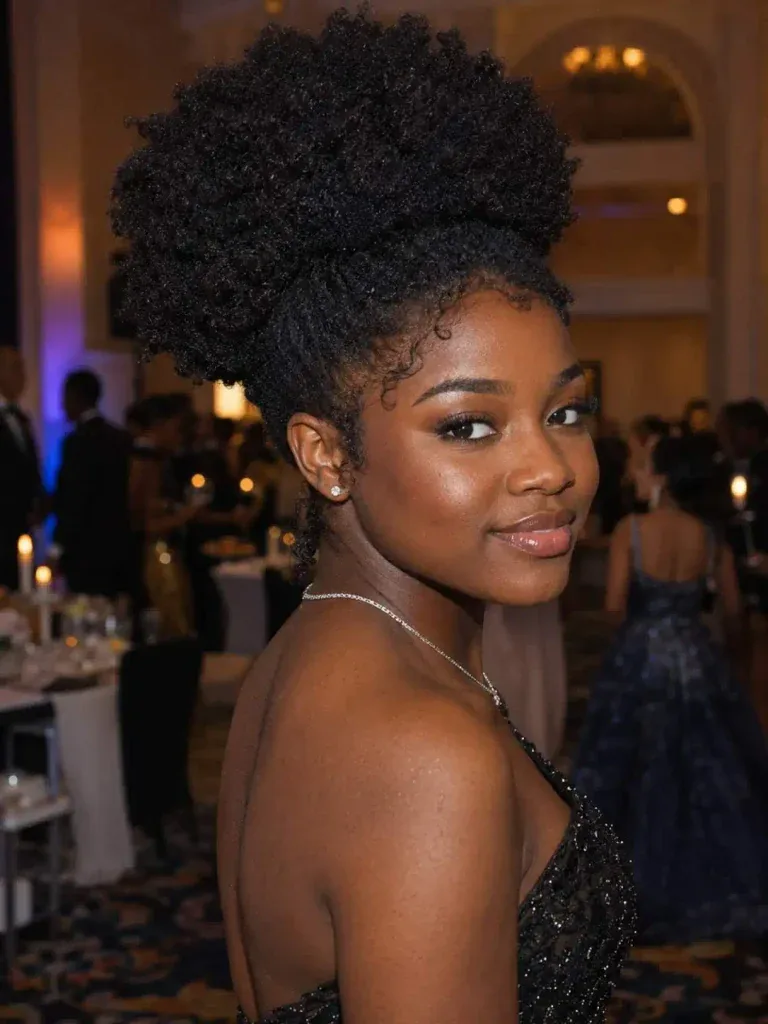
22. Curly Afro Puff Updo
A curly afro puff updo celebrates natural texture and volume, and it is a joyful, confident choice for a school dance. The curls are gathered up into a full, rounded puff that shows off their shape, keeps them off your neck, and moves beautifully when you dance. It is also one of the most comfortable styles to wear for hours.
Best for: natural curly and coily hair with enough length to gather up. Shorter curls can wear a smaller puff or two mini puffs with the same effect.
How to style: moisturise and define the curls, gather the hair up with a wide, gentle band, and shape the puff with your hands. Smooth the edges with a little gel, and add a decorative pin or clip if your dress is simple.
23. Defined Curls Pinned to One Side
Defined curls pinned to one side give you the glamour of wearing your curls down, with the practicality of keeping them out of your face. The curls are swept to one side and pinned flat on the other, so you get volume, shine and movement, but you can still see, dance and take photos without hair in your eyes.
Best for: naturally curly hair, medium to long, and anyone whose curls usually fall forward. It also suits a strapless dress, because the bare shoulder balances the sweep of curls.
How to style: define the curls with cream or gel, part the hair deeply to one side, and pin the lighter side flat with two crossed pins hidden under the curls. Shake the curls out gently on the heavy side for fullness.
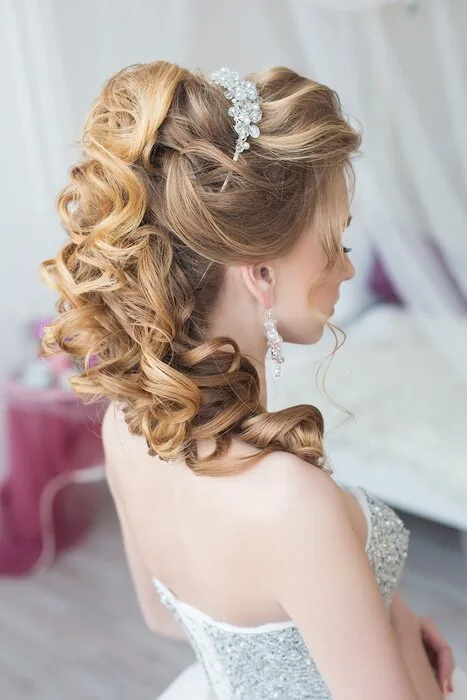
24. Bouncy Layered Curls
Bouncy layered curls are the high-energy choice for a school dance: full, springy curls that move every time you do. Layers keep the curls from sitting heavy and flat, so the shape stays light and bouncy all night instead of dropping by the second song. It is a happy, confident look that suits a fun, upbeat dance.
Best for: medium to long layered hair, naturally wavy or curly hair, and anyone who wants volume without an updo.
Maintenance: curls like these need a little help to last. Curl with a medium barrel, let each curl cool in your hand before you let it drop, and finish with a flexible-hold spray. If a curl falls, re-twist it around your finger and pin it for five minutes.
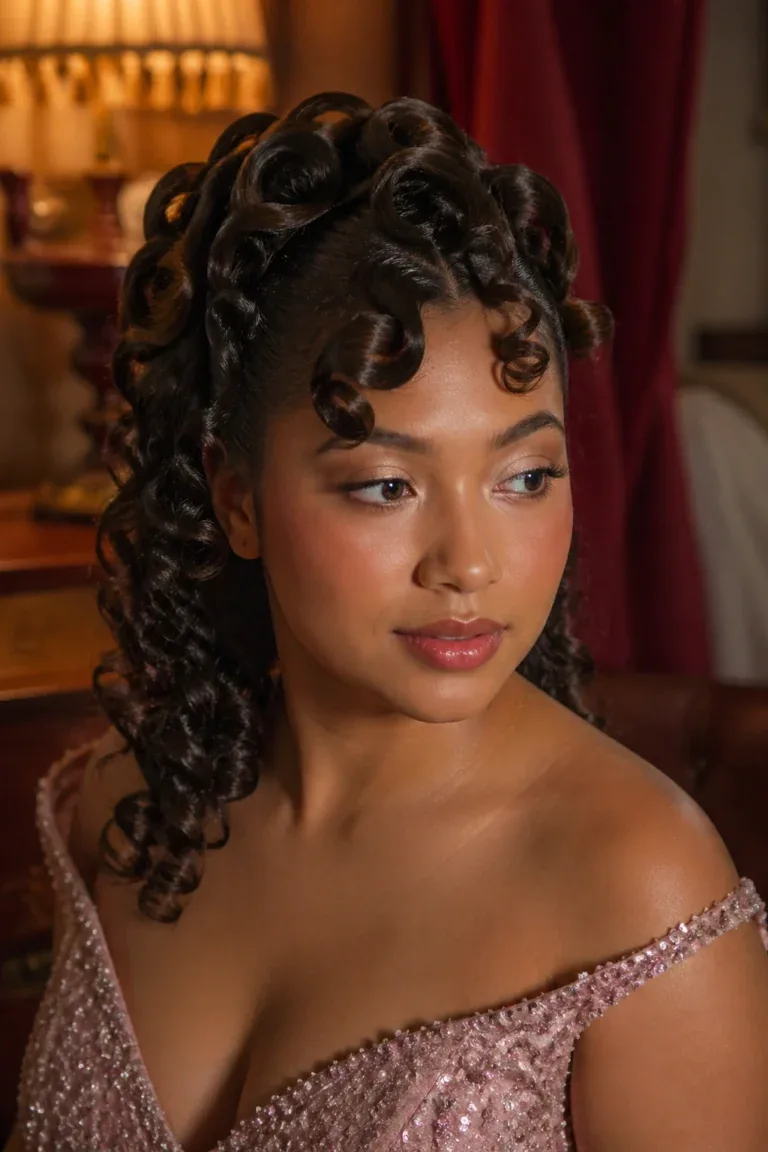
25. Sleek Bob With Tucked Ends
A sleek bob with tucked ends is the polished short-hair choice for a school dance, and it proves that you do not need long hair to look formal. The bob is smooth, the ends tuck under neatly, and the whole shape is clean and graphic. It looks sharp in photos and it does not move, which is a genuine advantage on a dance floor.
Best for: short to chin-length hair, straight or slightly wavy, and anyone with a dress that has a strong neckline or bold jewellery.
How to style: blow-dry with a round brush, turning the ends under, and finish with a flat iron on the very ends if needed. A little shine serum and a light spray keep it smooth, and a sparkly clip on one side adds a dance-night detail.
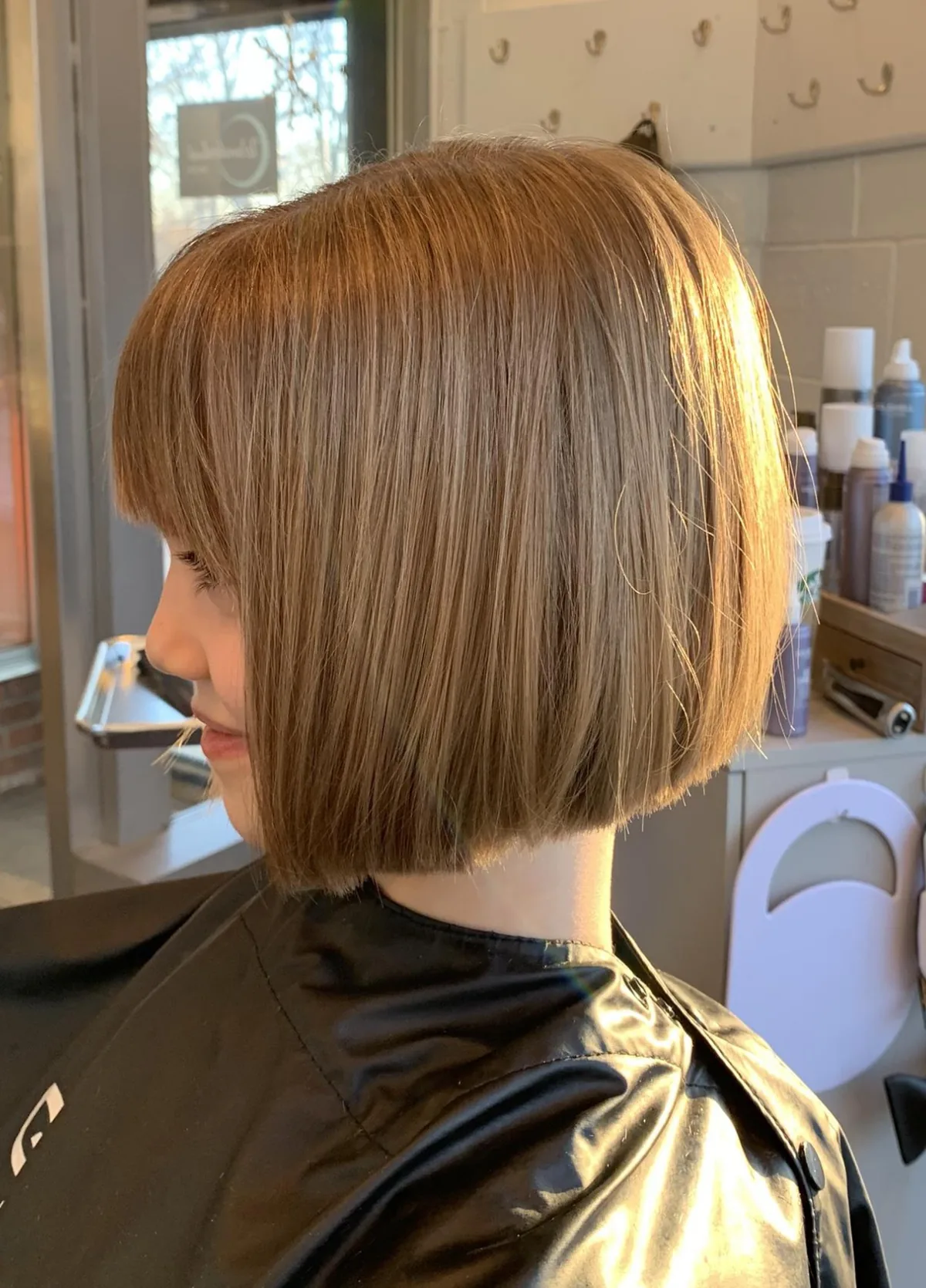
26. Textured Lob With Soft Waves
The textured lob with soft waves is the effortless middle-length style for a school dance: not too long, not too short, and full of movement. The waves give the lob body and life, the texture stops it looking flat in photos, and the length is short enough to hold its shape through hours of dancing.
Pros: easy to style, holds well, and suits almost every face shape. Cons: the waves will drop on very fine hair without texture spray, so build in grip before you curl.
How to style: curl the hair in alternating directions with a medium barrel, leave the ends out for a modern finish, and shake it out with your fingers. A texturising spray, not a heavy hairspray, keeps the waves soft and touchable.
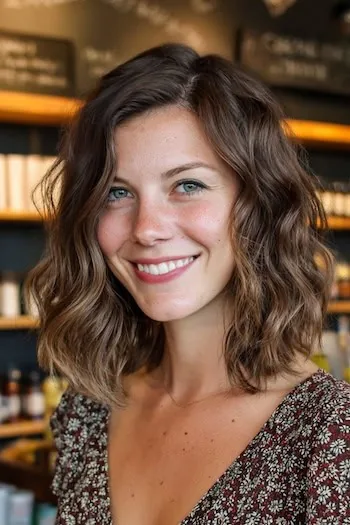
27. Short Pixie With Soft Volume
A short pixie with soft volume is the boldest choice on this list, and it can also be the most striking. With the hair short, your face, your earrings and your dress do all the talking, and a little volume on top gives the pixie a soft, evening finish instead of a daytime one. It is confident, modern and completely dance-proof — there is nothing to fall down.
Best for: short hair, obviously, and anyone who wants to stand out. It suits oval and heart-shaped faces especially well.
How to style: blow-dry the top up and back with a small round brush, add a little texturising paste for definition, and keep the sides smooth. A sparkly clip or a statement earring finishes the look.
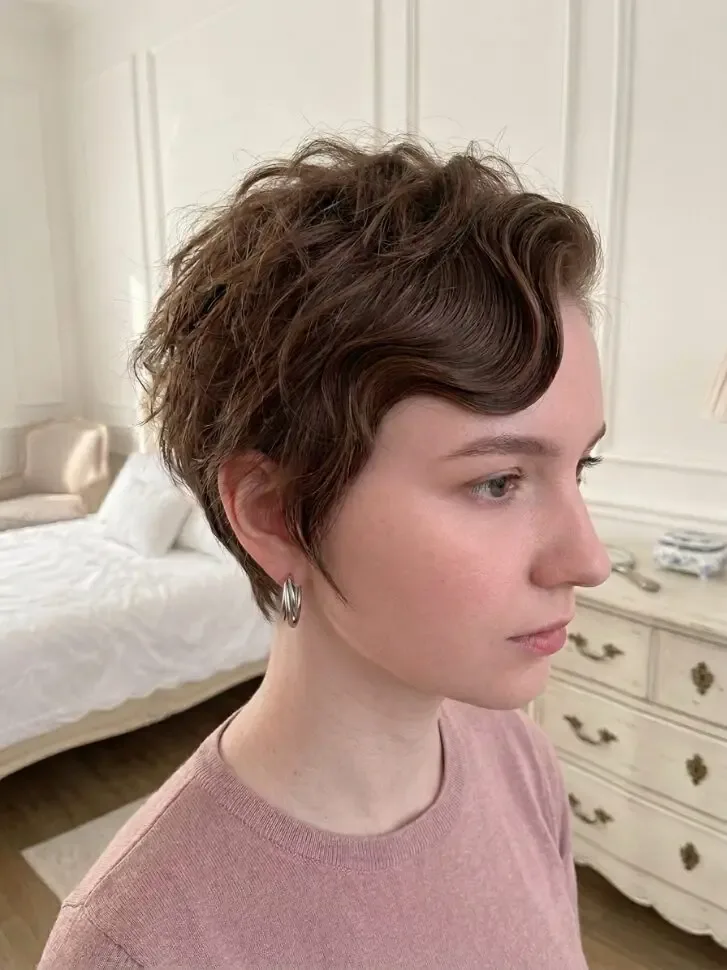
28. Curly Bob With a Side Part
A curly bob with a side part is the sweet spot for short curly hair at a school dance: the curls give you volume and personality, the side part gives you shape, and the length keeps everything manageable. It looks polished without hiding your natural texture, and it holds its shape far better than long curls do.
Best for: naturally curly hair at chin to shoulder length, and anyone who finds long curly styles too heavy or too hot to dance in.
How to style: define the curls with a curl cream, part the hair deeply to one side, and let the curls fall naturally. Pin back the lighter side if curls keep falling into your eyes, and use a little gel at the edges for a clean finish.
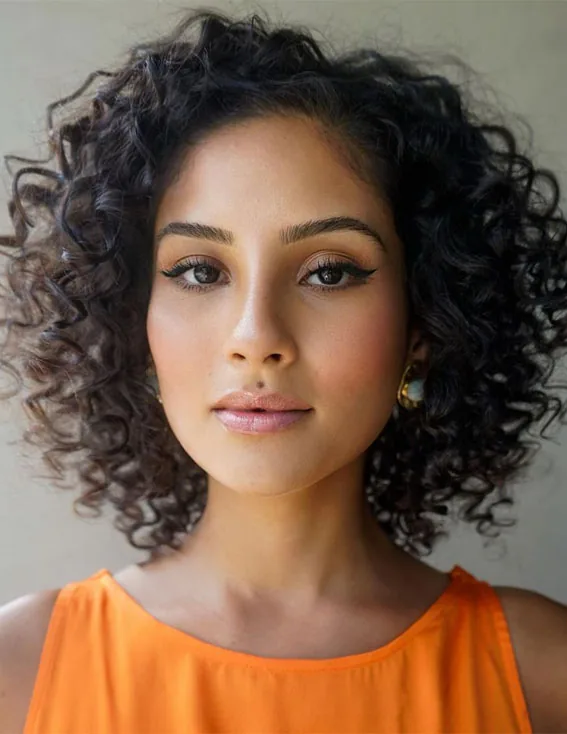
29. Braided Low Ponytail
A braided low ponytail is the quiet, elegant version of a ponytail, and it is one of the most reliable school dance styles. The braid adds texture and interest, the low position keeps it comfortable, and the whole thing stays put for hours. It suits a formal dress, a simple dress, and everything in between.
Best for: medium to long hair, straight or wavy, and anyone who wants a ponytail that looks deliberate rather than thrown together.
How to style: gather the hair low, braid it loosely, and secure the end with a small elastic wrapped in a strand of hair. Pull the braid gently wider for fullness, and leave a few soft pieces at the front if you want a gentler finish.
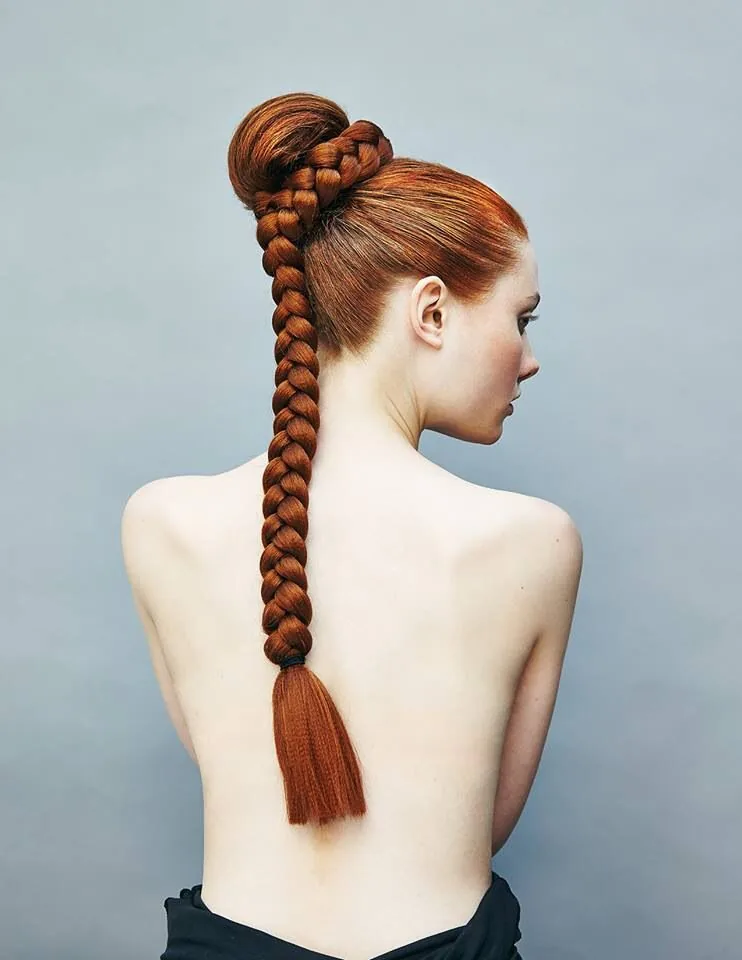
30. Rope-Braid Updo
A rope-braid updo twists two sections of hair around each other into a rope, then coils the rope into an updo. It looks intricate and expensive, but it is genuinely one of the easiest braided updos to learn, and it holds like a dream because the twist locks the hair in place as you go.
Pros: secure, elegant, and great for thick hair. Cons: it needs a little length to coil neatly, and very fine hair can look thin unless you pancake the rope first.
How to style: divide the hair into two sections, twist each one in the same direction, then twist them around each other in the opposite direction. Coil the rope into a bun at the nape and pin it firmly in three places.
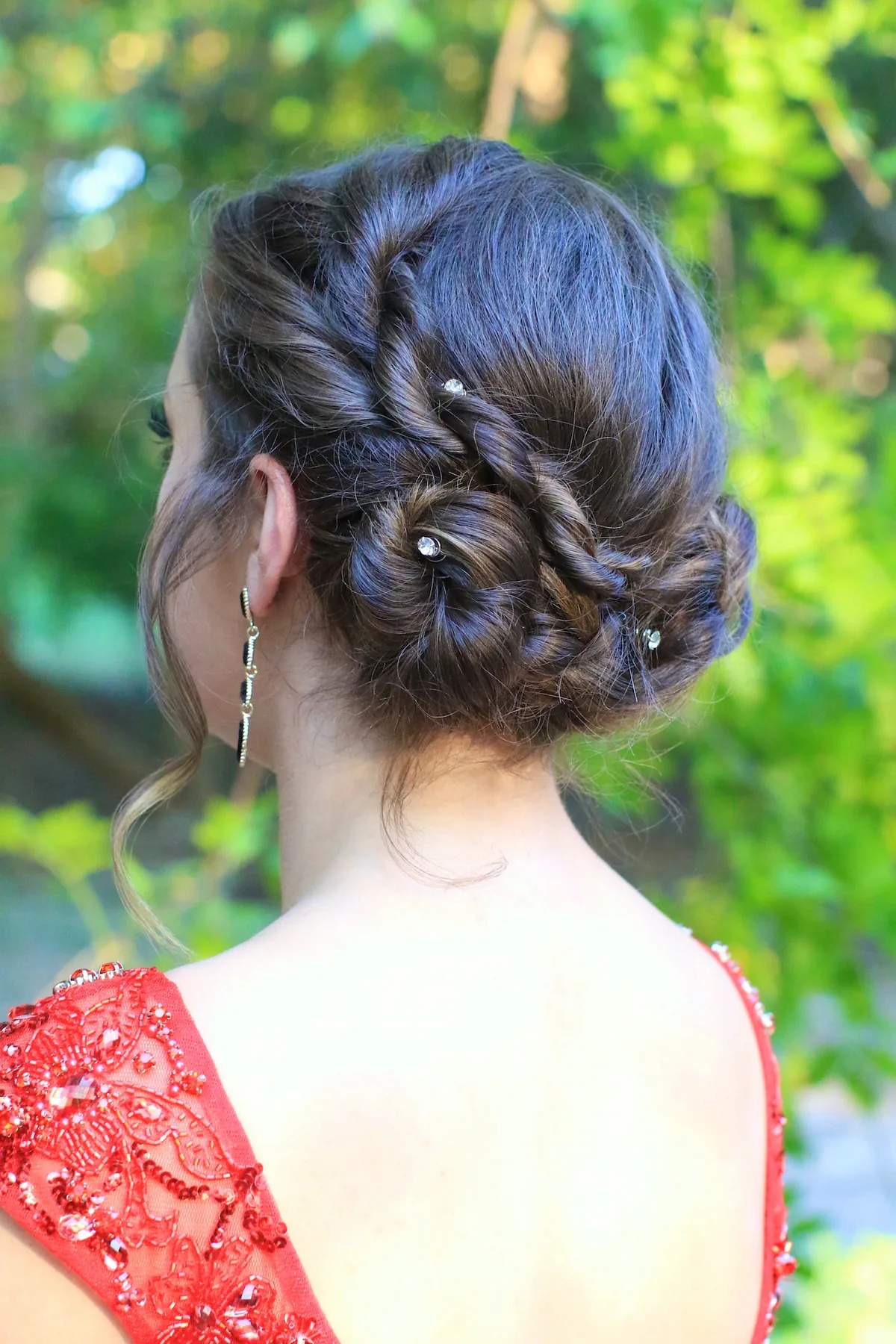
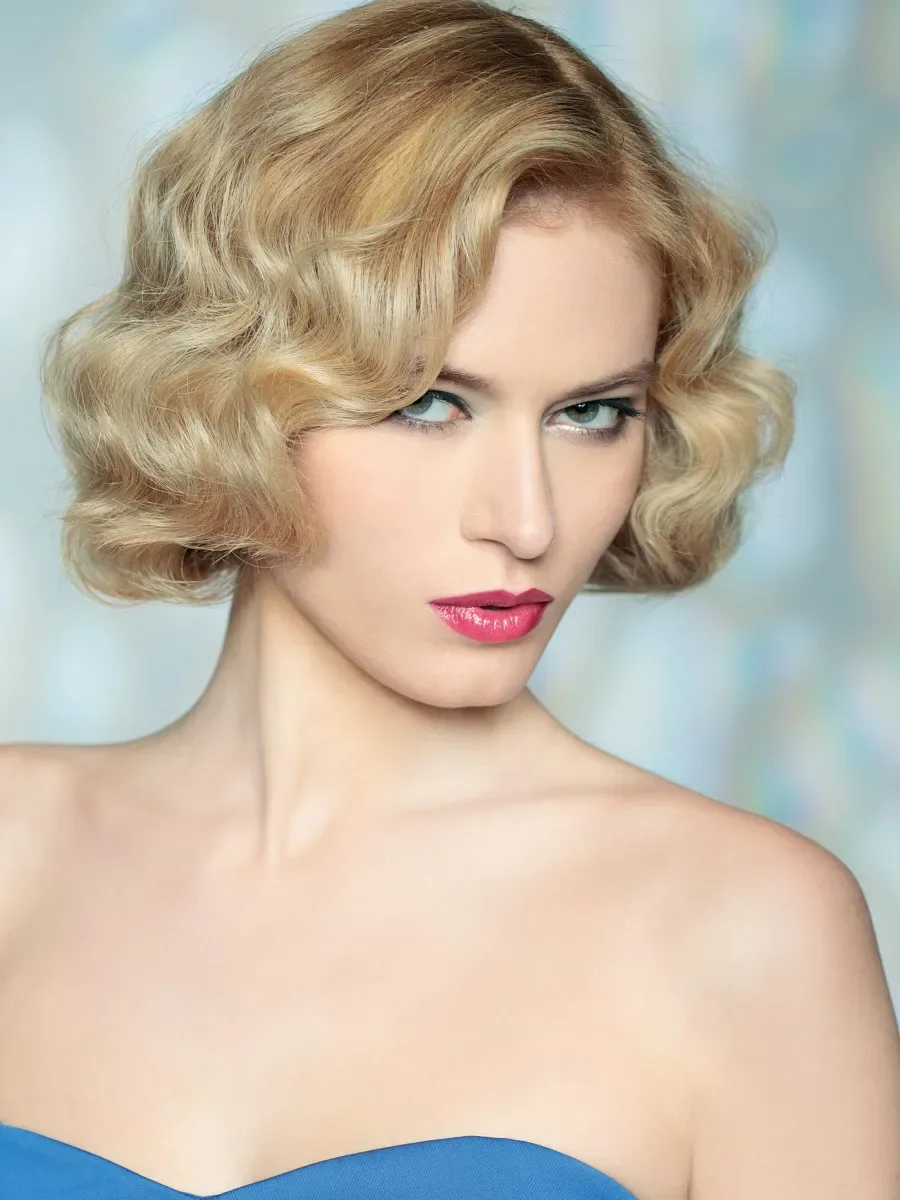
31. Vintage Finger Waves
Vintage finger waves are the most glamorous short-hair option for a school dance, and they turn a bob or a lob into a red-carpet look. The sculpted S-shaped waves lie close to the head, catch the light beautifully, and do not move at all once they are set — which makes them one of the most dance-proof styles here.
Best for: short to medium hair, and a vintage or formal dress. It also suits anyone who wants a statement style without an updo.
Cost and time: finger waves take patience. At home, use gel and clips to set the waves, let them dry completely, then remove the clips and smooth the shape. A salon can do them in about an hour, and they will last the whole night.
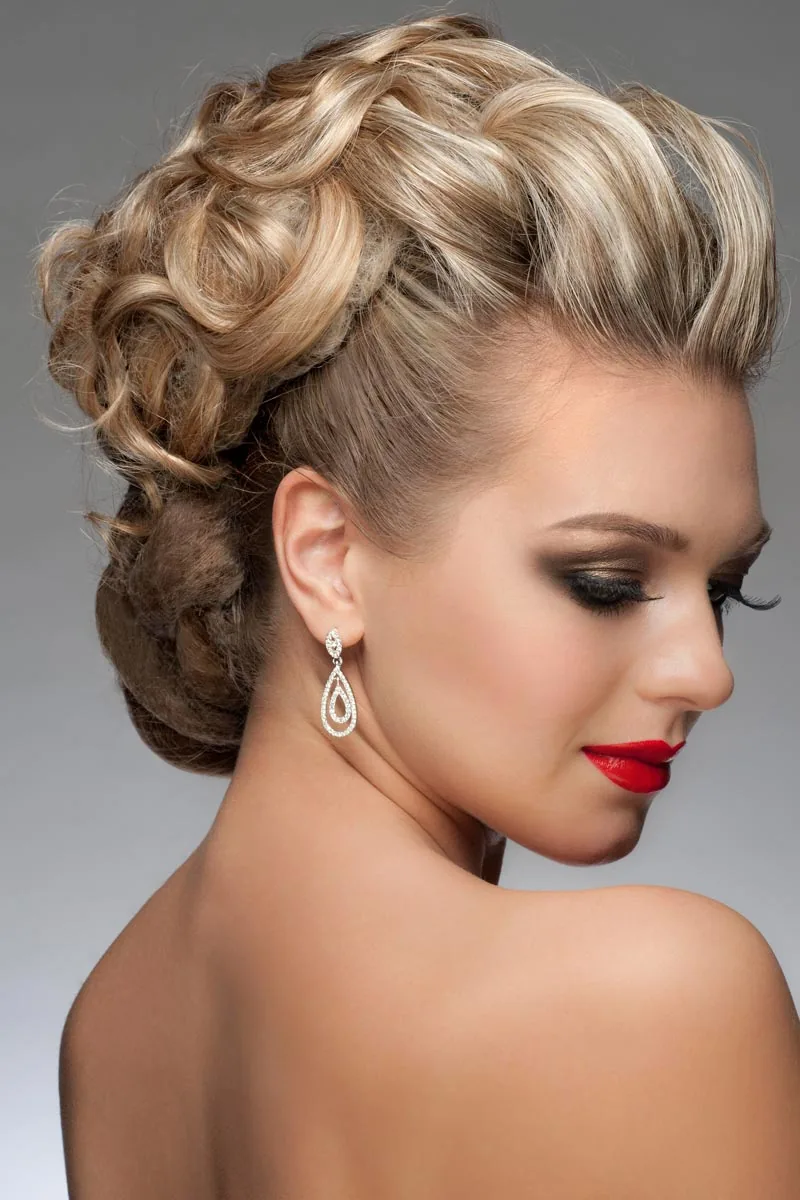
32. Glamorous Side-Swept Updo
The glamorous side-swept updo sweeps all the hair to one side and pins it into a soft, full updo at the nape. It is dramatic, elegant and made for photos, because the sweep creates a beautiful line from the crown to the shoulder. It is the style to choose if you want an updo that still feels like a statement.
Best for: medium to long hair, and a strapless or one-shoulder dress. Wear the sweep on the side opposite the bare shoulder.
What to ask a stylist: ask for the sweep to be pinned at the back of the head, not just at the side, so the weight is supported and the style does not slide. Two crossed pins at the nape do most of the work.
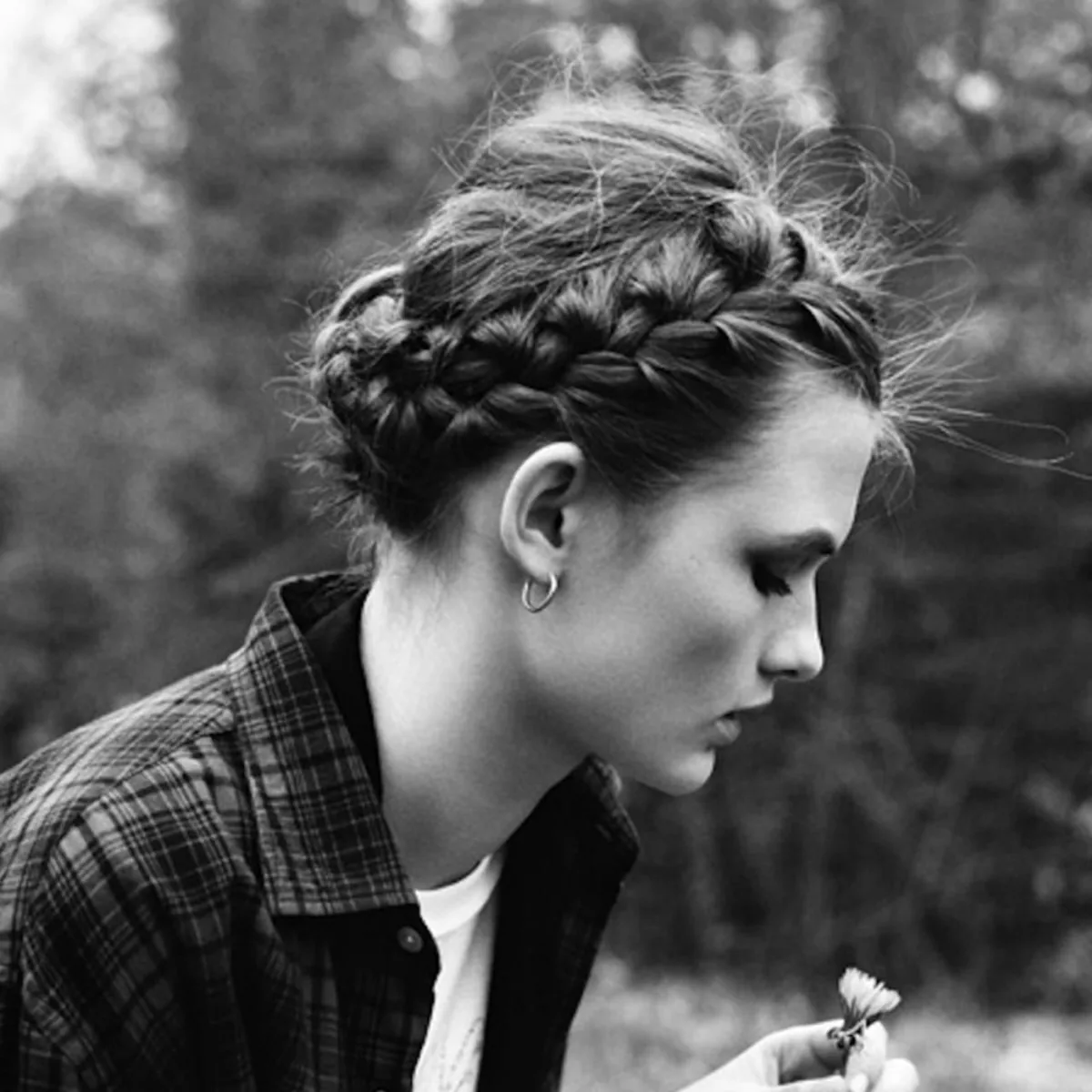
33. Romantic Milkmaid Braids
Romantic milkmaid braids wrap two braids across the top of the head like a crown, and they are the softest, most romantic braided style for a school dance. They keep every strand out of your face, they look beautiful from every angle, and they suit a floaty, romantic dress perfectly.
Pros: very secure, comfortable, and great for thick hair. Cons: they need length, and the braids can look thin on fine hair unless you pull them wider.
How to style: part the hair in the middle, braid each side from the nape upward, then cross the braids over the top of the head and pin them flat. Pull the braids gently wider, leave a few soft pieces at the front, and finish with spray.
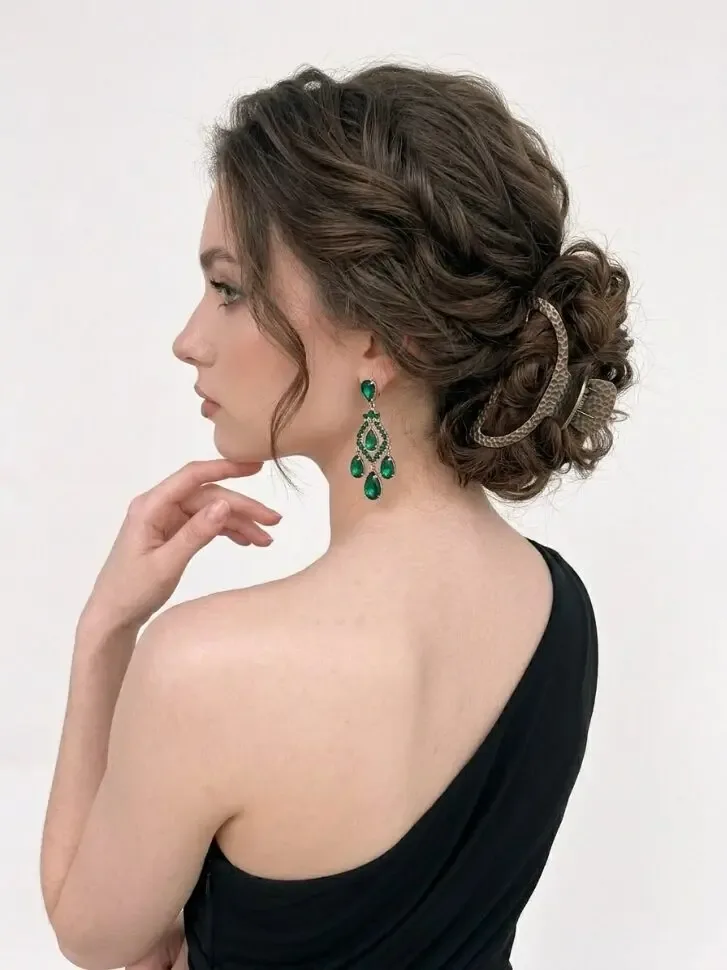
34. Simple Elegant Claw-Clip Updo
The simple elegant claw-clip updo is the easiest style on this list, and it is the one to choose if you are doing your own hair on the night. Hair is twisted up and held with a single beautiful claw clip — no pins, no spray marathon, no salon appointment. Choose a clip that matches your dress, and the clip itself becomes the jewellery.
Best for: medium to long hair, and anyone short on time or budget. It also works as a rescue style if your planned updo falls apart mid-dance.
Quick verdict: pick a strong, good-quality clip, not a flimsy one. Test it by dancing around your room for ten minutes. If it holds, it will hold all night.
What is the best hairstyle for a school dance if I will be dancing all night?
A secure updo, a high ponytail or a braided style is best for a night of dancing, because the hair is anchored and cannot fall into your face. Styles like a low chignon, a Dutch braid into a low bun, or a high sleek ponytail hold for hours, while loose curls and waves usually need re-pinning by the second song. Whatever you choose, test it by dancing at home for ten minutes first.
Should I wash my hair the day of the school dance?
No — wash your hair the night before the dance, not the morning of it. Freshly washed hair is slippery and refuses to hold pins, braids and curls, while hair washed the night before has just enough grip to hold a style all evening. If your hair gets oily quickly, wash it the night before and use a little dry shampoo at the roots on the day.
How do I keep my hairstyle from falling out while dancing?
Build in hidden support: use texture spray or dry shampoo at the roots first, pin every section in two places with crossed bobby pins, and finish with a flexible-hold spray. Start with day-old hair rather than freshly washed hair, and avoid touching your hair once it is styled. A braid or twist in the style also helps, because it holds the hair structurally instead of relying on spray alone.
What hairstyle goes best with a strapless dress?
Hair down or half-up usually suits a strapless dress best, because it fills the space above the neckline — soft Hollywood waves, a half-up twisted crown or loose curls all work well. An updo also works if you want to show off statement earrings or a necklace. Avoid a very high, severe bun, which can make a strapless neckline look bare and unbalanced.
Can I do a school dance hairstyle myself at home?
Yes, many school dance hairstyles are easy to do at home, including a low chignon, a bubble ponytail, a half-up twisted crown and a claw-clip updo. Do a full trial run two days before the dance, time yourself, and take photos from the front, side and back. For a French twist, finger waves or a complex braided updo, a stylist or a practised friend is worth it.
How early should I start getting ready for a school dance?
Give yourself at least an hour for hair, plus time for makeup and getting dressed — most people need two to three hours in total. A simple style takes 20 to 30 minutes, a curled or braided formal style takes 45 minutes to an hour, and a salon updo can take an hour or more. Do a trial run first so you know your real timing, and add fifteen minutes as a buffer.
What hairstyles work for short hair at a school dance?
Short hair looks great at a school dance with texture, volume and one strong detail. A sleek bob with tucked ends, vintage finger waves, a short pixie with soft volume, or a curly bob with a side part are all formal enough for a dance, and they hold their shape better than long styles. Add a sparkly clip or statement earrings to make the look feel like an occasion.
Should I wear my hair up or down for a school dance?
Wear it up if you plan to dance a lot, if your dress has a detailed back or high neckline, or if your hair usually falls flat by midnight. Wear it down if your dress is simple, if you love your natural texture, or if an updo makes you feel too formal. Half-up styles are the middle ground, and they suit almost everyone — hair out of your face, length still on show.
How do I stop frizz and flyaways at a school dance?
Start with fully dry hair, use a heat protectant before styling, and finish with a light serum on the ends and a flexible-hold spray. A tiny amount of hairspray on a clean toothbrush or a spoolie tames flyaways at the hairline without making the hair stiff. Avoid brushing styled hair at the dance, and keep your hands off it — touching it creates frizz faster than anything else.
What should I bring to fix my hair during the dance?
Bring two bobby pins that match your hair colour, one spare hair tie, a mini hairspray or travel-size dry shampoo, and a couple of tissues. That is all you need, and it fits in a small clutch or a friend’s bag. Do not bring a brush — it breaks up curls, pulls out pins and creates frizz. Fingers and pins only, once you are at the dance.
Conclusion
The best hairstyles for a school dance are the ones you forget about once the music starts. That is the real test, more than any photo or compliment: if you are not thinking about your hair, it is doing its job. Choose a style that fits your dress, your hair length and how much you actually plan to dance, try it once before the night, and pack two pins and a spare hair tie just in case.
Whether you go for a classic low chignon, soft Hollywood waves, a braided crown or a simple claw-clip updo, the formula is the same — texture first, pins second, spray last, and a trial run before the night. Do that, and your hair will look as good in the last photo of the night as it did in the first. Now pick your favourite from the list, book your trial run, and enjoy the dance.