Under the Trees and Down the Aisle: 34 Hairstyles for a Garden Wedding That Feel Soft, Romantic and Outdoor-Ready
A garden wedding asks your hair to do something no ballroom ever does: look perfect under open sky, in moving light, with a breeze that changes its mind every few minutes. There is no ceiling to soften the sun, no air conditioning to keep humidity in check, and no quiet corner where you can fix a style that has come undone. What you get in return is the most forgiving backdrop a wedding can offer. Dappled shade softens every curl, greenery makes even the simplest bun look intentional, and a style that loosens a little over the afternoon only looks more romantic in the photographs.
That trade is exactly why these hairstyles for a garden wedding are chosen the way they are. Every style here is built to survive sun, wind and a long afternoon outdoors, and to look better — not worse — as it relaxes. A low chignon that softens into face-framing tendrils by the first dance is not a failure; it is the plan. A braid that holds through the ceremony and still photographs beautifully at golden hour is worth more than a stiff updo that fights the breeze all day.
This guide covers 34 garden wedding hairstyles, from soft loose waves and flower crowns to veil-friendly low buns and braided updos, plus 8 practical guides on the things that actually decide whether outdoor hair works: humidity and breeze-proofing, choosing between a veil and a flower crown, working with fresh flowers, planning around heat and pollen, and coordinating your timeline with your florist and stylist. Whether you are the bride, a bridesmaid, or a guest heading to a ceremony under the trees, you will find a style here that fits your hair length, your dress, and the garden itself.
Reading the Garden: Sun, Shade and Ceremony Timing
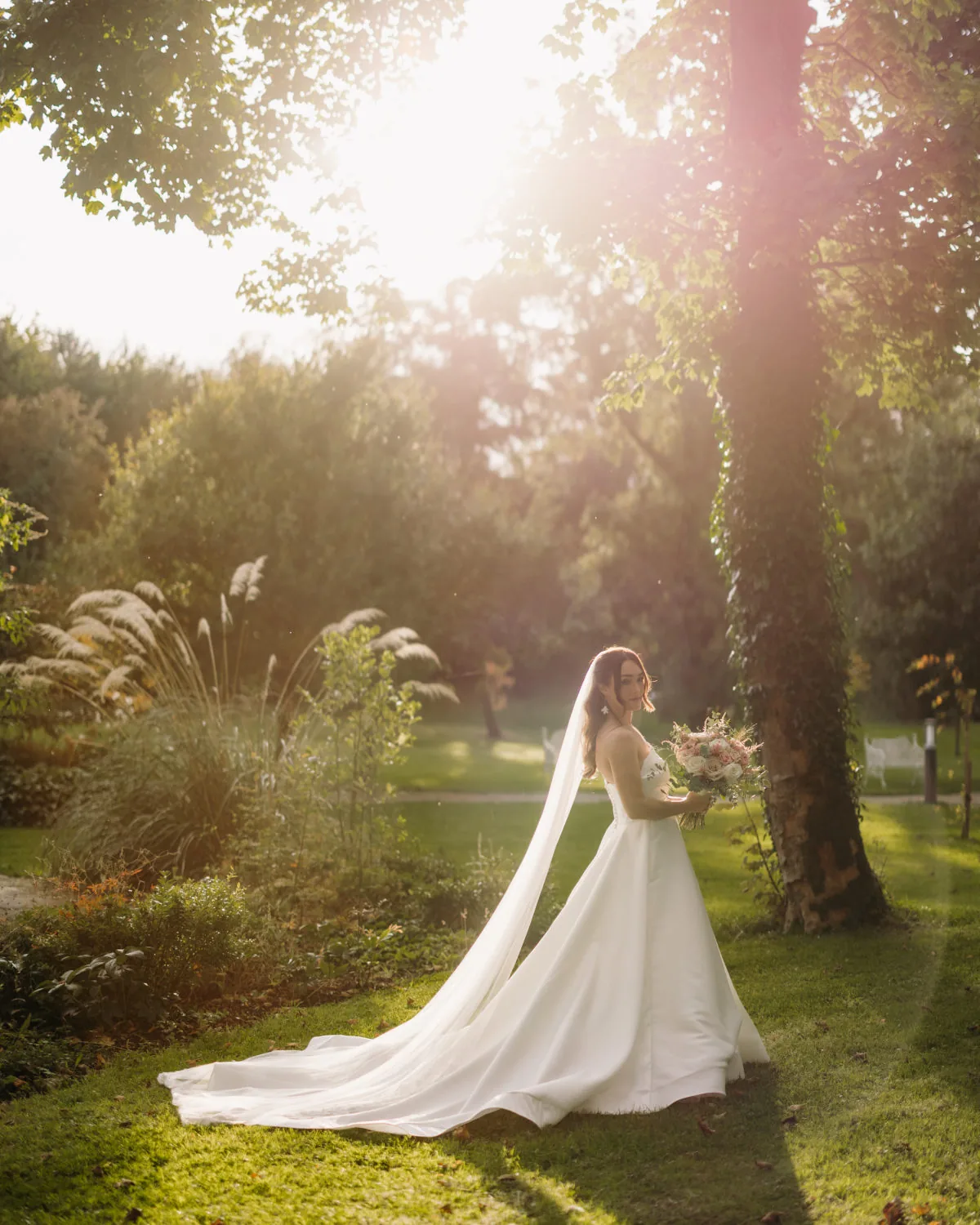
Before you choose a single pin, walk the garden — or at least study photographs of it at the hour your ceremony starts. A garden at noon is a different place from the same garden at five in the evening. Midday sun is harsh from above and flattens soft waves, while late-afternoon light slants through the trees and makes texture, braids and loose curls glow. If your ceremony is at midday, a polished updo will photograph more cleanly than loose hair that the sun bleaches out. If it is late afternoon, almost any romantic, textured style will shine.
Shade matters just as much. A ceremony under a big tree or a pergola gives you soft, even light and a little shelter from the breeze, so looser styles are safe. An open lawn with no cover means wind and direct sun, and that pushes you toward braids, twists and pinned-up styles that cannot be blown across your face mid-vow. Ask your venue which way the ceremony faces and where the sun will be during the vows — your photographer will already know, and the answer should shape your hair choice as much as your dress does.
What to ask: ask your photographer where the light falls during the ceremony and the couple portraits, and ask your stylist which of your shortlisted styles holds up best in that light. A style that looks lovely in a salon mirror can disappear in bright sun, while a braid that seems plain indoors can look extraordinary in dappled shade.
Humidity and Breeze-Proofing Your Style
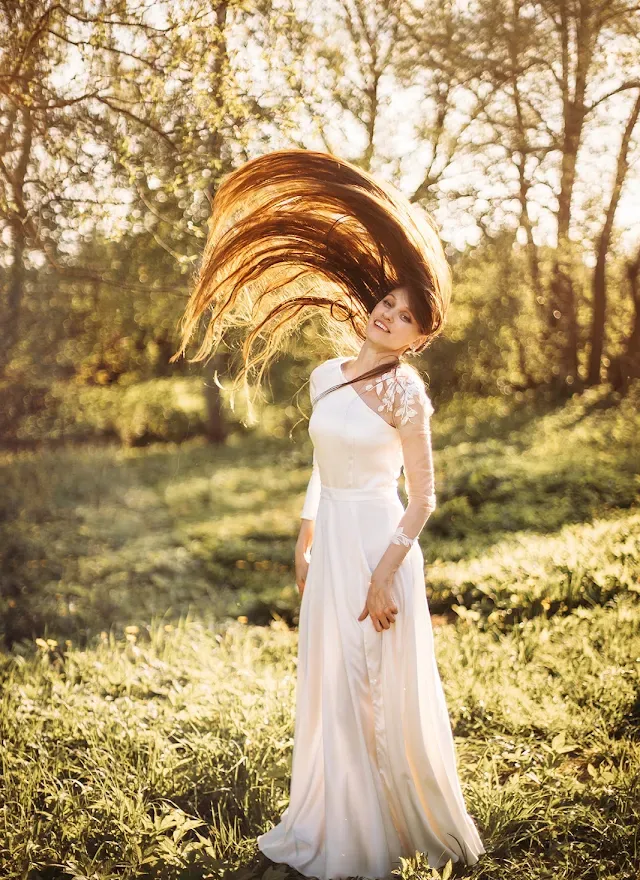
Outdoor air is the enemy of a freshly curled style, and humidity is the worst of it. Fine or straight hair that holds a curl for hours indoors can drop in twenty minutes outside, while thick or wavy hair can puff up as it absorbs moisture from the air. The fix is not more hairspray — it is building the style on a foundation that expects the weather. Start with second-day hair or hair prepped with a light mousse, because slightly textured hair grips pins and braids far better than freshly washed, slippery hair.
For curls, set them tighter than you want them to look. Curls always relax outdoors, so a tight set at 10 a.m. becomes a soft wave by the ceremony, which is exactly the romantic finish most brides want. For updos, anchor with a combination of pins and a braid or twist rather than pins alone: a braid gives the style its own structure, so even if a pin loosens, the shape stays. A light mist of flexible-hold spray beats a helmet of strong hold, which cracks and flakes in the sun.
Common mistake: styling on freshly washed hair with no product, then wondering why the curls fell before the photos. Wash the night before, add a little texture spray or mousse while blow-drying, and sleep with the style’s foundation — a loose braid, for instance — already in place. Your stylist can build on that base in half the time.
Veil or Flower Crown? Choosing What Sits on Top
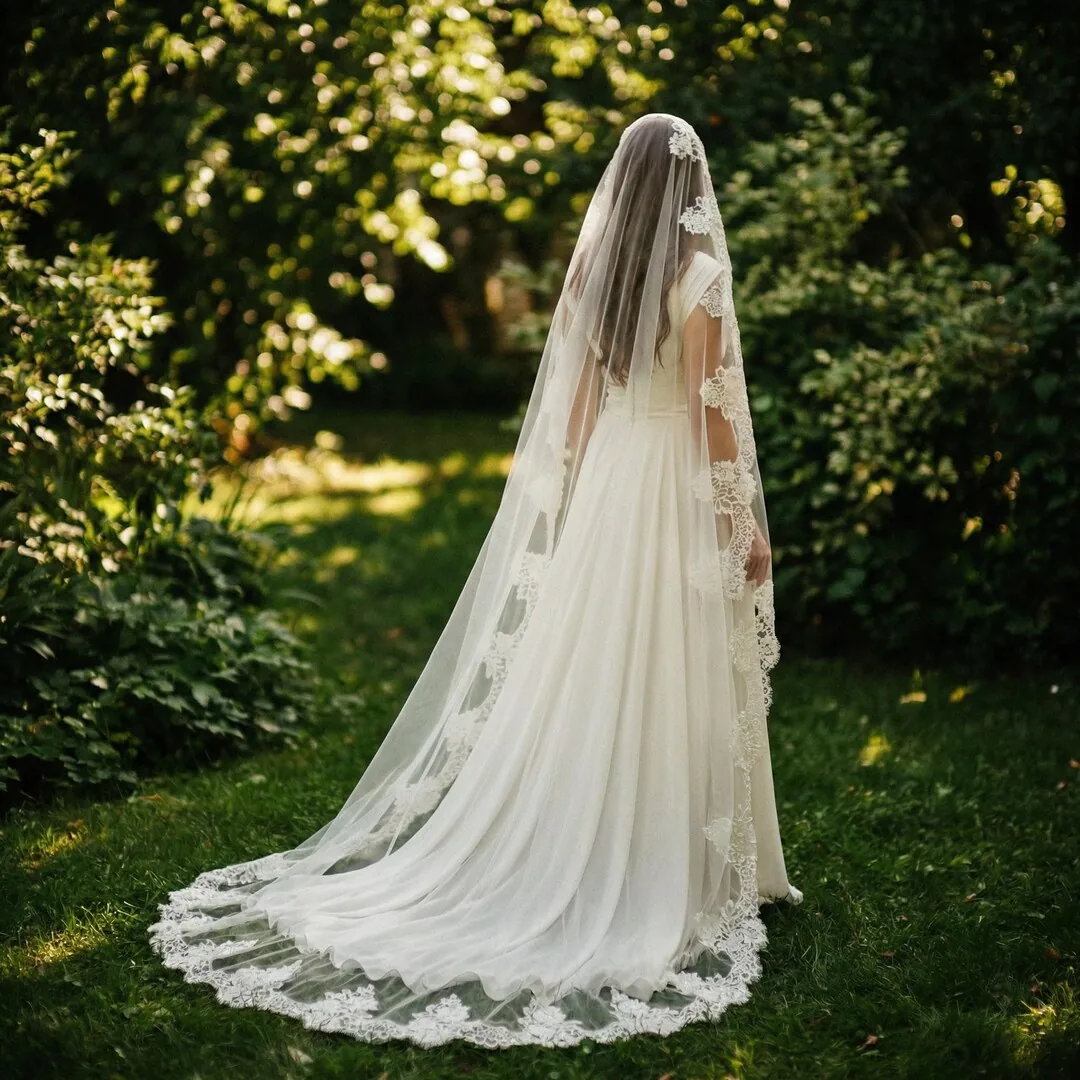
Few garden-wedding decisions change a hairstyle as much as what sits on top of it. A veil needs a secure anchor point — usually a low bun, a twist or a half-up section with enough structure to hold a comb — and it behaves very differently outdoors, where a breeze can lift a long veil into your face or wrap it around a branch. A flower crown, on the other hand, sits flatter, photographs beautifully against greenery, and never needs adjusting, but it can slip on fine hair and it competes visually with a very detailed updo.
The practical rule is simple: if you love a veil, keep it short or fingertip length for a garden ceremony, and choose a style with a clear anchor — a low chignon or a half-up twist — rather than loose hair with nothing to grip. If you love a flower crown, keep the hairstyle underneath simpler, so the flowers are the feature rather than one detail among many. Many brides now do both: a veil for the ceremony, swapped for a flower crown or fresh blooms for the reception, which also solves the problem of a veil that has been wind-blown for an hour.
Quick verdict: a veil suits classic, structured styles and formal gardens; a flower crown suits relaxed, bohemian styles and wild, cottage-style gardens. If you cannot decide, try both at your hair trial with your actual dress — the right one usually announces itself in the mirror within seconds.
Floral Accessories: Fresh, Dried or Faux?
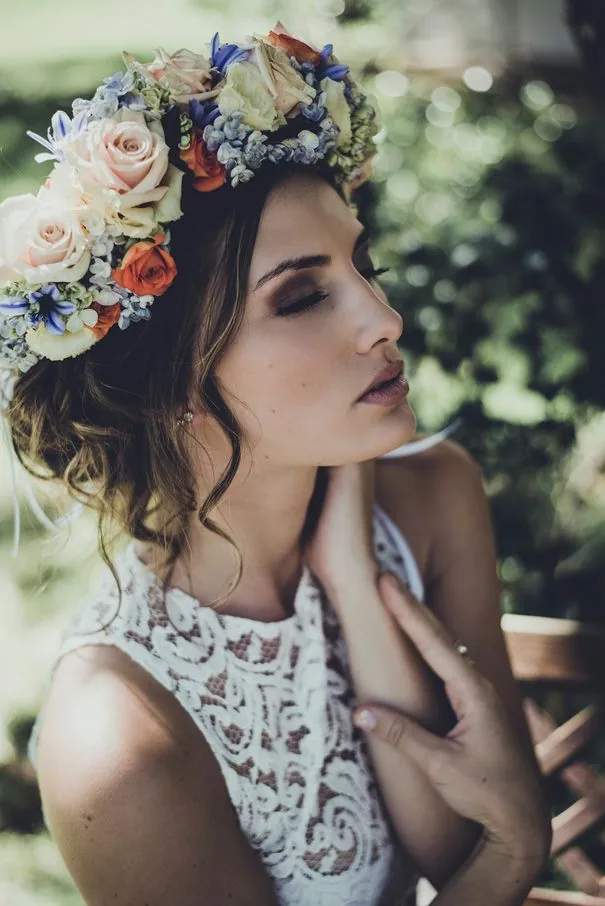
Fresh flowers are the obvious choice for a garden wedding, and they are also the most fragile. Cut blooms start to wilt within a few hours in warm sun, and delicate petals bruise easily against hair and veils. That does not mean you should avoid them — it means you should choose hardy varieties and treat them properly. Roses, spray roses, ranunculus, orchids and succulents hold up far better than peonies or gardenias in heat, and a florist can wire each stem and seal it so it lasts from the first photo to the last dance.
Dried flowers — lavender, baby’s breath, dried grasses — are the low-maintenance alternative, and they suit a rustic or bohemian garden beautifully. They never wilt, they weigh almost nothing, and they survive wind without shedding petals down your back. High-quality faux flowers have also improved enormously; from a photograph’s distance, a good silk bloom is indistinguishable from a real one, and you keep it afterwards as a keepsake. The honest trade-off is touch: up close, real flowers feel and smell like the garden, and faux ones do not.
Time and cost: fresh floral hairpieces usually cost the least in materials but need to be made the morning of the wedding and delivered to your stylist, so coordinate timing carefully. Dried and faux pieces cost more up front but can be fitted at your trial, weeks in advance, with no last-minute rush. Whichever you choose, bring the piece to your hair trial — a style built without it may not have room for it on the day.
Outdoor Photos: Angles, Light and Wind
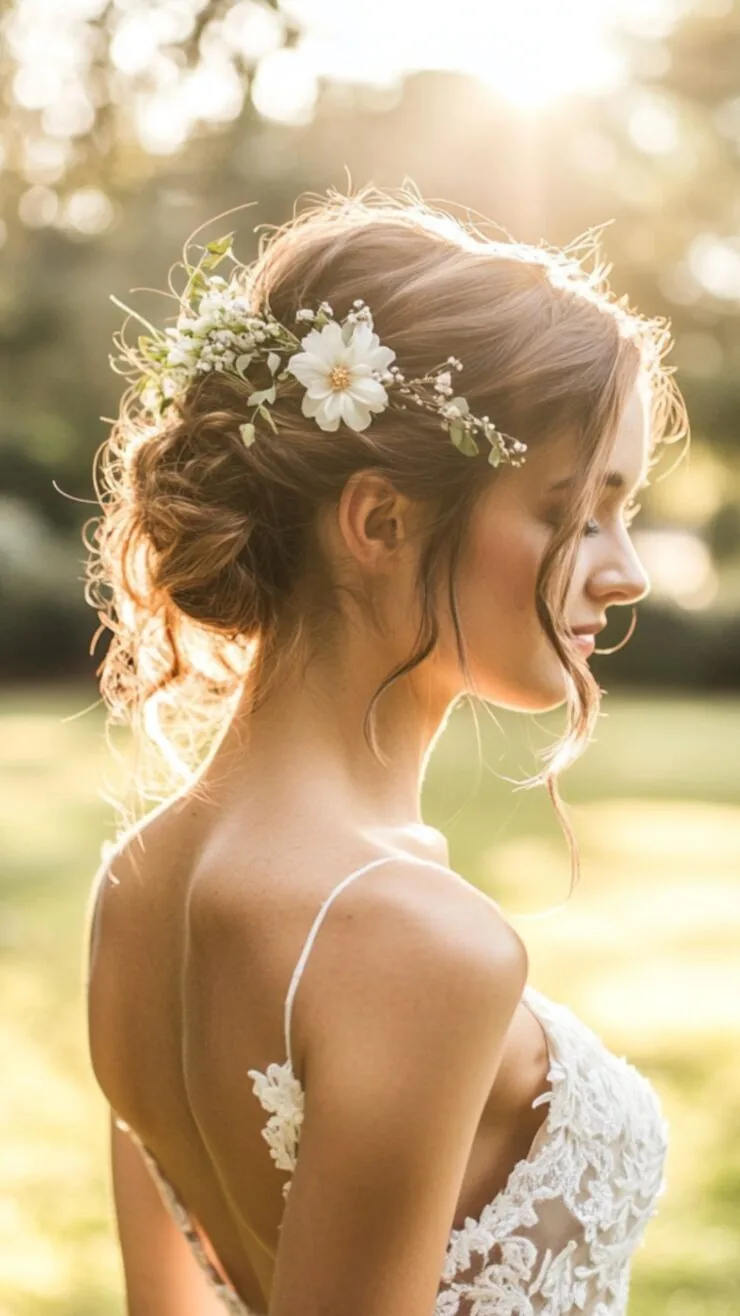
Garden photographs are where hairstyles earn their keep, and the camera sees things the mirror does not. A style that looks balanced from the front can look flat from the side, and a beautiful updo can vanish entirely in a back shot if there is no texture or accessory to catch the light. Before the wedding, look at your shortlisted styles from the back and from a three-quarter angle, not just face-on. Braids, twists and pinned curls photograph best from behind, while face-framing tendrils and side-swept styles shine in profile shots.
Wind is the photographer’s friend and the hairstyle’s test. A few loose strands blowing across a portrait look romantic; a whole section blown across your face looks like an accident. The difference is usually one or two well-placed pins. Ask your stylist to leave movement only where you want it — a tendril or two at the front, a soft end to a braid — and to secure everything else. And remember that golden hour, the hour before sunset, is the most flattering light of the day for hair: it warms up colour, adds shine to curls, and makes even a simple style look expensive.
Best for: brides who care about the album as much as the ceremony. If portraits matter to you, choose a style with visible texture from the back — a braid, a twist, a pinned curl — and schedule couple portraits for golden hour if your timeline allows it. Your photographer will thank you, and so will you in ten years.
Heat, Pollen and Allergies: Comfort Planning
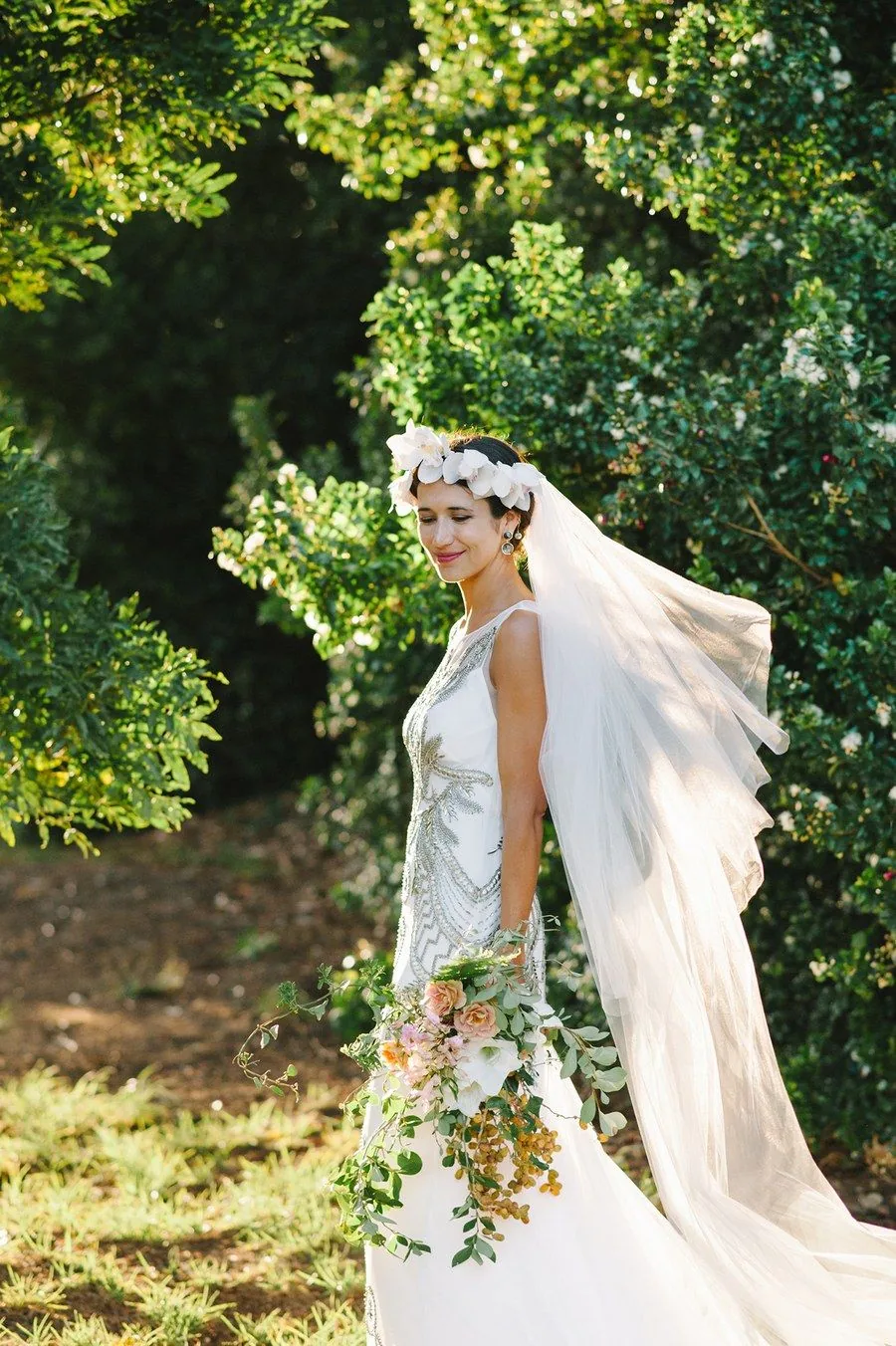
A garden in full bloom is also a garden full of pollen, and a summer garden is a hot one. Both affect hair more than most brides expect. Heat makes scalps sweat, and sweat loosens pins, flattens volume at the roots, and turns a smooth blowout frizzy within an hour. Pollen settles on hair like fine dust, dulling shine and irritating anyone with hay fever — and an allergic bride who spends the ceremony sneezing will not enjoy her hairstyle, however beautiful it is.
The practical answers are unglamorous but effective. For heat, keep hair off the neck: updos, braids and low buns are dramatically cooler than loose hair down your back, and a light dusting of dry shampoo at the roots before styling absorbs sweat before it starts. For pollen, a light veil or a style that keeps hair contained reduces what lands on it, and a quick brush-out before the reception removes most of what settled during the ceremony. If you suffer from hay fever, take your usual antihistamine early, tell your stylist, and keep tissues in your emergency kit rather than in your bouquet hand.
Who should plan for this: anyone marrying in late spring or summer, anyone with asthma or hay fever, and anyone whose ceremony runs longer than an hour outdoors. A five-minute conversation with your stylist about sweat and pollen can save you an hour of discomfort — and a style that was designed for heat will still look fresh at the last dance.
Your Hair Timeline: Trial, Florist and Stylist Coordination
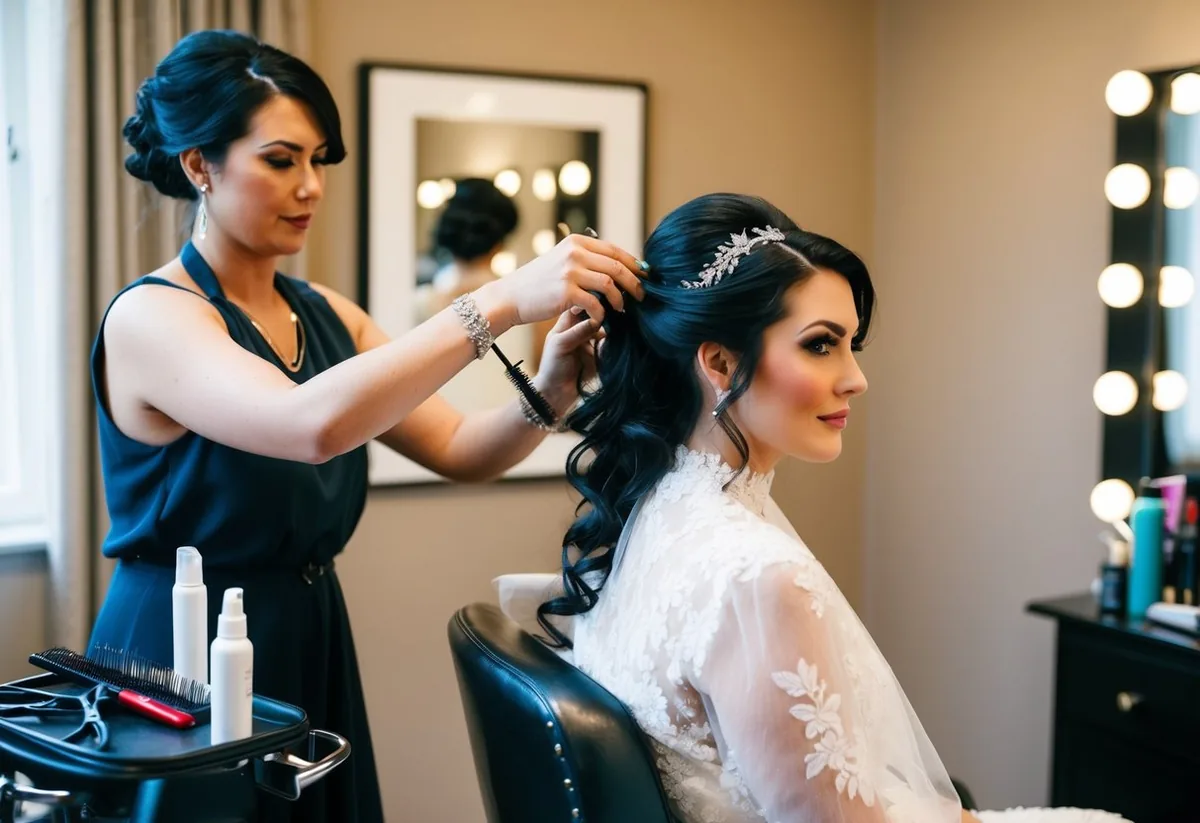
A garden wedding hairstyle is not a one-person job. Your stylist builds the style, your florist supplies the blooms that go into it, and your photographer needs to know when the hair will be finished so portraits can start on time. If those three people never talk to each other, the flowers arrive after the hair is done, or the hair runs late and eats into golden hour. The fix is a simple timeline, agreed at least a month before the wedding, with one person — usually the bride or the wedding planner — holding it.
Book your hair trial six to eight weeks before the wedding, and bring everything: your veil or flower crown, your hair accessories, photos of the garden, and a photo of your dress from the back. The trial is where you discover that a style you loved online does not suit your hair length, or that your flower crown needs a braid underneath it to sit properly. On the day itself, fresh flowers should arrive at the styling location at least an hour before the hair is finished, so the stylist can place them while the style is still being built, not as an afterthought pinned on top.
Maintenance: after the trial, photograph the finished style from every angle and write down the products used. On the day, your stylist recreates it faster, your bridesmaids can match it, and if anything goes wrong you have a reference photo to hand over. Keep a small kit — pins, a travel hairspray, a comb, blotting papers — with your maid of honour, not in a car parked half a mile away.
After the Last Dance: Outdoor-to-Reception Transition
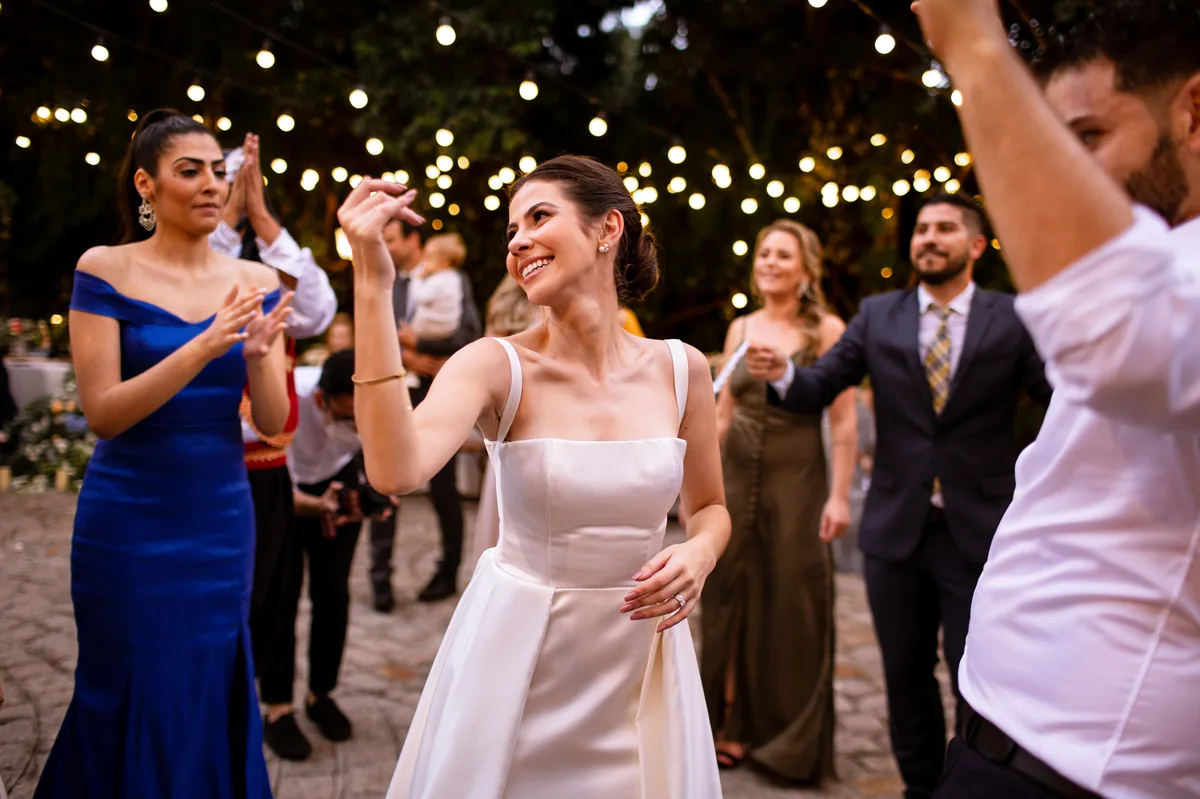
Most garden weddings move indoors — or under a marquee — for the reception, and that change of setting is the perfect moment to change your hair, or at least to refresh it. An hour outdoors leaves most styles a little looser, a little wind-blown, and a little less polished than they were at the ceremony. Rather than fighting that, plan for it: a style that transitions well is one that can be loosened deliberately, refreshed in five minutes, or transformed with a single accessory change.
The easiest transition is to take the veil off, shake out the curls a little, and add a fresh flower or a sparkly pin for the evening. A low bun can be loosened into a softer, messier version of itself. A half-up style can come fully down for dancing. If you want a real second look, choose a ceremony style with a foundation — a braid or a pinned base — that your stylist can rebuild into a different updo in fifteen minutes while you change dresses or freshen up. Tell your stylist in advance if you want this, so she blocks the time.
Quick verdict: do not plan a style that only looks right for the first hour. Plan one that looks right at the ceremony, still looks good after an hour outdoors, and can be refreshed in minutes for the party. That is the difference between hair you forget about and hair you keep worrying about all day.
1. Soft Romantic Loose Waves
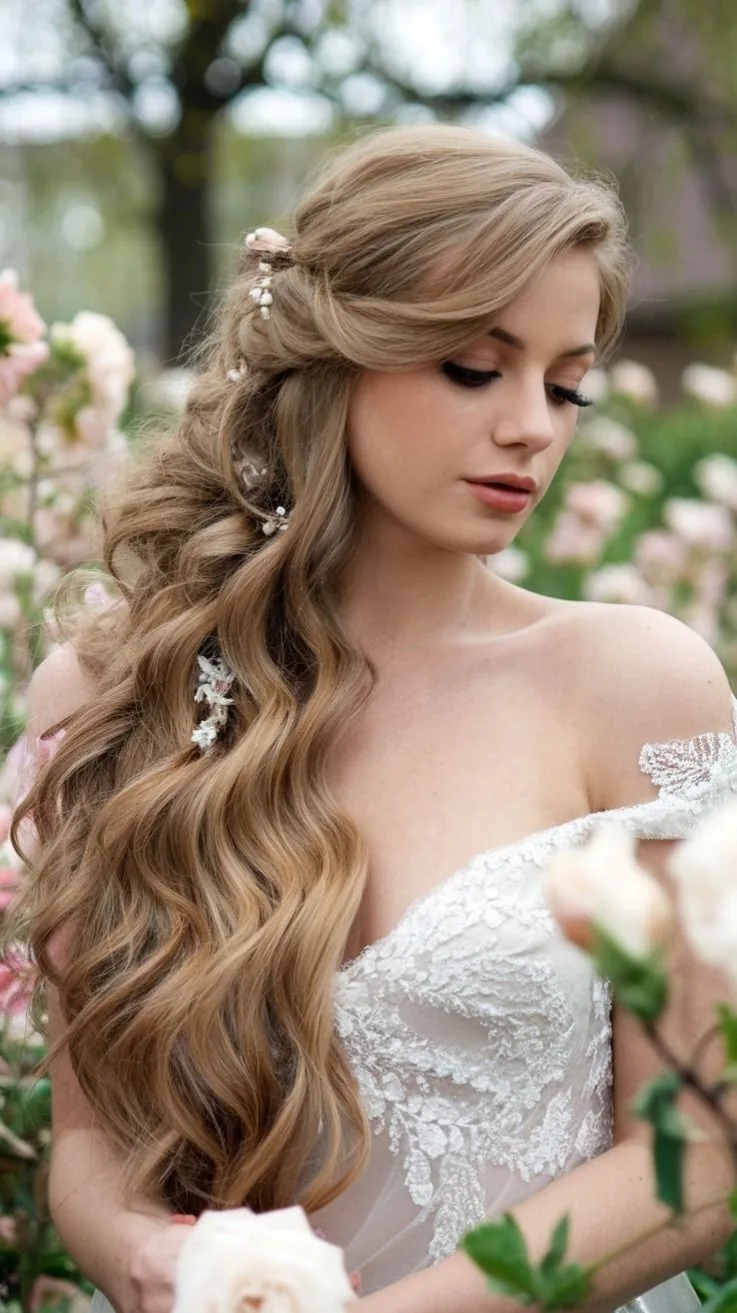
Soft loose waves are the default garden wedding hairstyle for a reason: they look like the garden itself — natural, a little wild, and completely unbothered by a breeze. The waves are large and loose, brushed out so they fall in soft ribbons rather than tight curls, and they catch dappled light beautifully. This is the style for a bride who wants to look like herself, only more so, and who does not want to spend the day thinking about her hair.
It works best on medium to long hair with some natural texture, and it is surprisingly practical outdoors. Because the style is already loose, wind cannot ruin it — it can only make it look more romantic. The risk is humidity: fine hair can drop its waves quickly, so set the curls tighter than you want them, let them cool completely before brushing them out, and finish with a flexible-hold spray rather than a stiff one. A middle or side part both work; a deep side part adds drama, a centre part feels softer and more modern.
Best for: brides with medium to long hair, outdoor ceremonies in light breeze, and dresses with open backs or delicate straps, where the waves frame the shoulders. What to ask your stylist: ask for large-barrel curls brushed out with a wide-tooth comb, and ask how the waves will hold in your hair type on a humid day — she may suggest setting them the night before for extra staying power.
2. Low Chignon with Face-Framing Tendrils
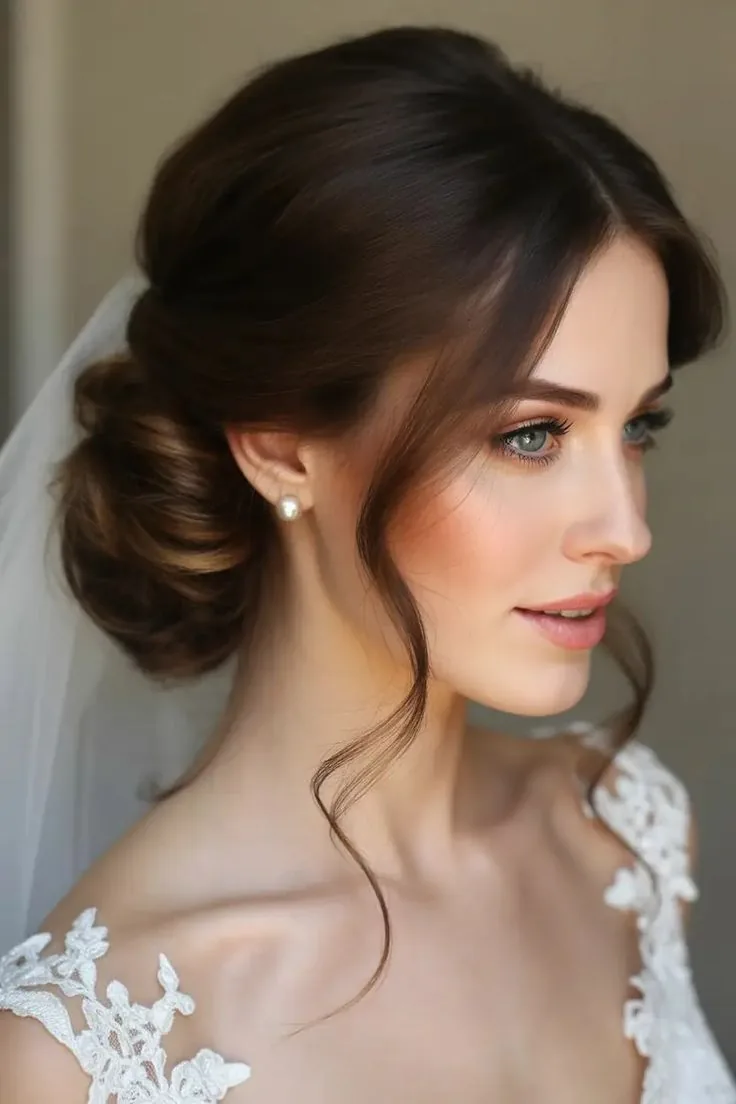
The low chignon is the quiet classic of garden weddings: hair gathered low at the nape, twisted or rolled into a soft knot, with a few tendrils left loose to frame the face. It is elegant without being stiff, it keeps hair off the neck on a warm day, and it gives a veil a perfect anchor point. In a garden, it reads as timeless rather than formal — especially when the knot is left a little soft and textured instead of pulled drum-tight.
What makes this version garden-ready is the deliberate looseness. Pull the chignon apart slightly after pinning it, let the tendrils fall naturally, and add a small sprig of greenery or a pearl pin to the side. The style suits almost every face shape because the tendrils soften the hairline, and it works on hair from shoulder length upward. For very fine hair, a little backcombing at the crown and a texturising spray give the knot the fullness it needs.
How to style: start with a low ponytail, twist the length loosely, coil it into a knot and pin in a figure-of-eight pattern so the pins grip from several directions. Leave two thin tendrils at the front, curl them lightly, and mist with flexible spray. Common mistake: pulling the chignon too tight at the nape — it looks severe in photographs and gives you a headache by the reception.
3. Garden Rose Half-Up Twist
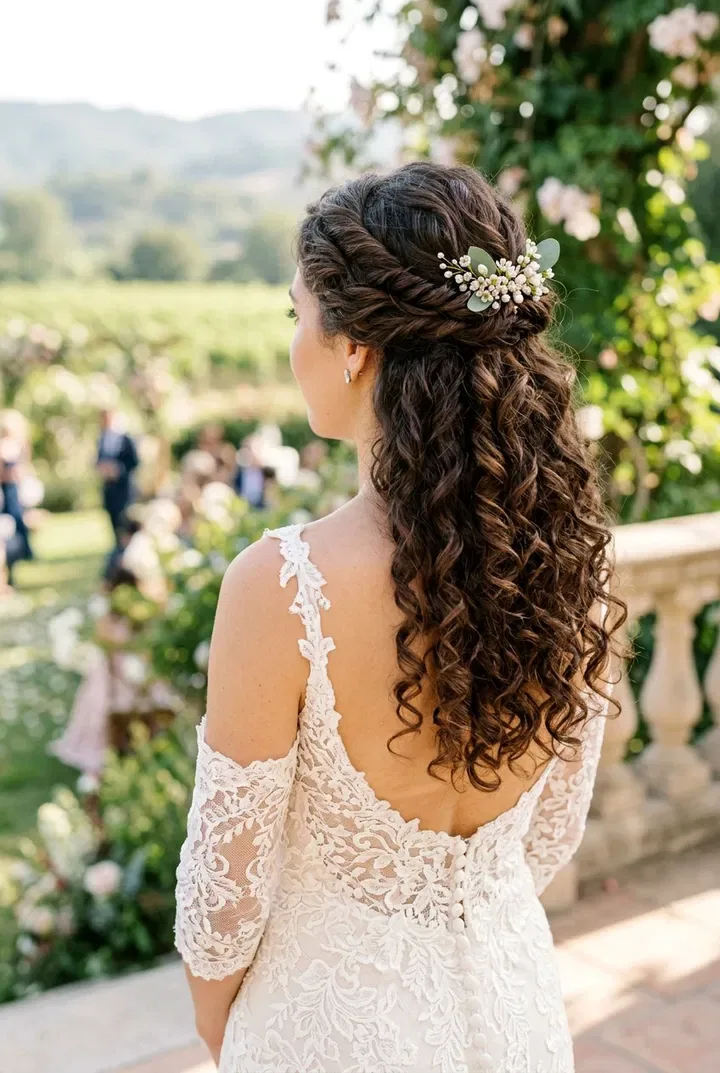
The half-up twist is the compromise every garden bride secretly wants: hair up enough to stay out of your face, down enough to look romantic in photographs. Two sections from the front are twisted back and pinned at the crown, while the rest falls in soft waves down the back. It is quick, it is comfortable, and it suits a ceremony under trees where the light falls on your shoulders and the back of your hair is on display.
This style earns its garden name from the way it takes flowers. A small rose or a sprig of lavender tucked where the twists meet looks like it grew there, and the twist itself gives a flower crown or a comb something solid to grip. It works on hair from just past the shoulders to waist length, and it flatters round and square faces because the volume at the crown lengthens the face. For fine hair, twist over a small cushion or add clip-in volume at the crown before pinning.
Pros and cons: the pros are comfort, speed and versatility — it takes about twenty minutes and survives wind better than fully loose hair. The con is that the loose lengths can still frizz in humidity, so ask your stylist to set the waves with a heat protectant and a little serum on the ends. Who should skip it: brides with very short hair, who will get a better result from a fully pinned style or a pretty accessory instead.
4. Braided Crown with Fresh Flowers
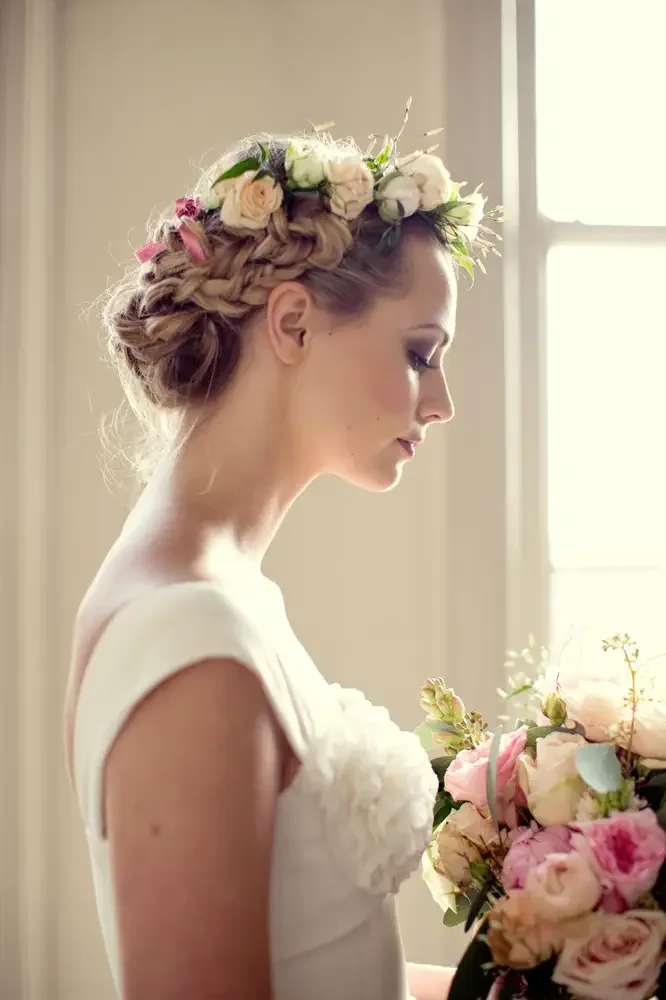
A braided crown — a Dutch or French braid wrapped around the head like a halo — is the most garden-like hairstyle there is, and it is also one of the most practical. The braid holds itself together, so wind cannot undo it, and the shape frames the face while keeping every strand off the neck. Woven with small fresh flowers, it looks as though the garden lent you its blooms for the day.
Building it well takes a stylist who is comfortable with braiding on your hair type. On thick hair, a single Dutch braid pulled apart for softness gives a full, romantic crown. On fine hair, two smaller braids joined at the back look fuller than one thin one, and a little texturising powder at the roots keeps the braid from slipping. Flowers should be wired by your florist and tucked into the braid as it is built, not pushed in afterwards, or they will slide out by the first photograph.
What to ask your stylist: ask whether your hair is long enough for a full crown (usually you need at least shoulder length) and whether she will braid it damp for extra grip. Time and cost: allow 45 to 60 minutes, longer than a simple updo, because the braid and the flower placement both take patience — and budget for the florist’s wiring time as well as the blooms themselves.
5. Elegant Low Bun with Pearl Pins
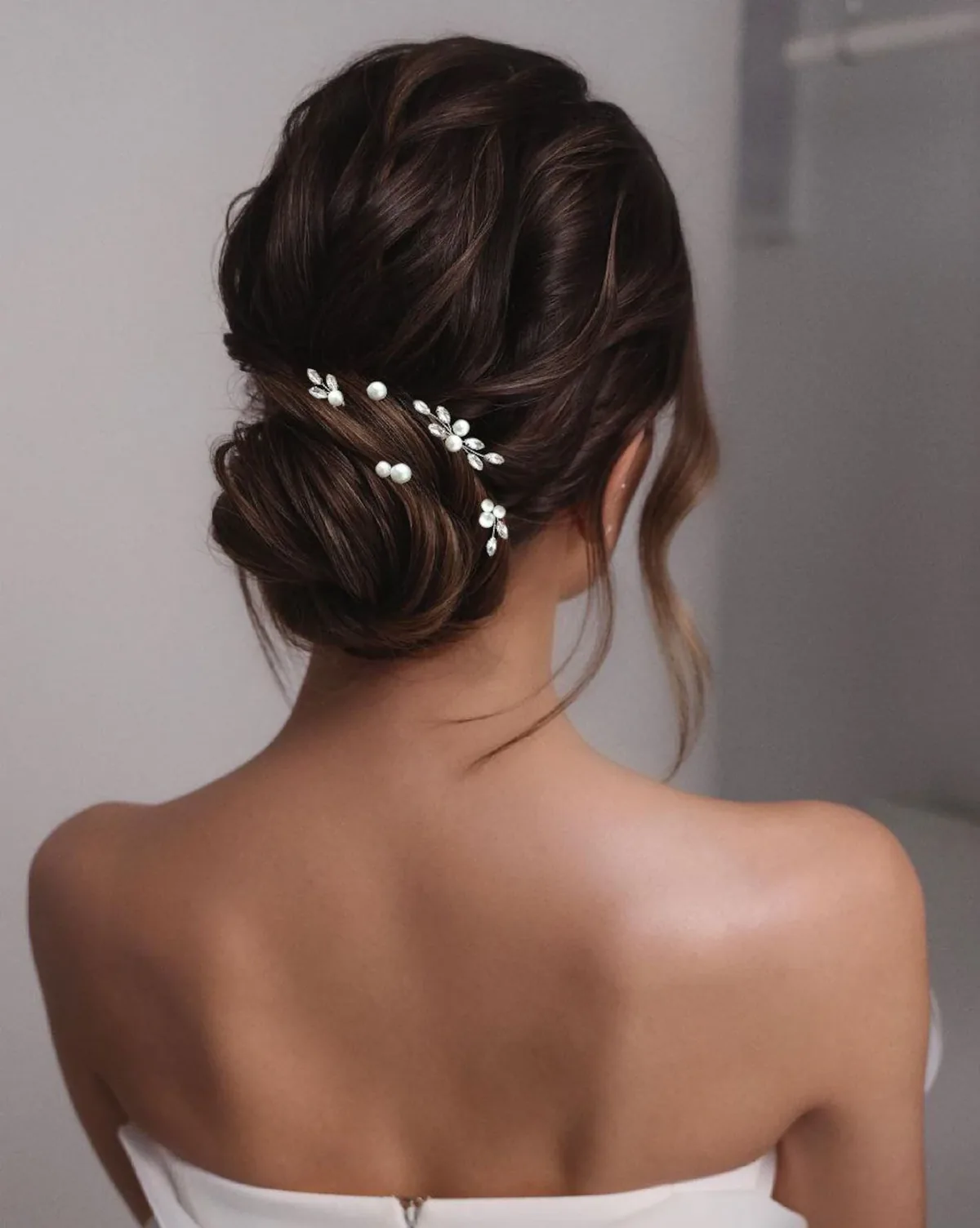
Pearl pins turn the simplest low bun into a bridal statement, and they do it without adding weight, heat or fuss. The bun itself is smooth and low at the nape, parted cleanly in the middle or on a soft side part, and the pearls — scattered like dew, or lined up in a gentle arc — catch the light every time you turn your head. Against greenery, the contrast of white pearls and green leaves is quietly stunning.
This is one of the most reliable garden styles because there is so little to go wrong. The bun is pinned flat and low, so wind passes over it, and the pins themselves help hold the style together. It suits formal gardens, evening ceremonies and brides who want a polished look that still feels soft. It also works beautifully with a veil: the veil comb slides in above the bun, and the pearls sit below it, so nothing competes.
Best for: brides with straight or slightly wavy hair, formal or evening garden ceremonies, and dresses with detailed backs, where a low bun shows off the design. Maintenance: almost none — carry two spare pins and a small mirror, and the style will last from the ceremony to the last dance without a touch-up.
6. Romantic Side-Swept Curls
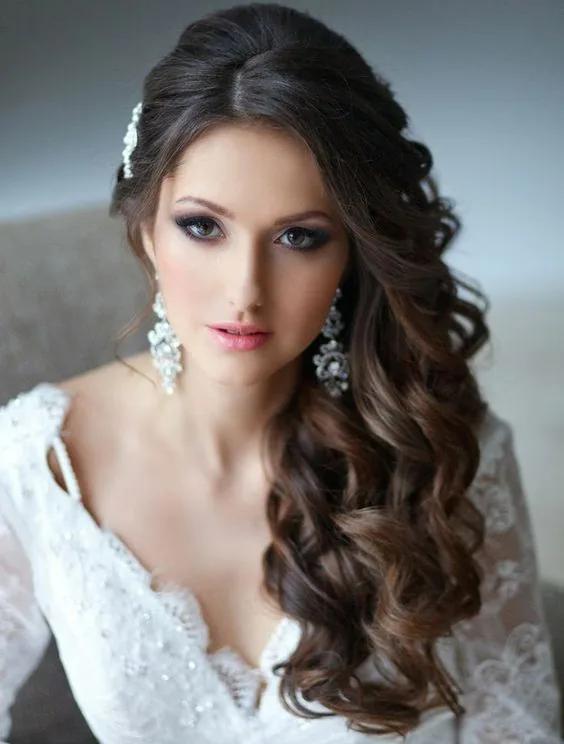
Side-swept curls are pure old-Hollywood romance, softened for a garden. All the hair is swept to one side in large, glossy curls that fall over one shoulder, leaving the other side of the neck and shoulder bare. It photographs beautifully — especially in profile and in golden-hour light — and it shows off a one-shoulder or strapless dress better than any updo.
The trick outdoors is anchoring the sweep so the wind does not undo it. A hidden braid or a row of pins along the swept side holds the shape, while the curls themselves are left free to move. This style needs length — at least past the shoulders — and it works best on hair that holds a curl, whether naturally or with hot rollers. On very fine hair, clip-in extensions at the back can give the sweep the fullness it needs to look intentional rather than thin.
Pros and cons: the pros are drama and glamour with very little effort once the curls are set. The con is that it is a one-sided style: if the wind blows from the wrong direction, the curls can end up across your face, so ask your stylist which side to sweep toward based on the ceremony layout and the prevailing breeze. Quick verdict: choose this if your dress has a bare shoulder and your ceremony is sheltered; choose a pinned style instead if the garden is fully exposed to wind.
7. Loose French Twist
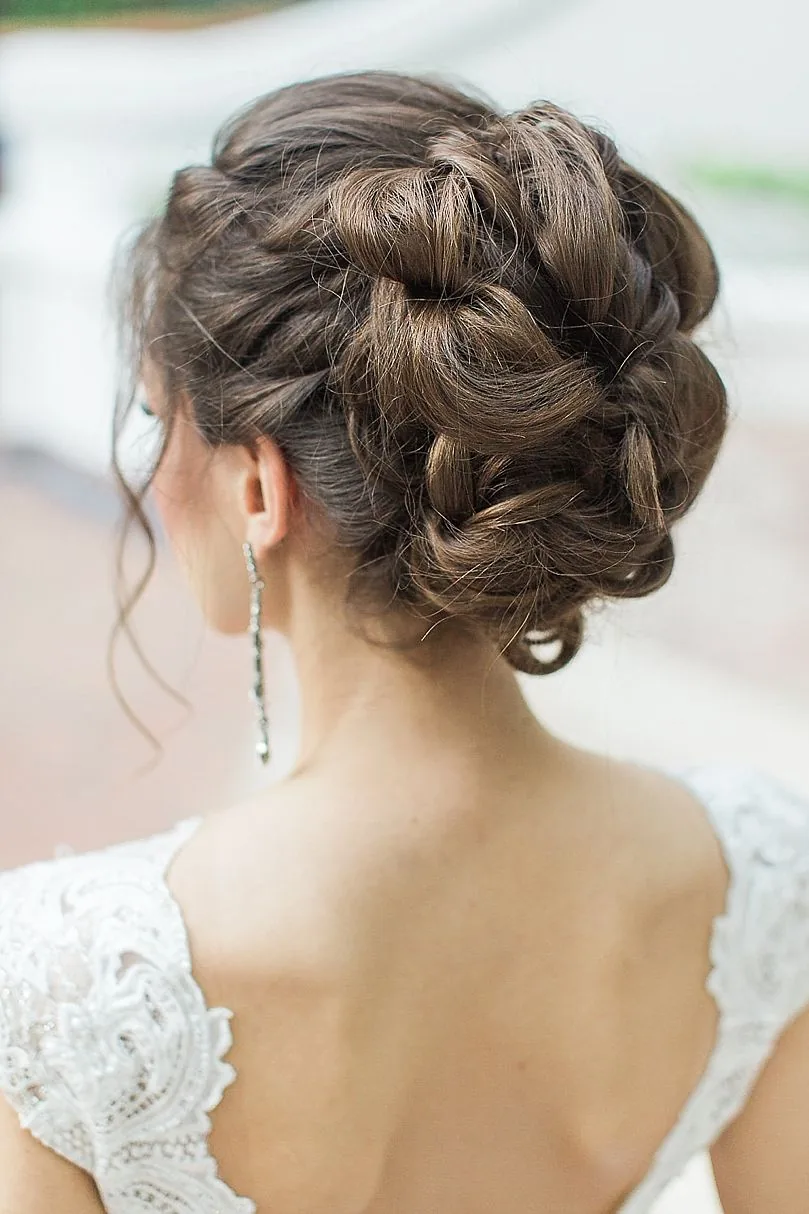
The French twist is the most elegant updo in the book, and the loose garden version keeps the elegance while dropping the stiffness. Instead of a tight, lacquered roll, the hair is swept up and twisted loosely, with soft volume at the crown and a few wisps escaping at the nape. It lengthens the neck, flatters every face shape, and looks extraordinary from the side — which is the angle your guests see for most of the ceremony.
For a garden, the loose version is essential. A tight twist looks severe in bright daylight and can feel uncomfortable in heat, while the soft version moves with you and photographs as relaxed rather than rigid. It works on medium to long hair, and it is one of the few updos that suits a veil and a flower equally well — a small sprig of greenery tucked into the top of the twist is all the decoration it needs.
How to style: gather the hair low, twist upward against the head, and pin vertically along the twist with long pins, leaving the top slightly pulled apart for softness. Common mistake: using too much hairspray to lock it in place — the twist should look soft, and a helmet of spray defeats the purpose. A flexible spray and well-placed pins hold it better and look better in photographs.
8. Boho Fishtail Braid
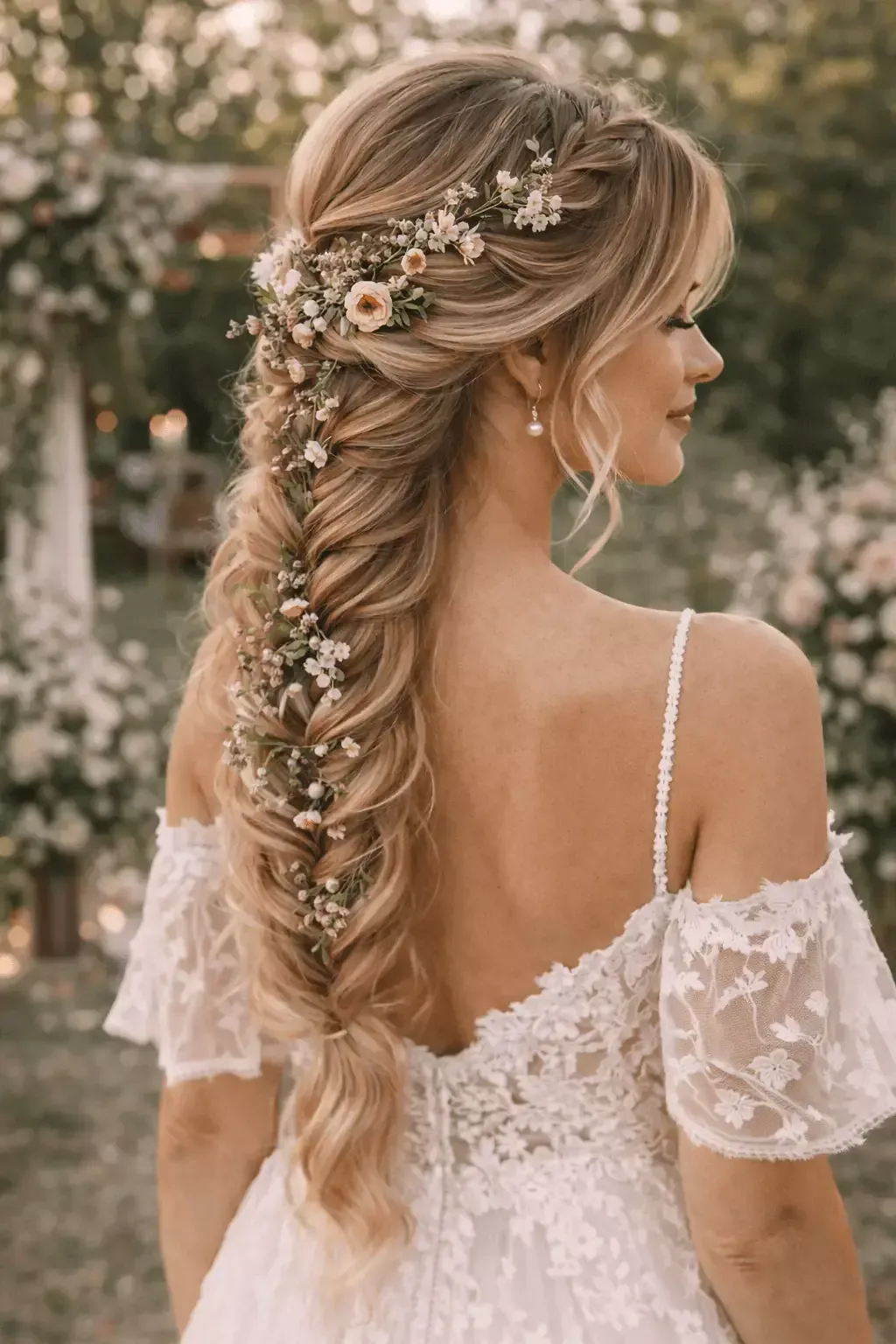
The fishtail braid looks far more complicated than it is, which is part of its charm. Two sections woven in small, overlapping pieces create a fine, intricate pattern that photographs like lace, and when it is pulled apart gently — pancaked, in stylist language — it becomes soft, full and bohemian. Draped over one shoulder, it is the perfect garden style: relaxed, textured, and completely unbothered by wind.
This is the braid to choose when you want your hair down but your ceremony is outdoors. Unlike loose waves, a fishtail cannot blow across your face, and unlike a tight updo, it still moves and feels free. It works on long hair best, and it is especially beautiful on hair with highlights or balayage, because the weaving shows off every shade. Add a few small flowers or a ribbon woven through the braid for a finishing touch that costs almost nothing.
Best for: bohemian and rustic garden weddings, brides with long hair and natural texture, and anyone who wants a style that looks better as the day goes on. What to ask your stylist: ask her to pancake the braid — gently pulling each loop wider — for fullness, and to secure the end with a clear elastic hidden under a wrapped strand of hair rather than a visible band.
9. Textured Low Ponytail with Ribbon
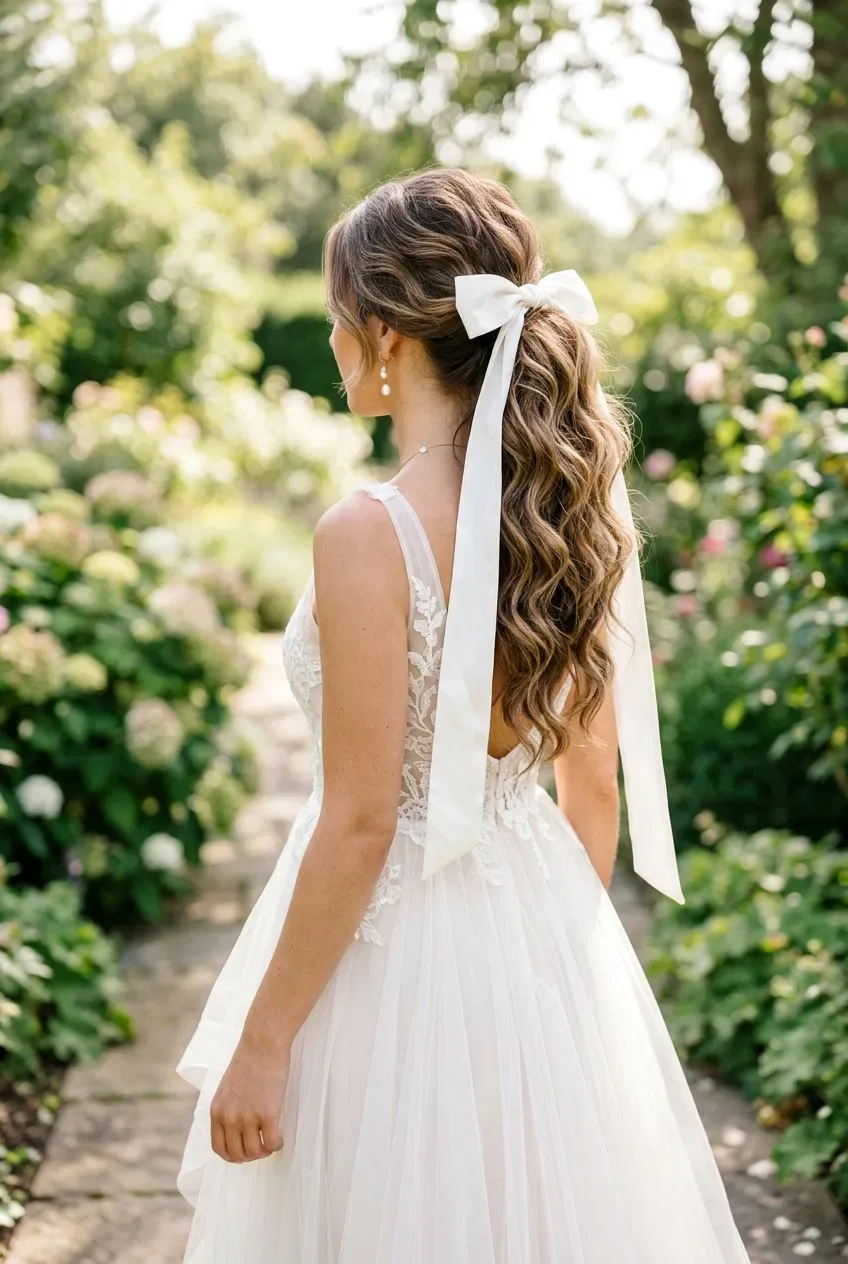
A low ponytail sounds too simple for a wedding until you see it done properly: softly waved, gently textured, tied low at the nape with a silk ribbon in a colour pulled from the flowers, and finished with a strand of hair wrapped around the band. It is modern, it is comfortable, and it is one of the few bridal styles that looks equally good in a garden and on a dance floor.
The ribbon is doing more work than it appears to. It adds colour and movement, it hides the elastic, and it gives the style a focal point that photographs beautifully from behind. Choose a ribbon that matches your bouquet or your bridesmaids’ dresses, and let the ends hang long — they will catch the breeze in photographs. Texture is the other key: a little dry shampoo or texturising spray at the roots keeps the ponytail from looking flat, and loose waves through the length stop it from looking like a gym ponytail.
Time and cost: this is one of the quickest bridal styles, usually 20 to 30 minutes, which makes it a good choice if your morning timeline is tight. Who should skip it: brides who want a fully formal look — a ponytail, however pretty, is relaxed by nature, and a cathedral veil or a very structured gown may call for something more built-up.
10. Classic Bridal Updo with Volume
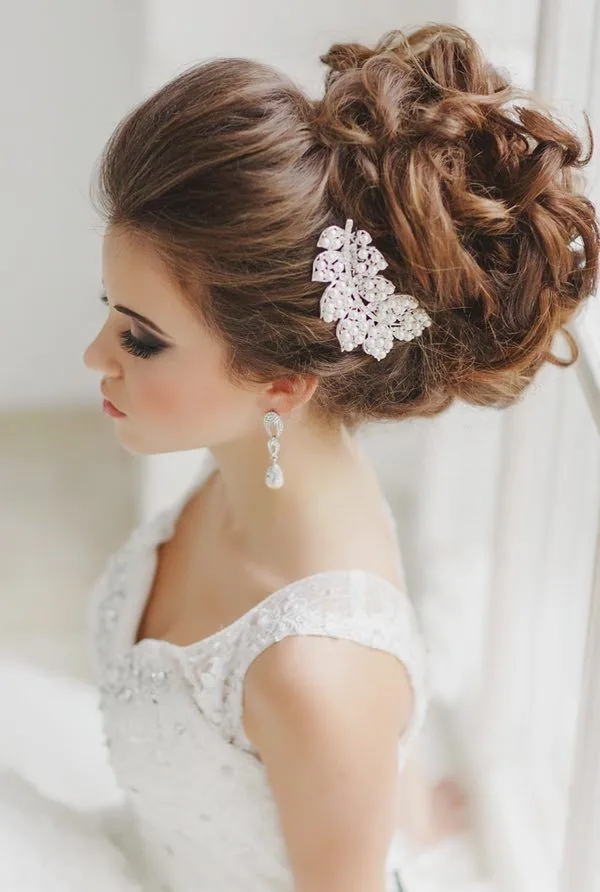
Some brides want a classic updo, and a garden is no reason to give it up. The classic version — volume at the crown, soft curls pinned into a full shape at the back, face-framing pieces left loose — is formal, photogenic and completely wind-proof. It is the style that looks right with a cathedral veil, a tiara, or a long-sleeved gown, and it keeps you cool on a warm afternoon.
The garden adjustment is in the finish. A classic updo built for a ballroom is often sprayed into a solid shape; the garden version should be built with the same structure but a softer surface, so it reads as romantic rather than rigid in natural light. Ask your stylist for texture on the outside — a few loosened curls, a soft edge at the hairline — while the inside stays firmly pinned. That way you get the height and the shape, but the style still looks like it belongs outdoors.
Best for: formal garden weddings, brides wearing a veil or tiara, and anyone with thick hair that holds volume well. Maintenance: carry extra pins and a travel hairspray, and ask your maid of honour to check the back of the style before the reception — a single slipped curl is easy to re-pin if you catch it early.
11. Waterfall Braid with Soft Curls
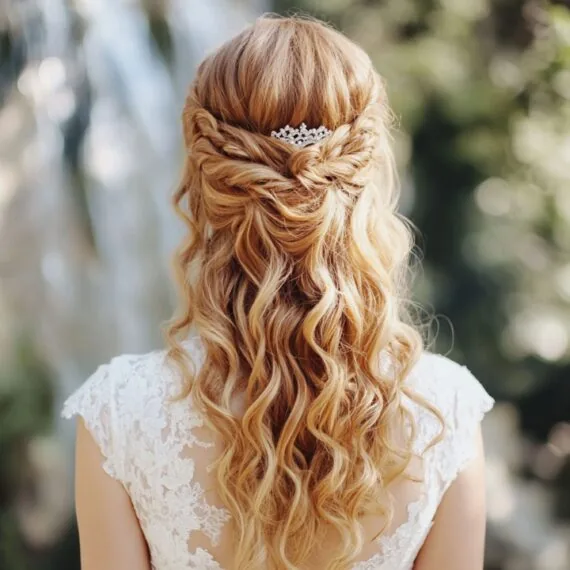
The waterfall braid is the prettiest trick in bridal hair: a braid that runs across the head, dropping strands through it like water, so the braid frames the hair while the curls below it flow free. It looks intricate in photographs, it keeps the front of your hair out of your face, and it leaves the length down for that romantic garden feel. Guests will ask how it was done — and your stylist will smile, because it is easier than it looks.
It works best on long, wavy or curly hair, where the dropped strands have natural movement, and it is lovely with flowers: a small bloom tucked into the braid at the temple, or a few sprigs along its path, turns a pretty style into a memorable one. The braid needs to be secure, though — in wind, a loose waterfall braid can unravel, so ask your stylist to anchor both ends with pins hidden under the curls, and to use a light spray on the braid itself.
Pros and cons: the pros are beauty and romance with hair still mostly down. The con is durability: on very fine or very straight hair, the dropped strands can slip out of the braid, so this style suits textured hair best. What to ask your stylist: ask her to braid on second-day hair with a little texturising spray, which grips far better than freshly washed hair.
12. Vintage-Inspired Hollywood Waves
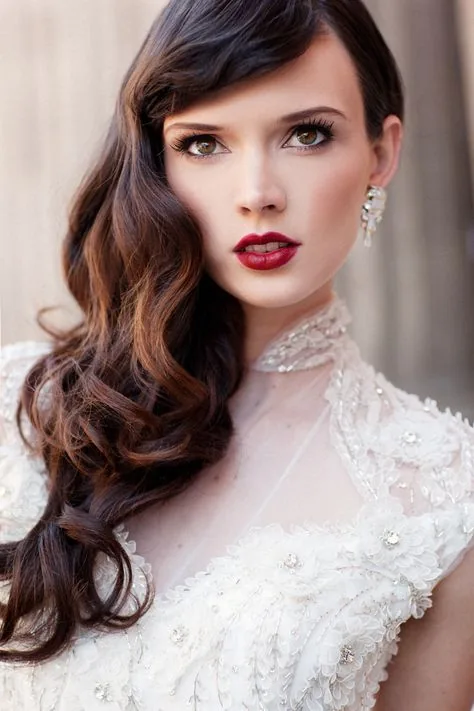
Hollywood waves — deep, glossy, uniform waves that fall in a single direction — bring old-school glamour to a garden, and the contrast is gorgeous: polished waves against wild greenery, vintage shine against soft petals. This is the style for a bride who wants to look like a film star at her own wedding, and who is willing to invest the styling time to get there.
Outdoors, Hollywood waves need protection. The style depends on shine and definition, both of which humidity attacks first. The answer is a strong setting routine: curls set with a large iron, pinned to cool, brushed out with a soft brush, and finished with a shine spray and a firm-hold mist. On the day, keep the waves on one side or swept back from the face with hidden pins, so a breeze lifts them rather than breaking them apart. If your ceremony is in high summer, consider a half-up version that pins the top section back while the waves fall below.
Time and cost: allow 60 to 90 minutes — this is one of the slowest styles to build, and it needs a stylist experienced with vintage setting. Who should skip it: brides with very fine hair that drops curls quickly, or ceremonies in strong wind, where the waves will separate no matter how well they are set. A softer, looser wave is the safer choice there.
13. Floral Headband with Loose Curls
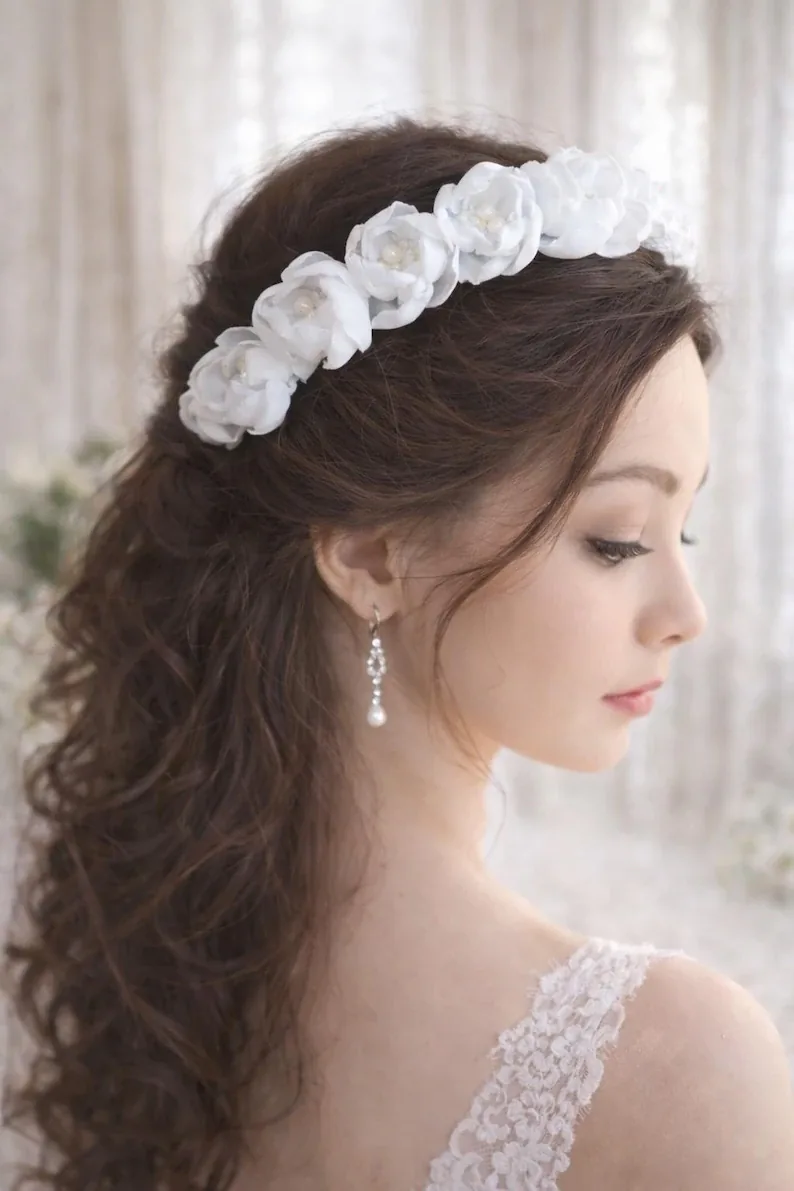
A floral headband — a band of small blooms worn across the forehead or at the hairline — is the easiest way to make loose curls feel bridal. It adds colour and structure to the front of the style, it photographs beautifully, and it needs no veil, no pins and no fuss. With soft curls falling past the shoulders, the effect is romantic without trying too hard.
The headband itself should be fitted at your trial, not on the morning of the wedding. A band that is too loose slides forward over your eyes; one that is too tight gives you a headache by the first dance. If you are using fresh flowers, your florist should build the band on a flexible wire base the day before and keep it cool overnight. For the curls underneath, keep them soft and brushed out — tight curls compete with the flowers, while soft waves let the headband be the star.
Best for: bohemian and festival-style garden weddings, brides with long hair, and anyone who wants a flower crown look without a full crown. Common mistake: choosing a headband that is too heavy for fine hair — it will slide. Ask your florist for a lightweight base and ask your stylist to anchor it with two hidden pins.
14. Messy Romantic Bun with Greenery
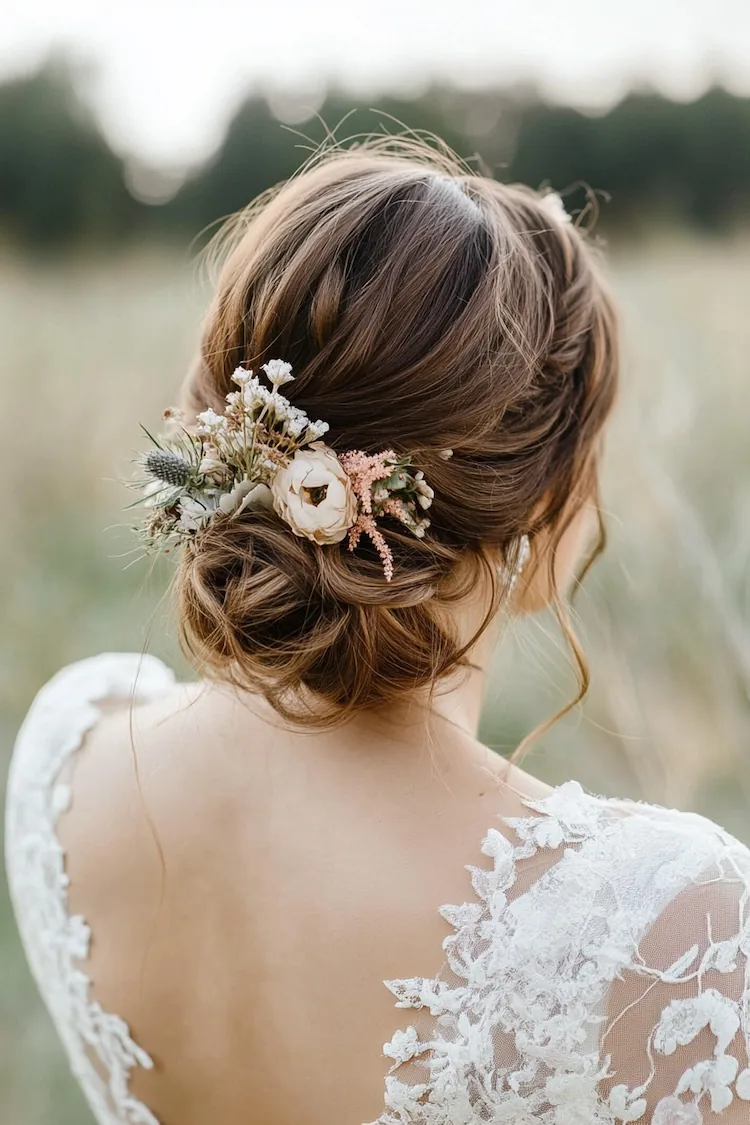
The messy bun is the garden wedding’s best friend, because it is designed to look slightly undone. Hair is gathered loosely, twisted into a soft knot, and pulled apart until it looks effortless — then a sprig of eucalyptus or olive branch is tucked into the side. The result is a style that looks like you spent ten minutes on it (even if you spent forty) and that only gets better as the afternoon loosens it further.
This is the style to choose when you are worried about perfection. There is no smooth surface to ruin, no precise part to disturb, and no curl to drop. Wind, humidity and dancing all make it look more romantic, not less. It suits medium to long hair, and it is especially flattering on brides with thick hair, where the bun has natural fullness. For fine hair, a little backcombing and a texturising spray give the knot the volume it needs.
How to style: gather the hair high or low, twist loosely, pin in a circle, then gently pull at the edges of the bun to widen it and let a few pieces fall free. Quick verdict: if you want to forget about your hair entirely after the ceremony, this is your style — it is the most forgiving updo on this list.
15. Sleek Low Bun with Centre Part
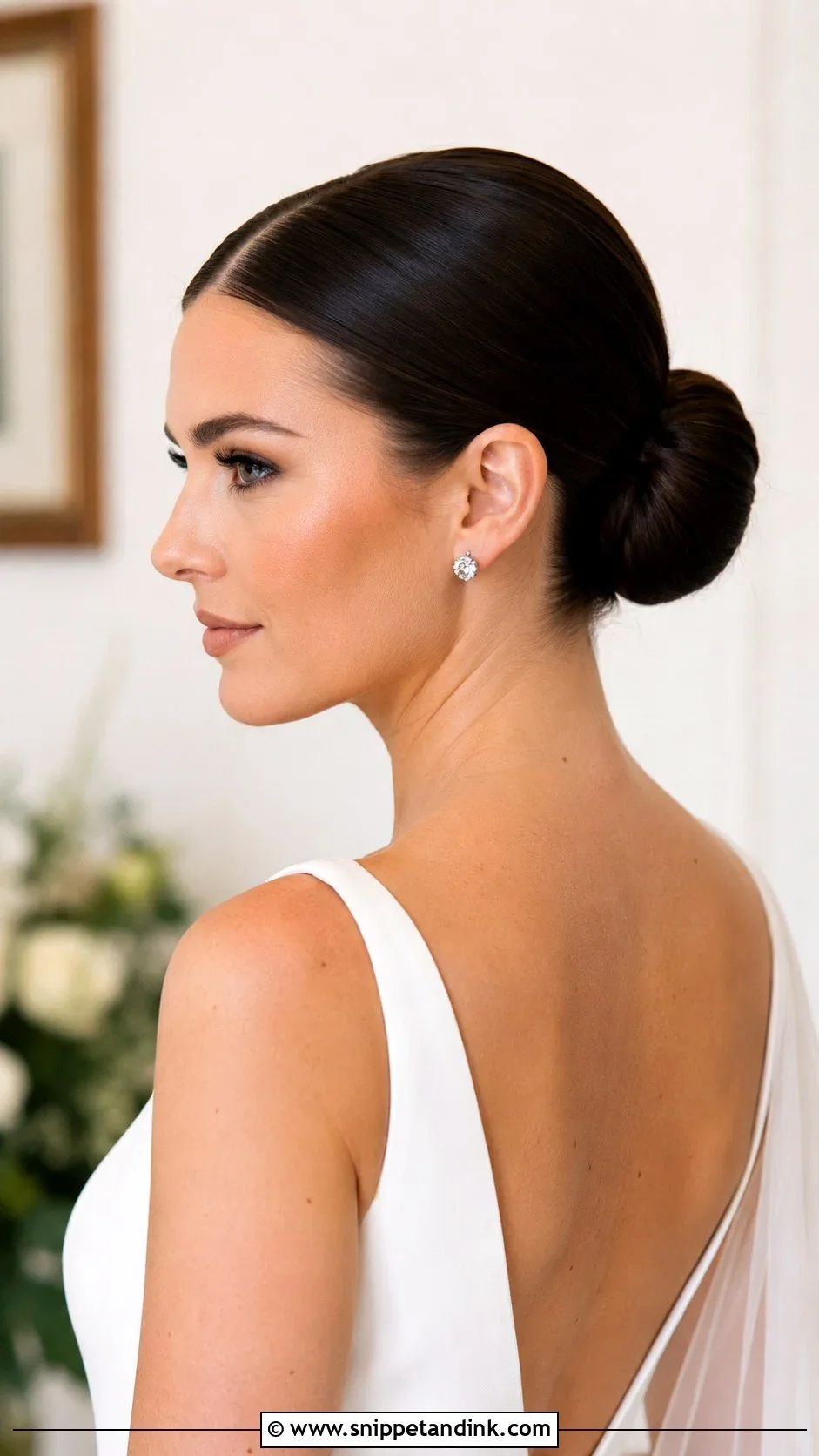
Not every garden bride wants soft and messy. The sleek low bun — a clean centre part, smooth hair pulled back to a neat knot at the nape — is modern, minimal and strikingly elegant against a wild garden. It lets the dress, the flowers and the setting do the talking, and it photographs with a crispness that soft styles cannot match.
Outdoors, sleek is harder than it looks. Humidity is the enemy of smooth hair: flyaways appear within minutes, and a centre part can go wavy at the roots. The fix is preparation — a smoothing serum, a fine-tooth comb, and a light-hold spray applied in layers, not all at once. A few flyaways are fine, and honestly charming in a garden; a halo of frizz is not, so ask your stylist for an anti-humidity spray and carry a clean mascara brush (a stylist’s favourite trick) to smooth stray hairs with a dab of spray.
Best for: modern and minimalist garden weddings, brides with straight hair, and structured or architectural dresses. Who should skip it: brides with very curly or frizz-prone hair in a humid climate — the maintenance will fight you all day, and a softer style will be happier.
16. Romantic Curly Updo for Natural Curls
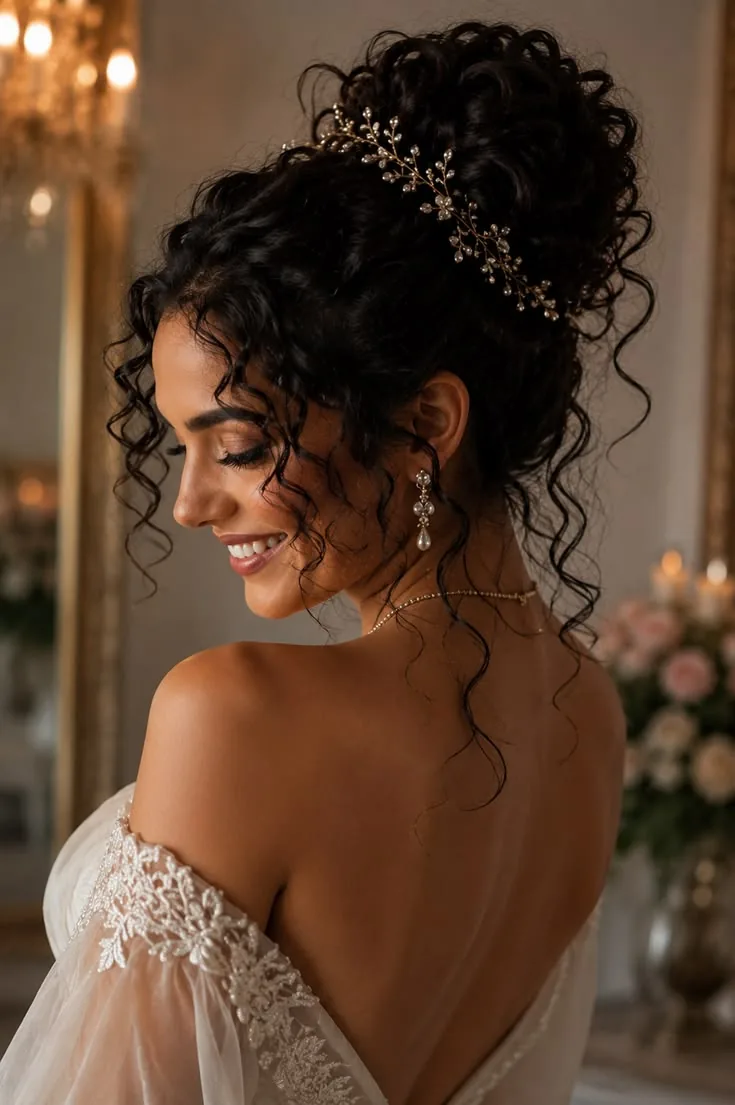
Natural curls do not need to be straightened or tamed for a garden wedding — they need to be celebrated. A romantic curly updo gathers the curls loosely at the back, pinning them in their natural pattern so the shape is full, textured and completely your own. It is one of the most beautiful styles in a garden, because the curls catch the light in a way straight hair never does, and the texture echoes the garden around you.
The key is working with the curl pattern, not against it. Wash and style the curls the way you normally do, let them dry fully, and then pin them up section by section, following the way they naturally fall. Do not brush them out, and do not pull them tight — tension is what causes frizz. A little curl cream on the ends and a light oil on the surface keeps the curls defined without weighing them down. Flowers tucked into a curly updo look wonderful, because the curls hold them in place naturally.
What to ask your stylist: ask for a stylist experienced with your curl type, and bring photos of your curls on a good day — not a straightened photo. Common mistake: straightening the front sections and leaving the back curly. In outdoor light, the difference shows immediately. Keep the texture consistent from front to back.
17. Half-Up Braided Crown
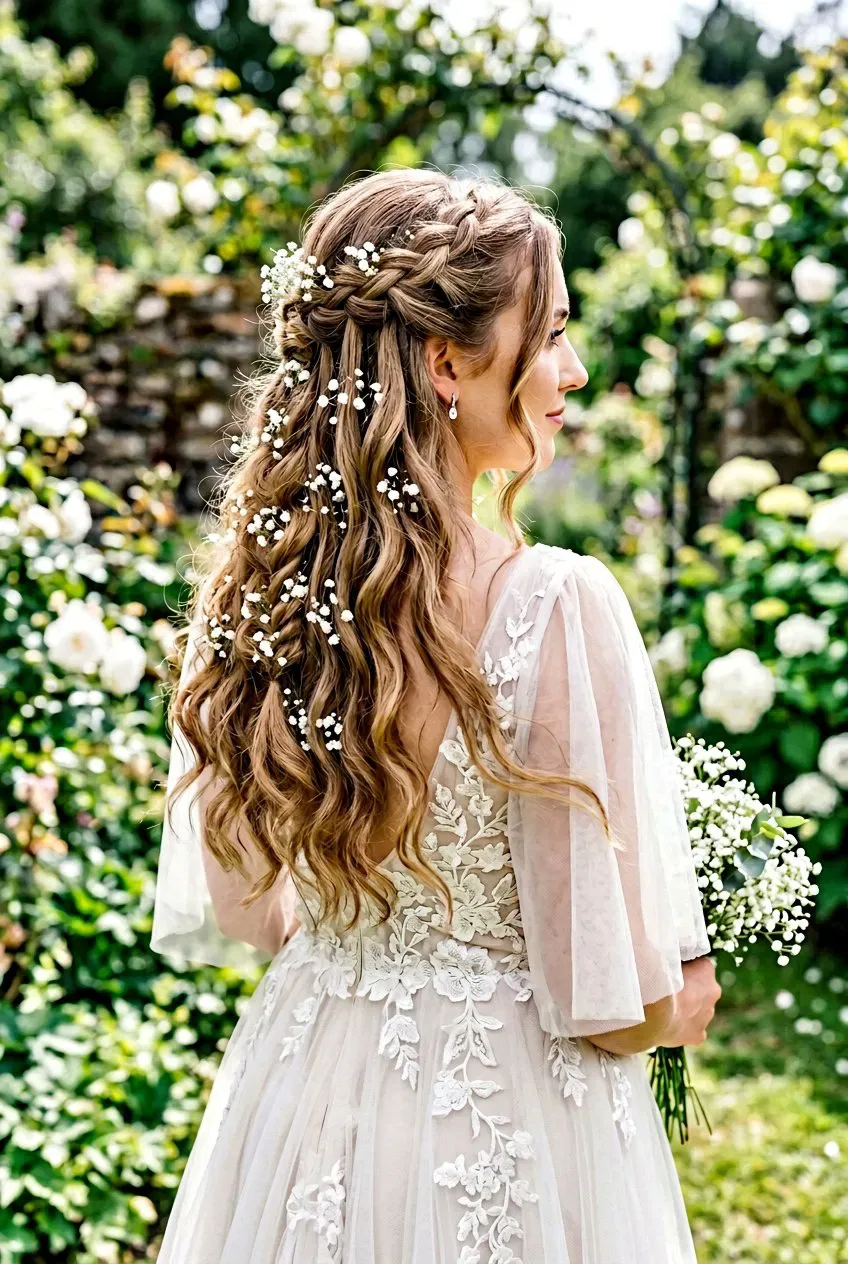
The half-up braided crown takes the prettiest part of a braided crown — the braid across the top of the head — and leaves the rest of the hair down in soft waves. You get the structure and the romance in one style, and it is one of the most photogenic choices for a garden: the braid frames the face from the front, and the waves show off the back in portraits.
Two small braids, one from each side, joined at the back of the crown, are easier to build and more forgiving than a single full crown, especially on fine hair. Pull the braids apart slightly for softness, pin the join with a decorative comb or a flower, and let the waves below fall naturally. This style survives wind well, because the front is secured, and it survives humidity well, because the waves below are already soft and loose.
Pros and cons: the pros are versatility and comfort — it works for brides and bridesmaids alike, and it takes about thirty minutes. The con is that it needs at least medium-length hair to look full; on short hair, the braids can look thin. Best for: brides who want braids and waves, outdoor ceremonies with a breeze, and anyone wearing a flower crown or a decorative comb.
18. Soft Gibson Tuck
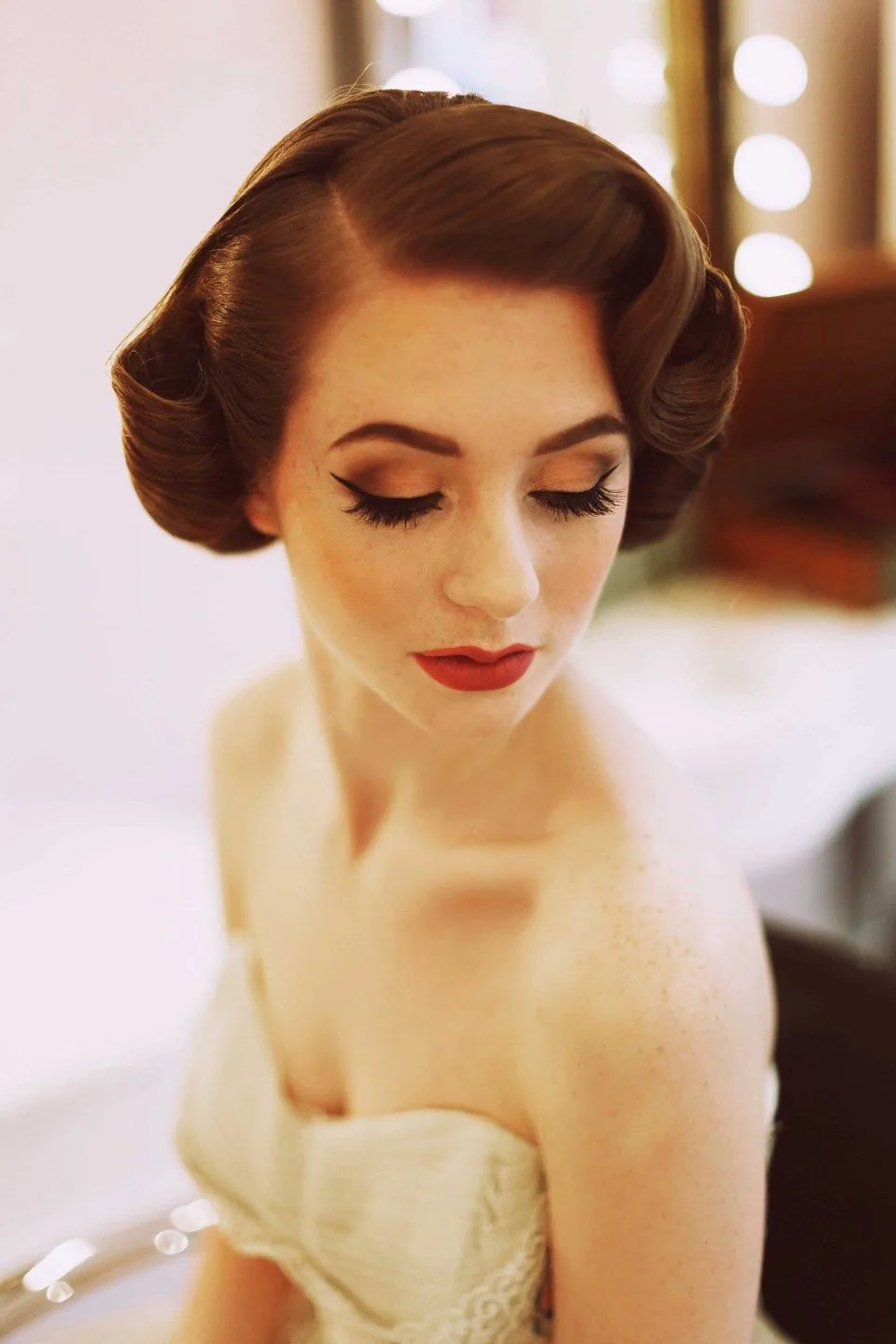
The Gibson tuck is a vintage trick that deserves a comeback: hair is gathered low, looped up and tucked into itself, creating a soft roll at the nape that looks like a chignon but takes half the time. The garden version is left deliberately soft, with volume at the crown and a few loose pieces at the sides, so it reads as romantic rather than costume-y.
It is a wonderful choice for brides with medium-length hair who struggle with full updos, because the tuck works with the length you have instead of demanding more. It also holds up beautifully outdoors: the tuck is self-anchoring, so wind cannot pull it apart, and it keeps the neck cool. A pearl comb or a sprig of baby’s breath pinned into the roll is all the decoration it needs, and it pairs beautifully with a fingertip veil.
Time and cost: about 30 minutes, making it one of the quicker updos on this list — a good choice for a tight morning schedule. Who should skip it: brides with very long, heavy hair, where the tuck can feel bulky and pull at the nape. A low chignon or a braided updo will be more comfortable there.
19. Twisted Low Chignon
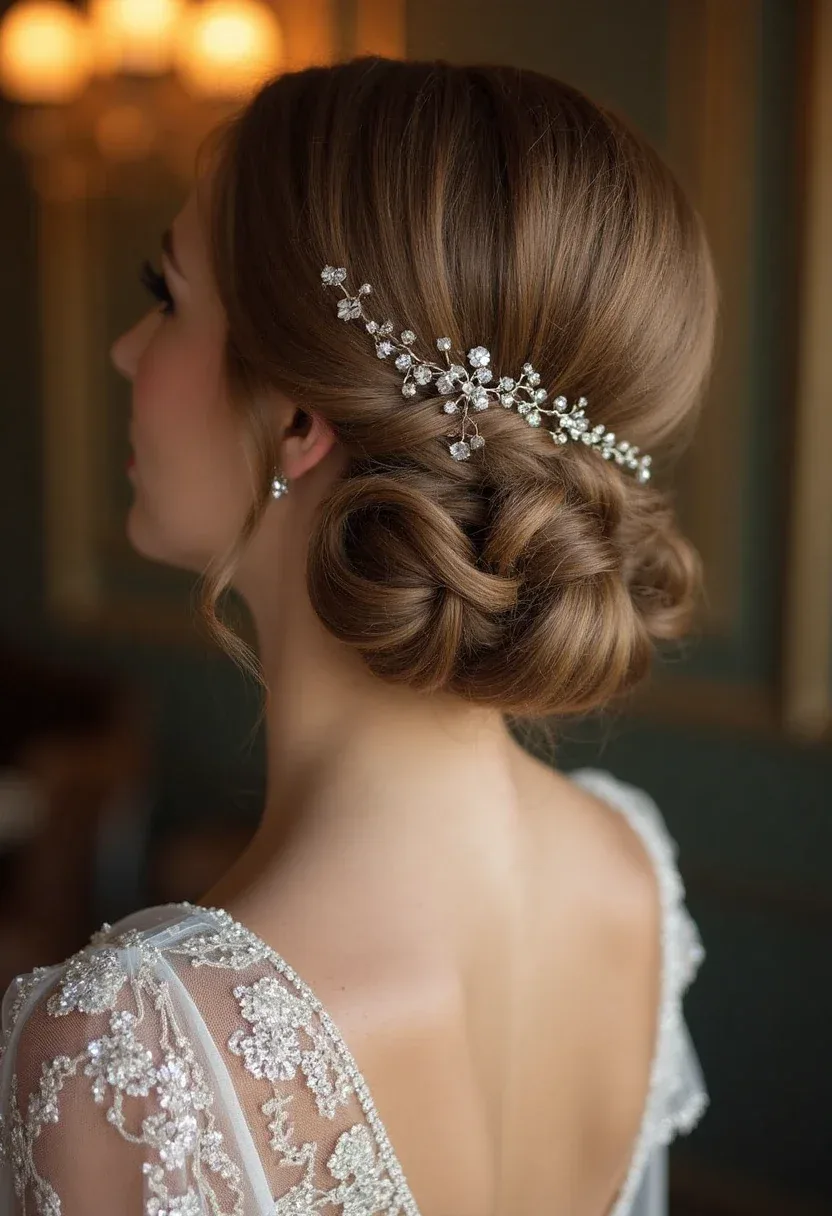
The twisted low chignon is the chignon’s more interesting cousin. Instead of a smooth roll, the hair is divided into two or three sections, each twisted, and then the twists are coiled together into a low knot. The result has visible texture and movement — you can see the twists in photographs — while keeping the same low, elegant silhouette that suits a garden so well.
Twists are also structurally stronger than a smooth roll. Each twist grips the next, so the style holds its shape even as pins loosen in the heat, and it is a good choice for thick hair, where a smooth chignon can feel heavy and flat. For fine hair, the twists add the appearance of fullness without backcombing. Finish it with a small flower or a gold pin at the side, and leave one soft tendril loose at each temple.
How to style: part the hair softly, twist each side section toward the back, join them low, then twist the remaining length and coil it into a knot, pinning as you go. Maintenance: check the knot once before the reception — a single loose twist is easy to re-pin, and a quick mist of spray will hold it for the evening.
20. Garden Party Bubble Braid
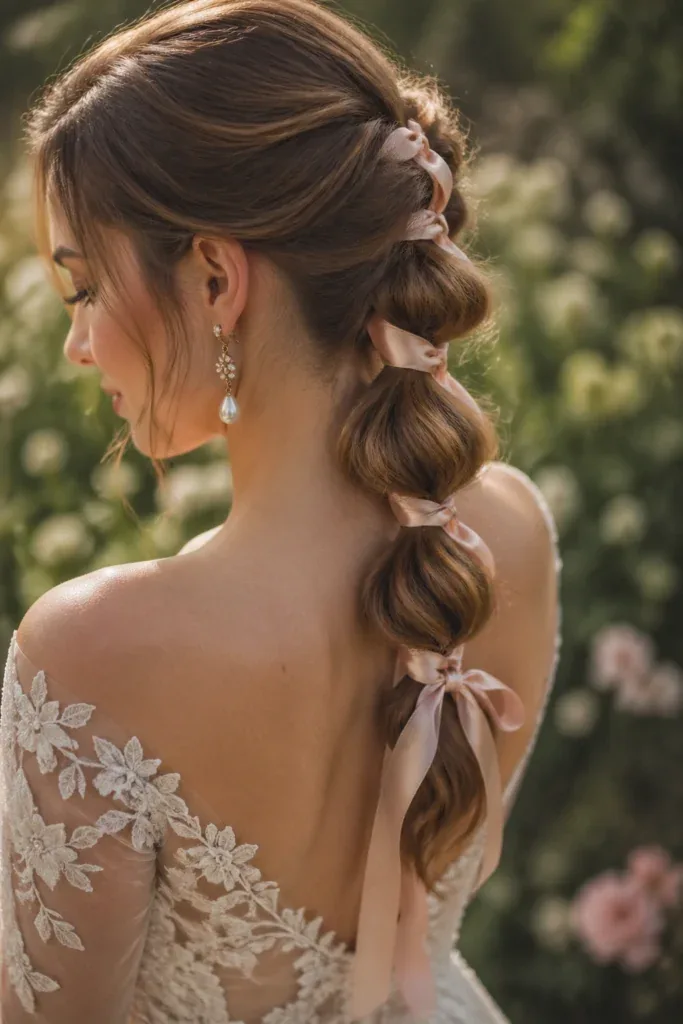
The bubble braid is the fun one — a ponytail divided into sections with elastics, each section pulled out into a soft bubble, creating a playful, textured braid that looks like a string of pearls down the back. For a garden party wedding, it is perfect: it is light, it moves beautifully, it photographs like a dream, and it is almost impossible to ruin, because the bubbles only get softer as the day goes on.
It works best on long hair, and it is a brilliant choice for bridesmaids as well as brides, because it is quick to build and looks intentional on almost everyone. Small flowers or tiny ribbons tied at each elastic turn it from pretty to unforgettable, and a bubble braid down the back shows off an open-back dress beautifully. On fine hair, use a texturising spray before you start, so each bubble holds its shape instead of collapsing.
Best for: relaxed and playful garden weddings, long hair, and brides who want a style that dances as well as it photographs. Common mistake: pulling the bubbles too tight — they should be soft and rounded, not stretched flat. Pull gently, a little at a time, and step back to check the shape after each one.
21. Loose Wavy Lob for Short Hair
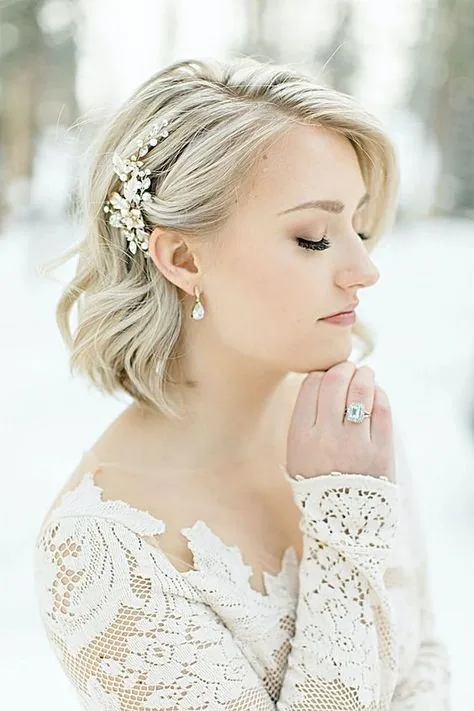
Short hair is not a limitation at a garden wedding — it is an advantage. A loose, wavy lob (a long bob that sits around the collarbone) is light, cool, and completely wind-proof in the ways that matter: there is nothing long enough to blow across your face, and the waves give it all the romance it needs. With a flower pin or a delicate headband, it is every bit as bridal as waist-length curls.
The key is texture. A lob that is too smooth looks like an everyday haircut; a lob with soft, piece-y waves and a little movement at the ends looks like a wedding style. Ask your stylist for loose waves set with a flat iron or a large curling iron, brushed out and finished with a texturising spray. A deep side part adds glamour, while a centre part with face-framing layers feels softer and more modern.
Pros and cons: the pros are comfort, coolness and zero maintenance — you will not think about your hair once all day. The con is that there is less to pin, so a veil needs a comb with a strong grip or a headband-style veil. What to ask your stylist: ask how to keep the waves from dropping in humidity — a light mousse applied before styling usually does the trick.
22. Romantic Pixie with Flower Pins
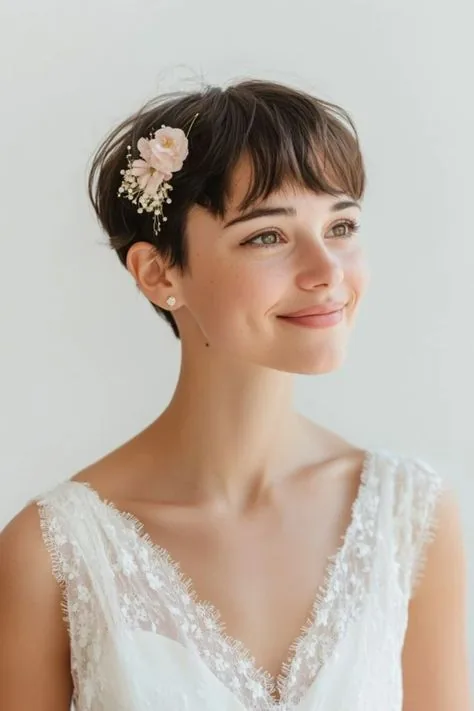
A pixie cut at a garden wedding is a statement of confidence, and it is a beautiful one. Short, textured, and full of personality, a pixie frames the face, shows off earrings and a neckline, and never needs a single pin. With a few small flower pins or a delicate vine tucked above one ear, it becomes unmistakably bridal — and it will stay perfect from the first photograph to the last dance, because there is nothing to come undone.
Styling a pixie for a wedding is about texture and shine, not structure. A little texturising paste through the top, a soft sweep across the forehead, and a gloss spray for shine are usually all it takes. The flowers do the rest. Choose small, lightweight blooms — baby’s breath, tiny spray roses, lavender — and pin them with bobby pins that match your hair colour, so the flowers appear to float. Keep the pins light: heavy accessories slide on short hair.
Best for: confident brides with short hair, hot-weather garden weddings, and anyone who wants to look like herself rather than like a wedding stereotype. Quick verdict: if you love your pixie, keep it. A garden is the most forgiving setting for short hair, and a flower pin is all the bridal styling you need.
23. Elegant French Braid Updo
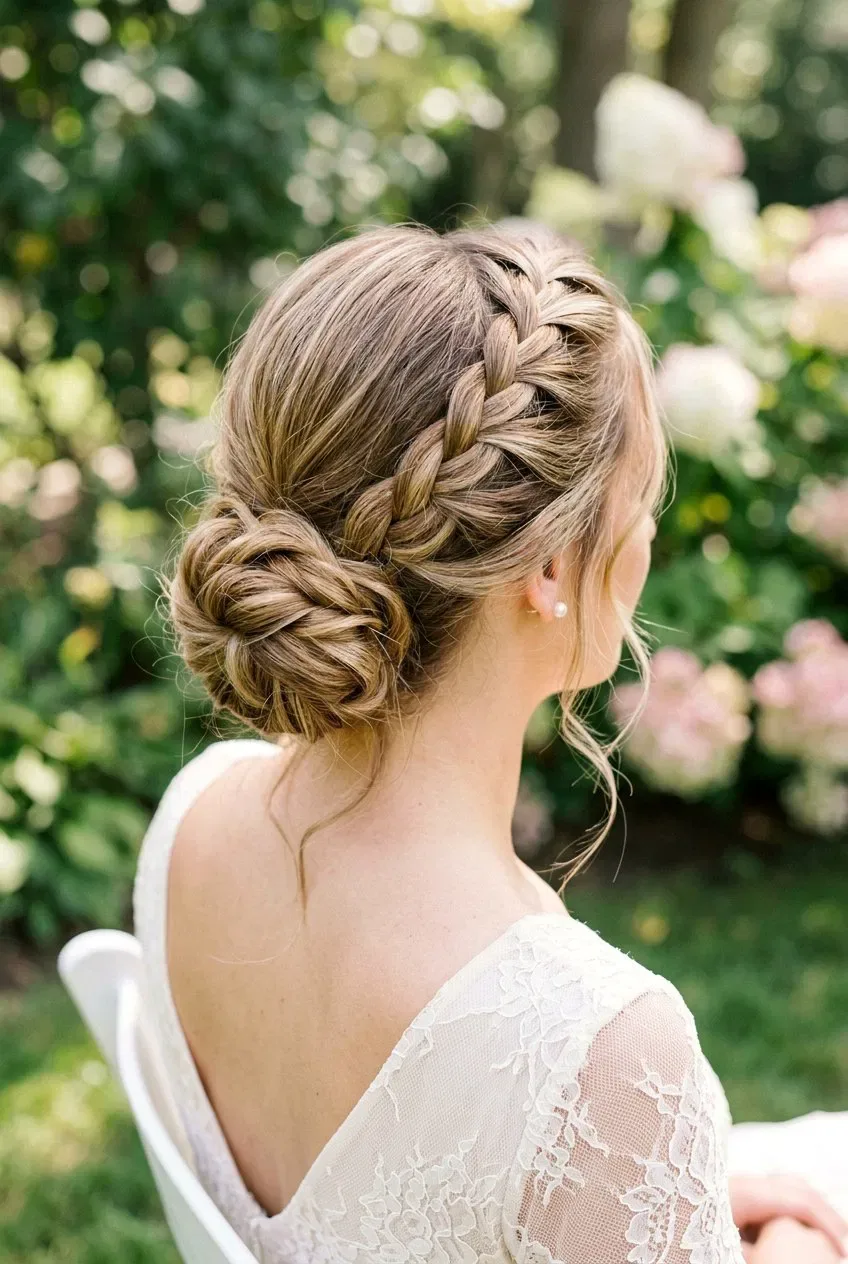
A French braid that starts at the crown and is coiled into a low updo is one of the most secure styles you can wear outdoors. The braid itself is the anchor: it holds the hair from the front all the way to the back, so wind, dancing and an hour in the sun cannot shift it. Finished with soft, pulled-apart texture and a flower at the coil, it is elegant without being stiff.
This style suits brides who want their hair fully up but do not want a plain bun. The braid gives the updo a visible pattern that photographs beautifully from every angle, and it works on medium to long hair. On thick hair, a single French braid gives a full, rich updo; on fine hair, two smaller braids joined at the back look fuller. It also takes a veil beautifully — the veil comb slides into the braid, which grips it far better than smooth hair does.
Time and cost: allow 45 minutes, and book a stylist who braids confidently — a hesitant braid shows in the finished shape. Who should skip it: brides with very short hair or layers that fall out of braids easily. A twisted updo or a pinned style will hold better there.
24. Soft Side Bun with Draped Curls
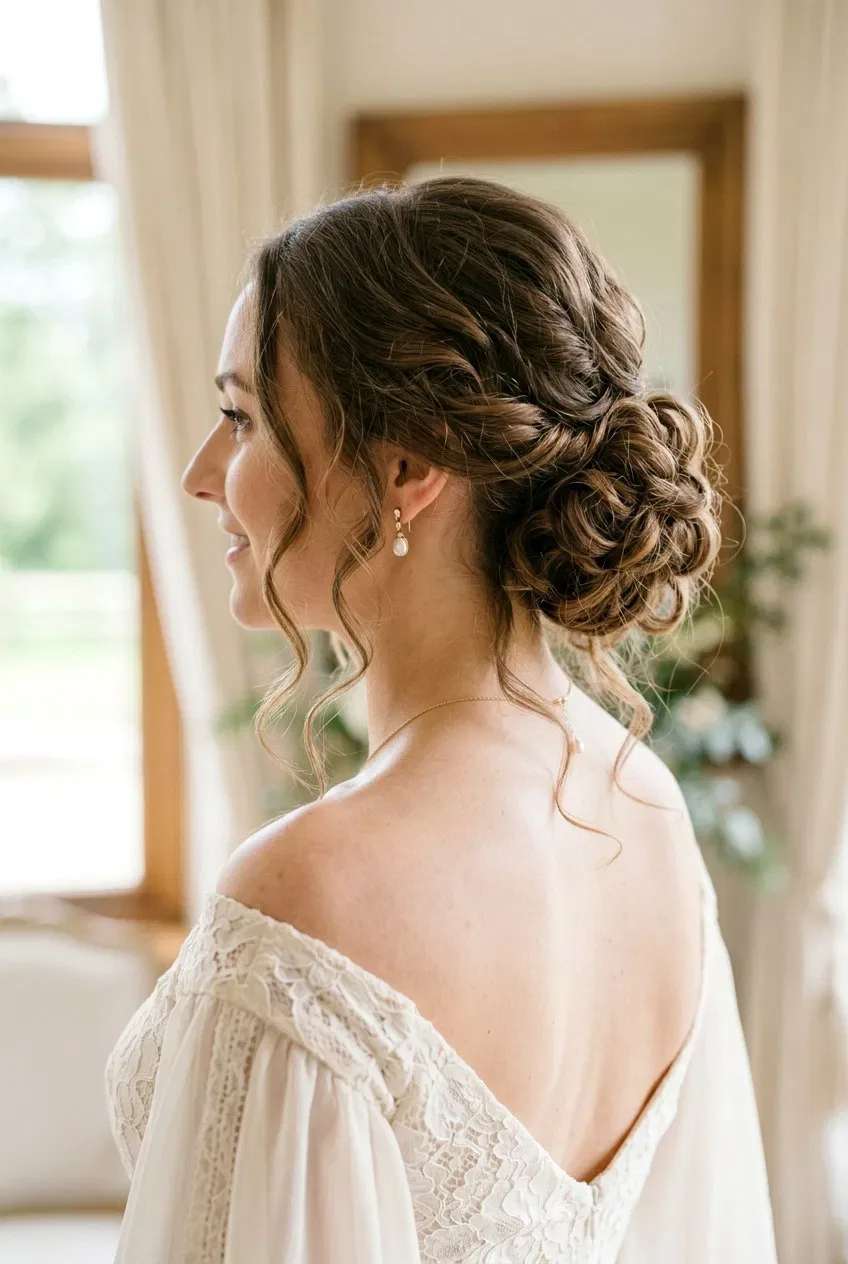
A side bun — hair gathered low and to one side, with curls draped over the shoulder — is asymmetrical, romantic, and made for photographs. It shows off one side of the face and neck, it balances a one-shoulder dress, and it gives the back of the style a soft, flowing line that a centred bun cannot match. In a garden, with light falling across one shoulder, it is quietly dramatic.
The bun itself should be soft, not tight: curls pinned loosely into a low knot, with a few ends left free to drape. The draped curls are the point, so set them well and let them fall over the shoulder on the same side as the bun. This style needs medium to long hair, and it suits brides with oval, round or heart-shaped faces particularly well, because the asymmetry balances the features.
Best for: brides who want an updo that still feels romantic, one-shoulder or strapless dresses, and golden-hour portraits. Common mistake: placing the bun too high — a side bun belongs low, near the nape and just behind the ear, or it starts to look like a topknot that slid sideways.
25. Boho Double Braids with Flowers
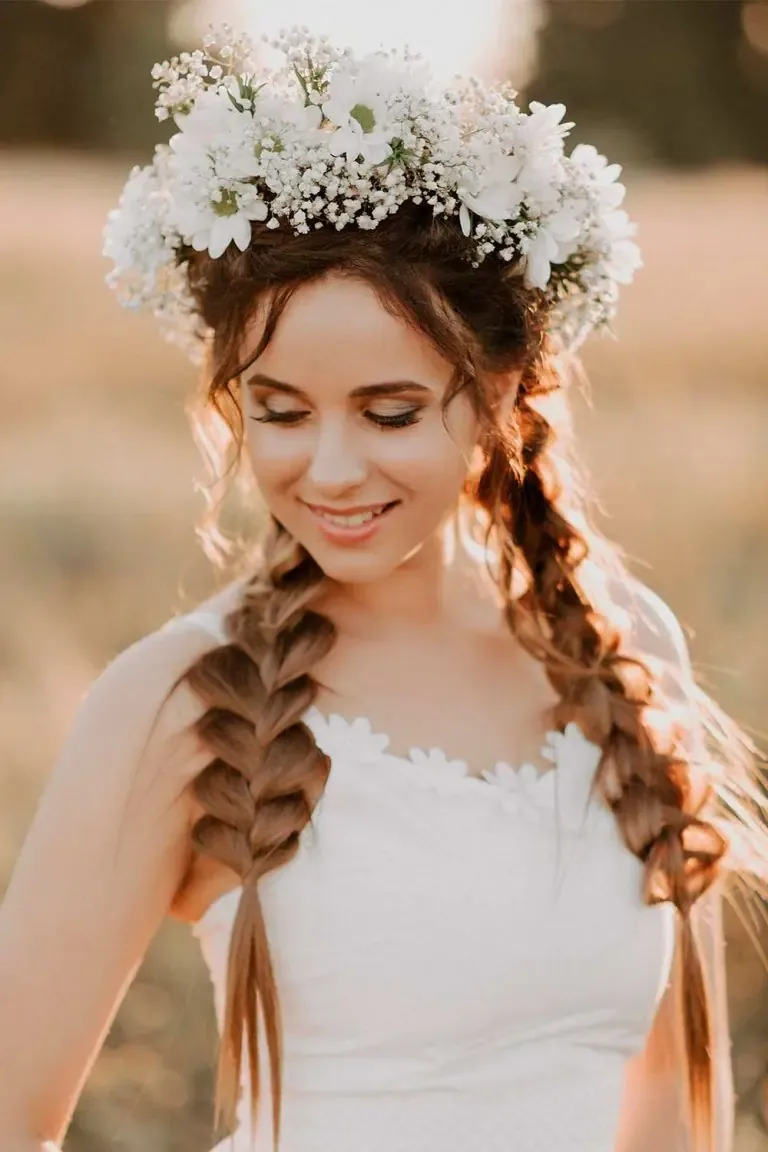
Double braids — two soft braids, one on each side, joined or left to fall — are the most relaxed style on this list, and that is exactly their charm. They are youthful without being childish, they keep every strand contained, and with small flowers woven through them they look like they belong in a wildflower garden. This is the style for a bride whose wedding is barefoot on the grass, not heels on a terrace.
Keep the braids soft. Dutch braids pulled apart for fullness look best, and the parting can be a centre part or a soft zigzag for extra texture. The flowers should be small and light — lavender, baby’s breath, tiny daisies — wired in as the braids are built. Heavy blooms will drag the braids down. This style is also a wonderful choice for bridesmaids, because it is quick, it suits almost everyone, and it photographs as a set beautifully.
Pros and cons: the pros are comfort, durability and charm — this style will survive wind, heat and dancing without a single touch-up. The con is formality: it is a relaxed style, and it will look out of place with a very formal gown or a cathedral veil. Quick verdict: choose it for a bohemian or festival garden wedding, and pair it with a simple dress and flat shoes.
26. Classic Veil-Friendly Low Bun
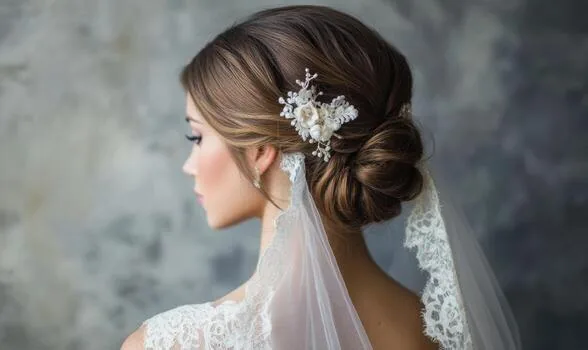
If you are wearing a veil, your hairstyle has a job to do: hold the veil securely, all day, in wind. The classic veil-friendly low bun is built for exactly that. The bun sits low and flat at the nape, with a smooth, firm shape that a veil comb can grip, and the hair above it is smoothed back so the veil falls cleanly. It is the most traditional bridal style on this list, and in a garden it looks timeless rather than old-fashioned.
The details matter. The bun should be built on a foundation — a small hair cushion or a braided base — so it has something for the comb to bite into. The veil comb itself should be sewn or pinned in place, not just slid in, and your stylist should test it by having you turn your head sharply and walk into a breeze. A fingertip or chapel-length veil works best outdoors; a cathedral veil catches the wind and pulls at the bun all day.
Best for: brides who have always dreamed of a veil, formal garden ceremonies, and anyone whose dress is traditional. Maintenance: ask your maid of honour to check the veil comb once before the reception, and carry a few extra pins. A veil that slips mid-ceremony is a photograph you will not want.
27. Romantic Textured Ponytail
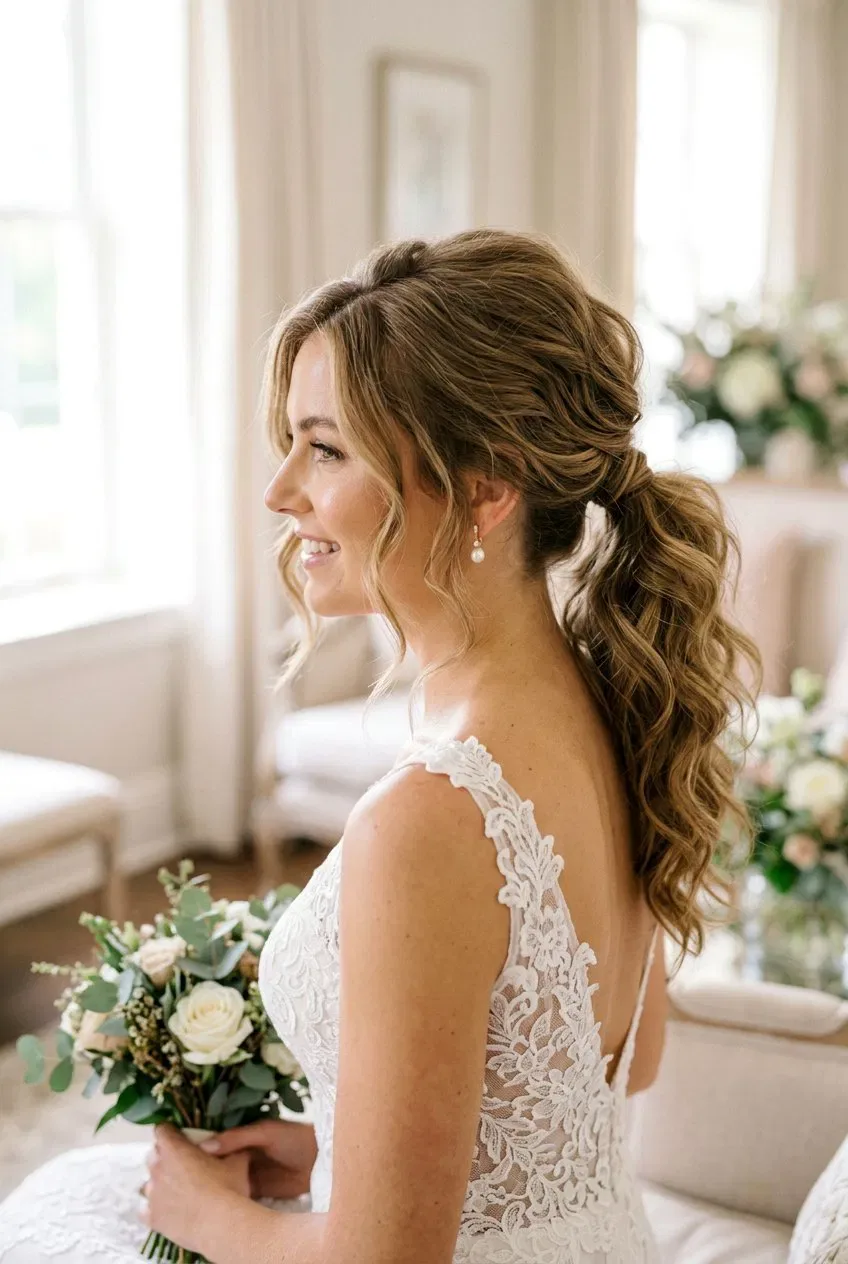
The romantic ponytail is the low ponytail’s wilder sister: higher at the back of the head, full of texture and volume, with curls tumbling down and soft pieces framing the face. It is modern, it is youthful, and it moves beautifully — in photographs, the ponytail catches the breeze and looks alive in a way a pinned-up style cannot.
Texture is everything here. Backcomb gently at the crown, add a little dry shampoo for grip, and curl the length in large sections before gathering it up. Wrap a strand of hair around the elastic to hide it, and let the curls fall over one shoulder rather than straight down the back, so they show in photographs. This style suits medium to long hair, and it is a good choice for brides who want to dance — there is nothing to come undone, and the ponytail only gets softer as the night goes on.
Pros and cons: the pros are movement, comfort and ease — it takes about 25 minutes and survives dancing better than any updo. The con is that it is a casual silhouette, so it suits relaxed garden weddings better than formal ones. Who should skip it: brides with very fine hair, where a high ponytail can look thin — a low, textured version will be kinder.
28. Soft Chignon with Baby’s Breath
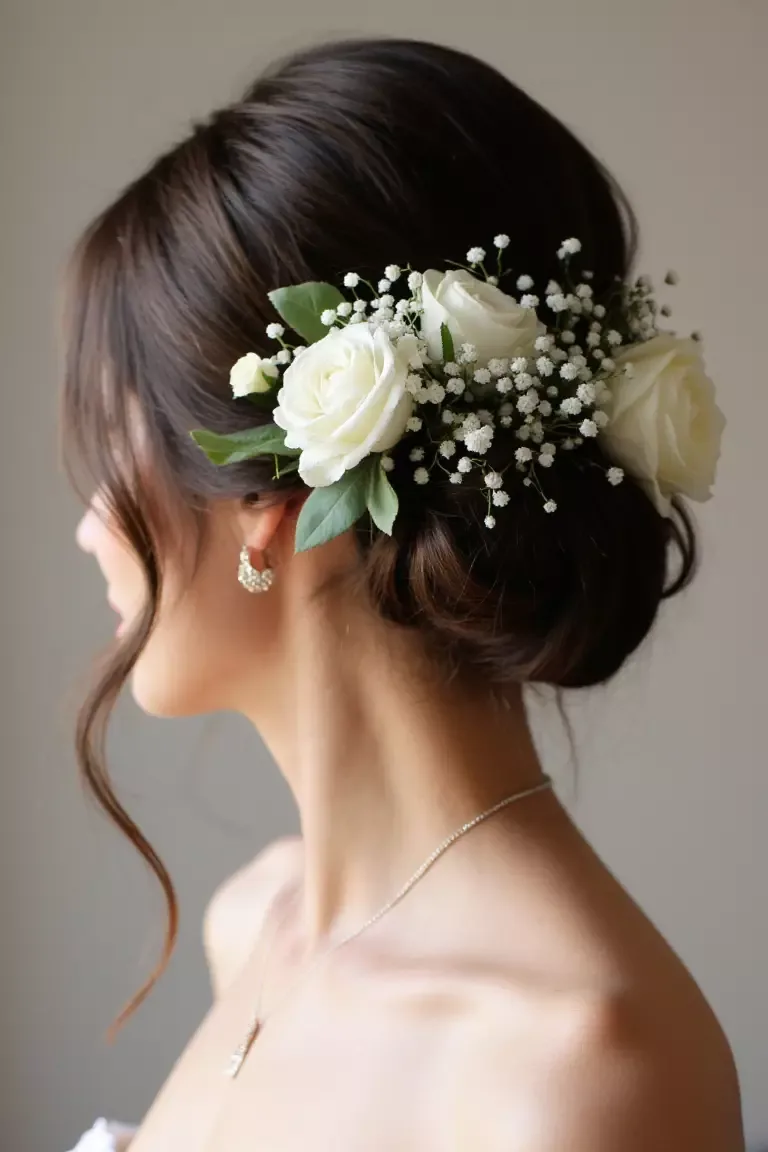
Baby’s breath is the quiet hero of garden wedding hair. It is light, it is cheap, it never wilts in the heat, and a few sprigs tucked into a soft chignon turn a simple updo into something that looks like it was gathered from the garden that morning. The chignon itself is soft and low, with a slightly undone finish, and the tiny white flowers catch the light like a dusting of stars.
This is one of the easiest floral styles to get right, which is why it is so popular. Your florist can supply a few stems, your stylist can tuck them in as she builds the chignon, and if a sprig falls out, another one goes in its place in seconds. It suits almost every hair type and every garden, from a formal rose garden to a wild cottage garden, and it works with or without a veil — the veil comb goes above the chignon, the flowers sit inside it.
Time and cost: the flowers cost almost nothing — a small bunch of baby’s breath is one of the cheapest florist supplies — and the style itself takes about 30 to 40 minutes. Best for: brides on a budget who still want a floral finish, and anyone who loves the look of fresh flowers but worries about wilting.
29. Vintage Finger Waves for Short and Medium Hair
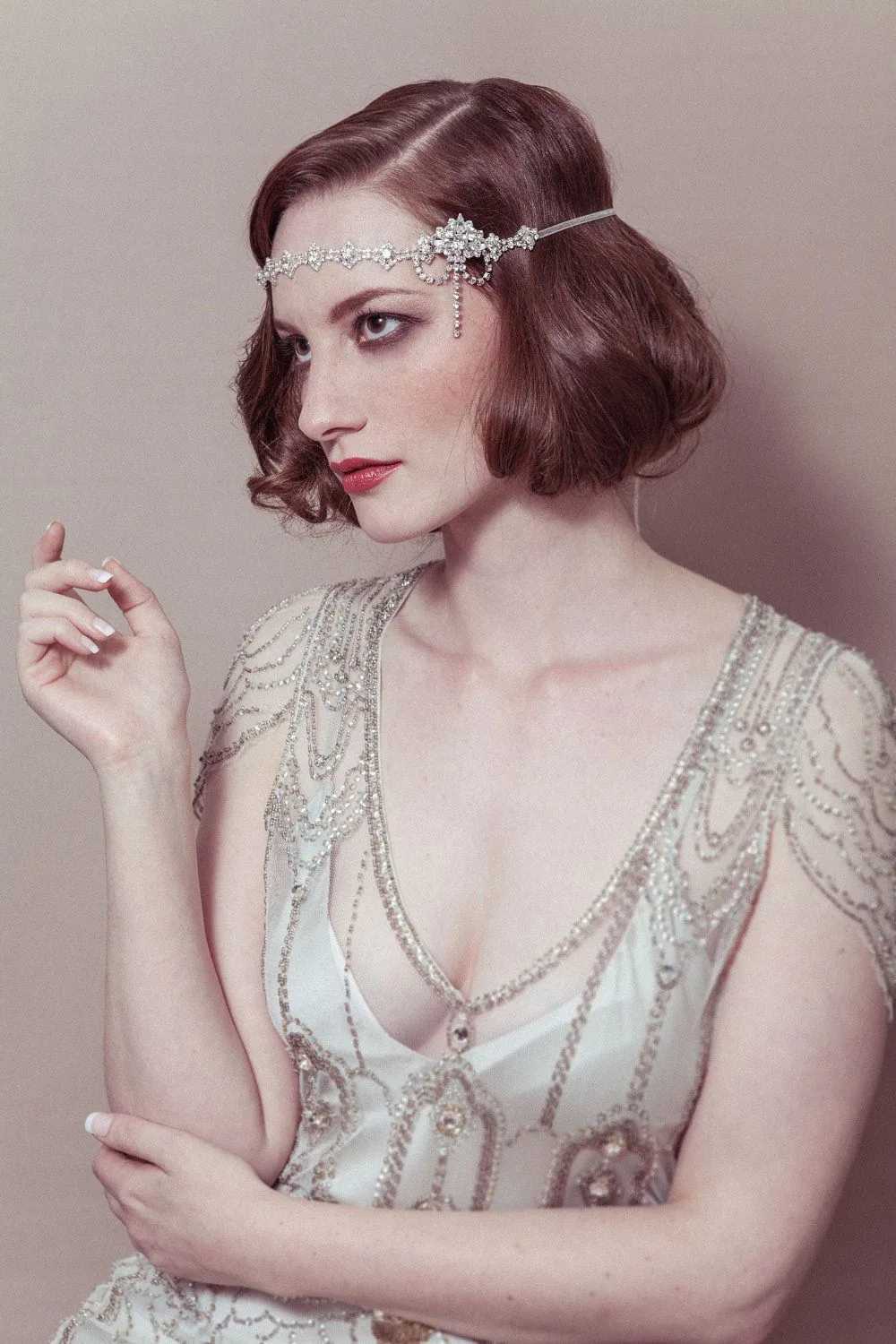
Finger waves — the sculpted, S-shaped waves of the 1920s — are the most glamorous short-hair choice for a garden wedding. They frame the face in perfect, glossy curves, they show off earrings and a neckline, and they need no pins, no veil and no flowers to look complete. With a vintage dress or a beaded headpiece, they are unforgettable.
Building finger waves takes skill and time: the hair is set with gel and shaped with a comb, then allowed to dry into its shape. Outdoors, the style is surprisingly durable — the waves are set close to the head, so wind cannot move them — but humidity can soften the edges, so a strong-hold gel and a finishing spray are essential. This is a style to book with a stylist who has done it before, and to trial well in advance.
Time and cost: allow 60 to 75 minutes, and expect to pay for the expertise — finger waves are a specialist skill. Who should skip it: brides with very long hair, where finger waves are impractical, and anyone who wants a relaxed, bohemian feel — this is a polished, vintage look, and it owns that.
30. Loose Dutch Braid into a Low Bun
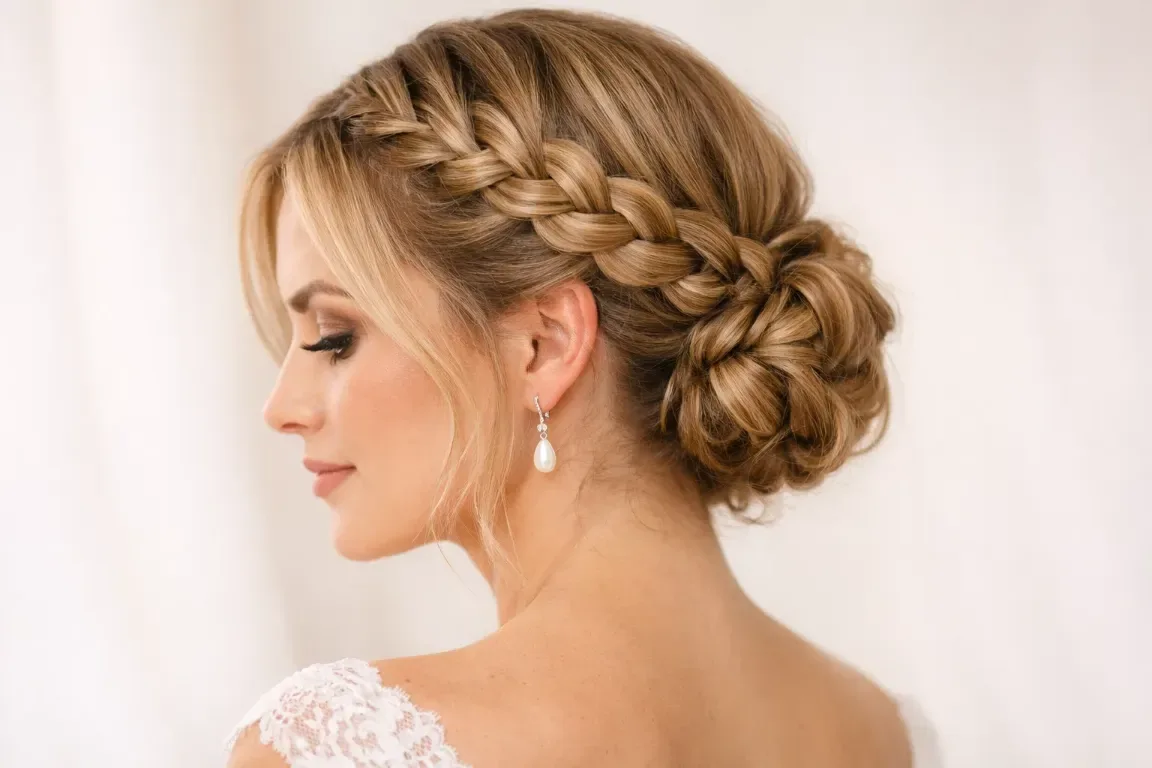
A Dutch braid that starts at the crown, runs down the back of the head, and coils into a low bun is the best of both worlds: the braid gives you structure and a beautiful pattern from behind, and the bun gives you the elegance of an updo. It is one of the most secure styles you can wear outdoors — the braid anchors everything — and it photographs beautifully from the back, which is the angle your guests see during the ceremony.
The garden version is pulled apart gently for softness, so the braid looks full and romantic rather than tight and severe. A flower or a pearl pin where the braid meets the bun marks the transition and gives the style a focal point. This suits medium to long hair, and it is especially good for thick hair, where the braid has natural fullness. For fine hair, a little texturising powder along the braid keeps it from looking thin.
How to style: braid from the front hairline toward the nape, keeping the braid loose and wide, then coil the remaining length into a low bun and pin it securely. Common mistake: braiding too tightly at the hairline — it looks severe in photographs and pulls uncomfortably by the afternoon. Keep the first few crosses soft.
31. Romantic Half-Up with Twisted Crown
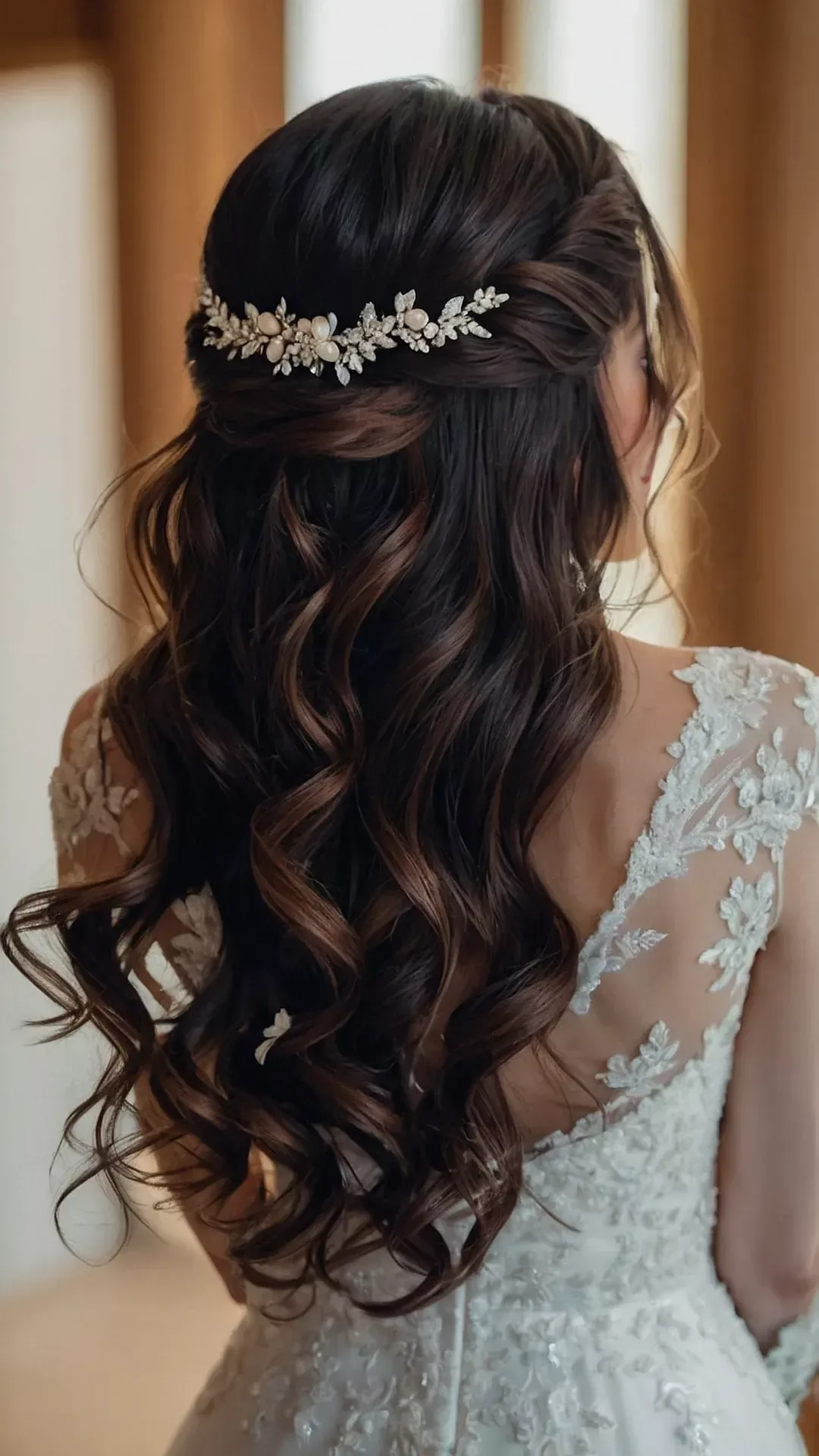
The half-up twisted crown is the twist version of the braided crown, and it is softer and quicker to build. Two sections from the front are twisted back and pinned at the crown, forming a gentle band across the top of the head, while the rest of the hair falls in waves. It is romantic, it is comfortable, and it is one of the most flattering styles for a garden, because the twists lift the face and the waves soften the shoulders.
This style is wonderfully versatile. It works with a flower crown, a veil comb, or a decorative pin, and it suits hair from shoulder length to waist length. On fine hair, the twists add volume at the crown that a plain half-up style lacks; on thick hair, they keep the front contained without making the style feel heavy. A few small flowers pinned where the twists meet turn it into a garden style in seconds.
Best for: brides who want a half-up style with more structure, outdoor ceremonies with a breeze, and anyone who prefers twists to braids. Maintenance: almost none — the twists hold themselves, and the waves below only get softer as the day goes on.
32. Garden-Inspired Braided Updo with Vines
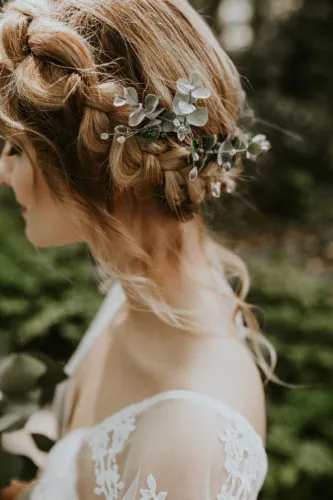
Greenery is the garden wedding’s secret weapon, and this updo uses it as the main event. A braided updo — braids woven and pinned into a low, textured shape — is threaded with thin vines of eucalyptus, ivy or olive branch, so the style looks as though the garden grew into it. It is organic, it is dramatic, and it is completely unique to an outdoor wedding.
The vines need to be chosen and placed carefully. Your florist should supply thin, flexible greenery — eucalyptus, ivy, ruscus — wired so it can be woven through the braids without snapping. The braids themselves should be built first, with the vines added as the stylist pins the updo together, so they sit inside the style rather than on top of it. The result is a style that looks wild and intentional at the same time, and that photographs like a piece of art.
What to ask your stylist: ask her to build the updo with the vines in hand, not after it is finished — weaving them in afterwards never looks as natural. Time and cost: allow 60 minutes and budget for the florist’s time, because wiring and placing greenery is skilled work. This is a statement style, and it is worth the investment.
33. Soft Curls with a Flower Crown
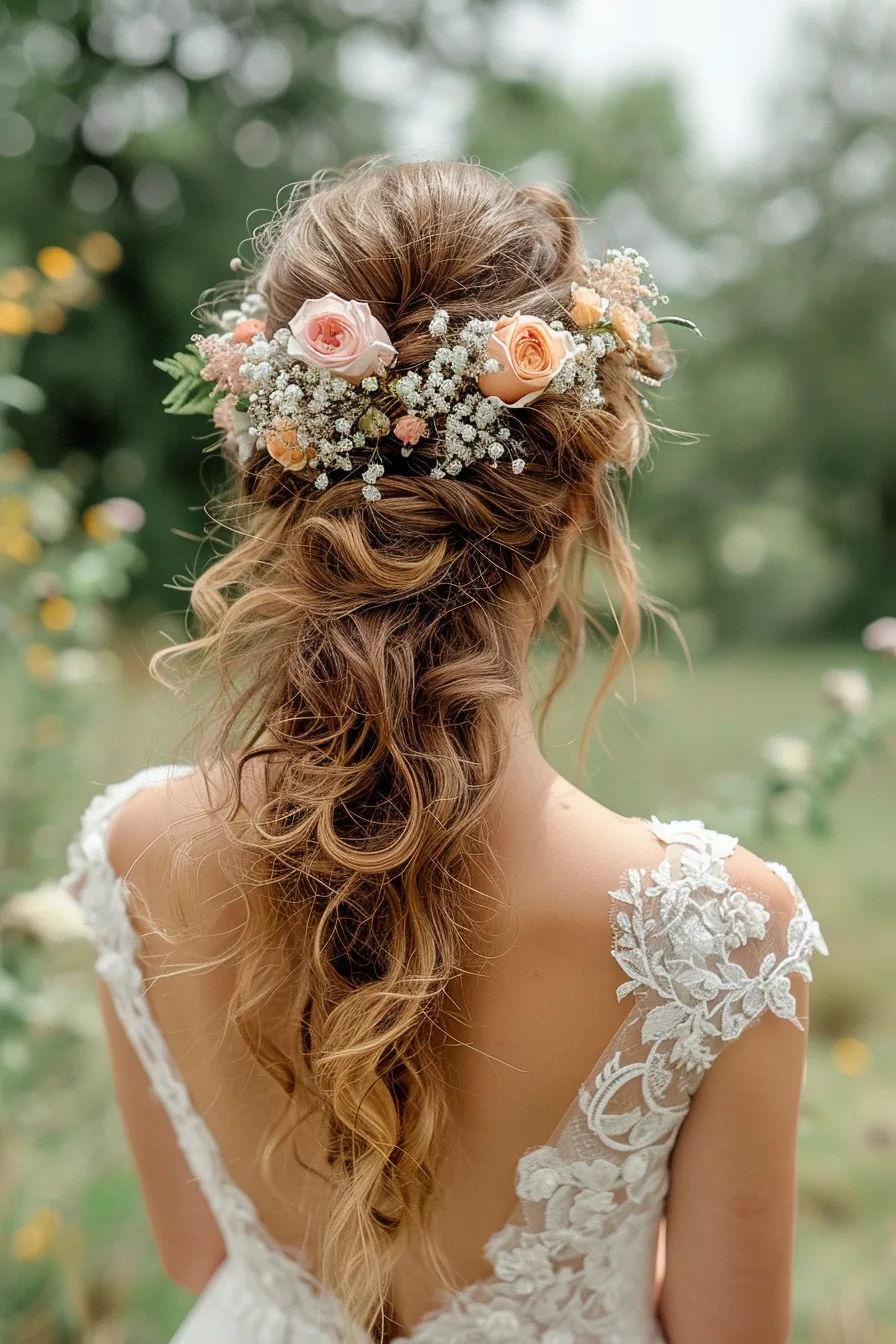
Soft curls and a flower crown are the classic garden wedding combination, and they are classic because they work. The curls are large, soft and brushed out, falling past the shoulders; the crown sits across the forehead or at the hairline, a ring of blooms in colours pulled from the bouquet. Together, they look like the definition of a garden bride — romantic, natural, and completely at ease outdoors.
The crown is the part that needs planning. It should be made to fit your head, not bought off the shelf and hoped for the best: a crown that is too big slides down over your eyes, and one that is too small gives you a headache. Have your florist measure your head at your trial, and ask your stylist to anchor the crown with two pins hidden in the curls. The curls underneath should be set tightly and brushed out, so they hold their shape in the breeze without going frizzy.
Best for: bohemian and romantic garden weddings, brides with long hair, and anyone who wants the most recognisably garden look there is. Common mistake: choosing a crown with large, heavy flowers on fine hair — it will slide. Small, lightweight blooms stay put and photograph just as beautifully.
34. Effortless Undone Updo for Outdoor Photos
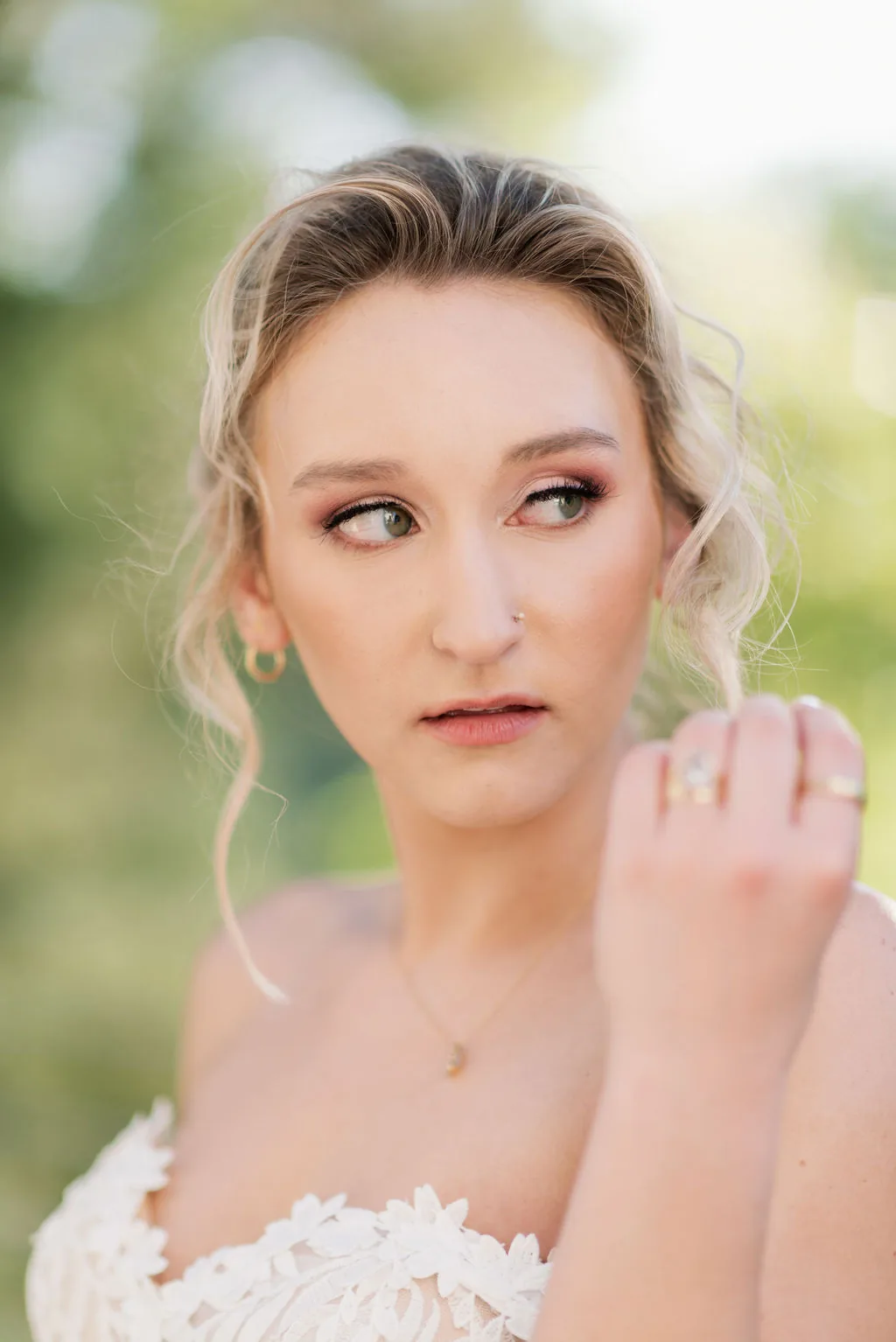
The undone updo is the style that looks like you did it yourself in five minutes — and that is the whole point. Hair is gathered loosely, pinned up in soft, imperfect sections, with pieces left to fall where they will. It is relaxed, it is modern, and it is the most honest garden style there is: it admits that a wedding outdoors is a living, moving thing, and it lets your hair be part of that.
Do not be fooled by the name — an undone updo still takes skill. The difference between artfully undone and actually messy is in the placement: the volume is built at the crown, the pins are hidden, and the loose pieces are chosen, not accidental. Ask your stylist to build it on second-day hair with texturising spray, and to leave the pieces that frame your face slightly longer than the rest, so they fall softly instead of poking out. In photographs, especially in golden-hour light, this style looks like a painting.
Quick verdict: choose this if you want the most relaxed, most photogenic style on this list, and if you are happy for your hair to loosen through the day. Who should skip it: brides who want a formal, structured look — this style is deliberately soft, and it will not stay crisp.
What is the best hairstyle for a garden wedding?
The best hairstyle for a garden wedding is one that is secure, soft and built for wind and humidity — usually a low chignon, a braided crown, a half-up twist or soft waves with the front pinned back. Choose a style that looks better as it loosens, not worse, and trial it outdoors if you can.
How do I keep my hair from going frizzy at an outdoor wedding?
Start with second-day hair, use a smoothing serum and an anti-humidity spray, and choose a style that contains the hair — a braid, a twist or an updo — rather than fully loose hair. A light mist of flexible-hold spray and a few well-placed pins will hold the style through heat and humidity.
Should I wear a veil or a flower crown to a garden wedding?
Both work, but they suit different styles. A veil needs a secure anchor, like a low bun or a half-up twist, and should be fingertip length or shorter outdoors so the wind cannot lift it. A flower crown suits relaxed, bohemian styles and needs no anchor, but it can slip on fine hair — have your stylist pin it in place.
Can I put fresh flowers in my hair for a garden wedding?
Yes, and it is one of the loveliest touches for a garden wedding. Choose hardy varieties like roses, orchids or ranunculus, have your florist wire each stem, and have your stylist place the flowers while the style is being built. Bring the flowers to your hair trial so the style is built around them.
What hairstyle works for short hair at a garden wedding?
A loose wavy lob, a romantic pixie with flower pins, or vintage finger waves all work beautifully on short hair at a garden wedding. Add a flower pin, a delicate headband or a small veil comb for a bridal finish, and keep the styling soft and textured rather than stiff.
How do I style curly hair for an outdoor wedding?
Work with your natural curl pattern: style the curls as you normally would, let them dry fully, then pin them up loosely section by section, following the way they fall. Do not brush them out or pull them tight, use a curl cream on the ends, and tuck flowers into the curls — they hold naturally.
What should I do if it rains on my garden wedding?
Have a backup plan: a marquee or a covered area, and a hairstyle that survives damp — a braid, a low bun or a pinned updo will hold in rain far better than loose curls. Keep a travel hairspray and extra pins in your emergency kit, and ask your stylist to stay nearby or to show your maid of honour a quick refresh.
When should I have my hair trial for a garden wedding?
Book your hair trial six to eight weeks before the wedding, and bring your veil or flower crown, your accessories, and photos of the garden and your dress. Trial the style outdoors if possible, so you can see how it holds in wind and natural light before the day itself.
How long does a garden wedding hairstyle take?
Most garden wedding hairstyles take 30 to 60 minutes. Simple styles like a textured ponytail or a messy bun take about 20 to 30 minutes, while braided crowns, Hollywood waves and finger waves can take 60 to 90 minutes. Build extra time into your morning for the flowers to be placed and for photographs.
How much does a garden wedding hairstyle cost?
A bridal hairstyle for a garden wedding typically costs about the same as any bridal styling, roughly $75 to $250 depending on your location and the stylist, plus the cost of fresh flowers or accessories. Complex braided or vintage styles and on-location styling usually cost more, so ask for a quote at your trial.
Conclusion
A garden wedding gives your hair something no ballroom can: light that flatters, greenery that frames, and a breeze that makes even the simplest style look alive. The hairstyles for a garden wedding that work best are the ones that accept that bargain — styles that are secure enough to survive the wind, soft enough to look romantic in dappled light, and relaxed enough to get better as the afternoon goes on. Whether you choose a low chignon with tendrils, a braided crown woven with fresh flowers, soft curls under a flower crown, or a veil-friendly bun that holds through the ceremony and the dancing, the right choice is the one that lets you forget about your hair and enjoy the day.
Start with the garden itself: look at the light, feel the breeze, and think about the heat. Then choose a style that fits your hair, your dress and the setting, trial it with your veil or flowers in place, and coordinate the timeline with your florist and your stylist. Do that, and your hair will do what great garden hair always does — look effortless, photograph beautifully, and still be there, softly loosened and more romantic than ever, at the last dance under the trees.