The Fontana Shag: San Bernardino County Modern
When we think of mid-century modern architecture, iconic names like Palm Springs, Case Study Houses, or Joseph Eichler often dominate the conversation. But nestled within the expansive landscape of San Bernardino County, a unique and often overlooked variant quietly flourished. Born from the postwar economic surge, the optimism of the aerospace age, and the practical needs of a growing working-class population, a distinctive style emerged: the Fontana Shag. More than just a quirky name, the Fontana Shag represents a localized, pragmatic, and utterly Californian interpretation of modernism, leaving a subtle but significant stamp on the region’s architectural identity.
Roots in the Postwar Boom: Fontana’s Forge
To understand the Fontana Shag, one must first understand the transformation of Fontana and the greater Inland Empire in the 1940s and 50s. The establishment of the Kaiser Steel Mill in 1942 turned the area into an industrial powerhouse, attracting thousands of workers seeking stable jobs and the California dream. This rapid population growth created an urgent demand for housing. Developers, not high-profile architects, became the key players. They needed to build quickly, affordably, and durably for a clientele of factory workers, engineers, and middle-class families.
These tract homes couldn’t be pure, bespoke modernism, but the modern aesthetic was in the air. Borrowing from the broader mid-century movement and adapting to budget constraints, a hybrid style was born. The name “Shag” itself is a colloquial term derived from the roof style—a low-pitched, often front-gabled roof with extended eaves, sometimes clad in wood shakes that gave a slightly shaggy, textured appearance compared to the sleek, flat roofs of high-end modernism. It was a practical compromise: modern in line, but cheaper and easier to build than complex butterfly roofs or expansive flat spans.

Anatomy of a Fontana Shag: Key Design Features
While variations exist, the classic Fontana Shag home possesses a recognizable set of characteristics that distinguish it from its more famous mid-century cousins.
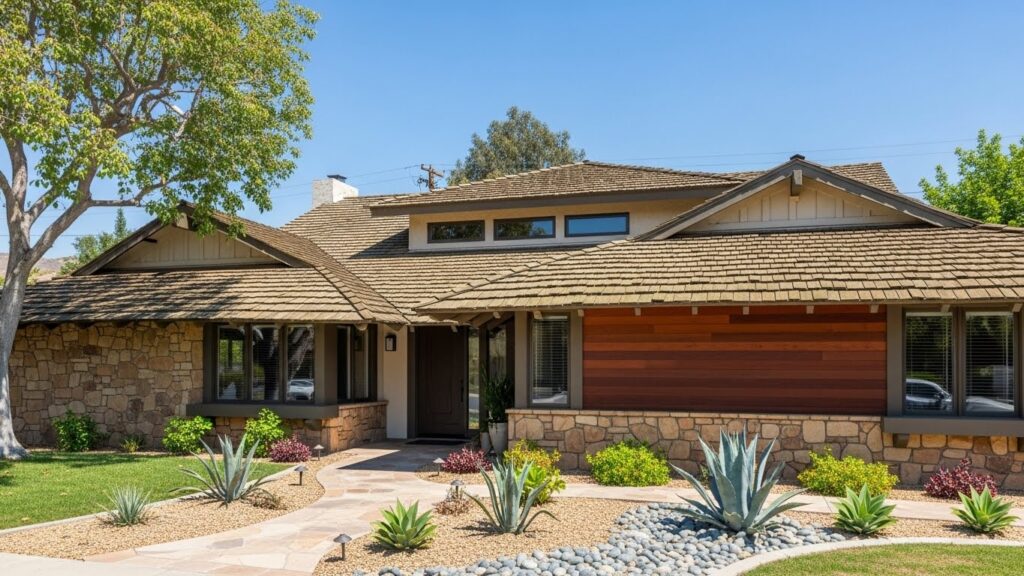
The Signature Roof: The defining element is the low-pitched “shag” roof with deep, overhanging eaves. This provided shade—a crucial consideration for the hot Inland Empire summers—and created covered entryways and carports. The roofline was often the home’s most dramatic architectural feature.
Material Mixology: To add visual interest and texture without high cost, builders used a mix of materials. A common formula featured rustic stone or brick veneer on the lower half of the facade, topped with horizontal wood siding or smooth stucco. This “base and cap” look grounded the home and added a touch of craft.
Floor-to-Ceiling Windows (Within Reason): True to its modern influences, the Fontana Shag embraced bringing the outdoors in. You’ll find generous use of large picture windows and aluminum-framed sliding glass doors leading to patios. However, these were often in standard sizes from building supply catalogs, not custom-designed walls of glass.
The Open, Yet Practical, Plan: The interior typically followed a modified open plan. The living room, dining area, and kitchen often flowed together, but the separation was more defined than in avant-garde designs. Hallways led to bedrooms, maintaining privacy for families. Functionality was paramount.
Integration with the Outdoors: Even on modest lots, the design encouraged outdoor living. Concrete patios, often covered by the eave’s extension, functioned as additional “rooms.” Landscaping tended to be low-maintenance, using native rocks, concrete planters, and hardy shrubs like oleander or juniper.

Fontana Shag vs. Palm Springs Modern: A Tale of Two Modernisms
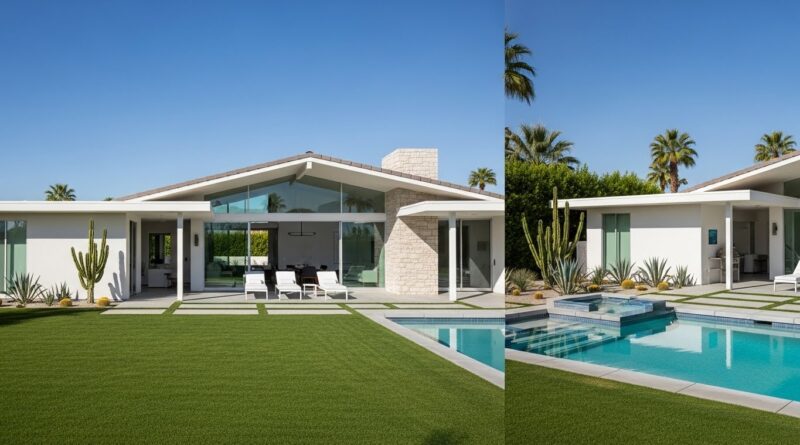
Comparing the Fontana Shag to the iconic modernism of nearby Palm Springs is instructive. Palm Springs modern was a destination style, often designed as second homes or luxury retreats for celebrities and the wealthy. It features pristine flat roofs, bold geometric forms, expansive glass, and lush, curated landscaping. It was about glamour, leisure, and architectural statement.
The Fontana Shag, by contrast, was everyday modernism. It was for the shift worker, the schoolteacher, the young family. Its materials were rustic and off-the-shelf. Its roof was pitched for practicality. Its lot was smaller. Yet, it shared the same core principles: connection to outdoors, clean lines, functional layout, and a break from traditional historical revival styles. The Fontana Shag democratized modern design, making it accessible to a blue-collar and middle-class audience that was shaping Southern California’s suburban fabric.

The Legacy and Preservation of a Local Icon
For decades, the Fontana Shag and its siblings throughout San Bernardino County were simply “old houses.” Many were altered with unsympathetic remodels, vinyl windows, or stucco-over projects that erased their character. However, in recent years, a growing appreciation for vernacular and regional modernism has sparked renewed interest. Homeowners and historians are beginning to recognize these structures as important pieces of a specific postwar cultural and industrial story.
Preserving a Fontana Shag home often involves restoration with sensitivity. Key efforts include: repairing or replicating the original wood siding and shakes, preserving or restoring the original aluminum window frames (which are now valued for their retro appeal), maintaining the material contrasts on the facade, and updating interiors in a way that honors the open flow. The goal isn’t to create a museum, but to retain the home’s authentic spirit while making it suitable for 21st-century living.
These homes are also gaining attention for their inherent sustainability features: their compact footprints, passive shading from deep eaves, and potential for energy-efficient updates align well with contemporary values. They are a testament to a form of “slow architecture” that responded directly to its climate and community.
How to Spot a Fontana Shag Today
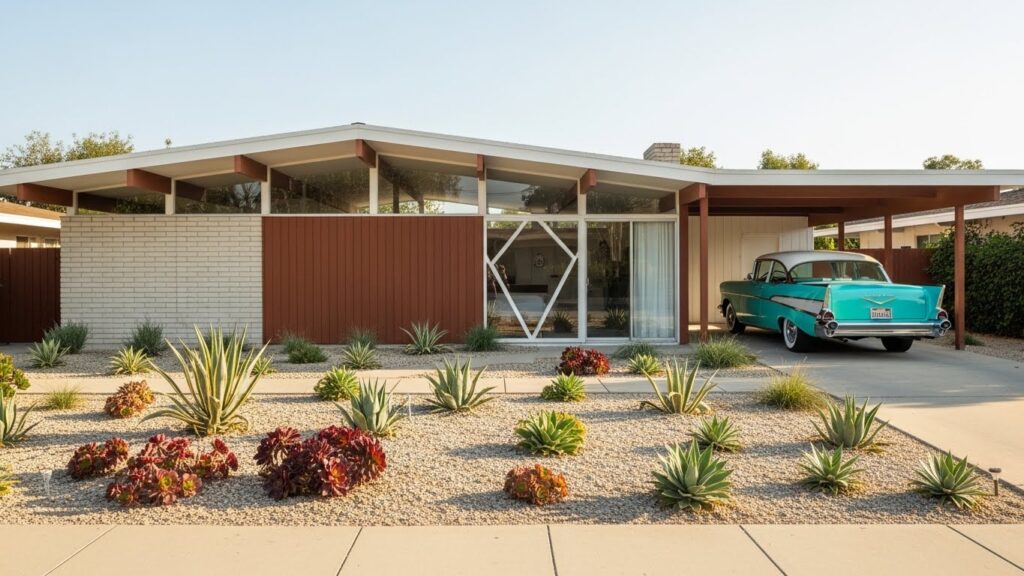
Driving through the older neighborhoods of Fontana, Rialto, Colton, and even parts of Rancho Cucamonga and Redlands, you can train your eye to spot these gems. Look for the low, shaggy roof silhouette against the mountain backdrop. Seek out the contrasting stone and wood or stucco on the front facade. Notice the modest, rectangular footprint and the simple, geometric lines. They are unassuming, but once you recognize the pattern, you’ll see a whole layer of regional history written in stucco, stone, and shingle.
The Fontana Shag is more than a architectural footnote. It is the physical embodiment of a pivotal era in Southern California—a time of industry, optimism, and suburban expansion. It represents the adaptation of a lofty design philosophy to the realities of tract building, creating a warm, livable, and distinctly Inland Empire version of the modern dream. In preserving these homes, we preserve the story of the families who built their lives in the shadow of the mills and under the vast San Bernardino sky, in houses that were quietly, unpretentiously, modern.