Sweat-Proof and Spin-Ready: 33 Hairstyles for a Spin Class That Stay Put Through Every Sprint
Spin class is the hardest workout your hair will ever do. Forty-five minutes of climbs, sprints and standing intervals in a warm, crowded studio, with sweat running down your neck and your heart rate pinned high — and your hair has to survive all of it without falling into your face, sticking to your neck or unravelling halfway through the playlist. The wrong hairstyle turns a great ride into forty-five minutes of pushing strands out of your eyes and re-tying a ponytail that keeps slipping.
The good news is that sweat-proof spin class hair is not complicated. It is a short list of styles that do three things at once: they lift every strand off your neck, they lock the front of your hair away from your face, and they hold their shape when they get damp. Braids, high buns, puffs and anchored ponytails all pass that test — loose hair, heavy accessories and anything held by a single clip do not. This guide gives you 33 hairstyles for a spin class that actually work, for every hair length and texture, from a five-minute high ponytail to cornrows that last the whole week.
Alongside the styles, you will find eight short guides on the things that matter just as much as the style itself: how to prep your hair before class, which headbands and hair ties genuinely stay put, how to control frizz mid-ride, how to refresh your hair after class without washing it, and how to time your wash days around your class schedule. Every section also carries a sweat test note — what the style looks like after forty-five minutes of hard riding — so you know exactly what you are getting.
Pick one style, try it on your next ride, and keep the ones that pass your own sweat test. Your hair should be the last thing you think about in the studio, not the first.
Why Sweat Ruins Most Hairstyles (and What Actually Holds)
Sweat is not just water. It is salty, slightly acidic moisture that loosens grip, weighs hair down and makes smooth styles go frizzy from the roots out. The moment sweat reaches your hairline, a style held by friction alone — a loose ponytail, a single clip, a silk scrunchie on clean hair — starts to slide. That is why the styles that survive a spin class are the ones built on structure: braids that interlock, buns anchored with more than one pin, and hair tied in two places instead of one.
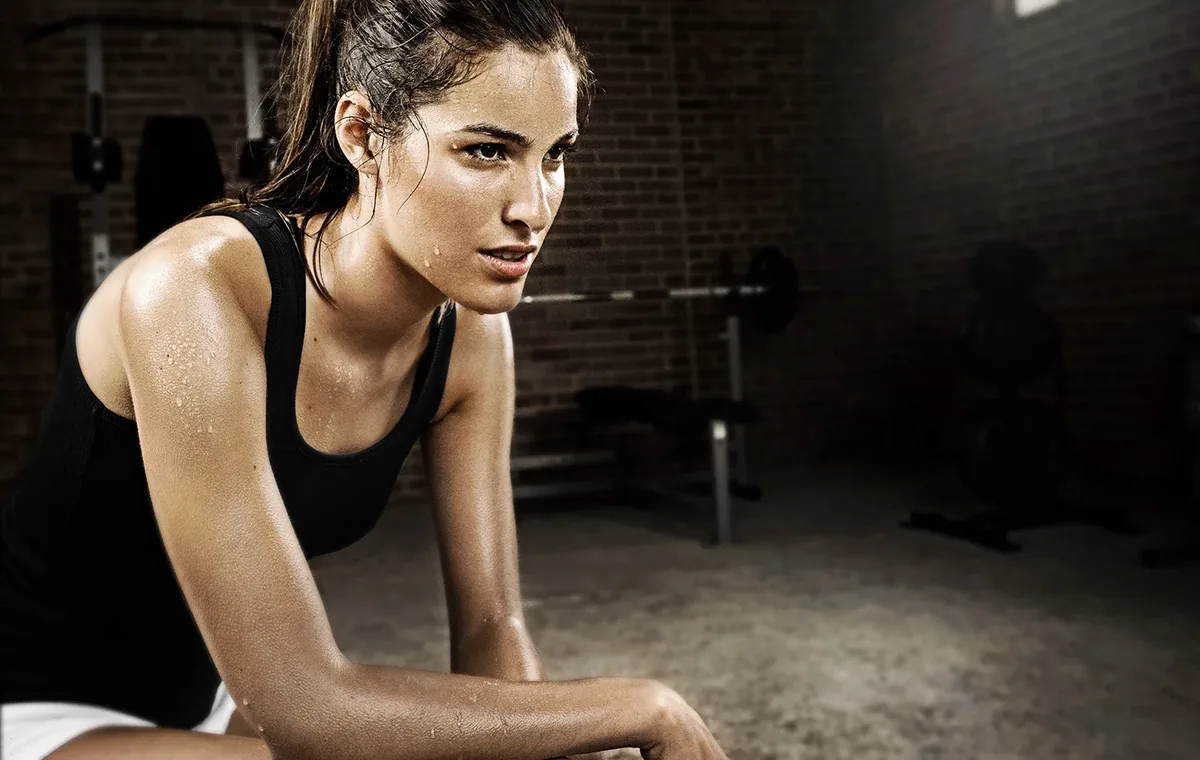
The second problem is heat. A spin studio warms up fast, and warm air relaxes curls, softens styling products and makes hair expand. A style that looks neat in a cool bathroom can look twice its size by the cool-down track. This is why the best spin class styles keep the bulk of the hair contained — in a braid, a bun or a tight ponytail — rather than letting it hang loose where heat and sweat can puff it up.
What actually holds: braids, buns with two or more anchor points, and ponytails secured with a no-slip tie plus a second tie at the base. What fails: single-clip styles, claw clips on sweaty hair, and anything that depends on hairspray alone. Quick rule: if you can shake your head hard and nothing moves, the style will survive the ride.
The Pre-Class Prep: Dry Shampoo, Grip and Product Order
The best spin class hairstyle starts ten minutes before you clip in, not in the studio. The order matters: dry shampoo first on the roots if your hair is a day past washing, then a light texturising spray or a pea-sized amount of styling cream for grip, and only then the style itself. Clean, slippery hair is the enemy of a secure ponytail — a little grit is what keeps the tie from sliding down your head mid-sprint.
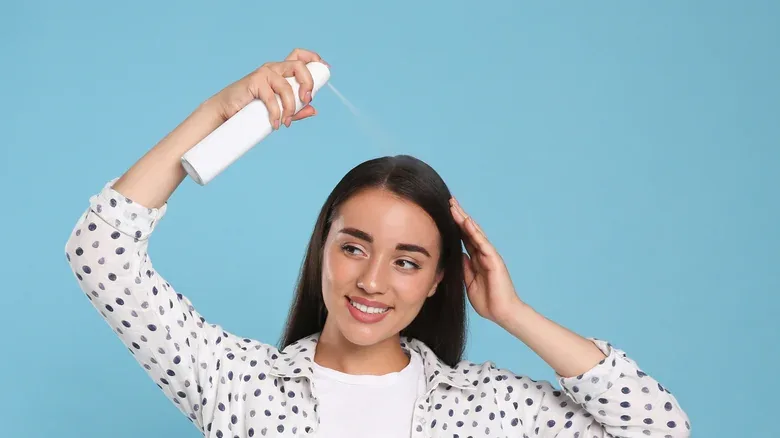
If you wash your hair on class mornings, skip conditioner on the roots and blow-dry completely before styling. Damp hair stretches, and a ponytail tied on damp hair loosens as it dries and shrinks. A fully dry base, a little texture product, and a tie that grips — not a silky one — will hold far better through forty-five minutes of sweat.
Best for: fine, slippery hair that usually slides out of ties. Product order: dry shampoo, then texture spray, then style, then a light flexible-hold spray to finish. What to avoid: heavy oils or leave-in creams before class — they make hair slide, and sweat makes the slide worse.
Headbands, Sweatbands and Hair Ties That Stay Put
Not all hair ties are equal, and in a spin class the difference shows up in minutes. The ties that hold are the thick, no-slip elastic ones with a slightly rough texture, or the coiled telephone-cord style that grips without denting. Thin drugstore elastics stretch out with sweat and heat, and silk scrunchies — lovely after class — slide straight off damp hair during it. Buy ties made for sport, and keep two in your gym bag, because one always snaps at the worst moment.
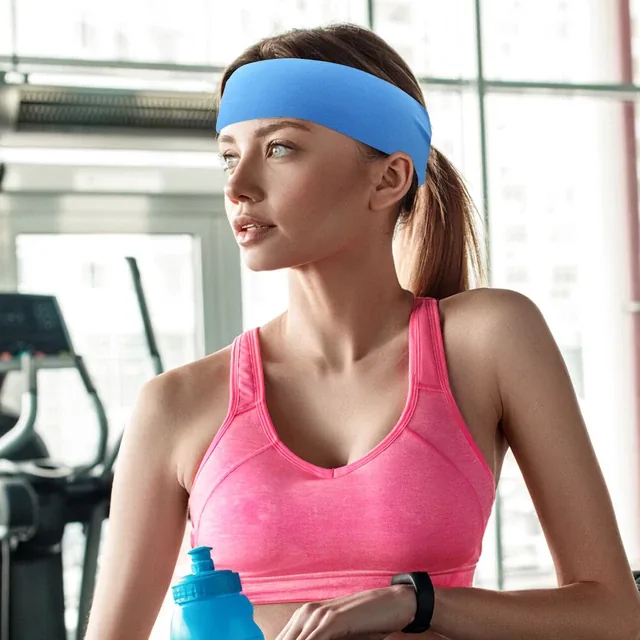
Headbands need the same thinking. A wide, moisture-wicking fabric headband or a proper terry sweatband catches sweat before it reaches your hairline and keeps baby hairs out of your eyes. Thin elastic headbands look neat but roll and slide once they get damp. The sweet spot is a band about two fingers wide, with a silicone grip strip inside or a textured weave that holds on its own.
Best buys: thick no-slip elastics, coiled cord ties, and wide moisture-wicking headbands with a grip strip. What to avoid: silk scrunchies, thin elastics and smooth metal-free bands that rely on tension alone. Quick test: wear the band through a warm-up — if it has moved by the first climb, it will not survive the class.
The High Sweat-Proof Ponytail
The high ponytail is the spin class classic for one simple reason: it lifts every strand off your neck, where sweat pools first, and keeps it swinging behind you instead of sticking to your skin. Gather your hair high at the crown, smooth the front with your palms, and secure it with a thick no-slip tie. The height matters — a ponytail that sits at the crown clears your neck completely, while a mid-height one still rests against it.
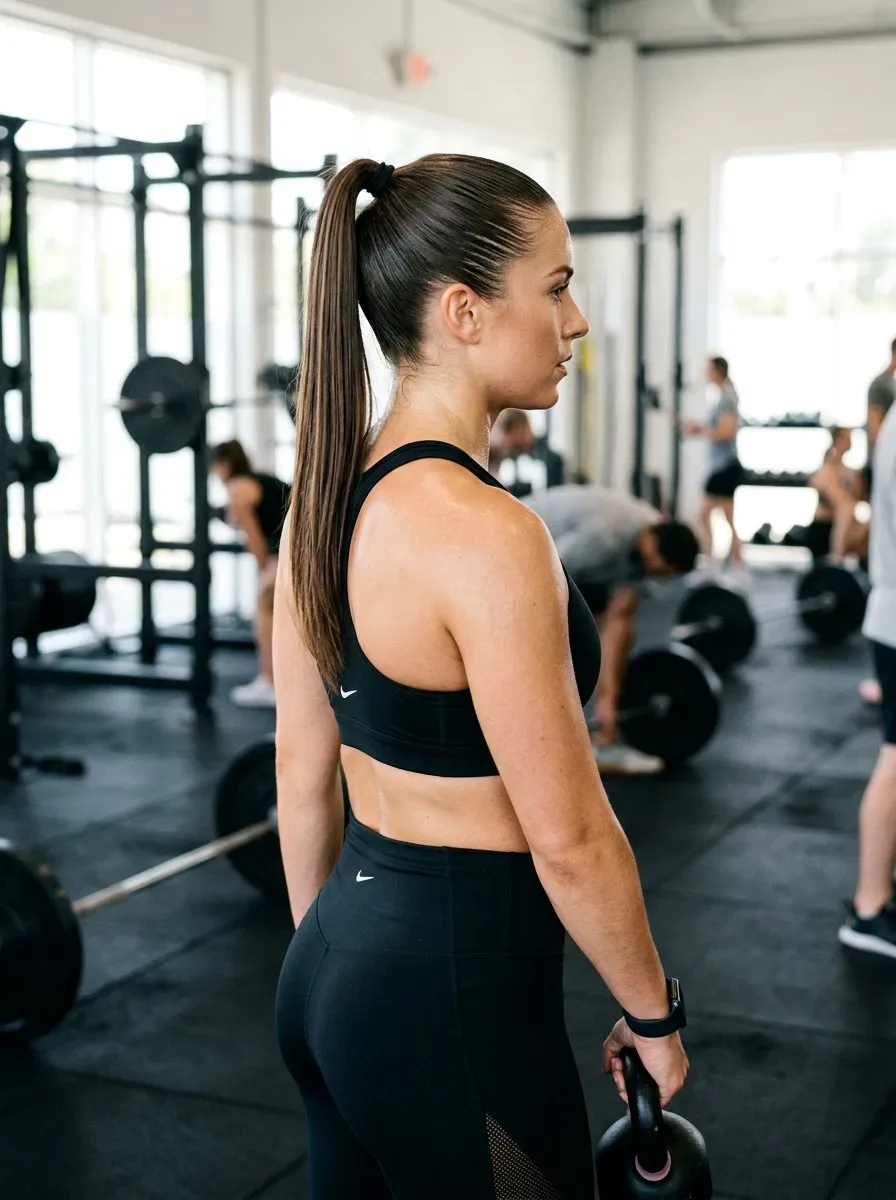
For extra hold, tie it in two stages: gather the top half first and secure it, then gather the rest and join it to the first tie. This double anchor stops the ponytail from sagging as it gets damp, and it is the single easiest upgrade to the most basic gym style. A quick wrap of a small strand around the base hides the tie and keeps the whole look intentional.
Pros: five minutes, keeps all hair off the neck, suits every length past the shoulders. Cons: can sag as sweat builds if tied once. Sweat test: stays high and secure for a full 45-minute class with a double tie; a single thin tie drops by the second climb. What to avoid: silk scrunchies and thin elastics — both slide on damp hair.
The Braided High Ponytail
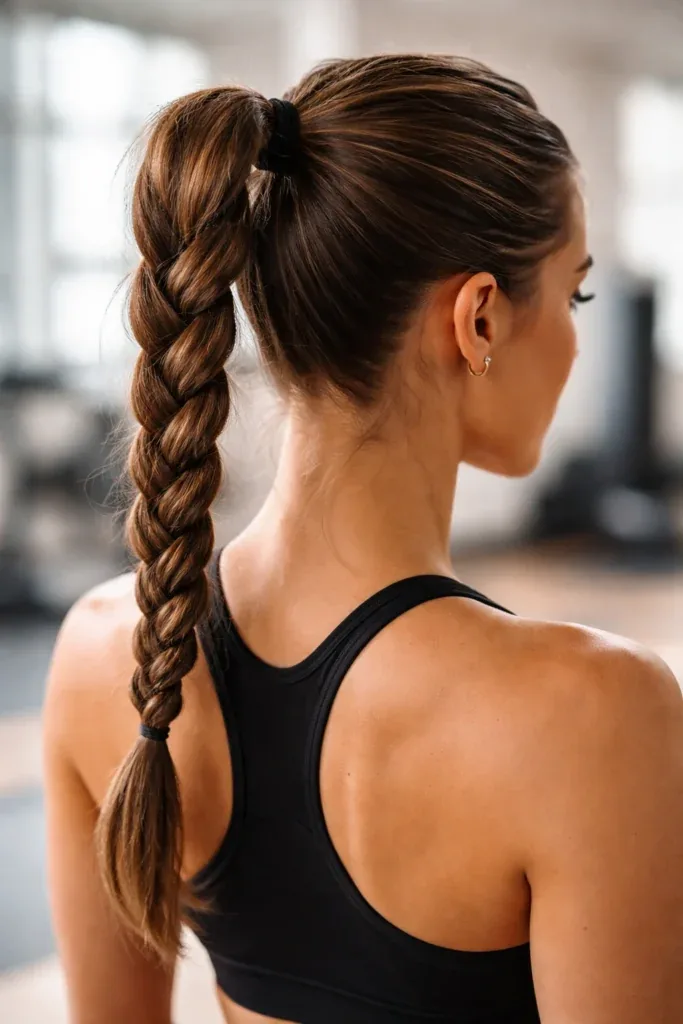
A braided high ponytail takes the classic ponytail and locks it down. Tie your hair high, then braid the tail itself — a simple three-strand braid is enough — and secure the end. The braid stops the tail from whipping across your face during out-of-the-saddle sprints, and it keeps the hair contained so sweat cannot turn it into a damp, tangled rope by the cool-down.
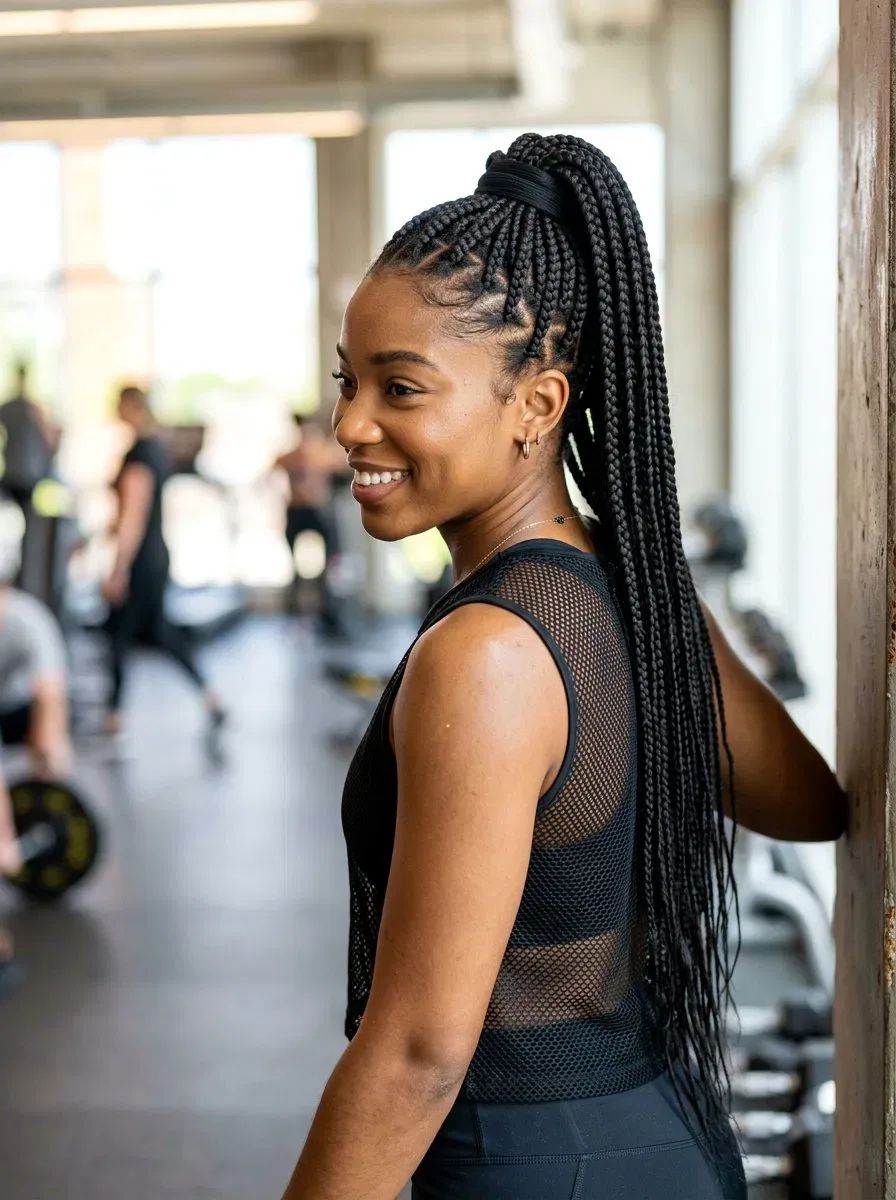
This is the style to choose when your ponytail always ends up a mess. The braid adds almost no time — two minutes at most — and it transforms how the style behaves when it gets wet. It also looks deliberately put-together, which is a bonus when you head straight from the studio to coffee or errands.
Pros: no whipping tail, tangle-free after class, looks polished. Cons: takes two minutes longer than a plain ponytail. Sweat test: the braid holds its shape fully damp and shakes out easily after class with no knots. What to avoid: braiding too loosely — a loose braid unravels when the tail gets heavy with sweat.
The French Braid
The French braid is the most reliable sweat-proof style ever invented, and it is the one to learn first if you only learn one. It gathers every strand from the hairline to the nape into a single interlocked braid, so nothing escapes — no baby hairs in your eyes, no damp pieces stuck to your neck, no sections falling loose as you sweat. Once it is in, it does not move.
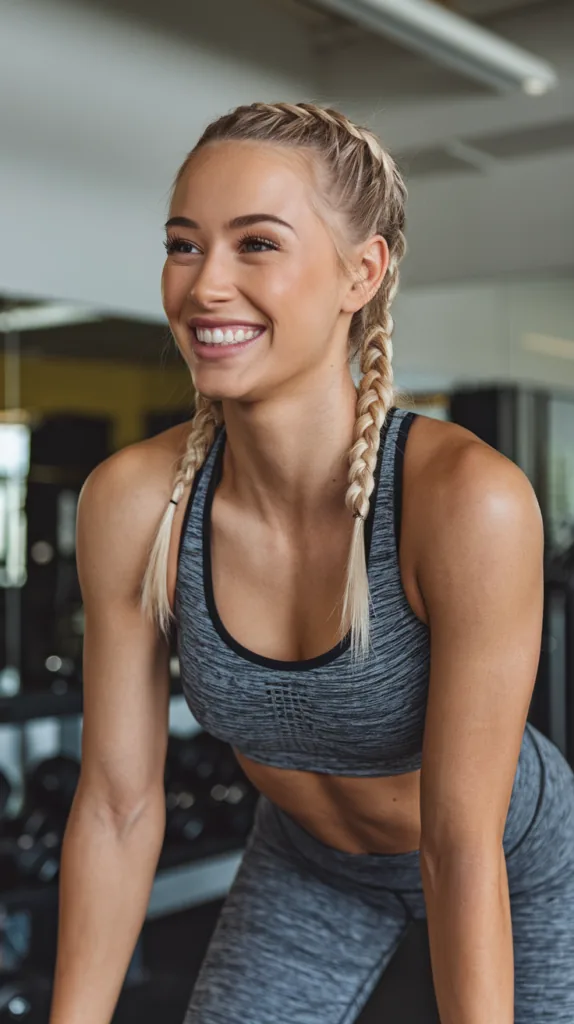
Start the braid high on the crown so the finished braid sits flat and close to the head, and keep the sections even as you add hair. If your hair is layered, a little styling cream on your fingers before you start will stop the shorter layers from poking out. Finish with a small elastic and tuck the end under for a neat finish, or leave the tail loose over one shoulder.
Pros: nothing escapes, holds through the hardest class, works on damp or dry hair. Cons: needs practice if you have never braided your own hair. Sweat test: still perfectly intact after a full class — the braid structure tightens slightly as hair dampens, rather than loosening. What to avoid: starting the braid too low, which leaves the front loose and lets sweat push strands into your face.
The Dutch Braid
A Dutch braid is a French braid turned inside out — the strands cross under instead of over, so the braid sits raised on top of the hair instead of woven into it. That raised ridge grips better and looks bolder, and it is the braid to choose when you want the style itself to be the statement. It holds just as tightly as a French braid, with a little more visual impact.
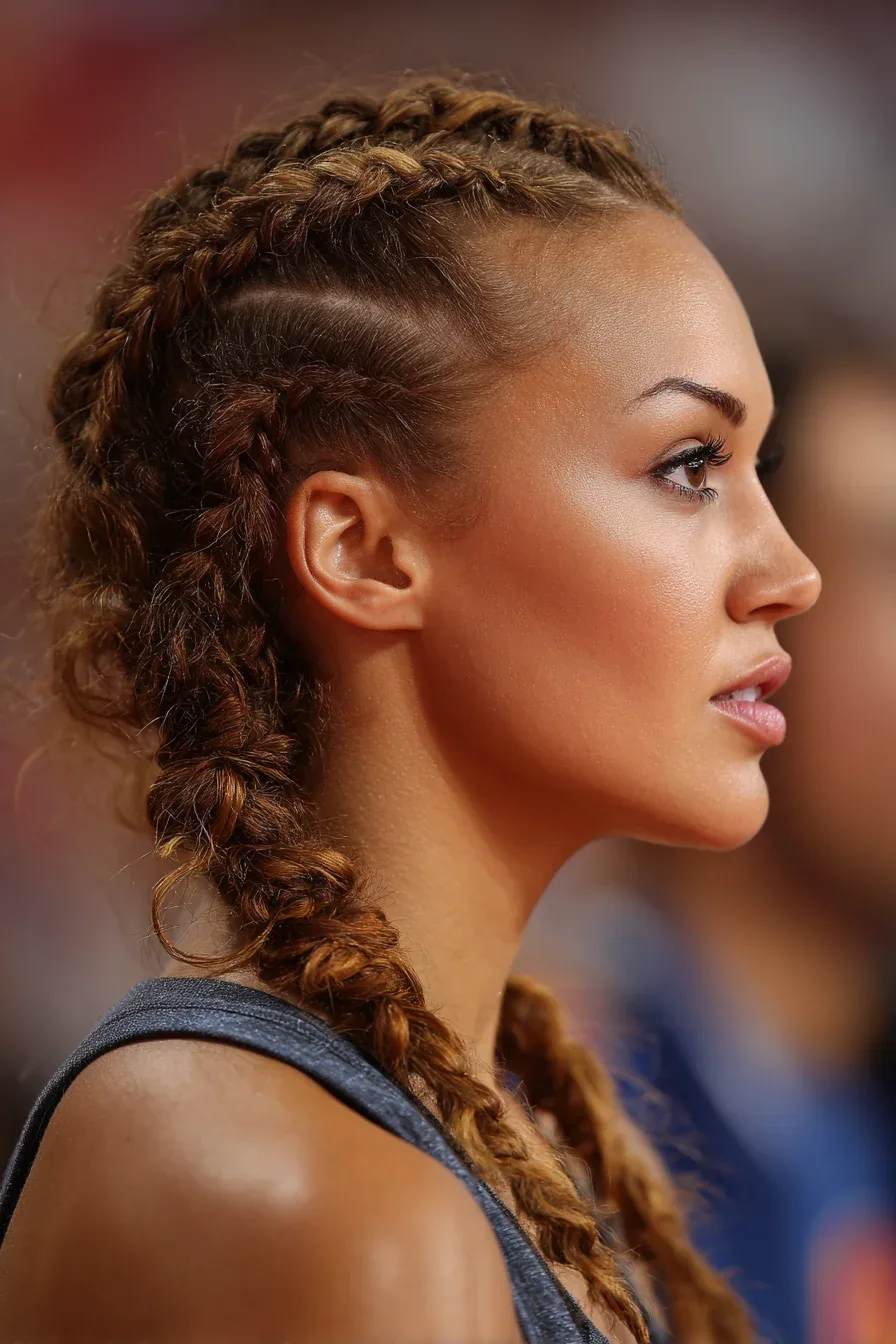
The technique is the same as a French braid, just reversed, so if you can do one you can do the other. Keep the tension even and the sections neat, and pull the edges of the braid gently outward at the end — the pancaking trick — for a fuller look that still holds. A single Dutch braid down the back is a spin class staple; two are even more secure.
Pros: bold look, excellent grip, easy to pancake for volume. Cons: the raised braid can press against a bike helmet, though spin class has none. Sweat test: holds completely through sprints and climbs, with no loose pieces at the hairline. What to avoid: uneven tension — a braid that is tight at the top and loose at the bottom will sag by the cool-down.
Double Dutch Braids (Boxer Braids)
Double Dutch braids — boxer braids — are the most secure style in this whole guide. Two braids, one on each side, gather every strand from the hairline to the nape, and the load is split between them, so neither one takes the full weight of sweaty hair. Nothing touches your neck, nothing falls in your face, and the style looks the same at the end of class as it did at the start.
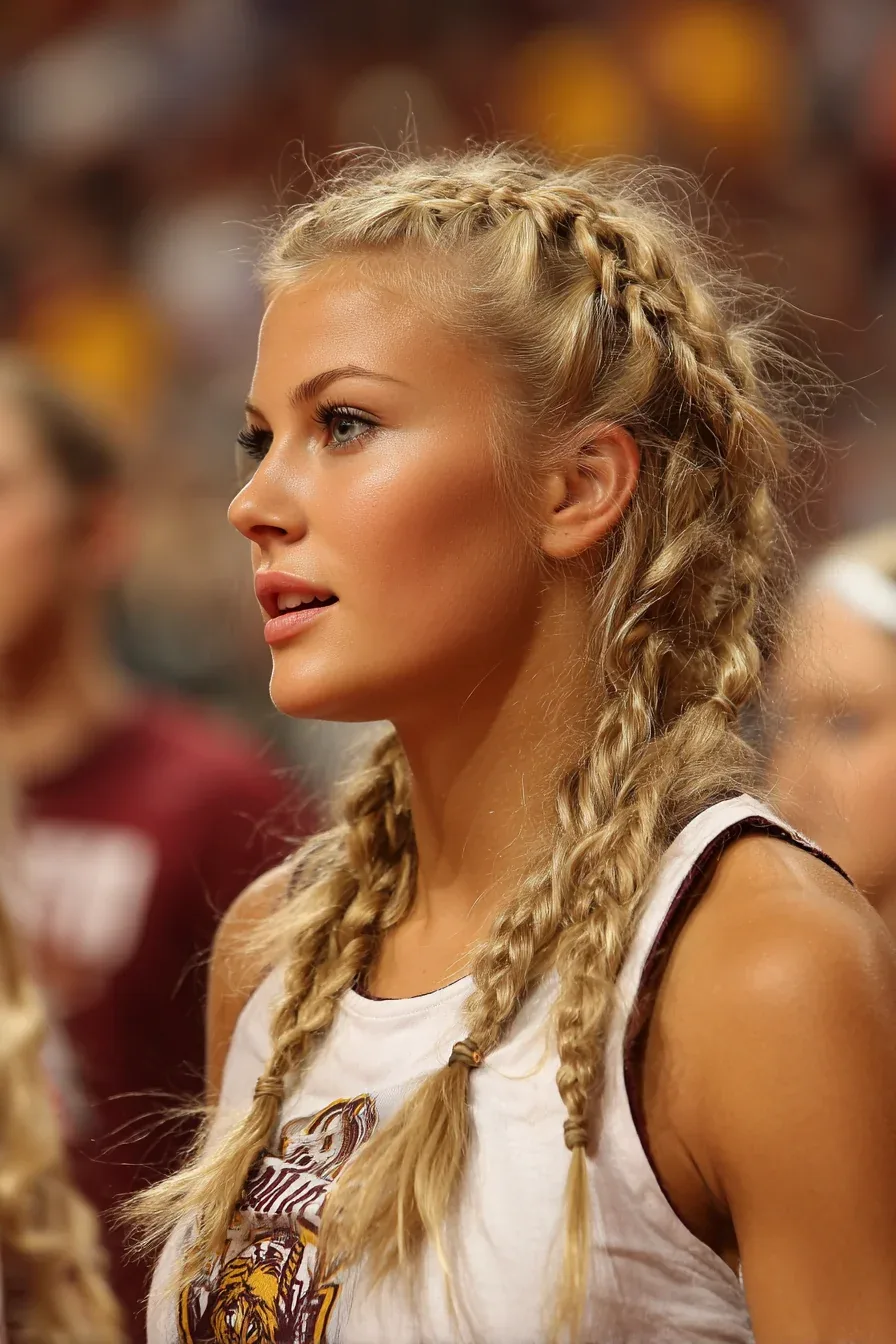
Part your hair cleanly down the middle with a tail comb, braid each side down to the nape, and secure both ends. This is the style for the longest, hardest classes, for back-to-back rides, and for anyone whose hair always defeats a single braid. It also survives a shower cap and a post-class errand run without needing to be redone.
Pros: the most secure style here, distributes weight, lasts for days. Cons: takes ten minutes and some practice. Sweat test: completely unchanged after 45 minutes — the two-braid structure does not shift at all. What to avoid: braiding over dirty, product-heavy hair, which makes the parting look messy and the braids slip.
The Fishtail Braid
A fishtail braid looks intricate and holds like a workhorse. It is built from just two sections, taking small pieces from the outside of each and crossing them over, which creates a dense, interlocked weave that grips even fine, slippery hair. It is prettier than a plain three-strand braid and just as sweat-proof, which makes it the best choice when you want the style to look like you tried.
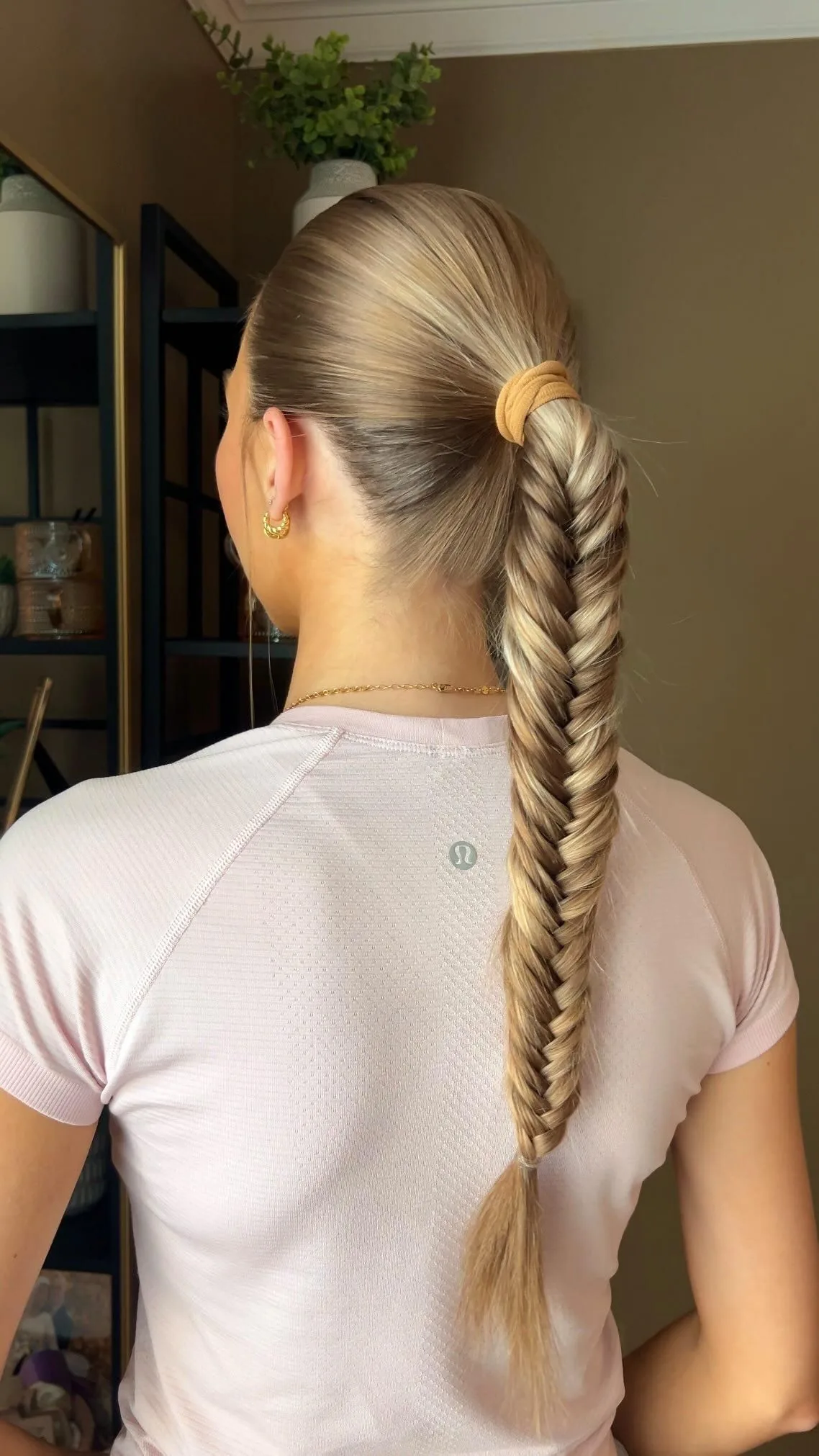
Gather your hair into a low ponytail first if you are new to fishtails — it keeps the sections controlled while you learn the rhythm. Once you are confident, braid it freehand from the nape. Keep the pieces small and even for the classic fishtail look, or take bigger pieces for a faster, chunkier version that still holds.
Pros: beautiful detail, grips fine hair well, holds all day. Cons: slower to build than a three-strand braid. Sweat test: the dense weave stays intact when damp and shakes out with soft waves after class. What to avoid: fishtailing on freshly washed, very clean hair — it slips; add texture spray first.
The Low Braided Bun
A low braided bun is the quiet achiever of spin class hair: braid your hair into a single braid, then coil it into a bun at the nape and pin it. The braid inside the bun gives it structure that a plain bun does not have, so it cannot unravel as it gets damp, and the low placement keeps it clear of the bike’s handlebars when you lean forward into a climb.
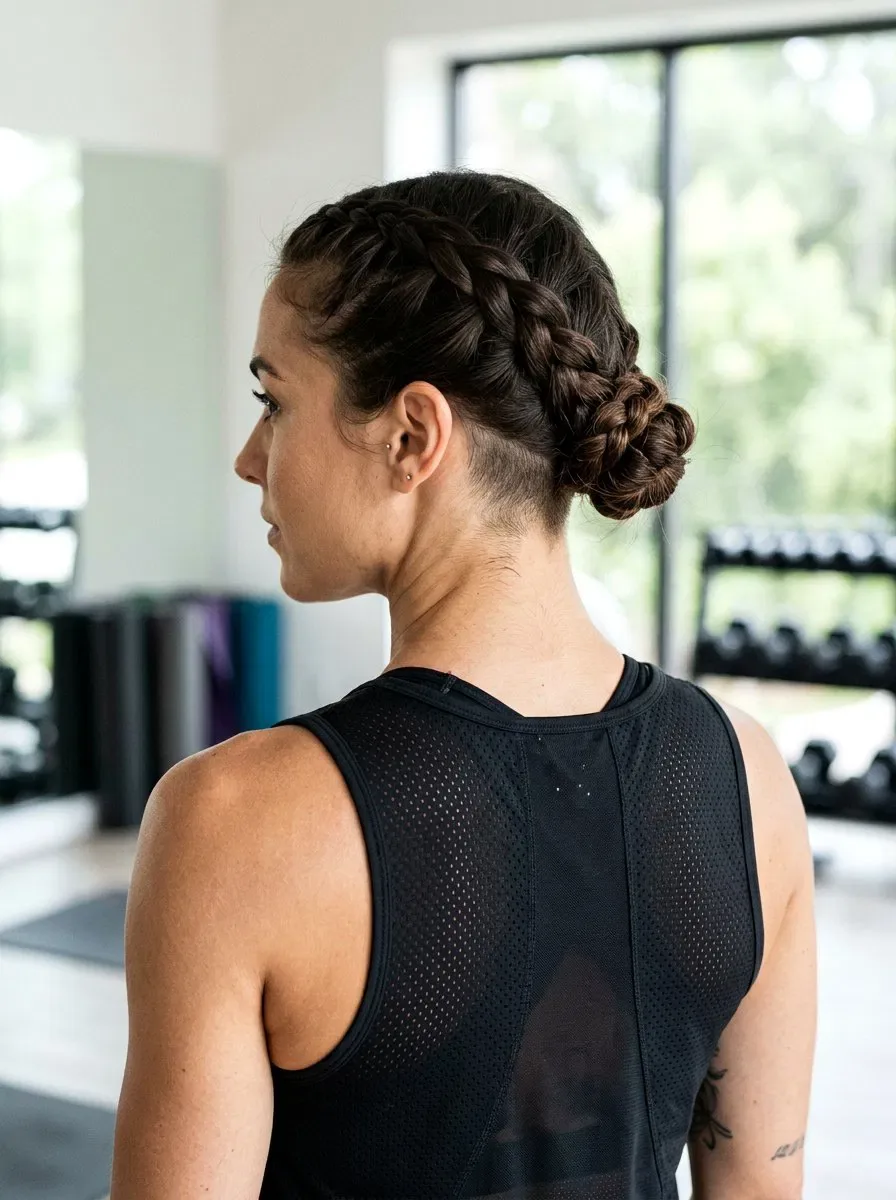
This is the style for anyone who finds a high bun heavy or headache-inducing. The weight sits low, the pins are easy to hide, and the finished bun looks neat enough for the office afterwards. Two or three pins that match your hair colour are all it takes — crossed pins at the base hold better than a single pin anywhere.
Pros: lightweight feel, cannot unravel, office-ready after class. Cons: needs pins, so keep spares in your gym bag. Sweat test: the braided core keeps the bun solid even when fully damp. What to avoid: pinning with a single bobby pin — crossed pins at three points are what hold it.
The High Ballerina Bun
The high ballerina bun is the neatest style you can wear to a spin class, and it is built for sweat. All the hair is swept up high, twisted and coiled into a tight bun, and pinned in place. Nothing touches your neck, nothing moves when you stand up on the pedals, and the style is so contained that sweat has almost nowhere to go — it dries off the surface instead of soaking into loose hair.
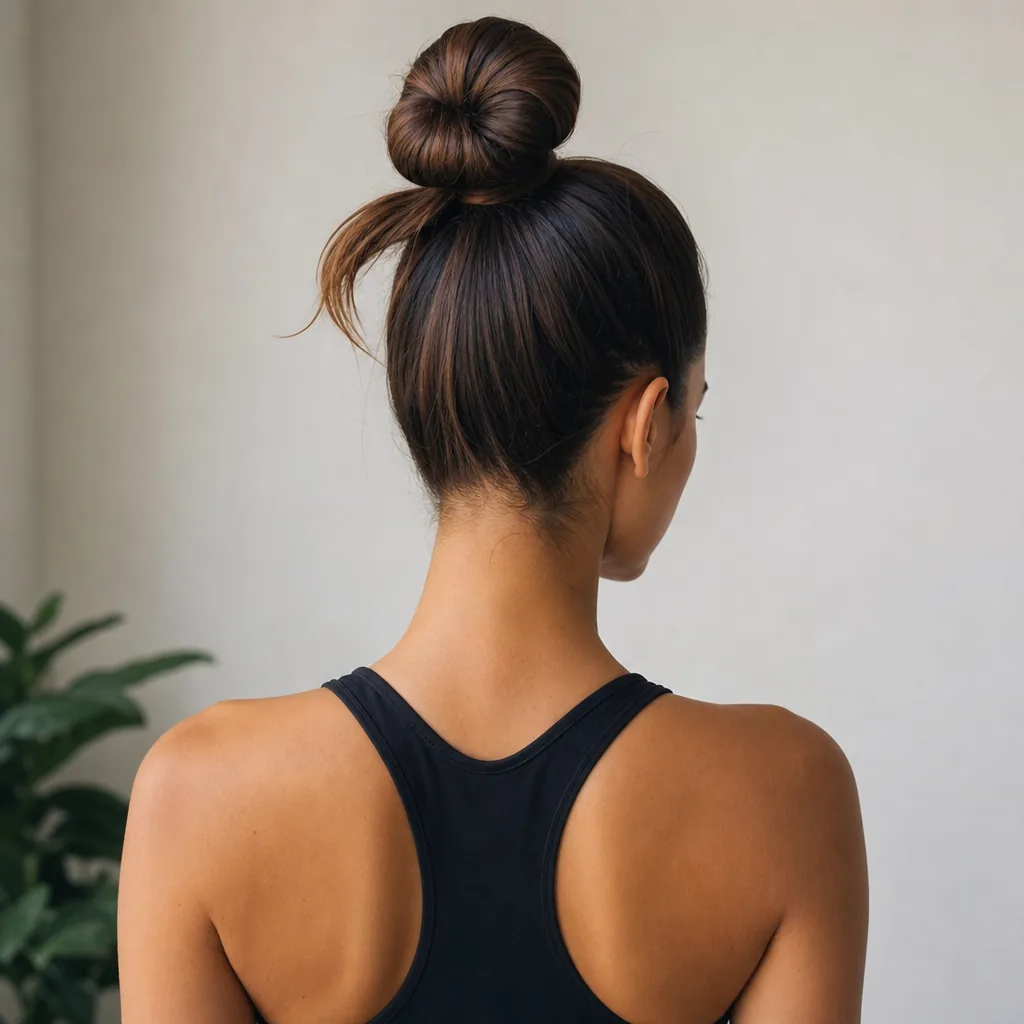
Use a hair donut or a rolled sock for a full, even bun if your hair is fine, and smooth the surface with a little gel or cream before twisting. The bun should sit at the very top of the crown, not at the back of the head, so it clears your neck completely and stays out of the way when you lean over the handlebars.
Pros: maximum neck clearance, zero movement, dries fast. Cons: can feel tight or heavy on very thick hair. Sweat test: the most sweat-proof bun here — the surface dries in minutes after class. What to avoid: a bun that is too tight at the hairline, which causes a headache by the second song.
The Messy Top Knot
The messy top knot is the ballerina bun’s relaxed cousin, and it is the fastest genuinely sweat-proof style in this guide. Gather your hair high, twist it loosely, wrap it into a knot and pin it with two or three pins. The looseness is the point — it is supposed to look undone — but the knot still keeps every strand off your neck and out of your face for the whole ride.
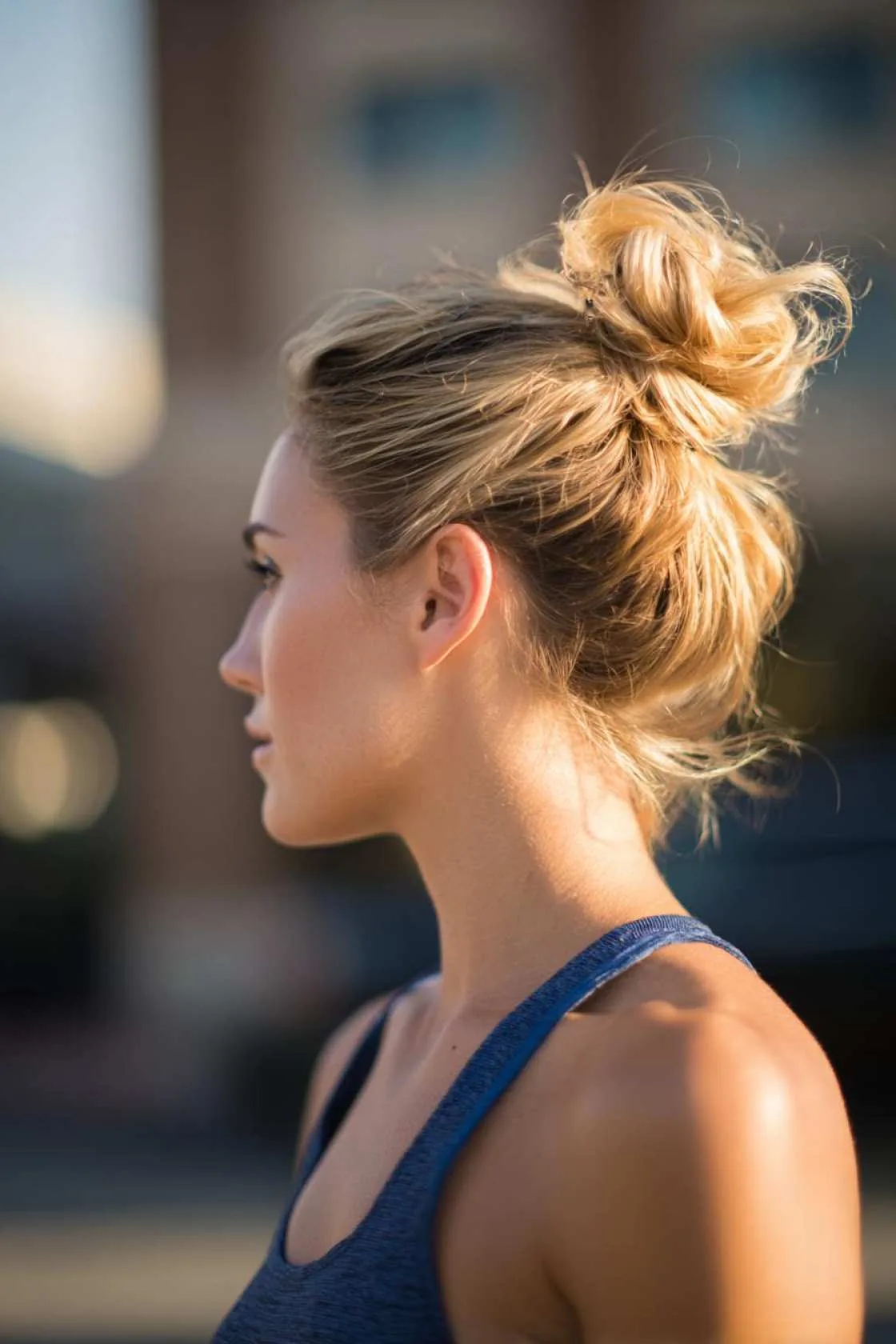
The trick is to make the mess deliberate: leave the front smooth and let only the knot itself be textured. A smooth front with a textured knot looks intentional; a messy front with a messy knot looks like you gave up. Two minutes, three pins, and you are clipped in.
Pros: two minutes, forgiving, looks good with gym clothes. Cons: loose pieces can escape if you skip the pins. Sweat test: holds through a full class with three pins; with one pin it loosens by the halfway mark. What to avoid: tying it with a single elastic and no pins — the knot will slide down as it gets damp.
The Bubble Ponytail
The bubble ponytail turns a plain ponytail into a style that actually holds better. Tie your hair high, then add small elastics down the tail every few inches and gently pull each section outward to form bubbles. Each extra elastic is another anchor point, so the tail cannot slide, whip or tangle — and the bubbles stop the hair from clumping into one damp rope.
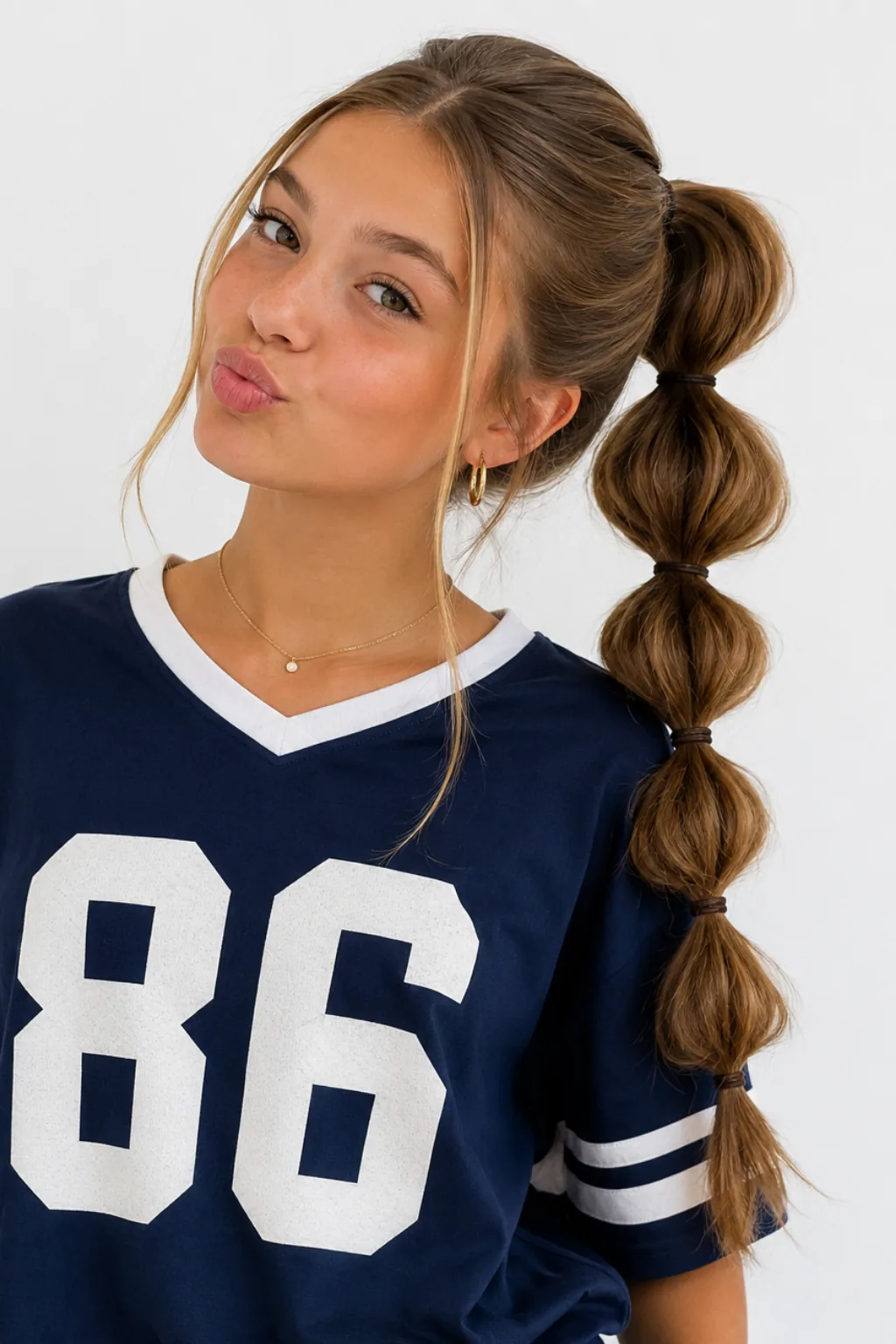
It works best on medium to long hair, and it is one of the most fun styles in this guide — it looks playful and deliberate, and it photographs brilliantly. Use clear or matching elastics so the bubbles, not the ties, are what people notice, and keep the sections even for the cleanest result.
Pros: extra anchor points, no tangling, playful look. Cons: needs several elastics and a few minutes. Sweat test: the segmented tail stays separated and tangle-free even when fully damp. What to avoid: spacing the elastics too far apart — the bubbles sag and the tail gets heavy.
The Low Ponytail with a Wrapped Base
A low ponytail with a wrapped base is the polished, low-effort option for riders who prefer their hair down low rather than up high. Gather the hair at the nape, secure it, then wrap a small strand around the tie and pin it underneath. The wrap does real work: it stops the tie from sliding and keeps the ponytail sitting neatly instead of drooping.
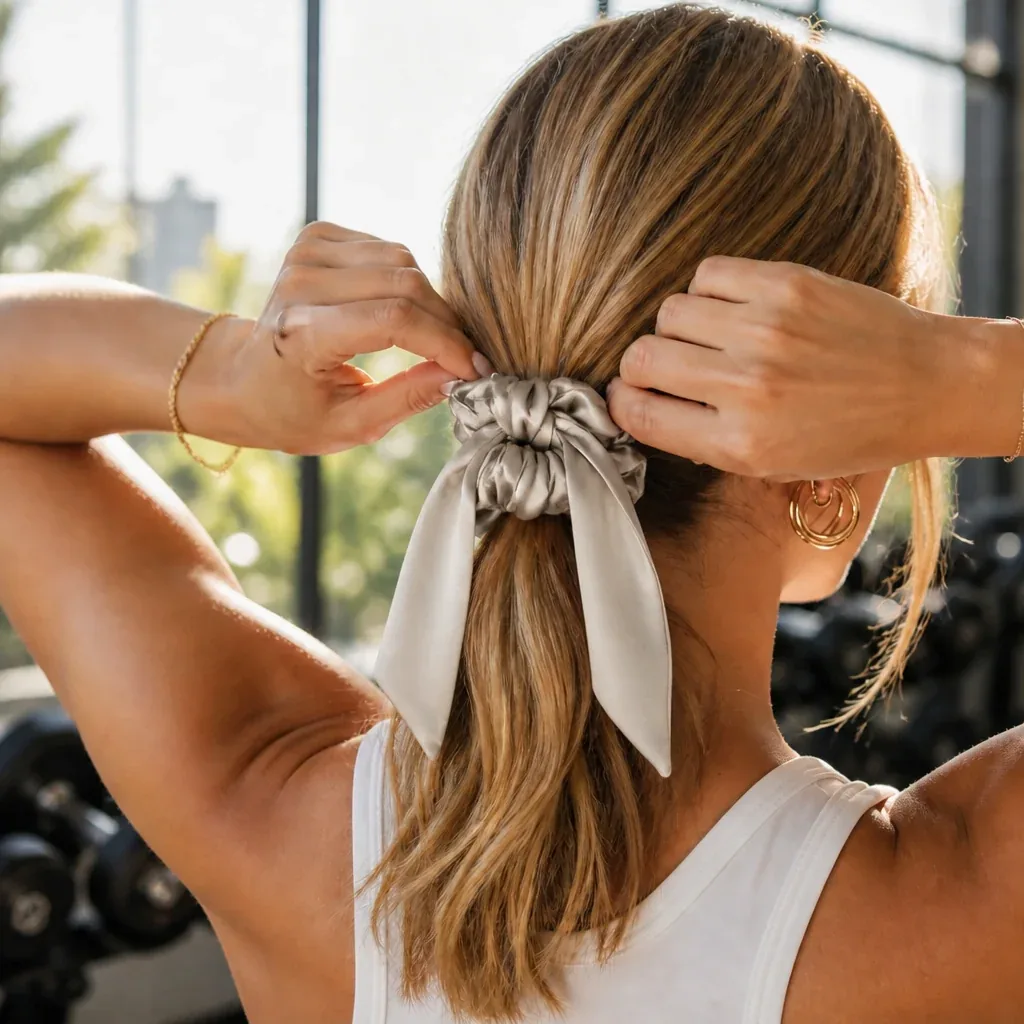
This is the style to choose when a high ponytail gives you a headache, or when you are heading somewhere smart straight after class. Keep the front smooth with a little cream, and the whole look reads as intentional rather than thrown together — even though it takes about three minutes.
Pros: headache-free, polished, quick. Cons: the nape still gets warm, since the hair rests low. Sweat test: holds well, though the nape area gets damper than a high ponytail. What to avoid: a heavy wrap strand that pulls the tie loose — keep the wrapped piece thin.
The Half-Up Top Knot
A half-up top knot is the compromise for riders who love their hair down but hate it in their face. Take the top section from temple to temple, twist it into a small knot at the crown and pin it, and let the rest fall behind your shoulders. The front is locked away from your eyes, the back stays loose and cool, and the style takes about ninety seconds.
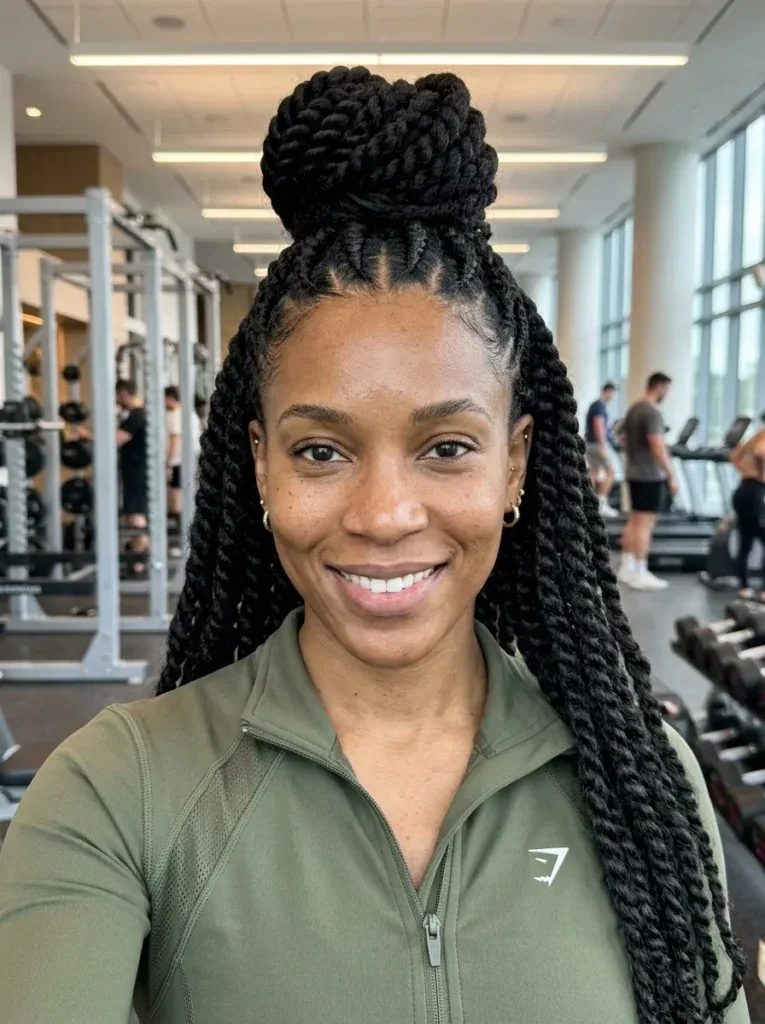
It works best on medium to long hair, and it is the easiest style in this guide to do on a bike — you can even fix it one-handed between songs. Keep the knot small and high so it clears your forehead, and use a coiled tie so it does not dent the hair when you take it down after class.
Pros: fastest half-up style, keeps the front clear, easy to fix mid-class. Cons: the loose back still gets sweaty and can stick to your neck. Sweat test: the knot holds perfectly; the loose hair underneath gets damp but stays out of your face. What to avoid: taking too much hair into the knot — a small, high knot holds better than a big, heavy one.
The Half-Up Braided Crown
A half-up braided crown is a half-up style with real staying power. Braid a small section from each temple, bring them together at the back of the crown and pin them, and the braids act like a headband made of your own hair — holding the front back, catching sweat at the hairline, and never sliding the way a fabric band can.
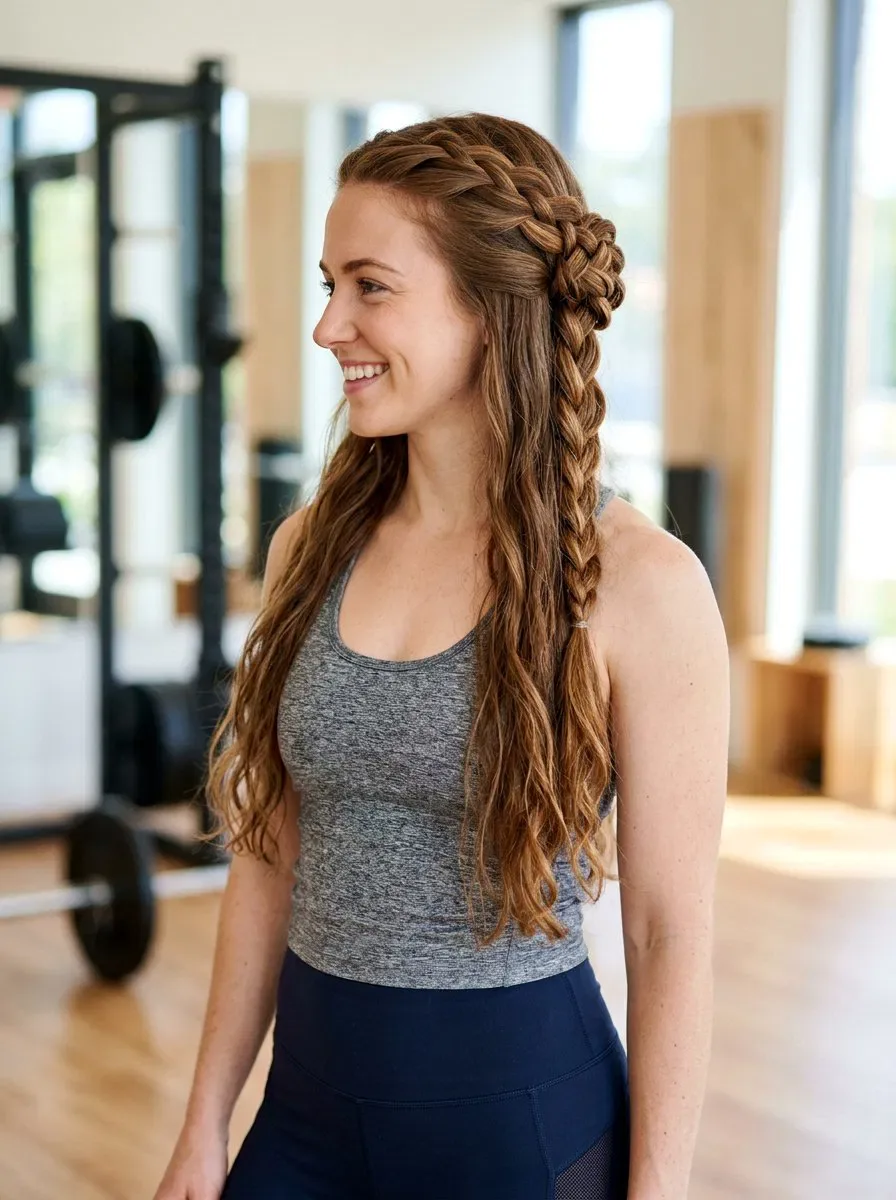
This is the style for riders who dislike headbands but still need the front controlled. The braids hold the hairline tidy through every sprint, and the loose hair behind keeps the look soft rather than severe. It takes five minutes and lasts the whole class without a single touch-up.
Pros: built-in headband, no slipping, pretty and practical. Cons: needs basic braiding skill. Sweat test: the braided crown stays in place when damp, unlike a fabric headband that can roll. What to avoid: braiding the crown pieces too thick — fine braids sit flatter and hold better.
Cornrows
Cornrows are the ultimate long-game spin class hairstyle. The hair is braided flat against the scalp in neat rows, so there is nothing to fall, nothing to stick to your neck, and nothing to redo — you can ride every day for a week or more on one set of cornrows, and they look just as neat on day seven as on day one.
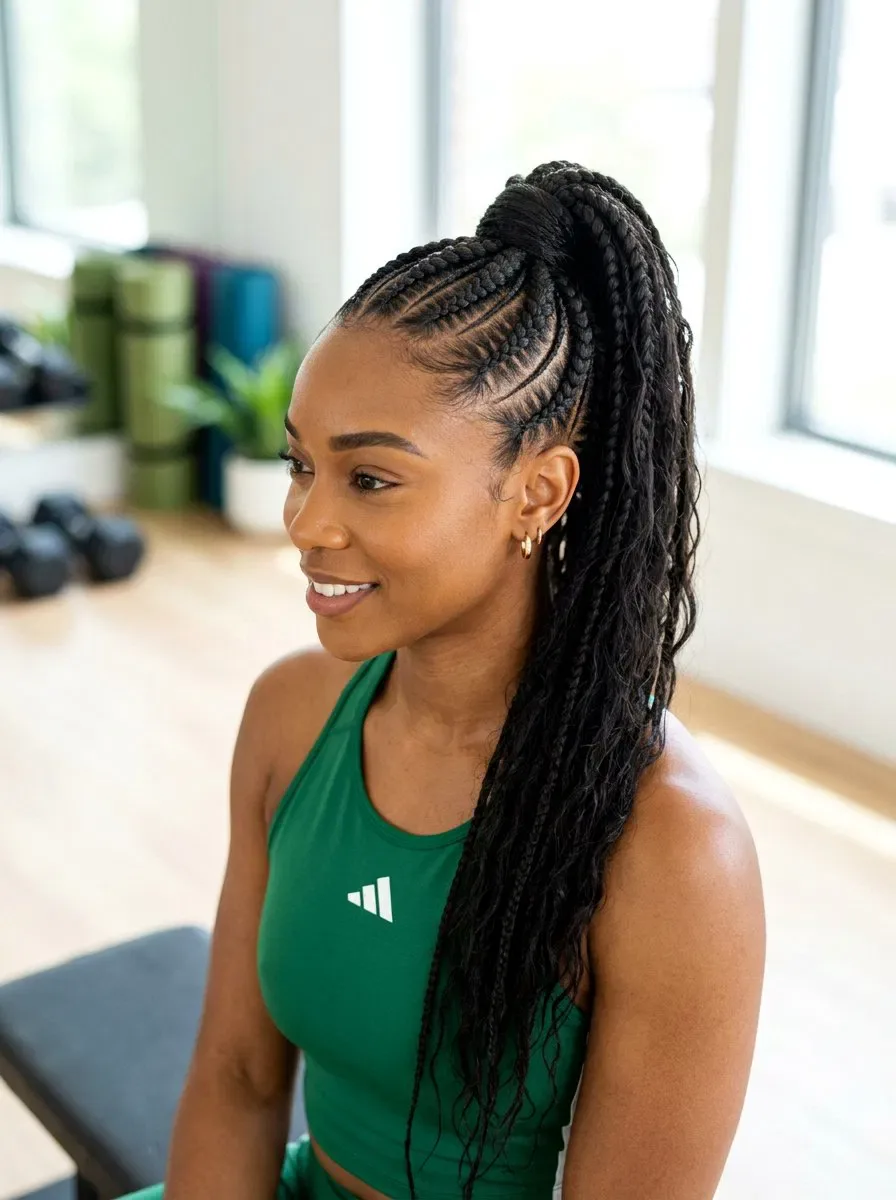
Because the style is installed rather than tied, sweat simply dries on the surface and the scalp stays ventilated between the rows. Keep the rows neat with a light oil on the scalp and a silk scarf at night, and rinse with diluted shampoo when you need a refresh without disturbing the braids.
Pros: lasts a week or more, zero daily styling, scalp stays cool. Cons: needs a braider and a few hours to install. Sweat test: unbeatable — sweat dries off the rows and the style does not move at all. What to avoid: braiding too tightly at the hairline, which causes tension and breakage over a week of sweat and workouts.
The Sleek Low Bun
A sleek low bun is the most elegant spin class style, and it is tougher than it looks. Smooth the hair back with a little gel, gather it at the nape, twist and pin it into a neat bun. The gel does the work here — it seals the surface so sweat beads off instead of soaking in, and it keeps flyaways glued down through the whole ride.
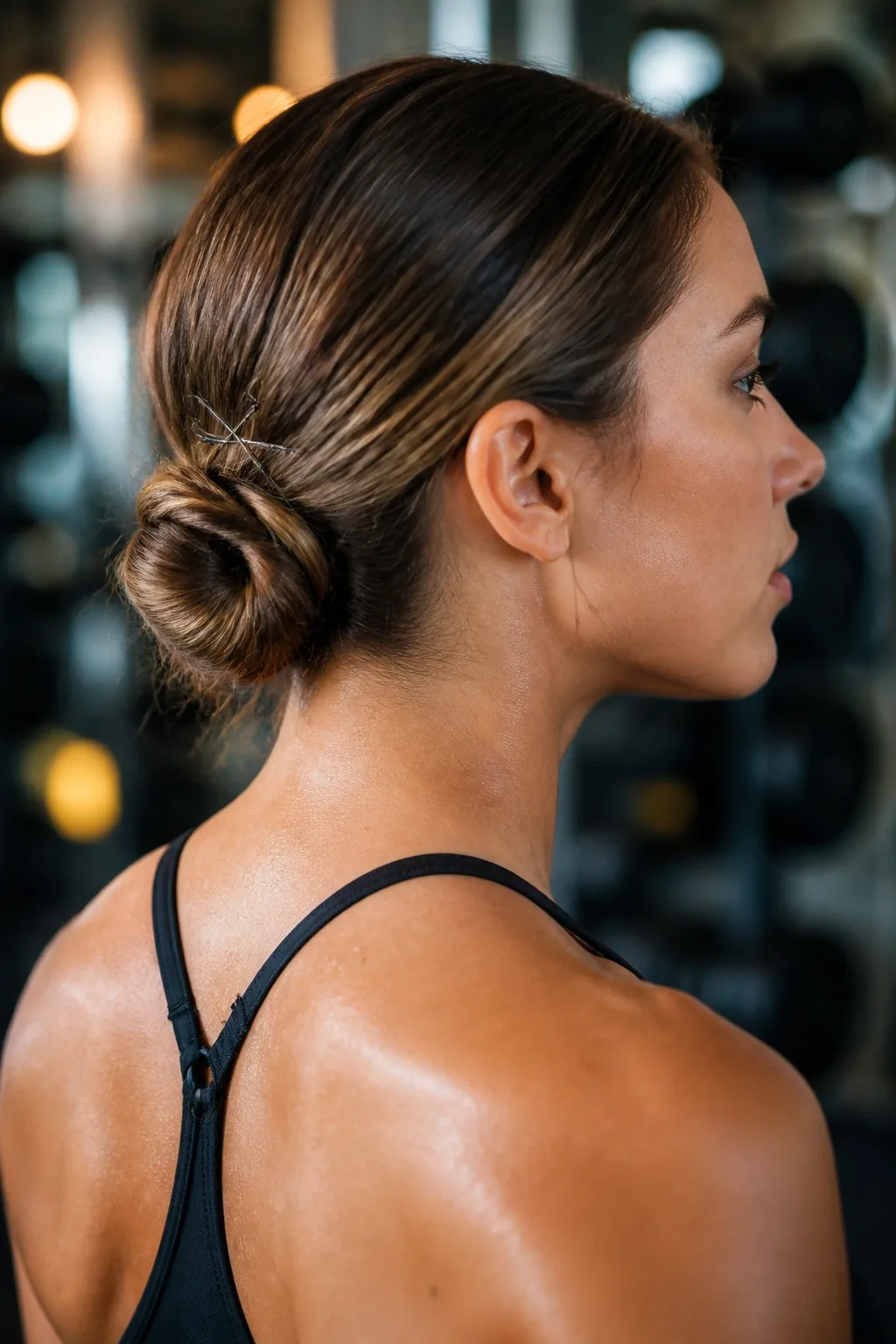
This is the style for riders who go from the studio to the office or to brunch. It looks intentional and polished, it photographs beautifully, and it takes about four minutes. The key is smoothing the hair while it is still slightly damp from product, so the surface sets smooth and stays that way.
Pros: elegant, office-ready, gel seals out sweat. Cons: shows every flyaway if the gel wears off. Sweat test: holds its shape fully damp, though the surface softens by the cool-down. What to avoid: skipping the gel — without it, a low bun on clean hair slides and frizzes fast.
Space Buns
Space buns are the most fun style in this guide, and they are surprisingly practical for spin. Part your hair down the middle, make two high buns — one on each side — and the weight is split evenly, so neither bun pulls or sags. Both buns sit high and clear of your neck, and the symmetry keeps the style balanced when you lean forward on the bike.
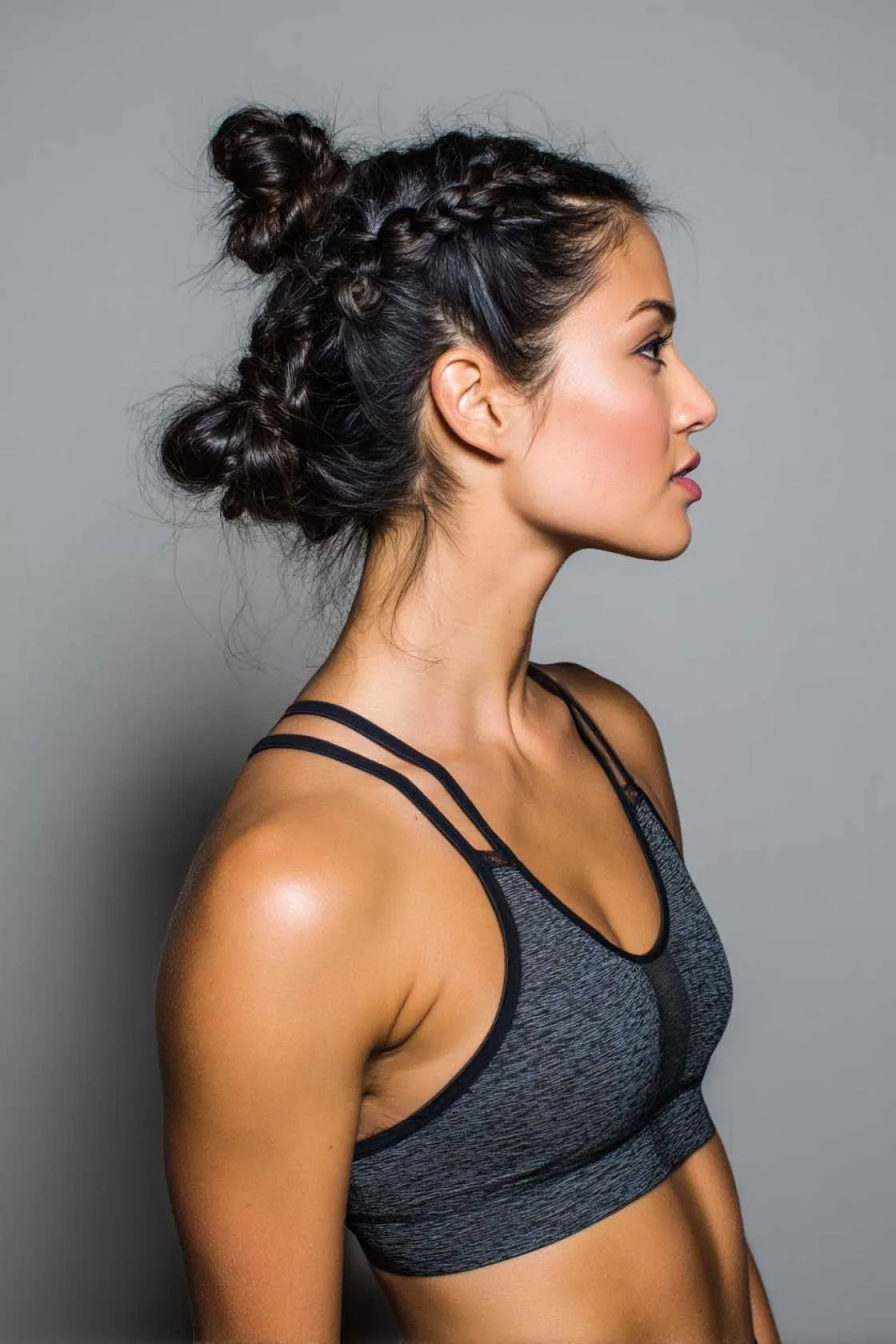
They are also the best style for shorter or layered hair, because the two-bun split means even short pieces get gathered into one bun or the other. Keep the buns tight and pin them at three points each, and they will survive the hardest interval session without a wobble.
Pros: balanced weight, works on shorter hair, playful and fun. Cons: bold look — not for riders who want to blend in. Sweat test: both buns hold firm through sprints; the split weight stops the sagging a single bun gets. What to avoid: loose, floppy buns — they bounce and pull when you stand on the pedals.
The Twisted Low Bun
A twisted low bun is the low bun’s softer, faster sister. Instead of braiding, divide the hair into two sections, twist each one, wrap them around each other into a bun at the nape and pin it. The twist gives the bun grip that a plain coil does not have, so it holds without needing gel or a donut, and the finished look has a lovely rope-like texture.
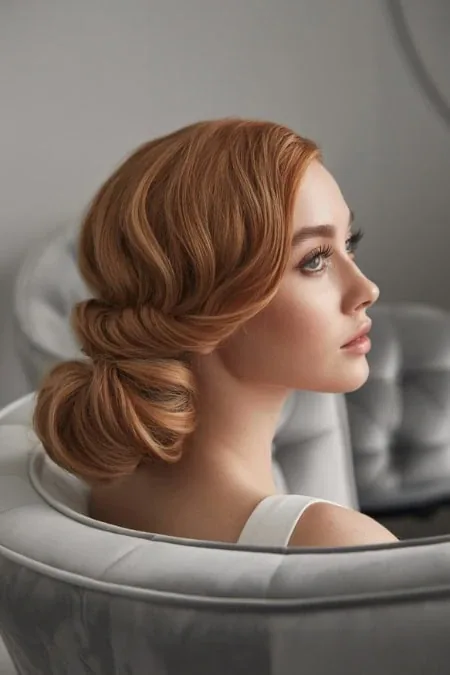
It takes about three minutes and works on medium to long hair of any texture. The twist is also forgiving — it does not need to be perfect to hold, which makes it a good first bun for anyone who finds braiding fiddly. Finish with two crossed pins and a light spray, and the bun will stay put through the whole ride.
Pros: three minutes, forgiving technique, holds without gel. Cons: can loosen on very silky hair. Sweat test: the twisted core grips well when damp and keeps its shape to the end of class. What to avoid: twisting in the same direction for both sections — twist them toward each other so they lock.
The Side Braid
A side braid is the most comfortable braid for spin, because it sits over one shoulder and never touches the back of your neck at all. Sweep all your hair to one side, braid it loosely from behind the ear down, and secure the end. When you lean forward over the handlebars, the braid simply rests on your shoulder instead of pressing against your back.
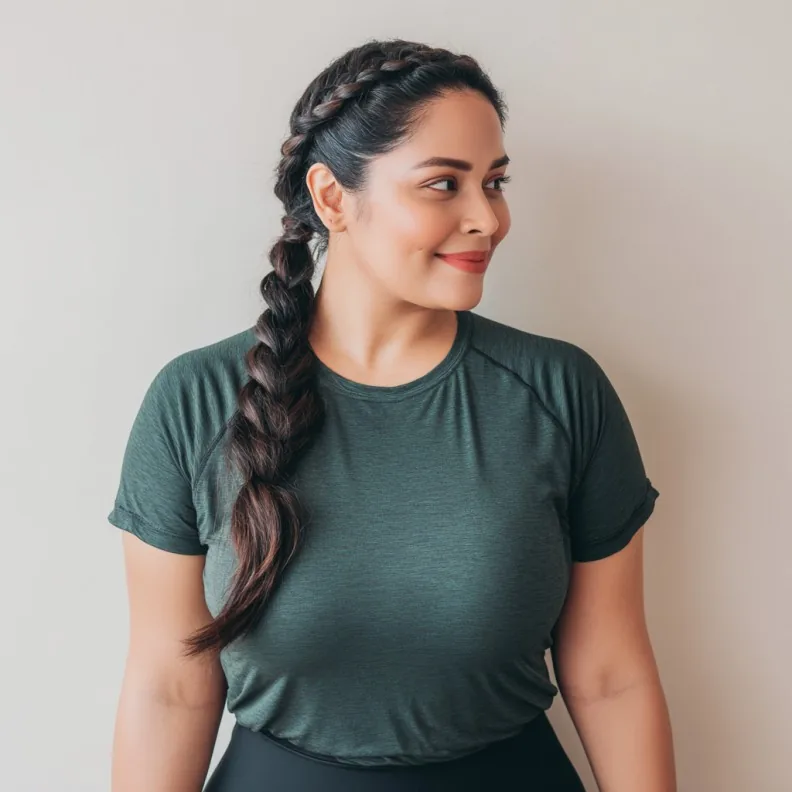
It is also the easiest braid to do on yourself, because you can see what you are doing in the mirror. Keep it slightly loose for a soft, romantic look, or pull it tight for a sporty finish — either way, the braid keeps the hair contained and the sweat off your neck. Switch sides each ride to keep the tension even.
Pros: zero neck contact, easiest braid to self-style, comfortable on the bike. Cons: the tail can swing during sprints. Sweat test: stays neat and contained; the shoulder placement keeps it out of the worst of the sweat. What to avoid: a braid that is too loose at the top — the front sections escape and fall into your face.
Pigtail Braids
Pigtail braids are double braids worn low and playful, and they are the best style for riders with thick or heavy hair. Part the hair down the middle, braid each side from behind the ear to the ends, and the weight is split in two — so the braids never pull, never sag, and never give you the headache a single heavy braid can cause by the last song.
They work on medium to long hair and they are wonderfully low-maintenance: once they are in, you can forget about them completely. They also look great under a cap or a headband, and they are one of the few styles that still look neat after a sweaty ride and a quick dry-shampoo refresh.
Pros: splits heavy hair in two, headache-free, stays neat after class. Cons: playful look that not everyone wants. Sweat test: both braids hold fully through the class with no sagging. What to avoid: an uneven part — a crooked centre part makes the whole style look lopsided in photos.
The Braided Headband with a Ponytail
A braided headband with a ponytail combines the two best spin class ideas in one style: a small braid along the hairline holds the front back, and a high ponytail holds the rest. The braid does what a headband does, but it never slides, never rolls, and never needs adjusting mid-ride — and the ponytail keeps everything off your neck.
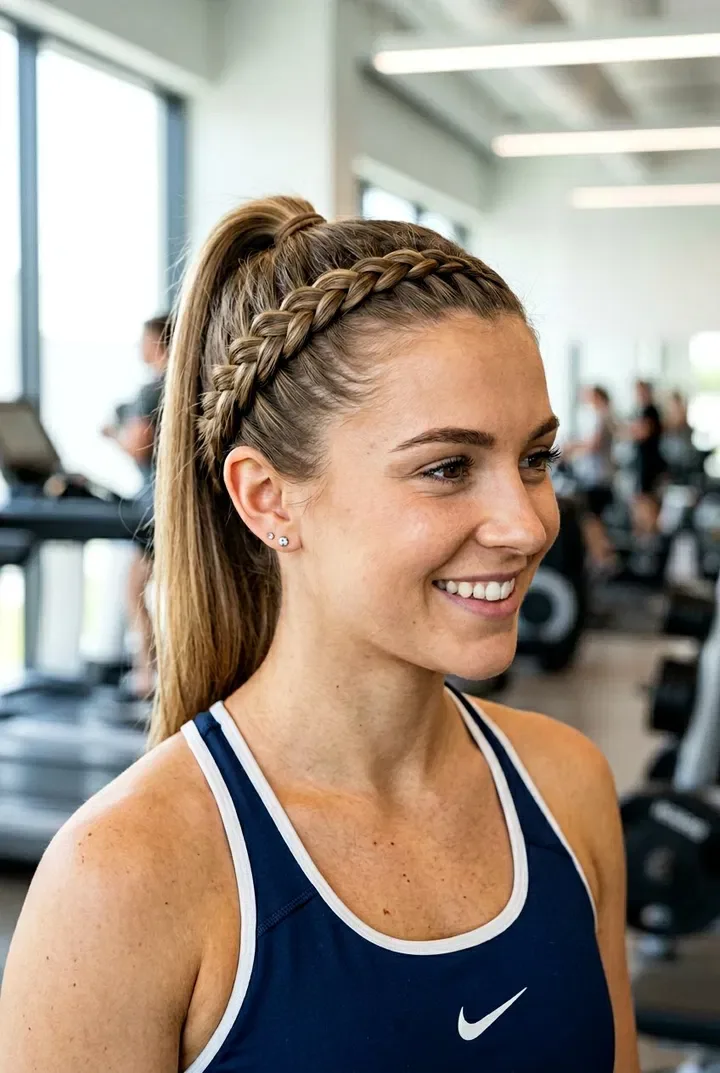
Braid a section from one temple across the hairline to the other, pin the end behind your ear, then gather the rest into a high ponytail. It takes five minutes and it is the style to choose when your baby hairs always escape, because the braid catches them all at the source.
Pros: catches baby hairs, never slides, keeps the front perfectly tidy. Cons: takes five minutes and a little braiding skill. Sweat test: the front stays completely clear for the full class — no strands in the eyes at all. What to avoid: making the headband braid too thick — a fine braid blends in and holds better.
The Slicked-Back Wet Look Ponytail
The slicked-back wet look ponytail is the style that treats sweat as a feature, not a problem. Work gel through damp hair, brush it all straight back, and tie it high. The wet look is already the finish, so sweat cannot ruin it — the style actually looks better as the class goes on, which is more than you can say for almost anything else in this guide.
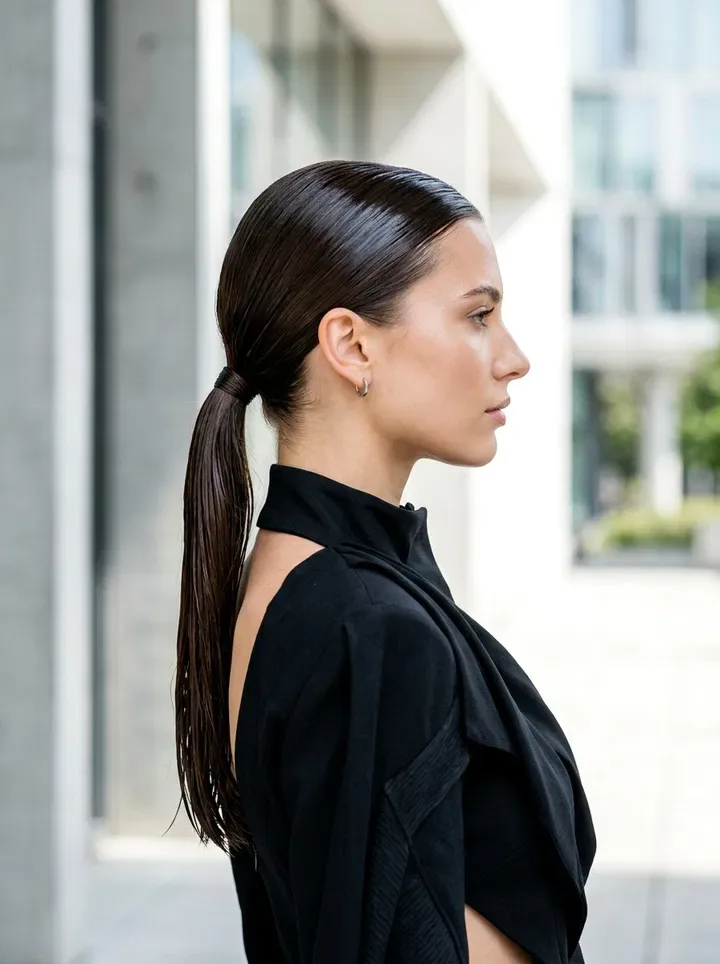
Use a strong-hold gel and a fine-tooth comb for the smoothest finish, and keep the ponytail high so the wet-look surface reads as deliberate. It suits straight and wavy hair best, and it is the most editorial, fashion-forward style you can wear to a spin class — it looks like you meant it.
Pros: sweat-proof by design, looks better as the ride goes on, very editorial. Cons: needs gel and a wash after class. Sweat test: the best result here — sweat blends into the wet finish instead of breaking it. What to avoid: using too little gel — a half-slicked style just looks greasy, not wet-look.
The Pineapple Puff (Curly Hair)
The pineapple puff is the curly-hair spin class classic: gather all your curls into a high, loose puff at the very top of your head and secure it with a satin scrunchie or a coiled tie. The curls pile up on top like a pineapple, they stay completely off your neck and face, and the loose gathering protects the curl pattern instead of crushing it.
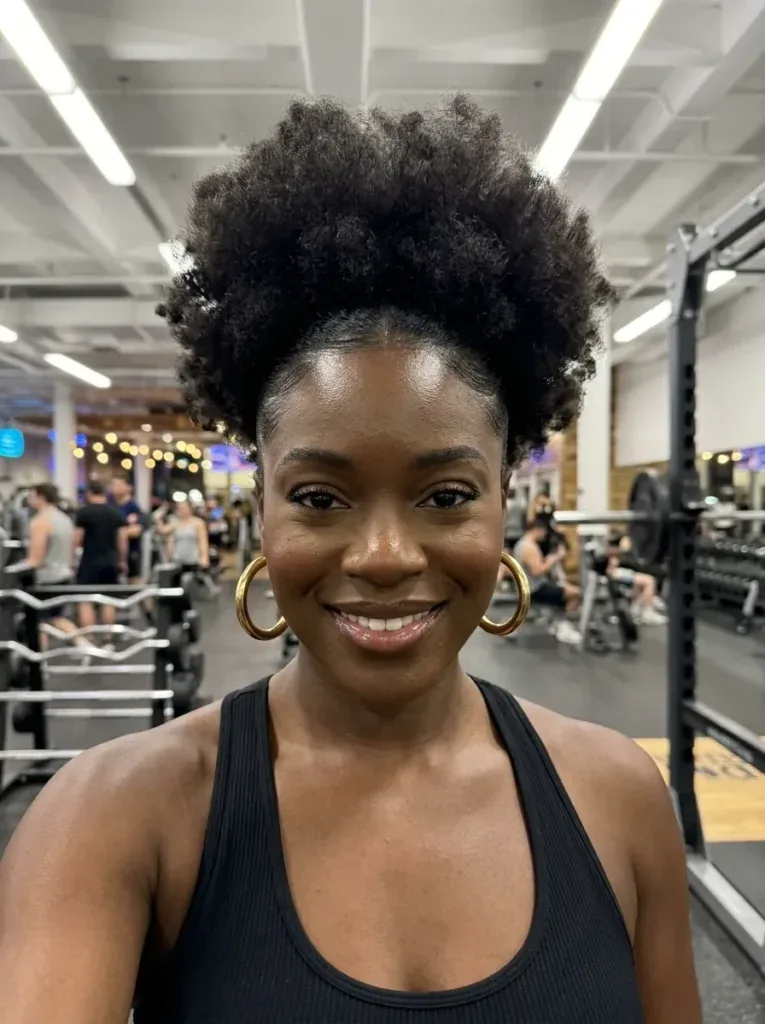
The key is looseness. Gather the curls gently with your fingers, not a brush, and do not pull the puff tight — a tight puff stretches the curls and causes breakage, while a loose one keeps the definition. A satin scrunchie or a silk-lined tie reduces friction, which matters when the puff is bouncing through sprints.
Pros: protects curl pattern, zero neck contact, one minute. Cons: can bounce during standing intervals. Sweat test: the puff holds its shape and the curls stay defined, with only the hairline needing a wipe. What to avoid: a tight elastic — it dents the curls and causes breakage at the gather point.
The Curly High Puff
The curly high puff is the pineapple’s tighter, more secure sibling. Gather the curls high and secure them firmly with a no-slip tie, then shape the puff with your fingers so it sits full and round. The firmer anchor stops the bounce that a loose pineapple gets during sprints, while the high placement still keeps every curl off your neck.
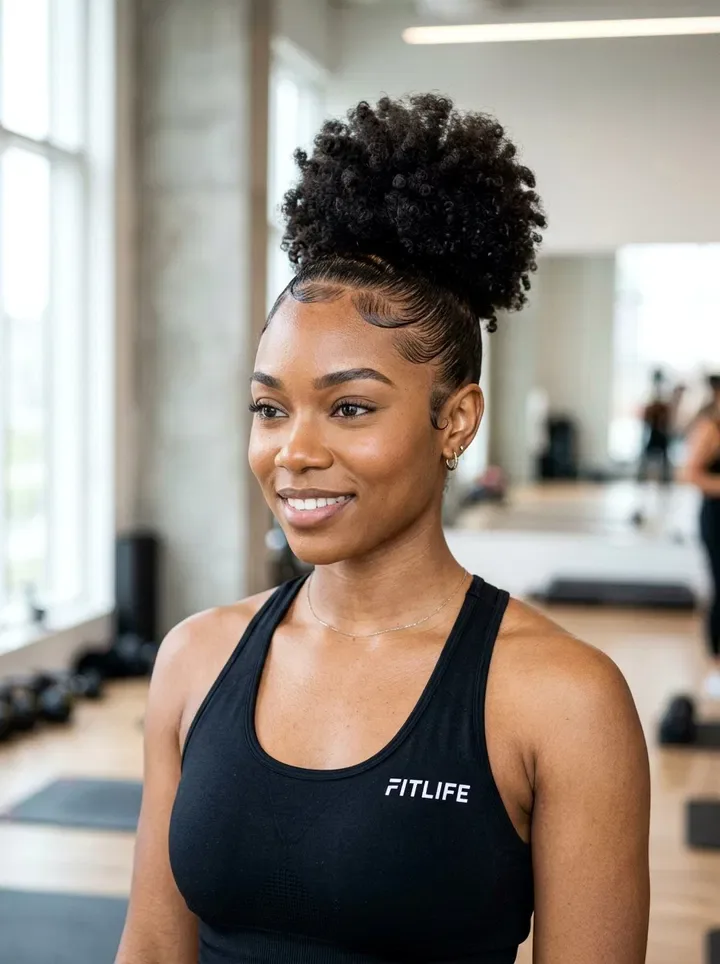
This is the style for the hardest, sweatiest classes, when you need the curls locked down. A little curl cream on the edges before you gather keeps the hairline smooth, and a headband over the front adds a second layer of security for the shortest curls that always escape.
Pros: very secure, keeps curls defined, great for intense classes. Cons: firmer hold means more tension on the curls. Sweat test: stays put through sprints with no bounce-related loosening. What to avoid: brushing the curls out before gathering — it turns definition into frizz before the class even starts.
The Low Puff with a Headband
A low puff with a headband is the gentlest secure style for curly and coily hair. Gather the hair low at the nape into a soft puff, then add a wide fabric headband to hold the front and catch sweat at the hairline. The low placement means almost no tension, the headband does the work of keeping the front tidy, and the puff itself is free to keep its natural shape.
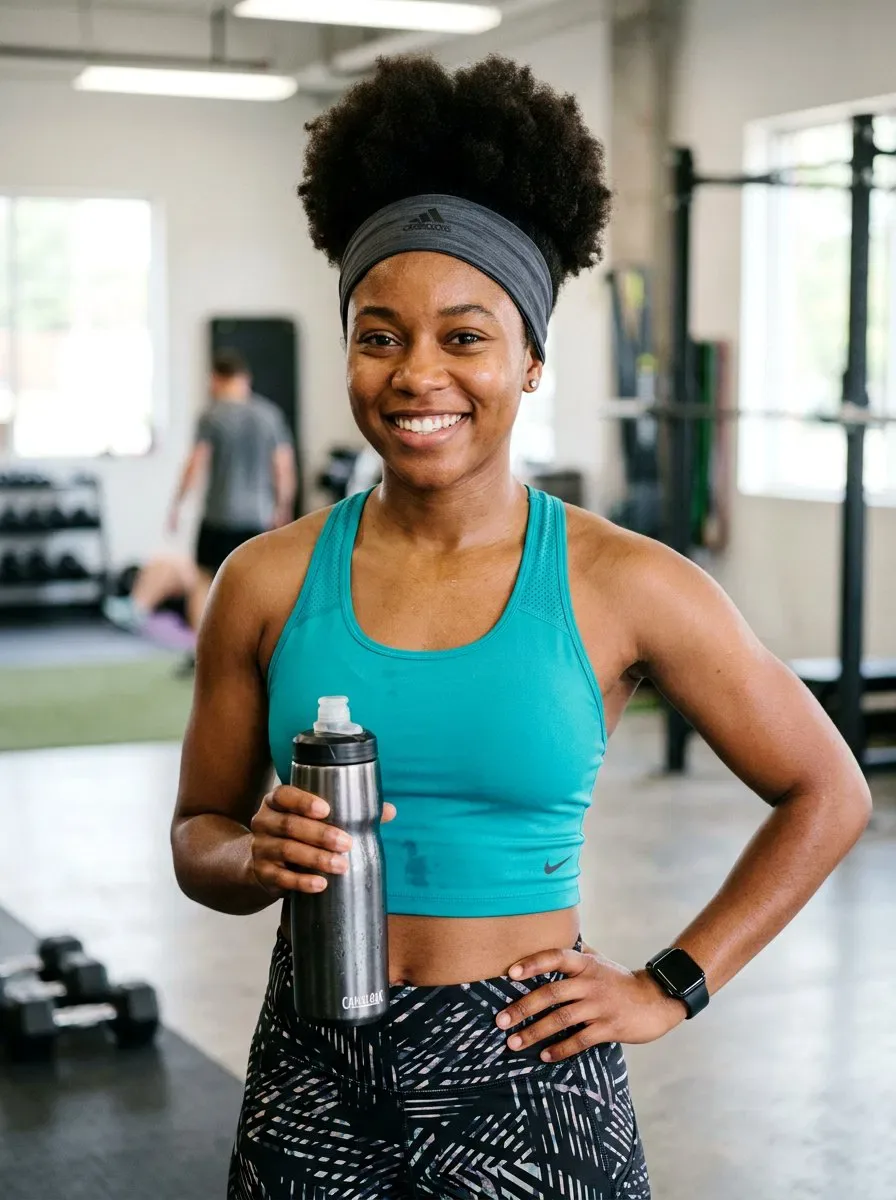
Choose a wide, moisture-wicking headband with a grip strip so it stays put when it gets damp, and gather the puff with a satin scrunchie to protect the curls. This is the most comfortable style in this guide for long rides, and the kindest to your hair over a week of daily classes.
Pros: almost no tension, very comfortable, protects curls. Cons: the nape gets warm since the puff sits low. Sweat test: the headband catches sweat before it reaches the hair, and the puff keeps its shape. What to avoid: a thin elastic headband — it rolls and slides once it gets damp.
Short Hair Slicked Back
Short hair slicked back is the easiest sweat-proof style of all, because there is so little hair to manage. Work a little gel or strong-hold cream through damp hair, comb it straight back from the forehead, and you are done — nothing can fall in your face, nothing touches your neck, and the style only gets better as sweat adds to the slick finish.
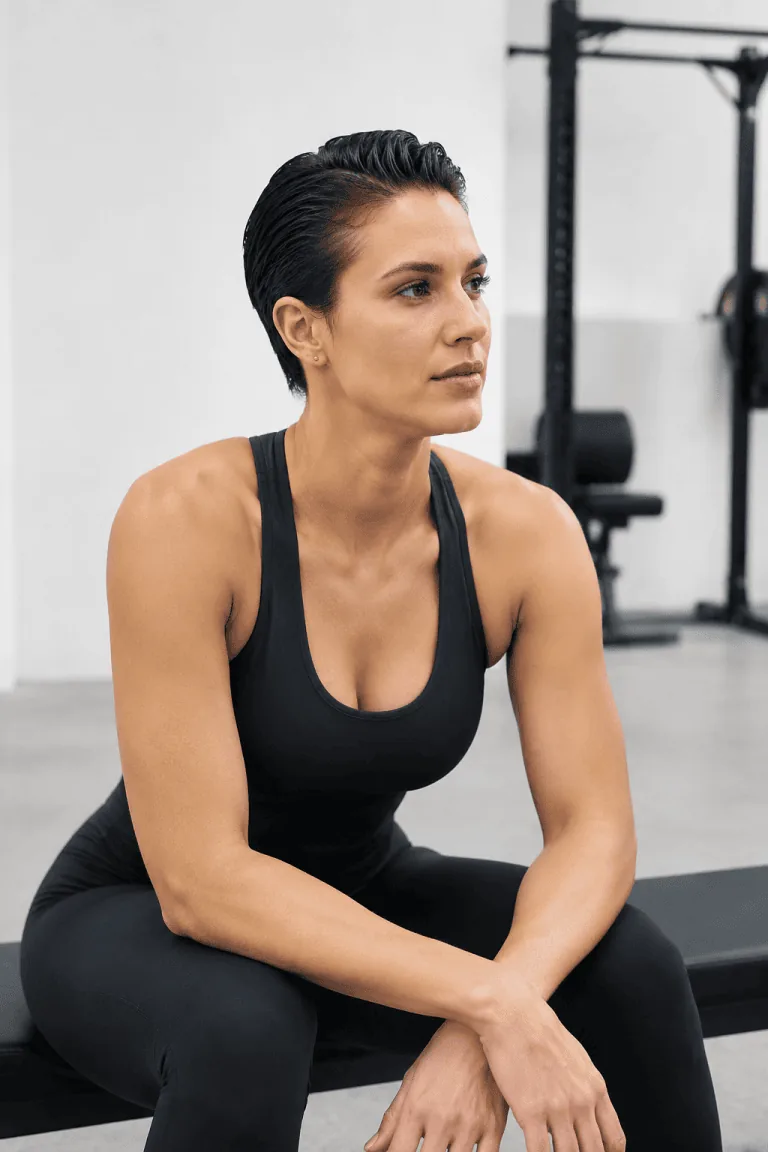
The product matters more than the technique here. A strong-hold gel keeps short hair glued back through the whole class, while a light cream will give up by the second climb. Use enough product, comb it through evenly, and let it set for a minute before you clip in.
Pros: one minute, nothing to fall or tangle, gets better with sweat. Cons: needs strong product and a wash after. Sweat test: holds completely — short slicked hair barely moves in a full class. What to avoid: light creams or pomades with no hold — they melt in the studio heat and the hair falls forward.
The Pixie with a Sweatband
A pixie cut with a sweatband is the spin class dream: the cut itself is already off your neck and out of your face, and the sweatband catches the sweat before it reaches your hairline. Put the band on, push the front of the pixie back or to the side, and you will not think about your hair once for the whole ride.
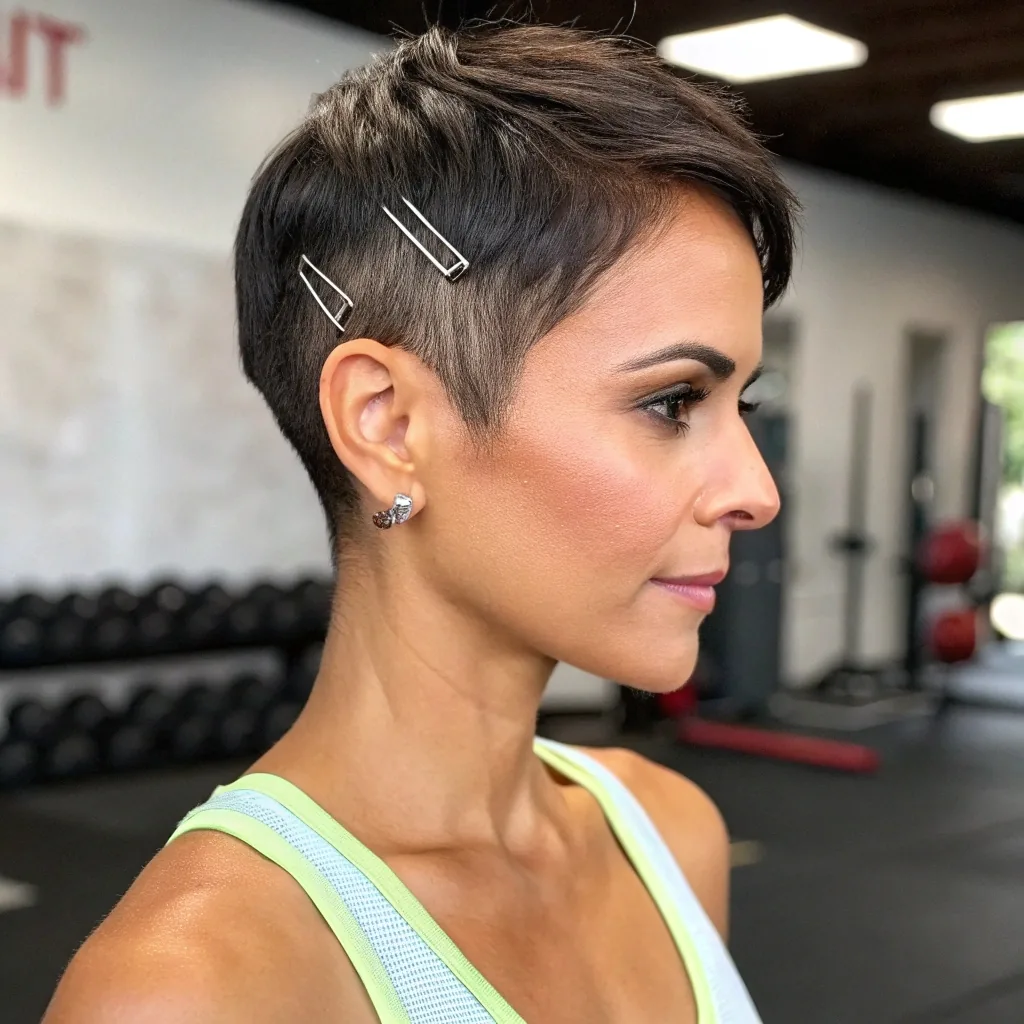
Choose a proper terry sweatband or a wide moisture-wicking band, not a thin elastic one — the band needs to absorb, not just decorate. Wear it across the forehead, just behind the hairline, so it catches sweat at the source and keeps the pixie looking deliberate rather than flattened.
Pros: zero styling time, sweatband does all the work, coolest option here. Cons: the band can flatten the front of the cut. Sweat test: the best sweat control in this guide — the band absorbs before sweat reaches the hair. What to avoid: a thin elastic band, which slides on a pixie and does nothing about sweat.
The Bob with a Headband
A bob with a headband is the short-hair rider’s best friend. The bob is too short to tie up and too long to ignore — it falls in your face when you lean forward and sticks to your neck when you sweat. A wide headband solves both problems at once, pushing the front back and catching sweat, while the bob itself stays loose and cool behind it.
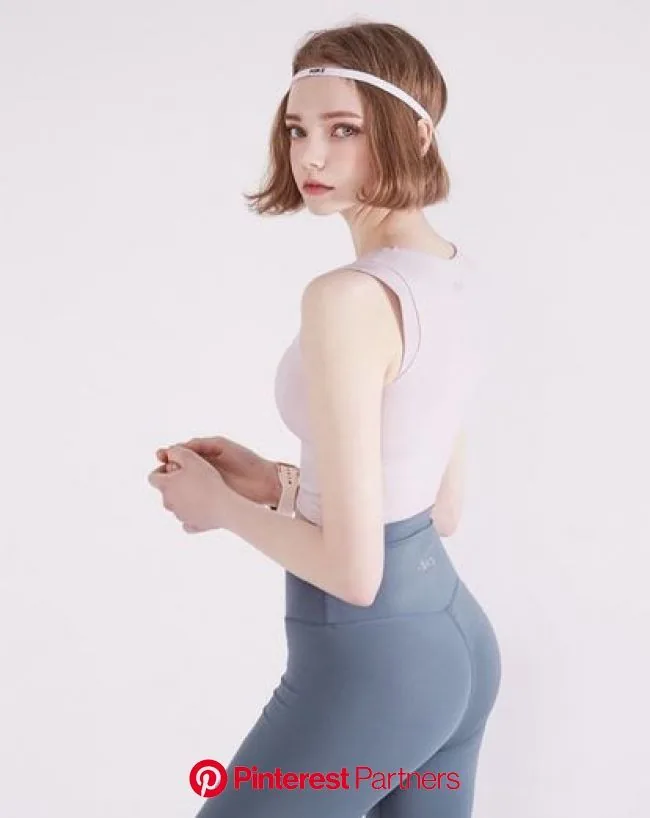
Pick a band with a grip strip and wear it a couple of fingers back from the hairline, so it holds the front sections without sliding forward. A fabric band with a little texture grips a bob far better than a smooth plastic one, and a wider band stays put longer than a thin one.
Pros: solves the bob’s two big problems, quick, comfortable. Cons: the back of the bob still gets sweaty. Sweat test: the front stays clear all class; the back dries fast because it is short. What to avoid: smooth plastic headbands — they slide straight off a bob once they get damp.
The French Twist Ponytail
A French twist ponytail is a ponytail with the front locked down by a twist. Take a section from each side of the front, twist them back toward the crown, pin them, and gather the rest into a ponytail. The twists hold the hairline the way a braid would, but they are faster and softer-looking, and they stop the front from falling forward when you lean over the bars.
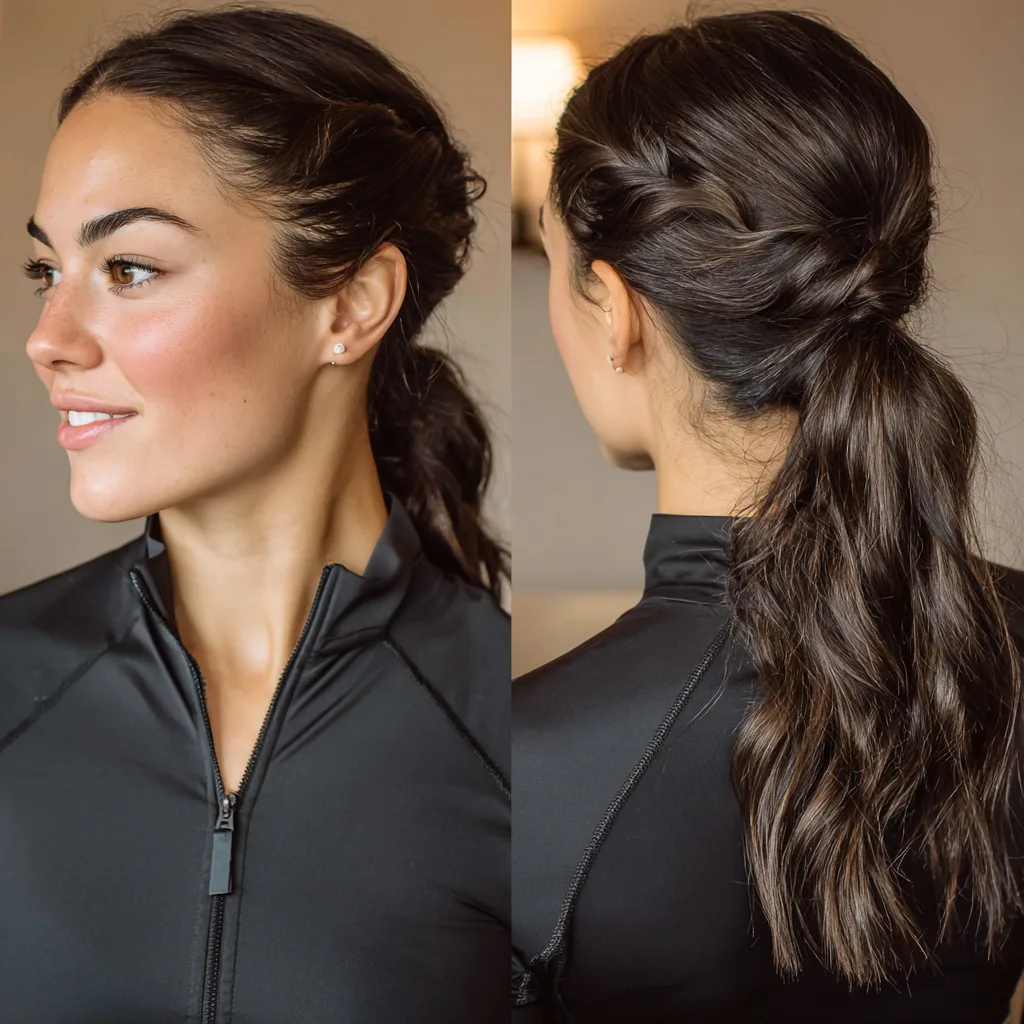
This is the style for riders whose ponytail is fine but whose front always escapes. The twists take two minutes and they do the job of a headband without any extra gear. Keep the twists even on both sides and pin them where they meet at the crown, and the whole style stays tidy for the full ride.
Pros: locks the front down, no headband needed, soft and pretty. Cons: needs pins and a little practice. Sweat test: the twists hold when damp and the front stays clear through sprints. What to avoid: twisting too loosely — a loose twist unravels once the hairline gets sweaty.
The Rope Braid Ponytail
A rope braid ponytail is the fastest braid in this guide — two sections twisted in the same direction, then wrapped around each other in the opposite direction, which locks them together like a rope. Tie your hair into a high ponytail first, then rope-braid the tail. It takes about a minute, it looks far more complicated than it is, and it holds like a proper braid.
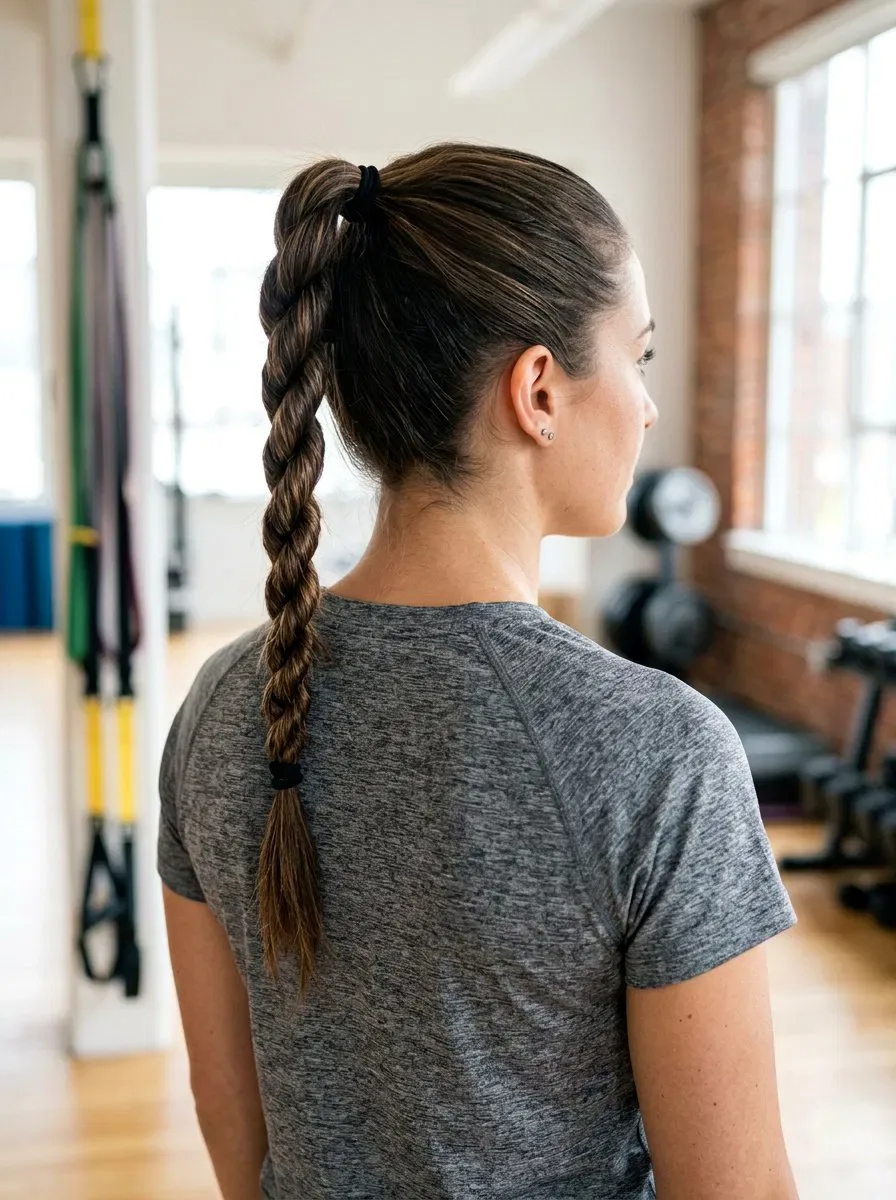
The rope braid is ideal when you are short on time but still want the tail contained. It stops the ponytail from whipping, it stops tangles, and it shakes out after class into soft, rope-like waves. Use a small elastic at the end and tug the rope gently to loosen it for a fuller look.
Pros: one minute, looks intricate, stops whipping and tangles. Cons: can unravel if the sections are not twisted tightly enough. Sweat test: holds fully damp and shakes out into soft waves after class. What to avoid: twisting both sections in opposite directions — they must twist the same way, then wrap the other way, or the rope falls apart.
The Pull-Through Braid
A pull-through braid looks like a complex Dutch braid but it is made entirely from ponytails — no braiding skill needed. Tie a small ponytail at the crown, tie another just below it, split the first in half, pull the second through the gap, and repeat down the head. The result is a full, chunky braid that holds with elastic alone.
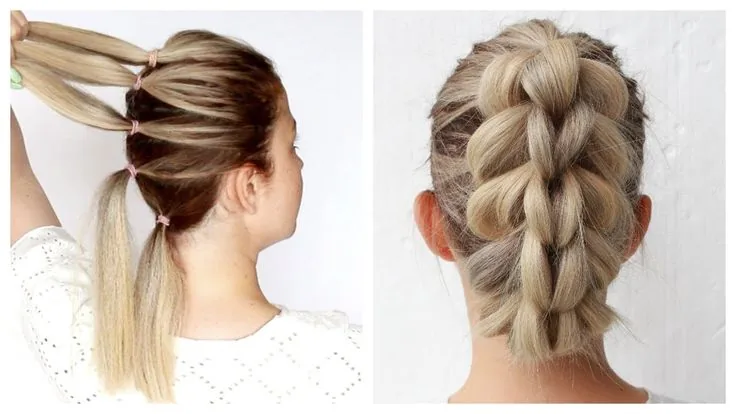
This is the style for anyone who cannot braid but wants the braid look and the braid security. Each elastic is an anchor point, so the style cannot unravel the way a real braid can, and the chunky sections hide layers and short pieces that usually escape. It takes about five minutes and looks impressively full.
Pros: no braiding skill needed, very full look, cannot unravel. Cons: uses a lot of elastics and takes five minutes. Sweat test: the elastic anchors hold completely, even when the hair is fully damp. What to avoid: spacing the ponytails too far apart — the braid sags and the gaps show.
The Braided Low Ponytail
A braided low ponytail is the calm, classic option for riders who want security without height. Braid the hair into a single low braid from the nape, or gather it into a low ponytail and braid the tail — either way, the braid keeps the hair contained, off the shoulders, and free of tangles, while the low placement keeps the weight comfortable.
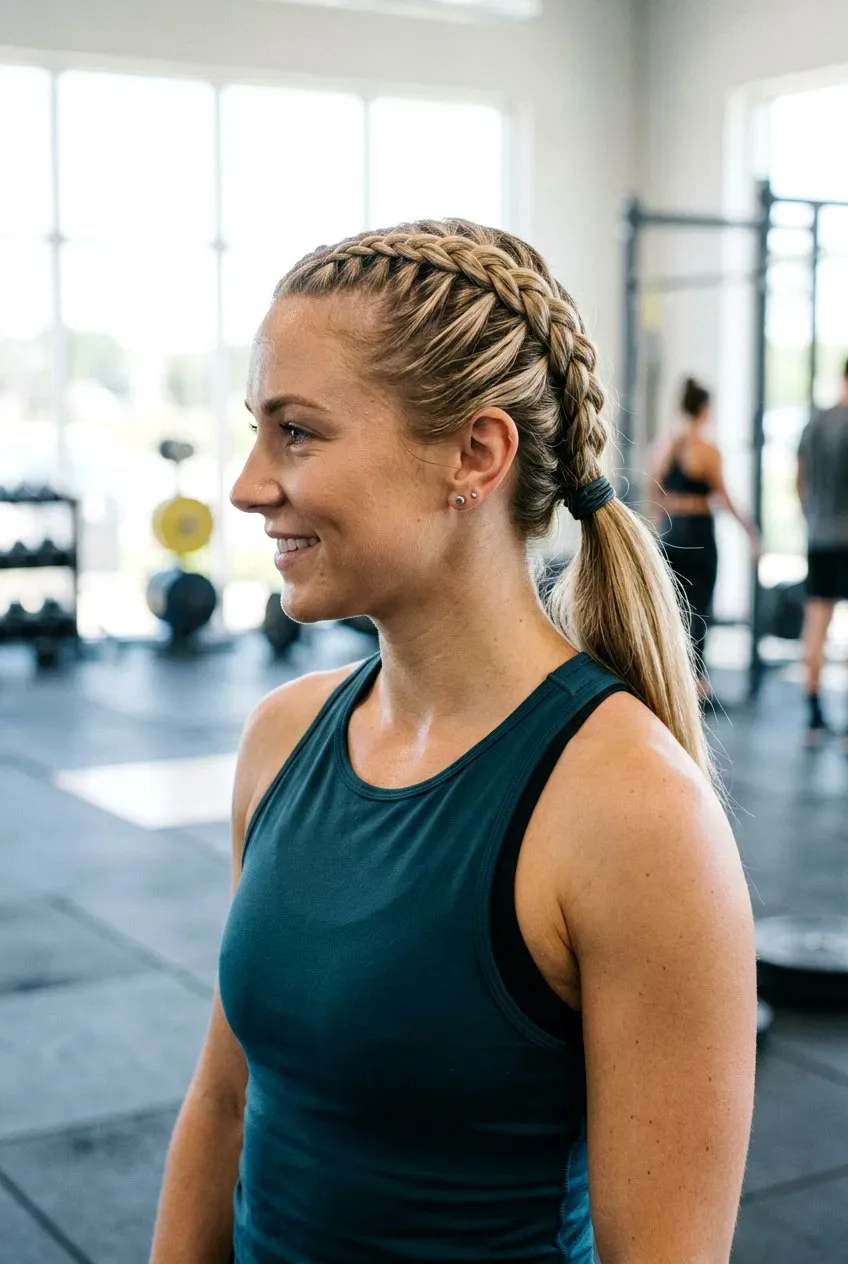
It is the best style for long, heavy hair, because the low braid carries the weight at the nape instead of pulling at the crown. It also survives the ride and the shower afterwards without turning into a knot, which is more than a loose low ponytail can say.
Pros: comfortable for heavy hair, tangle-free, no headache. Cons: the nape still gets warm. Sweat test: the braid holds its shape when damp and brushes out easily after class. What to avoid: braiding on freshly conditioned hair — it is too slippery and the braid loosens.
The Wrapped High Bun with a Headband
A wrapped high bun with a headband is the belt-and-braces spin class style: the bun holds the hair, and the headband holds the front and catches the sweat. Sweep the hair into a high bun, pin it, then add a wide moisture-wicking headband a couple of fingers back from the hairline. Two systems, each covering what the other misses.
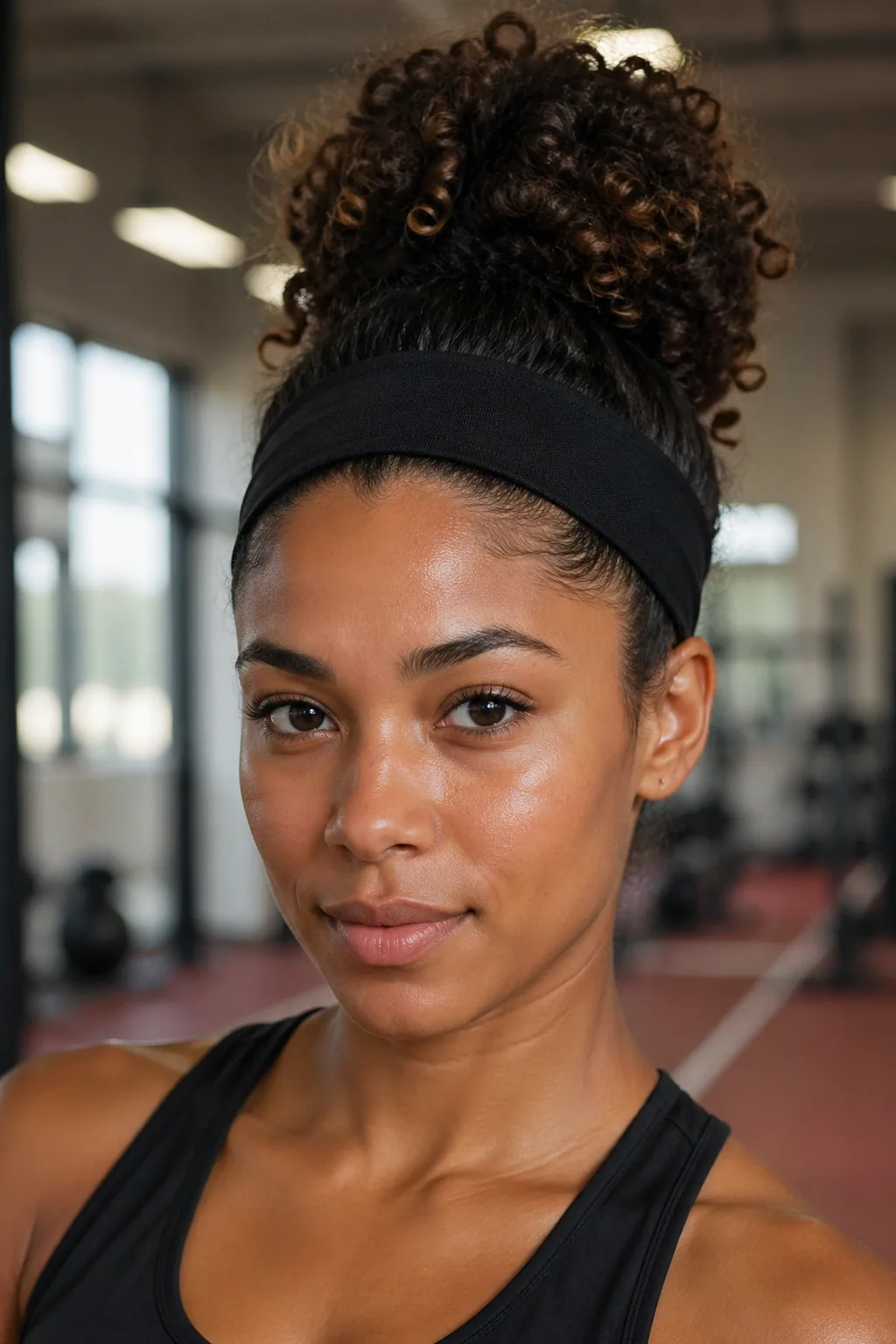
This is the style to choose for the sweatiest classes, the hottest studios, and the days you know you will be dripping by the third song. The headband catches sweat before it reaches the bun’s base, and the bun keeps the bulk of the hair up and dry. It is also the most forgiving style here — even a slightly messy bun looks deliberate under a headband.
Pros: double protection, best sweat control for long hair, forgiving. Cons: two pieces of gear to manage. Sweat test: the driest hairline in this guide — the band absorbs while the bun stays dry. What to avoid: a headband that is too tight — it gives you a headache and leaves a dent in the hair.
Your Go-To Gym Style, Sweat-Proofed
The last style in this guide is not a new style at all — it is the one you already wear, made sweat-proof. Whatever your go-to is — a ponytail, a bun, a braid — add the three upgrades that make any style spin-ready: a second anchor point, a no-slip tie instead of a silky one, and a headband or a braided front to lock the hairline. That is all it takes to turn a style that fails at song three into one that lasts the cool-down.
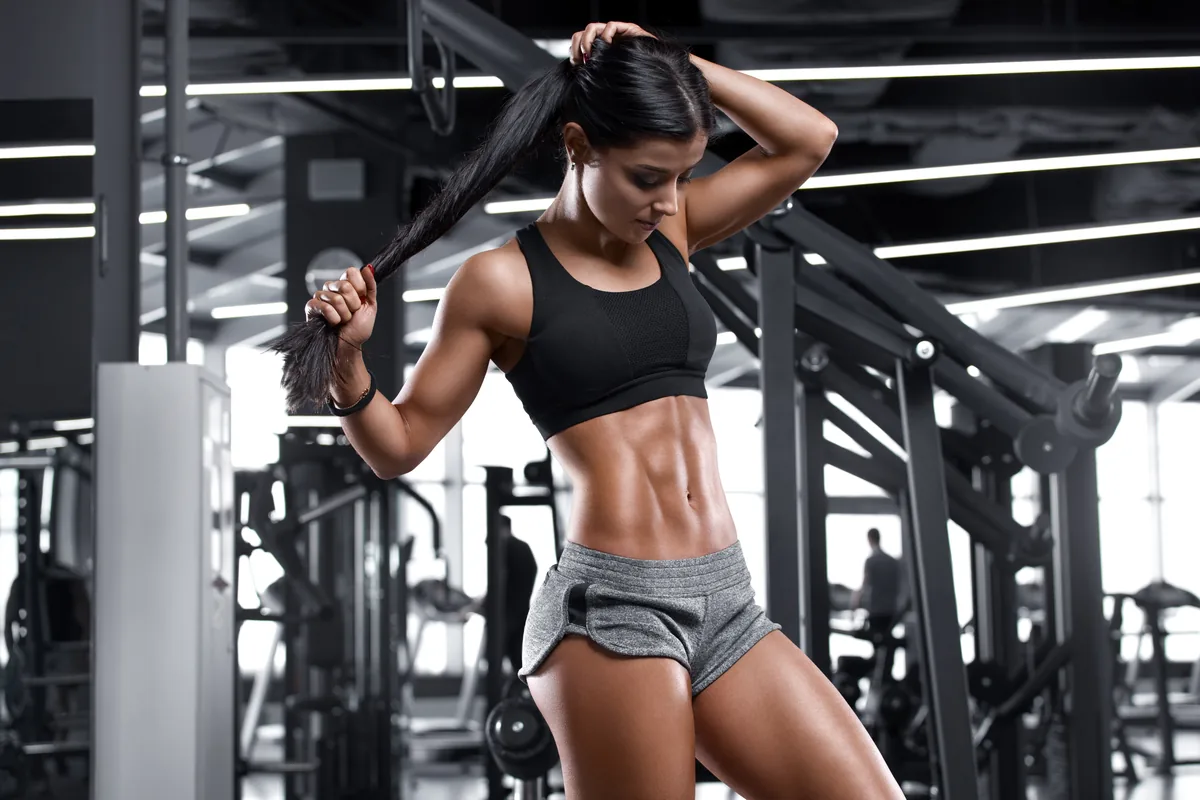
Start with your usual style and test it honestly. Ride a full class in it, and notice exactly where it fails — the front escaping, the tie sliding, the nape getting damp. Fix only the failing part, one upgrade at a time, and within a few rides you will have a style that is yours, that you can do in two minutes, and that you never have to think about in the studio again.
Pros: no new skill to learn, built on a style you already like, fast. Cons: needs an honest test ride to find the weak point. Sweat test: your own — ride a full class and check what moved. What to avoid: changing everything at once — fix one weak point per ride and you will know exactly what worked.
Keeping Hair Off Your Neck and Face on the Bike
The bike itself decides a lot about spin class hair. When you lean forward into a climb, your head drops and gravity pulls every loose strand toward your face. When you stand up on the pedals, the movement shakes loose anything that is only half-secured. A style that survives spin has to pass both positions — and the test is simple: bend forward at the waist and shake your head. If anything falls, it will fall in class.
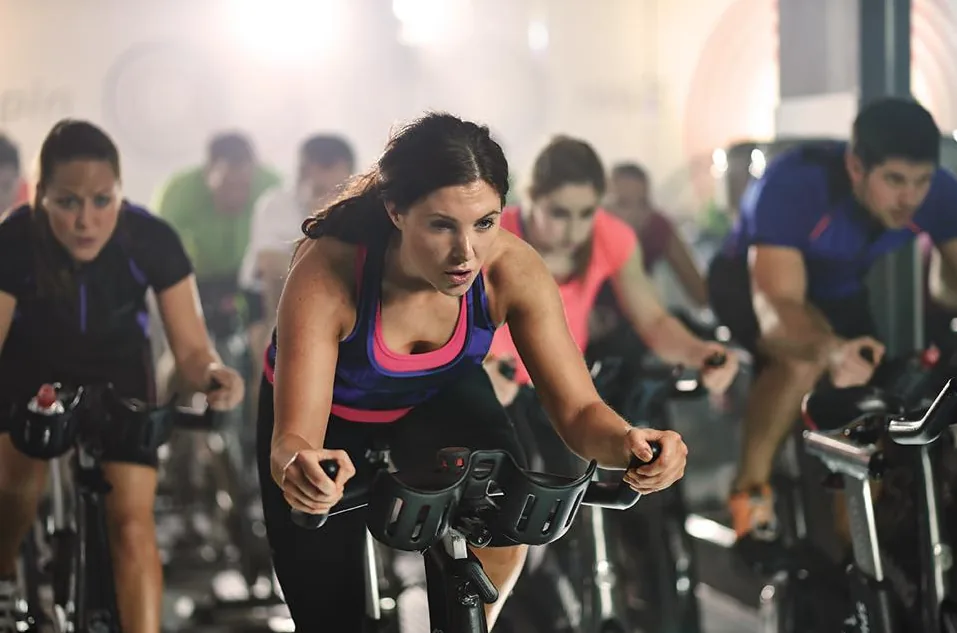
Height is your friend here. High ponytails, high buns and high puffs all clear the neck and the shoulders completely, and they stay clear when you lean forward. Low styles can work too, but only if they are braided or pinned — a loose low ponytail will swing forward onto your shoulder and stick there the moment you sweat.
Quick test: bend forward and shake your head before you clip in — if nothing moves, the style is ride-ready. Best for: every rider, every class. What to avoid: loose hair at the nape and unsecured front sections, which are the first things gravity takes.
Sweat, Frizz and Flyaways: Damage Control Mid-Class
Frizz in a spin class is not a styling failure — it is physics. Sweat dampens the hair, the studio heat opens the cuticle, and the shorter hairs around your hairline curl up and stick out. You cannot stop it completely, and you do not need to: the goal is to keep it from reaching your eyes and to keep the style’s shape intact until the cool-down.
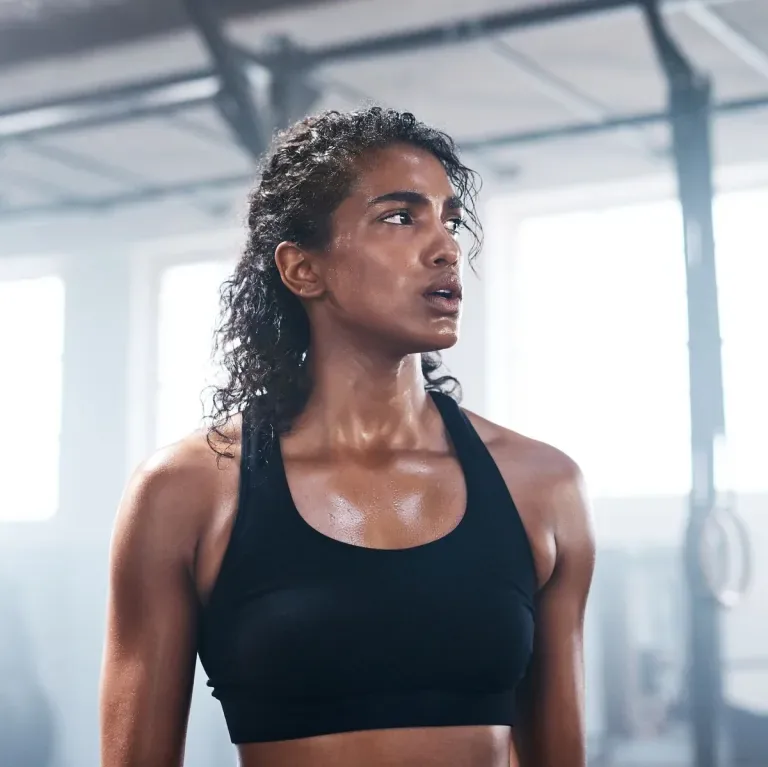
The best mid-class fix is the simplest one: smooth the hairline with damp palms. Wet your hands at the water fountain, smooth the flyaways back, and the moisture resets them for another ten minutes. A tiny amount of hair gel on your fingertips does the same job for longer, and it fits in a gym bag pocket. What does not work is brushing dry, sweaty hair — that turns flyaways into a halo of frizz.
Mid-class fix: damp palms smoothed over the hairline, or a fingertip of gel. Best for: wavy and curly hair, which frizzes first. What to avoid: brushing sweaty hair dry — it breaks the curl pattern and doubles the frizz.
The Post-Class Refresh: No-Wash-Day Rescue
You do not need to wash your hair after every spin class — and if you ride four or five times a week, you should not. The post-class refresh is a three-minute routine: let the hair cool down first, because brushing hot, sweaty hair spreads the dampness; then work dry shampoo into the roots, wait sixty seconds, and brush it through. The powder absorbs the sweat and the salt, and the brushing redistributes it so there is no white residue.
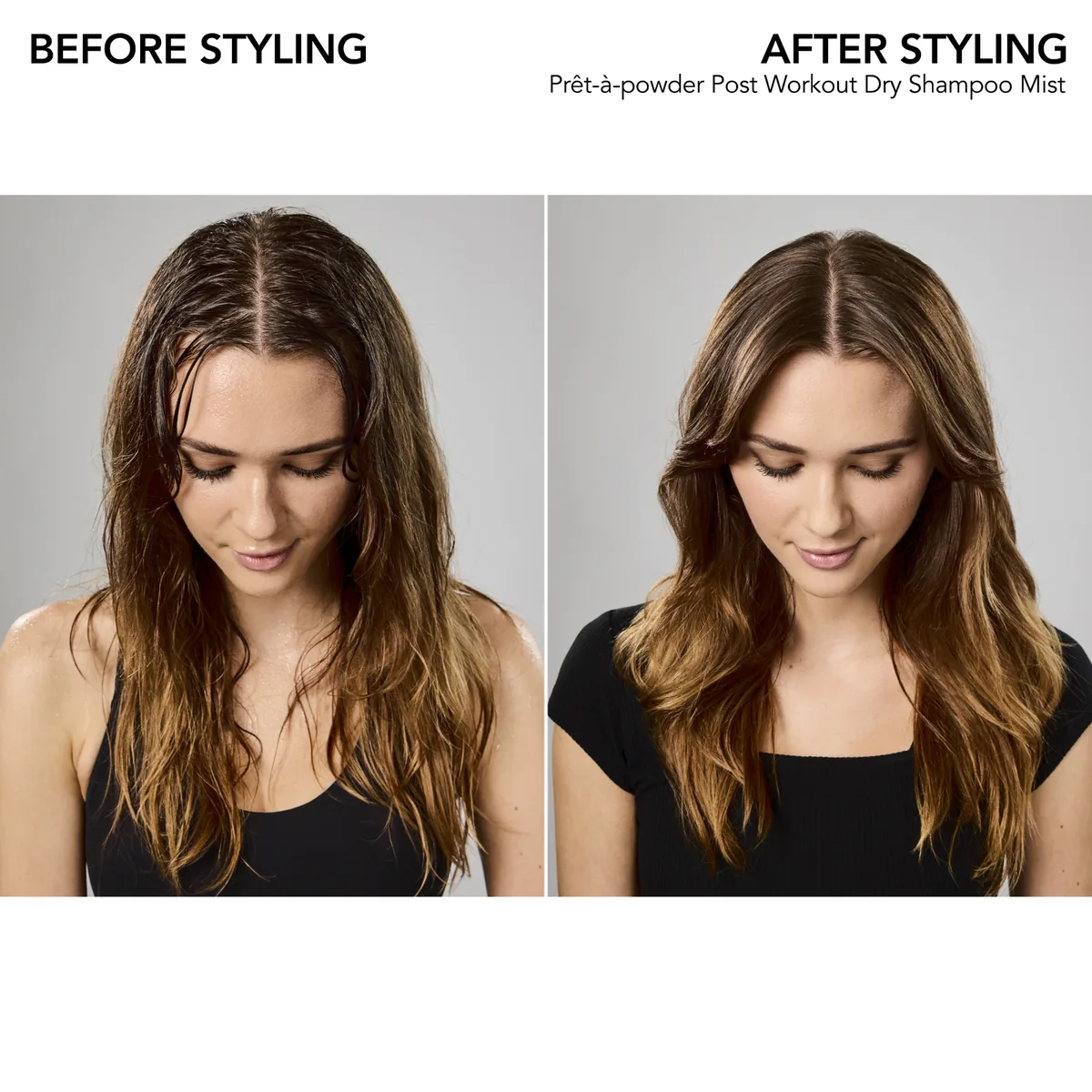
For the lengths, a light mist of leave-in conditioner or a drop of hair oil on the ends revives the shape without a wash. If the style was a braid, take it out, shake it, and the braid waves become the hairstyle for the rest of the day. If it was a bun, a quick brush and a loose low ponytail is all you need.
Best for: riders who spin most days and cannot wash daily. Routine: cool down, dry shampoo at the roots, brush through, oil on the ends. What to avoid: washing every day — it strips natural oils and makes the scalp produce more oil, not less.
Wash-Day Timing Around Your Class Schedule
The smartest wash-day schedule is built around your classes, not the calendar. Wash on the morning of your hardest class day, so you start with a clean base and the style holds best when you need it most. Then let the hair go two or three days, using dry shampoo and braids on the in-between days, and wash again before the next hard session. Sweat itself is not dirt — it is mostly water and salt — so a sweaty second-day ride does not demand a wash.
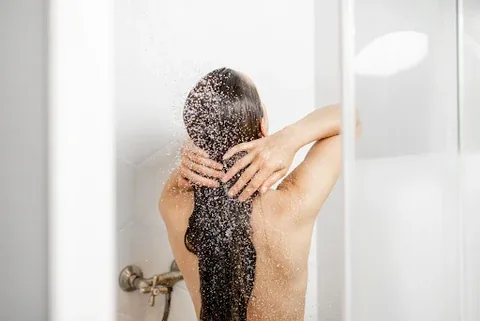
The trick is the rest-day wash. If you take a rest day, wash that morning and let the hair air-dry properly, so the scalp gets a real reset. And if your hair is fine and gets greasy fast, a water-only rinse after class — no shampoo — removes the salt without stripping the oils, and it buys you another day.
Best for: anyone riding three or more times a week. Schedule: wash before hard class days, dry shampoo between, water-only rinse when needed. What to avoid: daily shampooing — it dries the lengths out and trains the scalp to over-produce oil.
The Spin Class Hair Kit: What to Pack in Your Gym Bag
A spin class hair kit fits in a small pouch and saves almost every bad hair day. The essentials are: two no-slip hair ties, three bobby pins that match your hair colour, a wide moisture-wicking headband, a travel dry shampoo, a small tube of hair gel, and a few clear elastics. That is the whole kit — six items, one pouch, and it covers a slipped tie, an escaped front section, a frizzy hairline and a post-class refresh.
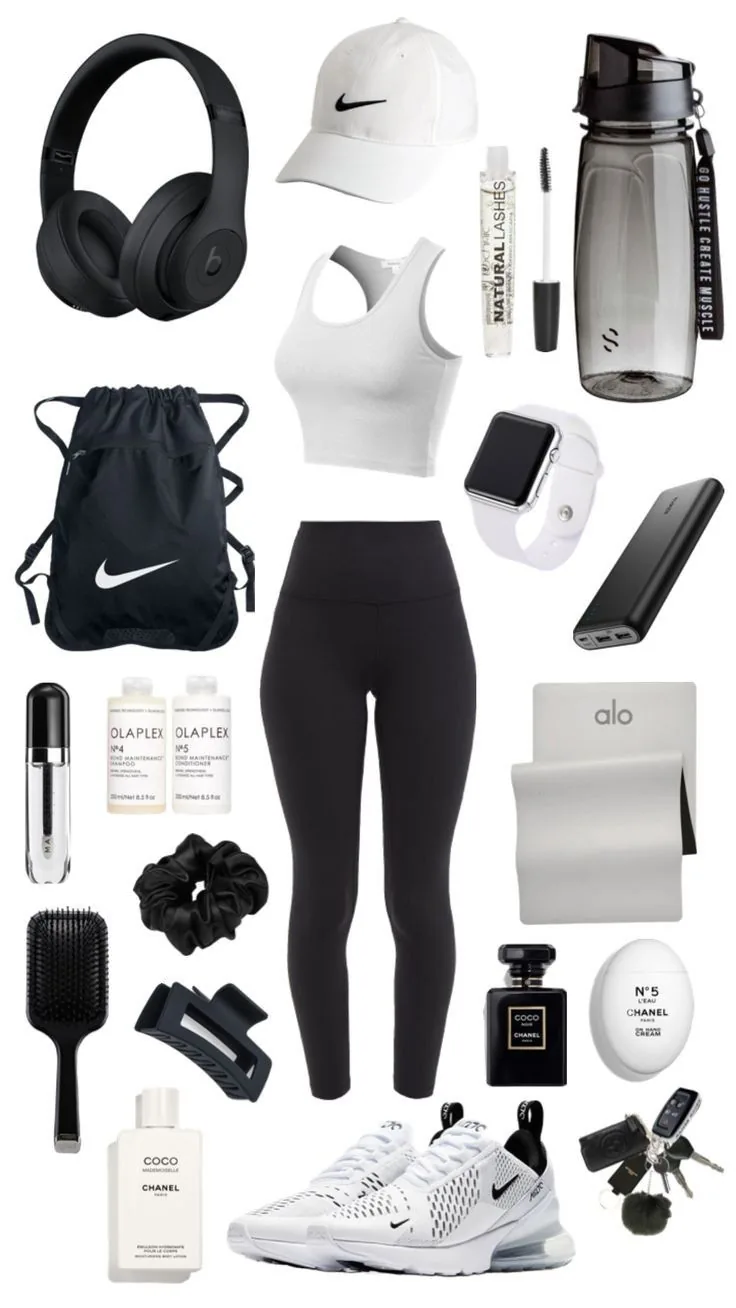
Add two things if you ride most days: a silk scrunchie for the journey home, so the post-class ponytail does not dent or break the hair, and a small microfibre towel for blotting the hairline instead of rubbing it. Rubbing wet hair causes breakage; blotting does not. Keep the pouch packed and in the bag permanently, and restock the pins and elastics once a month — they are the things that vanish first.
Best for: every regular rider. The kit: two ties, three pins, one headband, dry shampoo, gel, clear elastics. What to avoid: packing a brush for mid-class use — a brush belongs after the cool-down, never on hot, sweaty hair.
What is the best hairstyle for a spin class?
A high ponytail or a French braid is the best hairstyle for a spin class, because both keep every strand off your neck and out of your face for the whole ride. A high ponytail takes five minutes and suits every length past the shoulders; a French braid holds even better and nothing escapes from it. If you have curly hair, a high puff or a pineapple puff is the equivalent — high, contained and off the neck.
How do I keep my hair from getting sweaty in spin class?
You cannot stop your hair from getting sweaty in a spin class, but you can control where the sweat goes. A wide moisture-wicking headband or sweatband catches sweat at the hairline before it reaches your hair, and a high, contained style — a bun, a braid or a high ponytail — keeps the bulk of your hair up and dry. Keep the studio fan on if there is one, and blot the hairline with a microfibre towel during the cool-down rather than rubbing it.
Can I wear my hair down in a spin class?
You can, but it is the least practical choice: loose hair sticks to a sweaty neck, falls into your face when you lean forward, and tangles badly by the cool-down. If you love your hair down, a half-up top knot or a half-up braided crown is the better compromise — the front is locked away and the back still flows. Save fully loose hair for the ride home, not the ride itself.
What is the best hairstyle for curly hair in spin class?
A high puff or a pineapple puff is the best spin class hairstyle for curly hair. Gather the curls high and loose with a satin scrunchie or a coiled tie, and the puff keeps every curl off your neck while protecting the curl pattern. For the hardest classes, a curly high puff with a firmer tie and a headband over the front holds better. Never brush curly hair before class — finger-comb it instead, or the curls turn to frizz before you clip in.
What is the best hairstyle for short hair in spin class?
Short hair slicked back with a strong-hold gel is the best spin class hairstyle for short hair, and a pixie with a terry sweatband is the easiest of all. A bob needs a wide headband with a grip strip, because a bob is too short to tie up and too long to ignore — the band holds the front back and catches sweat at the hairline. Whatever the cut, the rule is the same: keep the front out of your eyes and let the sweatband do the work.
Should I wear a headband or a sweatband for spin class?
A sweatband is better if you sweat heavily, because a terry band absorbs moisture before it reaches your hairline. A wide moisture-wicking fabric headband is better if you want style as well as function, and it doubles as a hair holder. Thin elastic headbands are the worst choice — they roll and slide once they get damp. Whichever you choose, make sure it is about two fingers wide and has a grip strip or a textured weave inside.
How do I stop frizz after a spin class?
Let your hair cool down before you touch it, then smooth the hairline with damp palms or a fingertip of gel — never brush hot, sweaty hair, because that turns flyaways into a halo of frizz. A quick dry shampoo at the roots absorbs the sweat and salt, and a drop of hair oil on the ends revives the shape. If your hair frizzes badly, a braid for the ride itself prevents most of it, because the hair dries in the braid instead of loose.
How often should I wash my hair if I do spin class every day?
You do not need to wash your hair after every spin class, even if you ride daily. Wash two or three times a week, use dry shampoo on the roots on the other days, and rinse with water only after a particularly sweaty ride — sweat is mostly water and salt, not dirt. Daily shampooing strips natural oils and makes the scalp produce more oil, which makes the hair greasier faster, not cleaner.
Does sweat damage your hair?
Sweat itself does not seriously damage hair — it is mostly water and salt — but leaving it to dry in your hair every day can dry out the lengths and irritate the scalp, and salt crystals can make the hair feel rough and tangled. The fix is simple: rinse or refresh after class, use dry shampoo between washes, and keep the hair protected in a braid or bun during the ride. The real damage comes from tight, wet styling and rough brushing, not from the sweat itself.
What is the best hair tie for spin class?
A thick, no-slip elastic tie or a coiled telephone-cord tie is the best hair tie for a spin class, because both grip damp hair without sliding. Thin drugstore elastics stretch out with sweat and heat, and silk scrunchies slide straight off damp hair during a ride — save the silk scrunchie for after class, when it protects the hair without needing to hold it. Always carry a spare tie in your gym bag, because one always snaps at the worst moment.
Conclusion
The best hairstyles for a spin class are not the prettiest ones in the mirror — they are the ones you forget about for forty-five minutes. A French braid that never moves, a high ponytail that stays high, a bun that keeps your neck cool, a puff that protects your curls: each one does the same three jobs, keeping hair off your neck, out of your face, and in one piece until the cool-down. Pick the style that fits your hair length and texture, add a headband if you sweat heavily, and test it on a real ride before you trust it.
Start with the guides — prep your hair before class, pack the small gym-bag kit, and learn the three-minute post-class refresh so you are not washing your hair every day. Then ride, notice what moved, fix one thing, and ride again. Within a few classes you will have a style that is yours, that takes two minutes, and that lets you think about the music, the climb and the sprint — never about your hair.