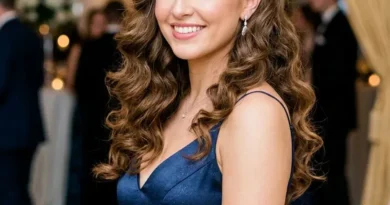
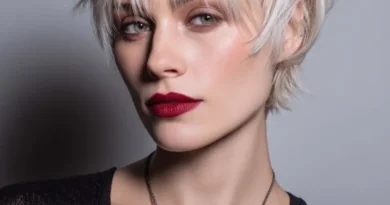
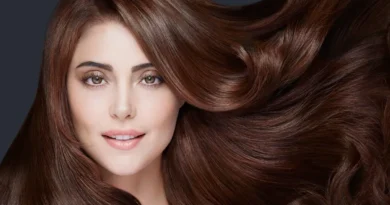
Wider at the Jaw? 41 Hairstyles for a Pear Face Shape That Balance Everything Out
A pear face shape — also called a triangle face shape — is wider at the jaw than it is at the forehead, with a narrower forehead, wider cheekbones that sit low, and a jawline that does most of the talking. It is a striking, memorable face shape, and it is also one of the easiest to get wrong with a haircut: anything that adds bulk at jaw level, ends in a hard line at the chin, or pulls the hair flat against the top of the head will make the jaw look wider still, while the forehead disappears altogether. The good news is that the fix is simple, and it works in the opposite direction to what most people expect: instead of hiding the jaw, you balance it by adding soft width and lift higher up, around the forehead, temples and crown.
This guide brings together 41 hairstyles for a pear face shape, from curtain bangs and side-parted lobs to voluminous blowouts, textured pixies, soft curls and half-up styles that all do the same clever job — they build gentle fullness at the top and keep the jawline soft and open. Eight guides explain the principles first: how to spot a pear face shape, how to add width at the forehead and temples, how to soften a strong jawline, which partings work best, where volume should sit, which bangs balance a pear face, the mistakes that widen the jaw, and exactly what to say to your stylist. Every style explains why it works for a pear face, what to watch out for, and one styling tip — so you can choose with confidence instead of guessing.
What Is a Pear Face Shape and How Do You Spot It?

A pear face shape, also known as a triangle face shape, is defined by its proportions: the forehead is the narrowest part of the face, the cheekbones sit wide and low, and the jaw is the widest point, often with a strong, defined jawline and a chin that is broader or squarer than in other face shapes. It is the reverse of a heart face shape, which is wide at the forehead and narrow at the chin, and it is different from a square face, where the forehead and jaw are roughly the same width. If your face is longest in the jaw area and your forehead looks small in comparison, you are probably looking at a pear shape — and the haircuts that flatter you will be the ones that restore visual balance between the top and the bottom of your face.
The easiest way to check is with a mirror and a measuring tape, or simply by pulling your hair right back and looking at the outline of your face. Measure across your forehead, across your cheekbones and across your jaw: in a pear face the jaw measurement is the largest, the cheekbones come second, and the forehead is the smallest. A photo taken straight on, with your hair tied back, makes the proportions obvious. Keep in mind that face shape is a guide, not a rule — your hair texture, your features and your personal style matter just as much. The goal of this guide is not to hide your face shape but to balance it, so the strong jaw that makes a pear face distinctive looks intentional rather than heavy.
Adding Width at the Forehead and Temples
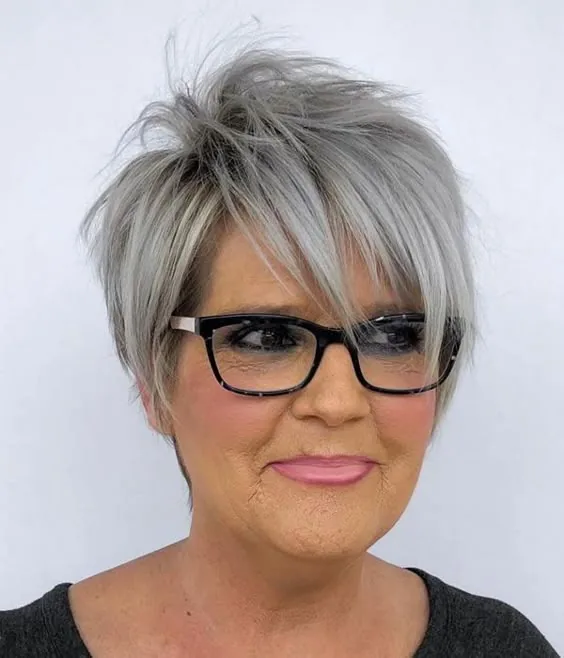
The single most useful trick for a pear face shape is adding soft width at the forehead and temples, because that is the narrowest part of the face and the part that needs the most help. Volume at the crown, a side sweep that crosses the forehead, curtain bangs that flare out at the temples, or layers that start high and flick outward around the cheekbones all do the same thing: they widen the upper half of the face so it matches the jaw, and the whole face looks more oval and balanced. This is why so many of the hairstyles in this guide have their fullness at the top — it is not a coincidence, it is the whole point.
To get that width, think in terms of lift and sideways movement rather than length. Blow-dry the roots upward with a round brush, part the hair on the side so a heavy sweep crosses the forehead, or ask for layers that begin at the cheekbone and turn outward. A little texture at the temples — a wave, a flick, a curtain bang that opens outward — is worth more than inches of length at the bottom. What you want to avoid is the opposite: hair scraped flat against the scalp with all the volume sitting at the ends, which leaves the forehead looking even narrower and the jaw looking even wider. Balance, for a pear face, is always built from the top down.
Softening a Strong Jawline

A strong jawline is one of the most striking features of a pear face shape, and the goal is not to hide it — it is to soften it, so it reads as defined rather than heavy. Softness comes from movement and from hair that falls past the jaw in a way that breaks up the hard line. Long layers that curve inward at the ends, soft waves that start above the jaw and fall past it, and face-framing pieces that end below the chin all blur the edge of the jaw instead of drawing a line along it. The jaw is still there, and it still looks strong, but the hair makes it look like a feature rather than a frame.
The styles that harden a jawline are the ones that end in a blunt, straight line exactly at chin level, or that tuck tightly behind the ears and expose the full width of the jaw with nothing to soften it. If you love a bob, keep it either above the jaw with volume at the crown, or a little longer than the jaw with soft, textured ends that curve under or flick out — never a heavy, one-length line sitting right on the jawbone. A few loose pieces left out around the face in an updo do the same job: they break the outline, they move when you move, and they keep the jaw from being the only thing anyone sees.
The Best Partings for a Pear Face

Parting is the cheapest, fastest face-shape tool there is, and for a pear face it matters more than length. A deep side part is usually the most flattering choice, because it throws a heavy sweep of hair across the forehead — instantly adding width where the face is narrowest — and it creates diagonal lines that break up the symmetry of a wide jaw. A soft, off-centre part does a similar job in a subtler way, while a centre part can work if the hair has volume at the roots and face-framing layers that open outward at the temples, rather than falling flat and straight down either side of the face.
What to avoid is a severe, flat centre part with pin-straight hair and no volume at the top, because it splits the face into two halves, leaves the forehead looking narrow, and lets the jaw take centre stage unopposed. If you love a centre part, make it work by adding root lift, a curtain bang, or waves that start at cheek level and widen outward — the part itself is not the problem, the flatness around it is. Try the deep side part for a week before you commit to a cut: it is a free experiment, and for many pear-shaped faces it is the single change that makes the biggest difference.
Volume Placement Rules for a Pear Face

Volume placement is the golden rule of pear-face styling: put the volume where the face is narrow, and keep it soft where the face is wide. That means lift at the crown, fullness at the temples and cheekbones, and a lighter, more tapered finish around the jaw and ends. A blowout that is big at the roots and falls into soft waves is the classic example, and so is a layered cut where the shortest layers sit high and the longest layers fall past the jaw without puffing out. When the volume sits at the top, the face looks balanced; when it sits at the bottom, the jaw looks wider.
The practical version of this rule is easy to remember: style the top of your hair first, and the ends last. Mousse or root-lifting spray at the crown, a round brush lifting the roots upward, and a little backcombing or a volumising powder at the part will do more for a pear face than any amount of curling at the ends. At the ends, keep the finish soft — a gentle inward curve, a loose wave, or a tapered layer that falls close to the neck. Big, bouncy curls that start at the jaw and puff outward are the one thing to be careful with: they add exactly the width you are trying to avoid, in exactly the place you are trying to soften.
Bangs That Balance a Pear Face
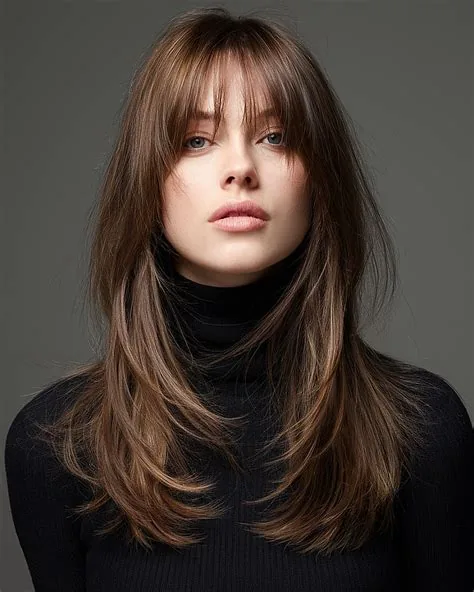
Bangs are one of the best tools for a pear face shape, because they add width and softness exactly where the face is narrowest — across the forehead. Curtain bangs are the safest and most flattering choice: they part in the middle, sweep out to each side, and create a wide, soft frame at the temples that balances the jaw below. Side-swept bangs do a similar job with a more dramatic diagonal line, and a soft, wispy fringe adds texture across the forehead without the heaviness of a blunt cut. All three work because they fill in the narrow forehead and draw the eye upward.
The bang to be careful with is a heavy, blunt, straight-across fringe, especially one cut short and flat, because it can make the forehead look even smaller and the jaw look even wider by comparison — it shortens the top of the face instead of widening it. If you love the look of a blunt fringe, ask for a longer, softer version that is textured at the ends and sits at or just below the eyebrows, or a curtain version that opens at the centre. Bangs grow out fast, so they are a low-risk experiment: try curtain bangs for a month, and if you do not love them, they blend into face-framing layers within a few weeks.
Common Mistakes That Widen the Jaw
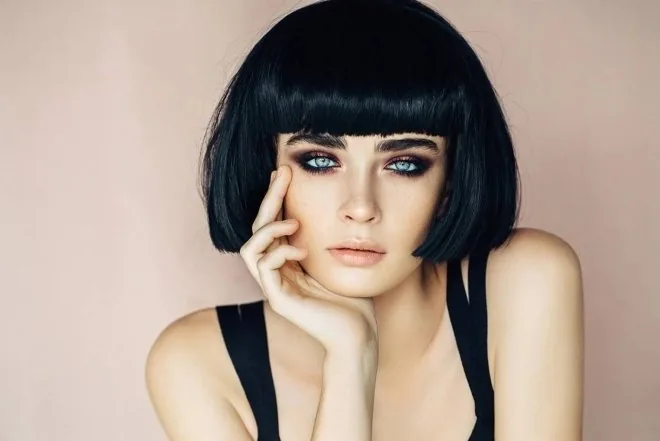
The mistakes that make a pear face look wider at the jaw are all variations on the same theme: adding weight, width or a hard line at chin level while leaving the top of the head flat. A one-length bob that ends exactly at the jaw is the classic example, because the blunt edge draws a horizontal line across the widest part of the face. Heavy, bulky curls that start at the jaw and puff outward do the same thing, as does a sleek, scraped-back ponytail with no volume at the crown and no pieces left out around the face. In each case the hair is emphasising the jaw instead of balancing it.
The other common mistake is the opposite extreme: hiding the jaw completely behind a heavy curtain of hair that falls straight down from a centre part, which makes the face look smaller and narrower at the top and leaves the jaw as a solid block underneath. The fix for both mistakes is the same — lift and softness at the top, movement and taper at the bottom. If you have made one of these mistakes, you do not need a drastic cut to fix it: a side part, some root lift, a few face-framing layers, or a curtain bang can rebalance a style in a single appointment. The jaw is not the problem; the placement of the volume is.
How to Talk to Your Stylist About Face-Shape Balance

The most useful thing you can say to your stylist is not the name of a haircut but the result you want: more width at the forehead and temples, softness around the jaw, and volume at the crown rather than at the ends. Bring photos of women with a similar face shape and a similar hair texture to yours, showing the style from the front and from the side, and point at the specifics — where the layers start, where the volume sits, how the bangs fall. A good stylist will look at your face shape, your hairline and your natural growth patterns before they pick up the scissors, and will tell you honestly if a style needs adapting for your hair.
Ask four questions before the cut. First, where will the shortest layers sit, and will they add width at my temples or at my jaw? Second, how will this style look when it air-dries, not just when it is blow-dried? Third, how will it grow out — will the shape hold for eight weeks, or will the jawline get heavy again in a month? Fourth, what should I do at home to keep the volume at the crown, and how much time will that take every morning? If the answers do not match the balance you want, say so before the cutting starts. A consultation that takes ten minutes can save you three months of growing out a cut that fights your face shape.
1. Long Layers with Face-Framing Volume
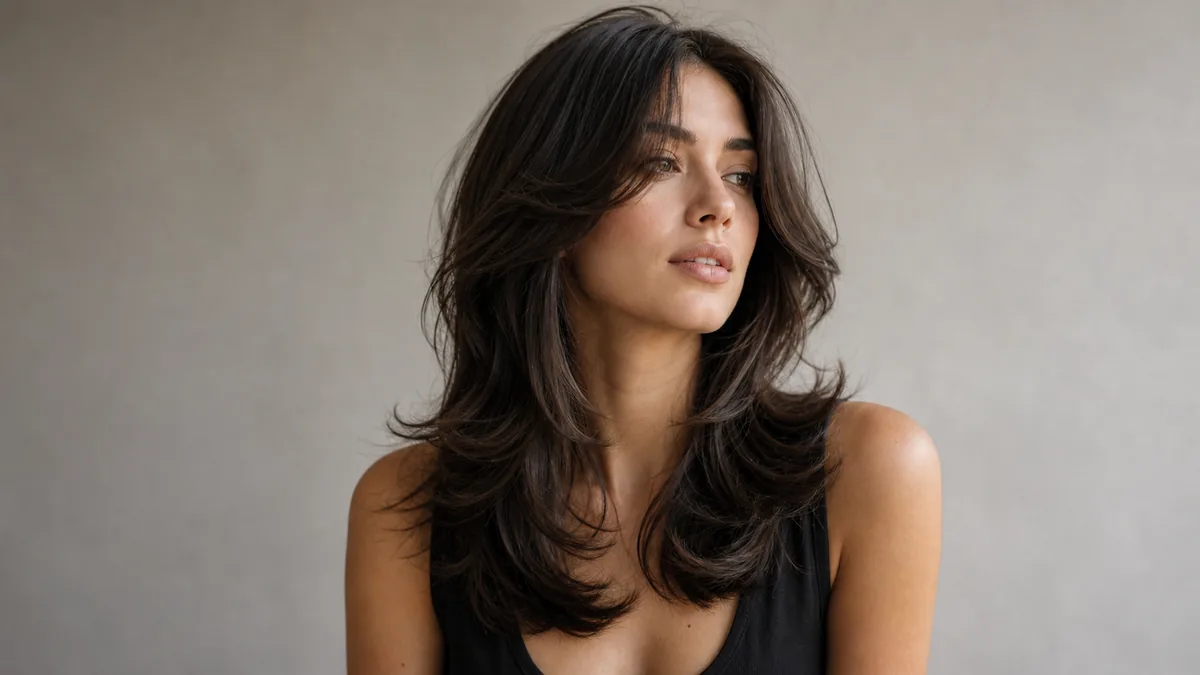
Long layers with face-framing volume are the most reliable hairstyle for a pear face shape, because they do the balancing work in two directions at once. The face-framing layers start high, around the cheekbones, and open outward at the temples, which widens the narrow upper half of the face, while the long layers below fall past the jaw in soft, tapered lengths that never puff out at chin level. The result is a face that looks longer and more oval, with the jaw softened rather than hidden, and hair that moves beautifully whether it is worn straight or waved.
Why it works for a pear face: the fullness sits at the temples and crown, exactly where a pear face is narrowest, and the ends stay light around the jaw. What to watch out for: layers that start at the jaw and flick outward will add width in the wrong place, so ask for the shortest layer to sit at the cheekbone, not the chin. One styling tip: blow-dry the face-framing pieces with a round brush, curving them away from the face, and the volume will hold all day.
2. Curtain Bangs with Shoulder-Length Layers
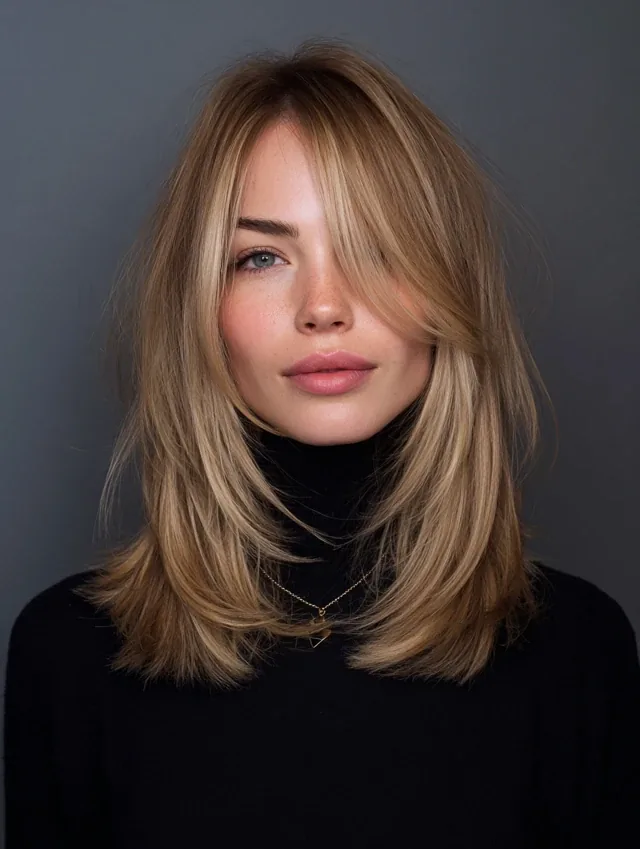
Curtain bangs with shoulder-length layers are the pear-face classic, and there is a good reason they appear on almost every face-shape list: the bangs part in the middle and sweep out to each side, creating a wide, soft frame across the forehead and temples, while the shoulder-length layers keep the hair light enough to move and long enough to fall past the jaw. It is a style that flatters almost every hair texture, grows out gracefully, and looks just as good air-dried as it does blow-dried, which makes it one of the easiest balancing cuts to live with.
Why it works for a pear face: the curtain bang widens the forehead visually, which is the whole point of balancing a pear shape. What to watch out for: bangs cut too short will close the forehead in instead of opening it, so keep them at cheekbone length or longer. One styling tip: blow-dry each side of the bang away from the centre part with a round brush, and they will fall into their natural curtain shape without any effort.
3. Side-Parted Lob

A side-parted lob is the short-to-medium cut that does the most for a pear face, because the deep side part throws a heavy sweep of hair across the forehead — instant width where it is needed most — while the lob length ends just past the jaw in soft, textured ends that do not draw a hard line. The asymmetry of the part also breaks up the symmetry of a wide jaw, so the face looks less blocky and more dynamic. It is polished enough for work, easy enough for every day, and one of the best choices if you want to go shorter without making your jaw the star of the show.
Why it works for a pear face: the side sweep adds diagonal width across the forehead and the lob ends below the jaw, not on it. What to watch out for: a centre-parted lob with blunt ends at chin level will do the opposite of what you want, so keep the part deep and the ends textured. One styling tip: part the hair while it is damp, then blow-dry the heavy side with a round brush for lift at the roots.
4. Voluminous Blowout with Layers at the Temples

A voluminous blowout with layers at the temples is the glamour version of pear-face balancing: big, bouncy hair with lift at the roots, fullness through the temples, and ends that curve softly under or fall in loose waves past the jaw. The volume is deliberately placed high, so the upper half of the face looks wide and the jaw looks proportionate, and the movement of the blowout keeps the whole style soft and feminine rather than severe. It is a salon favourite for a reason, and once you learn the round-brush technique, it is a routine you can repeat at home in under half an hour.
Why it works for a pear face: the blowout builds volume at the crown and temples, exactly where a pear face needs it. What to watch out for: volume that starts at the jaw and puffs outward will widen the lower face, so keep the lift at the roots and let the ends fall soft. One styling tip: blow-dry in sections with a large round brush, rolling the roots up and the ends under, and finish with a light hairspray so the lift lasts.
5. Textured Pixie with Volume on Top
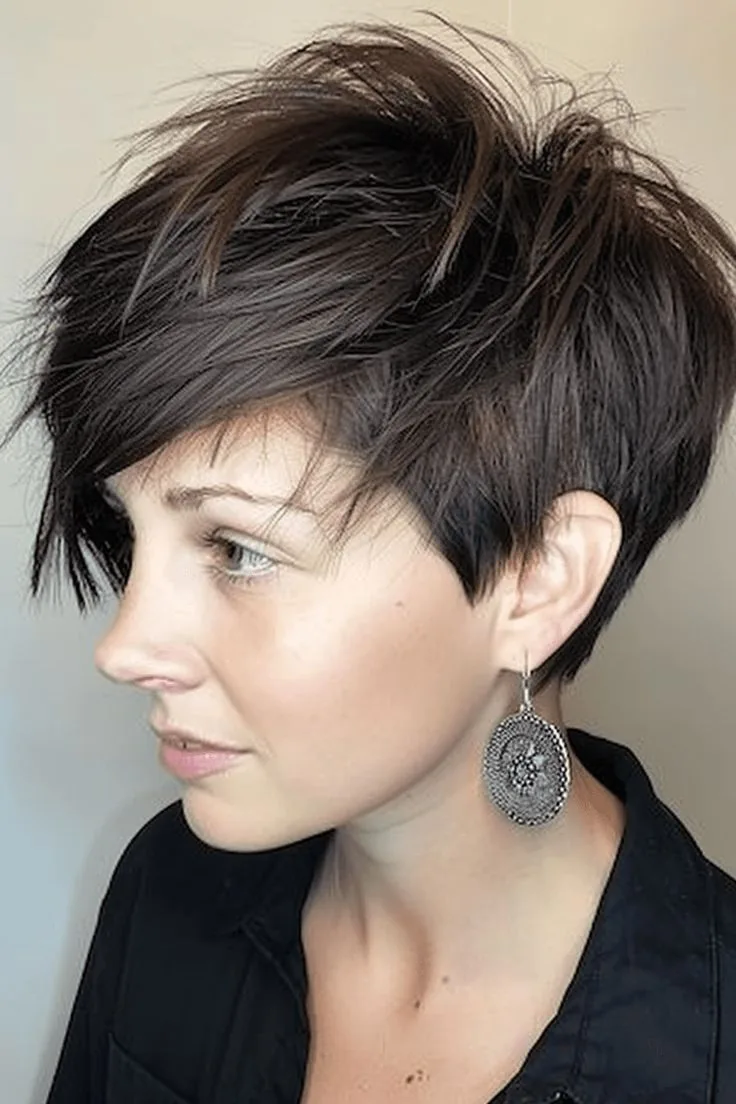
A textured pixie with volume on top is the boldest short choice for a pear face, and it works because the whole point of a pixie is the top: choppy, piecey layers on the crown create height and width at the forehead, while the sides are kept soft and tapered so they never add bulk at the jaw. The texture stops the short length from looking severe, and the height on top draws the eye upward, away from the jawline. It is a two-minute morning routine, a statement cut, and proof that short hair can balance a pear face just as well as long hair can.
Why it works for a pear face: the height and texture sit at the crown, widening the narrow forehead, while the tapered sides keep the jaw open. What to watch out for: a pixie that is flat on top and bulky at the sides will emphasise the jaw, so ask for texture and lift on top and a clean, tapered nape. One styling tip: a pea-sized amount of texturising paste, worked through the top with your fingers, is all it takes — let the cut do the work.
6. Chin-Length Bob with a Deep Side Sweep
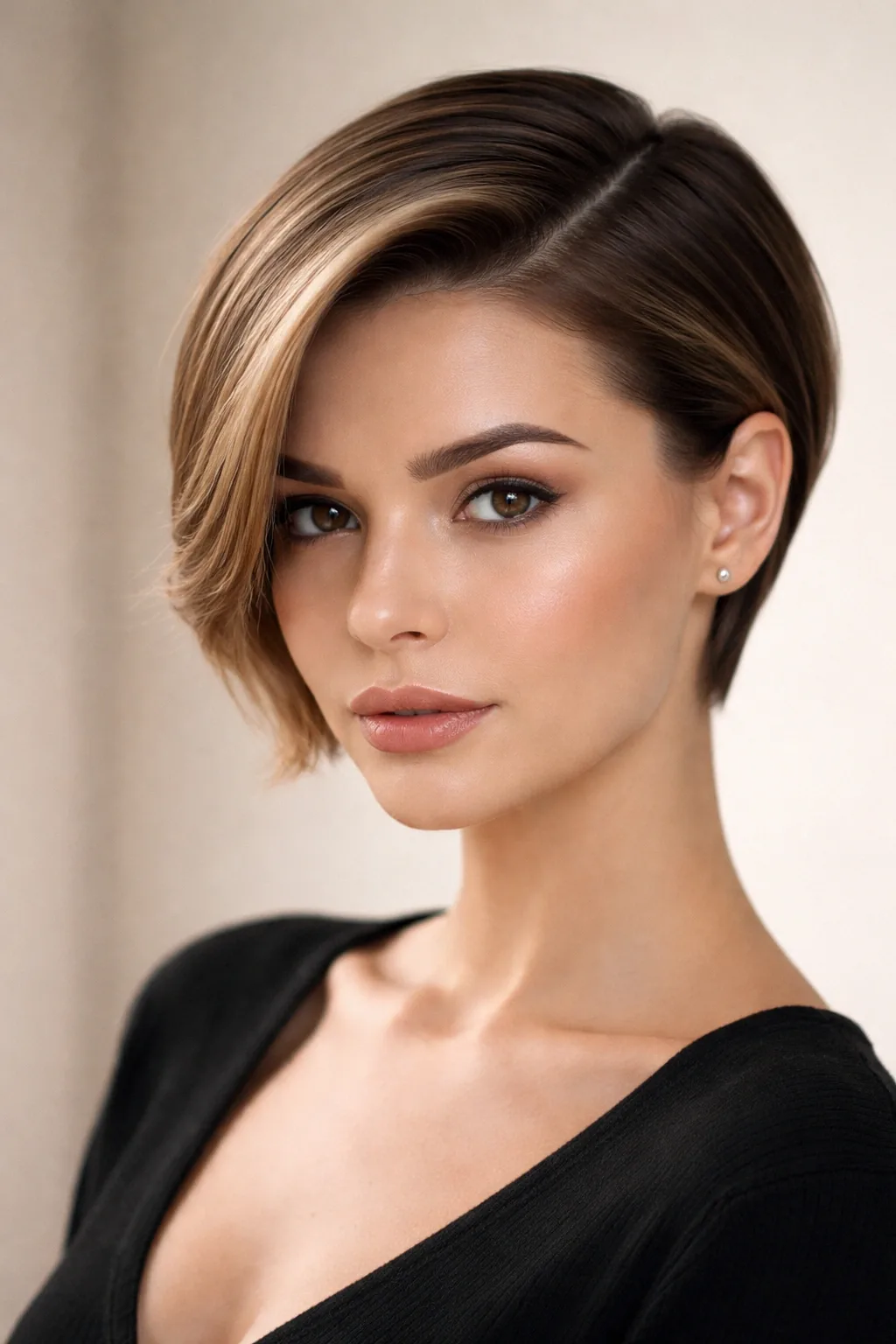
A chin-length bob with a deep side sweep is a careful exception to the rule about bobs ending at the jaw: it works because the deep side sweep does so much balancing work at the top that the chin length stops being a problem. The heavy sweep crosses the forehead diagonally, adding width and movement where the face is narrow, while the bob itself is kept soft and textured at the ends, with the front pieces curving slightly under so they frame the jaw rather than sitting on it. It is a chic, French-inspired cut that looks deliberate and polished rather than heavy.
Why it works for a pear face: the side sweep widens the forehead and creates a diagonal line that breaks up the jaw. What to watch out for: blunt, one-length ends sitting exactly on the jawbone will harden the jaw, so ask for textured, point-cut ends and a slight under-curve. One styling tip: tuck the shorter side behind the ear and let the longer side sweep across — the asymmetry is what makes this bob flattering.
7. Wavy Midi with a Side Part
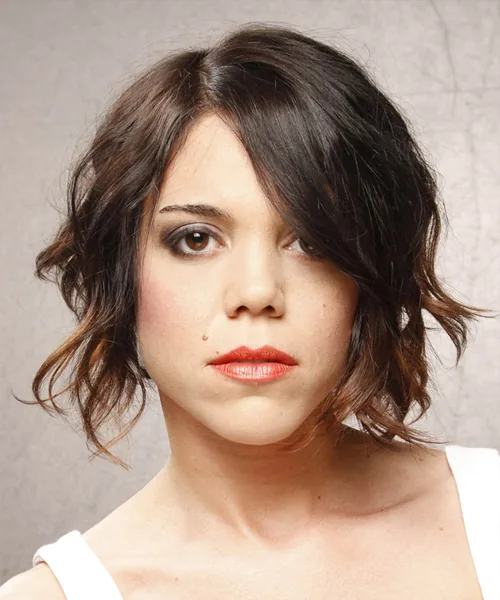
A wavy midi with a side part is the easy, everyday answer for a pear face: a collarbone-length cut with soft, undone waves and a side part that throws volume across the forehead, while the waves themselves start above the jaw and fall past it in a way that softens the jawline without adding bulk. The midi length is the most versatile there is — long enough to tie up, short enough to dry quickly — and the waves give it movement that straight hair at this length simply does not have. It is the cut for women who want balance without thinking about it every morning.
Why it works for a pear face: the side part widens the forehead and the waves soften the jaw without puffing out at chin level. What to watch out for: waves that are all the same size and start exactly at the jaw will create a wide band at the widest point, so vary the wave size and start them higher up. One styling tip: wrap sections around a curling wand, leave the ends out, and brush through for soft, uneven waves.
8. Feathered Layers with a Curtain Fringe
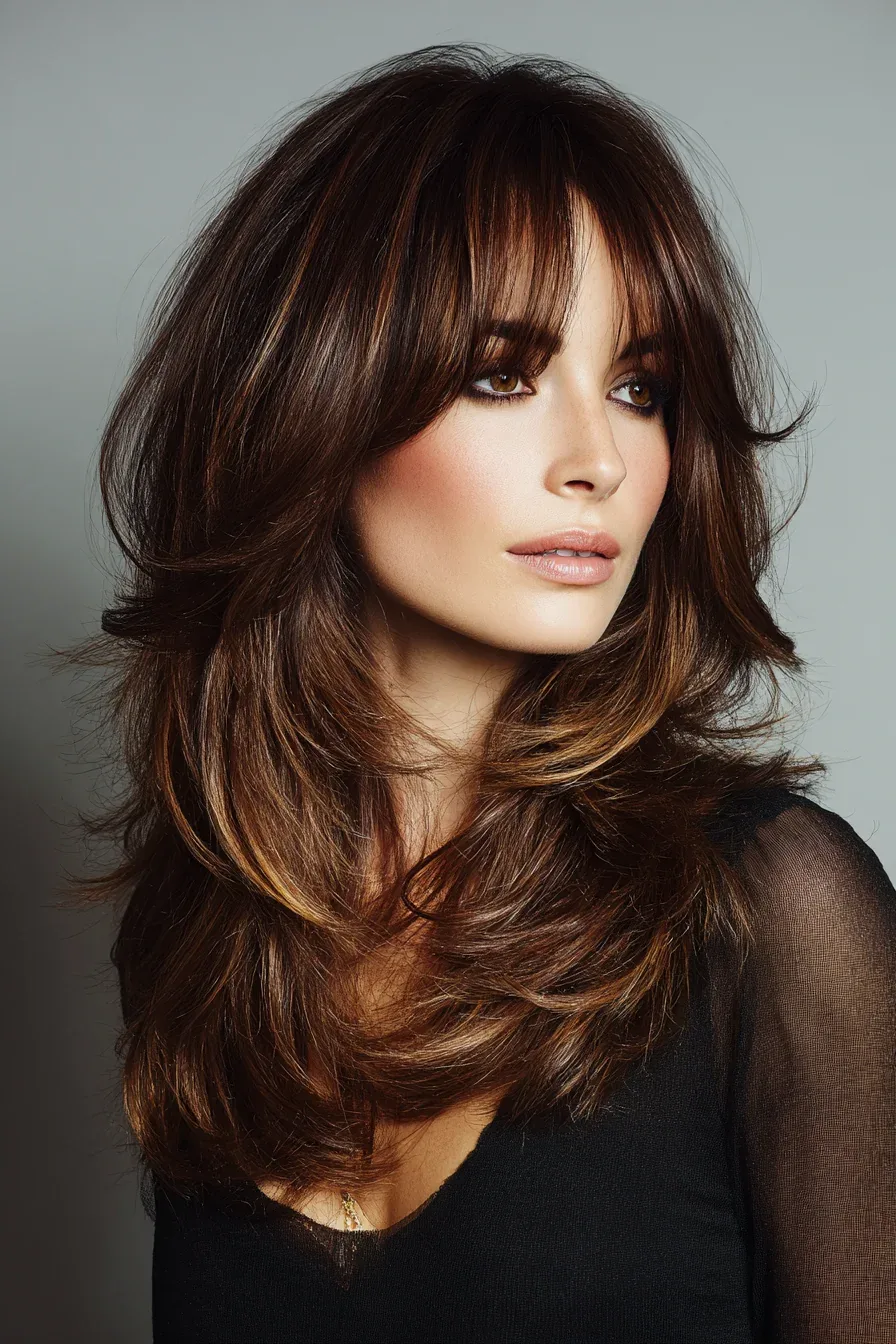
Feathered layers with a curtain fringe are the soft, seventies-inspired choice for a pear face, and they work because feathering is all about outward movement at the top: the layers are cut to flick away from the face at the temples and cheekbones, which widens the upper face, while the curtain fringe opens across the forehead and draws the eye upward. The feathered ends stay light and airy, so they never sit heavy on the jaw, and the whole style has a breezy, lived-in feel that suits wavy and straight hair alike. It is a cut with a lot of personality and very little maintenance.
Why it works for a pear face: the feathered layers flare outward at the temples, adding width where the face is narrow. What to watch out for: feathering that starts at the jaw will flare out at the widest point, so ask for the feathering to begin at the cheekbone. One styling tip: blow-dry the layers with a round brush, flicking them outward, and finish with a light texturising spray for movement.
9. Blunt Bob with Volume at the Crown
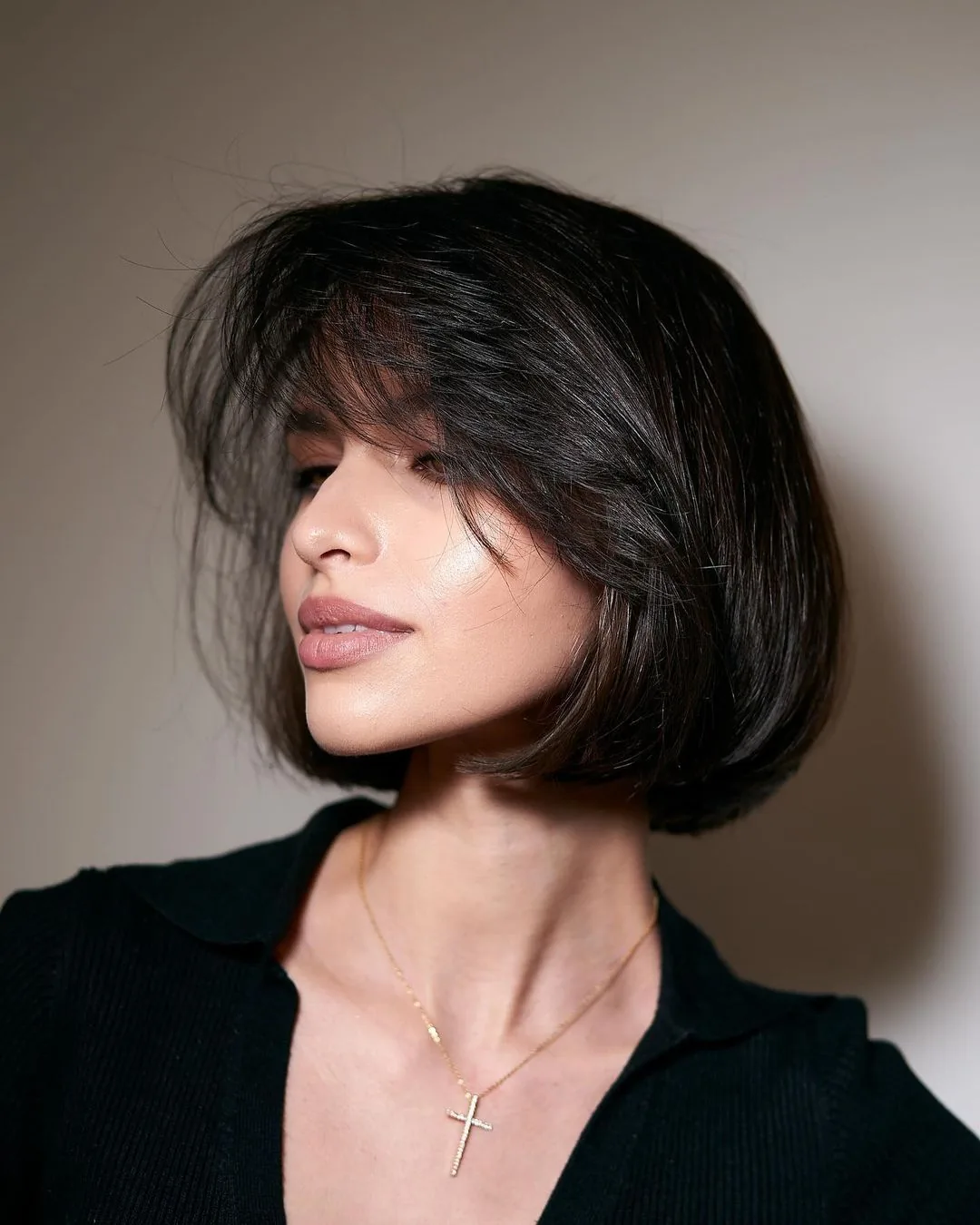
A blunt bob with volume at the crown is the sharp, modern bob for a pear face — but only because the crown volume changes the whole equation. A blunt bob on its own can harden a jawline, yet when the top is lifted and full, the eye goes to the crown and the forehead, not to the ends, and the blunt edge reads as a deliberate, graphic line rather than a heavy frame around the jaw. The key is the contrast: big on top, clean and controlled at the bottom, with the ends kept slightly under so they curve toward the neck instead of flaring out at the jaw.
Why it works for a pear face: the crown volume widens the top of the face and balances the blunt ends. What to watch out for: a flat crown with a blunt bob will put all the attention on the jaw, so root lift is not optional here — it is the whole point. One styling tip: use a root-lifting spray at the crown, blow-dry the roots upward with a round brush, and keep the ends smooth with a flat iron.
10. Long Shag with Wispy Bangs
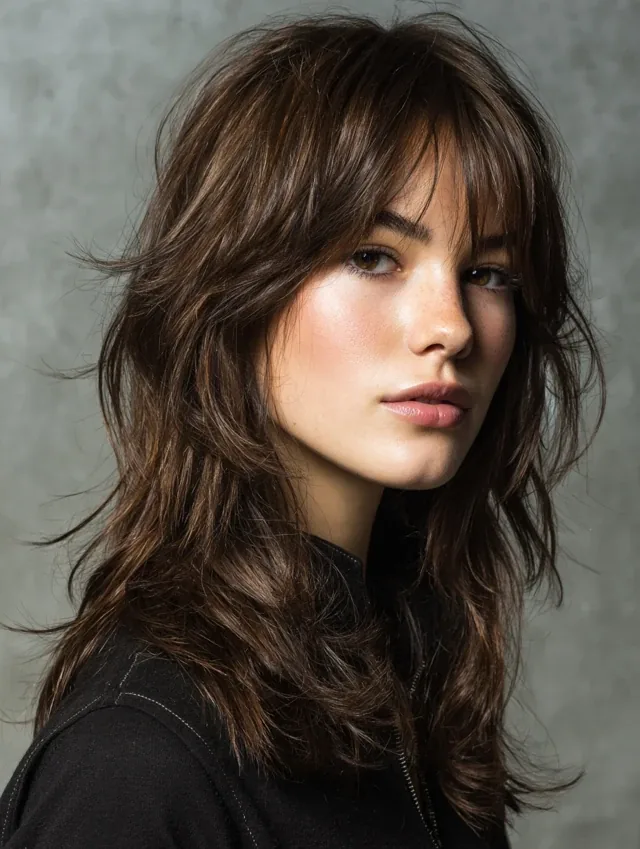
A long shag with wispy bangs is the textured, rock-and-roll choice for a pear face, and it works because a shag is built from short layers on top: choppy, uneven layers around the crown and temples create width and movement exactly where a pear face needs it, while the longer layers underneath fall past the jaw without adding bulk. The wispy bangs add a light, see-through texture across the forehead, which widens it visually without the heaviness of a blunt fringe. It is a wash-and-go cut that looks better slightly grown out, because the texture hides the roots and the shape holds for months.
Why it works for a pear face: the short top layers add width at the temples, and the wispy bangs soften the forehead. What to watch out for: a shag with too much bulk at the ends will widen the jaw, so ask for the weight to be removed from the bottom layers. One styling tip: a little texturising spray on damp hair, scrunch and air-dry, and the cut does the rest.
11. Half-Up Hairstyle with Volume at the Crown
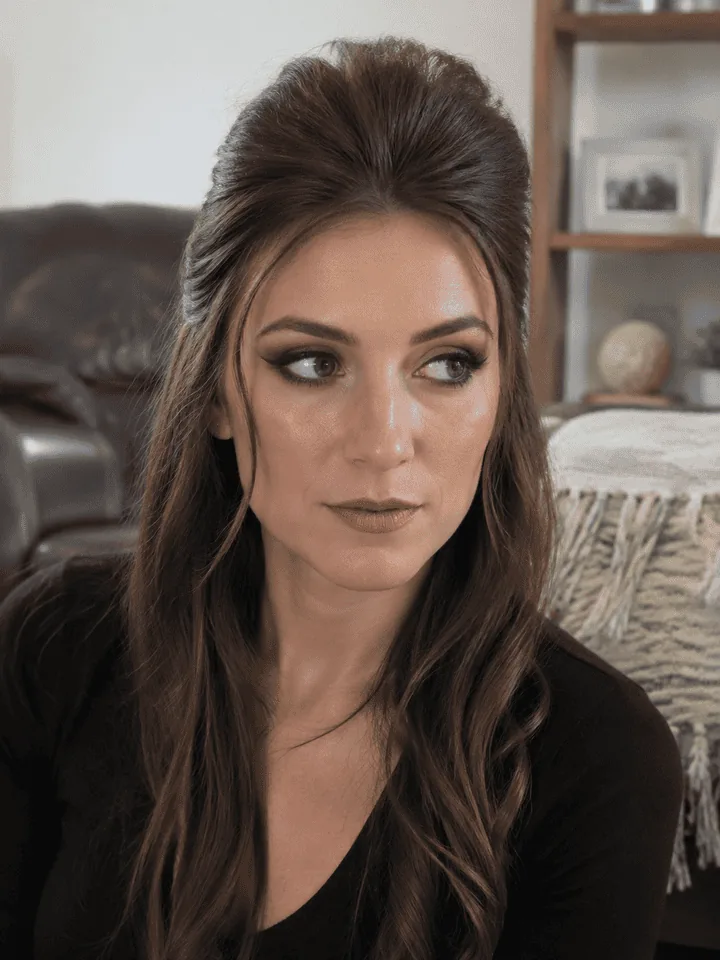
A half-up hairstyle with volume at the crown is the updo that actually flatters a pear face, because it does two balancing jobs at once: the top half is lifted and pinned with height at the crown, which widens the forehead and adds vertical lift, while the bottom half falls loose around the shoulders and past the jaw, softening the jawline instead of exposing it. A few face-framing pieces left out around the temples complete the effect, breaking up the outline of the jaw and keeping the style soft. It is romantic, practical, and one of the easiest styles to do on yourself.
Why it works for a pear face: the crown height widens the top of the face, and the loose lengths soften the jaw. What to watch out for: a flat, scraped-back half-up with no volume and no loose pieces will expose the full width of the jaw, so backcomb the crown and leave pieces out. One styling tip: tease the crown lightly before pinning, then pull a few strands loose around the face and curl them softly.
12. Side-Swept Bangs with Long Layers
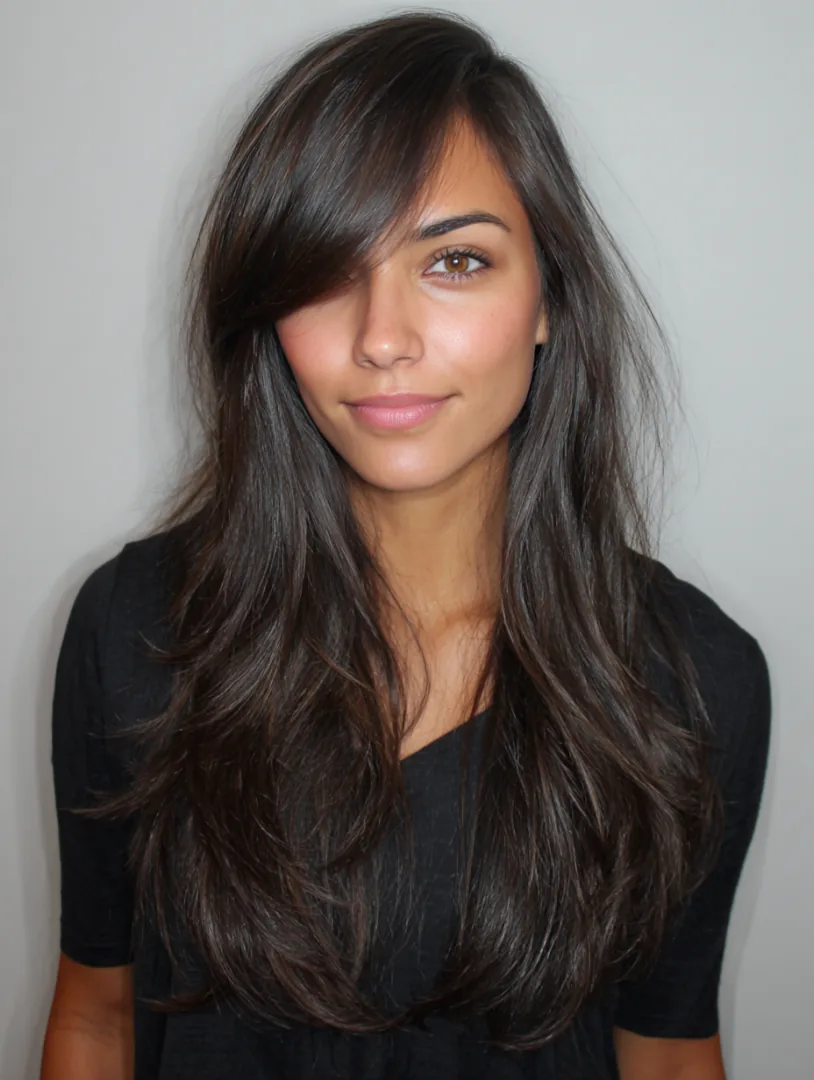
Side-swept bangs with long layers are the classic face-framing combination for a pear face, because the bang sweeps diagonally across the forehead in one long, soft line, instantly adding width and a sense of movement to the narrowest part of the face, while the long layers fall past the jaw in tapered lengths that never sit heavy at chin level. The diagonal line is the secret: it breaks up the horizontal width of the jaw and makes the whole face look more dynamic and less blocky. It suits almost every hair texture and grows out beautifully, blending into the layers within a few weeks.
Why it works for a pear face: the diagonal sweep adds width across the forehead and breaks up the jawline. What to watch out for: bangs that are too short and too blunt will shorten the forehead instead of widening it, so keep them long enough to sweep past the eyebrow. One styling tip: blow-dry the bangs to one side with a round brush while they are damp, and they will hold their sweep all day.
13. Bouncy Curly Cut with Layers on Top
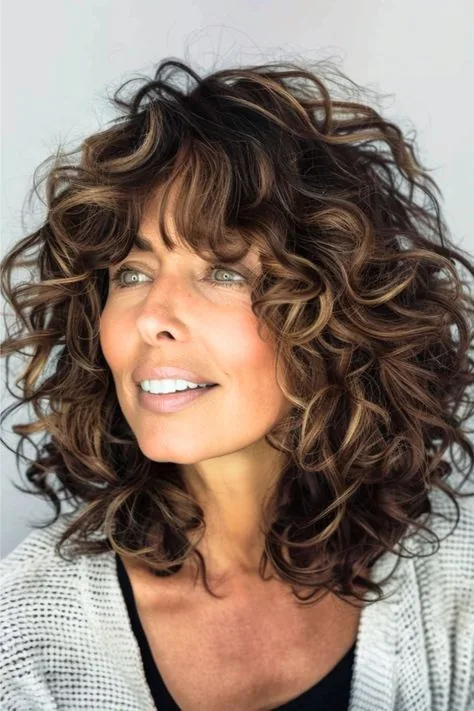
A bouncy curly cut with layers on top is the curly-haired answer to a pear face, and the rule for curls is the same as for straight hair: the volume goes on top. Short, rounded layers at the crown let the curls spring up and outward around the forehead and temples, widening the upper face, while the longer layers underneath are kept tapered so the curls fall past the jaw in a narrower shape instead of puffing out into a triangle. The result is curls that look abundant and joyful without making the lower face look wider, and a shape that holds its balance as it grows.
Why it works for a pear face: the top layers create width and height at the crown, and the tapered lower layers keep the jaw from looking wider. What to watch out for: one-length curls with no layers will form a triangle that is widest at the jaw, which is exactly the shape to avoid, so layers on top are essential. One styling tip: apply curl cream to damp hair, diffuse with the head tipped forward so the roots lift, and scrunch out the crunch once dry.
14. Asymmetrical Bob with Soft Angles
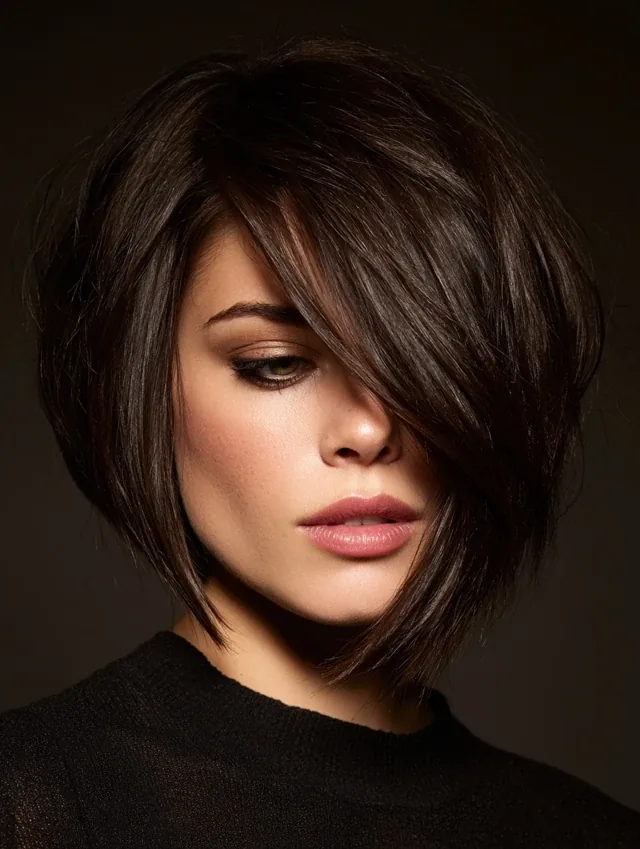
An asymmetrical bob with soft angles is the modern, architectural choice for a pear face, because asymmetry breaks up the symmetry of a wide jaw in a way that no symmetrical cut can. One side falls a little longer than the other, which creates a diagonal line across the face, and the soft, textured ends keep the cut from looking severe. The longer side draws the eye downward and softens the jaw on that side, while the shorter side opens up the face and shows off the cheekbone. It is a confident, contemporary cut that photographs beautifully and grows out with its shape intact.
Why it works for a pear face: the diagonal asymmetry breaks up the horizontal line of the jaw. What to watch out for: a sharp, blunt asymmetry with a hard edge at the jaw will harden the jawline, so ask for soft, point-cut ends and a gentle angle. One styling tip: blow-dry smooth with a paddle brush, tuck the shorter side behind the ear, and let the longer side fall forward to frame the jaw.
15. Soft Curls with a Side Part
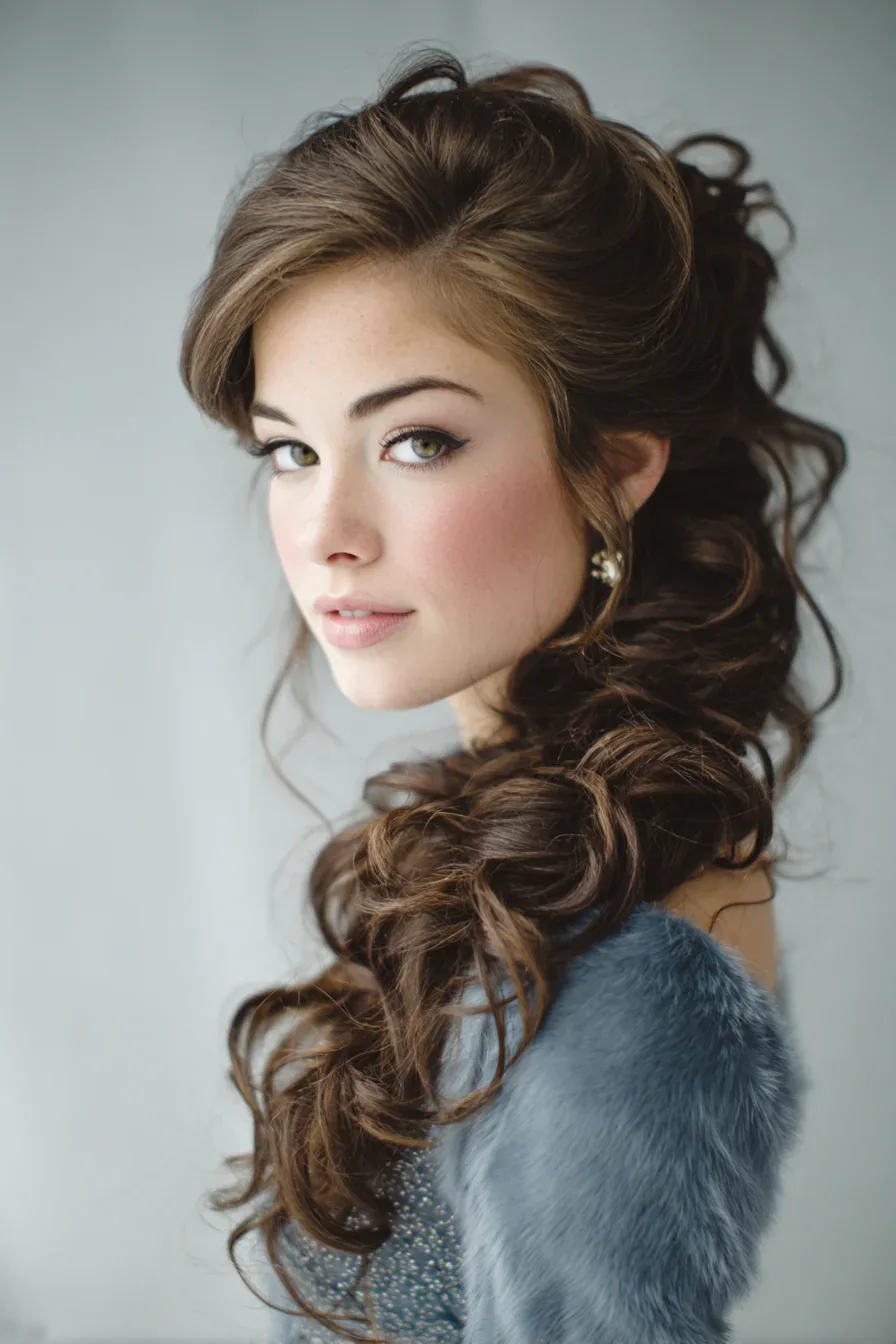
Soft curls with a side part are the romantic, feminine choice for a pear face, because the side part throws a heavy sweep across the forehead while the curls themselves are kept soft and loose, starting above the jaw and falling past it in gentle waves that blur the jawline instead of framing it. The softness is the point: these are not tight ringlets that puff outward, but brushed-out, touchable curls that move when you move and catch the light at the temples. It is a style that works for weddings, date nights and everyday wear alike, and it suits medium to long hair of almost any texture.
Why it works for a pear face: the side part widens the forehead, and the soft curls blur the jawline without adding bulk. What to watch out for: tight curls that start at the jaw and spring outward will add width at the widest point, so keep the curls loose and start them higher up. One styling tip: wrap sections around a large-barrel curling iron, brush the curls out for softness, and finish with a light-hold spray.
16. Layered Bob with Crown Volume
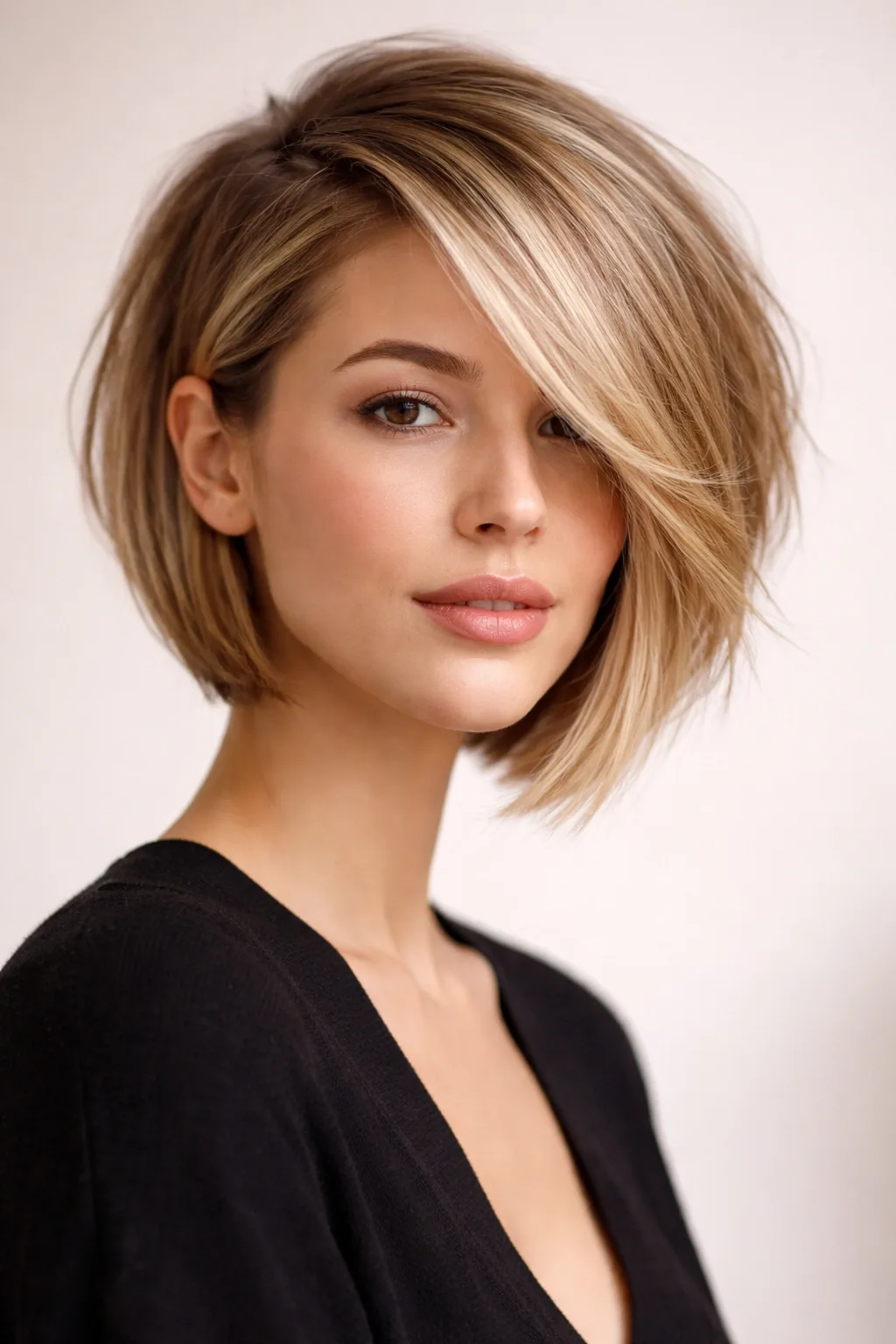
A layered bob with crown volume is the bob that actually works for a pear face, because the layers are doing the opposite of what most bobs do: instead of adding weight at the ends, they remove it, and instead of sitting flat on top, they lift. The crown is layered short and full, which widens the forehead and temples, while the ends are tapered and textured so they fall close to the neck and never flare out at the jaw. It is a bob with movement and height, not a bob with a heavy edge, and that difference is everything for a pear-shaped face.
Why it works for a pear face: the crown layers add width at the top, and the tapered ends keep the jaw soft. What to watch out for: a layered bob with the shortest layers at the jaw will puff out at chin level, so ask for the layering to be concentrated at the crown. One styling tip: blow-dry the crown with a round brush, lifting the roots upward, and use a flat iron only on the very ends to keep them smooth.
17. Long Waves with a Deep Side Part
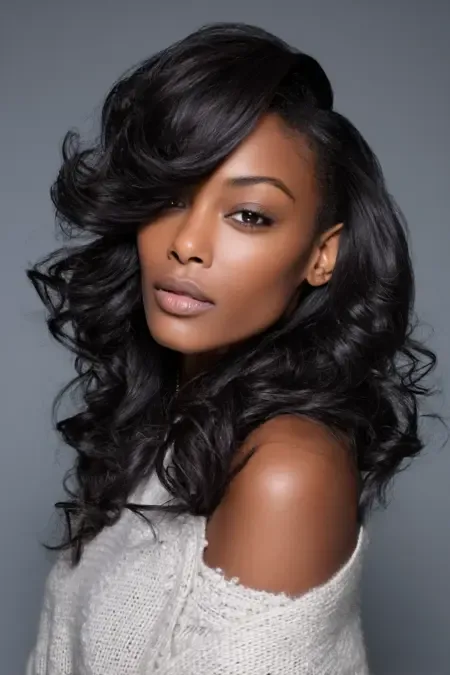
Long waves with a deep side part are the simplest balancing style for a pear face, and sometimes the simplest is the best: the deep part throws a heavy, glossy sweep across the forehead, the waves start at cheek level and fall past the jaw in soft, uneven lengths, and the whole look is long, flowing and feminine without ever adding bulk at the chin. The length itself helps, because long hair draws the eye downward and makes the face look longer and narrower overall, which softens the width of the jaw by proportion. It is a low-maintenance style that looks expensive with very little effort.
Why it works for a pear face: the deep side part widens the forehead, and the long length elongates the face. What to watch out for: waves that are all the same length and volume at the jaw will create a wide band at the widest point, so vary the wave size and keep the roots lifted. One styling tip: part deeply while the hair is damp, then wrap the front sections around a curling wand away from the face.
18. French Bob with Bangs
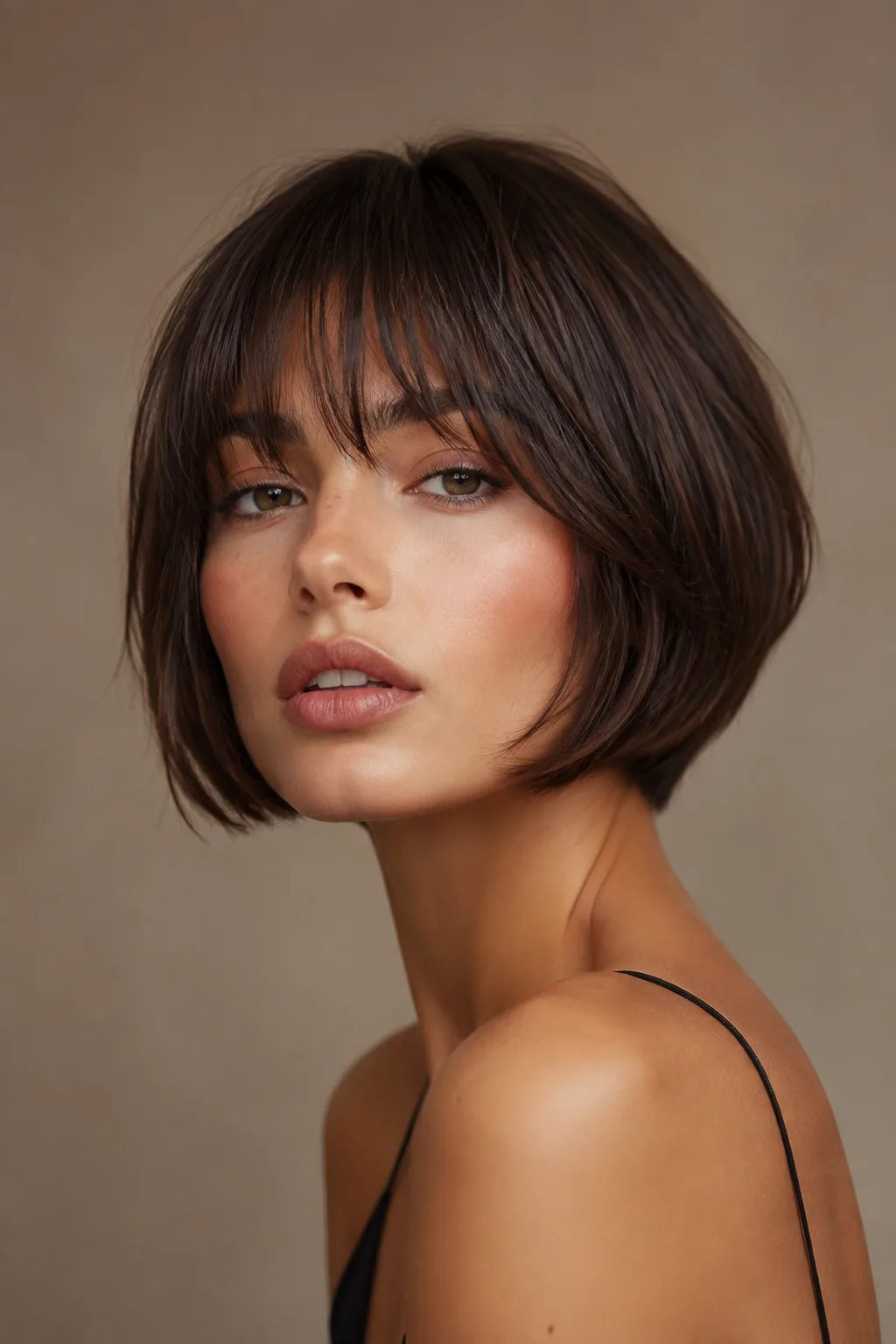
A French bob with bangs is the chic, Parisian choice for a pear face, and it works when the bangs and the volume are placed correctly: the fringe sits across the forehead and widens it, the bob itself is short and swingy with volume at the crown, and the ends are kept soft and textured rather than blunt, so they never draw a hard line at the jaw. The French bob is shorter than most bobs, which means it ends above the jaw rather than on it, and that short length, combined with the fringe, keeps the balance firmly at the top of the face. It is a bold, fashionable cut with a lot of personality.
Why it works for a pear face: the bangs widen the forehead and the short length ends above the jaw, not on it. What to watch out for: a French bob with a heavy, blunt fringe and flat crown will close the forehead in and expose the jaw, so keep the fringe soft and the crown lifted. One styling tip: blow-dry the fringe forward with a round brush, then sweep it slightly to one side for a soft, lived-in finish.
19. Butterfly Cut with Face-Framing Layers
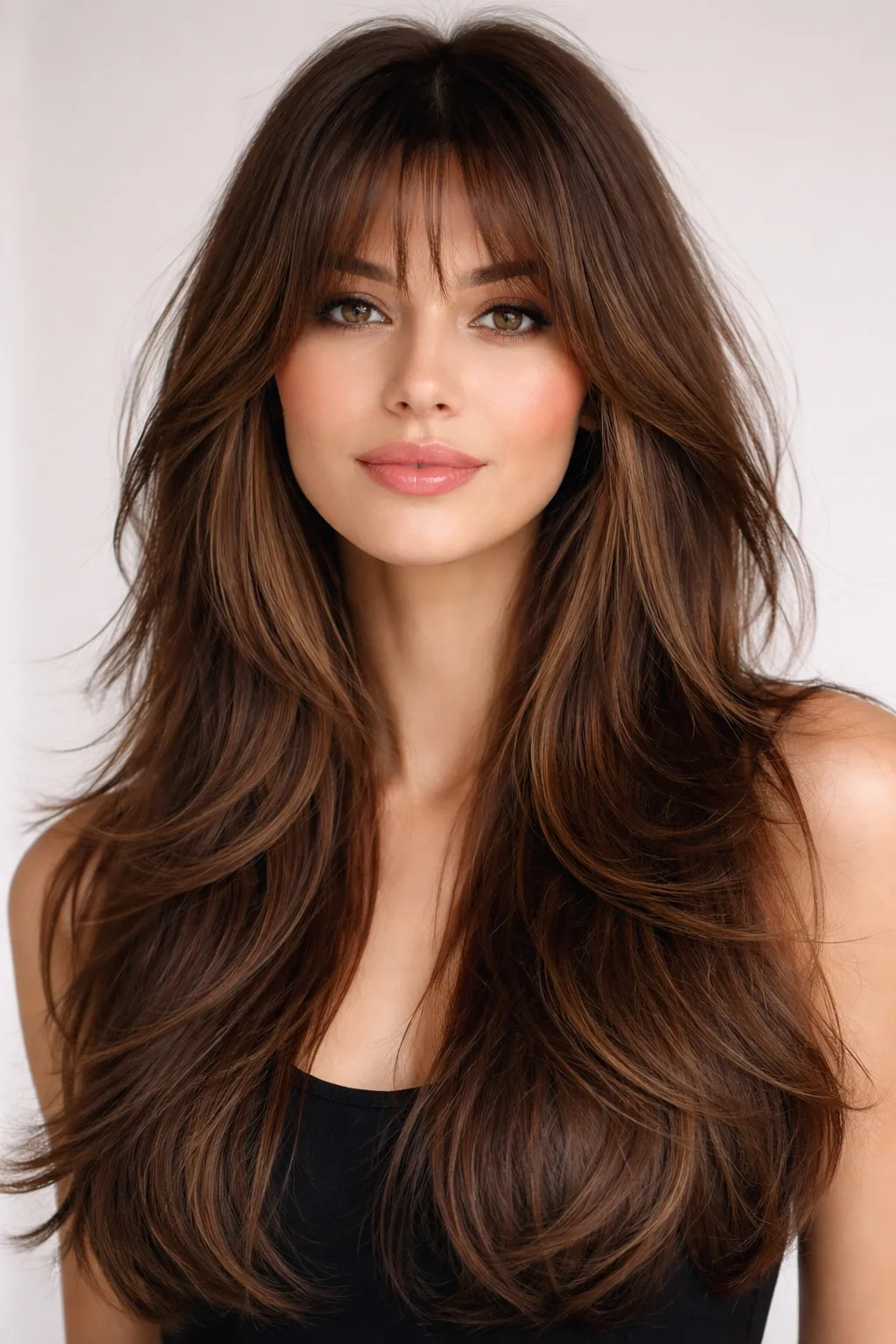
The butterfly cut with face-framing layers is the viral layered cut that happens to be excellent for a pear face, because its whole design is top-heavy: short, bouncy layers at the crown and around the face create width and movement at the forehead and temples, while the long layers underneath fall past the jaw without adding bulk. The face-framing pieces are the key — they start at the cheekbone, open outward, and draw the eye to the upper half of the face, while the length underneath keeps the overall shape long and balanced. It is a cut that looks twice as thick as it is, with movement that photographs beautifully.
Why it works for a pear face: the short top layers add width at the temples, and the long bottom layers keep the jaw soft. What to watch out for: face-framing layers that start at the jaw will widen the lower face, so ask for them to start at the cheekbone. One styling tip: blow-dry the top layers with a round brush for lift, flip the ends out slightly, and finish with a light texturising spray.
20. Textured Lob with Bangs

A textured lob with bangs is the modern, low-effort lob for a pear face, because the bangs fill in the narrow forehead while the textured ends keep the lob from sitting heavy at the jaw. The texture is what makes this lob different from a blunt one: the ends are point-cut and uneven, so they move and separate instead of forming a solid line, and the layers through the crown add lift and width at the top. It is shoulder-length, which means it grows out well, ties up easily, and suits almost every hair texture from straight to wavy. It is also one of the easiest cuts to style in the morning.
Why it works for a pear face: the bangs widen the forehead, and the textured ends soften the jawline. What to watch out for: a lob with blunt ends at chin level and no bangs will do the opposite of what you want, so keep the ends textured and the fringe soft. One styling tip: rough-dry with a little mousse, bend the ends under with a flat iron, and let the bangs fall naturally across the forehead.
21. High Ponytail with Face-Framing Pieces
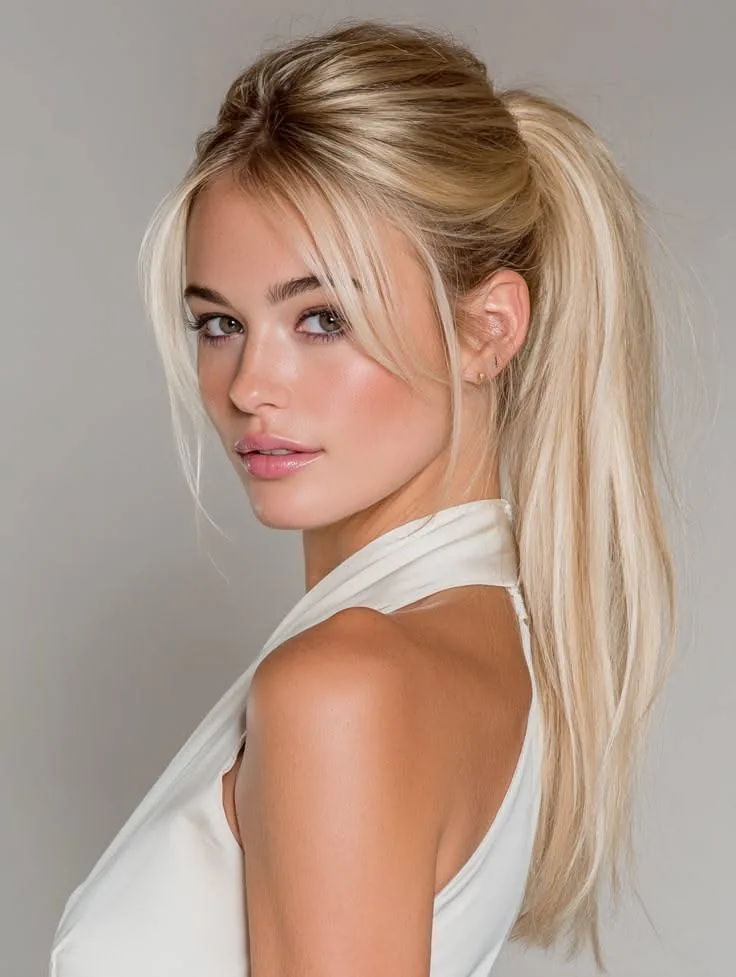
A high ponytail with face-framing pieces is the energetic, lifted style that can work for a pear face — but only with the pieces left out. A high ponytail on its own, scraped back tight with nothing around the face, will expose the full width of the jaw and make it look wider, which is why the face-framing pieces matter so much: two soft strands left out at the temples break up the outline of the jaw, add width at the forehead, and keep the style from looking severe. The height of the ponytail also helps, because it adds vertical lift and draws the eye upward, away from the jawline.
Why it works for a pear face: the height lifts the eye upward, and the loose pieces soften the jaw and widen the temples. What to watch out for: a tight, scraped-back ponytail with no volume and no loose pieces will emphasise the jaw, so always leave pieces out and add lift at the crown. One styling tip: gather the hair high, secure tightly, wrap a small section around the band, and curl the loose pieces softly around the face.
22. Low Chignon with a Side Sweep

A low chignon with a side sweep is the elegant updo for a pear face, because the side sweep does the balancing work before the updo even starts: it crosses the forehead diagonally, adding width and movement, while the chignon itself sits low and soft at the nape, with a few loose pieces left out around the face to break up the jawline. Unlike a tight, scraped-back bun, this chignon is deliberately loose and soft, with volume at the crown and texture at the front, so the face is framed rather than exposed. It is a wedding-guest favourite and a formal-occasion classic for a reason.
Why it works for a pear face: the side sweep widens the forehead, and the loose pieces soften the jaw. What to watch out for: a slicked-back chignon with no volume and no loose pieces will expose the jaw completely, so keep the front soft and the crown lifted. One styling tip: sweep the front to one side, twist the hair into a loose knot at the nape, and pull out a few face-framing pieces to soften the front.
23. Braided Crown with Volume on Top
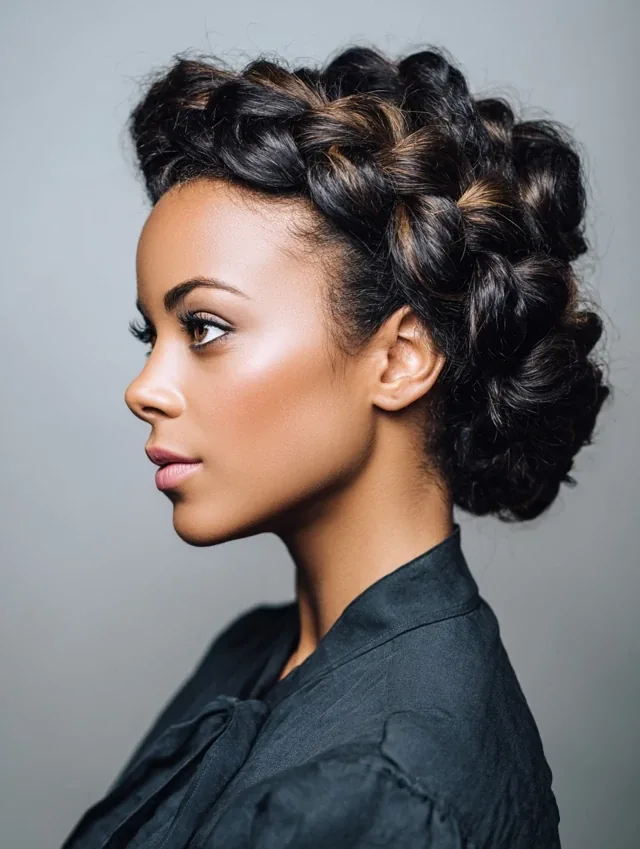
A braided crown with volume on top is the romantic, festival-ready style that flatters a pear face, because the braid itself sits across the crown like a halo, adding width and interest at the top of the face, while the volume underneath it lifts the forehead and temples. The braid draws the eye upward and across, rather than down to the jaw, and the loose lengths underneath fall past the jaw in soft waves that soften it. It is a special-occasion style that also works for holidays and summer evenings, and it keeps the hair off the face and neck while still looking soft and feminine.
Why it works for a pear face: the braid adds width at the crown, and the loose lengths soften the jaw. What to watch out for: a tight braid pulled flat against the scalp with no volume will expose the forehead and jaw, so keep the crown lifted and the braid slightly loosened. One styling tip: curl the hair first for grip, braid across the crown, pull the braid apart gently for fullness, and leave face-framing pieces out.
24. Sleek Mid-Part Long Layers
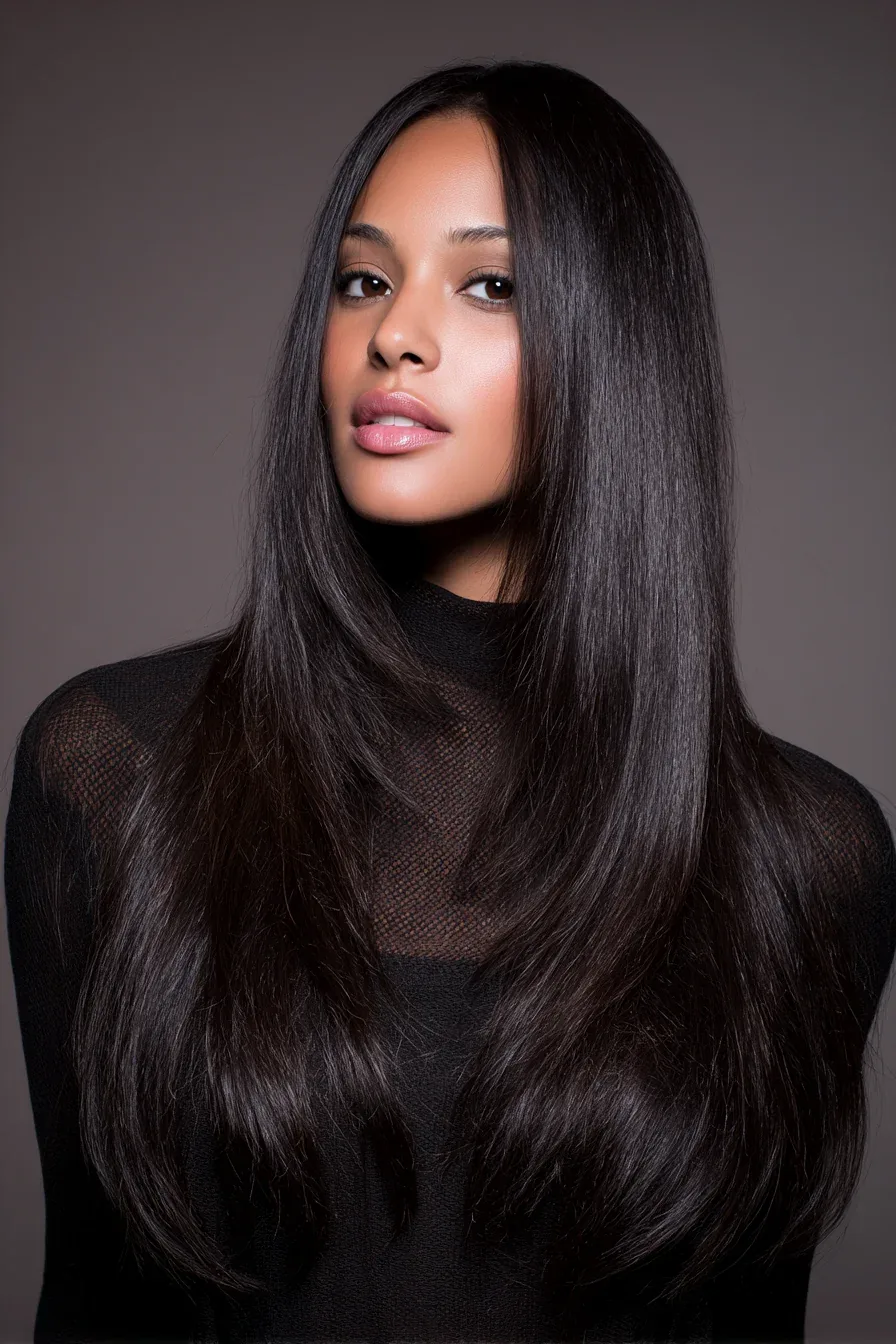
Sleek mid-part long layers are the riskiest style on this list for a pear face, and they are included because they can work — if the volume is right. A centre part with flat, straight hair and no lift will split the face in two and leave the jaw unopposed, but the same part with root lift, face-framing layers that open outward at the temples, and long layers that fall past the jaw can look sleek and elegant rather than heavy. The key is the lift: without volume at the crown, this style fails for a pear face, and with it, it can look polished and expensive.
Why it works for a pear face: only when the roots are lifted and the face-framing layers open outward at the temples, widening the forehead. What to watch out for: flat roots and pin-straight lengths with a centre part will make the jaw look wider, so this is a style that needs styling every time — never wear it flat. One styling tip: use a root-lifting spray, blow-dry the roots upward, and curve the face-framing layers away from the face with a round brush.
25. Wavy Shag with Curtain Bangs
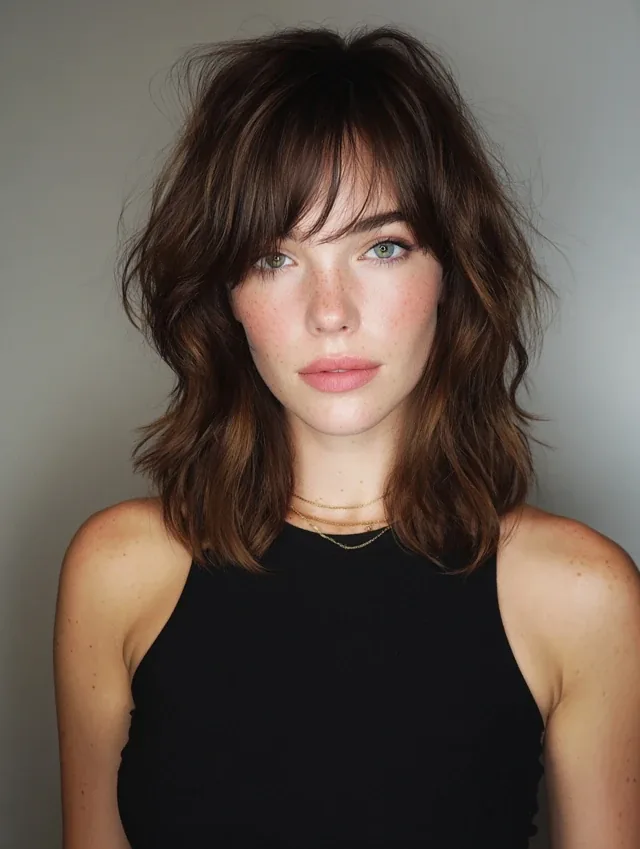
A wavy shag with curtain bangs is the textured, lived-in choice for a pear face, because a shag is built from short layers on top and curtain bangs are built to widen the forehead — together, they put all the width exactly where a pear face needs it. The wavy texture keeps the layers soft and separated, so they never form a heavy block at the jaw, and the longer layers underneath fall past the chin in a tapered shape that softens the jawline. It is a cut with a lot of movement, very little maintenance, and a shape that looks better slightly grown out, because the texture hides the roots.
Why it works for a pear face: the top layers and curtain bangs widen the forehead and temples, while the tapered ends keep the jaw soft. What to watch out for: a shag with too much bulk at the ends will widen the lower face, so ask for the weight to be removed from the bottom layers. One styling tip: a little texturising spray on damp hair, scrunch and air-dry, and let the natural wave do the work.
26. Short Bob with a Textured Top

A short bob with a textured top is the short, modern cut for a pear face that works because the texture is concentrated where it matters: on top. Choppy, piecey layers at the crown create height and width at the forehead, while the sides are kept soft and tapered so they never add bulk at the jaw, and the ends are textured rather than blunt so they move instead of sitting in a solid line. It is a bob that looks current and effortless, with a morning routine that takes two minutes, and it suits fine to medium hair particularly well, because the texture creates the illusion of fullness.
Why it works for a pear face: the textured top adds width and height at the crown, while the tapered sides keep the jaw open. What to watch out for: a short bob that is bulky at the sides and flat on top will emphasise the jaw, so ask for the texture on top and a clean, tapered nape. One styling tip: a little texturising paste worked through the top with your fingers, and the cut does the rest.
27. Long Curtain Layers
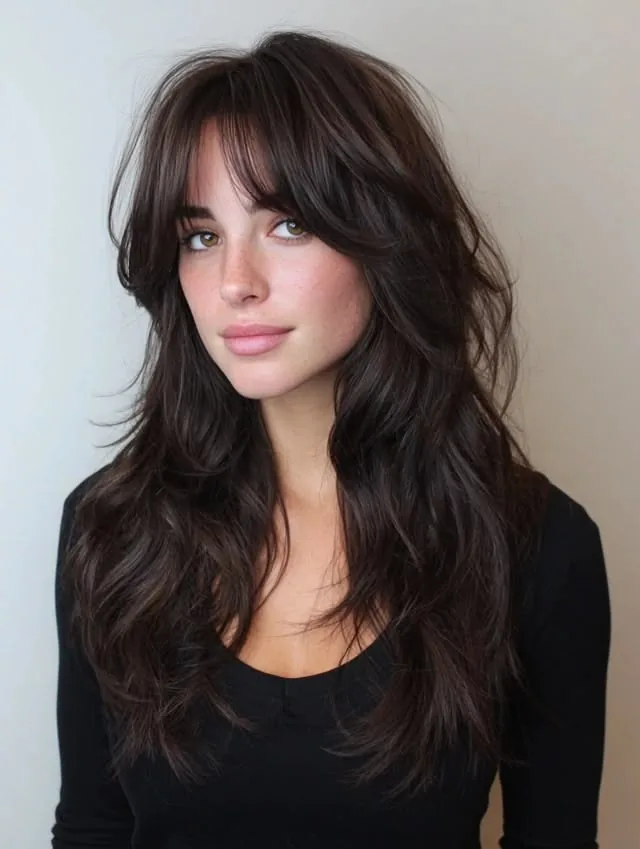
Long curtain layers are the soft, flowing choice for a pear face, because the layers are cut to open like a curtain around the face: they start at the cheekbones, sweep outward at the temples, and fall in long, tapered lengths past the jaw, which widens the upper face and softens the lower face in a single movement. The length draws the eye downward and makes the face look longer, while the curtain shape keeps the hair from falling flat against the forehead. It is a versatile, low-maintenance style that works straight, wavy or curled, and grows out beautifully because the layers are long and gradual.
Why it works for a pear face: the curtain layers open outward at the temples, adding width where the face is narrowest. What to watch out for: layers that start at the jaw will open outward at the widest point, so ask for the shortest layer to sit at the cheekbone. One styling tip: blow-dry the face-framing pieces with a round brush, curving them away from the face, and the curtain shape will hold all day.
28. Side-Parted Pixie with a Long Fringe
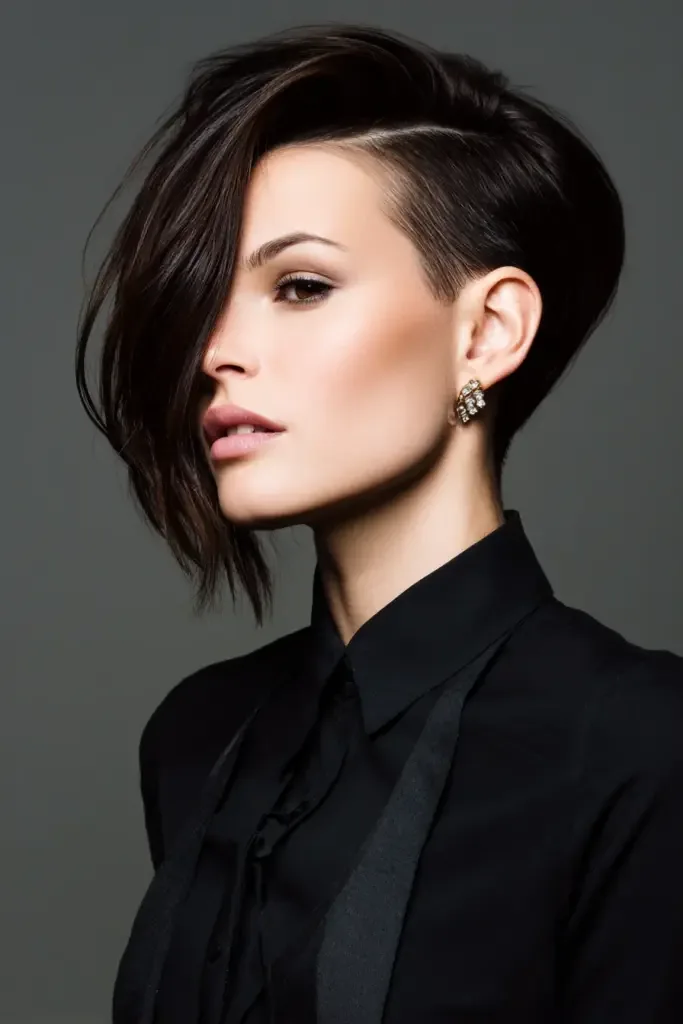
A side-parted pixie with a long fringe is the short cut that balances a pear face with a single diagonal line: the long fringe sweeps across the forehead from a deep side part, adding width and movement where the face is narrowest, while the pixie itself is kept textured on top and tapered at the sides, so it never adds bulk at the jaw. The long fringe is the key — it gives a pixie the softness and the face-framing that a short fringe cannot, and it can be worn swept to the side, tucked behind the ear, or pushed forward, which makes the style surprisingly versatile for such a short cut.
Why it works for a pear face: the long fringe sweeps across the forehead, widening it, while the tapered sides keep the jaw open. What to watch out for: a pixie with a short, blunt fringe and flat top will close the forehead in and expose the jaw, so keep the fringe long and the top textured. One styling tip: blow-dry the fringe to one side with a round brush, and use a little texturising paste on the top for lift.
29. Voluminous Curls with a Side Part
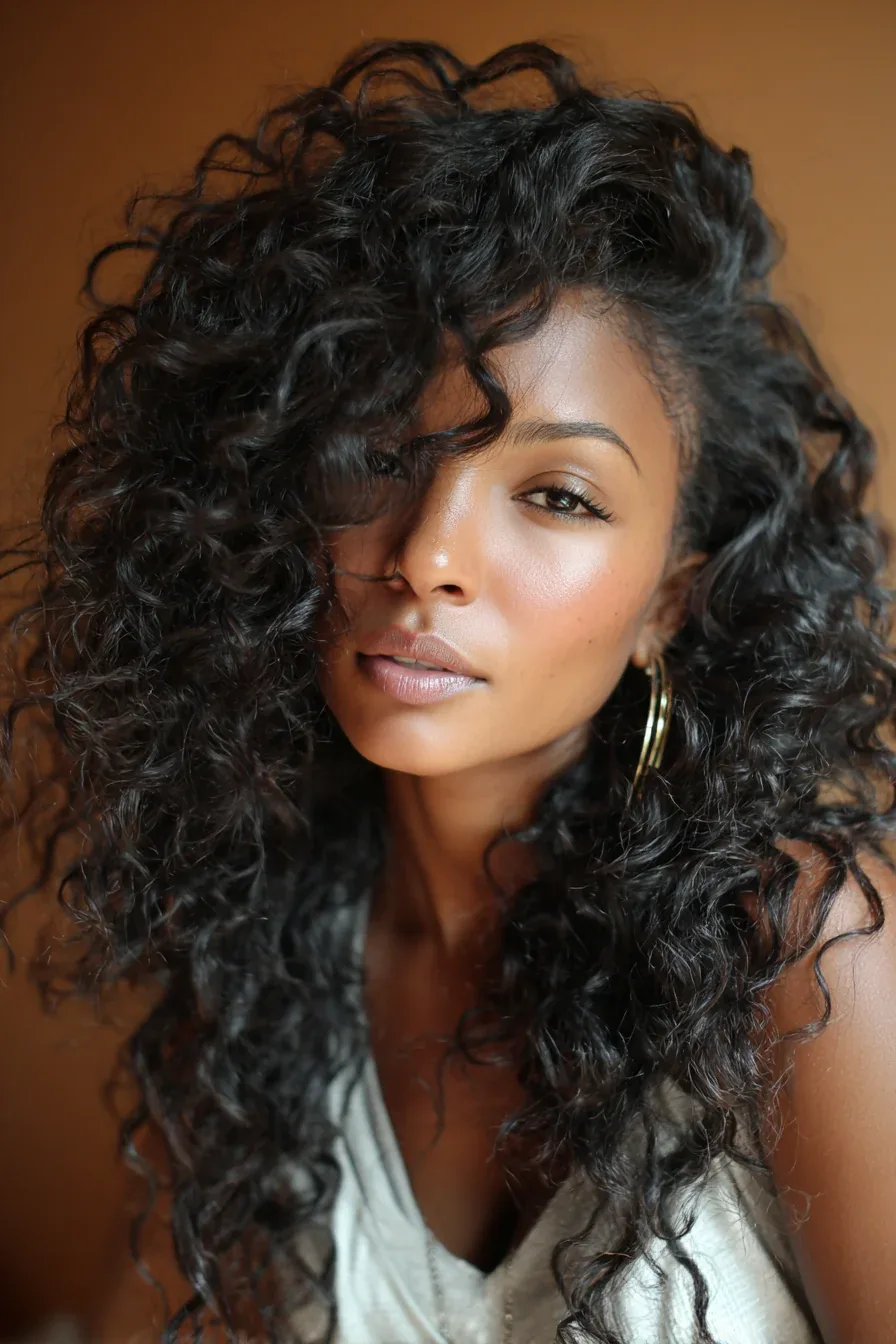
Voluminous curls with a side part are the big, joyful choice for a pear face, and they work when the volume is placed high: the side part throws a heavy sweep across the forehead, the curls at the crown spring up and outward around the temples, and the longer curls underneath are kept tapered so they fall past the jaw in a narrower shape instead of puffing out into a triangle. The result is curls that look abundant and full of life without making the lower face look wider, and a shape that holds its balance as it grows. It is a style that suits naturally curly hair best, because the curl pattern does most of the work.
Why it works for a pear face: the top curls add width at the crown and temples, and the side part widens the forehead. What to watch out for: curls with no layers will form a triangle that is widest at the jaw, so rounded layers on top are essential, and heavy curls at chin level will add width in the wrong place. One styling tip: diffuse with the head tipped forward for root lift, and scrunch out the crunch once the curls are dry.
30. Layered Midi with Flipped-Out Ends
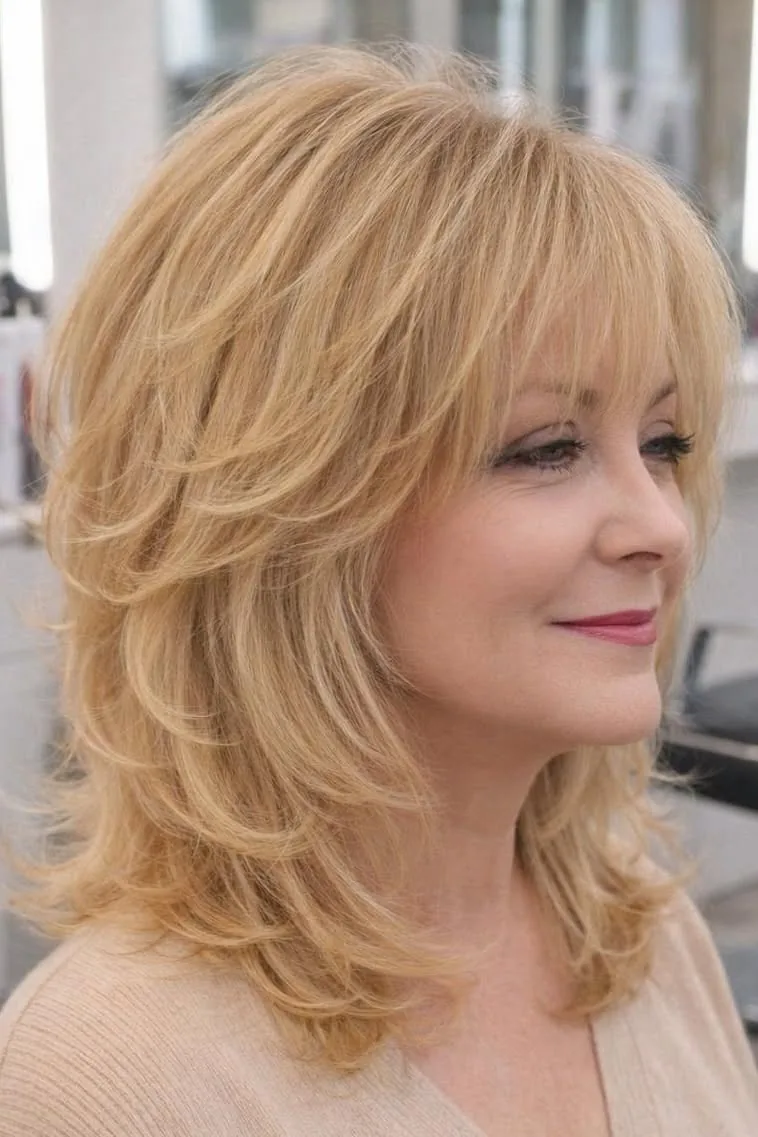
A layered midi with flipped-out ends is the playful, retro-inspired choice for a pear face, and the flip is doing more work than it looks: when the ends flip outward at the temples and cheekbones, they add width to the upper face, but when the flip sits at the jaw, it adds width to the lower face — so the placement of the layers matters enormously. In this version the shortest layers flip out at the cheekbones, while the longer layers underneath curve softly under at the jaw, which gives the style its bounce and movement without widening the chin. It is a fun, bouncy cut that suits straight to wavy hair and looks great with a little texture.
Why it works for a pear face: the flipped layers at the cheekbones widen the temples, while the under-curved ends keep the jaw soft. What to watch out for: flipped ends at jaw level will widen the jaw, so ask for the flip to happen higher up and the ends to curve under at the bottom. One styling tip: blow-dry the top layers with a round brush, flicking them outward, and curve the bottom layers under for contrast.
31. Messy Bun with Curtain Pieces
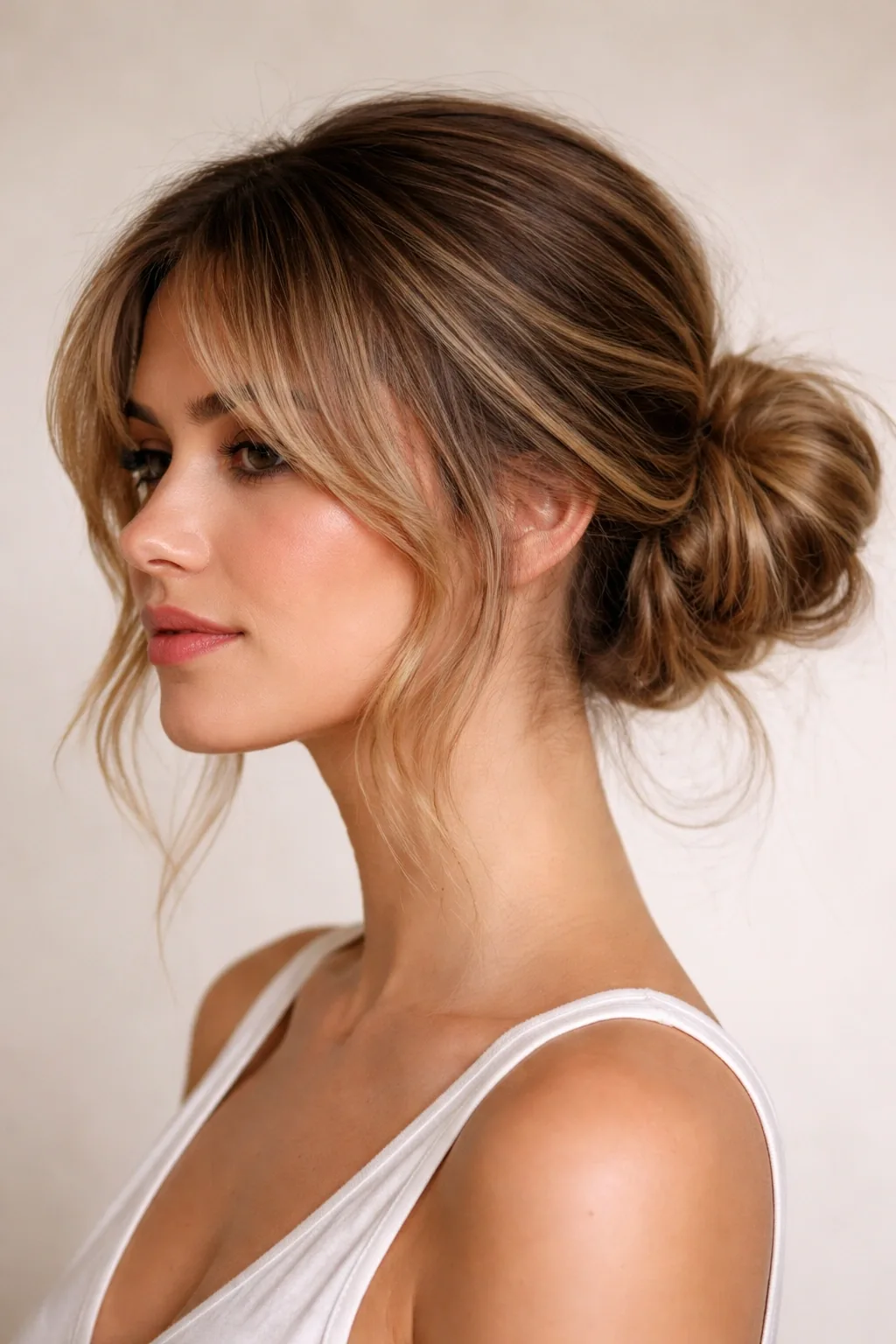
A messy bun with curtain pieces is the everyday, off-duty style that can flatter a pear face — as long as the curtain pieces stay out. A messy bun on its own, pulled back tight with nothing around the face, will expose the full width of the jaw, but the same bun with two soft curtain pieces left out at the temples, a little volume at the crown, and a deliberately loose, undone finish looks soft, relaxed and balanced. The pieces break up the outline of the jaw, the crown volume widens the forehead, and the messiness keeps the whole thing from looking severe. It is the thirty-second style for busy days that still looks like you meant it.
Why it works for a pear face: the curtain pieces soften the jaw and widen the temples, and the crown volume lifts the top of the face. What to watch out for: a tight, scraped-back bun with no volume and no loose pieces will emphasise the jaw, so always leave pieces out and keep the bun loose. One styling tip: gather the hair loosely, pin it up, pull out the curtain pieces, and finish with a texturising spray for grip and softness.
32. Bixie Cut with Volume on Top
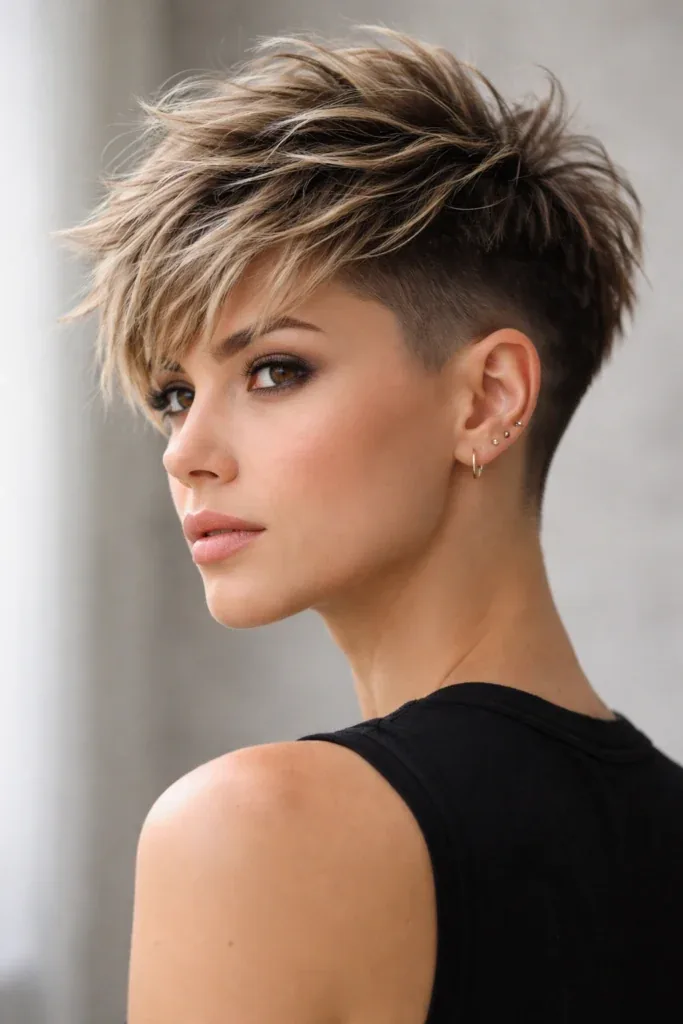
A bixie cut with volume on top is the short cut for women who cannot decide between a bob and a pixie — so they get both, with the volume placed exactly where a pear face needs it. The bixie is longer than a pixie and shorter than a bob, with soft, textured layers and a fringe that can be worn swept to the side, and in this version the top is kept full and lifted, which widens the forehead and temples, while the sides are tapered so they never add bulk at the jaw. It is a fresh, modern cut that is easy to style, easy to grow out, and surprisingly flattering on a pear-shaped face.
Why it works for a pear face: the volume on top widens the narrow forehead, and the tapered sides keep the jaw open. What to watch out for: a bixie that is flat on top and bulky at the sides will emphasise the jaw, so ask for texture and lift on top and a clean, tapered shape underneath. One styling tip: a little texturising paste on damp hair, rough-dry with your fingers, and sweep the fringe to the side.
33. Long Straight Hair with Face-Framing Layers
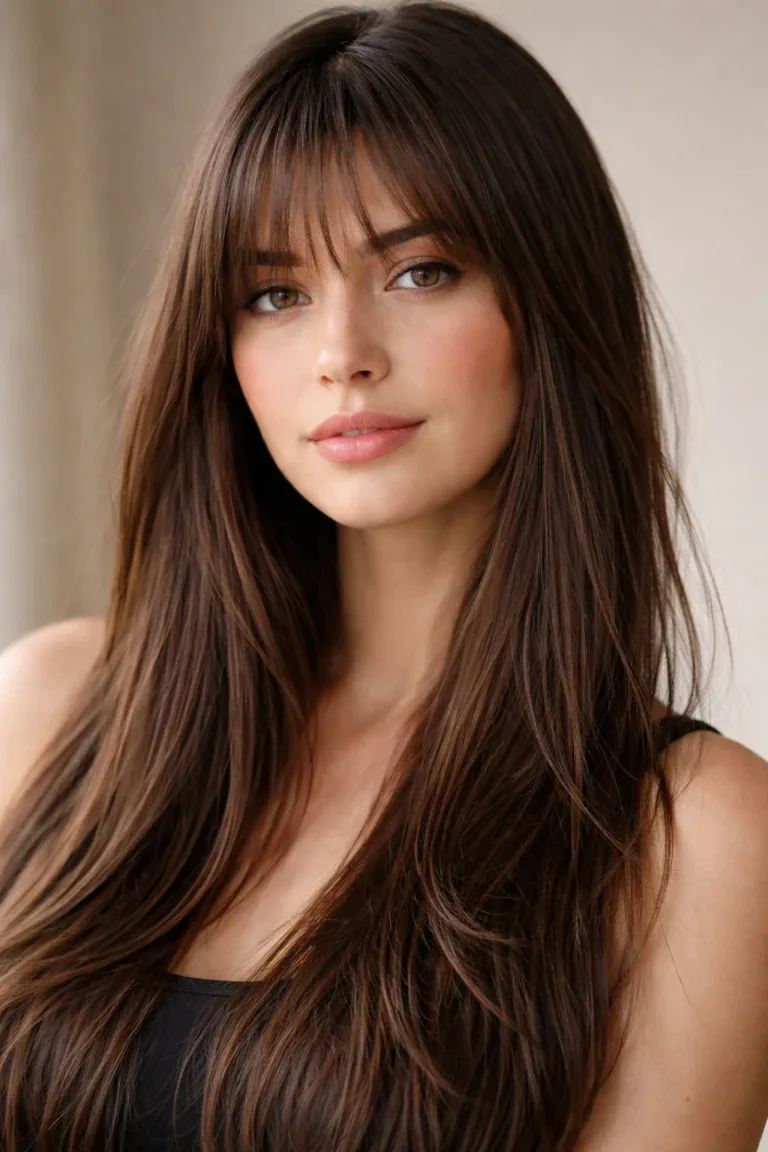
Long straight hair with face-framing layers is the sleek, minimal choice for a pear face, and it works because the face-framing layers are doing all the balancing: they start at the cheekbones, open outward at the temples, and draw the eye to the upper half of the face, while the long, straight lengths underneath fall past the jaw in a clean, tapered line that never puffs out. The length itself helps too, because long hair makes the face look longer and narrower overall, which softens the width of the jaw by proportion. It is a polished, expensive-looking style that suits naturally straight hair best and needs very little styling to look good.
Why it works for a pear face: the face-framing layers widen the temples, and the long length elongates the face. What to watch out for: one-length straight hair with no layers and a centre part will split the face and leave the jaw unopposed, so the layers and the root lift are essential. One styling tip: blow-dry the face-framing pieces with a round brush, curving them away from the face, and finish with a shine spray for a glassy finish.
34. Soft Waves with a Side-Swept Fringe
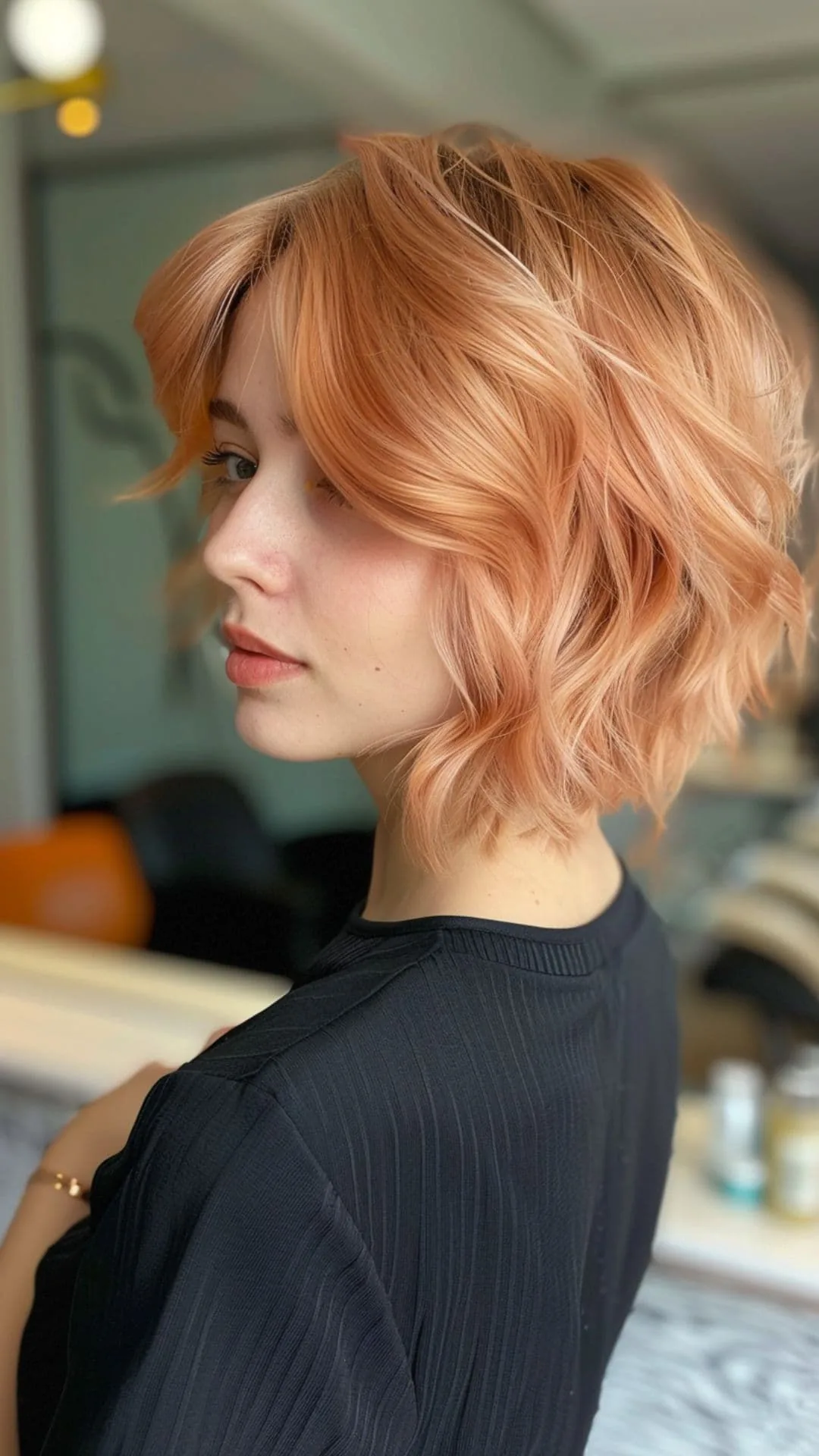
Soft waves with a side-swept fringe are the gentle, romantic combination for a pear face, because the fringe sweeps diagonally across the forehead, adding width and movement, while the waves themselves start above the jaw and fall past it in soft, uneven lengths that blur the jawline without adding bulk. The softness is the whole point: nothing in this style is sharp or severe, and the diagonal line of the fringe breaks up the horizontal width of the jaw in a way that a straight fringe never could. It suits medium to long hair, works for weddings and everyday wear alike, and grows out gracefully as the fringe blends into the layers.
Why it works for a pear face: the diagonal fringe widens the forehead, and the soft waves blur the jawline. What to watch out for: waves that are all the same size and start exactly at the jaw will create a wide band at the widest point, so vary the wave size and start them higher up. One styling tip: blow-dry the fringe to one side with a round brush, then wrap the lengths around a large-barrel curling iron and brush through for softness.
35. Chin-Length Shag
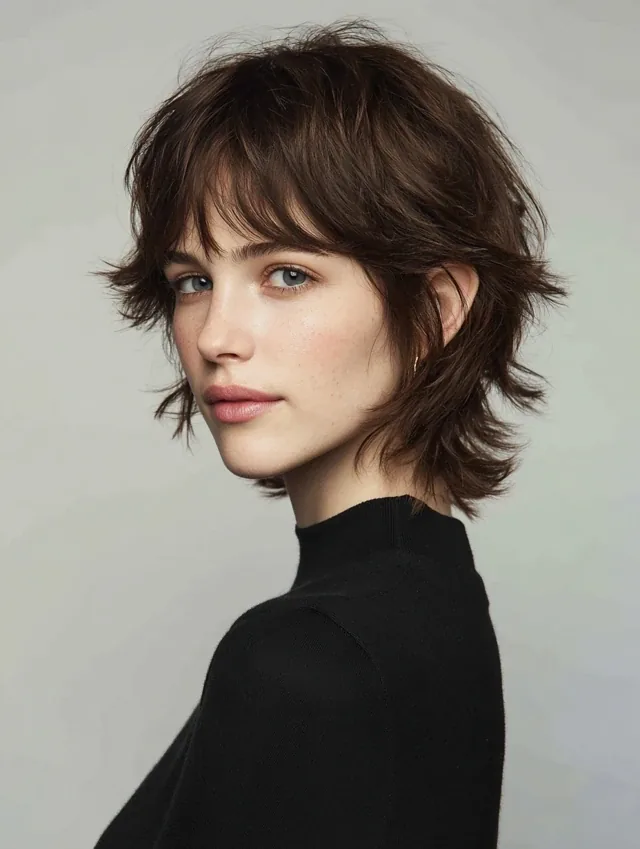
A chin-length shag is the textured, edgy short cut for a pear face, and it works because a shag is built from short layers on top: choppy, uneven layers around the crown and temples create width and movement exactly where a pear face needs it, while the chin length is softened by the texture, so the ends never form a solid, heavy line at the jaw. The fringe — usually soft and wispy — adds width across the forehead, and the whole cut has a lived-in, rock-and-roll feel that suits wavy and straight hair alike. It is a low-maintenance cut that looks better slightly grown out, because the texture hides the roots.
Why it works for a pear face: the short top layers add width at the temples, and the textured ends keep the jaw soft. What to watch out for: a chin-length shag with too much bulk at the ends will widen the jaw, so ask for the weight to be removed from the bottom layers and the texture concentrated on top. One styling tip: a little texturising spray on damp hair, scrunch and air-dry, and the cut does the rest.
36. Half-Up Twist with Volume
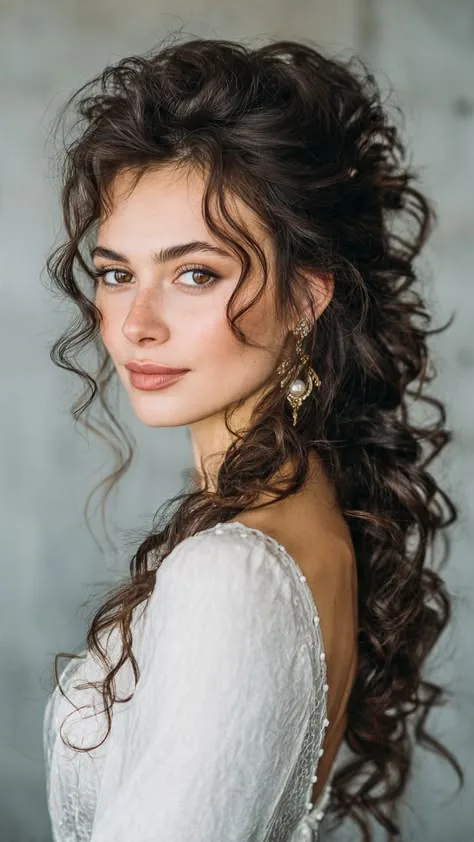
A half-up twist with volume is the romantic, five-minute style for a pear face, because the twist itself sits at the crown, where it adds height and width to the top of the face, while the loose lengths underneath fall past the jaw in soft waves that soften it. Two sections are twisted back from each side and pinned together, which creates a gentle lift at the crown and a soft, swept shape across the forehead, and a few face-framing pieces left out around the temples complete the balance. It is a style that works for weddings, date nights and Sunday lunches alike, and it is one of the easiest updos to do on yourself.
Why it works for a pear face: the crown twist adds height and width at the top, and the loose lengths soften the jaw. What to watch out for: a flat half-up twist with no volume and no loose pieces will expose the jaw, so backcomb the crown lightly and leave pieces out around the face. One styling tip: twist two sections from each side back to the crown, pin them together, and curl the loose lengths with a large-barrel iron.
37. Layered Cut with Bangs and Waves
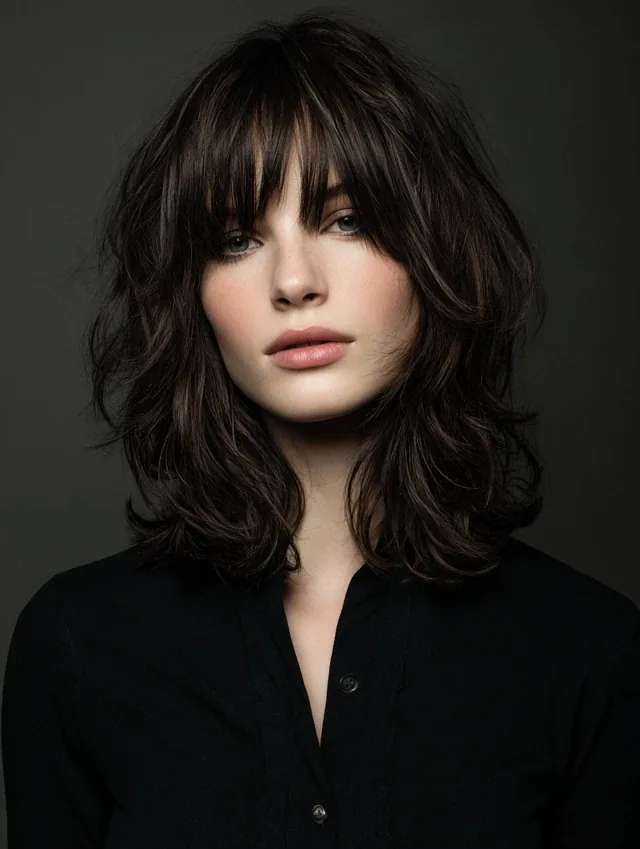
A layered cut with bangs and waves is the all-in-one balancing style for a pear face, because it combines three of the best tools in one cut: the bangs widen the forehead, the layers add volume at the temples, and the waves soften the jawline without adding bulk. The layers start high, around the cheekbones, and fall in soft, uneven lengths past the jaw, while the waves themselves are loose and brushed-out rather than tight and bouncy, so they move when you move and never form a wide band at chin level. It is a versatile, feminine cut that suits almost every hair texture and grows out well, because the layers are long and gradual.
Why it works for a pear face: the bangs and top layers widen the forehead and temples, and the waves blur the jaw. What to watch out for: bangs that are too heavy and waves that start at the jaw will close the forehead in and widen the lower face, so keep the bangs soft and the waves starting higher up. One styling tip: blow-dry the bangs with a round brush, wrap the lengths around a curling wand, and brush through for soft, uneven waves.
38. Low Ponytail with a Side Part and Volume
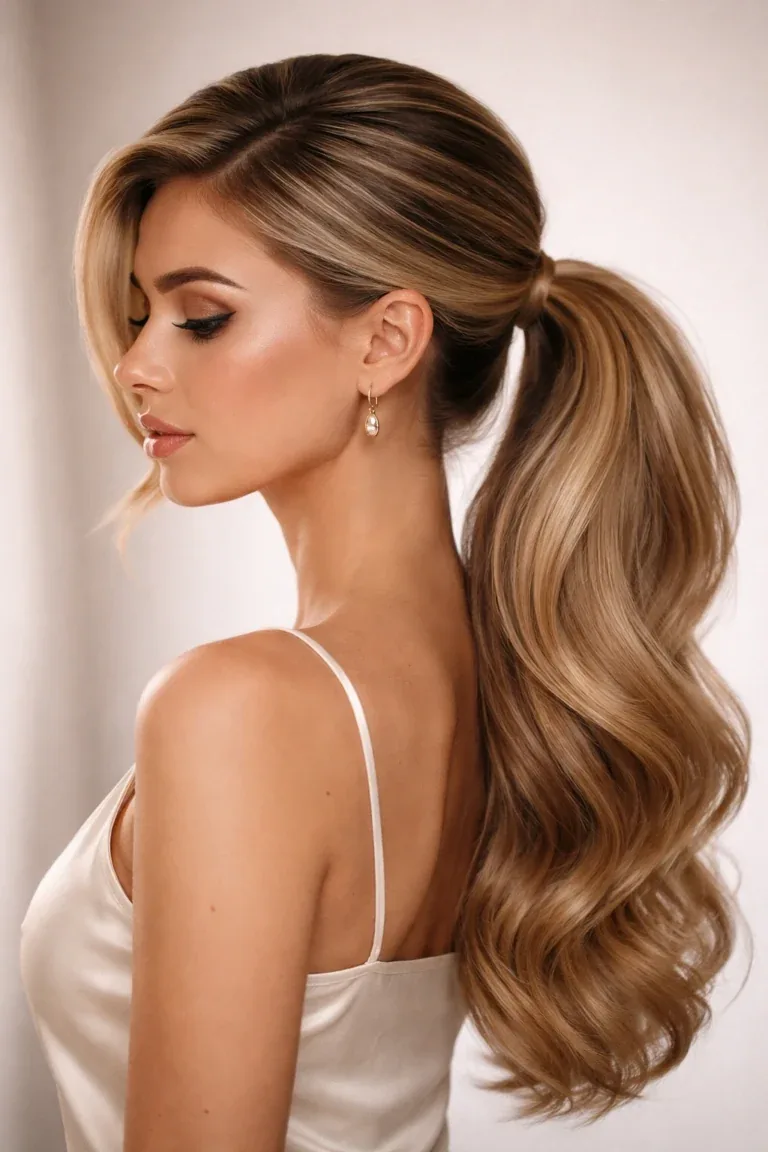
A low ponytail with a side part and volume is the polished, grown-up ponytail for a pear face, because the side part throws a sweep across the forehead, the crown is lifted for height, and the ponytail itself sits low and soft at the nape, with a few face-framing pieces left out to break up the jawline. Unlike a high, scraped-back ponytail, this version is deliberately soft and controlled: the hair is smoothed back, not pulled tight, and the volume at the crown keeps the balance at the top of the face. It is the hairstyle for work, for weddings, and for any day when you want to look like you have everything handled.
Why it works for a pear face: the side part and crown volume widen the top of the face, and the loose pieces soften the jaw. What to watch out for: a tight, flat low ponytail with no volume and no loose pieces will expose the jaw completely, so keep the crown lifted and always leave pieces out. One styling tip: smooth the hair back with a little pomade, secure low at the nape, wrap a section around the band, and curl the loose pieces softly.
39. Romantic Updo with Loose Pieces
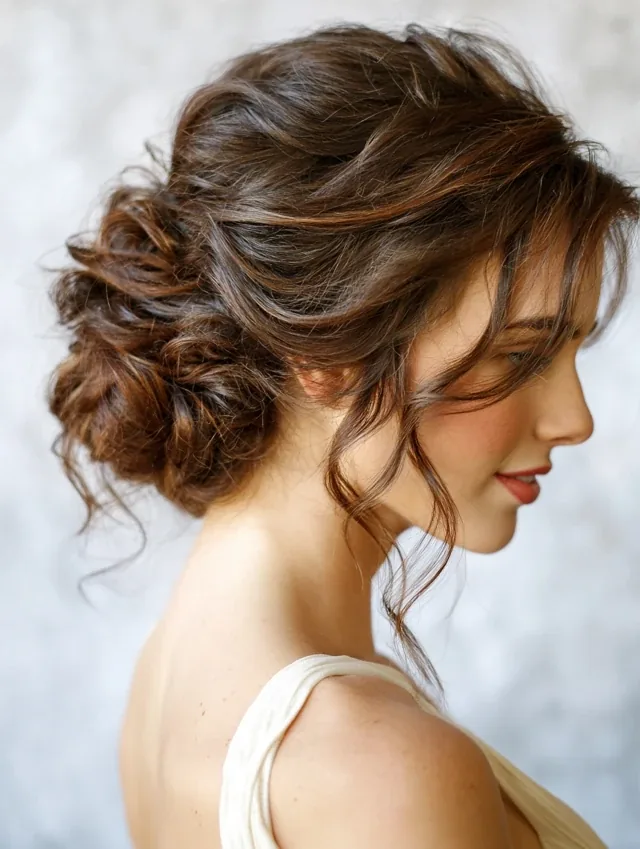
A romantic updo with loose pieces is the special-occasion style for a pear face, because the looseness is doing the balancing work: soft, loose curls are pinned up into a shape that looks effortless but holds all night, with volume at the crown, a side sweep across the forehead, and pieces pulled out around the face to break up the jawline. The romance comes from the softness — nothing is scraped back or pulled tight — and the loose pieces are what make it flattering for a pear face, because they blur the outline of the jaw and add width at the temples. It is the updo for weddings, anniversaries and any night you want to feel beautiful.
Why it works for a pear face: the crown volume and side sweep widen the top, and the loose pieces soften the jaw. What to watch out for: a tight, sculpted updo with no volume and no loose pieces will expose the jaw completely, so keep the front soft and the crown lifted. One styling tip: curl the hair first, pin sections loosely up and back, pull out face-framing pieces, and finish with a flexible-hold hairspray.
40. Short Layered Cut with Side Bangs
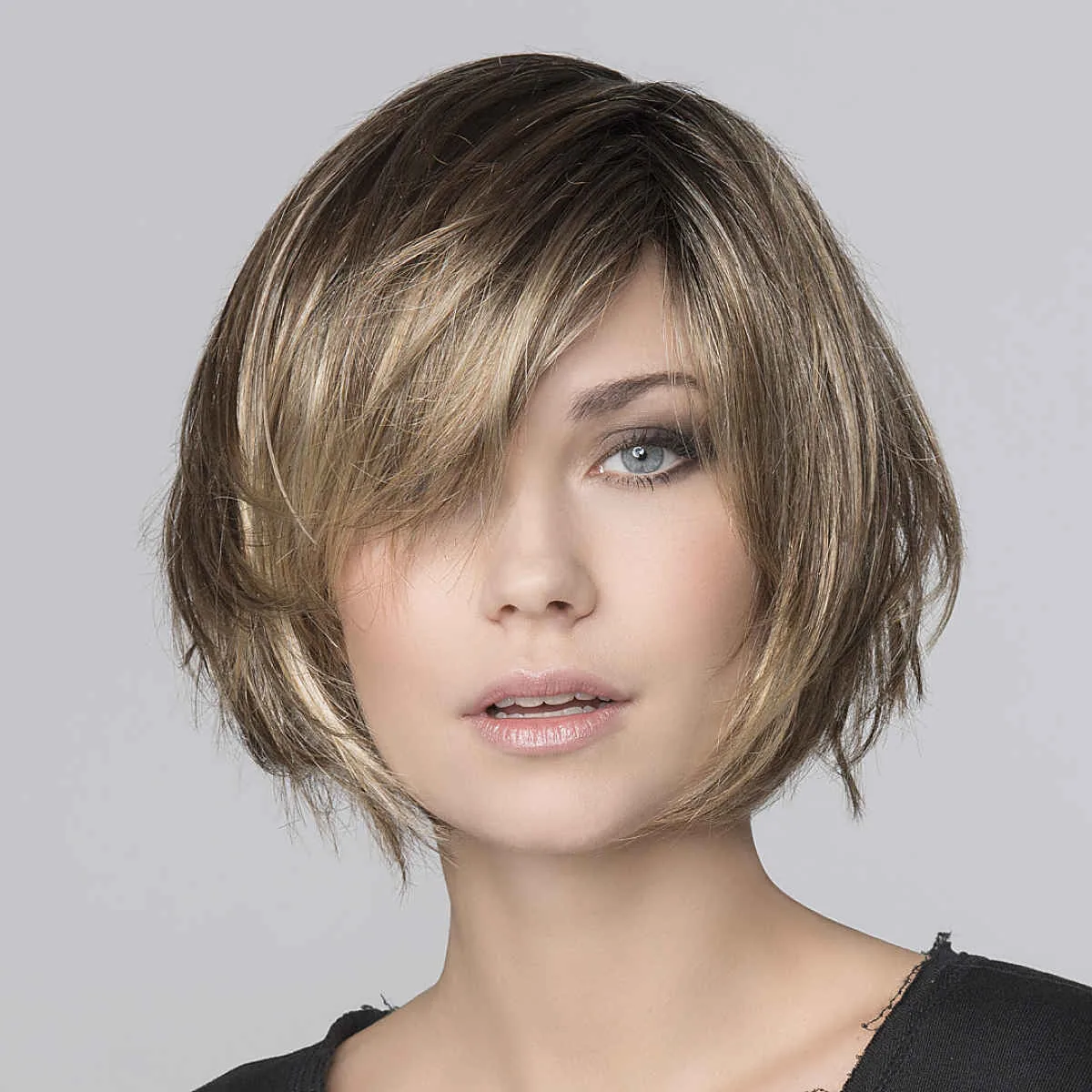
A short layered cut with side bangs is the short, practical choice for a pear face, because the side bangs sweep diagonally across the forehead, adding width and movement, while the layers through the crown add height and fullness at the top, and the tapered sides keep the cut from adding bulk at the jaw. It is a cut that works for fine to medium hair particularly well, because the layers create the illusion of fullness, and it is one of the easiest short cuts to style in the morning — a little texturising product, a quick rough-dry, and the cut does the rest. It is also a great choice if you want to go short without losing the softness that balances a pear face.
Why it works for a pear face: the side bangs widen the forehead, and the crown layers add height at the top. What to watch out for: a short cut that is flat on top and bulky at the sides will emphasise the jaw, so ask for the layers concentrated at the crown and a clean, tapered nape. One styling tip: blow-dry the side bangs with a round brush, sweeping them across the forehead, and work a little texturising paste through the top for lift.
41. Wavy Bob with a Deep Side Part
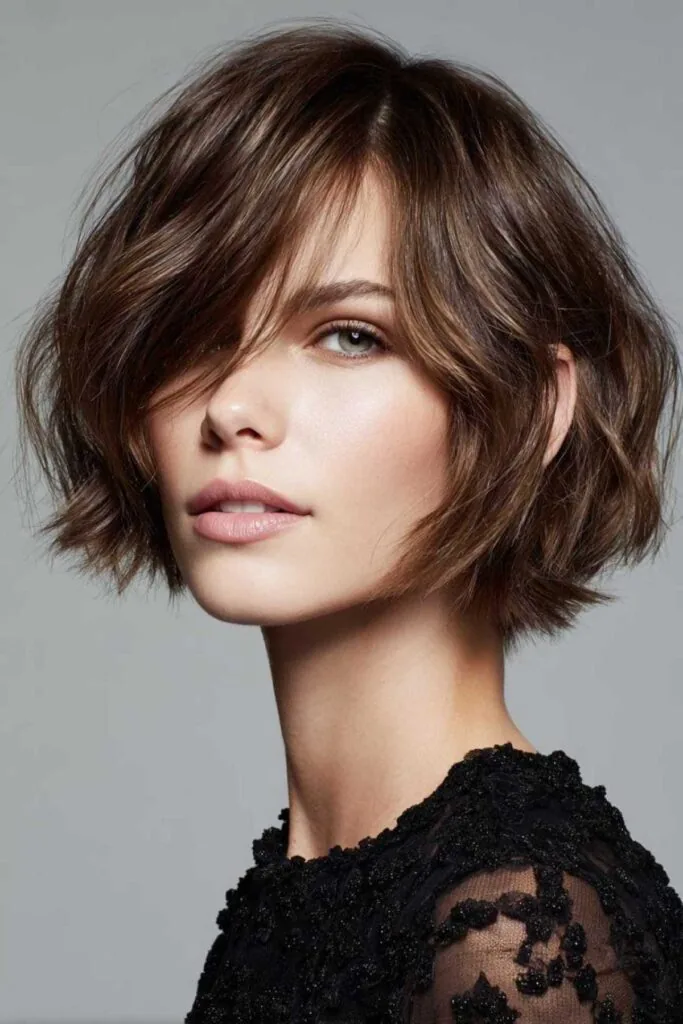
A wavy bob with a deep side part is the final, foolproof bob for a pear face, because it combines the two most reliable balancing tools in one cut: the deep side part throws a heavy sweep across the forehead, and the waves soften the jawline without ever forming a hard line at the chin. The waves are kept soft and uneven, starting above the jaw and falling past it, so they blur the outline rather than framing it, and the bob length ends just below the jaw in textured ends that move. It is a bob that looks modern and effortless, suits almost every face and hair texture, and grows out gracefully because the waves hide the in-between stages.
Why it works for a pear face: the deep side part widens the forehead, and the soft waves blur the jawline. What to watch out for: a wavy bob with a centre part and blunt ends at chin level will do the opposite of what you want, so keep the part deep and the ends textured. One styling tip: wrap sections around a curling wand, leave the ends out, brush through for soft waves, and part deeply while the hair is damp.
What is the best hairstyle for a pear face shape?
The best hairstyle for a pear face shape is one that adds width at the forehead and temples and softens the jawline: curtain bangs with shoulder-length layers, a side-parted lob, long layers with face-framing volume, or a voluminous blowout with layers at the temples. The right choice depends on your hair texture and how much styling you will actually do — a cut that fits your routine will always look better than a theoretically perfect one you never style.
How do I know if I have a pear face shape?
You have a pear face shape if your jaw is the widest part of your face, your cheekbones are wide and low, and your forehead is the narrowest part. Measure across your forehead, cheekbones and jaw in a mirror with your hair pulled back: in a pear face the jaw measurement is the largest and the forehead is the smallest. A straight-on photo with your hair tied back makes the proportions easy to see.
Should I get bangs with a pear face shape?
Yes — bangs are one of the best tools for a pear face shape, because they add width across the forehead where the face is narrowest. Curtain bangs are the safest choice, side-swept bangs add a flattering diagonal line, and a soft, wispy fringe works well too. Avoid a heavy, blunt, straight-across fringe cut short, because it can make the forehead look even smaller and the jaw look wider by comparison.
What hairstyles should I avoid with a pear face shape?
Avoid hairstyles that add bulk at jaw level or end in a hard line at the chin: a one-length bob that ends exactly at the jaw, heavy curls that start at the jaw and puff outward, and a sleek, scraped-back ponytail with no volume at the crown and no pieces left out around the face. A flat centre part with pin-straight hair and no lift at the roots will also make the jaw look wider.
Is a bob good for a pear face shape?
A bob can be good for a pear face shape if it is cut and styled the right way: keep it either above the jaw with volume at the crown, or a little longer than the jaw with soft, textured ends, and pair it with a deep side part or bangs. A blunt, one-length bob that ends exactly at the jaw with a centre part is the version to avoid, because the blunt edge draws a line across the widest part of the face.
What parting is best for a pear face shape?
A deep side part is usually the most flattering parting for a pear face shape, because it throws a heavy sweep of hair across the forehead and creates diagonal lines that break up the symmetry of a wide jaw. A soft, off-centre part works well too. A centre part can work if the hair has volume at the roots and face-framing layers that open outward at the temples, rather than falling flat and straight down either side of the face.
Can short hair work for a pear face shape?
Yes — short hair can work very well for a pear face shape, as long as the volume sits on top. A textured pixie with volume on top, a side-parted pixie with a long fringe, a bixie with volume on top, or a short bob with a textured top all add width at the forehead and temples while keeping the sides tapered. The short cuts to avoid are the ones that are flat on top and bulky at the sides, because they emphasise the jaw.
How do I add volume at the crown for a pear face?
To add volume at the crown, use a root-lifting spray or mousse at the roots while the hair is damp, blow-dry the roots upward with a round brush, and finish with a little backcombing or volumising powder at the part. Parting the hair on the side also creates instant lift at the crown. Keep the volume at the top and let the ends fall soft — big, bouncy curls at the jaw will add width in the wrong place.
Does long hair suit a pear face shape?
Yes — long hair suits a pear face shape very well, because the length draws the eye downward and makes the face look longer and narrower overall, which softens the width of the jaw by proportion. The most flattering long styles have face-framing layers that start at the cheekbone and open outward at the temples, a side part, and soft waves that start above the jaw and fall past it, rather than one-length straight hair with a centre part and no layers.
What should I ask my stylist for a pear face shape?
Ask your stylist for width at the forehead and temples, softness around the jaw, and volume at the crown rather than at the ends — and ask where the shortest layers will sit, because layers that start at the cheekbone balance a pear face while layers that start at the jaw widen it. Bring photos of women with a similar face shape, and ask how the style will look air-dried, how it will grow out, and what you should do at home to keep the volume at the crown.
Conclusion
A pear face shape is not a problem to fix — it is a striking, memorable face shape with a strong jawline and a narrow forehead, and the right hairstyle simply balances those proportions so they look intentional. The principle is the same in every style in this guide: add soft width and lift at the forehead, temples and crown, and keep the jawline soft and open with movement that falls past it rather than sitting on it. Curtain bangs, a deep side part, face-framing layers that start at the cheekbone, and volume at the crown are the four tools that do most of the work, and they work in almost any length, from a textured pixie to long, flowing layers.
Start with the balance you want, not the name of a haircut, and tell your stylist exactly that: more width at the top, softness around the jaw, and volume at the crown rather than at the ends. Bring photos of women whose face shape is like yours, ask where the shortest layers will sit, and try the deep side part for a week before you commit to a cut — it is a free experiment, and for many pear-shaped faces it is the single change that makes the biggest difference. Then go home, shake your hair dry, and let the balance do the talking — because when the top of the face matches the bottom, a pear face shape looks exactly as striking as it was always meant to.