Afro Hairstyles for Women: 38 Styles That Celebrate Volume, Shape and Texture
An afro is not just a hairstyle — it is a shape, a statement, and a celebration of what natural hair does best. When it is picked out and shaped well, an afro has a presence no other style can match: a perfect round silhouette that frames the face, catches the light, and turns an ordinary day into a moment. It is bold without trying, elegant without fuss, and deeply personal, because no two afros are ever quite the same. The curl pattern, the density, the length and the shape all belong to the woman wearing it, and that is exactly the point. The afro has been a symbol of pride and beauty for generations, and it remains one of the most joyful hairstyles a woman can wear.
This guide gathers 38 afro hairstyles for women, from the classic rounded afro to the tapered cut, the high-top, the afro puff, the twist out, the frohawk and the picked-out glam afro — plus styles for short hair, long hair, fine hair and dense coils, and looks for work, weddings and formal evenings. Eight guides cover what makes a great afro, how the main shapes differ, the care basics that keep natural hair healthy, how the style changes with length, how colour, twists, braids and accessories transform it, and the mistakes that flatten a good afro. A quick honest note before you begin: an afro does ask for care — moisture, gentle detangling and night protection — and shrinkage means the hair will often look shorter than it really is. Both are part of the deal, and both are easy to live with once you know the routine.
What Makes a Great Afro — Shape, Density and Definition
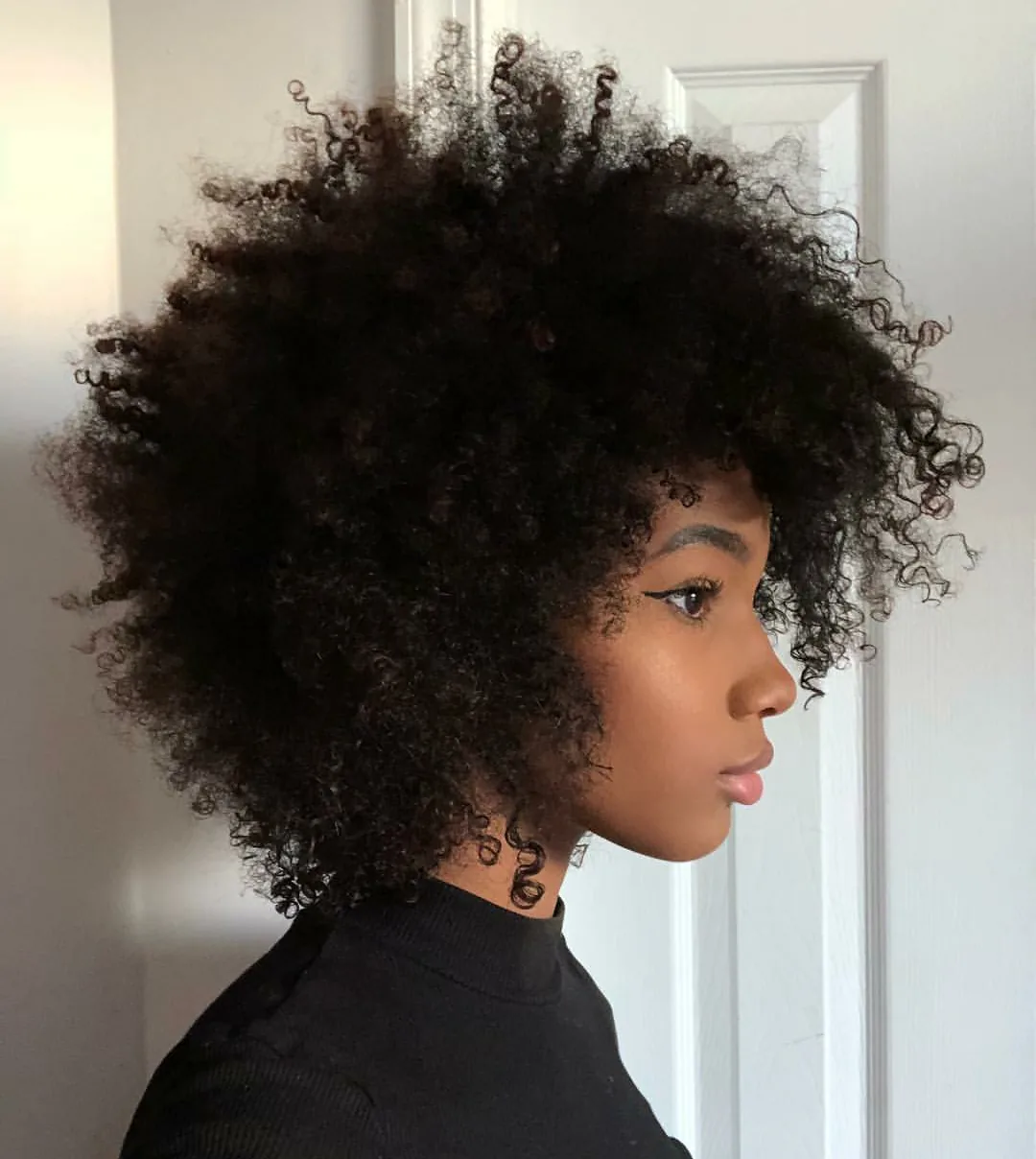
A great afro starts with shape, and shape is mostly about balance: the silhouette should frame the face rather than fight it, with the fullest point sitting where it flatters you most. A round afro suits almost everyone because it echoes the natural growth pattern of the hair, but the best shape for you depends on your face and your hair. A slightly taller crown lengthens a round face; a wider, lower shape softens a long face; and a tapered silhouette — full on top, shorter at the sides and back — slims the whole outline. A good stylist will shape the afro while it is dry and picked out, because afro hair changes shape dramatically when it is wet, and a cut made on wet hair can end up much shorter and rounder than planned.
Density and definition are the other two ingredients. Density is how much hair you have, and it decides how full the afro can be: dense hair gives a big, sculpted silhouette with very little effort, while lower-density hair needs a little help — a pick, a little product, and a shape that works with the volume you have rather than against it. Definition is about how the curls clump together: some afros look best with clear, separated curls, others with a soft, cloud-like finish where the curls blend into one another. Neither is better — the cloud look is softer and bigger, the defined look is neater and more sculpted. The afro that suits you is the one that respects your density and your curl pattern instead of trying to force them into someone else’s shape.
Afro Shapes — Round, Tapered, High-Top and Flat-Top
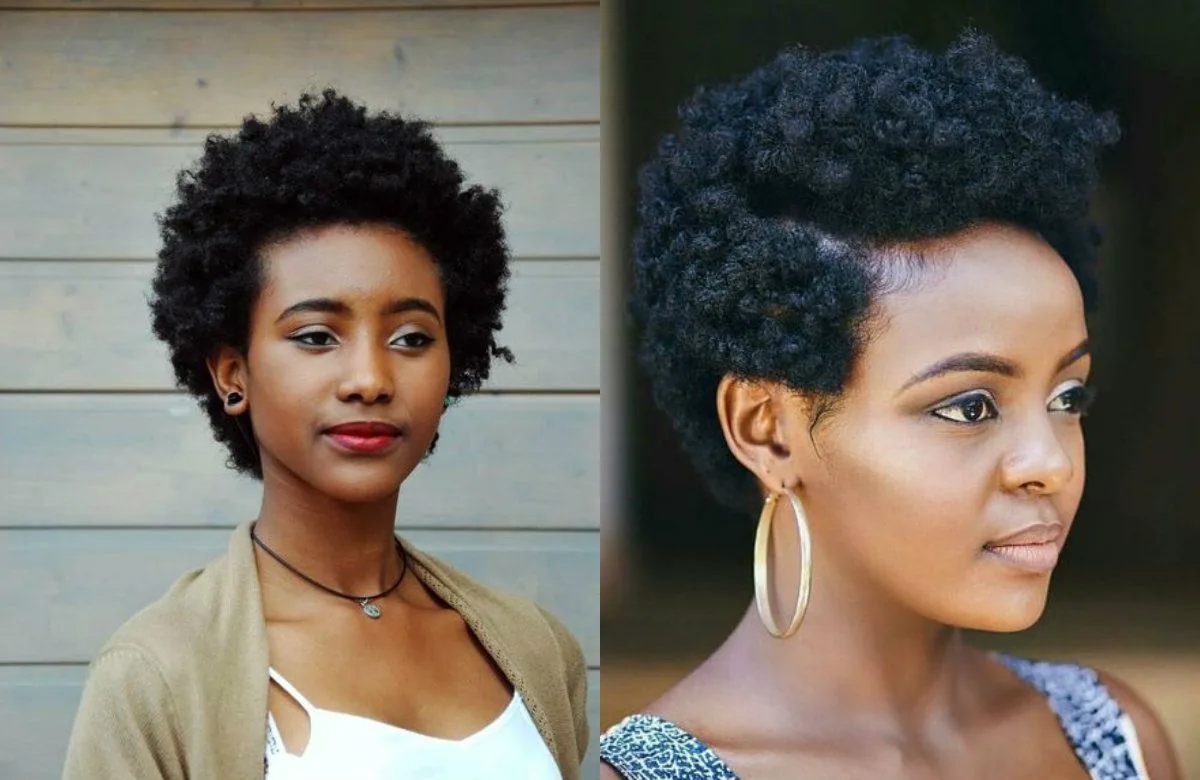
The round afro is the classic: a full, even circle of hair around the head, roughly the same length all over, shaped so the silhouette is smooth from every angle. It is the most forgiving shape, it suits almost every face, and it is the shape most women picture when they think of an afro. It works at every length from a short TWA to a long, grown-out afro, and it is the easiest shape to maintain at home, because you can pick it out evenly and trim the outline yourself between salon visits. If you are growing your first afro, start round — it is the shape that teaches you how your hair behaves.
The tapered afro is full on top and shorter at the sides and back, which gives it a more sculpted, modern line and makes the face look slimmer; it is the shape to ask for if a full round afro feels too wide for you. The high-top afro pushes the height upward, with the sides kept short and the top grown tall — a bold, dramatic shape that suits oval and round faces particularly well. The flat-top afro is the sharpest of the four: the top is cut flat and level, like a tabletop, with neat, tapered sides, and it needs regular trimming to keep its edge. Each shape is a different attitude — round is classic, tapered is modern, high-top is bold, flat-top is sharp — and the right one is the one that matches how you want to feel when you walk into a room.
Afro Care Basics — Moisture, Detangling and Night Protection
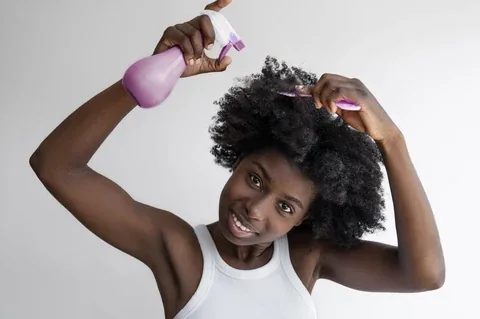
Afro hair is naturally dry, because the oils from the scalp have a long, winding journey down a curly strand, and that is why moisture is the first rule of afro care. The routine that works for most women is simple: wash with a gentle, sulphate-free shampoo, condition generously, and then seal the moisture in with a leave-in conditioner followed by a cream and a light oil — the method many natural-hair wearers call LOC, for liquid, oil and cream. Water is the real moisturiser, not oil on its own, so a daily spritz of water or a water-based leave-in keeps the afro soft between wash days. Deep-condition once a week or so, and your hair will stay flexible, shiny and far less likely to break.
Detangling is the second rule, and the gentle way is the only way that works long term. Detangle on damp, conditioned hair with your fingers first, then a wide-tooth comb, working from the ends upward in small sections — never from the roots down through a knot, which is how breakage happens. At night, protect the afro with a satin or silk bonnet or a satin pillowcase, because cotton absorbs moisture and creates friction that flattens the shape and causes frizz. For a big afro, the pineapple — a loose, high puff on top of the head — keeps the shape overnight, and a quick pick in the morning brings it back. Care for an afro is not complicated, but it is consistent: moisture, gentle detangling and night protection, every week, without fail.
Afro on Different Lengths — From TWA to Long
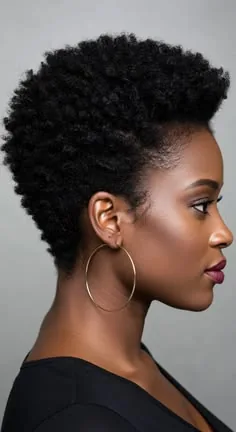
A teeny weeny afro, or TWA, is the shortest afro there is — a close, even crop that shows off the curl pattern and the shape of the head. It is the easiest afro to care for, it needs almost no styling time, and it is the look many women choose after a big chop, when they cut away damaged or relaxed hair and start fresh with their natural texture. A short afro, a few inches long, is the next stage: it can be picked out into a small, neat round shape, it takes a little product and a pick, and it already has real presence. Both are low-maintenance, wash-and-go styles, and both look wonderful with earrings and a strong brow, because the face is fully on show.
A medium afro is where shaping really begins — enough length for a full round silhouette, a tapered cut, or a defined twist out, and the length most women settle into for everyday wear. A long afro is the most dramatic version: a big, sculpted cloud that needs more moisture, more detangling time and more patience, but rewards it with a silhouette nobody forgets. The honest truth about length is shrinkage: coily hair can shrink to half its stretched length or less, so a long afro may look shoulder-length when it reaches the middle of your back. Judge your afro by its stretched length when you plan a cut, not by how it looks dry, and grow it out in stages — TWA to short to medium — enjoying each length instead of rushing past it.
Afro with Colour, Twists, Braids and Accessories
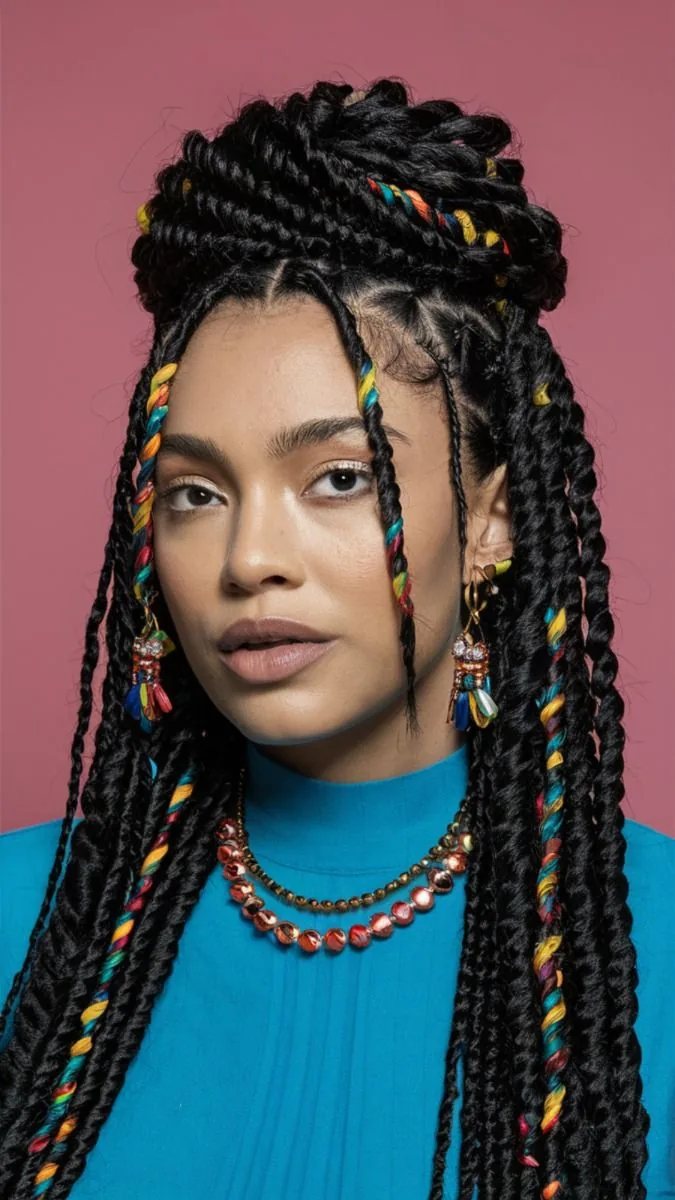
Colour changes an afro completely, because the curls catch the light in a way straight hair never does — a few honey-blonde tips make the curls look three-dimensional, a burgundy rinse gives the whole shape a warm glow, and a copper or auburn shade makes the silhouette look even bigger. The safest way to colour afro hair is gradually: highlights or a rinse first, a full colour later, and always with a deep-conditioning treatment afterwards, because bleach and colour lift the cuticle and dry the hair out. If you are nervous about permanent colour, try a temporary rinse or a semi-permanent shade first — it washes out over a few weeks and lets you test a colour before you commit to it.
Twists, braids and accessories are the other ways to transform an afro without changing its length. A twist out gives the afro a defined, stretched pattern; flat twists or cornrows across the front turn the afro into a half-up style; and a few small braids woven into the sides add detail without losing the shape. Accessories should be light — a silk scarf, a thin headband, gold cuffs on a few twists, or small pins — because heavy clips drag an afro down and flatten it. The rule is simple: one accent at a time. A coloured afro with gold cuffs is a statement; a coloured afro with cuffs, a scarf and a headband is a costume. Let the shape do the talking, and let the accent finish the sentence.
Afro for Work, Weddings and Formal Events
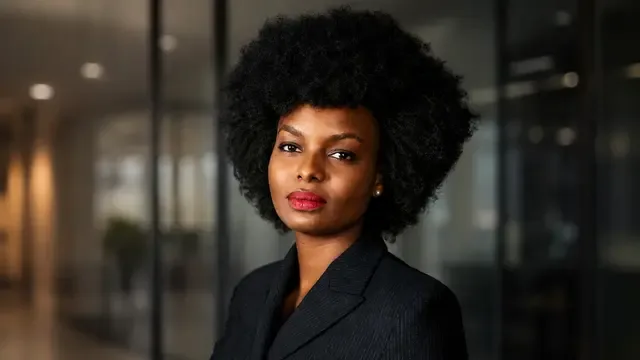
An afro is a perfectly professional hairstyle, and the version that works best at work is the shaped, defined one: a neat round or tapered afro, with the edges smoothed and the shape even, reads as deliberate and polished in exactly the way a good haircut does. The key is definition and tidiness — a picked-out afro that has been shaped, a little edge control on the hairline, and a silhouette that holds its line through the day. Keep accessories minimal at work: no big scarves, no statement cuffs, just the afro itself, well shaped and well cared for. If your workplace is conservative, a tapered afro or a low puff is the safest shape, because it looks the most like a conventional short cut while still being unmistakably an afro.
For a wedding, the afro becomes a crown in its own right: a full, picked-out glam afro with defined curls, or a tapered afro with gold accessories, looks extraordinary with a gown, and it photographs beautifully because the shape is so strong. Brides often add a twist out for definition, a few fresh flowers, or gold cuffs on twists for a regal finish. For a formal evening, the same rules apply — shape, definition, and one elegant accent — and the afro’s height does the work that an updo does for other hair types, elongating the neck and balancing a long dress. Whatever the occasion, do a trial run first, and wear the style for a full day before the event, because an afro that has been shaped and tested will hold its line far better than one tried for the first time on the morning of the day.
Growing Out and Shaping an Afro
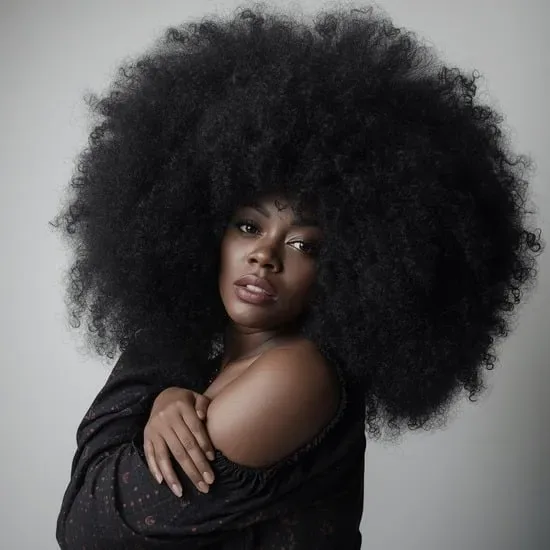
Growing out an afro is a slow, satisfying process, and the first thing to accept is that it will go through awkward stages — the in-between length where it is too long to be a TWA and too short to be a round afro, the stage where one side grows faster than the other, and the stage where shrinkage makes it feel like it is not growing at all. It is growing: coily hair grows at roughly the same rate as any other hair, about half an inch a month, but shrinkage hides the length. Take a photo of your stretched hair every month if you want proof, and trim the ends every couple of months to keep the shape even, because split ends travel upward and breakage is what actually stops an afro from gaining length.
Shaping is what turns grown-out hair into an afro, and the golden rule is to cut it dry and picked out, never wet. Wet afro hair stretches and hangs, so a cut made on wet hair will spring up shorter and rounder than expected once it dries — which is how many women end up with an accidental TWA. A good afro cut is done in stages: pick the hair out fully, look at the silhouette from every angle, and trim a little at a time, checking as you go. Between salon visits, you can maintain the outline yourself with sharp hair scissors, trimming only the hairs that stick out beyond the silhouette. And if you are growing out a relaxer, the transition period — two textures at once — is the hardest part: protective styles like twist outs and braids make it manageable, and a big chop, when you are ready, is the cleanest fresh start.
Common Afro Mistakes and How to Fix Them
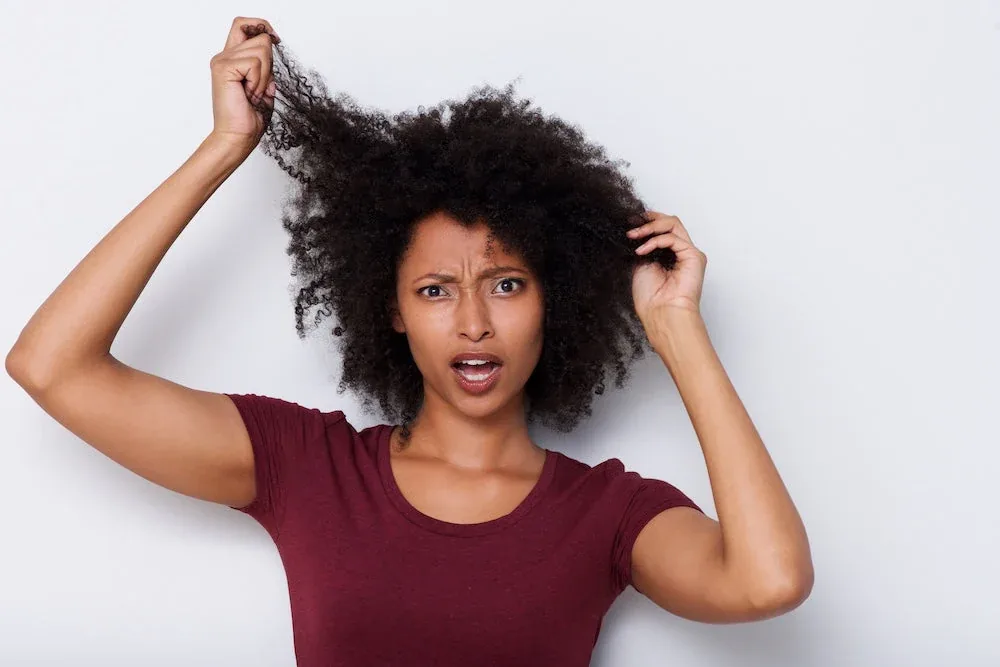
The most common afro mistake is using the wrong products — heavy butters and oils on their own, with no water-based moisture underneath, which leaves the hair greasy on the surface and dry underneath. The fix is the layering order: water or a water-based leave-in first, then a cream, then a light oil to seal it in. Too much product is the second mistake: product build-up weighs the curls down, flattens the shape and makes the afro look dull, so clarify with a gentle shampoo when the hair starts to feel coated, and use less product than you think you need. The third mistake is picking the afro when it is wet, which stretches the curls and makes the shape collapse once it dries — pick it out when it is dry, gently, from the roots, and it will hold its volume.
The other mistakes are about tools and habits. Using a fine-tooth comb on dry afro hair causes breakage and frizz — use your fingers or a wide-tooth comb on damp, conditioned hair instead. Sleeping without protection flattens the afro and dries it out overnight — a satin bonnet or pillowcase fixes that in one night. Skipping trims lets split ends travel up the strand and thin the afro out over time — a small trim every eight to twelve weeks keeps the ends healthy. And the mistake that costs the most is impatience: an afro that is constantly being restyled, re-picked and re-wetted never gets a chance to settle. Pick it once, shape it, and leave it alone — the afro looks its best when it is allowed to be itself.
1. The Classic Rounded Afro
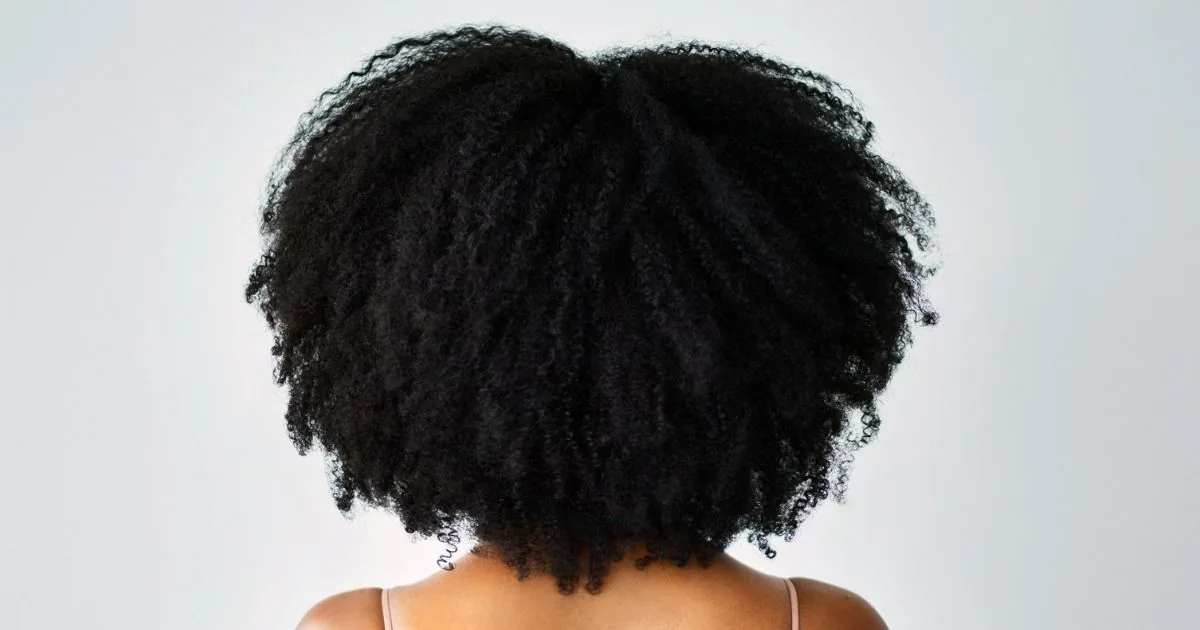
The classic rounded afro is the shape every other afro is measured against: a full, even circle of hair around the head, roughly the same length all over, picked out so the silhouette is smooth from the front, the sides and the back. It is the afro as an icon — bold, balanced and instantly recognisable — and it works because it follows the natural growth pattern of the hair instead of fighting it. There is nothing fussy about it: no part, no accessories, no complicated styling, just the curls, picked out and shaped into a perfect round. It shows off the face completely, it elongates the neck, and it has a presence that a smaller style can never match.
This shape suits almost every face, but it is most flattering on oval, heart-shaped and square faces, where the roundness softens the jaw and balances the features. For maintenance, a classic round afro needs a pick-out every morning — two or three minutes with an afro pick, lifting from the roots — and a refresh with a water spritz every couple of days to keep the curls soft. On time and cost, it is one of the cheapest afros to keep: a pick, a leave-in conditioner and a satin bonnet are the whole toolkit, and a shape-up trim every six to eight weeks at the salon keeps the circle even. A do-it-yourself trim of the stray hairs is easy once you learn the silhouette, but leave the main shaping to a stylist who cuts afro hair dry.
2. The Tapered Afro
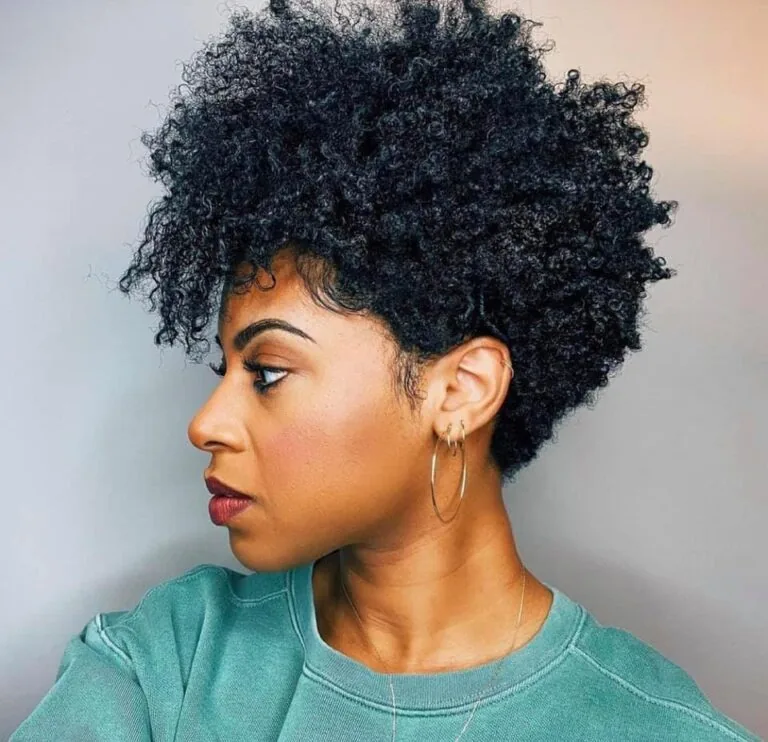
The tapered afro is the modern classic: full and rounded on top, gradually shorter at the sides and back, so the silhouette is sculpted rather than wide. It is the afro for women who love the volume but want a sleeker outline, and it is the shape that photographs best, because the taper gives the afro a clear, deliberate line. The top can be as full as you like — a soft cloud, a defined twist out, or a picked-out round — while the tapered sides keep the whole style feeling neat and intentional. It suits a professional setting as well as a night out, which is why it has become the most requested afro cut of recent years.
The tapered shape suits round and square faces especially well, because the height on top lengthens the face and the short sides slim the outline. Maintenance is a little more demanding than a round afro: the taper grows out in about three to four weeks, so it needs a shape-up every three to four weeks to keep its edge, and the top needs picking out every day to keep its volume. In terms of cost, expect regular barber or salon visits for the taper — many women alternate a full salon cut with a quick shape-up — while the top is entirely do-it-yourself with a pick and a little leave-in. It is a little more upkeep than a round afro, and the sculpted line is worth every visit.
3. The High-Top Afro
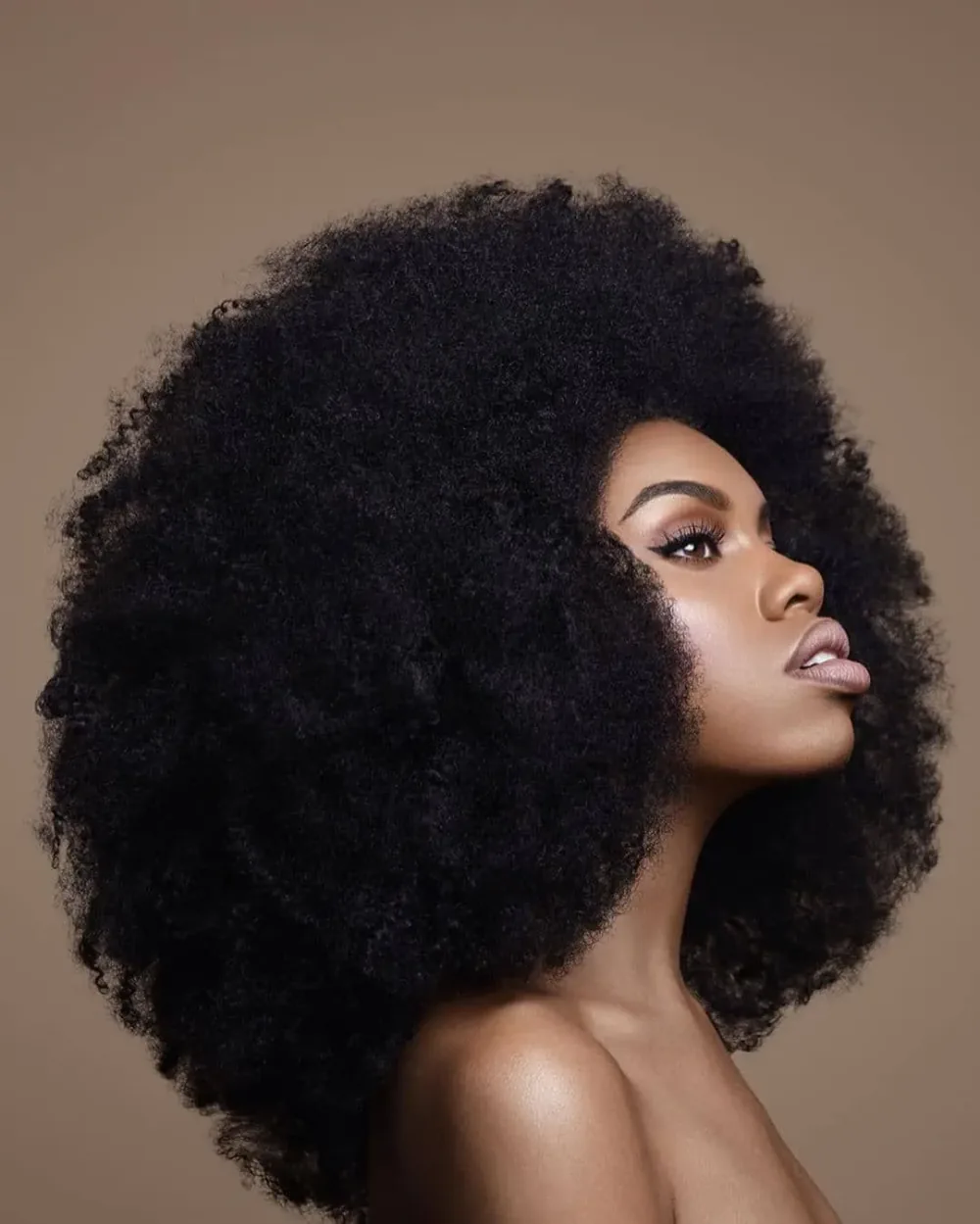
The high-top afro pushes the volume upward: the sides are kept short and neat, and the top is grown tall, so the silhouette is all height. It is a bold, dramatic shape with real attitude, and it suits women who want their hair to be the first thing anyone notices. The high top works best on dense hair, because height needs volume to hold its shape, and it looks most striking when the top is picked out into a soft, even cloud rather than left flat. It is a style with history — a favourite of the eighties that never really went away — and it still turns heads everywhere it goes.
This shape suits oval and round faces best, because the height lengthens the face and balances a fuller cheek. For upkeep, the high top needs the sides kept short, so a shape-up every two to three weeks is the norm, and the top needs daily picking to hold its height — a pick and a little holding product at the roots will keep it standing tall. Time-wise, it takes five to ten minutes each morning, and the cost is mostly in the regular taper visits; the top itself is free to maintain at home. If you want drama without a full round afro, the high top gives you the biggest silhouette per inch of hair — just be ready for the attention, because a high top does not do subtle.
4. The Flat-Top Afro
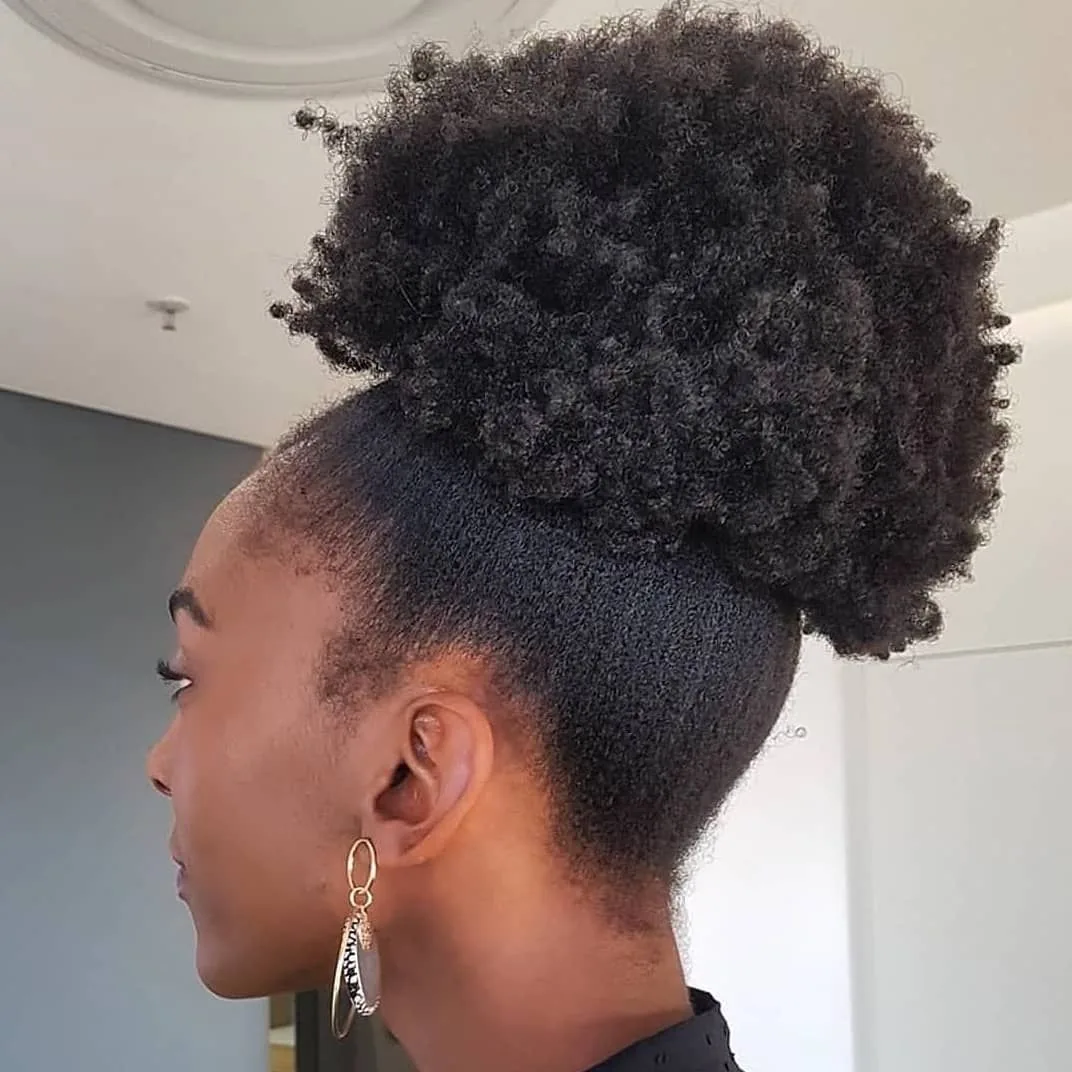
The flat-top afro is the sharpest afro there is: the top is cut flat and level, like a tabletop, with neat tapered sides, so the silhouette is a clean, geometric block rather than a soft circle. It is a precise, architectural style, and it looks extraordinary when it is fresh — the flat top catches the light along its edge and gives the whole head a sculpted, almost sculptural quality. It is the afro for women who love clean lines and do not mind a style that announces itself, and it pairs beautifully with strong earrings, a bold lip, and a confident outfit.
The flat top suits oval and square faces well, and it flatters strong jawlines because the geometric shape echoes them. Maintenance is the most demanding of any afro shape: the flat top grows out visibly within two weeks, and it needs a professional trim every two to three weeks to keep its level edge — a do-it-yourself trim will almost always end up uneven. Daily care is simple, though: a light pick to lift the top, a little product to keep the edges smooth, and a satin bonnet at night to protect the shape. Cost-wise, budget for regular barber visits; the flat top is a salon-dependent style, and that is the price of its precision. If you want the sharpest afro in the room, this is it — just keep the appointments.
5. The Teeny Weeny Afro (TWA)
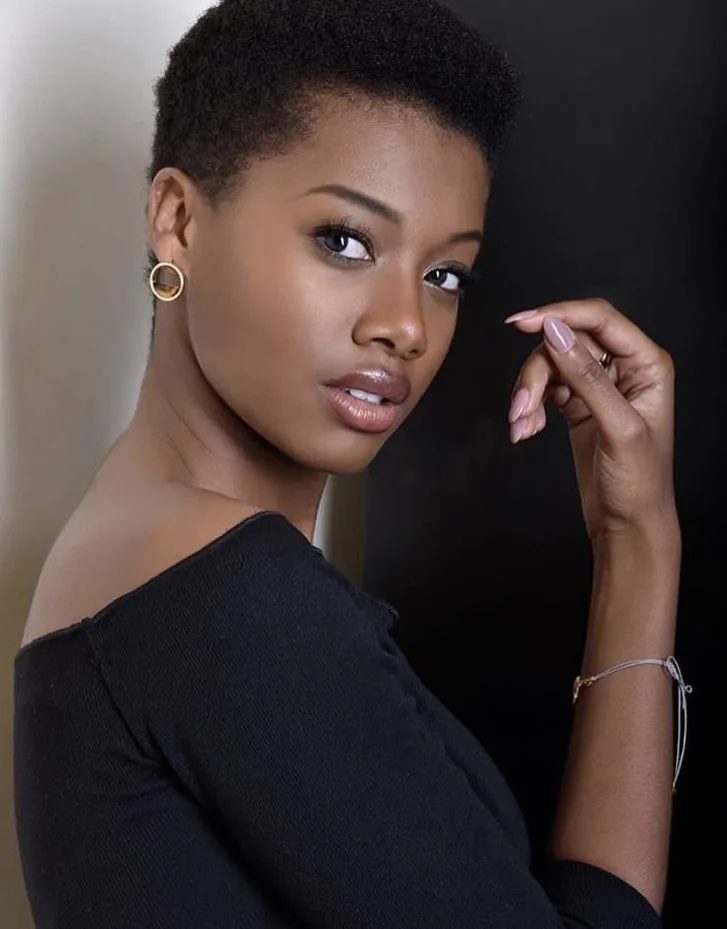
The teeny weeny afro — the TWA — is the shortest afro of all: a close, even crop, usually under two inches long, that shows off the curl pattern and the shape of the head in full. It is the look many women choose after a big chop, when they cut away relaxed or damaged hair and start fresh with their natural texture, and it is also the look women choose simply because they love it — because a TWA is striking, confident and completely low-maintenance. With so little length, the curls form a tight, beautiful pattern close to the scalp, and the face becomes the whole focus: the eyes, the cheekbones, the smile.
A TWA suits every face shape, because there is so little hair that the shape barely interferes with the face at all — and it is especially flattering with statement earrings and a strong brow. Maintenance could not be easier: wash, condition, a little leave-in, and you are done in five minutes, with no detangling marathons and no picking. The refresh is a daily spritz of water and a dab of cream, and a shape-up every three to four weeks keeps the outline neat. Cost is minimal — a TWA is the cheapest afro to keep, and many women maintain it at home with clippers. If you are thinking about a big chop, the TWA is the reward on the other side: freedom, in about two inches of curls.
6. The Afro Puff
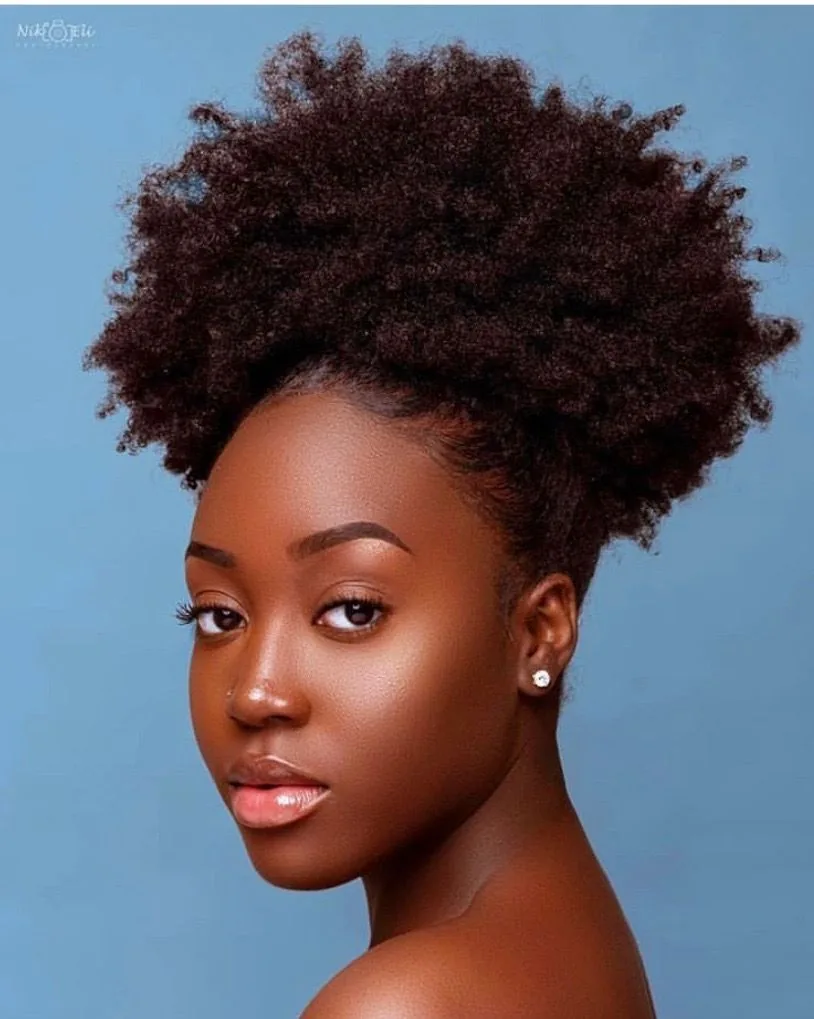
The afro puff is the afro gathered up into a single, glorious ball — usually high on the head, sometimes at the crown, sometimes low at the nape — and it is one of the most joyful hairstyles there is. The puff keeps the hair off the face and neck while showing off the volume, and it works at almost every length, from a short puff that sits close to the head to a big, full puff that is a statement all on its own. It is quick, it is easy, and it is endlessly adaptable: a high puff for a night out, a low puff for work, a side puff for something different.
The puff suits every face shape, and it is particularly flattering on round faces, because the height on top lengthens the face. For maintenance, a puff needs the hair gathered gently — never pulled tight, which causes breakage at the edges — with a satin scrunchie or a soft band, and the edges smoothed with a little gel. It refreshes easily: take it down at night, moisturise, and re-puff in the morning in under five minutes. Time and cost are minimal — this is a do-it-yourself style through and through, with no salon visit needed unless you want a shape-up. If you want the afro’s volume with the practicality of an updo, the puff is the answer, and it takes about as long as making a cup of tea.
7. Double Afro Puffs
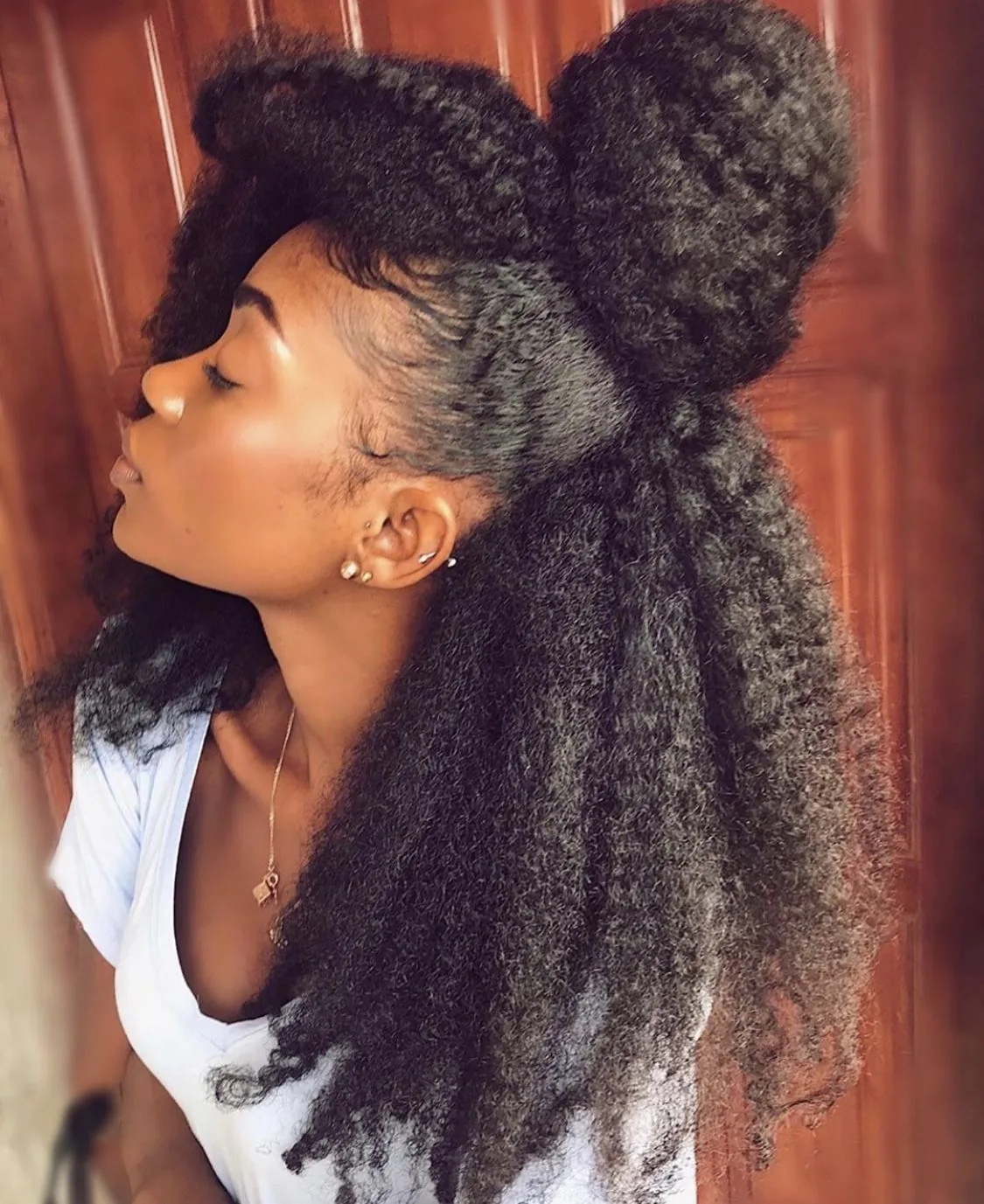
Double afro puffs — two puffs, one on each side of the head — are the playful side of the afro: fun, youthful and full of personality, without ever looking childish when they are done well. The puffs can be big and full for a bold, statement look, or small and neat for something softer, and they work beautifully with a centre part, a zigzag part, or no part at all. They suit festivals, holidays, weekends and any day when you want your hair to make people smile, and they are also a practical choice, because two smaller puffs are easier to manage than one big one on very thick hair.
Double puffs suit oval, heart-shaped and round faces, and they are particularly charming on shorter and medium-length afros, where the puffs sit neatly on either side. For upkeep, the puffs need to be even — part the hair carefully, use the same amount of hair on each side, and secure each puff with a soft band rather than a tight elastic, which can snap the edges. They refresh in minutes each morning, and they last all day if the edges are smoothed with a little gel. Cost is nothing beyond your usual products — this is a pure do-it-yourself style — and the time is about ten minutes. Two puffs, twice the fun, and a style that suits a festival as well as a lazy Sunday.
8. The Afro with a Twist Out
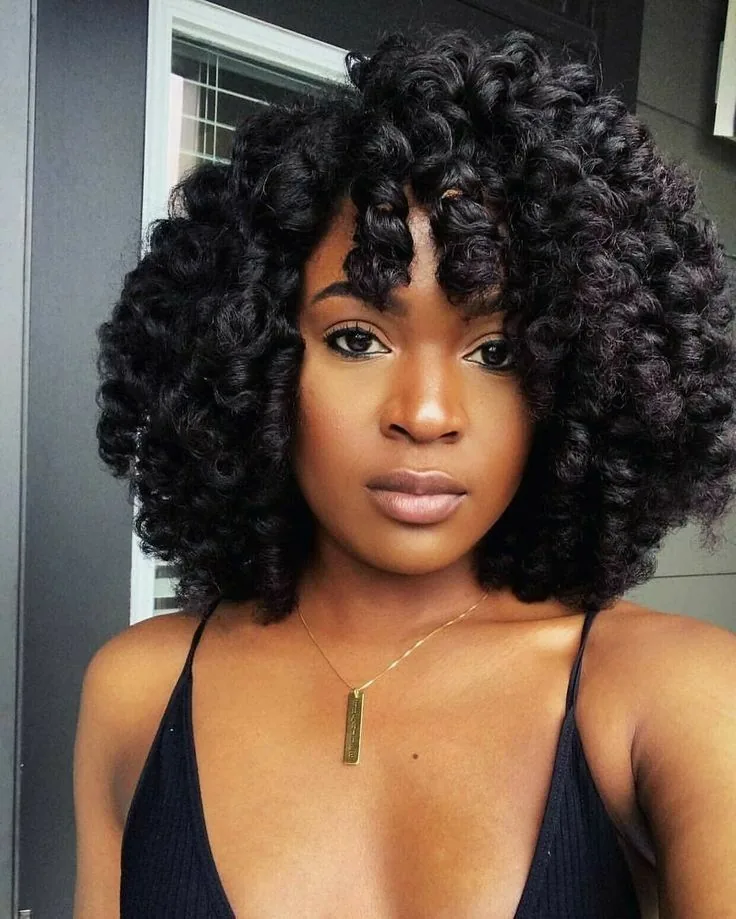
The afro with a twist out is the most popular way to wear a defined afro: the hair is twisted into two-strand twists while damp, left to dry, and then unravelled, so the afro has a clear, stretched curl pattern instead of a soft cloud. The result is a bigger, more defined afro with beautiful texture — the curls are visible, the shape is fuller than the hair’s natural state, and the style lasts for days. A twist out also stretches the hair, which reduces shrinkage and shows off the length you actually have, and it is the afro style that photographs best, because the definition catches the light in every curl.
A twist out suits every face shape and every curl pattern, though it shows up best on medium and long afros, where the twists have enough length to form a clear pattern. Maintenance is the trade-off: the twists take thirty to sixty minutes to install the night before, depending on the size of the twists and the length of the hair, and the style then lasts three to five days with nightly pineapple protection. Refreshing is a morning pick at the roots and a light spritz — the curls themselves need no restyling. Cost is low if you do it yourself, which most women do, though a salon twist out is a relaxing treat. If you want the afro with definition, stretch and staying power, the twist out is the classic choice.
9. The Afro with a Braid Out
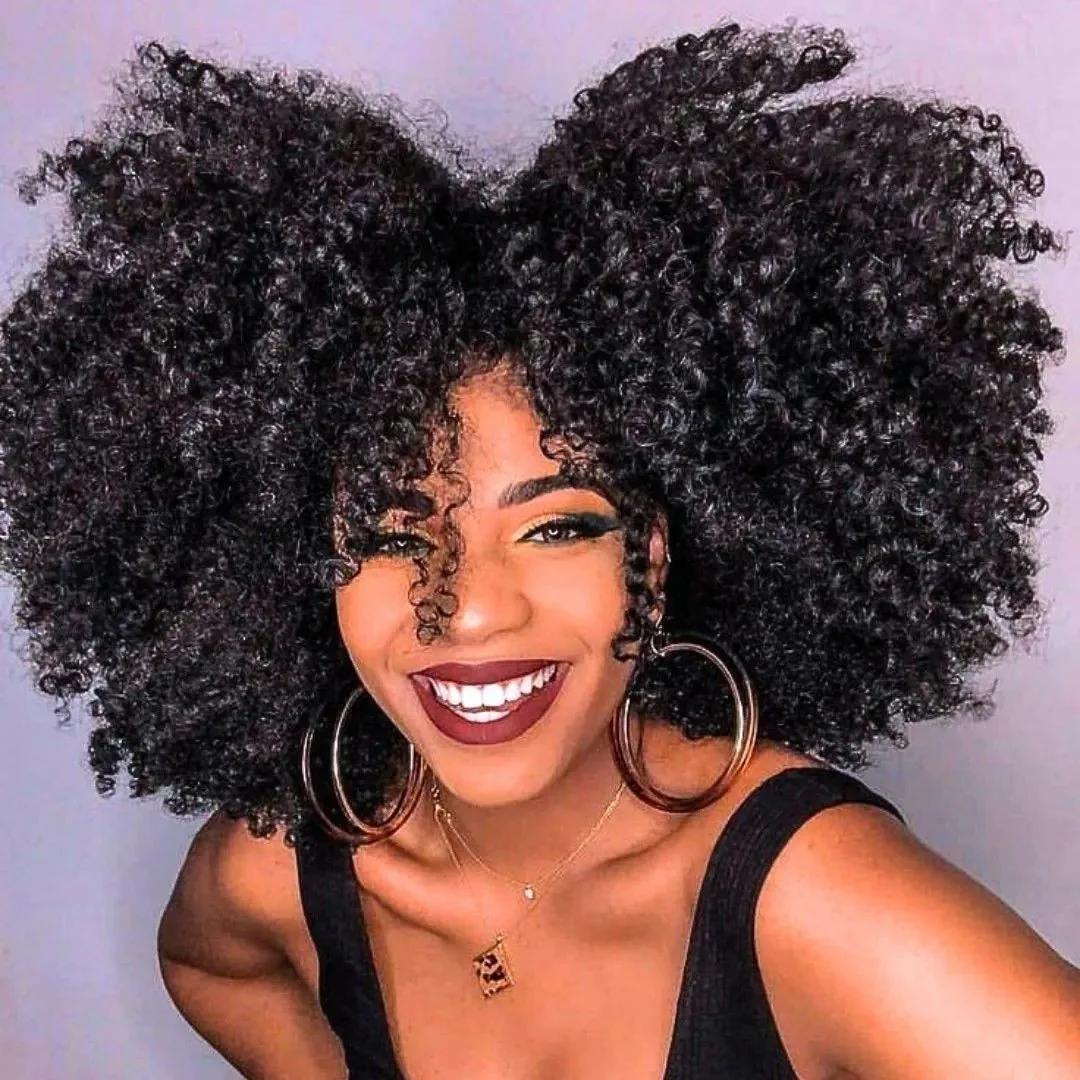
The afro with a braid out is the twist out’s wavier cousin: the hair is braided while damp, left to dry, and then unravelled, so the afro has a soft, crimped wave pattern instead of a tight curl. The waves give the afro a looser, more flowing texture, and the style has a romantic, tousled quality that a twist out does not. A braid out also stretches the hair more than a twist out, so it is a good choice if you want to show off length, and it works beautifully on longer afros, where the waves have room to fall and move.
A braid out suits oval, round and heart-shaped faces, and it is most flattering on medium and long hair, where the wave pattern has enough length to show. For maintenance, the braids take forty to seventy minutes to install — a little longer than twists — and the style lasts three to four days, with the waves loosening a little each day into a softer, bigger afro. Refreshing is simple: a morning pick at the roots and a little oil on the ends. Time-wise it is a weekend-evening job, and cost-wise it is a do-it-yourself style for most women, though a salon braid out is a good option before a special event. If your twist out feels too tight and defined, try a braid out — the waves are the softer, looser answer.
10. The Afro with Finger Coils
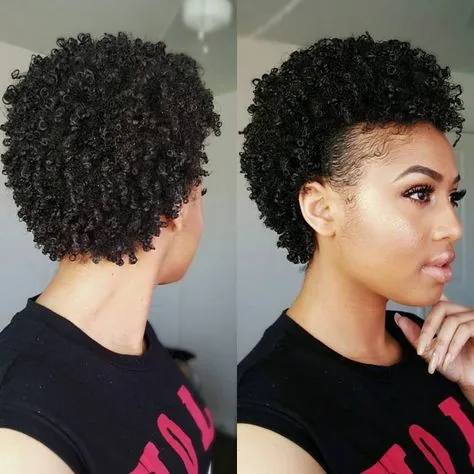
The afro with finger coils is the most defined afro of all: each small section of hair is coiled around a finger while damp, so the afro is made of neat, springy, uniform coils that catch the light like a sculpture. It is a beautiful style — precise, glossy and incredibly detailed — and it suits women who love definition and do not mind spending time on their hair. Finger coils work on short, medium and long afros, and they look especially striking on a TWA or a short afro, where the coils form a perfect, even pattern close to the head.
Finger coils suit every face shape, and they are a wonderful choice for a special occasion, because the definition photographs beautifully. The trade-off is time: coiling a whole head takes one to two hours, depending on the length and how small the coils are, so this is not an everyday style for most women. Maintenance is gentle — the coils last three to five days if they are protected at night with a satin bonnet, and refreshing is a matter of re-coiling the few that have loosened. Cost is low if you do it yourself, though a salon coil set is a popular pre-event treatment. If you want the most defined afro possible, finger coils are the answer — just set aside an evening for it.
11. The Afro with Bantu Knots
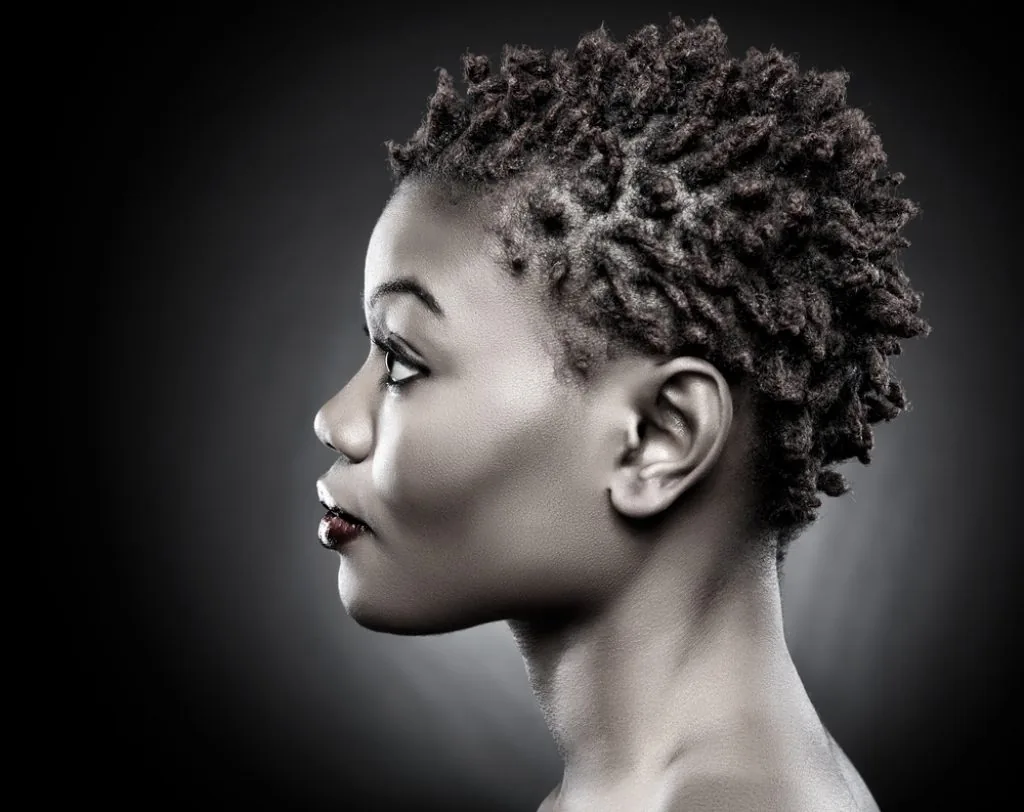
The afro with bantu knots is a style with deep roots and a striking silhouette: small sections of hair are twisted and coiled into neat knots all over the head, creating a sculptural, geometric pattern that is both a style in itself and the starting point for a beautiful knot out. Bantu knots are a protective style — the ends are tucked away inside the knots, so the hair is protected from breakage — and they are also a statement, because the knots themselves are so visually bold. They suit festivals, holidays, photoshoots and any occasion when you want your hair to be the centre of attention.
Bantu knots suit every face shape, and they work on short, medium and long hair, though they show up best on medium lengths, where the knots have enough hair to form a clear shape. For maintenance, the knots take thirty to sixty minutes to install, and they last three to five days as a style — and when you take them down, you get a bonus: a bantu knot out, with big, bouncy, defined curls. Refreshing is not really needed, because the knots hold their shape, and the cost is minimal if you do them yourself. If you want a protective style that is also a work of art, bantu knots are the afro’s most sculptural option.
12. The Afro with Cornrows on Top
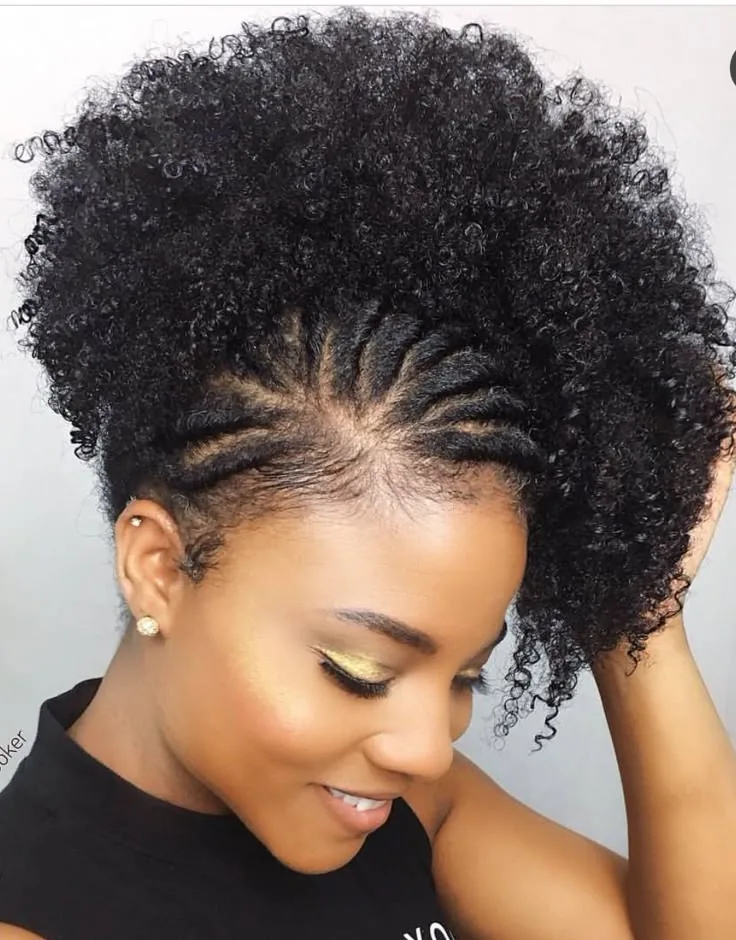
The afro with cornrows on top is a half-up style with real edge: the front section of the hair is braided into neat cornrows, while the back is left as a full, picked-out afro. The cornrows give the style structure and detail at the front, and the afro at the back gives it volume and softness — a combination that looks deliberate, stylish and completely modern. The cornrows can be straight back, curved, or in a zigzag pattern, and they can be as few as two or as many as six, depending on how much detail you want.
This style suits oval, round and heart-shaped faces, and it is most flattering on medium and long afros, where the back section has enough volume to balance the braided front. For upkeep, the cornrows need to be redone every one to two weeks, depending on how fast your hair grows, and the afro at the back needs daily picking to keep its shape. Time-wise, the cornrows take thirty to sixty minutes to install, and many women have them done at a salon or by a braider — cost varies, but it is a modest salon service. The afro itself is do-it-yourself. If you want the afro with a bit of structure and a lot of personality, cornrows on top are the way to do it.
13. The Afro with a Side Part
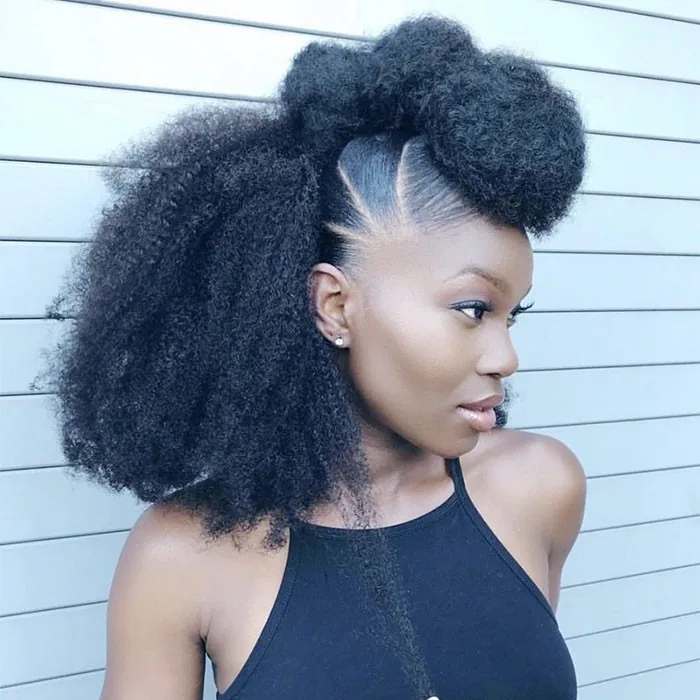
The afro with a side part is the classic round afro with a single, elegant change: a deep part on one side, which sweeps the hair across the forehead and gives the whole silhouette an asymmetric, glamorous line. The part changes everything — it creates a sweeping diagonal across the face, it adds volume on one side, and it gives the afro a polished, almost old-Hollywood quality that a centre part never quite achieves. It is the afro for a long dress, a dramatic neckline, or any evening when you want to look like you stepped out of another era.
A side part suits round and square faces particularly well, because the diagonal sweep breaks up the symmetry of the face and softens a strong jaw. For maintenance, the part needs to be set while the hair is damp — part it with the tail of a comb, smooth the hair on either side, and let it dry in place — and the afro needs its usual daily pick to keep its volume. Refreshing is a morning pick and a quick check that the part is still in place. Time and cost are the same as a classic round afro, with no extra salon visit needed — the part is a styling choice, not a cut. If you want your round afro to feel instantly more glamorous, part it on the side and watch the whole silhouette change.
14. The Afro with Bangs
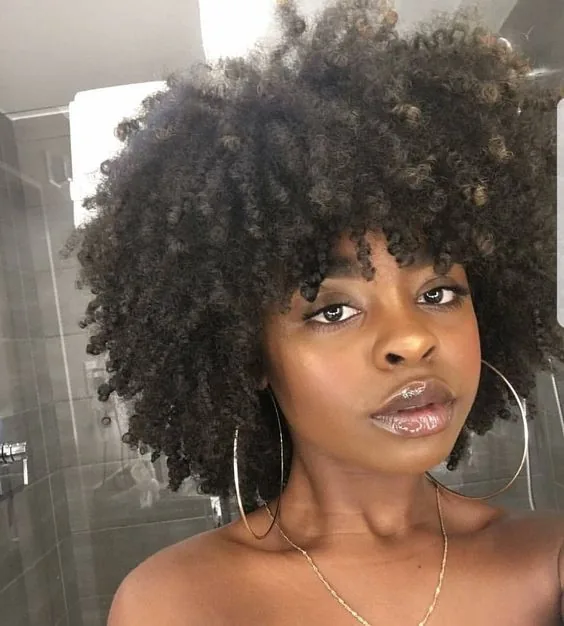
The afro with bangs is a softer, more playful take on the classic shape: a fringe of curls falls across the forehead while the rest of the afro keeps its full, round silhouette. The bangs break up the roundness of the afro, give the face a frame, and add a youthful, romantic touch that suits almost everyone. They can be short and curly, sitting just above the brow, or longer and swept to one side, blending into the rest of the afro — and they are the detail that turns a familiar shape into something new.
Bangs suit oval, long and heart-shaped faces best, because the fringe shortens the forehead and balances the length of the face. For maintenance, the bangs need the most attention of any part of the afro: they are the first thing to frizz in humidity, so a little leave-in and a quick finger-coil in the morning keeps them defined. The rest of the afro follows its usual routine — a daily pick, a spritz every couple of days — and the bangs need a small trim every four to six weeks to keep them above the eyes. Time-wise it is only a couple of extra minutes a day, and cost-wise there is no extra salon visit beyond your usual shape-up. If you want your afro to feel softer and more romantic, start with the fringe.
15. The Afro with a Headband
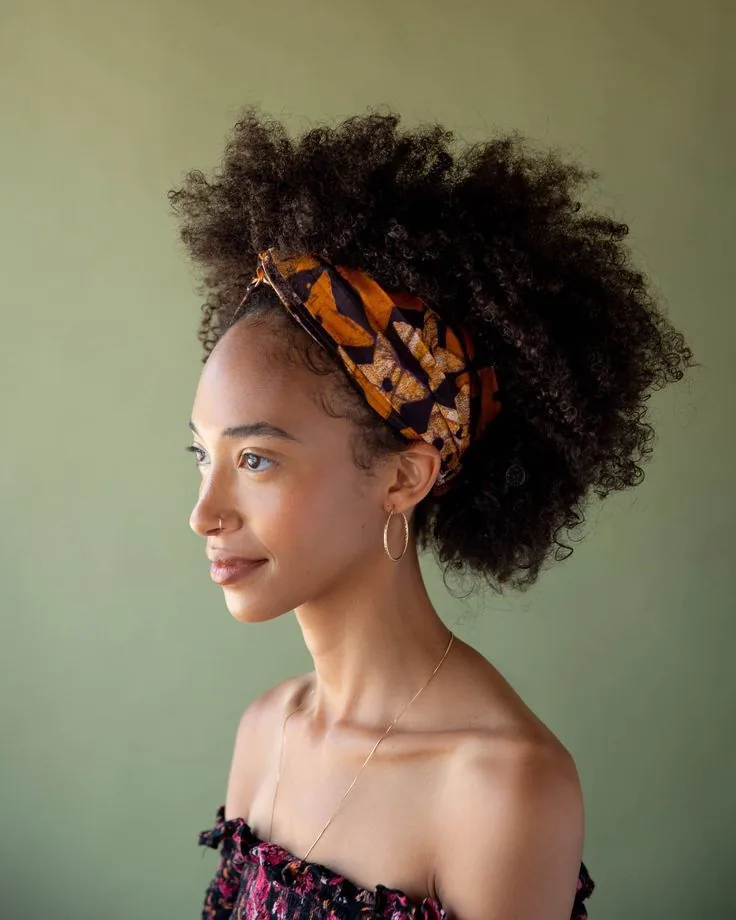
The afro with a headband is the quickest transformation in this guide: one accessory, and the whole afro changes. A headband pushes the front of the afro back, shows off the face, and adds a line of colour or texture across the hair — and it works with every afro length, from a short TWA to a long, grown-out cloud. A thin, fabric headband is the everyday choice; a wide, patterned one is the statement; and a beaded or velvet band turns the afro into evening hair in seconds. It is also the most practical afro accessory, because it keeps the hair out of your face on a windy day or during a workout.
A headband suits every face shape, and it is especially useful for women growing out an afro, because it tidies the in-between lengths while the hair grows. For upkeep, the headband itself needs nothing — just choose one that is comfortable and does not pull — and the afro underneath follows its normal routine. One warning: a tight headband worn every day can cause breakage along the hairline, so vary the position, choose a soft fabric, and give your edges a rest. Time is zero — the headband goes on in seconds — and cost is the price of the band itself. If you want a different afro every day without a different haircut, buy three headbands and rotate them.
16. The Afro with a Silk Scarf
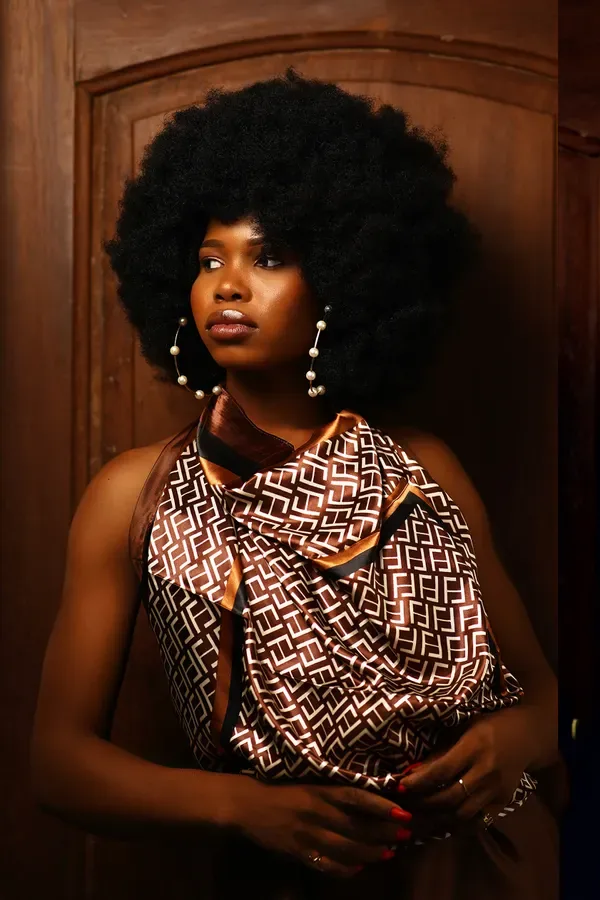
The afro with a silk scarf is elegance with a practical streak: a scarf tied around the hairline, knotted at the front, the side or the back, adds colour and pattern while protecting the edges and keeping the afro in place. A silk or satin scarf is the right fabric, because it does not absorb moisture the way cotton does, and it glides over the hair instead of creating friction. The scarf can be a thin band across the front, a wide wrap that covers the crown, or a full head wrap with the afro puffing out at the back — and each version gives the same afro a completely different mood.
A silk scarf suits every face shape, and it is a lifesaver on a bad hair day, a humid day, or a day when the afro needs a little help holding its shape. For maintenance, the scarf needs nothing more than a wash now and then, and the afro underneath needs its usual moisture and picking — the scarf actually helps, by protecting the hairline from friction and weather. Time is a minute or two to tie it, and cost is the price of a scarf, which can be as little as a few dollars. One tip: tie the scarf loosely enough that it does not flatten the afro, and vary the knot position so the edges are not always pressed in the same place. A scarf is the afro’s oldest friend, and it still works.
17. The Afro with Gold Cuffs and Jewellery
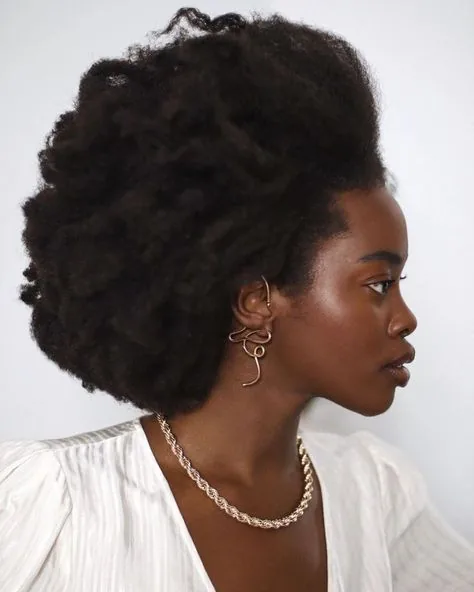
The afro with gold cuffs is the afro dressed up: small gold rings, cuffs and beads threaded onto individual twists or braids within the afro, catching the light every time the head moves. The gold against dark, curly hair is one of the most beautiful combinations in hairstyling — warm, regal and completely striking — and a few cuffs are all it takes, because the metal does the work. They suit a wedding, a party, a photoshoot, or any day when you want the afro to feel like jewellery rather than just hair.
Gold cuffs suit every face shape, because they are an accent rather than a shape, and they work best on afros with some defined twists or braids to thread them onto — a twist out, a few small braids, or finger coils. For upkeep, the cuffs need nothing beyond a quick wipe if they tarnish, and the afro underneath follows its normal routine; the cuffs themselves last for years. Time is a few minutes to place them, and cost is the price of a pack of cuffs, which is modest — though real gold, if you want it, is a different budget. One caution: choose cuffs that are smooth inside, so they do not snag the hair, and remove them before washing. If you want your afro to look like a crown, gold is the fastest way there.
18. The Afro with Honey Blonde Tips
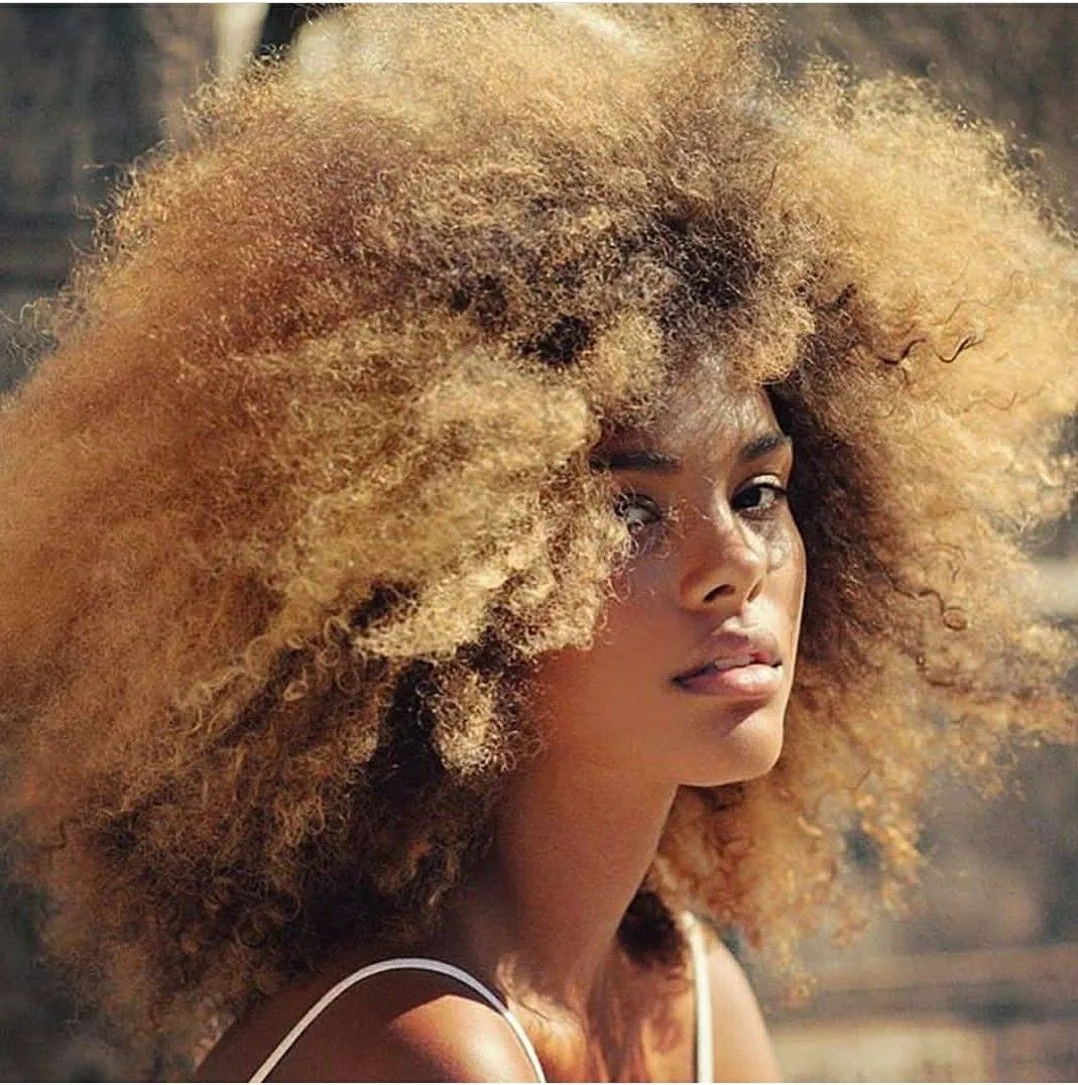
The afro with honey blonde tips is sunshine on the ends of the curls: the top of the afro stays its natural dark shade, and the last inch or two of each curl is lightened to a warm honey blonde, so the afro looks three-dimensional and the curls catch the light. It is the most flattering colour for an afro, because the lighter ends make the curl pattern visible from across the room, and the dark roots keep the look grounded and natural. It suits a summer holiday, a new season, or any moment when you want your afro to feel lighter and brighter without changing its shape.
Honey blonde tips suit every skin tone, because honey is a warm, golden shade that flatters warm and cool undertones alike — though the exact shade should be chosen with your stylist to match your skin. For maintenance, coloured ends need more moisture than the rest of the hair, so a weekly deep-condition is essential, and the tips will need a touch-up every eight to twelve weeks as the hair grows. Time-wise, the colouring takes one to two hours at a salon, and the cost is a salon colour service — more than a home rinse, but worth it, because lightening afro hair at home is the fastest way to damage it. If you want colour without the commitment of a full head, the tips are the perfect halfway point.
19. The Afro with Burgundy Colour
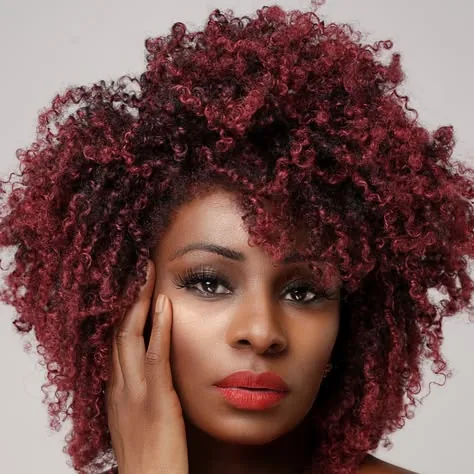
The afro with burgundy colour is rich, warm and quietly dramatic: a deep wine-red shade that glows in the sunlight and looks almost black indoors, so the afro has a secret — a colour that reveals itself when the light hits it. Burgundy is one of the most flattering colours for dark hair, because it does not need heavy bleaching to show up, and it suits every skin tone, from the palest to the deepest. It is the colour for autumn, for a new chapter, or for a woman who wants her afro to have a little more mystery.
Burgundy suits every face shape, because colour is an accent rather than a shape, and it works at every afro length, from a TWA to a long afro. For upkeep, a burgundy rinse fades over four to six weeks, so a colour-refreshing conditioner or a top-up rinse keeps it rich, and the coloured hair needs a weekly deep-condition to stay soft. Time-wise, the colouring takes one to two hours at a salon, and the cost is a salon colour service — though a semi-permanent burgundy rinse at home is a low-cost way to test the shade first. If you want a colour that is bold without being loud, burgundy is the afro’s most elegant choice.
20. The Afro with a Bold Copper Colour
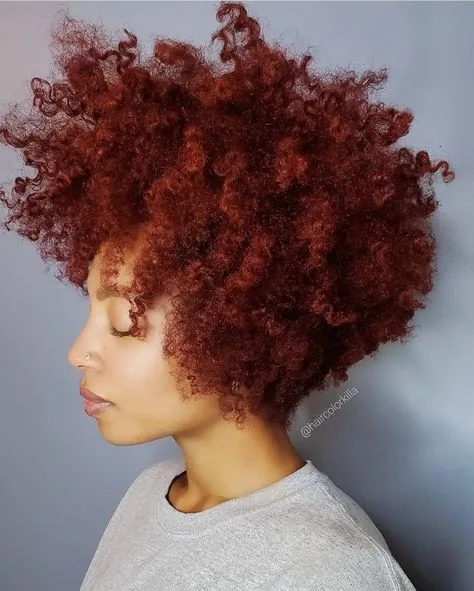
The afro with a bold copper colour is the loudest afro in this guide: a rich, fiery copper-red that makes the whole silhouette glow, like autumn leaves in the sun. Copper is a statement colour — it does not whisper, it announces — and on an afro it is extraordinary, because the curls multiply the colour into hundreds of little highlights. It suits women who love attention, who want their hair to be a conversation, and who are ready for the upkeep that a bold colour demands, because copper fades faster than any other shade.
Copper suits warm skin tones best, though a deeper, more auburn copper flatters cooler skin too — ask your stylist to match the shade to your undertone before you commit. For maintenance, copper needs the most care of any colour here: a colour-safe shampoo, cold-water rinses, a weekly deep-condition, and a colour top-up every four to six weeks to keep it fiery rather than faded. Time-wise, the colouring takes two to three hours at a salon, including lightening, and the cost is a full salon colour service — this is not a home dye job, because lightening afro hair evenly is a professional skill. If you want the boldest afro possible, copper is it — just be ready to look after it.
21. The Short Afro
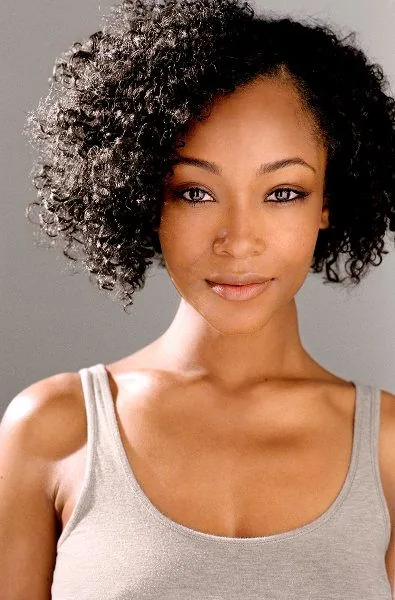
The short afro is the sweet spot between a TWA and a medium afro: a few inches of curls, picked out into a small, neat round shape, with real presence but none of the weight of a longer afro. It is the length most women settle into after growing out a TWA, and it is the length that proves a small afro can be just as striking as a big one — the silhouette is compact, the curls are clear, and the face is fully on show. It suits everyday wear, it suits work, and it suits a night out, because it is neat enough to be polished and full enough to be a statement.
A short afro suits every face shape, and it is particularly flattering on round and heart-shaped faces, where the small round shape balances the features without overwhelming them. For maintenance, the short afro needs a daily pick — two minutes, lifting from the roots — and a spritz of water every couple of days to keep the curls soft. A shape-up trim every six to eight weeks keeps the outline neat, and the cost is low: a short afro is one of the cheapest afros to keep, with a pick, a leave-in and a bonnet as the whole toolkit. If you are growing out a TWA and wondering when your hair becomes an afro, this length is the answer — congratulations, you are there.
22. The Medium Afro
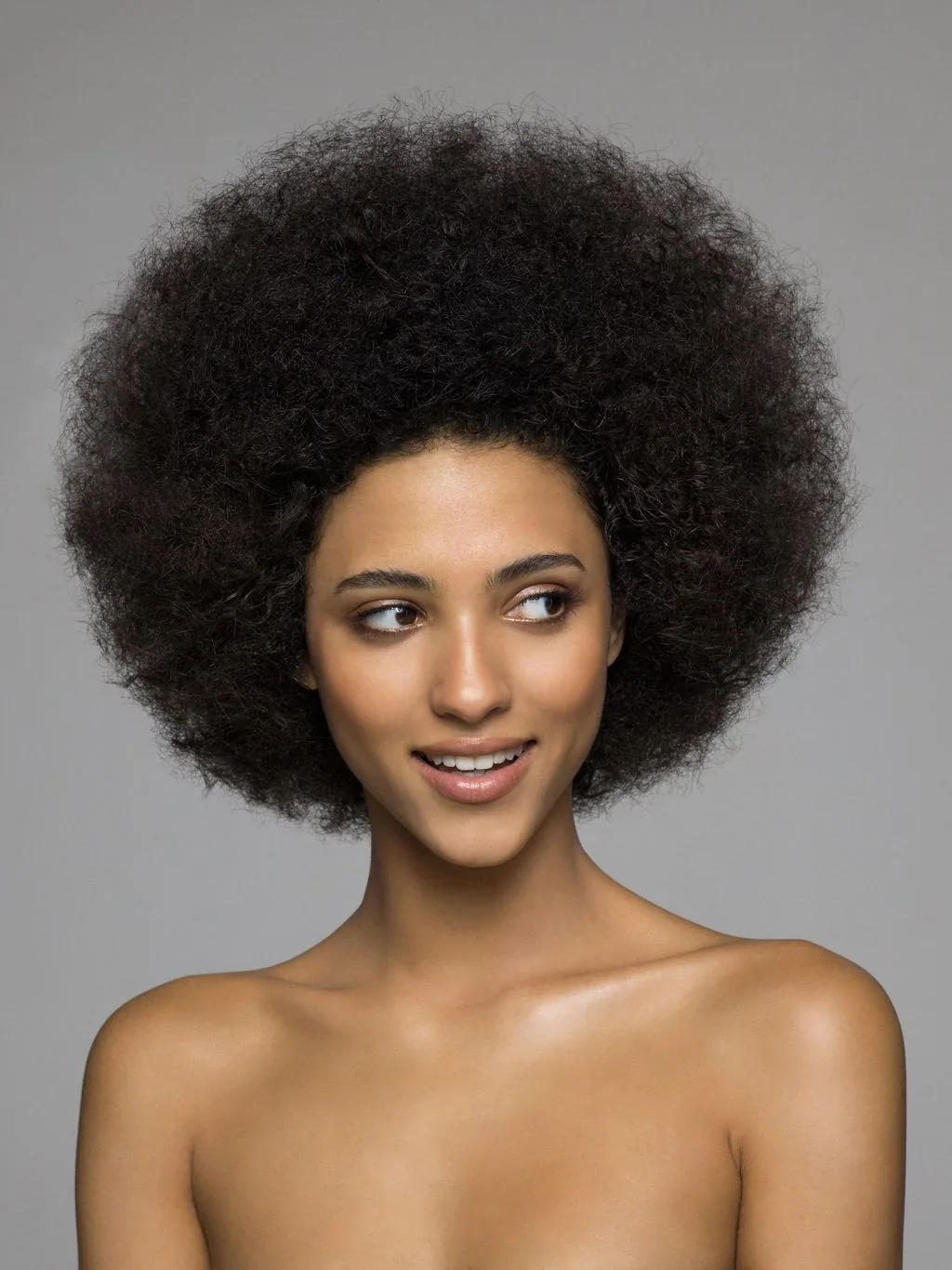
The medium afro is the length most women live in: enough hair for a full, round silhouette, a tapered cut, a twist out or a puff, and not so much that the care routine becomes a project. It is the most versatile afro length, because it does every style in this guide well, and it is the length where the afro really starts to show its personality — the shape, the definition, the way it moves when you do. A medium afro is also the easiest length to shape at the salon, because there is enough hair to sculpt and not so much that the cut takes an hour.
A medium afro suits every face shape, and it is the length that suits the most styles, so it is the best length to experiment at — try the taper, try the twist out, try the puff, and see what feels like you. For upkeep, the medium afro needs a daily pick, a weekly wash and deep-condition, and a shape-up trim every six to eight weeks. Time-wise, the routine takes about ten minutes a day, and the cost is a regular salon shape-up plus your usual products — a modest, manageable budget. If you are not sure which afro length is yours, grow to medium and stay there for a while: it is the length that does everything, and it does it well.
23. The Long Afro
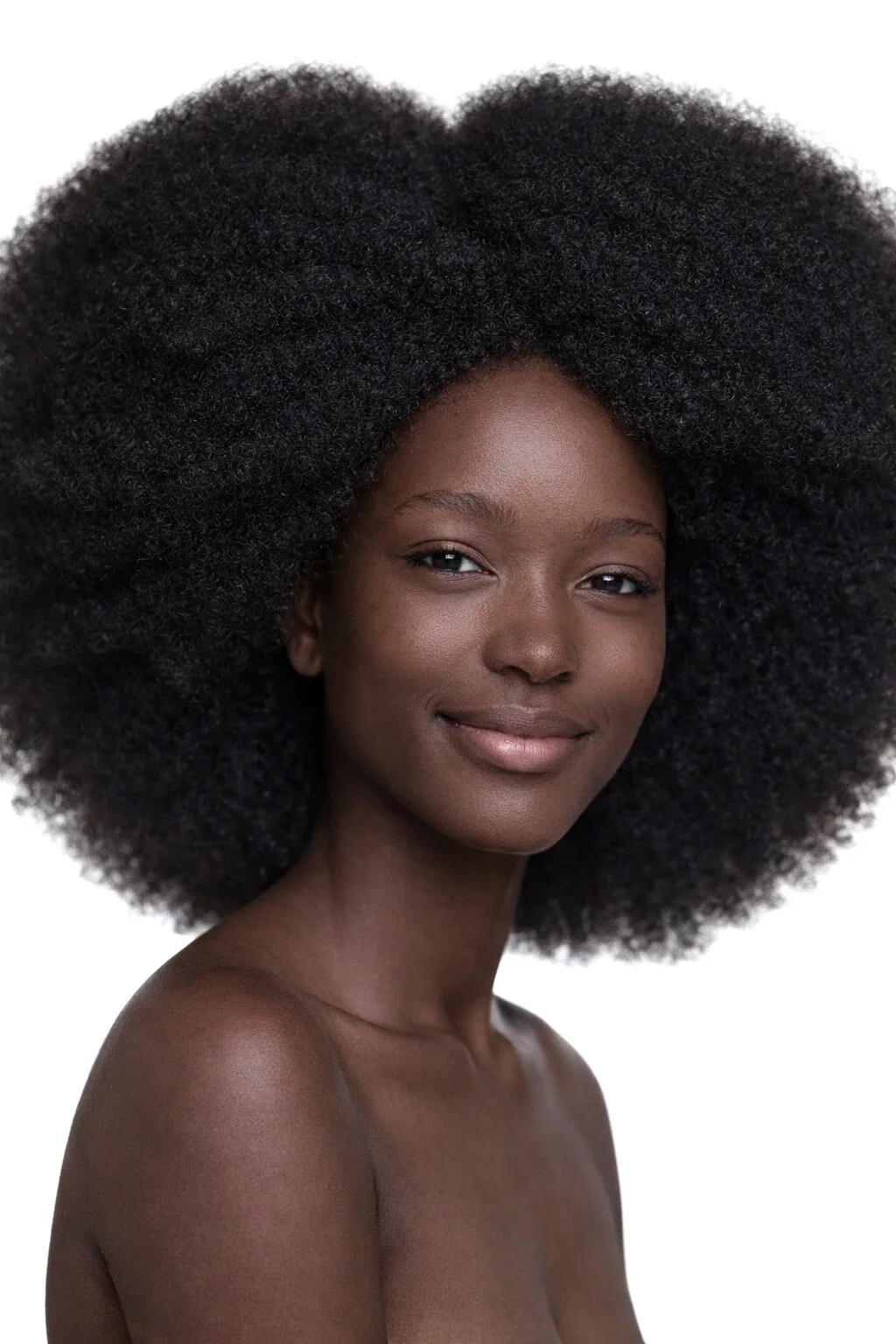
The long afro is the most dramatic afro there is: a big, sculpted cloud of curls that reaches past the shoulders when stretched, and holds a silhouette nobody forgets. It is the afro as a statement — the volume, the shape, the sheer presence of it — and it is the length that gets the most compliments, the most photographs, and the most questions about how long it took to grow. It did take a while: a long afro is years of care, patience and trims, and it shows. But the reward is a hairstyle that is completely, unmistakably yours, because no two long afros are ever alike.
A long afro suits oval, round and heart-shaped faces, and it is most flattering when the shape is kept even — a long afro that is wider at the bottom than the top can overwhelm the face, so a good shaping keeps the silhouette balanced. For maintenance, the long afro needs the most care of any length: a weekly wash and deep-condition, detangling in sections, a daily pick, and a shape-up trim every eight to ten weeks. Time-wise, wash day can take two to three hours, and the cost is higher — more product, more salon time — but the result is the biggest afro in the room. If you have the patience, the long afro is the ultimate reward: years of care, worn all at once, in one glorious cloud.
24. The Afro for Fine Hair
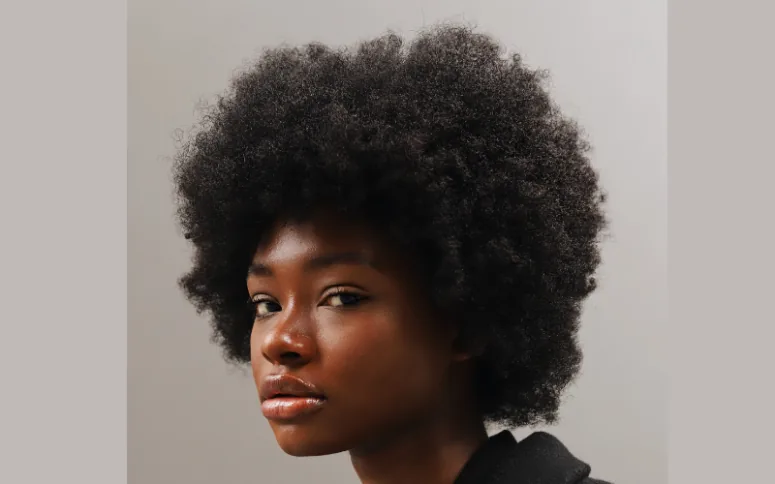
The afro for fine hair — or lower-density hair — is proof that an afro is not only for thick, dense curls: with the right shape and a little help, finer hair makes a beautiful, soft afro with its own kind of elegance. The key is to work with the volume you have rather than chasing someone else’s: a shorter, rounder shape looks fuller than a long afro on fine hair, and a defined twist out or finger coils make the curls look thicker than they are, because definition creates the illusion of density. A pick, used gently at the roots, lifts the hair without breaking it, and a light product — never a heavy butter — keeps the curls from being weighed down.
Fine hair suits a shorter afro best, and it flatters oval, heart-shaped and long faces, where the soft, compact shape balances the features. For upkeep, the fine-hair afro needs a lighter routine than a dense afro: a little leave-in, a light cream, and no heavy oils, which flatten fine curls. Refreshing is a morning pick at the roots and a light spritz — never a heavy re-wetting, which makes fine hair limp. Time is five minutes a day, and cost is low, because fine hair uses less product. If your hair is fine and you have been told an afro is not for you, that is not true — it is for you, in a shorter shape, with lighter products, and it will look lovely.
25. The Afro for Thick, Dense Hair
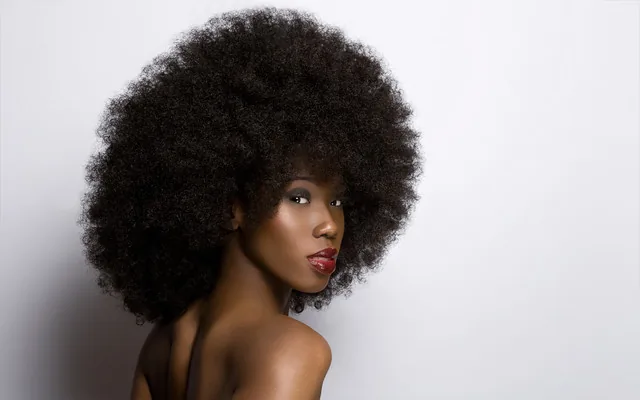
The afro for thick, dense hair is the afro in its fullest glory: a big, sculpted cloud that holds its shape with almost no effort, because the density does the work. Thick hair gives the afro its height, its width and its presence, and it is the hair type that makes the classic round afro look like the pictures — full, even and completely unmistakable. The challenge is not volume but weight: a dense afro is heavy, and it needs to be shaped properly, or it can overwhelm the face and pull downward over the course of the day.
Thick, dense hair suits a longer afro best, because the length balances the volume, and it flatters oval, round and square faces, where the fullness softens the features. For maintenance, a dense afro needs more product than a fine afro — a generous leave-in, a rich cream, and an oil to seal it in — and detangling in sections, because a dense afro tangles easily if it is handled in one go. Wash day takes longer, often two to three hours, and a shape-up trim every six to eight weeks keeps the silhouette from getting too wide. Cost is a little higher, because dense hair uses more product, but the result is the afro that everyone pictures when they hear the word. If your hair is thick, the afro is not just a style — it is your hair’s natural destiny.
26. The Afro for 3C Curls
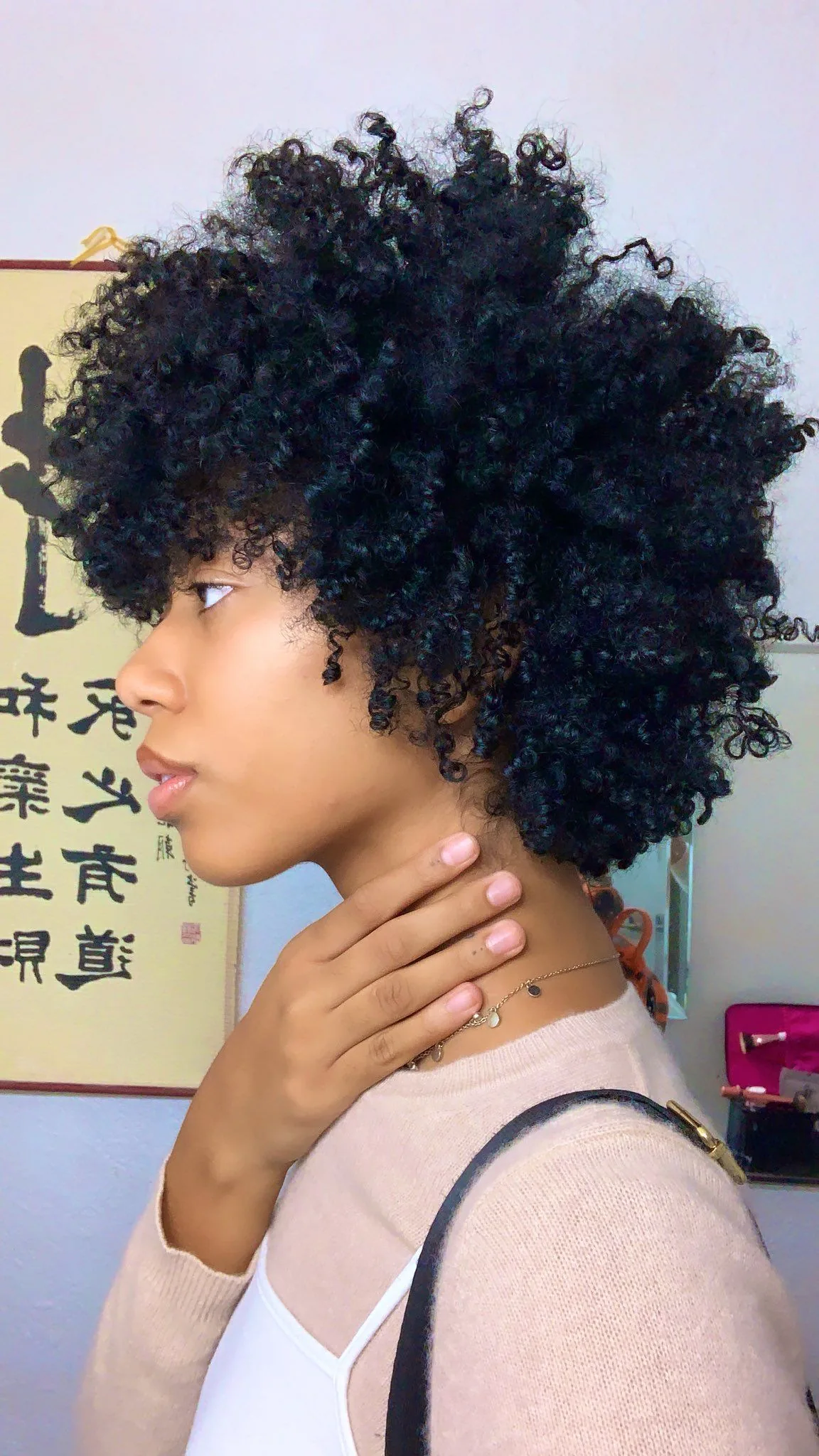
The afro for 3C curls is the afro with the most visible curl pattern: tight, springy, corkscrew curls, about the width of a pencil, that clump together into a defined, bouncy afro with real texture. 3C curls are the loosest of the afro curl types, so the afro they make is a little softer and a little more stretched than a 4C afro — the curls are clear, the shape is full, and the shrinkage is less dramatic, so the length shows more. It is a beautiful, versatile curl type, and it makes an afro that is both defined and voluminous at the same time.
A 3C afro suits every face shape, and it is most flattering in a medium length, where the curls have enough room to spring and the shape stays balanced. For upkeep, 3C curls need a curl cream or a light gel to define the pattern, and a pick at the roots for volume — the two together give definition and height at the same time. Refreshing is a morning spritz and a gentle scrunch, and a shape-up trim every eight weeks keeps the outline neat. Time is ten minutes a day, and cost is low, because 3C curls need less product than tighter curl types. If your curls are 3C, your afro is the defined one — let the curls show, and they will do the work.
27. The Afro for 4A Curls
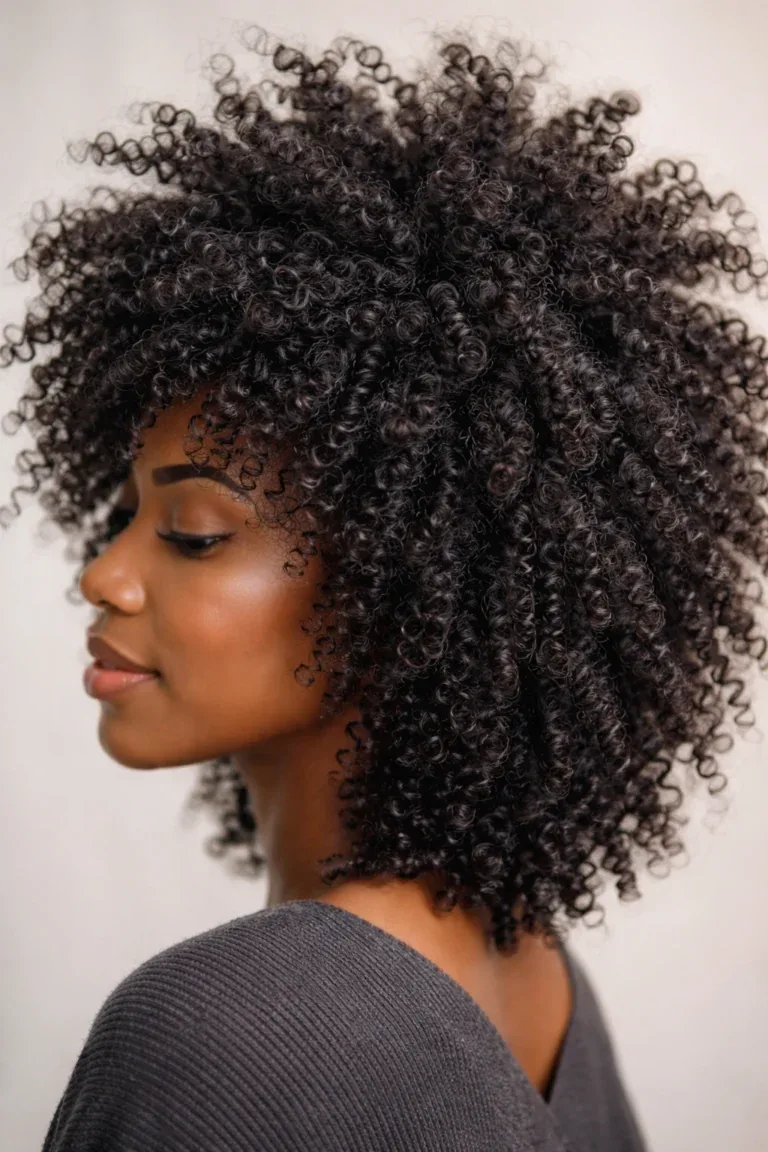
The afro for 4A curls is the afro with the classic coil: tight, springy, S-shaped curls, about the width of a crochet needle, that form a defined, dense afro with a soft, cloud-like finish. 4A curls are the bridge between the looser 3C curls and the tighter 4B coils, so the afro they make has both definition and volume — the curls are visible, the shape is full, and the shrinkage is noticeable but not extreme. It is a versatile curl type, and it makes an afro that looks good in almost every style in this guide, from a twist out to a picked-out round.
A 4A afro suits every face shape, and it is most flattering in a short to medium length, where the coils have enough room to spring without the weight pulling them down. For maintenance, 4A curls need a leave-in and a cream to keep them soft, and a pick at the roots for volume — definition comes naturally to 4A hair, so the routine is about moisture and shape rather than forcing a pattern. Refreshing is a morning spritz and a gentle pick, and a shape-up trim every eight weeks keeps the outline even. Time is ten minutes a day, and cost is modest. If your curls are 4A, your afro is the balanced one — defined enough to show the pattern, full enough to be a statement.
28. The Afro for 4B and 4C Coils
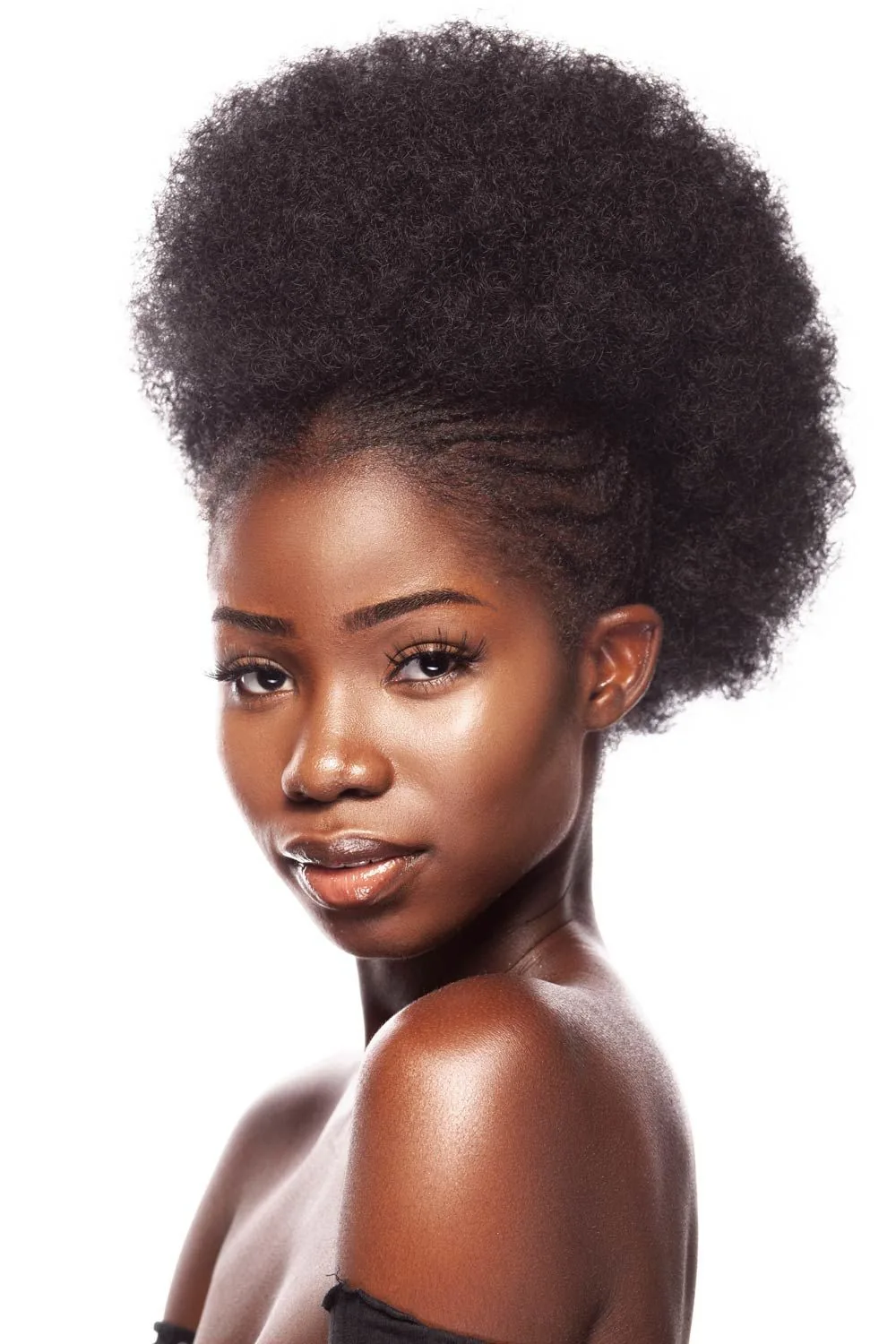
The afro for 4B and 4C coils is the afro in its most iconic form: tight, dense, zigzag coils that stand up and out from the head, creating a big, sculpted silhouette with extraordinary volume. 4B and 4C hair has the most shrinkage of any curl type — the coils can spring up to half their stretched length or less — which means the afro looks shorter than it really is, and the volume is enormous for the length. It is the hair type that the afro was made for, and it makes a shape that no other hair type can match: a perfect, dense, cloud-like round that holds its form all day.
A 4B and 4C afro suits every face shape, and it is most flattering in a medium to long length, where the volume has room to be a statement. For upkeep, 4B and 4C coils need the most moisture of any curl type: a generous leave-in, a rich cream, and an oil to seal it in, plus a weekly deep-condition, because the tight coils make it hard for the scalp’s natural oils to travel down the strand. Detangling must be gentle and in sections, on damp, conditioned hair. Time-wise, wash day can take three hours, and the cost is a little higher, because the hair uses more product — but the result is the afro that defines the style. If your coils are 4B or 4C, your afro is the original, and it is magnificent.
29. The Afro for Work

The afro for work is the shaped, defined version of the style: a neat round or tapered afro, with the edges smoothed and the silhouette even, that reads as deliberate and polished in exactly the way a good haircut does. It keeps the hair completely off the face and collar, it holds its line through a long day of meetings, and it looks professional without hiding the hair’s natural texture. The key is tidiness — a picked-out afro that has been shaped, a little edge control on the hairline, and no accessories beyond a plain pin if you need one. It is the afro as a workhorse: practical, comfortable and quietly impressive.
A work afro suits every face shape, and it is most flattering in a short to medium length, where the shape is easy to keep neat. For maintenance, the work afro needs a morning pick, a quick edge smooth, and a shape-up trim every four to six weeks to keep the outline crisp — a tapered afro needs the most frequent trims, a round afro the least. Time is five minutes a day, and cost is a regular salon shape-up plus your usual products. If your workplace is conservative, the tapered afro or a low puff is the safest shape, because it looks the most like a conventional short cut while still being unmistakably an afro. Wear it with confidence: a well-shaped afro is as professional as any hairstyle there is.
30. The Afro for a Wedding
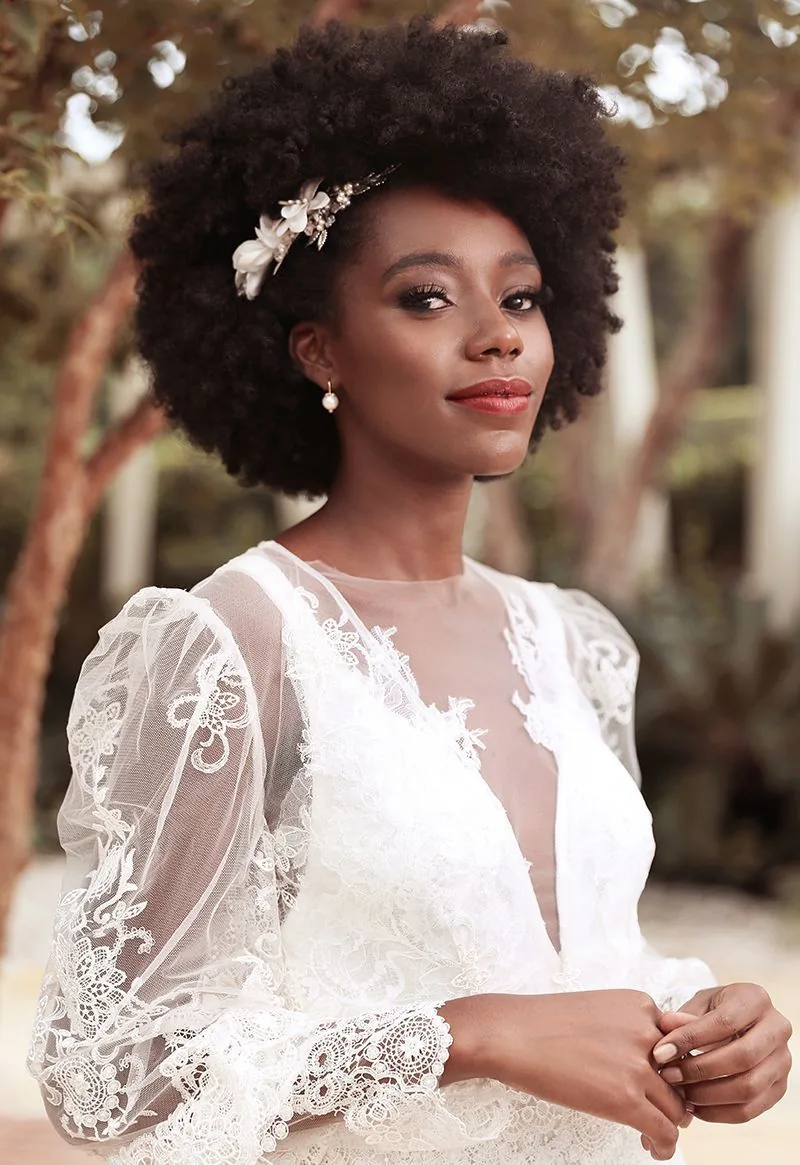
The afro for a wedding is the afro as a crown: a full, picked-out glam afro with defined curls, or a tapered afro with gold accessories, that looks extraordinary with a gown and photographs beautifully because the shape is so strong. Brides often add a twist out for definition, a few fresh flowers, or gold cuffs on twists for a regal finish — and the afro’s height does the work that an updo does for other hair types, elongating the neck and balancing a long dress. It is a bridal style that is completely, unmistakably natural, and that is exactly what makes it so powerful on the day.
A wedding afro suits every face shape, and it is most flattering when it is full and defined, with the edges smoothed and the shape even from every angle. For upkeep, the wedding afro needs a trial run — wear the style for a full day at least a month before the wedding, with the accessories, to test how it holds — and a fresh shape-up a week before the day. Time-wise, the styling on the day takes thirty to sixty minutes, and the cost is a salon styling session plus any accessories. If you are a bridesmaid, the same afro worn a little smaller and softer is the perfect coordinated look. The afro does not need a veil to be bridal — it is already a crown.
31. The Afro for a Formal Evening
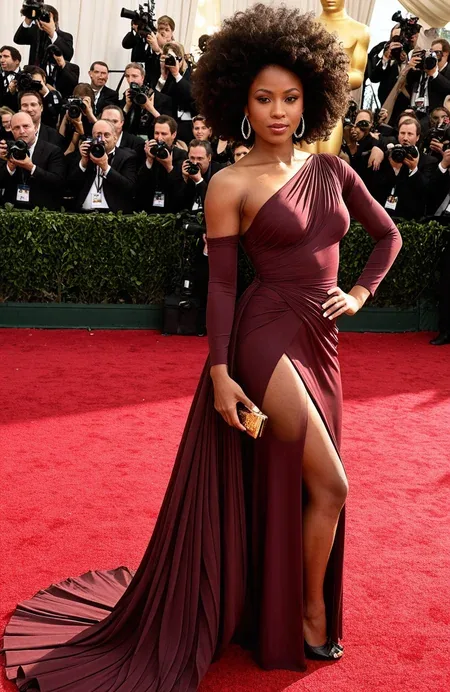
The afro for a formal evening is the glam afro: a big, picked-out, defined afro, with the edges smoothed, the shape sculpted, and one elegant accent — a gold cuff, a jeweled pin, or a silk scarf — to finish it. It is the afro for a black-tie dinner, a gala, or any evening when the dress is long and the hair should be just as dramatic. The afro’s height and volume balance a long gown perfectly, and the shape photographs beautifully, because the silhouette is so strong and so clear. It is the afro at its most glamorous, and it takes surprisingly little to get there — shape, definition, and one accent.
A formal afro suits every face shape, and it is most flattering when it is full and defined, with a clear silhouette and a smooth hairline. For maintenance, the formal afro needs a fresh shape-up a few days before the event, a twist out or finger coils for definition, and a light holding product to keep the shape through the evening. Time-wise, the styling takes thirty to forty-five minutes, and the cost is a salon styling session if you want it done professionally — though a do-it-yourself twist out the night before is a perfectly good alternative. If you want to feel like the most glamorous woman in the room, the formal afro is the way to do it — just let the shape do the talking.
32. The Afro with a Defined Part and Sleek Edges
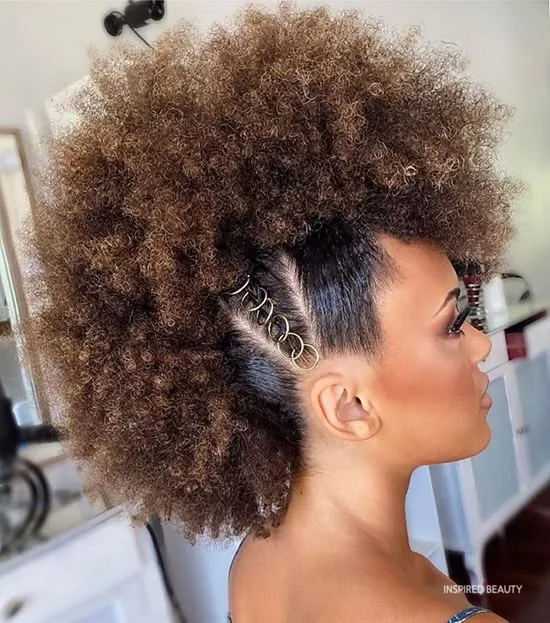
The afro with a defined part and sleek edges is the polished version of the style: a clear, sharp part — centre or side — and a smooth, laid hairline, so the afro looks sculpted and intentional from the front. The edges are smoothed with a little gel and a soft brush, and the part is set while the hair is damp, so the lines stay clean all day. It is the afro for women who love a crisp finish, and it turns a soft, cloud-like afro into a style that looks like it was designed, not just grown. The contrast between the sleek front and the full, voluminous back is what makes it so striking.
A defined part and sleek edges suit oval, round and heart-shaped faces, and they are most flattering on short and medium afros, where the part and the edges are easy to see. For upkeep, the edges need a daily smooth — a little gel, a soft brush, and a silk scarf for ten minutes to set them — and the part needs to be re-set each morning with the tail of a comb. Time is five extra minutes a day, and cost is a small tube of edge control and a brush. One caution: do not pull the edges too tight or use too much gel every day, because the hairline is delicate and breakage there is slow to grow back. If you want your afro to look its most polished, the part and the edges are the finishing touch.
33. The Afrohawk
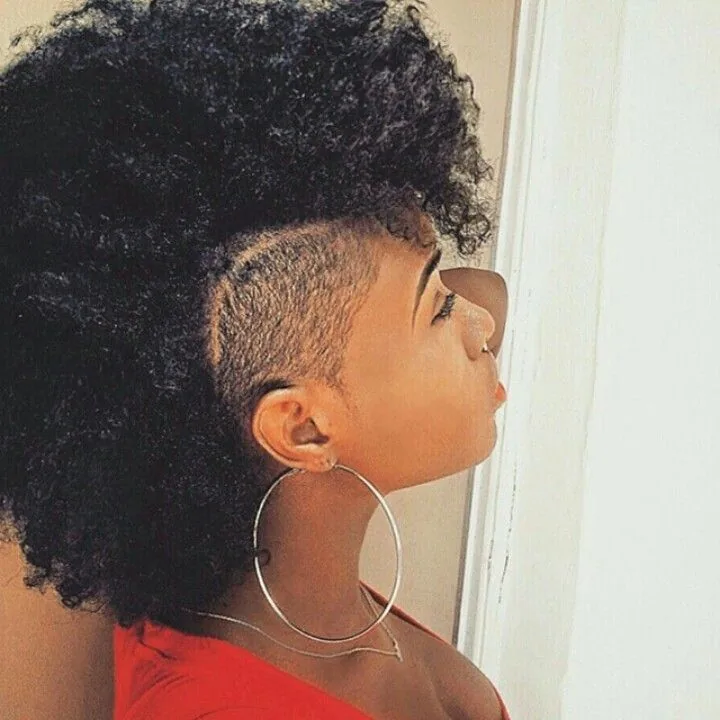
The afrohawk is the afro with an attitude: the sides are kept short or faded, and the centre strip of hair is left long and picked out into a tall, dramatic mohawk shape. It is the boldest afro in this guide — a style that does not ask for attention, it takes it — and it suits women who love an edge, who want their hair to be a statement, and who are not afraid of a style that people will remember. The afrohawk can be as subtle or as dramatic as you like: a gentle centre strip for a soft version, or a tall, sculpted ridge for the full effect.
An afrohawk suits oval and round faces best, because the height lengthens the face and the short sides slim the outline. For maintenance, the sides need a shape-up every two to three weeks to keep the contrast sharp, and the centre strip needs daily picking to hold its height — a pick and a little holding product at the roots will keep it standing tall. Time is ten minutes a day, and cost is mostly in the regular taper visits; the centre strip is free to maintain at home. If you want the afro with the most edge, the afrohawk is it — just be ready for the compliments, because a style this bold does not go unnoticed.
34. The Afro with Shaved Sides
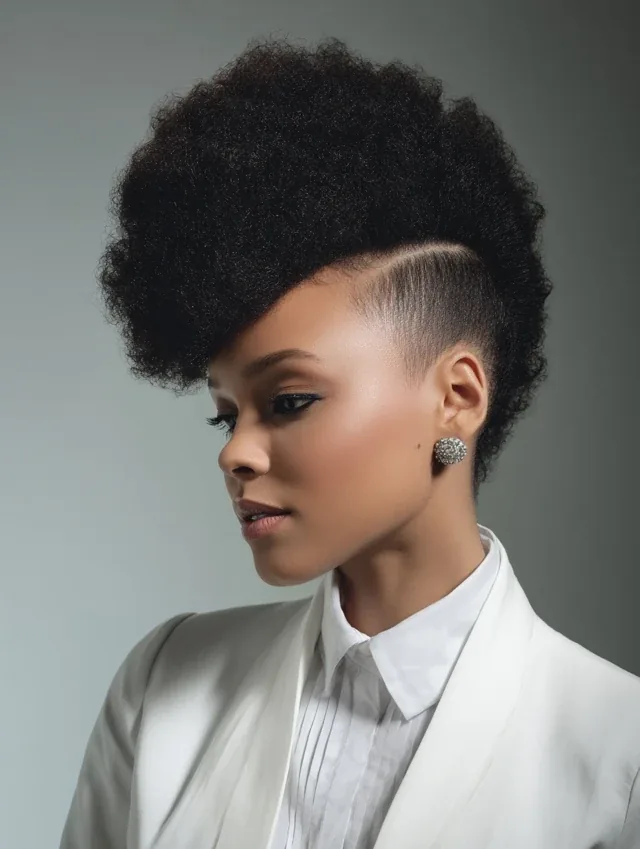
The afro with shaved sides is the afrohawk’s cooler cousin: the sides are shaved or faded close to the scalp, while the top is left full and picked out, so the afro has a dramatic contrast between the smooth sides and the voluminous top. The shaved sides can be plain, or they can carry a design — a line, a curve, a pattern shaved into the fade — which makes the style completely personal. It is a modern, confident look, and it suits women who want their afro to feel contemporary and a little bit rebellious, without losing the volume that makes an afro an afro.
Shaved sides suit oval, round and square faces, and they are most flattering on short and medium afros, where the contrast between the sides and the top is clear. For upkeep, the shaved sides grow out visibly within two weeks, so a shape-up every two to three weeks is essential to keep the fade sharp — this is a salon-dependent style, and a do-it-yourself fade will almost always end up uneven. The top needs its usual daily pick and a little product. Time is five to ten minutes a day, and cost is regular barber visits for the fade. If you want your afro to feel modern and a little bit daring, shaved sides are the way to do it — just keep the appointments.
35. The Afro with a Low Puff Ponytail
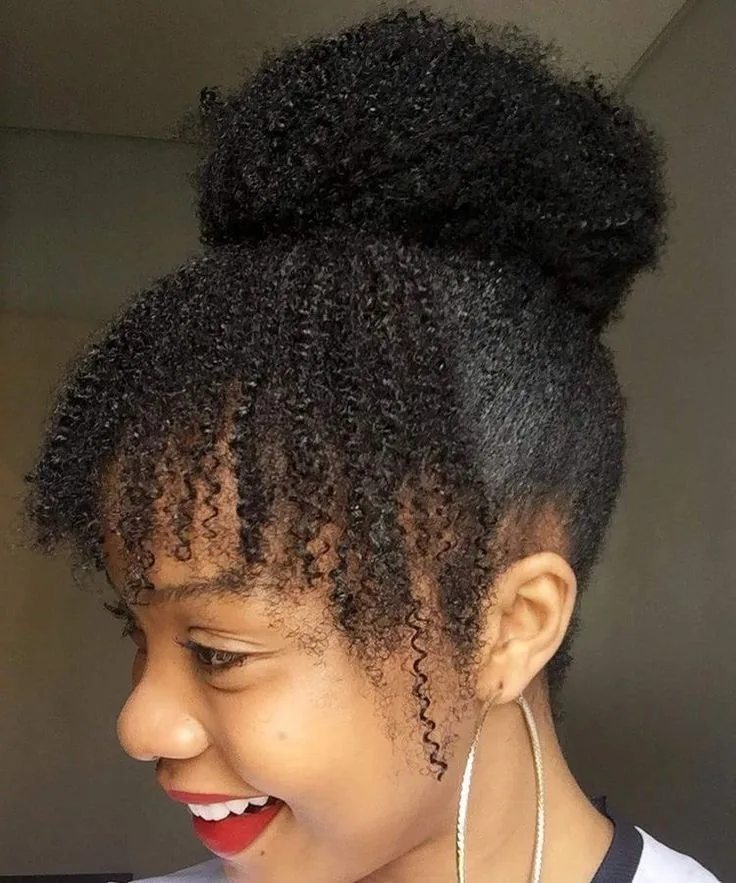
The afro with a low puff ponytail is the afro gathered low at the nape, into a single, full puff that sits at the back of the head like a soft, round ponytail. It is the most practical afro updo: the hair is completely off the face and neck, the puff shows off the volume, and the style works for work, for the gym, and for a night out. It is also the most protective afro style, because the ends are tucked into the puff and the hair is not being handled all day — which makes it a good choice for women growing out their afro, who want to protect the length while it grows.
A low puff ponytail suits every face shape, and it is particularly flattering on long and oval faces, because the low puff balances the length of the face. For maintenance, the puff needs to be gathered gently — never pulled tight, which causes breakage at the edges — with a satin scrunchie or a soft band, and the edges smoothed with a little gel. It refreshes in under five minutes each morning, and it lasts all day if the band is secure. Time and cost are minimal — this is a do-it-yourself style, with no salon visit needed unless you want a shape-up. If you want the afro’s volume with the practicality of a ponytail, the low puff is the answer.
36. The Afro with a Pineapple Puff
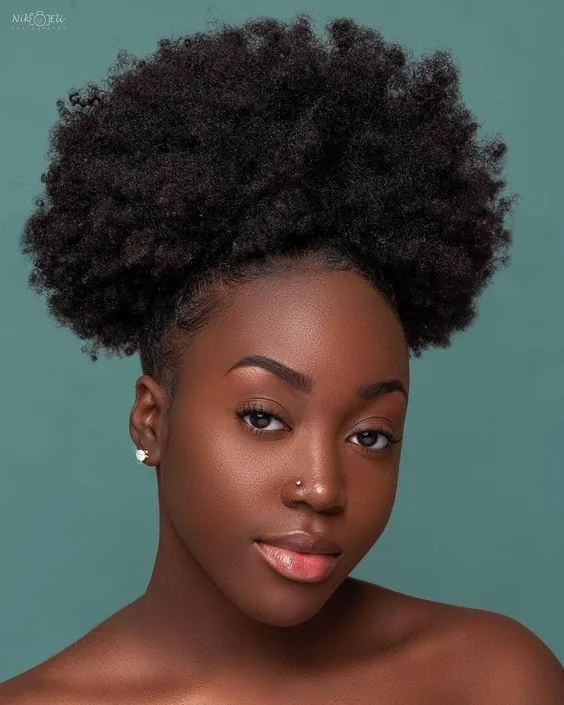
The afro with a pineapple puff is the high puff taken to its joyful extreme: the hair is gathered loosely on top of the head, like the leaves of a pineapple, so the curls fall forward and around the face in a big, bouncy crown. It is a fun, youthful style, and it is also the way many women protect their afro at night — the pineapple keeps the curls from being flattened while they sleep, so the morning afro is still full and defined. Worn out during the day, it is a statement: a high, loose puff that shows off the curls and the volume at their best.
A pineapple puff suits every face shape, and it is particularly flattering on round faces, because the height on top lengthens the face. For upkeep, the pineapple needs to be gathered loosely — a tight pineapple will flatten the curls and cause breakage — with a satin scrunchie, and the edges smoothed with a little gel. It refreshes in minutes each morning, and it is the easiest afro style to take down at night and re-do in the morning. Time and cost are minimal — this is a pure do-it-yourself style — and the pineapple doubles as a night-time protective style, which makes it the most useful afro in this guide. If you want a high puff that is also a hair-care trick, the pineapple is the one.
37. The Afro with a Wash-and-Go
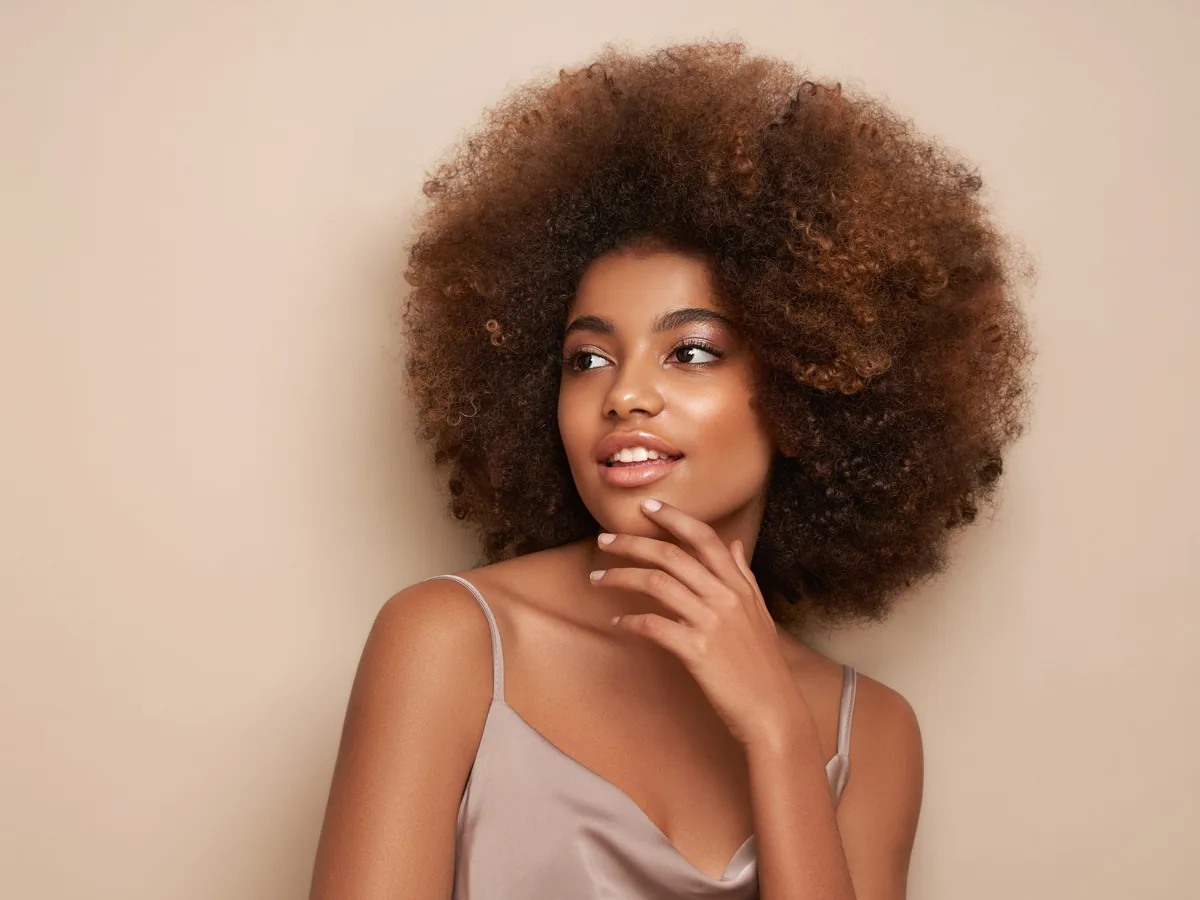
The afro with a wash-and-go is the simplest afro of all: wash the hair, apply a leave-in and a curl-defining product, and let it dry — no twisting, no braiding, no heat, just the curls as they are. The result is a soft, defined afro with the hair’s natural curl pattern on full display, and it is the style that shows off the curls most honestly, because nothing has been done to change them. A wash-and-go is the everyday afro for women who love their curls and do not want to spend an hour styling them — it is the afro as nature intended, with a little help from a good product.
A wash-and-go suits every face shape and every curl pattern, though it shows up best on 3C and 4A curls, where the pattern is clear, and it is most flattering in a short to medium length, where the curls have enough room to spring without the weight pulling them down. For maintenance, the wash-and-go needs a wash every two to three days, a leave-in and a curl cream or gel, and a morning refresh with a water spritz and a gentle scrunch. Time is fifteen to twenty minutes on wash day and five minutes on refresh days, and cost is low — a wash-and-go is a product-only style, with no salon visit needed. If you want the afro with the least effort and the most honesty, the wash-and-go is the one.
38. The Picked-Out Glam Afro
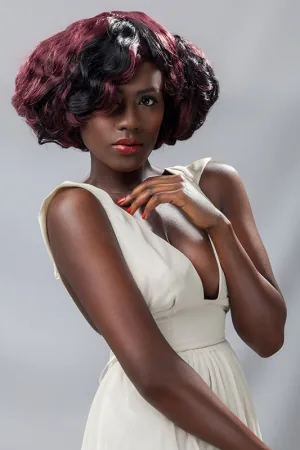
The picked-out glam afro is the biggest, boldest afro in this guide: the hair is picked out to its fullest, stretched to its maximum volume, and shaped into a huge, perfect round that is a statement all on its own. It is the afro for a party, a photoshoot, a night out, or any moment when you want your hair to be the main event — and it is the style that gets the most compliments, the most photographs, and the most stares. The glam afro is not an everyday style; it is an occasion style, and it is worth every minute of the picking, because the result is unforgettable.
A glam afro suits every face shape, and it is most flattering when it is full and even, with the edges smoothed and the shape balanced from every angle. For upkeep, the glam afro needs a full pick-out — ten to fifteen minutes with an afro pick, lifting from the roots, section by section — and a light holding product to keep the shape through the evening. It lasts for a night, not a week, and the refresh is a morning pick if you want to wear it again the next day. Time-wise, it is the most demanding afro to style, and cost-wise it is a do-it-yourself style, though a salon pick-out before a big event is a treat. If you want the biggest afro possible, the glam afro is the final word — pick it out, shape it, and wear it like the crown it is.
What is an afro hairstyle?
An afro hairstyle is a natural hairstyle in which curly or coily hair is picked out and shaped into a full, rounded silhouette around the head. The hair is worn in its natural texture, without straightening, and the shape comes from the curl pattern, the density and the way the hair is picked and trimmed. Afros suit every face shape and work at every length, from a short TWA to a long, grown-out cloud.
How do you shape an afro?
To shape an afro, pick the hair out fully when it is dry, using an afro pick to lift the curls from the roots, and look at the silhouette from every angle. Trim a little at a time, cutting only the hairs that stick out beyond the silhouette, and check as you go. Always shape an afro when it is dry and picked out, never wet, because wet afro hair stretches and springs up shorter and rounder once it dries.
How do I make my afro bigger?
To make your afro bigger, pick it out when it is dry, lifting the curls from the roots with an afro pick, section by section, and use a little leave-in conditioner for softness. A twist out or braid out will also stretch the hair and add volume, and a tapered cut — full on top, shorter at the sides — makes the top look bigger by contrast. Avoid heavy products, which weigh the curls down and flatten the shape.
How often should I wash my afro?
Most women wash an afro once a week, with a gentle, sulphate-free shampoo, followed by a generous conditioner and a leave-in. Between wash days, a daily spritz of water or a water-based leave-in keeps the curls soft. If your scalp gets oily or you work out often, wash twice a week, and deep-condition once a week to keep the hair flexible and less likely to break.
How do I stop my afro from shrinking?
You cannot stop shrinkage completely — it is a natural part of coily hair — but you can reduce it. A twist out or braid out stretches the hair and shows off more length, and banding the hair loosely overnight, or wearing it in a pineapple puff, keeps it stretched. Picking the afro out when it is dry also shows more length than leaving the curls clumped together. Shrinkage is not a flaw; it is a sign of healthy, springy curls.
Can I wear an afro to work?
Yes, you can wear an afro to work — a neat, shaped round or tapered afro, with the edges smoothed and the silhouette even, is a perfectly professional hairstyle. Keep accessories minimal, choose a tapered afro or a low puff if your workplace is conservative, and keep the shape trimmed regularly so it always looks deliberate. A well-shaped afro is as professional as any other hairstyle.
How do I protect my afro at night?
To protect your afro at night, wear a satin or silk bonnet, or sleep on a satin pillowcase, because cotton absorbs moisture and creates friction that flattens the shape and causes frizz. For a big afro, gather the hair loosely into a pineapple puff on top of the head, which keeps the shape overnight, and pick it out again in the morning. Never sleep with your afro loose on a cotton pillowcase if you want it to hold its shape.
What products do I need for an afro?
For an afro you need a gentle, sulphate-free shampoo, a rich conditioner, a water-based leave-in conditioner, a cream, a light oil, and an afro pick. A wide-tooth comb and a satin bonnet complete the toolkit. Layer the products in order — water or leave-in first, then cream, then oil to seal — and use less product than you think you need, because build-up weighs the curls down and flattens the shape.
How long does it take to grow an afro?
Coily hair grows at roughly half an inch a month, the same as any other hair, so growing a medium afro from a TWA takes about a year, and a long afro takes two to three years. Shrinkage hides the length, so the afro will look shorter than it really is — judge your progress by your stretched length, not by how it looks dry. Regular trims every eight to twelve weeks keep the ends healthy and help the afro gain length.
Is an afro a protective style?
An afro itself is not a protective style, because the ends are exposed to the air and to friction, but it can be worn protectively — with the ends tucked into a puff, a pineapple, or a twist out, and with the hair moisturised and covered at night. True protective styles, like braids, twists and bantu knots, tuck the ends away completely. For the healthiest afro, alternate between wearing it out and wearing it in a protective style.
Conclusion
The afro is not the easiest hairstyle — it asks for moisture, for gentle detangling, for night protection, and for patience while it grows. But it gives back more than it asks for: a shape that belongs to no one else, a silhouette that turns heads, and a style that is at once a celebration, a statement and a crown. Behind the volume is a simple truth — the afro is your hair, as it grows, shaped with care and worn with pride. Every style in this guide is a variation on that truth: round or tapered, high-top or flat-top, puff or twist out, coloured or natural, for work or for a wedding.
Start with the shape that feels like you — the classic round afro, if you are not sure — and learn its routine: moisture, a pick, a satin bonnet, and a shape-up every few weeks. Wear it out, wear it up, wear it coloured, wear it big. And when someone asks how you got your hair to look like that, tell them the truth: you did not do anything to it. You just let it be itself, and gave it a little help. The afro has been a symbol of pride and beauty for generations, and it still is. Wear it that way.