Curl Meets Fringe: 44 Hairstyles for Women With Curly Bangs That Frame the Face Just Right
Curly bangs are the one fringe that never sits still — and that is exactly why they work so well. A straight fringe is drawn on with a ruler; a curly fringe is drawn by the curl itself, springing up a little shorter than you expected, softening at the edges, and framing the face in a way no flat iron ever could. For years curly-haired women were told to avoid bangs altogether, as if a fringe and a curl pattern could not share the same head. The truth is the opposite: when the bangs are cut to match the curl, they are the most flattering part of the whole haircut, adding shape at the forehead, balance to long curls, and a softness that a bare forehead simply cannot give.
This guide gathers 44 hairstyles for women with curly bangs, from a wispy fringe on a bob to a full coil fringe on an afro, from wash-day routines to wedding-guest updos. Eight guides first walk you through what actually matters: matching the bangs to your curl pattern, how a curly fringe should be cut, the wash-day routine that keeps the fringe behaving, frizz control, growing the bangs out gracefully, and which products help versus which ones weigh curls down. Whether your curls are loose waves or tight coils, there is a fringe here that was made for them.
Matching Your Bangs to Your Curl Pattern
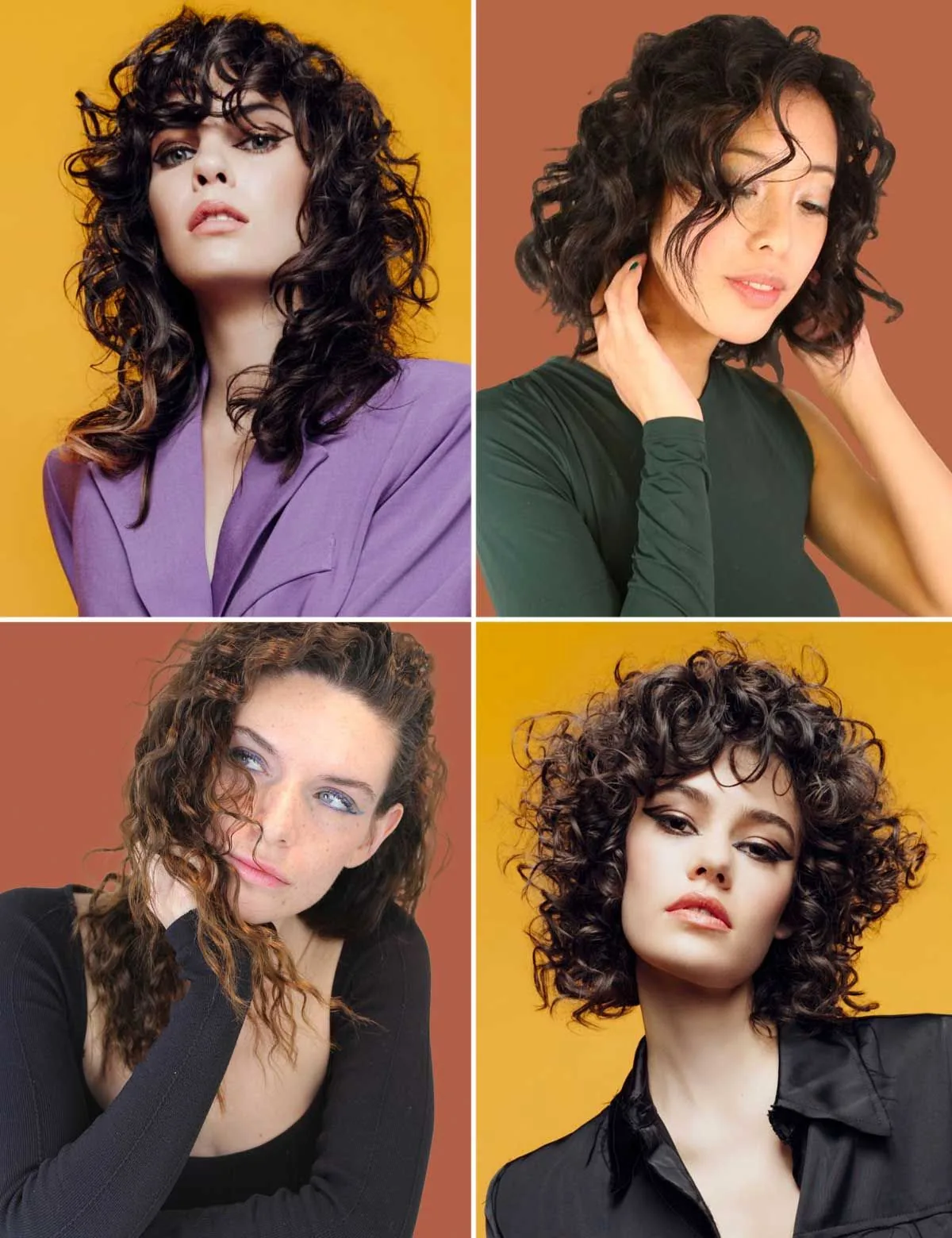
Every curly fringe starts with the same question: what does your curl actually do when it is left alone? A loose 2C wave falls in a soft S and will sit longer and flatter across the forehead, so the bangs can be cut a touch longer and will still read as a fringe. A 3A curl springs into a defined ringlet and will bounce up by an inch or more as it dries, which is why cutting curly bangs wet is the classic mistake — what looks perfect on a wet head becomes a surprise fringe halfway up the forehead by lunchtime. Tighter 3C and 4A coils shrink the most, sometimes by half their length, so the bangs need to be cut with the shrinkage in mind, longer than the finished look, and shaped while dry.
Best for: every curl type, as long as the length is planned around the pattern. How to style: let the fringe dry in its natural pattern before you judge it, and never stretch it straight to check the length. What to ask: ask your stylist to cut the bangs dry, curl by curl, and to show you where each curl will land when it springs up. Common mistake: cutting the fringe to the same length as a straight fringe — on curls, always leave extra length and trim in small steps. Quick verdict: match the cut to the curl and the fringe practically styles itself.
How Curly Bangs Should Be Cut
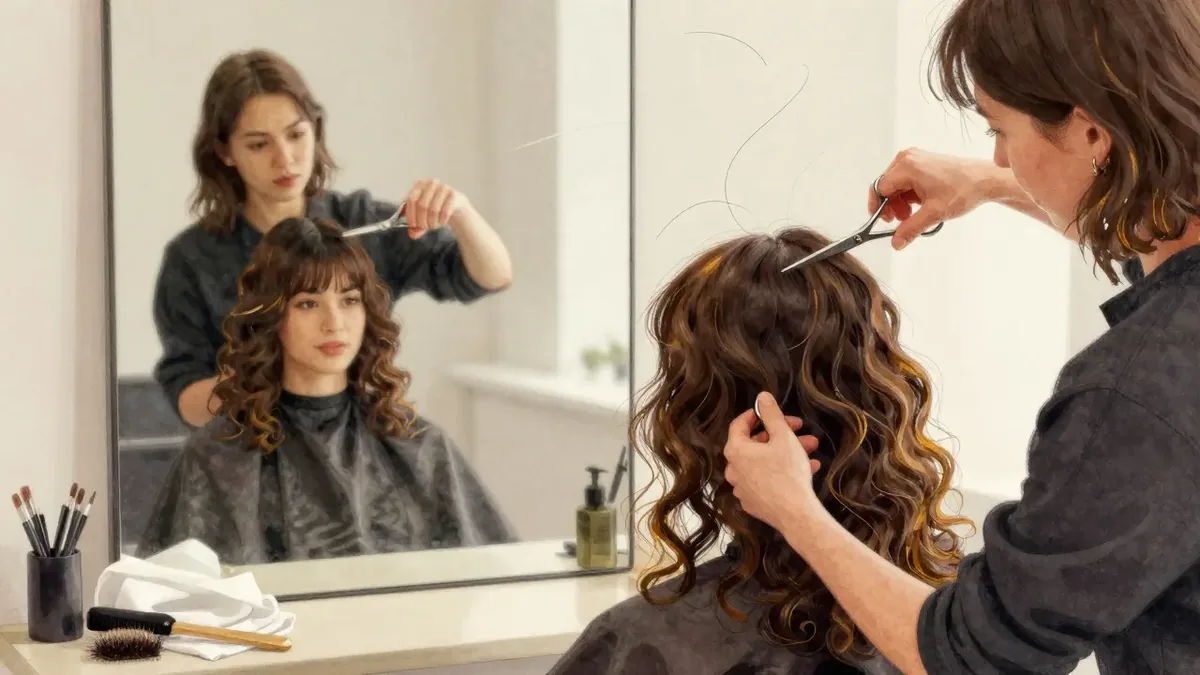
A curly fringe is not cut — it is sculpted, one curl at a time. The stylist should work on dry, styled hair, lifting each curl, letting it fall where it naturally wants to land, and snipping the very tip so the curl keeps its shape instead of being sliced into a blunt line. Blunt cutting across a curly fringe creates a shelf: the curls bunch at the ends and the fringe looks heavy and square. Point-cutting into the curl, or cutting curl by curl, keeps the edge soft and lets the individual ringlets show. The fringe should also be cut longer at the sides than in the centre, so it blends into the rest of the hair instead of stopping in a hard line across the forehead.
Pros: a curl-by-curl cut grows out beautifully and needs less styling every morning. Cons: it takes longer in the chair and costs more than a quick wet trim. Maintenance: a dry trim every six to eight weeks keeps the shape; a wet trim between visits will almost always take off too much. Cost and time: expect 15 to 30 minutes extra on top of a normal cut. Who should avoid it: anyone who wants a razor-sharp, graphic fringe — curls will not hold that line. Quick verdict: dry, curl by curl, longer at the sides — that is the whole secret.
The Wash-Day Styling Routine for a Curly Fringe
The fringe dries first and misbehaves first, so it deserves its own little routine inside wash day. Start by washing and conditioning as usual, then, while the hair is still soaking wet, smooth a pea-sized amount of leave-in conditioner or curl cream through the fringe only — less product than you think, because the fringe is a small area and product builds up fast there. Scrunch the curls gently upward, then use a diffuser on low heat, cupping the fringe curls in the diffuser bowl for a few seconds each. If you air-dry, clip the fringe curls loosely to one side with a flat clip while they set, which stops them from splitting into a gap in the middle.
Best for: wash days when you want the fringe to look intentional rather than accidental. How to style: style the fringe first, before the rest of the hair, while it is wettest. What to ask: ask your stylist which cream weight suits your curl — a light milk for fine curls, a richer cream for thick ones. Common mistake: using the same heavy butter on the fringe as on the lengths; the fringe will go limp and stringy. Maintenance: on non-wash days, refresh the fringe with a spritz of water and a tiny drop of cream, scrunch, and let it dry — two minutes, no full wash needed.
Frizz Control for the Fringe
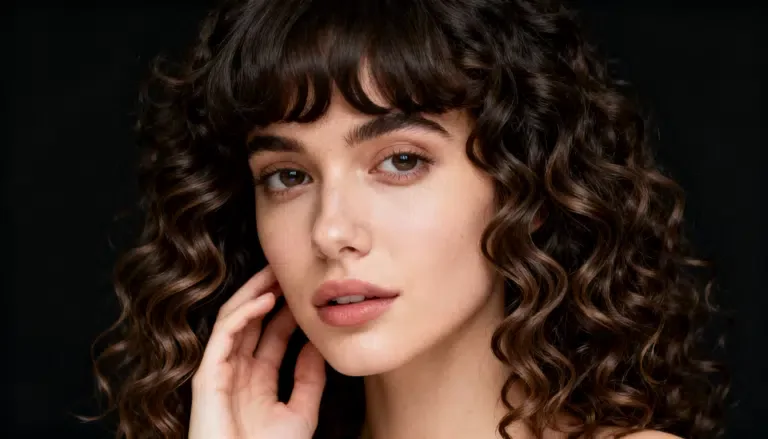
The fringe lives in the worst possible place for frizz: right above the forehead, where sweat, skin oils, and the steam from a hot shower all meet the hair. A few flyaways there are more visible than frizz anywhere else on the head, so the fringe needs a different strategy from the rest of the hair. The first rule is to touch it less — every time fingers run through the fringe, the curl clumps break apart and the frizz multiplies. The second rule is to seal the cuticle while the hair is still wet: a light gel or a drop of oil smoothed over the surface of the fringe locks the curl pattern in before the air can puff it up.
Pros: a smooth fringe makes the whole haircut look polished, even on a humid day. Cons: too much gel makes the fringe stiff and crunchy, which looks worse than the frizz did. Maintenance: a silk or satin pillowcase helps more than any product, because the fringe rubs against the pillow all night. Common mistake: brushing the fringe dry — a brush turns a curl into a halo of frizz in one stroke. Quick verdict: seal it wet, hands off while it dries, and let the gel cast break naturally once it is fully dry.
Growing Out Curly Bangs Gracefully
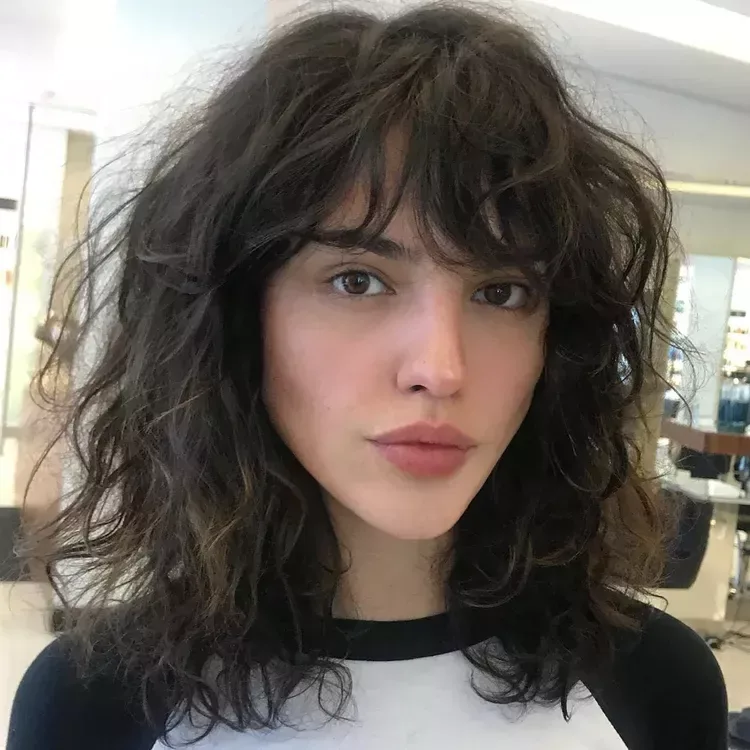
Every curly fringe eventually reaches the awkward stage, and the awkward stage on curls is actually easier than on straight hair — because curls disguise length. As the fringe grows, the curls get heavier and start to fall to the sides on their own, which is the beginning of a curtain fringe. The trick is to stop trimming the centre and let the sides catch up, while keeping the fringe shaped: a stylist can thin the ends slightly so the growing fringe does not turn into a heavy block across the forehead. In the meantime, a side part, a flat clip, or a twist pinned to one side turns a growing fringe into a style rather than a problem.
Best for: anyone who wants to change their fringe without a drastic chop. How to style: part the fringe to the side and let the curls fall naturally; a little cream keeps the longer pieces from flipping outward. What to ask: ask for a dusting, not a trim — just the split ends, so the length keeps coming. Common mistake: cutting the fringe yourself in frustration at the awkward stage, which restarts the whole cycle. Maintenance: plan on three to four months for a fringe to reach chin length on curls, depending on shrinkage. Quick verdict: curls make growing out a fringe the easiest transition in hair — let the sides do the work.
Curly Bangs for Different Face Shapes
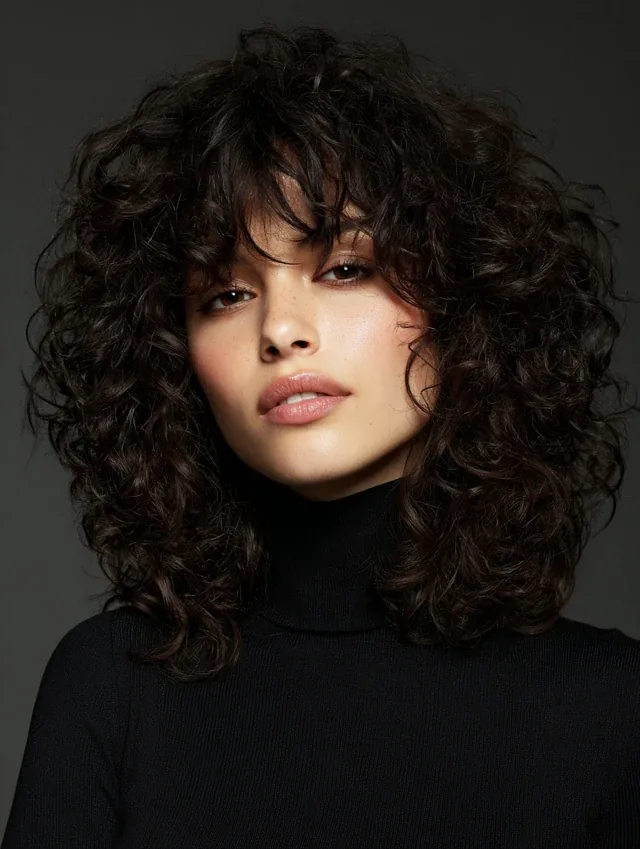
A curly fringe flatters every face shape, but the shape of the fringe should change with the shape of the face. On a round face, a longer, side-swept curly fringe adds length and angles, drawing the eye down and breaking up the width. On a long face, a fuller fringe that sits at eyebrow level shortens the forehead and balances the length. On a square face, soft, wispy curls at the edges soften the jawline far better than a blunt, heavy fringe. On a heart-shaped face, a curtain-style curly fringe that parts in the middle balances a wider forehead against a narrower chin. The fringe is not one-size-fits-all — it is a frame, and the frame should fit the picture.
Pros: the right fringe shape can do more for a face than any contouring product. Cons: the wrong shape — a very short, blunt fringe on a round face, for example — can emphasise exactly what you wanted to soften. Maintenance: face-framing curls need a trim slightly more often than the rest of the hair, because they grow out of shape first. Who should avoid it: nobody, really — the question is never whether to have curly bangs, only which shape. Quick verdict: longer and side-swept for round faces, fuller and brow-length for long faces, soft and wispy for square faces.
Products That Work — and Ones That Weigh Curls Down
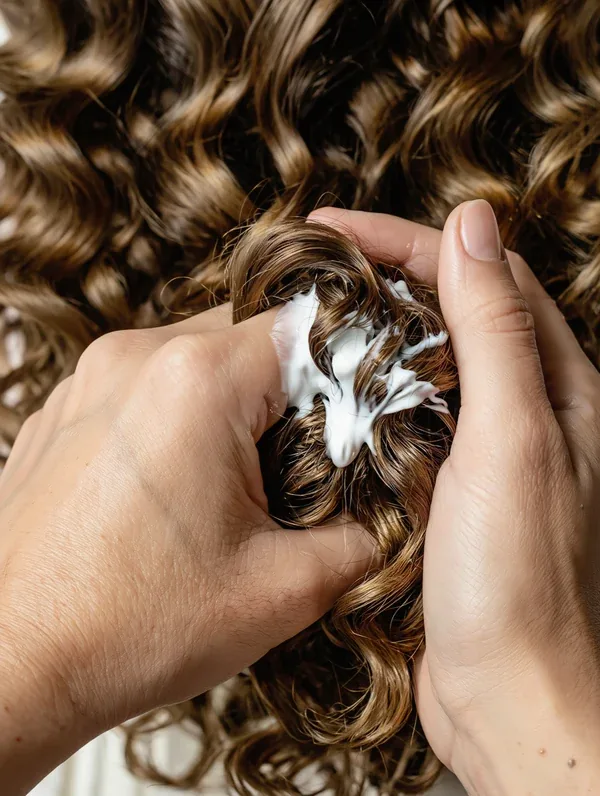
The fringe is the smallest area of hair on your head, and it is the easiest to overload. A product that works beautifully on the lengths can turn the fringe into a limp, stringy curtain, because the same amount of cream spread over a few curls is three times too much. What works: a lightweight leave-in milk or a pea-sized amount of curl cream, a light hold gel scrunched in while wet, and a drop of oil smoothed over the surface once dry. What weighs curls down: heavy butters, thick pomades, and anything with a lot of silicones, all of which coat the fine fringe curls and pull them flat. Mousse is the fringe’s best friend — it gives hold and volume without weight, and it dries without leaving the hair sticky.
Best for: anyone whose fringe looks great on wash day and flat by day two. How to style: apply product to the fringe with your fingertips, curl by curl, instead of raking it through. What to ask: ask your stylist to recommend one product for the fringe specifically, not a whole routine. Common mistake: using the same amount of product on the fringe as on the rest of the hair — halve it, then halve it again. Maintenance: clarify the fringe once a week with a gentle shampoo, because product builds up fastest exactly where the hair is shortest. Quick verdict: light products, tiny amounts, mousse over butter.
Salon vs DIY Trimming for Curly Bangs
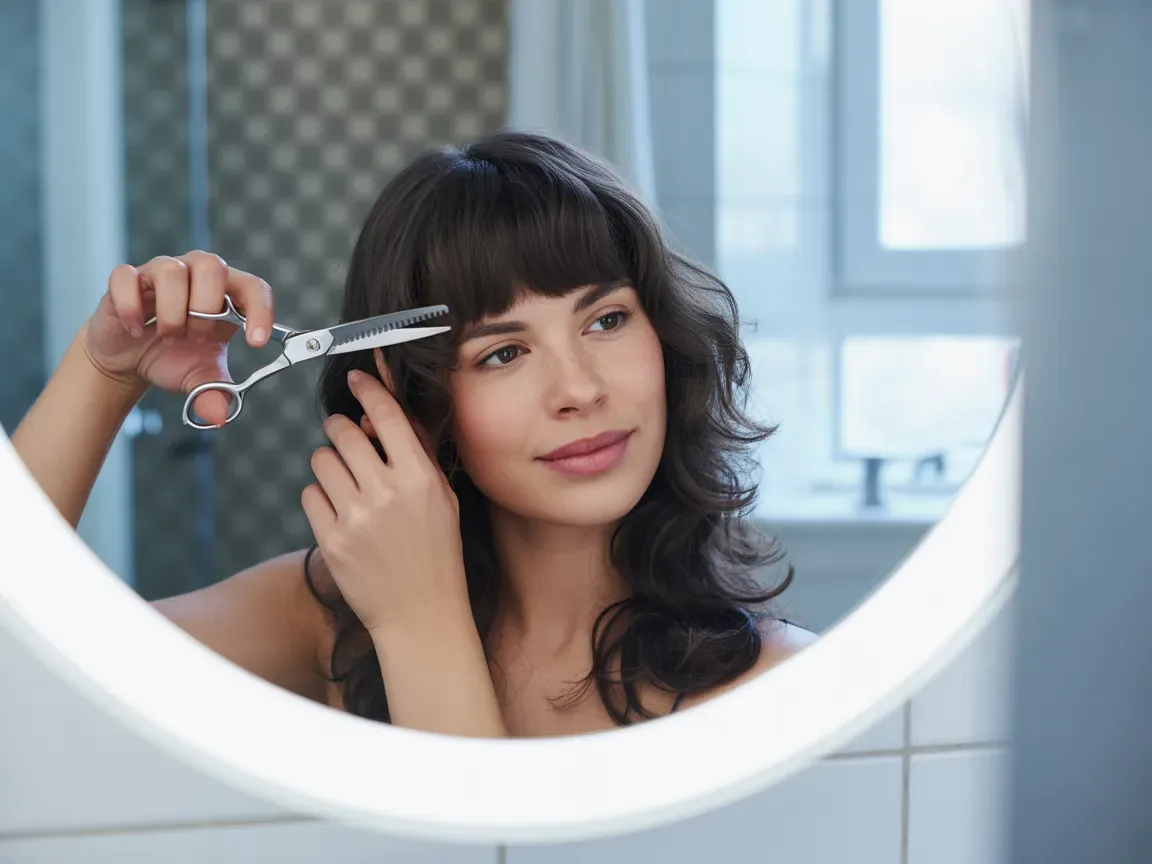
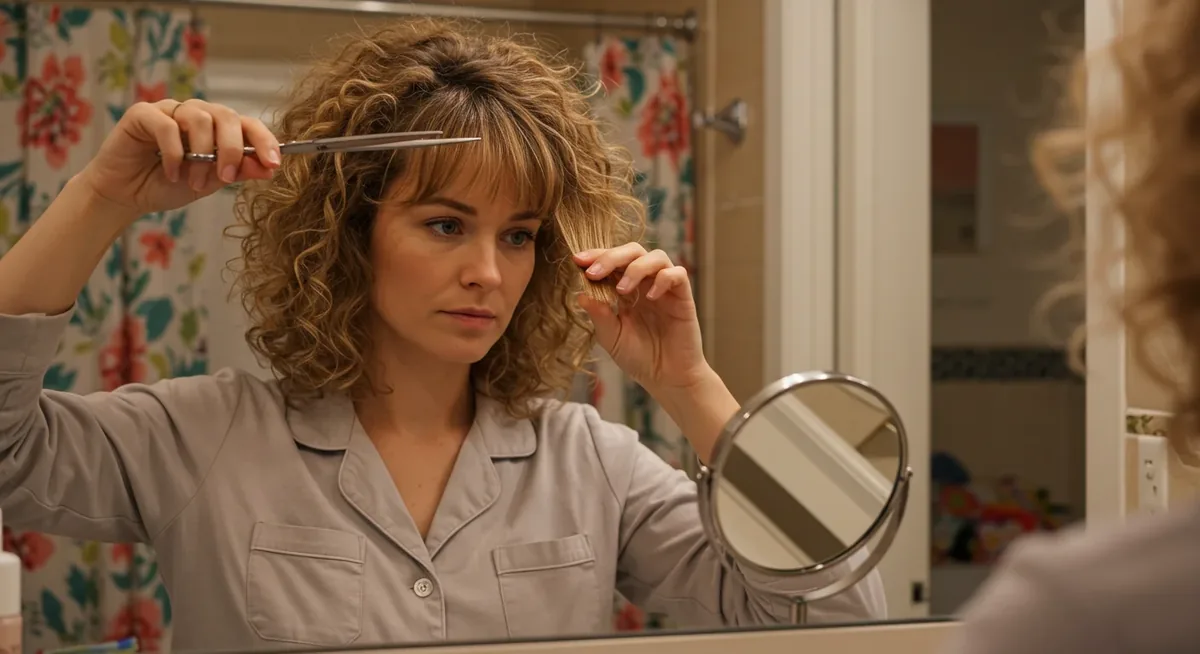
A salon trim is the safe choice, and for the first cut it is the only choice worth making — a stylist who understands curls will cut the fringe dry, curl by curl, and set a shape you can live with for months. But between salon visits, a careful DIY dusting is perfectly doable, and it is how most curly-haired women keep a fringe looking good. The rules are strict: work on dry, styled hair, never wet; trim one curl at a time, snipping only the very tip; and stop after three curls, step back, and look before you cut another. The moment you start cutting across the whole fringe in a straight line, you have stopped trimming and started ruining it.
Pros of DIY: free, fast, and you can fix a single wayward curl the moment it appears. Cons: one impatient snip can take off an inch of shrinkage you did not expect, and a fringe grows back slowly. Maintenance: a salon trim every six to eight weeks, with a DIY dusting only when a single curl sticks out. Cost and time: a fringe trim at a salon is usually the cheapest service on the menu, often under fifteen minutes. Who should avoid DIY: anyone with very tight coils, where shrinkage makes every cut unpredictable. Quick verdict: salon for the shape, DIY only for a single stray curl — never for the whole fringe.
1. The Classic Curly Fringe with Long Layers
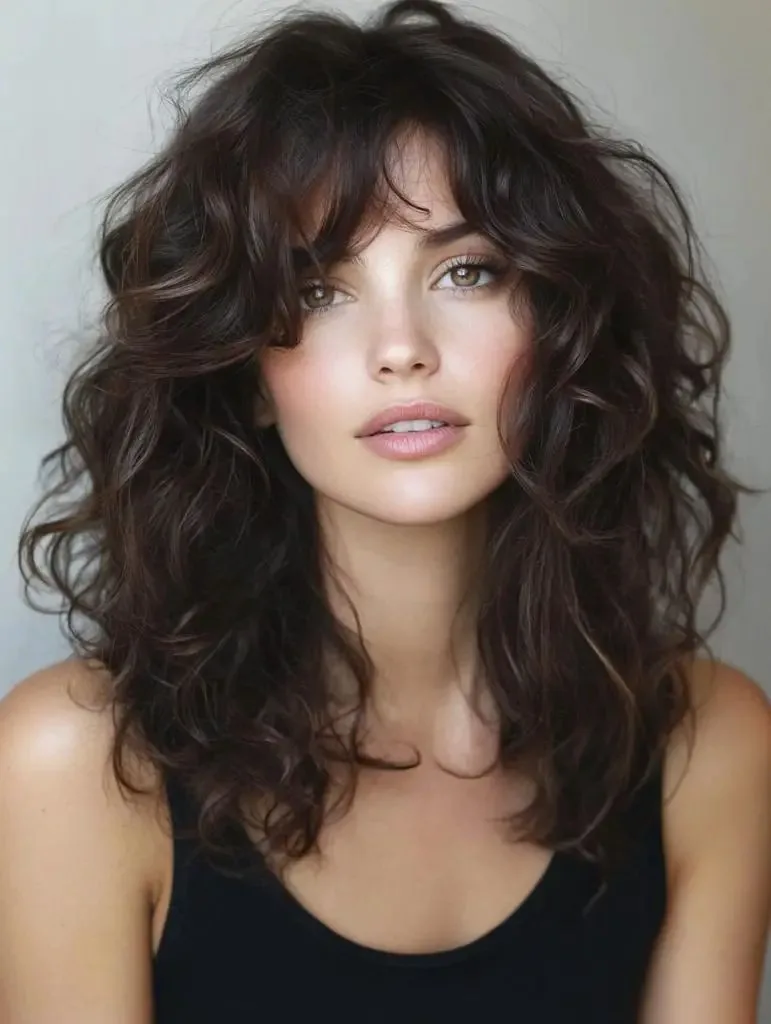
The classic curly fringe is the look that made curly bangs famous: a full, soft fringe across the forehead, long layers falling past the shoulders, and curls that frame the face from the brow down to the collarbone. The fringe sits at eyebrow level when dry, with the curls separating naturally into soft pieces rather than a solid wall, and the long layers keep the rest of the hair from looking heavy. It is the most versatile curly fringe there is — it works on loose waves and tight curls alike, and it looks just as good air-dried as it does diffused.
Best for: women growing their hair long who want shape at the front without losing length. How to style: diffuse the fringe first, then the lengths, scrunching upward for volume. What to ask: ask for long layers that start below the chin, so the fringe is the shortest point and everything else falls away from it. Pros: timeless, low-maintenance, and flattering on nearly every face shape. Cons: the fringe needs a trim every six weeks or it starts to cover the eyes.
2. Soft Curly Bangs with a Bob
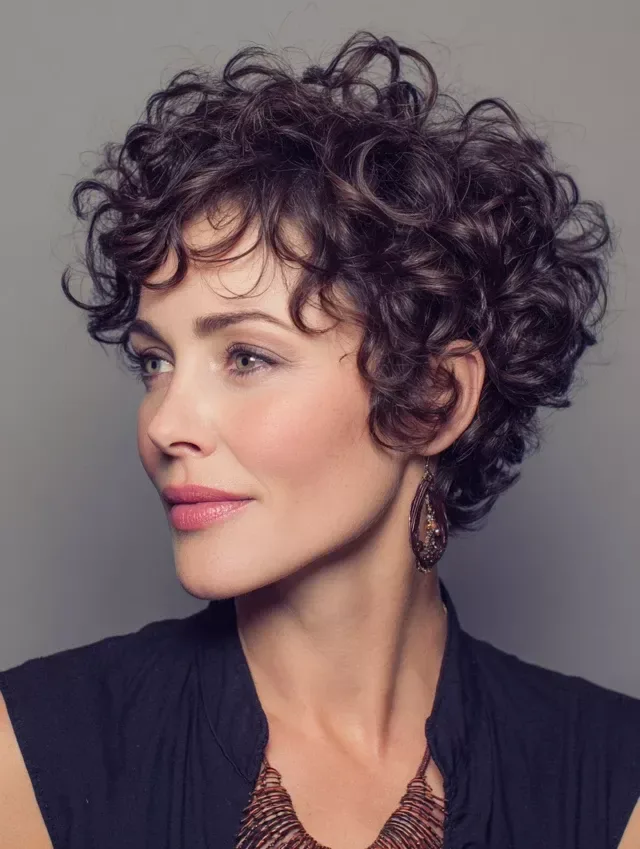
A bob with curly bangs is the short haircut that still feels soft. The bob sits at the jaw or just below it, the curls bounce up into a rounded shape, and the fringe falls in loose pieces across the forehead, breaking up the roundness of the cut so it never looks like a helmet. It is a brilliant choice for women whose curls are too heavy for long hair but who do not want a pixie — the bob keeps enough length to show the curl pattern, and the bangs give it a face-framing finish that a plain bob lacks.
Pros: bouncy, youthful, and easy to wash and go. Cons: the bob can puff out into a triangle if the layers are not cut correctly, so the shape depends on a good stylist. Maintenance: a trim every five to six weeks keeps the line clean. Common mistake: cutting the bob too short at the back, which pushes all the volume to the sides. Quick verdict: the bob-and-fringe combination is the easiest way to make short curls look deliberate.
3. Curly Bangs with a Shag Cut
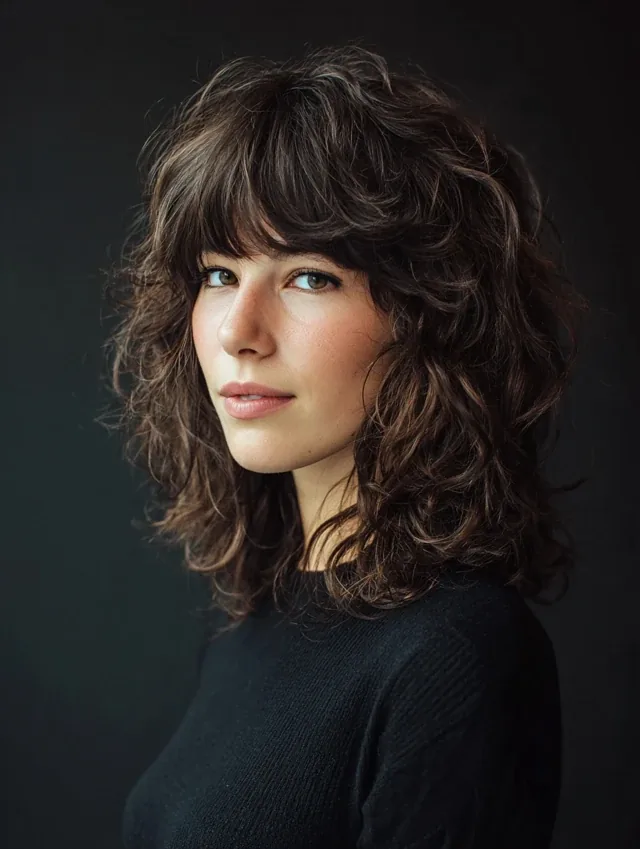
The shag was made for curly bangs. All those choppy layers, all that texture at the crown, and a fringe that blends straight into the shortest layers — on curls, a shag looks less like a haircut and more like the way the hair wanted to fall all along. The fringe is cut longer at the edges so it melts into the face-framing layers, and the whole cut moves when you do, which is exactly what a shag should do. It is the most low-effort style in this guide: the messier it gets, the better it looks.
Best for: thick curly hair that needs weight removed, and anyone who hates styling. How to style: scrunch in a little mousse, diffuse or air-dry, and shake it out — that is the whole routine. What to ask: ask for lots of internal layers at the crown and a fringe that connects to the shortest layer. Pros: huge volume, almost no styling, and it grows out gracefully. Cons: fine curls can look stringy in a shag, so this one suits medium to thick hair best.
4. Wispy Curly Bangs
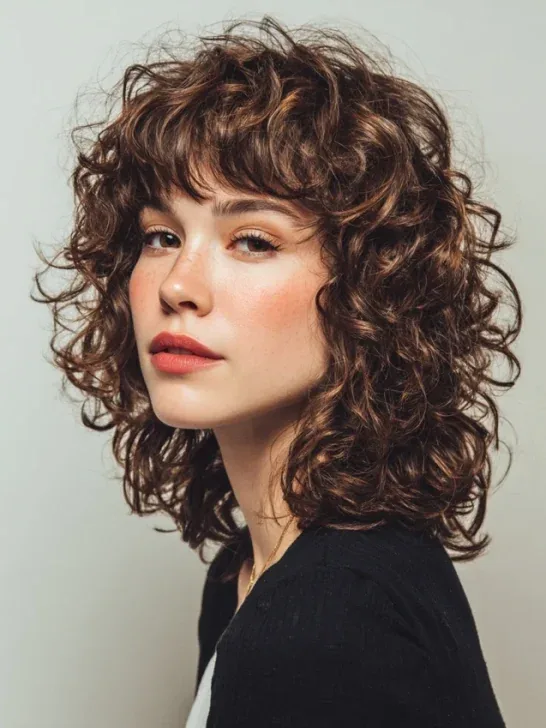
Wispy curly bangs are the fringe for women who are nervous about bangs. Instead of a full, heavy fringe, a few soft curls fall across the forehead with gaps of skin showing between them, so the look is light, airy, and easy to grow out if you change your mind. The wisps soften a high forehead without hiding it, and they give the face a frame without the commitment of a full fringe. They work beautifully on fine curls, where a heavy fringe would look thin and straggly anyway.
Pros: the lowest-commitment fringe in this guide, and the easiest to style — the wisps fall where they want to. Cons: on very humid days the wisps can frizz into a halo, so a drop of gel is worth using. Maintenance: a quick trim of the longest wisps every few weeks is all it needs. Who should avoid it: women who want a strong, statement fringe — wispy bangs are deliberately subtle. Quick verdict: if you have never had bangs, start here.
5. Curly Bangs with a Pixie Cut
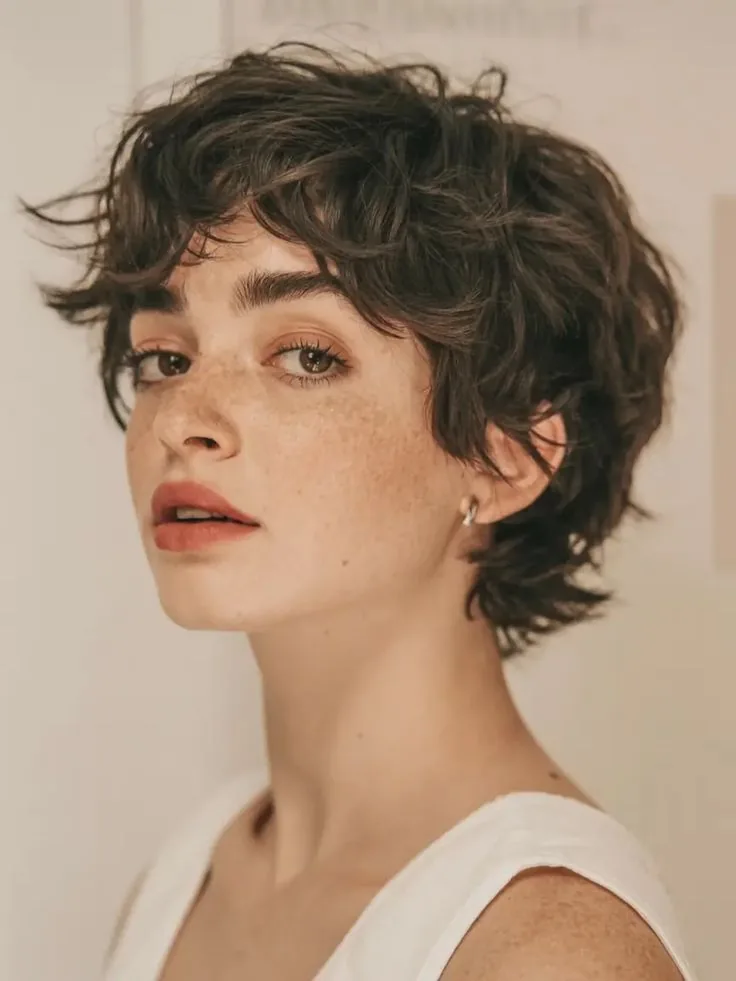
A pixie with curly bangs is short hair with a personality. The curls on top are left long enough to spring into a fringe across the forehead, while the sides and back are cut close, so the whole cut has a beautiful contrast: soft curls on top, clean lines underneath. The fringe is the star of the cut — it gives the pixie its softness and its femininity, and it stops the short cut from looking severe. It is also one of the easiest styles to wear: wash it, scrunch it, and walk out the door.
Best for: women who want a dramatic short cut without losing softness at the front. How to style: a pea-sized amount of curl cream, scrunched into the top curls while wet. What to ask: ask for length on top that reaches the eyebrows when dry, with tapered sides. Pros: wash-and-go, cool in summer, and the fringe grows out into a lovely short shag. Cons: it needs a trim every four weeks to keep its shape, which is more salon time than a longer cut.
6. Curtain Curly Bangs
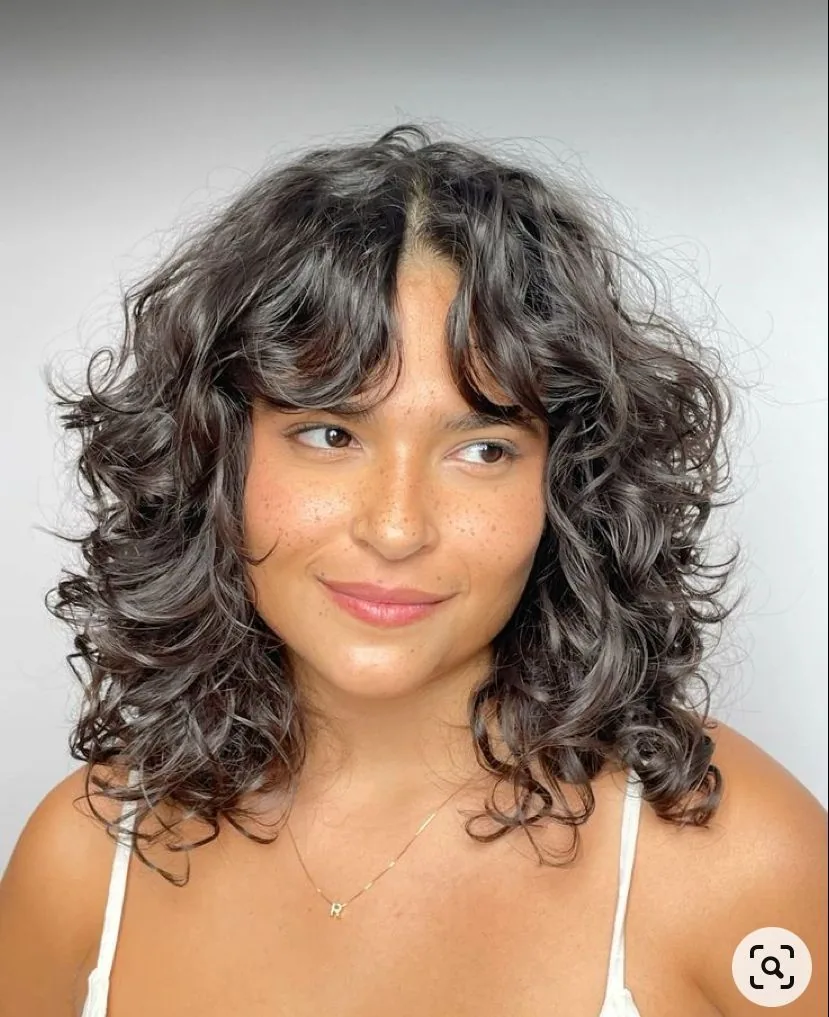
Curtain bangs on curly hair part in the middle and fall to either side of the face like a pair of curtains, and on curls they are even softer than on straight hair — each side falls in loose ringlets that frame the cheekbones. They are the most flattering fringe for a wide forehead, because the centre part breaks up the width, and they are the easiest curly fringe to grow out, because they are already growing to the sides. A curtain fringe also works when the rest of the hair is tied up: the two side pieces stay out, framing the face, while everything else goes back.
Pros: grows out beautifully, flatters wide foreheads, and works with updos. Cons: the centre part can split into a gap if the curls are very tight, so a little cream helps them cling together. Maintenance: trim the longest pieces every eight weeks, or let them keep growing into face-framing layers. Common mistake: cutting curtain bangs too short — they need to reach at least the cheekbone to fall to the sides properly. Quick verdict: the curtain fringe is the grown-up, low-drama curly bang.
7. Curly Bangs with a Layered Lob
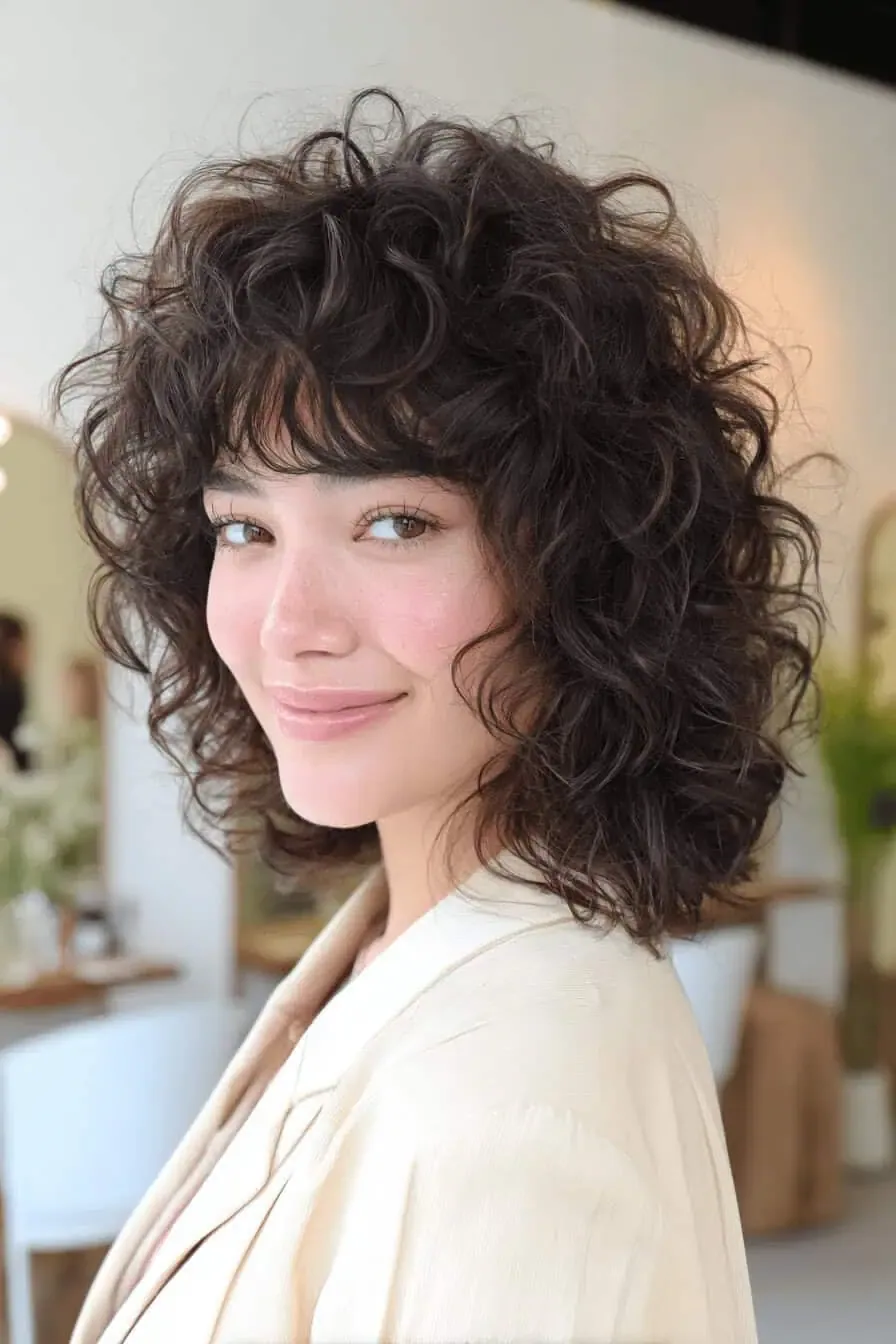
The lob — the long bob — is the safe middle ground between short and long, and curly bangs make it feel finished. The hair sits at the collarbone, the layers give the curls room to bounce, and the fringe adds shape at the top so the cut never looks flat or boxy. It is the haircut for women who want a change without a commitment: long enough to tie back, short enough to feel light, and the bangs make it look like a real style rather than hair that is simply growing out.
Best for: shoulder-length curls that need shape and movement. How to style: diffuse upside down for volume at the roots, then let the fringe fall naturally. What to ask: ask for layers that start at the chin, so the curls stack nicely instead of forming a triangle. Pros: ties back easily, dries quickly, and suits almost every face shape. Cons: the lob hits the awkward growing-out stage faster than longer hair, so it needs regular trims.
8. The Tight Coils Fringe
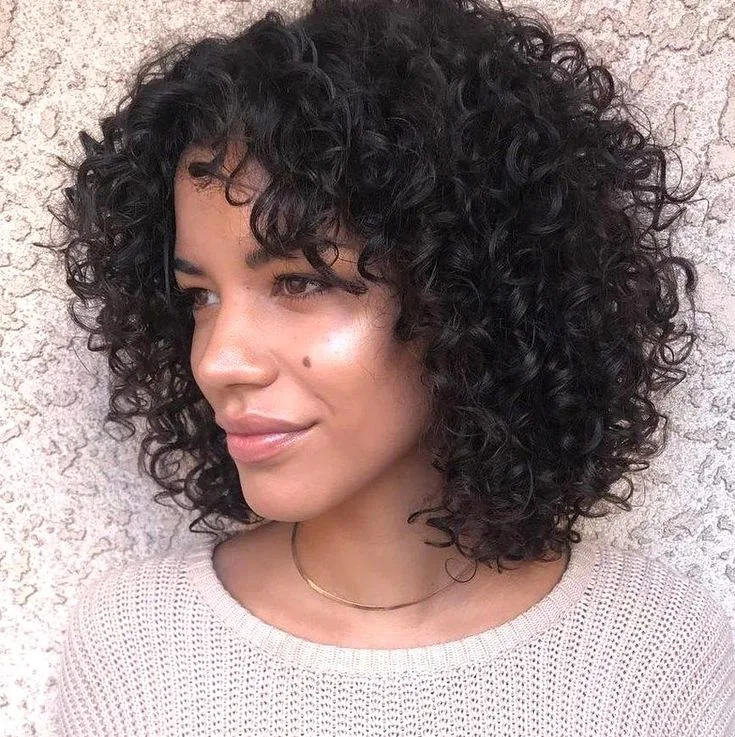
A tight coils fringe is a celebration of the curl itself: short, springy coils across the forehead that sit close to the head and frame the eyes like a beautiful natural headband. The coils are cut while dry and styled, each one trimmed to land exactly where it wants to be, so the fringe has a soft, rounded edge rather than a hard line. It is a bold look, but it is also a practical one — the coils are short enough that they never fall into the eyes, and they hold their shape all day without any styling.
Pros: striking, low-maintenance once cut, and it shows off the curl pattern at its best. Cons: shrinkage makes the length unpredictable, so the cut must be done by someone who works with coils regularly. Maintenance: moisturise the fringe daily with a light leave-in, because short coils dry out faster than longer hair. Who should avoid it: anyone who wants to hide their forehead — this fringe is short and proud of it. Quick verdict: the tight coils fringe is the most confident fringe in this guide.
9. Curly Bangs with a High Ponytail
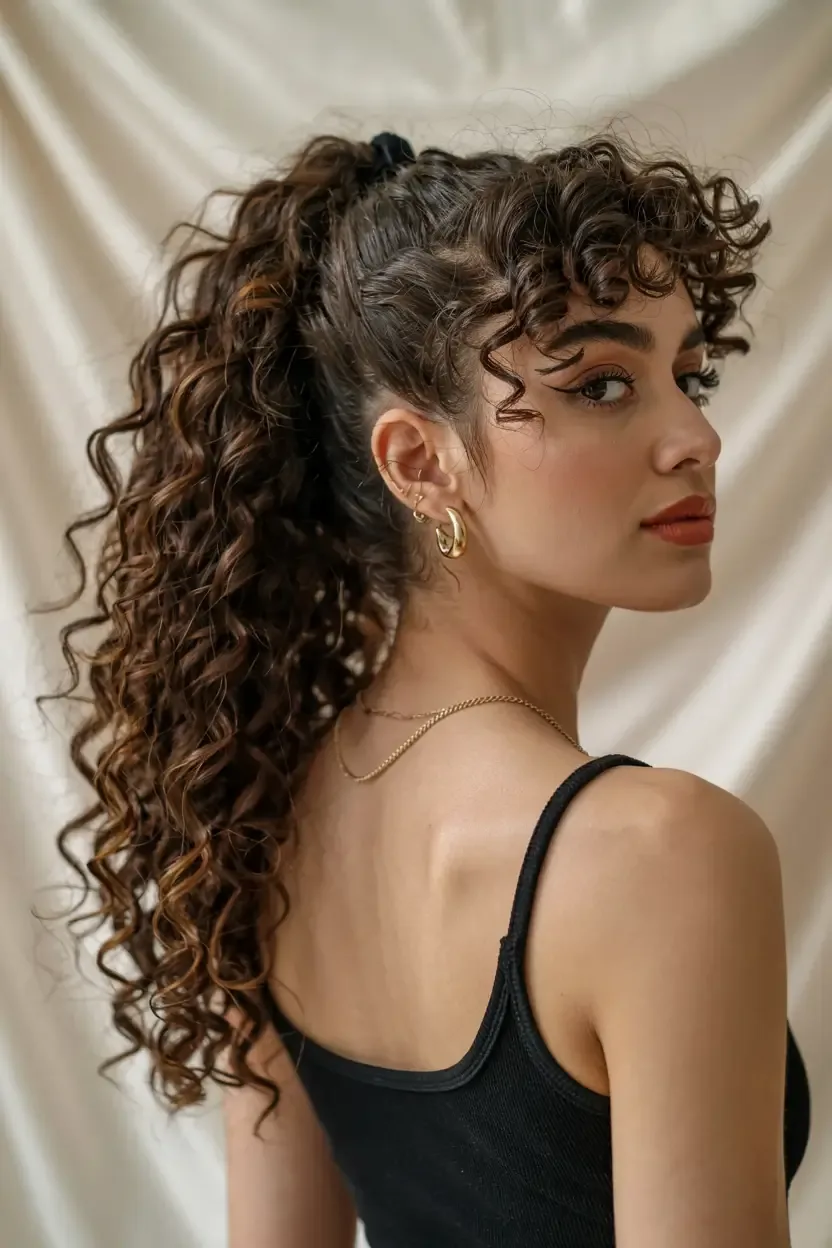
A high ponytail with curly bangs is the sporty look that still feels polished. The hair is swept up high, the curls cascade down the back in a bouncy tail, and the fringe stays out across the forehead, softening the whole style and stopping the pulled-back look from feeling severe. It is the hairstyle for a busy day, a workout, or a night out — it keeps the hair off the neck, shows off the face, and the bangs make it look like a style rather than a last resort.
Best for: long curly hair on days when you need it out of the way. How to style: gather the hair high with your fingers, not a brush, so the curls keep their pattern, and let the fringe fall free. What to ask: nothing — this is a styling choice, not a cut. Pros: five minutes, no heat, and the fringe does all the styling work. Cons: a very tight ponytail can give you a headache and break the curls at the hairline, so keep it firm but not pulled. Maintenance: a silk scrunchie protects the curls better than a thin elastic.
10. Curly Bangs with a Messy Bun
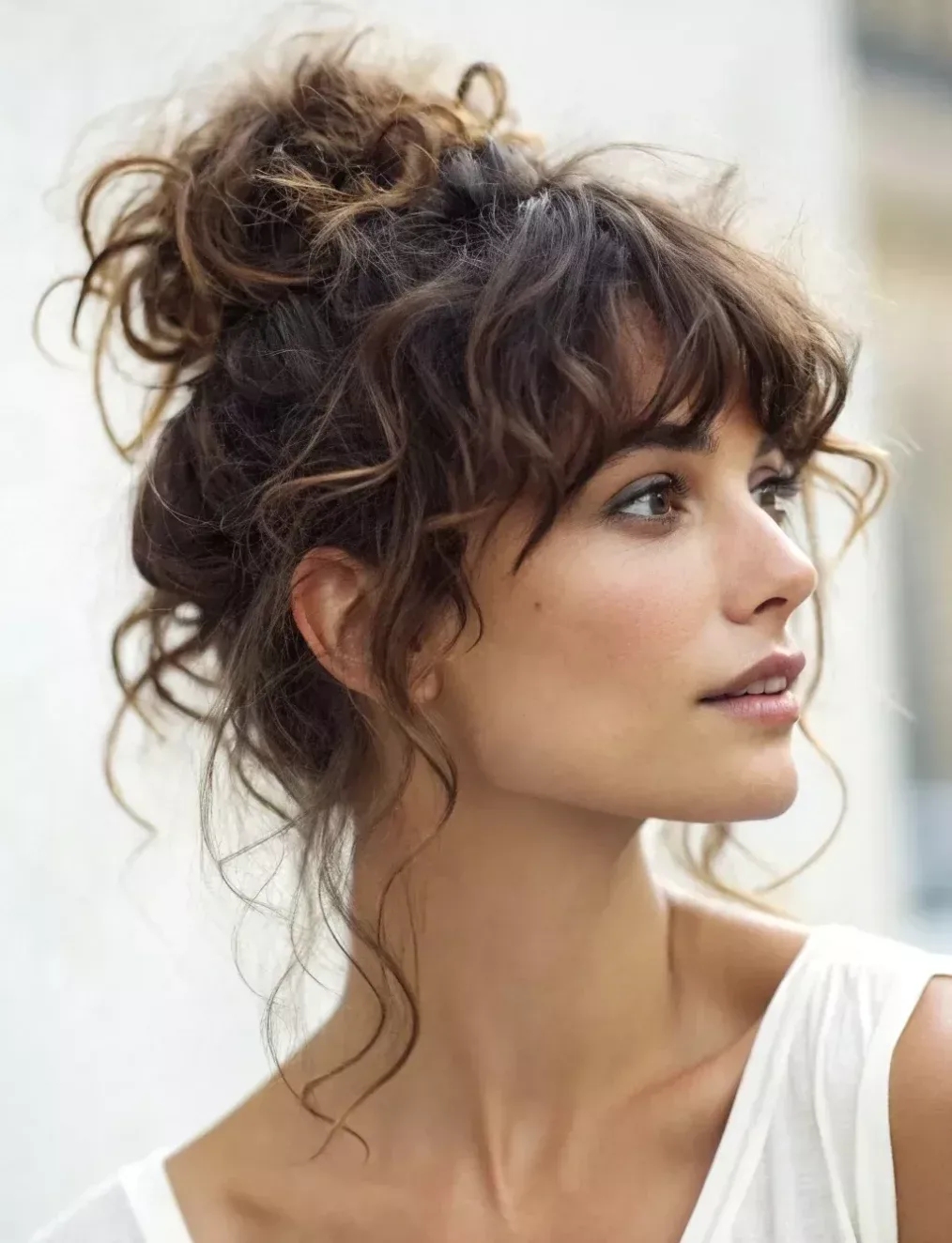
The messy bun is the hairstyle every curly-haired woman already knows, and curly bangs are what turn it from a lazy-day fix into a real look. The bun sits high or low, the curls spill out of it in soft pieces, and the fringe frames the face so the whole style looks intentional instead of accidental. The secret is to leave the fringe completely alone when you put the bun up — do not pull it back, do not smooth it down, just let it be the frame while the bun does the work behind it.
Pros: two minutes, no mirror needed, and the fringe makes it look dressed up. Cons: a bun that is too tight pulls the fringe back with it, so keep the front loose. Maintenance: a couple of pins hold the bun; the fringe needs nothing. Common mistake: smoothing the fringe with a brush before putting the bun up — the brush breaks the curls and the fringe goes frizzy. Quick verdict: messy bun plus curly fringe is the easiest good hair day there is.
11. Curly Bangs and an Afro
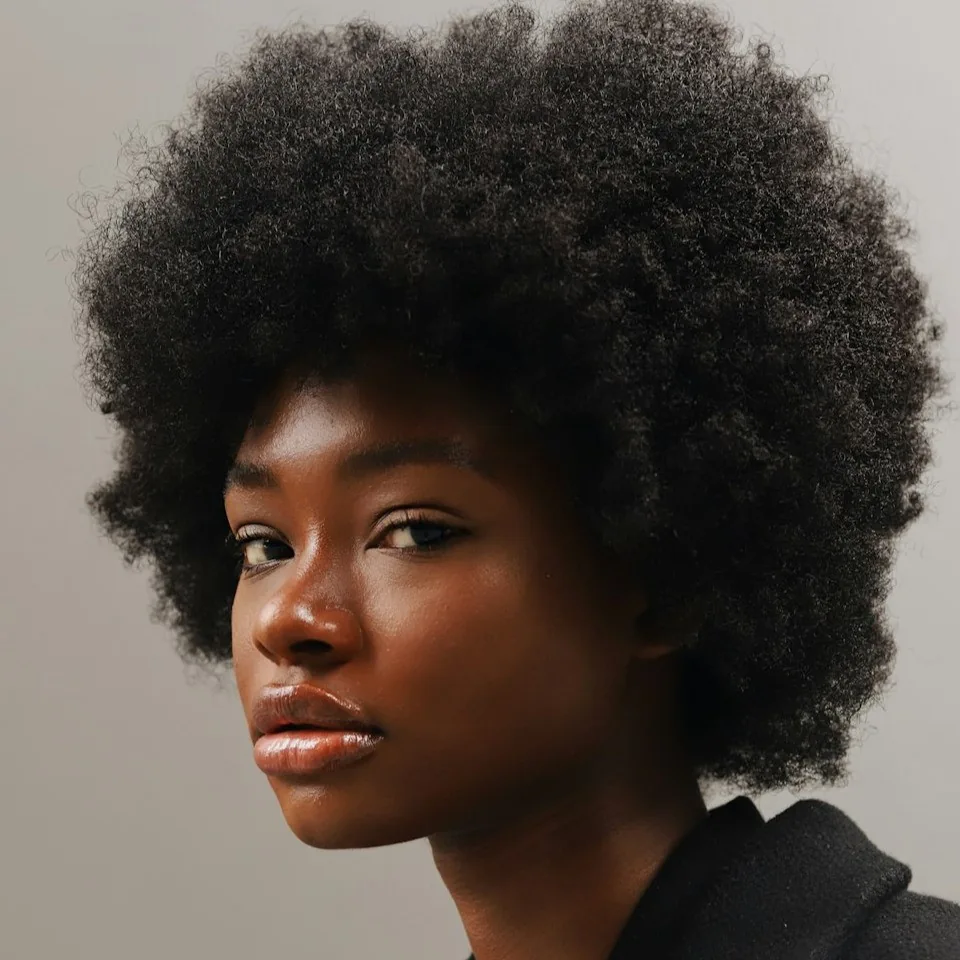
An afro with a curly fringe is volume in its most beautiful form. The afro gives the hair its magnificent rounded shape, and the fringe is simply the front of that shape, cut a little shorter so it frames the forehead and the eyes instead of covering them. There is no hard line between the fringe and the rest of the hair — it is all one beautiful shape, with the front pieces falling slightly lower to give the face a frame. It is a look that needs confidence, but it rewards it: nothing else in this guide has this much presence.
Best for: coily and kinky hair types that hold a rounded afro shape. How to style: pick the afro out gently with a wide-tooth comb or pick, and shape the front pieces with your fingers. What to ask: ask your stylist to shape the afro first, then define the fringe within that shape, rather than cutting the fringe separately. Pros: show-stopping volume and a fringe that never needs heat. Cons: the shape needs regular trims to stay rounded instead of growing out wide. Maintenance: moisturise daily — an afro fringe dries out faster than the rest of the hair because it is exposed to the air all day.
12. Curly Bangs with a Half-Up Half-Down Style

Half-up half-down is the compromise that curly hair does better than any other hair type, and curly bangs are what make it look finished. The top half is pulled back into a small ponytail or bun, the rest falls loose in curls, and the fringe frames the face so the pulled-back top never looks severe. It is the style for a day when you want your hair out of your face but you still want to show off your curls — a wedding, a party, a long day at work, or simply a day when the hair is behaving and you want everyone to see it.
Pros: keeps the hair out of your face while showing off the length. Cons: the top section can pull the fringe back if it is gathered too tightly, so leave the front pieces completely free. Maintenance: one elastic and two pins, and you are done. How to style: gather the top section from above the ears, not from the hairline, so the fringe stays untouched. Quick verdict: the half-up is the curly fringe’s best friend — they were made for each other.
13. Side-Swept Curly Bangs
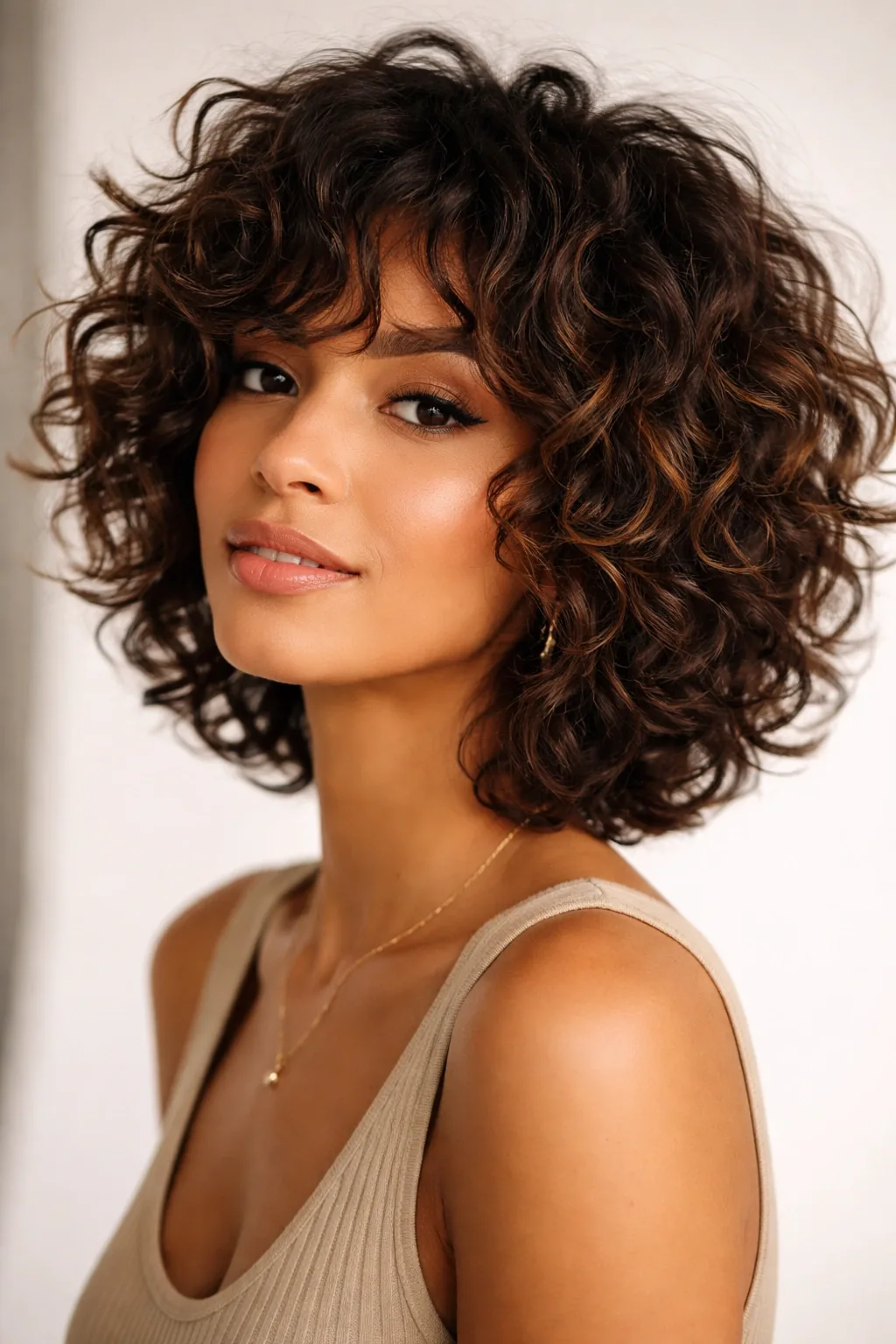
Side-swept curly bangs are the fringe for women who like their hair to move. Instead of falling straight down, the fringe sweeps across the forehead to one side, the curls falling in a soft diagonal that flatters the cheekbones and adds asymmetry to the whole face. It is a wonderful choice for a round face, because the diagonal line breaks up the width, and for anyone whose curls naturally fall to one side anyway — this fringe works with the hair’s natural direction instead of fighting it.
Best for: round and square faces, and curls with a natural side fall. How to style: while the fringe is wet, comb it to the side you want and let it dry there — curls remember where they dried. What to ask: ask for the fringe to be cut longer on the sweeping side, so the diagonal has room to develop. Pros: soft, flattering, and easy to grow out. Cons: a strong cowlick can fight the sweep, so this one needs a little cream to hold its direction. Common mistake: cutting side-swept bangs the same length all across — the sweep needs length on one side.
14. Curly Bangs with a Braided Crown
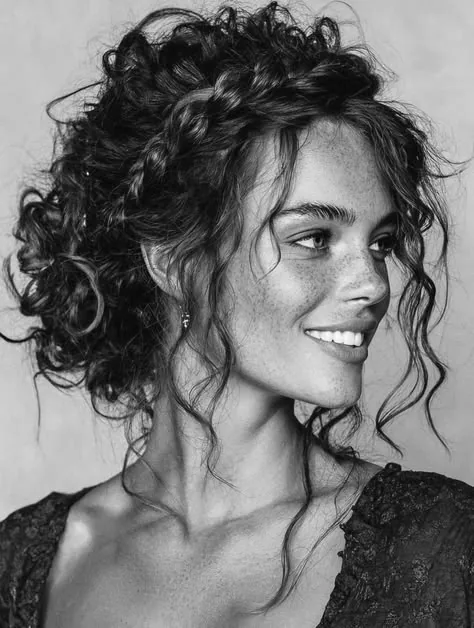
A braided crown with curly bangs is the romantic updo that looks like it took an hour and actually takes fifteen minutes. The braid circles the head like a crown, the rest of the curls are pinned up or left loose, and the fringe falls soft across the forehead, giving the whole style a soft, feminine frame. It is the hairstyle for a wedding guest, a garden party, or a summer evening — it keeps the hair up and off the neck, it photographs beautifully, and the bangs stop the braided crown from looking too severe or too formal.
Pros: elegant, cool in hot weather, and it holds all day. Cons: braiding curly hair takes practice, because the curls want to spring out of the braid — a little cream before you braid helps enormously. Maintenance: pin the braid at four points and carry two spare pins. Who should avoid it: very short hair, which will not reach around the head in a braid. Quick verdict: the braided crown is the most romantic style in this guide, and the fringe is what makes it soft.
15. Curly Bangs with Medium-Length Hair
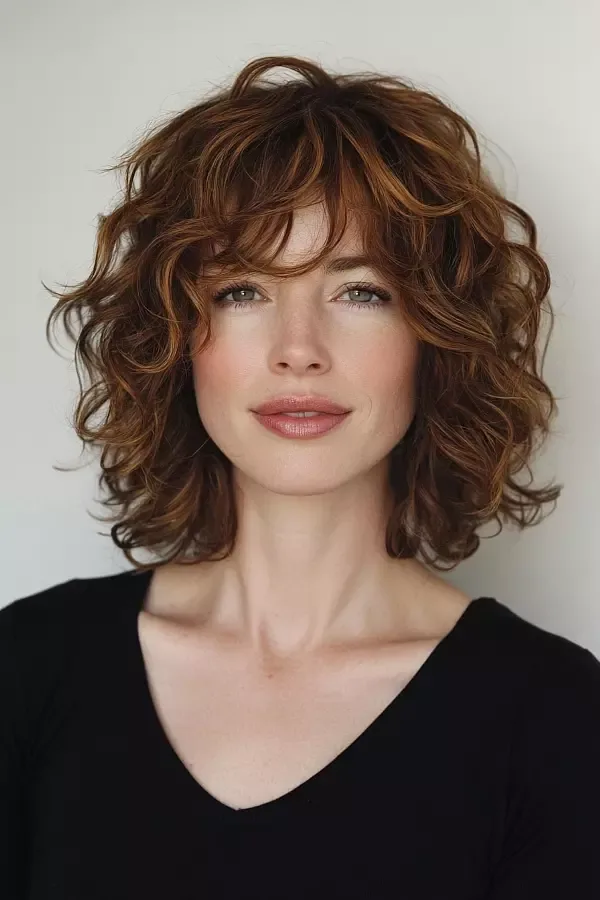
Medium-length hair is the length most curly-haired women actually live with, and curly bangs are what keep it from looking shapeless. At shoulder length, curls can easily turn into a wide, formless mass — but a fringe gives the cut a focal point at the top, and layers through the lengths give it shape at the sides. The result is a cut that has structure without being short, and movement without being unmanageable. It is the everyday length, made to look like a real style.
Best for: women who want a practical length with a polished finish. How to style: diffuse the fringe first, then the lengths, and finish with a drop of oil on the surface. What to ask: ask for layers that start at the cheekbone, so the curls stack rather than spread. Pros: ties back, dries fast, and suits every lifestyle. Cons: medium length is the length most likely to puff out in humidity, so a little gel on the surface helps. Maintenance: a trim every eight weeks keeps the layers from growing into a triangle.
16. Curly Bangs with Short Curly Hair
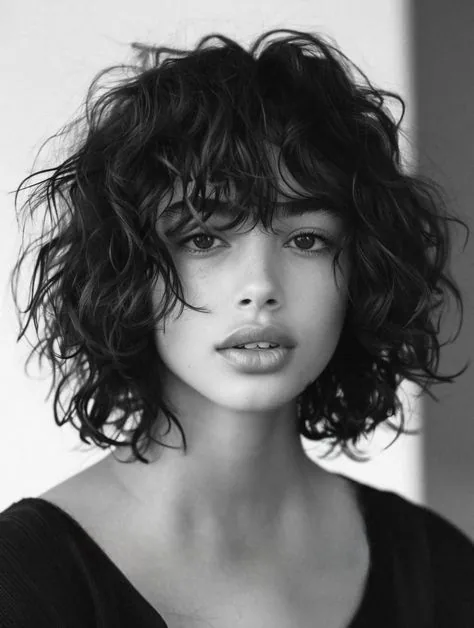
Short curly hair with bangs is the cut that proves short hair can be soft. The curls sit close to the head in a rounded shape, the fringe falls across the forehead in loose pieces, and the whole cut has a lightness that long curly hair can never have. It dries in minutes, it needs almost no styling, and it looks good even on the days when you do nothing to it at all — which, for curly hair, is a rare and wonderful thing. It is also the cut that shows off the curl pattern best, because there is no weight pulling the curls down.
Pros: dries fast, shows the curl pattern, and needs almost no product. Cons: it grows out of shape quickly, so it needs a trim every four to five weeks. Maintenance: a little cream on wet hair is the whole routine. Common mistake: cutting short curly hair wet — always cut it dry, or the shrinkage will surprise you. Quick verdict: short curls plus a fringe is the lowest-effort good hair in this guide.
17. Curly Bangs with Long Curly Hair
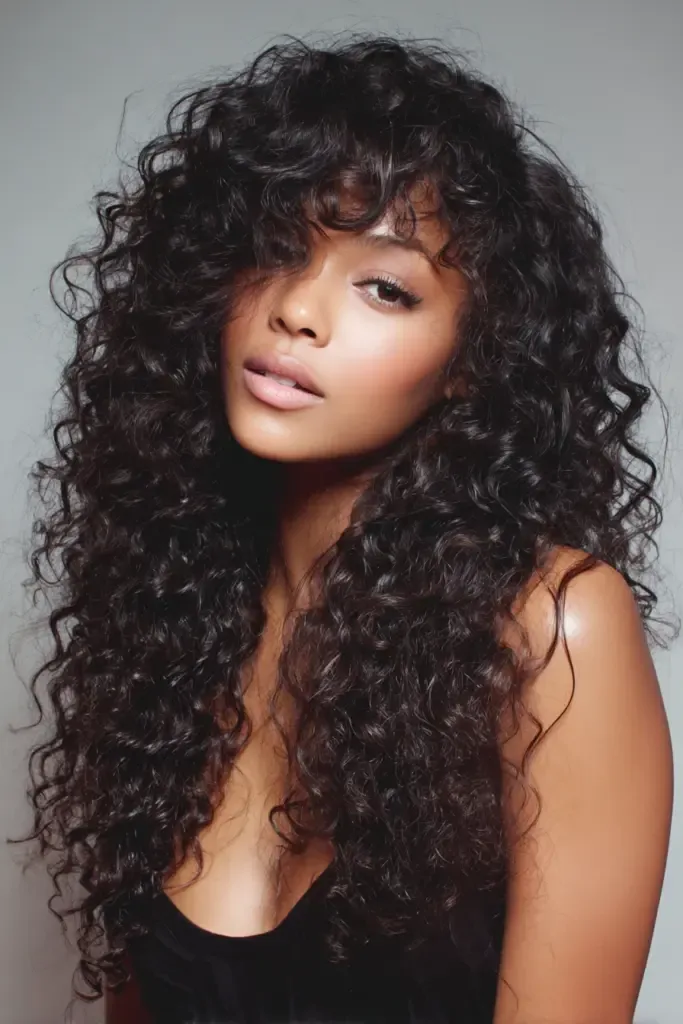
Long curly hair with bangs is the look that stops people in the street. The length gives the curls room to form their full pattern, falling past the shoulders in waves and ringlets, and the fringe gives the face a frame at the top so the length never overwhelms the features. The secret is balance: the fringe should be full enough to hold its own against all that hair, and the layers should start at the chin so the curls have shape instead of forming a heavy curtain. It is a high-maintenance look, but it is also the most dramatic one in this guide.
Best for: women with healthy, thick curls who love length. How to style: diffuse in sections, starting with the fringe, and use a light oil on the ends. What to ask: ask for long layers and a fringe that is cut dry, so the length is right. Pros: maximum drama, endless styling options, and the fringe stops long hair from hiding the face. Cons: wash day takes time, and the fringe needs refreshing on non-wash days. Maintenance: a trim every ten weeks, and a deep condition once a week to keep the ends healthy.
18. Curly Bangs with a Side Part
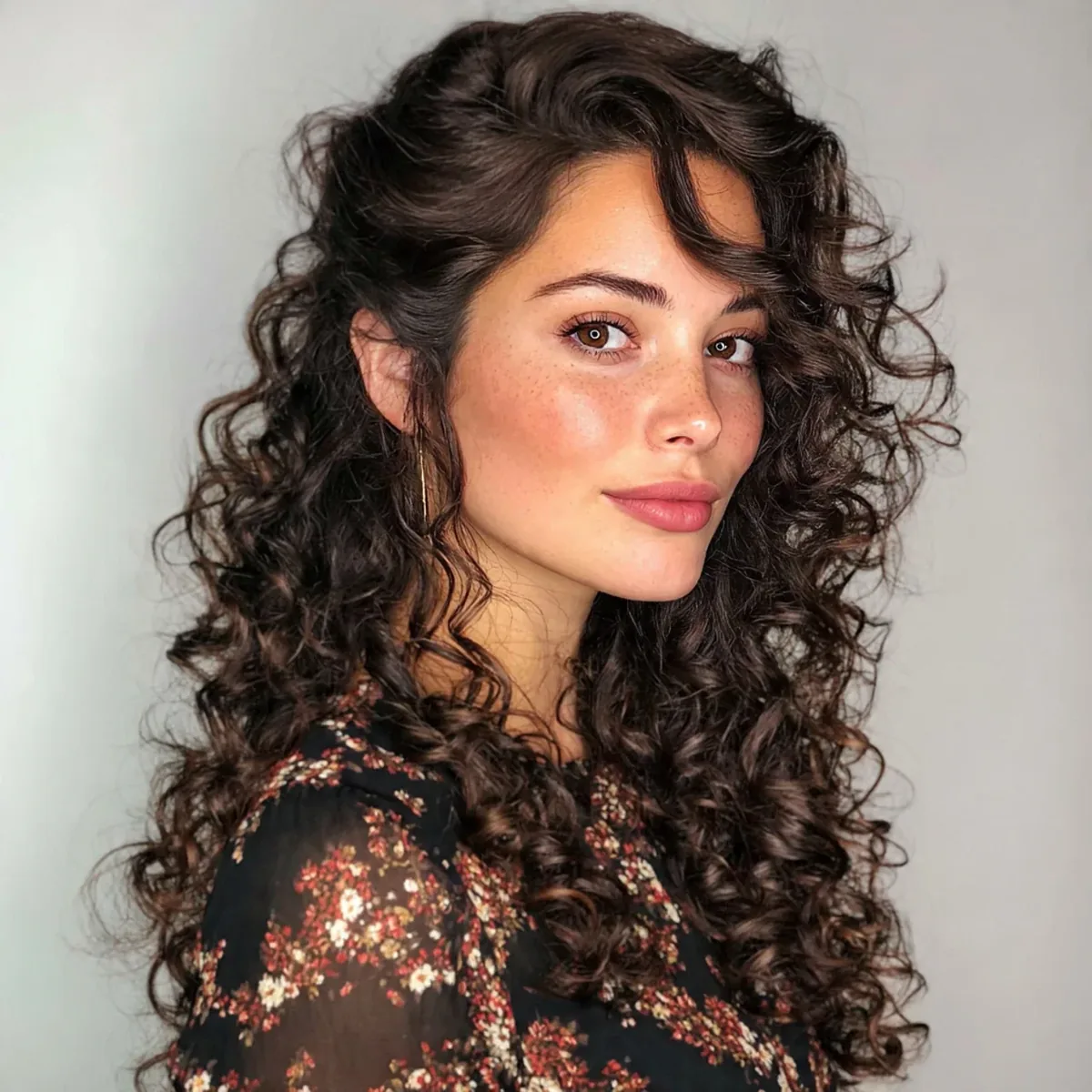
A side part changes everything about a curly fringe. Instead of falling straight down, the fringe falls across the forehead in a deep diagonal, adding volume on one side and a soft, asymmetric frame to the face. It is the most flattering parting for a wide forehead, because the diagonal breaks up the width, and for a round face, because the asymmetry adds angles. It also gives the hair instant volume at the roots on the heavier side, which is a gift for fine curls that tend to fall flat.
Pros: instant volume, flattering asymmetry, and it works with almost any length. Cons: the part can drift back to the middle as the hair dries, so set it while the hair is wet. Maintenance: a clip while the fringe dries holds the part in place. How to style: part the wet fringe deeply to one side and diffuse it in that direction. Quick verdict: if your fringe feels boring, change the part before you change the cut.
19. Curly Bangs with a Middle Part
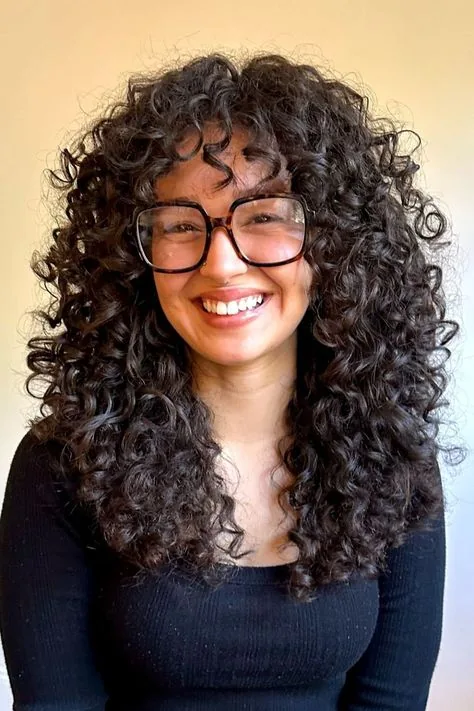
A middle part with curly bangs is the symmetrical, modern look: the fringe parts in the centre and falls evenly to both sides, framing the face like a pair of curtains. On curls it is softer than on straight hair, because each side falls in loose ringlets rather than a flat sheet, and it is wonderfully flattering on oval and heart-shaped faces, where the symmetry balances the features. It is also the parting that shows off the curl pattern best, because both sides of the fringe are visible at once.
Best for: oval and heart-shaped faces, and anyone who loves symmetry. How to style: part the wet fringe in the middle and let each side dry in its own curl pattern. What to ask: ask for the fringe to be cut slightly longer at the sides so it falls evenly. Pros: balanced, modern, and easy to grow out into a curtain fringe. Cons: a very round face can look wider with a middle part, so this one suits oval faces best. Common mistake: forcing a middle part on curls that naturally fall to one side — work with the hair’s direction, not against it.
20. Curly Bangs and a Claw Clip Updo
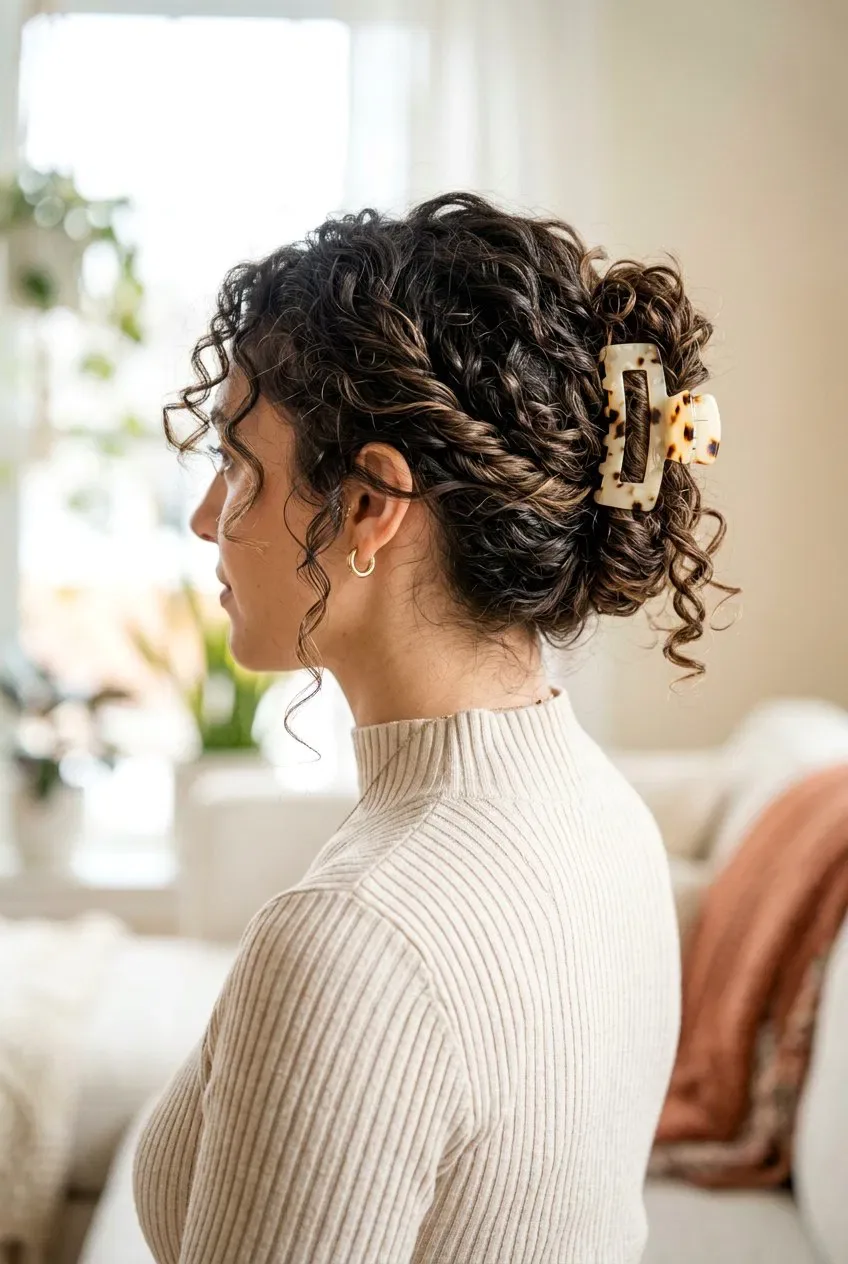
The claw clip is the accessory curly hair has been waiting for, and with curly bangs it becomes a real hairstyle. Twist the lengths up, clip them in place, let a few curls escape around the edges, and the fringe frames the face so the whole thing looks deliberate instead of thrown together. It takes thirty seconds, it does not dent the curls the way an elastic does, and it is gentle enough to wear all day without a headache. It is the updo for a hot day, a busy day, or a day when the hair simply will not cooperate.
Pros: thirty seconds, no heat, no headache, and the curls stay intact. Cons: very thick hair needs a large, strong clip, or it will slide out by lunchtime. Maintenance: carry a spare clip in your bag. How to style: twist the hair up loosely — a tight twist fights the curl pattern. Quick verdict: the claw clip plus a curly fringe is the fastest good hair day in this guide.
21. Curly Bangs with a Low Bun
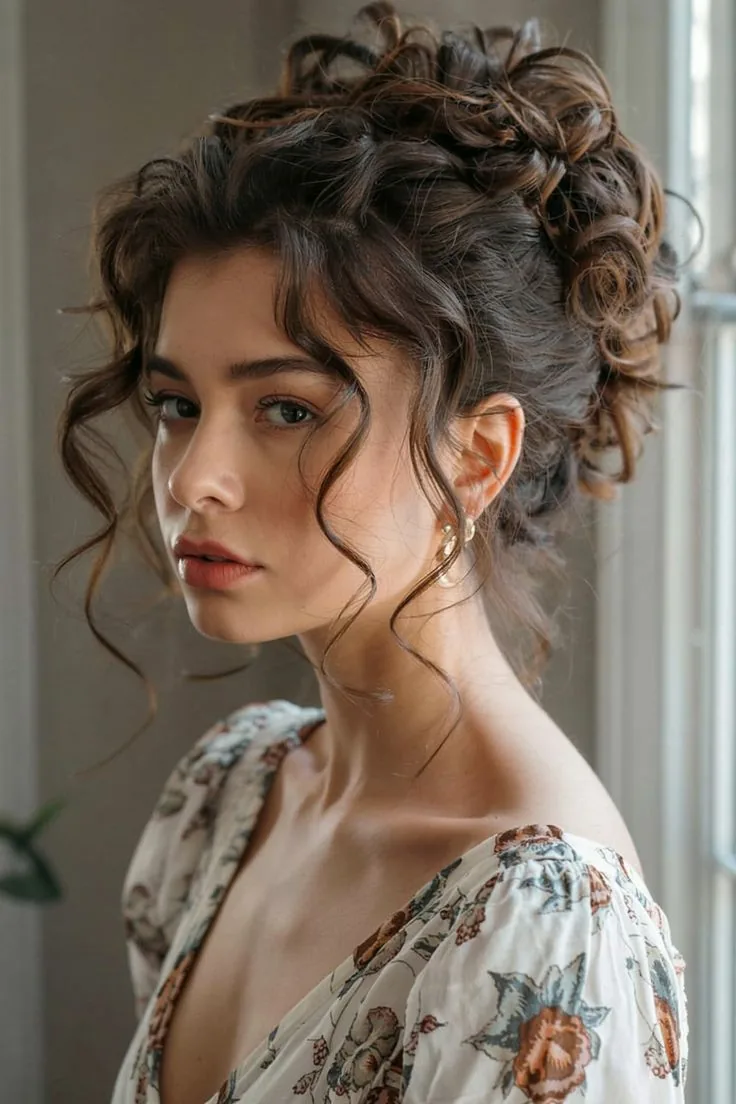
A low bun with curly bangs is the elegant updo that works for a wedding, a job interview, or a formal dinner — and it is far easier than it looks. The bun sits at the nape, the curls are pinned up softly rather than pulled tight, and the fringe stays out across the forehead, softening the whole style and stopping the updo from looking severe. It is the hairstyle for a woman who wants to look polished without spending an hour in front of the mirror, and it holds all day with just a few pins.
Best for: formal occasions and long days when the hair needs to stay put. How to style: gather the hair low with your fingers, twist it loosely, and pin it at three points. What to ask: nothing — this is a styling choice. Pros: elegant, comfortable, and it makes the fringe the star. Cons: a bun that is too tight pulls the fringe back, so keep the front loose. Maintenance: two spare pins in your bag fix anything that slips. Common mistake: smoothing the fringe down with gel before pinning the bun — the fringe should stay soft and free.
22. Curly Bangs with a Diffused Blowout
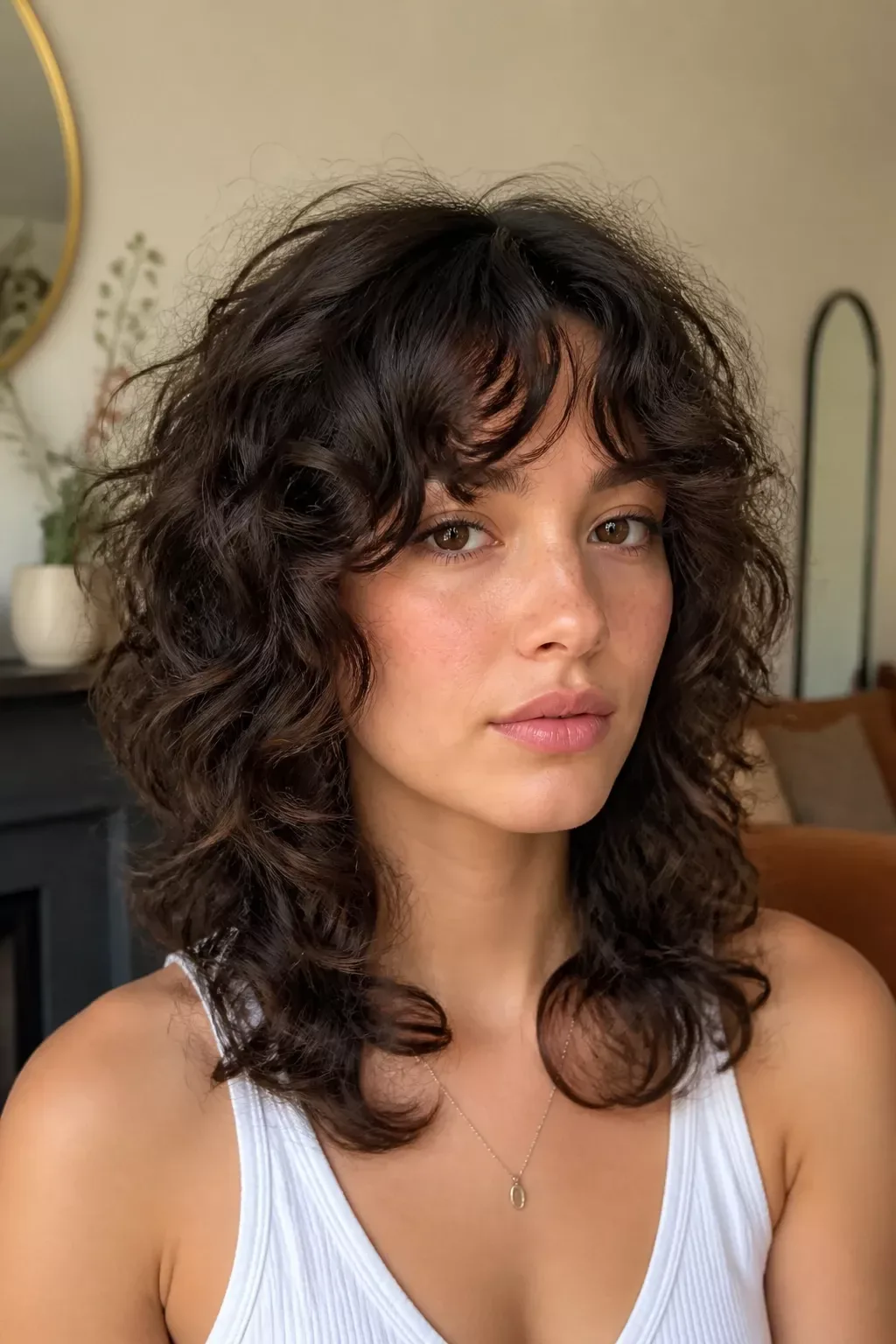
A diffused blowout is the curly version of a salon blowout: big, bouncy, full of volume, with the fringe falling in soft, defined curls across the forehead. The diffuser is the key — it dries the curls without blowing them apart, so the pattern stays intact while the volume builds. Start with the fringe, cupping each curl in the diffuser bowl, then work through the lengths, lifting at the roots. The result is hair that looks like it has been professionally styled, with a fringe that frames the face beautifully.
Pros: maximum volume and definition, and the fringe looks its best diffused. Cons: it takes twenty minutes, which is longer than air-drying. Maintenance: a diffuser on low heat is gentler than high heat and gives better definition. How to style: use a heat protectant, diffuse on low, and do not touch the curls until they are completely dry. Quick verdict: if you have a diffuser, use it — it is the single best tool for a curly fringe.
23. Curly Bangs with Beachy Waves
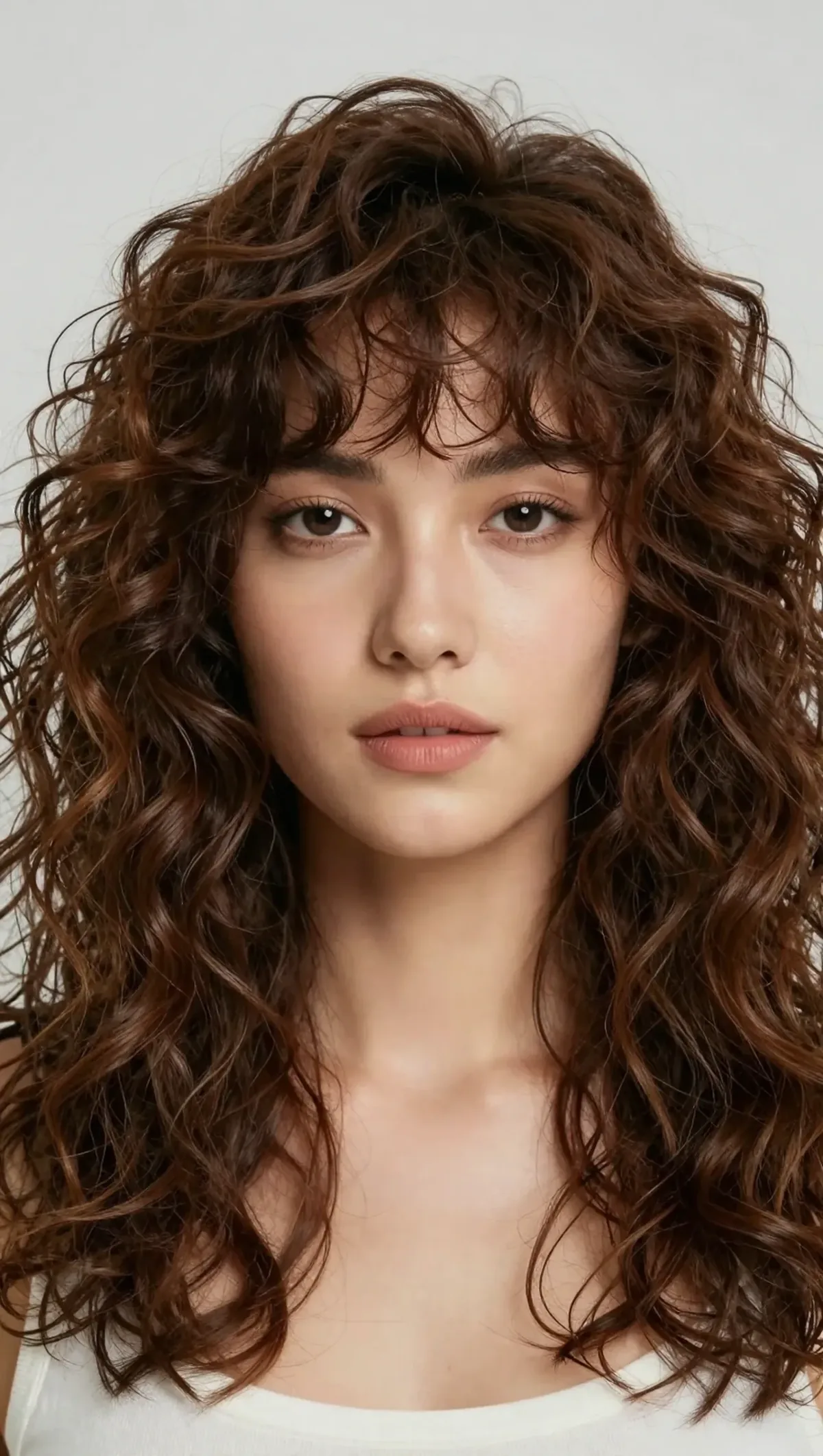
Beachy waves with curly bangs are the relaxed, sun-kissed look: loose, tousled curls that fall like they have just come back from the sea, and a fringe that is soft and piecey rather than neat. The fringe is the key to making beachy waves look like a style instead of bedhead — it gives the face a frame and stops the loose waves from looking shapeless. A little sea-salt spray or texturising spray adds to the effect, giving the curls a matte, lived-in texture that photographs beautifully in sunlight.
Best for: loose curls and waves, summer days, and holidays. How to style: scrunch in a little salt spray, air-dry, and shake the curls out with your fingers. What to ask: ask for a fringe that is cut slightly longer, so it can be tousled to the side. Pros: effortless, summery, and it looks better the messier it gets. Cons: salt spray can dry the hair out, so use it sparingly and condition well. Maintenance: a deep condition once a week keeps beachy hair from turning straw-like.
24. Curly Bangs with Bouncy Ringlets
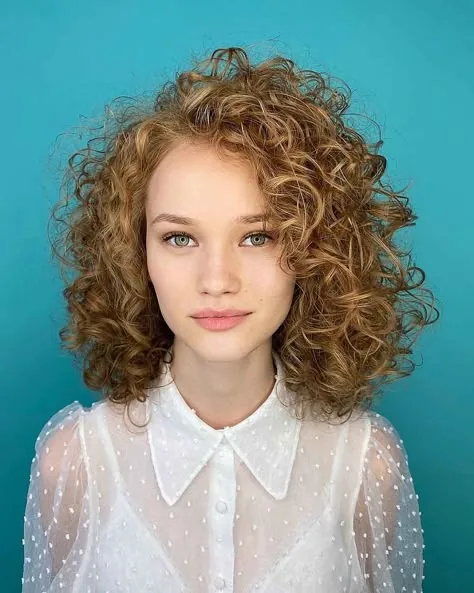
Bouncy ringlets with a curly fringe are the most joyful hairstyle in this guide. Each curl forms a perfect ringlet, the fringe falls in matching ringlets across the forehead, and the whole head of hair moves when you do. It is the look for a party, a celebration, or any day when you want your hair to be the main event. The secret is definition: a good curl cream, scrunched in while the hair is wet, and a diffuser to set the ringlets without frizz. When the ringlets are defined, the fringe practically styles itself.
Pros: show-stopping definition and bounce. Cons: ringlets need regular trims to keep their shape, or they grow out into a heavy mass. Maintenance: refresh the ringlets on day two with a spritz of water and a drop of cream. Common mistake: brushing ringlets dry — one brush stroke turns them into a frizz cloud. Quick verdict: if your curls form ringlets naturally, a fringe will show them off at their best.
25. Curly Bangs with a Textured Pixie
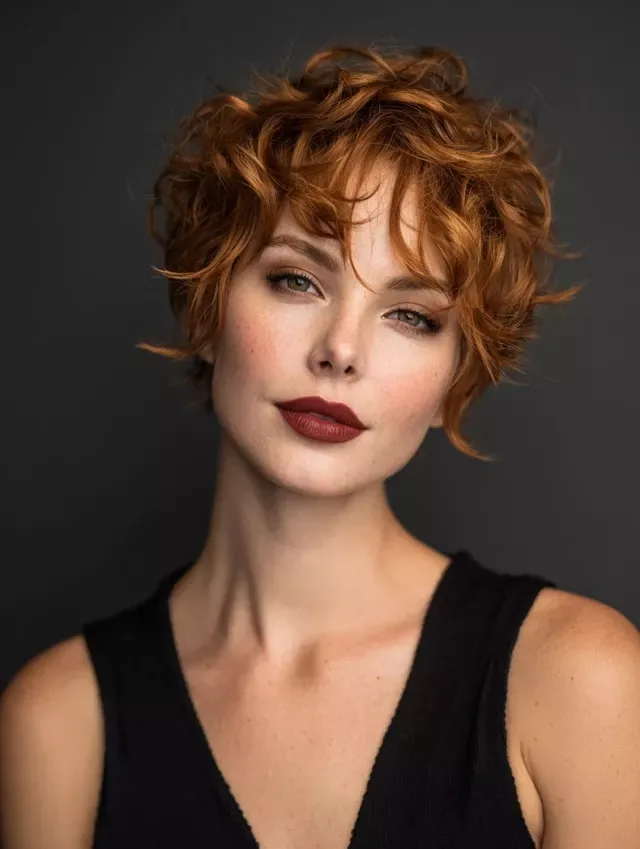
A textured pixie with curly bangs is the short cut with the most personality in this guide. The top is left long and choppy, the curls are cut to different lengths so they spring up in different directions, and the fringe is part of that texture — a few curls falling across the forehead, a few sweeping to the side, nothing neat and nothing symmetrical. It is a cut that looks different every day, because the curls fall differently each morning, and that unpredictability is exactly what makes it charming.
Best for: women who want a short cut that never looks boring. How to style: a little texture paste or curl cream, scrunched in with your fingers. What to ask: ask for a textured, point-cut finish rather than a blunt one. Pros: wash-and-go, full of character, and it grows out into a lovely short shag. Cons: it needs a trim every four weeks, and it is not a cut you can tie back on a bad hair day. Maintenance: a pea-sized amount of product is all it needs — more will weigh the texture down.
26. Curly Bangs with a French Twist
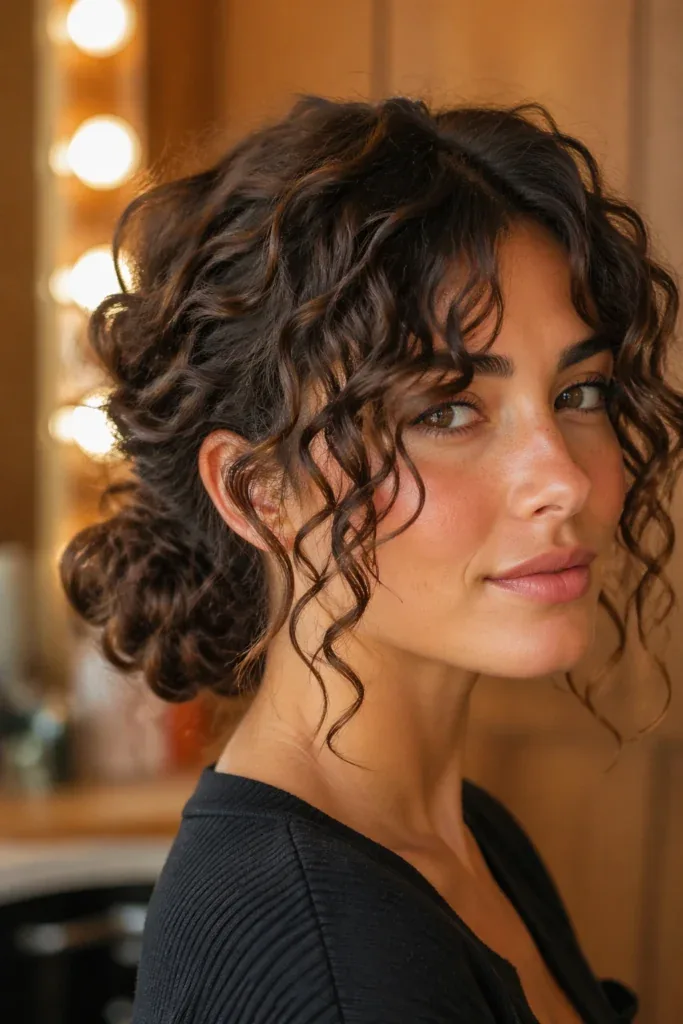
A French twist with curly bangs is old Hollywood glamour, softened by curls. The twist sweeps the hair up into an elegant roll at the back, the curls are tucked in softly rather than pulled tight, and the fringe falls across the forehead in loose pieces, giving the classic updo a modern, romantic feel. It is the hairstyle for a black-tie event, a formal wedding, or any evening when you want to look like you have stepped out of a film — and the bangs are what stop it from looking too severe or too retro.
Pros: timeless elegance, and it holds all night. Cons: a French twist on curly hair needs more pins than on straight hair, because the curls want to escape. Maintenance: pin it at five points, not three, and carry spare pins. Who should avoid it: very short hair, which will not twist up. Quick verdict: the French twist is the most formal style in this guide, and the curly fringe is what makes it feel modern.
27. Curly Bangs with Space Buns
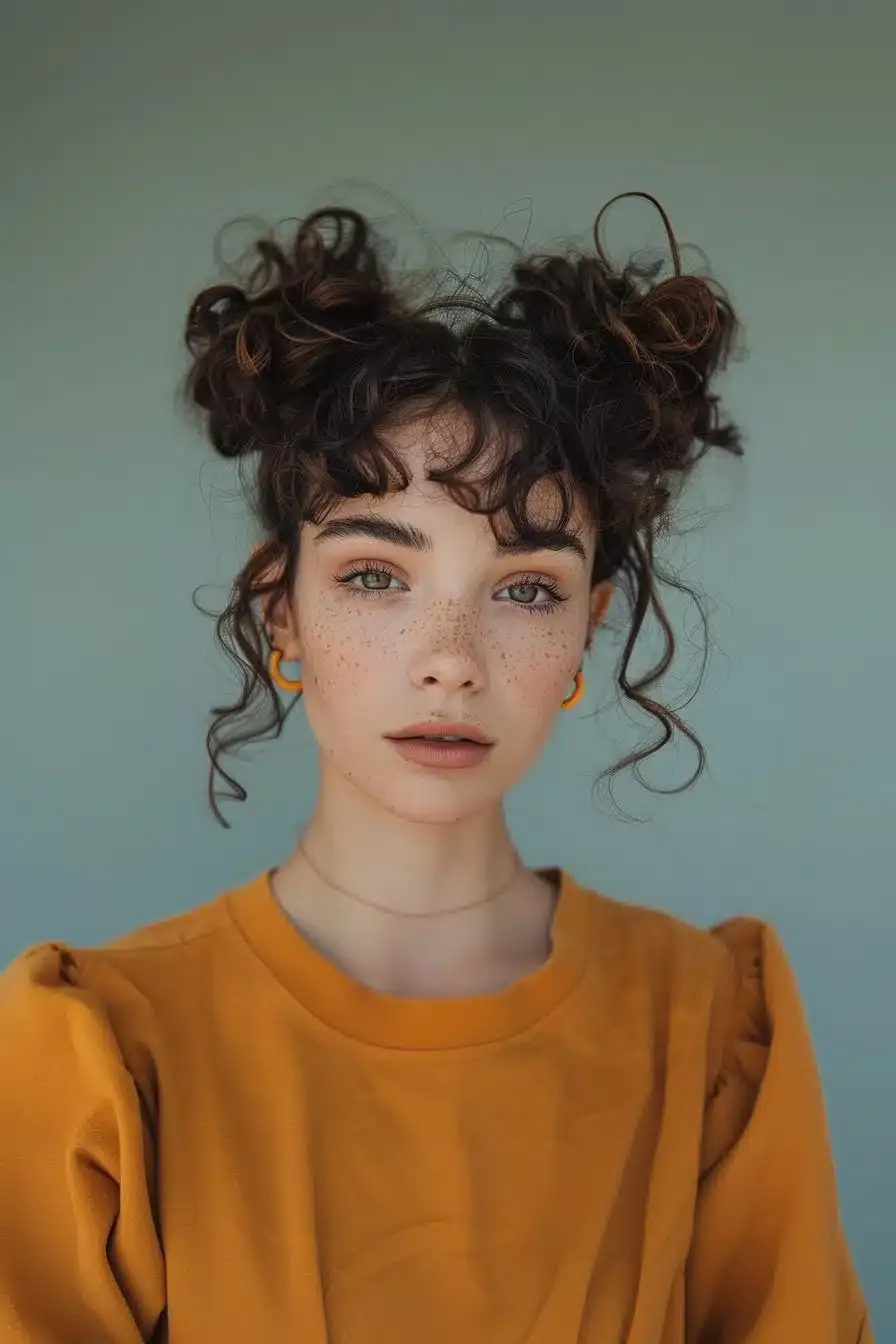
Space buns with curly bangs are the playful look — two buns on top of the head, curls spilling out of them, and a fringe across the forehead that keeps the whole style from looking like a costume. It is the hairstyle for a festival, a concert, a holiday, or simply a day when you feel like having fun with your hair. The buns do not need to be neat — the messier they are, the better they look — and the fringe gives the face a frame so the buns read as a style rather than a joke.
Best for: festivals, holidays, and anyone under thirty at heart. How to style: part the hair in the middle, twist each side into a bun, and pin it loosely. What to ask: nothing — this is a styling choice. Pros: fun, fast, and it keeps the hair completely out of the way. Cons: it is a young, casual look, so it does not suit a formal occasion. Maintenance: a couple of pins per bun, and the fringe needs nothing at all. Common mistake: making the buns too tight — loose buns suit curls far better.
28. Curly Bangs with a Low Ponytail
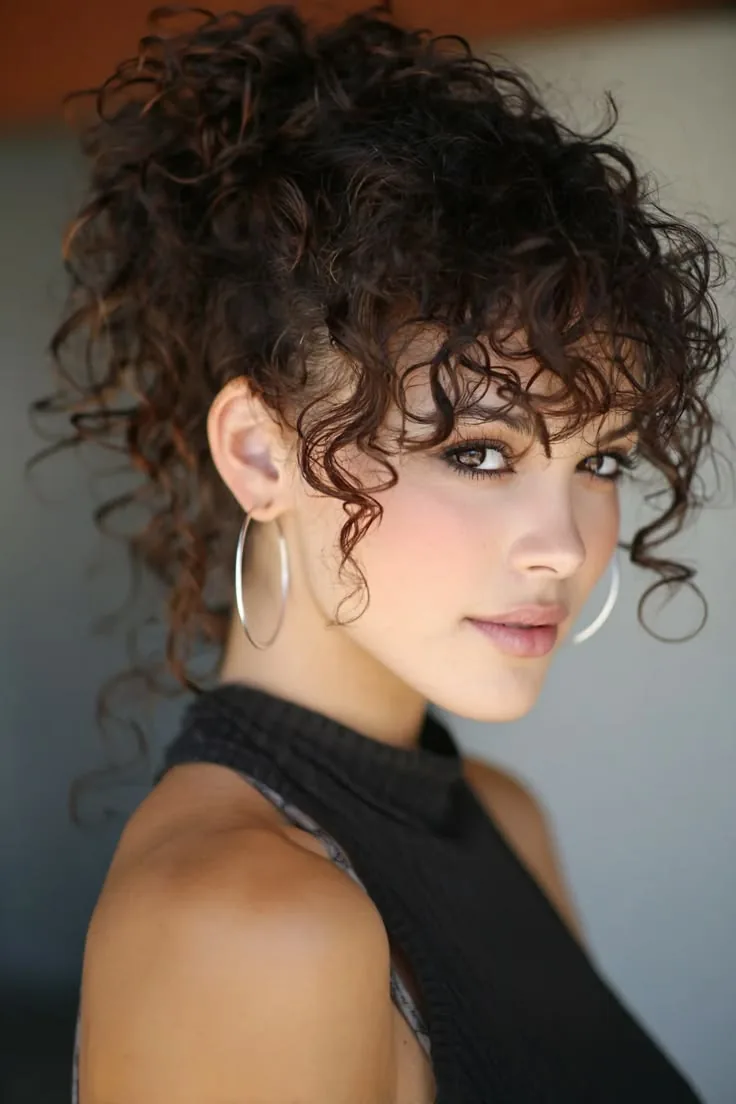
A low ponytail with curly bangs is the quiet, elegant version of the ponytail. The hair is gathered low at the nape, the curls fall in a soft tail down the back, and the fringe frames the face so the whole style looks polished rather than pulled back. It is the hairstyle for the office, for a dinner, or for a day when you want to look put-together without trying very hard. A ribbon or a silk scrunchie around the base turns it from everyday into something special in about ten seconds.
Pros: elegant, comfortable, and it suits every age. Cons: a low ponytail can look flat at the roots, so lift the crown with your fingers before you tie it. Maintenance: a silk scrunchie protects the curls. How to style: gather the hair with your fingers, not a brush, so the curl pattern stays intact. Quick verdict: the low ponytail is the most versatile style in this guide — it goes everywhere.
29. Curly Bangs with a Top Knot
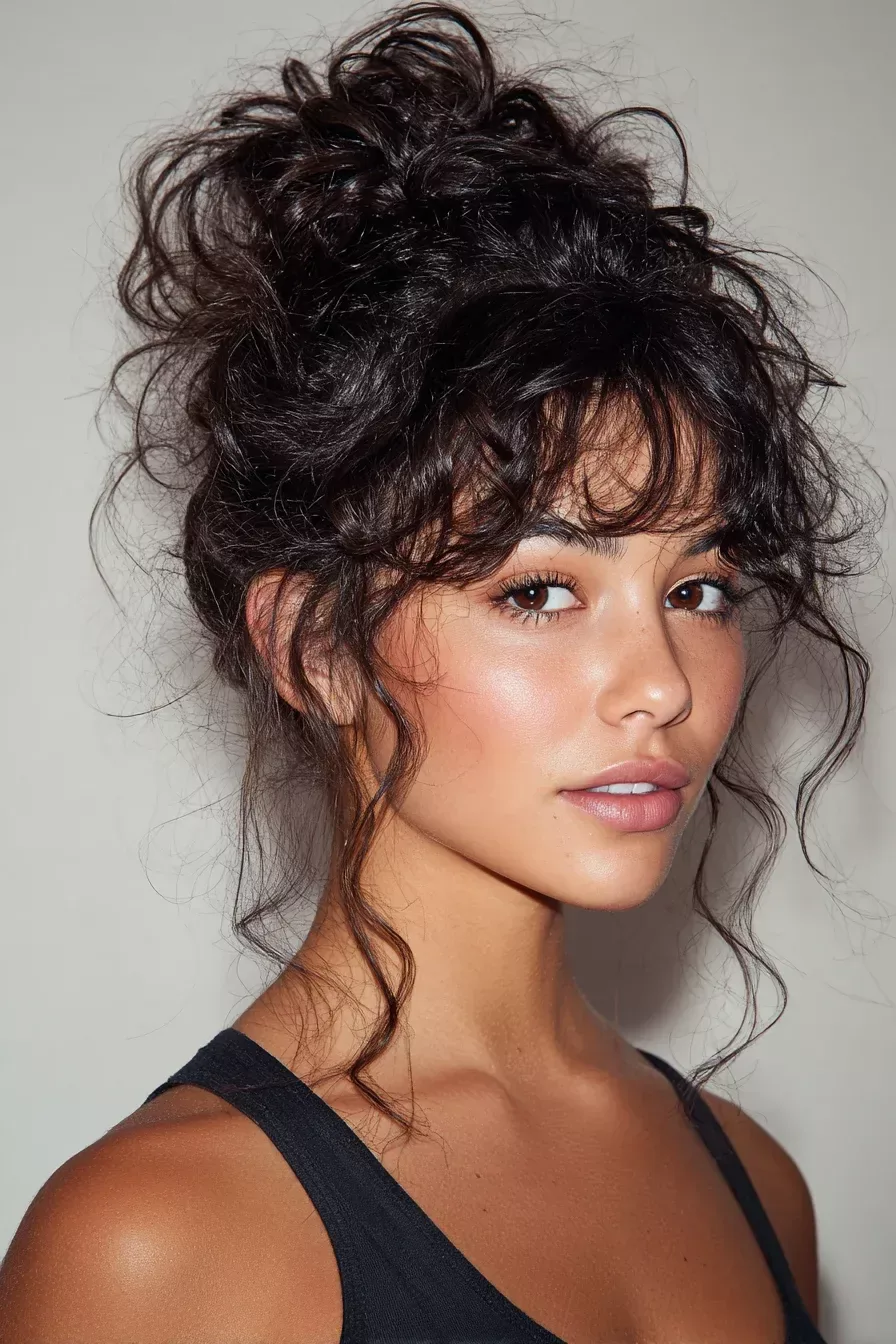
A top knot with curly bangs is the high, confident updo: the hair is swept up into a knot on top of the head, the curls spill out of the knot in soft pieces, and the fringe frames the face so the height of the knot never overwhelms the features. It is the style for a hot day, a workout, or a night out — it keeps the hair completely off the neck, it shows off the face, and the bangs make it look like a real hairstyle rather than a gym fix. The higher the knot, the more dramatic the effect, and the fringe is what keeps it grounded.
Best for: long curly hair on hot days and busy days. How to style: gather the hair high, twist it loosely, and pin the knot in place. What to ask: nothing — this is a styling choice. Pros: keeps you cool, shows off the face, and takes two minutes. Cons: a very tight top knot can pull at the hairline, so keep it firm but not yanked. Maintenance: a strong elastic and two pins hold it all day.
30. Curly Bangs with a Braided Ponytail
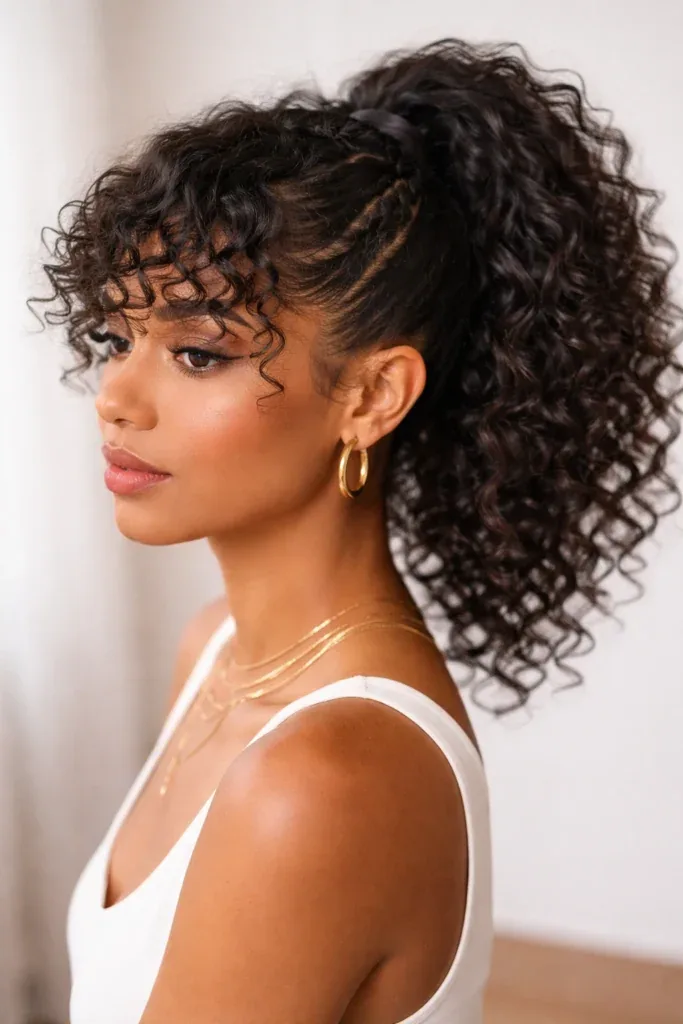
A braided ponytail with curly bangs is the practical style that still looks beautiful. The hair is gathered into a ponytail, the tail is braided loosely so the curls show through the braid, and the fringe stays out across the forehead, softening the pulled-back look. It is the hairstyle for a long day, a workout, or a holiday — it keeps the hair contained and tangle-free, it survives wind and humidity, and the bangs make it look like a style rather than a way of getting the hair out of the way.
Pros: tangle-free, survives humidity, and it looks good all day. Cons: braiding curly hair takes a little cream first, or the curls spring out of the braid. Maintenance: a single elastic at the end, and the fringe needs nothing. How to style: braid loosely, and pull a few curls out of the braid for softness. Quick verdict: the braided ponytail is the hardest-working style in this guide.
31. Curly Bangs for a Round Face
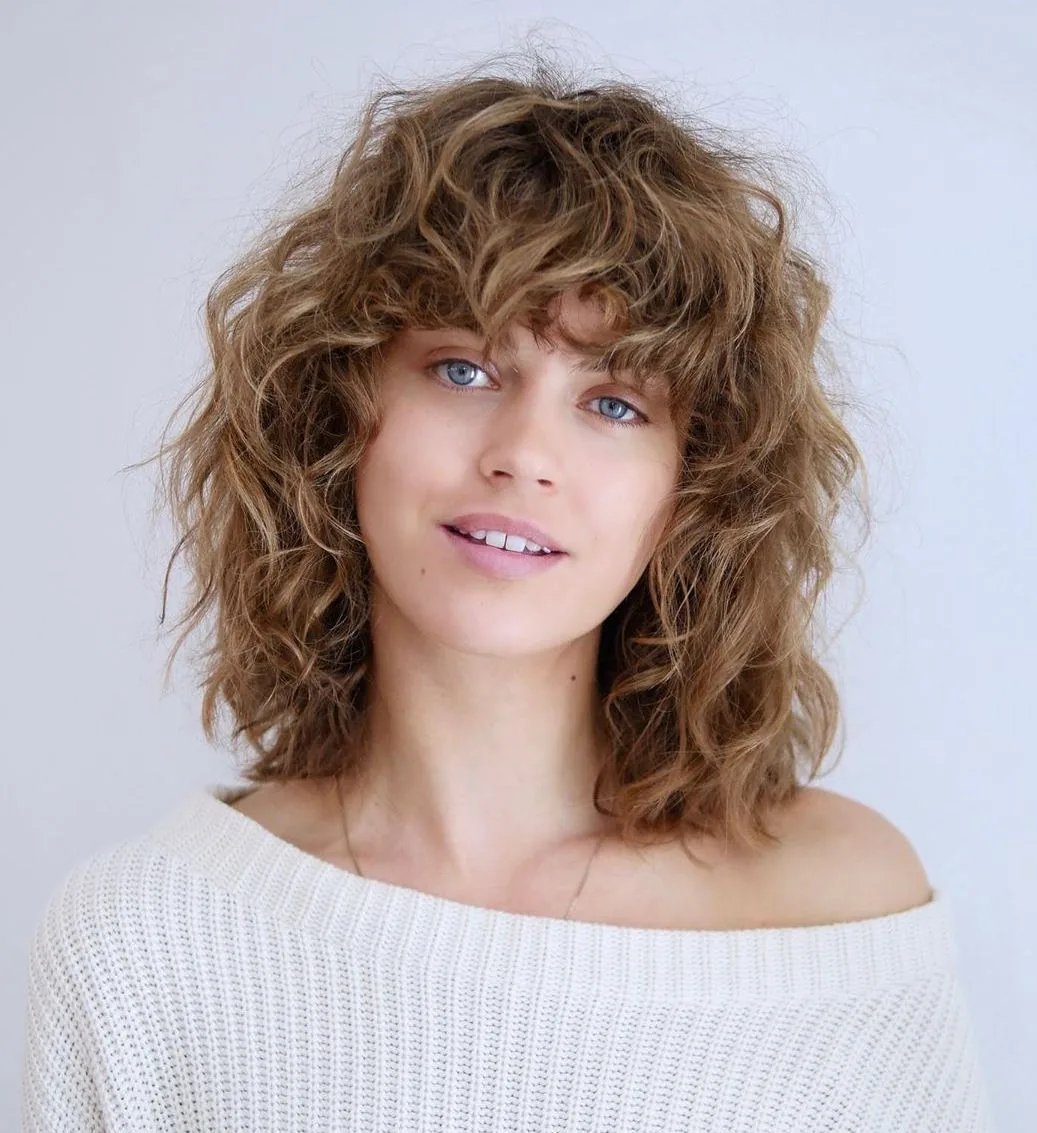
For a round face, the right curly fringe is a long, side-swept one. The diagonal line of the fringe breaks up the width of the face, the longer pieces draw the eye down toward the chin, and the curls at the sides add length to the overall shape. What to avoid is a short, blunt fringe that stops straight across the forehead — it cuts the face in half horizontally and makes it look wider. The best round-face fringe is one that is longer at the sides than in the middle, so the face looks longer and the features look more defined.
Best for: round faces that want length and angles. How to style: sweep the fringe to one side while it is wet and let it dry there. What to ask: ask for a side-swept fringe that reaches the cheekbone at its longest point. Pros: slims the face visually and adds angles. Cons: a side-swept fringe needs a little cream to hold its direction. Common mistake: a short, straight-across fringe on a round face — it does the opposite of what you want. Quick verdict: long, side-swept, and longer at the edges is the round-face rule.
32. Curly Bangs for an Oval Face
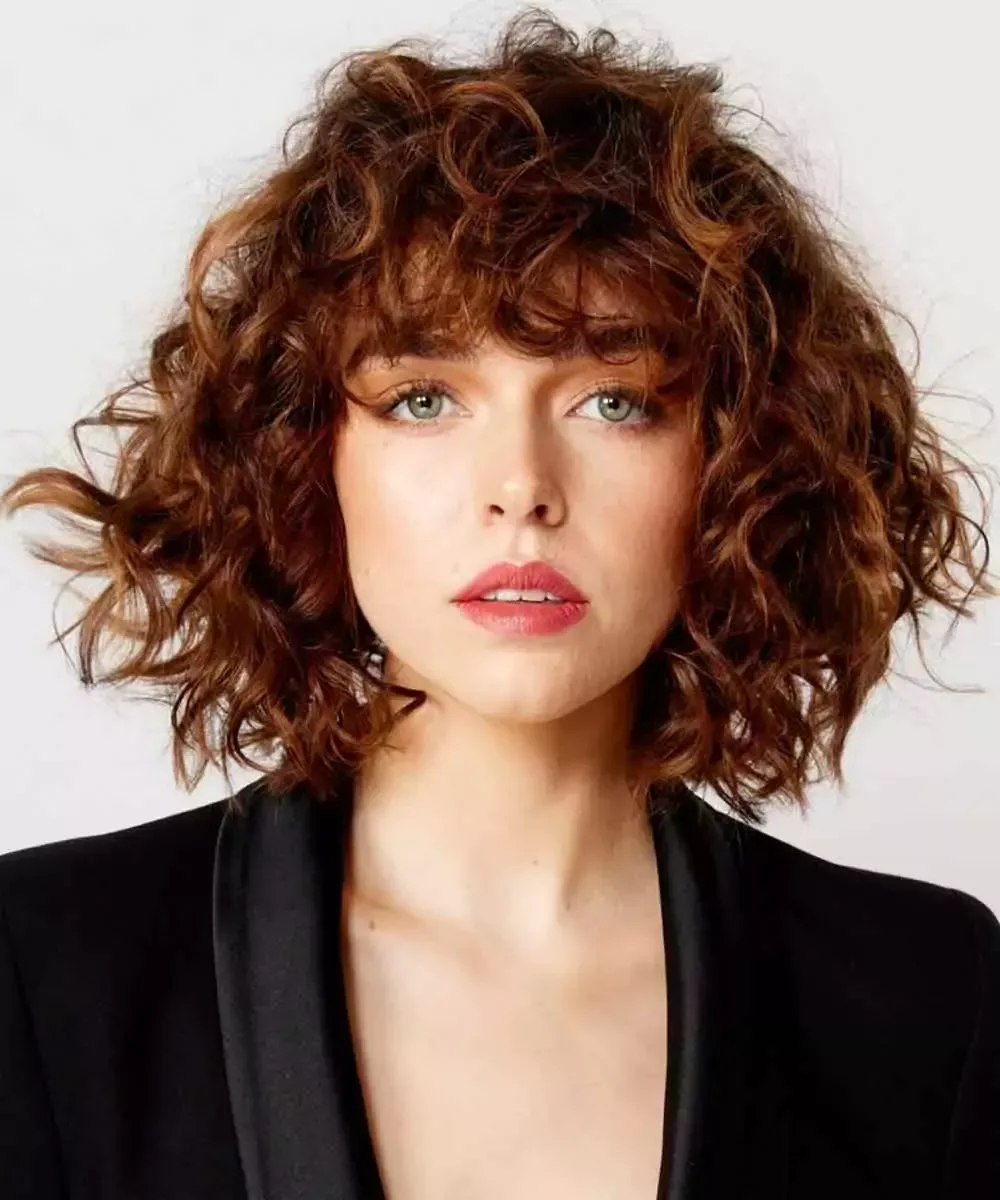
An oval face can wear almost any curly fringe, which is both a blessing and a problem — the choice is wide open, so the fringe should be chosen for the hair, not the face. A full, brow-length fringe looks wonderful on an oval face, because the balanced proportions can take the weight of a strong fringe without looking overwhelmed. A curtain fringe is equally good, parting in the middle and framing the cheekbones. The only fringe to be careful with is a very short, baby fringe, which can make an oval face look longer than it is.
Pros: almost every fringe shape works on an oval face. Cons: the wide choice can make it hard to decide — start with a full fringe and adjust from there. Maintenance: a trim every six weeks keeps the shape. How to style: let the fringe fall naturally and see where it wants to sit before you decide on a parting. Quick verdict: oval faces have the easiest job in this guide — pick the fringe you love, and it will almost certainly work.
33. Curly Bangs for a Heart-Shaped Face
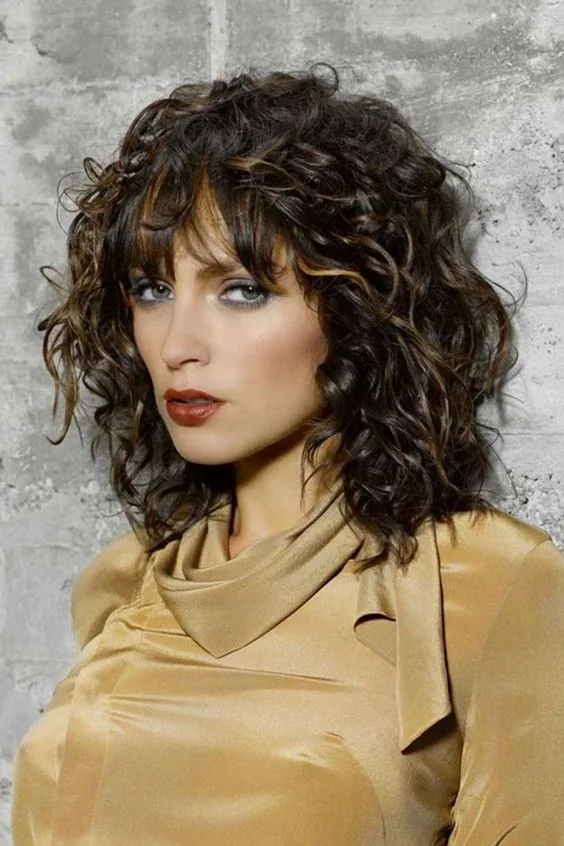
A heart-shaped face — wider at the forehead, narrower at the chin — is beautifully balanced by a curtain curly fringe. The centre part breaks up the width of the forehead, the two sides fall past the cheekbones and add width where the face is narrowest, and the whole effect is one of balance. A wispy fringe works well too, softening the forehead without adding weight. What to avoid is a heavy, blunt fringe that adds even more width at the top of the face and makes the chin look smaller by comparison.
Best for: heart-shaped faces that want balance. How to style: part the fringe in the middle and let each side fall past the cheekbone. What to ask: ask for a curtain fringe that reaches the cheekbone, with soft, wispy pieces at the centre. Pros: balances the face beautifully. Cons: a curtain fringe needs a little styling to keep the centre part in place. Maintenance: a trim every seven weeks. Common mistake: a heavy, straight-across fringe on a heart-shaped face — it emphasises the width at the top.
34. Curly Bangs with Highlights
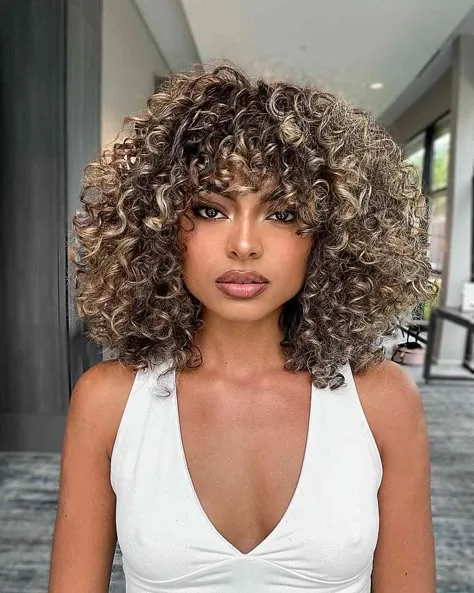
Highlights on curly bangs are like sunlight through a window — a few lighter pieces woven through the fringe catch the light and make the curls look three-dimensional. The trick is placement: highlights should be painted on the curls that sit on the surface, so they show, and kept away from the very front hairline, where they can look harsh. A few face-framing highlights through the fringe also brighten the whole face, and they make the curl pattern easier to see in photographs. On dark curls, a caramel or honey tone works beautifully; on lighter hair, a golden blonde adds warmth.
Pros: adds dimension and brightness without a full colour change. Cons: highlighted curls need more moisture, because lightener dries the hair out. Maintenance: a gloss or toner every six weeks keeps the highlights from turning brassy. Cost and time: a partial highlight takes about an hour at the salon. Who should avoid it: very damaged curls — get the health back first, then add colour. Quick verdict: highlights are the easiest way to make a curly fringe look expensive.
35. Curly Bangs with Balayage
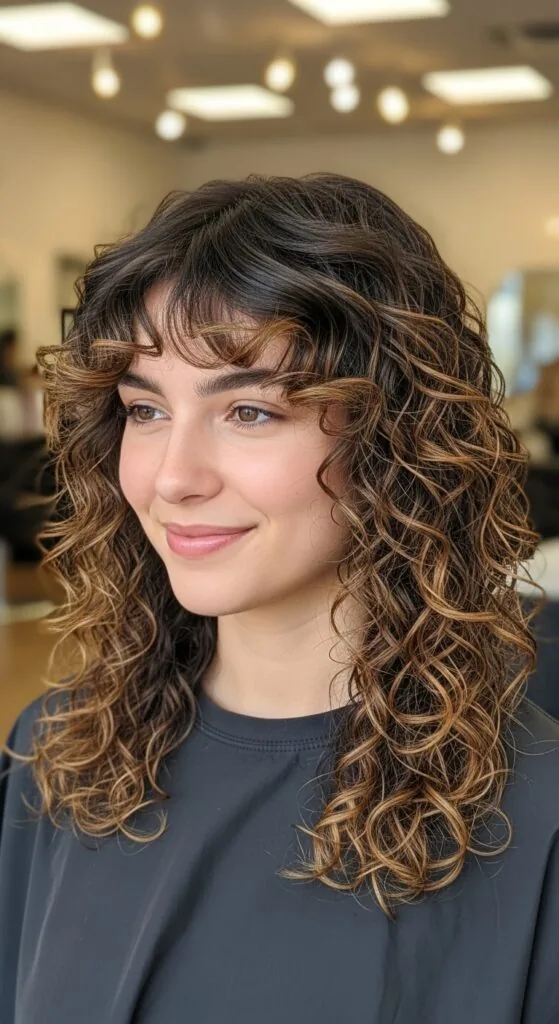
Balayage on curly hair is painted freehand, curl by curl, so the colour follows the pattern of the hair instead of fighting it — and on a curly fringe, that means the lightest pieces land exactly where the curls catch the light. The fringe gets a soft, sun-kissed finish, lighter at the ends and darker at the roots, with no harsh line as it grows out. It is the lowest-maintenance colour there is, because the grow-out is part of the look, and it makes the curls look fuller and more defined, because the eye reads the lighter pieces as depth.
Best for: women who want colour without the upkeep of root touch-ups. How to style: balayage looks best on defined curls, so a good curl cream is part of the routine. What to ask: ask for the colour to be painted on the surface curls of the fringe, not all the way through. Pros: grows out gracefully, adds dimension, and needs a salon visit only every three to four months. Cons: it is a skilled technique, so it costs more than a simple highlight. Maintenance: a colour-safe shampoo and a weekly deep condition keep the colour fresh.
36. Curly Bangs with a Silk Scarf or Headband
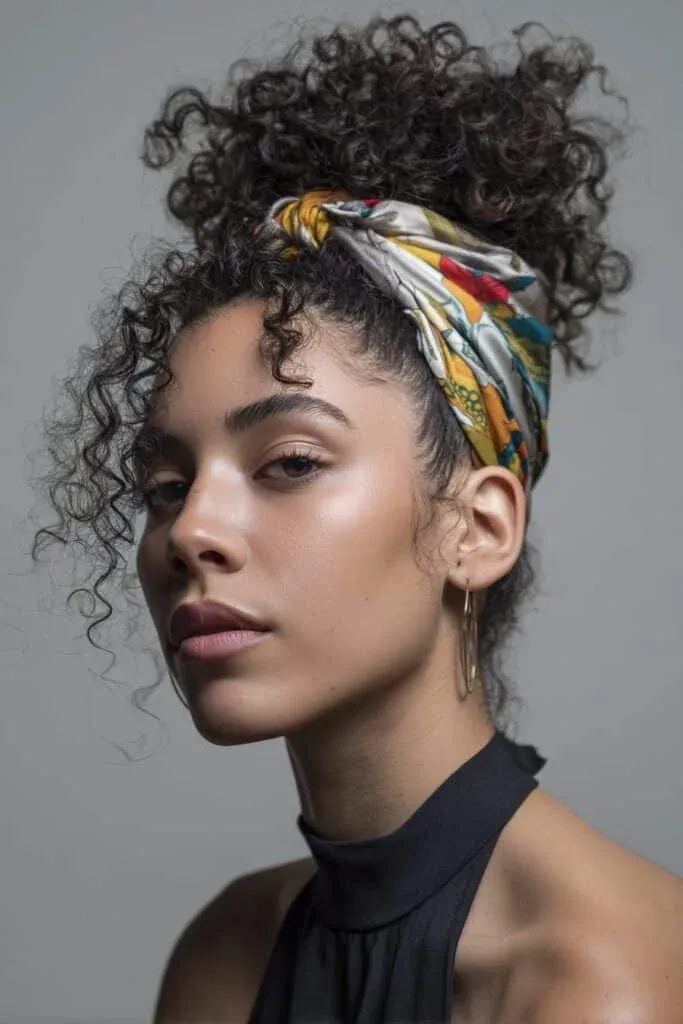
A silk scarf or a headband with curly bangs is the accessory that does two jobs at once: it keeps the hair back and it makes the fringe the star. The scarf sits behind the fringe, pushing the rest of the hair back, and the fringe falls in front of it in soft curls — the contrast between the smooth silk and the textured curls is beautiful, and the look works for a bad hair day, a holiday, or a day when you want to feel a little more dressed up. A wide headband does the same job with less fuss, and a printed scarf adds colour to a simple outfit.
Pros: instant polish, hides a bad hair day, and protects the hairline from breakage. Cons: a scarf that is tied too tightly can flatten the curls at the crown. Maintenance: none — the accessory is the styling. How to style: place the scarf or headband just behind the fringe, never over it. Quick verdict: a silk scarf and a curly fringe is the easiest dressed-up look in this guide.
37. Curly Bangs with Pearl Clips
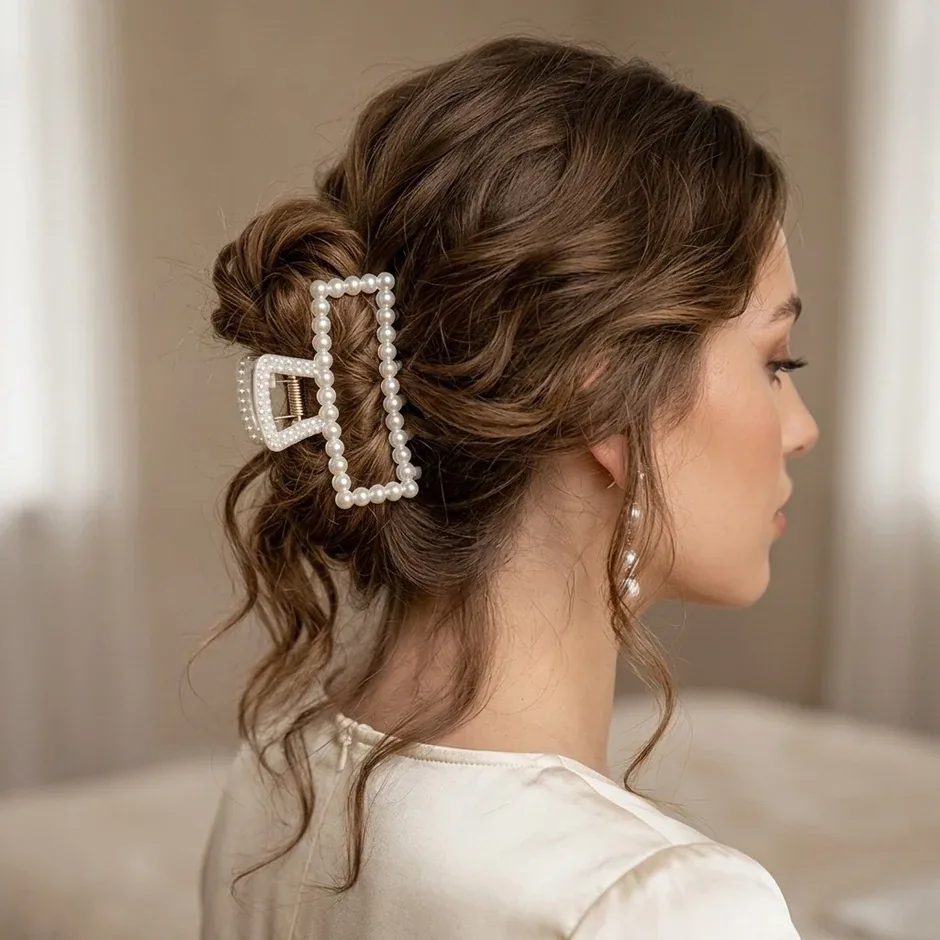
Pearl clips on curly bangs are the small detail that makes a simple style feel special. One pearl clip pinning back a single fringe curl, or a pair of clips holding the sides while the centre fringe falls free, adds a touch of elegance without any effort at all. They work for a wedding, a party, or a day when you want your everyday curls to feel a little more dressed up — and they are the easiest accessory to use, because they simply clip in and stay put. The contrast between the soft curls and the smooth pearls is quietly beautiful.
Best for: weddings, parties, and days when you want a little sparkle. How to style: clip one side of the fringe back and let the rest fall free. What to ask: nothing — this is an accessory choice. Pros: instant elegance, no styling skill needed, and the clips are inexpensive. Cons: heavy clips can slide out of fine curls, so choose lightweight ones. Maintenance: carry a spare clip in your bag. Common mistake: using too many clips at once — one or two is elegant, five is a costume.
38. Curly Bangs for a Wedding Guest
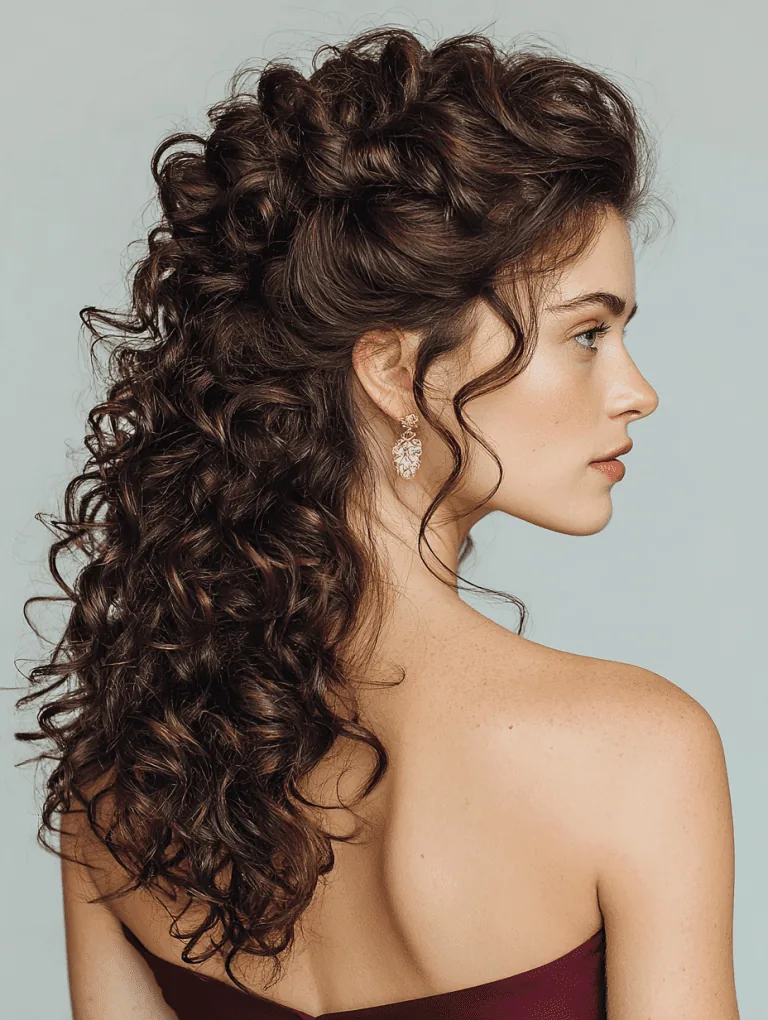
As a wedding guest with curly bangs, you have an advantage: your fringe already gives you a frame, so the rest of the style can be simple and still look finished. A low bun with the fringe falling soft across the forehead, a half-up with curls cascading down, or a braided crown with the fringe out — all of them look elegant, all of them hold through a long day of ceremony, photographs, and dancing, and none of them need a salon appointment. The key is to choose a style that will still look good at midnight, not just at noon.
Pros: elegant, long-lasting, and the fringe does the styling work. Cons: outdoor weddings and humidity can frizz the fringe, so a little gel is worth using. Maintenance: pin the style at four points and carry two spare pins. How to style: style the fringe first, while it is wet, and build the updo around it. Quick verdict: for a wedding, let the fringe be the frame and keep the rest of the style simple.
39. Curly Bangs for the Office

Curly bangs at work are completely professional — the idea that a fringe is not office-appropriate is long out of date. What matters is that the fringe is neat: defined curls, no frizz halo, and a length that stays out of the eyes. A low bun with a curly fringe, a sleek low ponytail with the fringe out, or simply wearing the curls down with a well-shaped fringe all read as polished and professional. The fringe actually helps at work, because it gives the face a frame in video calls, where the camera sees the top half of the head most clearly.
Best for: office days, video calls, and job interviews. How to style: define the fringe with a little gel while wet, and smooth any flyaways with a drop of oil. What to ask: ask your stylist for a fringe length that sits at the eyebrows, so it never falls into your eyes during the day. Pros: polished, professional, and it frames the face on camera. Cons: the fringe needs a quick refresh after lunch, when it can start to frizz. Maintenance: a spritz of water and a drop of cream at midday is all it takes.
40. Curly Bangs for Date Night
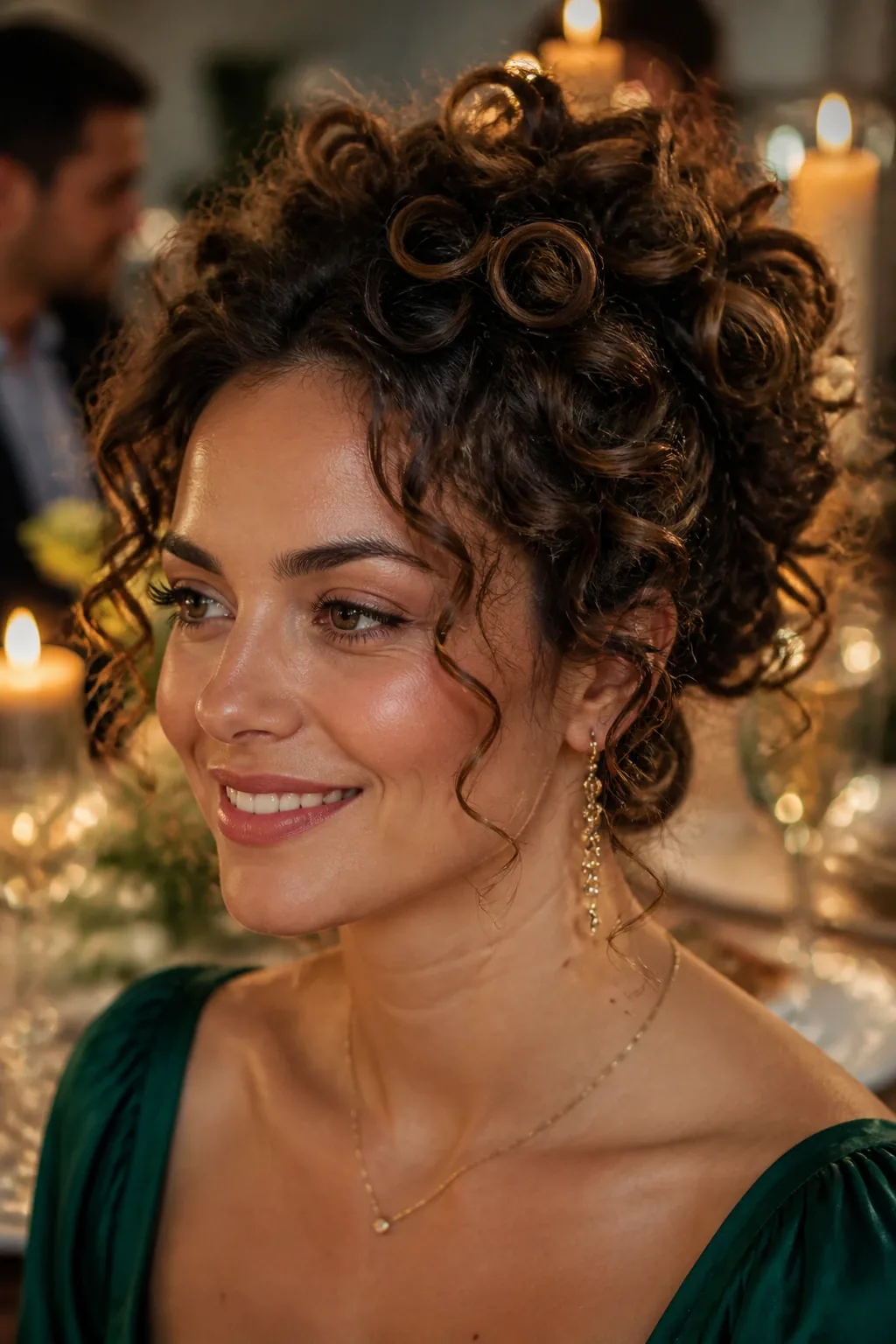
Date night is when curly bangs earn their keep. A fringe frames the eyes, softens the face, and gives the whole look a romantic, touchable quality that no other haircut can match. Wear the curls down with a full fringe, or sweep the hair into a low bun and let the fringe fall free — either way, the fringe is the detail that makes the style feel special. A little shine serum on the surface of the curls catches the candlelight, and a single pearl clip adds just enough sparkle without trying too hard.
Pros: romantic, flattering, and the fringe frames the eyes beautifully. Cons: a fringe that is too long will fall into your eyes over dinner, so keep it at eyebrow length. Maintenance: style the fringe first, while it is wet, and let it dry completely before you leave. How to style: diffuse the fringe for definition, then add a drop of oil for shine. Quick verdict: for date night, let the curls down and let the fringe do the talking.
41. Curly Bangs with 3A Curls
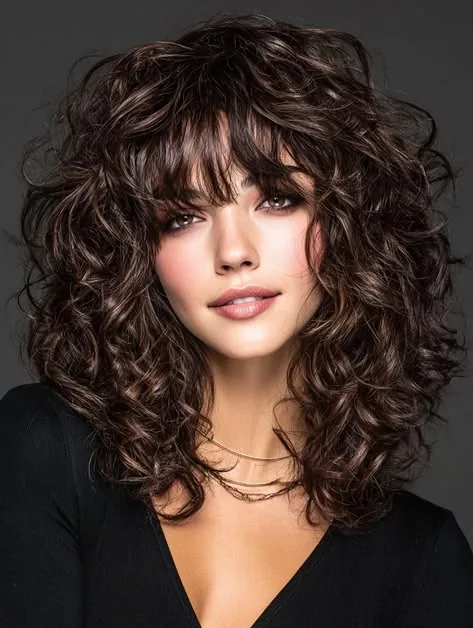
Type 3A curls — loose, springy, S-shaped curls — make one of the easiest curly fringes there is. The curls are defined but not tight, so the fringe falls in soft, bouncy pieces across the forehead with very little shrinkage to plan around. A 3A fringe can be cut a touch shorter than other curl types, because the bounce is gentle, and it styles with almost nothing: a little cream, a scrunch, and air-dry is genuinely enough. It is the fringe for women who want curls that look effortless, because on 3A hair they very nearly are.
Best for: loose curls that want a low-effort fringe. How to style: a pea-sized amount of curl cream, scrunched in while wet, then air-dry. What to ask: ask for a fringe cut dry, at eyebrow length, with the sides left slightly longer. Pros: minimal shrinkage, easy styling, and the fringe grows out gracefully. Cons: 3A curls can fall flat at the roots, so a little mousse at the fringe roots helps. Maintenance: refresh with water and cream on day two.
42. Curly Bangs with 3B and 3C Curls

Types 3B and 3C — springy ringlets and tight corkscrews — make a fringe with real presence. The curls are defined and bouncy, the fringe has volume and shape, and the shrinkage is noticeable enough that the cut must be planned carefully: what looks right wet will spring up by an inch or more when dry. A 3B/3C fringe looks best when it is cut curl by curl, with the centre pieces slightly shorter than the sides, so the fringe has a soft, rounded shape rather than a straight line. The result is a fringe that is full, defined, and unmistakably curly.
Pros: full, defined, and the fringe holds its shape all day. Cons: shrinkage makes the cut unpredictable, so it must be done dry by someone who works with curls. Maintenance: moisturise the fringe daily, because 3B and 3C curls dry out faster than looser types. How to style: a light gel scrunched in while wet, diffused on low heat. Quick verdict: the 3B/3C fringe is the most classically curly fringe in this guide — full, springy, and proud of it.
43. Curly Bangs with 4A Coils
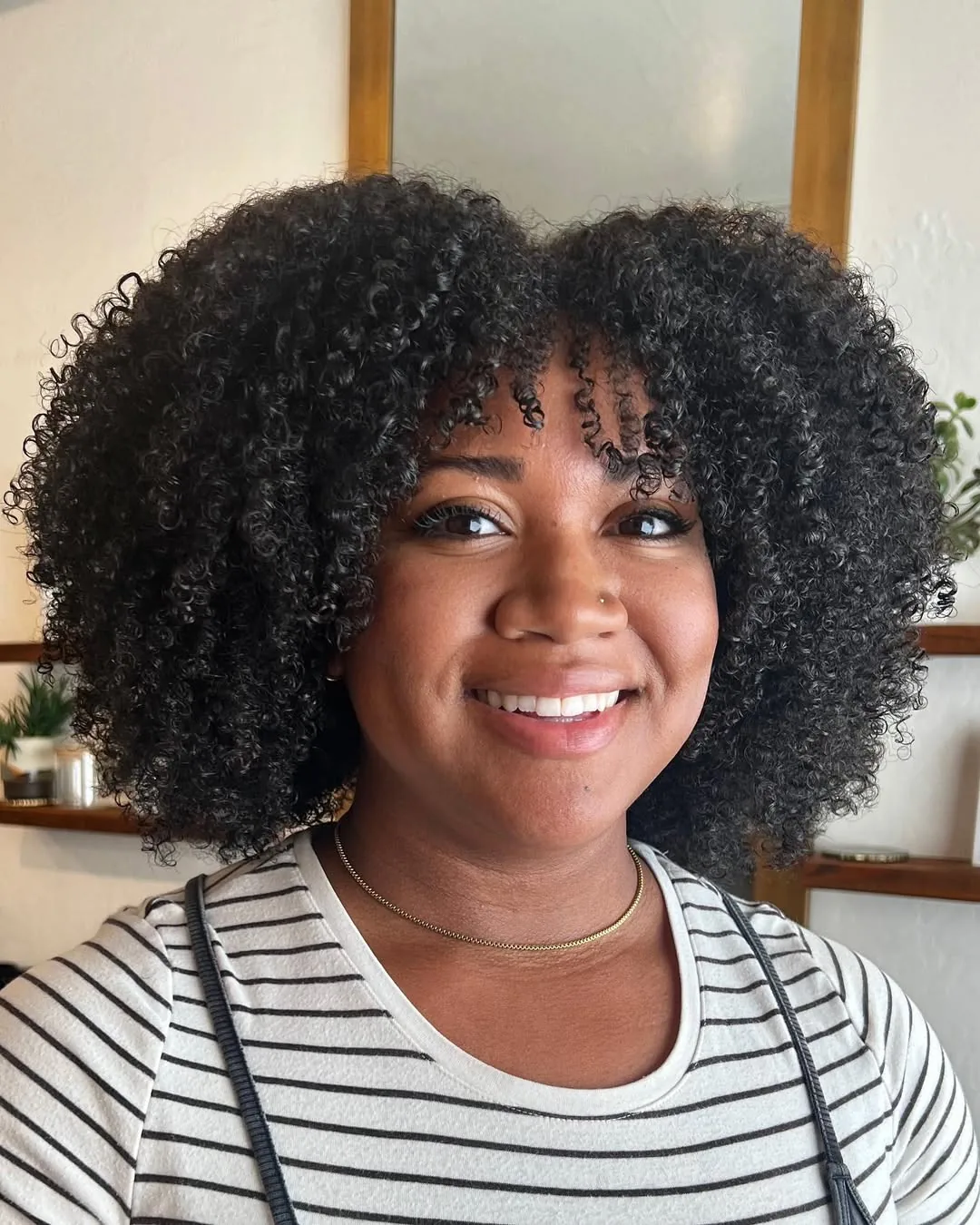
Type 4A coils — small, defined, springy coils — make a fringe that is short, textured, and full of character. The coils shrink more than any other curl type, sometimes by half their length, so the fringe must be cut long and shaped while dry, with each coil trimmed to land exactly where it belongs. When it is done right, the result is beautiful: a soft, rounded fringe of tiny coils that frames the forehead like a natural headband, with a texture that no other hair type can imitate. It is a fringe that needs a specialist, but it rewards the effort.
Best for: coily hair that wants a short, defined fringe. How to style: a leave-in conditioner and a light oil, applied coil by coil while wet. What to ask: ask for a dry cut, coil by coil, and for the fringe to be left longer than you think it needs to be. Pros: striking texture and a fringe that never needs heat. Cons: the most shrinkage of any curl type, so the cut is the hardest to get right. Maintenance: daily moisture is essential — short coils dry out fast.
44. The Grown-Out Curly Bangs Curtain
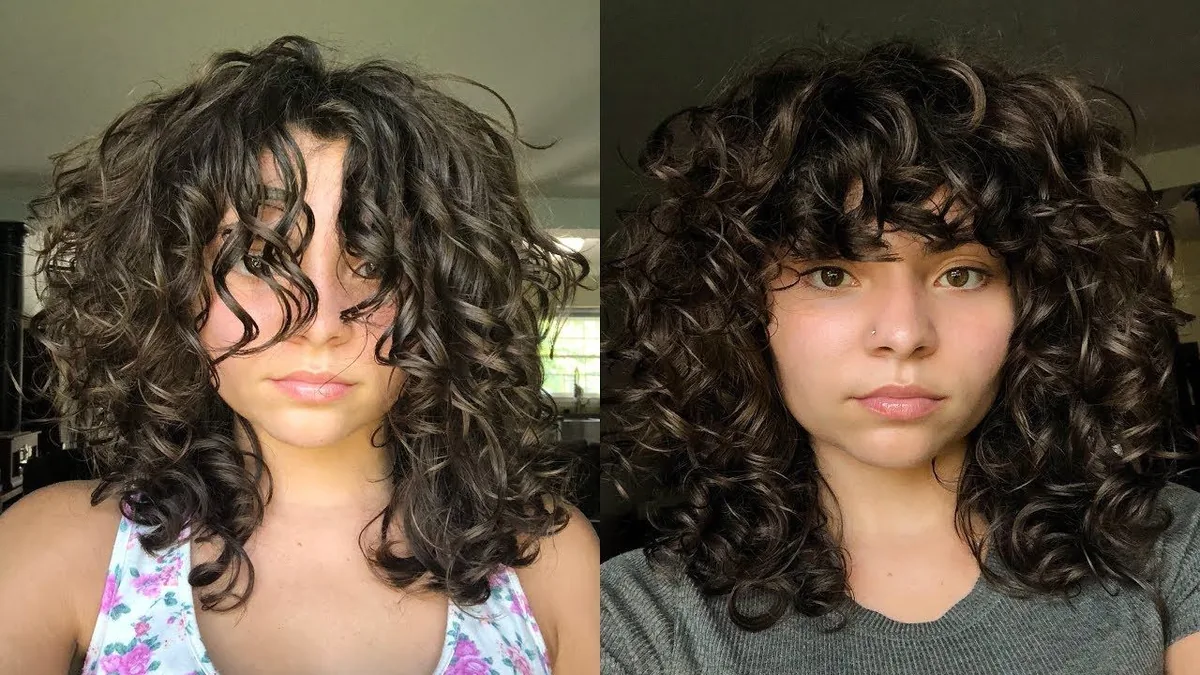
The grown-out curly fringe is not a mistake — it is a style in its own right. When a curly fringe grows past the eyebrows, the curls get heavier and start to fall to the sides on their own, becoming a curtain fringe that frames the face instead of covering the forehead. It is the easiest transition in hair: there is no awkward stage, because the curls disguise the length, and the result is a soft, face-framing layer that works with the hair tied up or worn down. If you have been growing your fringe out and wondering whether to cut it back, this is your sign to let it keep going.
Pros: no awkward stage, works with updos, and it grows out into face-framing layers. Cons: at chin length the fringe can start to flip outward, so a little cream helps it fall smoothly. Maintenance: a dusting of the ends every few months is all it needs. How to style: part it in the middle and let each side fall naturally. Quick verdict: the grown-out fringe is proof that curly bangs never really end — they just become something else.
Do curly bangs work on all curl types?
Yes, curly bangs work on all curl types, from loose 2C waves to tight 4A coils — the fringe just needs to be cut differently for each pattern. Loose curls can take a longer fringe with little shrinkage, while tighter coils need extra length left in to allow for shrinkage as the hair dries. The key is a dry, curl-by-curl cut by a stylist who understands curly hair, and a fringe shape that matches your face. No curl type is excluded; the cut is simply adjusted to the pattern.
How short should curly bangs be cut?
Curly bangs should be cut longer than the finished length you want, because curls shrink as they dry — loose curls by about half an inch, tighter coils by an inch or more. A good rule is to cut the fringe at eyebrow level when dry, leaving it slightly longer at the sides so it blends into the rest of the hair. Always cut curly bangs dry, curl by curl, and trim in small steps rather than cutting to the final length in one go.
How do I stop my curly bangs from frizzing?
Stop curly bangs from frizzing by sealing the curl pattern while the hair is still wet: smooth a light gel or a drop of oil over the surface of the fringe, then do not touch it until it is completely dry. Avoid brushing the fringe dry, which breaks the curl clumps into frizz, and sleep on a silk or satin pillowcase so the fringe does not rub against cotton all night. On humid days, a little extra gel on the fringe is worth it, because the fringe shows frizz more than any other part of the hair.
Can I cut curly bangs at home?
You can trim a single stray curl at home, but you should not cut a whole curly fringe yourself. Work only on dry, styled hair, trim one curl at a time, snip only the very tip, and stop after three curls to check the shape before cutting more. Never cut curly bangs wet, and never cut straight across the whole fringe, because shrinkage and the curl pattern will make the result unpredictable. For the first cut and for reshaping, a salon cut by a curl specialist is worth the cost.
How often should curly bangs be trimmed?
Curly bangs should be trimmed every six to eight weeks to keep their shape, with shorter cuts like pixies needing a trim every four weeks. The fringe grows out of shape faster than the rest of the hair because it is the shortest part, so regular trims matter more here than anywhere else. Between salon visits, a careful DIY dusting of a single stray curl is fine, but a full reshape belongs in the salon.
Do curly bangs suit a round face?
Yes, curly bangs suit a round face very well when the fringe is long and side-swept rather than short and blunt. A side-swept fringe adds a diagonal line that breaks up the width of the face, and longer pieces at the sides draw the eye down toward the chin. Avoid a short, straight-across fringe on a round face, because it cuts the face in half horizontally and can make it look wider. A curtain fringe that parts in the middle is another good option for round faces.
What products should I use on curly bangs?
Use lightweight products on curly bangs: a leave-in milk or a pea-sized amount of curl cream, a light hold gel scrunched in while the hair is wet, and a drop of oil smoothed over the surface once dry. Mousse is excellent for the fringe because it gives hold and volume without weight. Avoid heavy butters, thick pomades, and products with a lot of silicones, which coat the fine fringe curls and pull them flat and stringy.
How do I style curly bangs on non-wash days?
Style curly bangs on non-wash days by refreshing them with a spritz of water and a tiny drop of curl cream, then scrunching gently and letting them air-dry — the whole refresh takes about two minutes. Do not re-wet the whole head; the fringe dries first and misbehaves first, so it is the only part that needs refreshing. If the fringe has flattened overnight, flip your head forward, shake the roots with your fingers, and add a spritz of dry shampoo at the roots.
Will curly bangs grow out awkwardly?
No, curly bangs grow out more gracefully than straight bangs, because the curls disguise the length and the fringe naturally starts to fall to the sides as it grows. As the fringe gets longer, it becomes a curtain fringe, and then a face-framing layer, with no awkward stage in between. To help the transition, part the fringe to the side or in the middle and let the curls fall naturally, and ask your stylist for a light dusting of the ends rather than a full trim.
Are curly bangs high maintenance?
Curly bangs are medium maintenance: they need a trim every six to eight weeks, a quick refresh on non-wash days, and a little product to control frizz, but they do not need daily heat styling the way a straight fringe does. Once the fringe is cut to match your curl pattern, it largely styles itself — the curls fall where they want to fall, and the fringe looks intentional with very little effort. The most important maintenance is the cut itself: a good dry, curl-by-curl cut makes everything else easy.
Conclusion
Curly bangs are not a risk — they are a reward. The 44 hairstyles in this guide all start from the same simple truth: when the fringe is cut to match the curl, it frames the face, softens the features, and gives the whole haircut a shape that no straight fringe can imitate. From a wispy fringe on a bob to a full coil fringe on an afro, from a wash-day routine to a wedding-guest updo, there is a curly fringe here for every curl pattern, every face shape, and every kind of day.
Start with the guides, not the gallery. Learn your curl pattern, find a stylist who cuts curls dry, and choose a fringe shape that fits your face — longer and side-swept for a round face, fuller and brow-length for a long one, soft and wispy for a square one. Then let the curls do what they do best: spring up, soften at the edges, and frame your face in a way that is entirely your own. Your bangs were never the problem. They were the answer all along.