Go Short, Stay Stunning: 38 Short Hairstyles for Women That Prove Less Hair Is More
Going short is not giving up on your hair — it is finally letting it do the talking. A great short cut puts your face, your bone structure and your personality front and centre, with nothing to hide behind. It is the haircut equivalent of walking into a room and not apologising for being there. And the best part? Short hair is honest. It either suits you and your life, or it does not — and when it does, you will wonder why you spent years hiding behind length you never really loved.
This guide brings together 38 short hairstyles for women, from the classic bob and the textured pixie to the French bob, the bixie, the shaggy mullet and the brave, beautiful buzz cut. Eight guides answer the questions that come up before the chop: how to choose a length for your face shape, how to style short hair in five minutes, the myths that stop women going short, how to grow it out without the awkward stage, what upkeep really costs, how short hair works for fine versus thick hair, the colours that make a short cut pop, and exactly what to ask your stylist before the scissors come out. Every cut comes with who it suits best, how to style it, and what to ask for in the chair — so you can book with confidence, not nerves.
Choosing Your Short Length by Face Shape
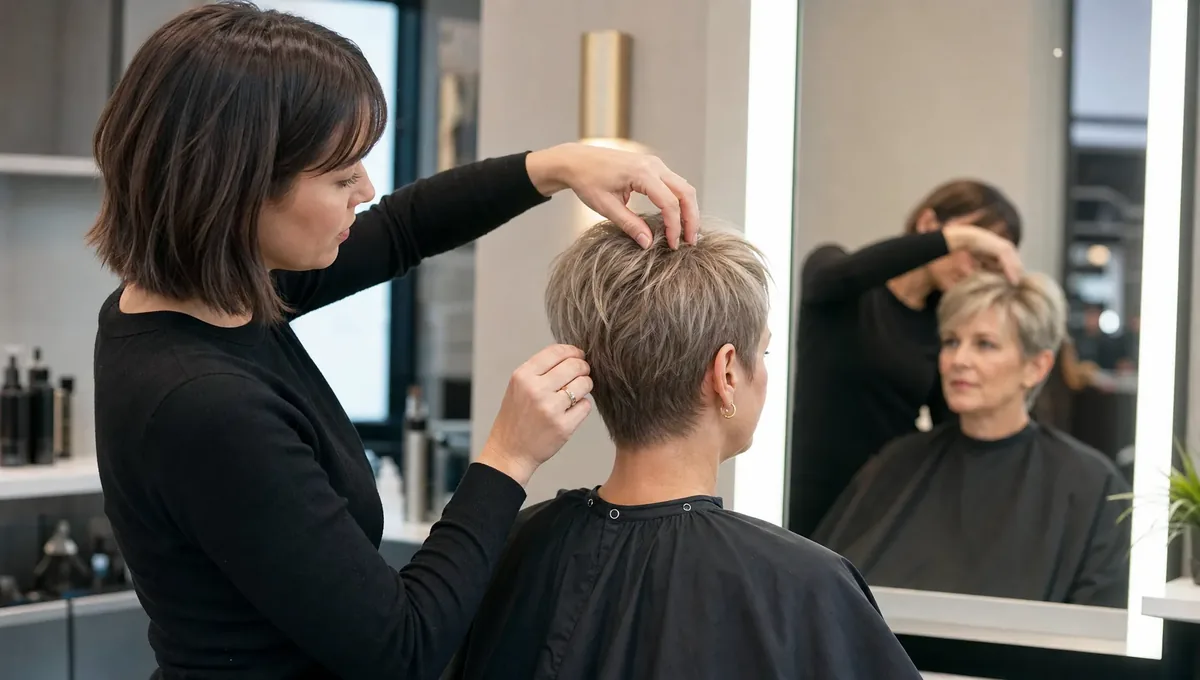
Face shape is the single most useful shortcut when choosing a short cut, because the wrong length can exaggerate what you wanted to soften. Oval faces can wear almost anything short, so the choice comes down to personality and how much styling you will do. Round faces look longer with a pixie that has height on top, a deep side part, or a bob that ends below the chin — all three draw the eye up and down rather than across. Square faces soften with texture at the ends, a side-swept fringe and a part that breaks the jawline’s straight lines. Long faces benefit most from a fringe, width at the cheeks, or a bob that adds fullness where the face is narrow.
Heart-shaped faces suit short cuts with volume at the jaw — a wavy bob, a textured pixie with longer sides, or curls that start at chin level — which balance a wider forehead and a narrower chin. The mistake is treating face-shape advice as law. Your hair texture, your cowlicks and your willingness to style matter just as much as your bone structure, and a confident woman wearing a cut she loves will always look better than a hesitant woman wearing the theoretically correct one. Use face-shape picks as a starting point, try the cut in a consultation, and trust your own eyes in the mirror more than any diagram.
The 5-Minute Short Hair Styling Routine
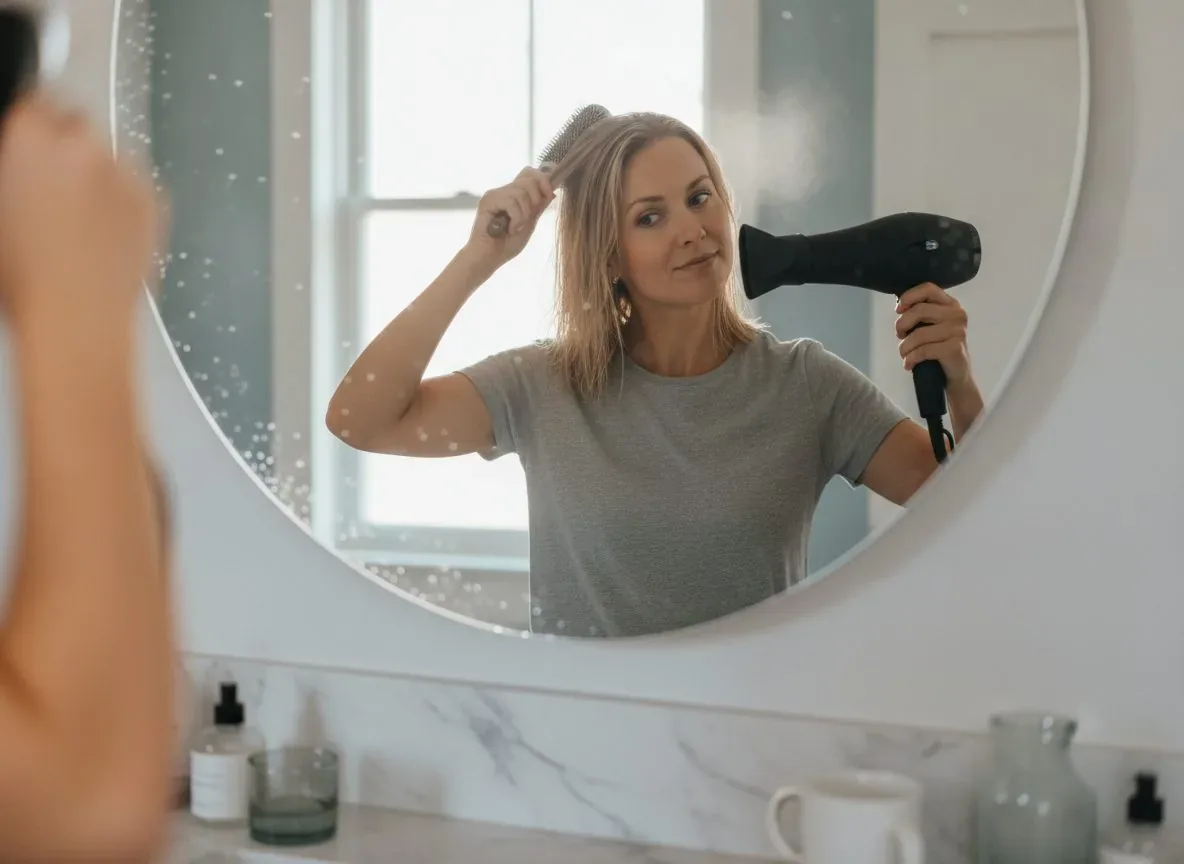
Five minutes is genuinely enough for short hair — that is one of the main reasons women go short and never go back. The secret is a cut with shape built in: layers that fall into place, a fringe that behaves, and ends that bend rather than stick out. Start with damp hair and a pea-sized amount of styling cream or mousse worked through the roots. Rough-dry with your fingers, pushing the roots up for lift and the front pieces in the direction you want them to fall. Then spend one minute on the details: smooth the fringe with a flat iron, pinch the ends with a little wax for definition, and you are done.
The time-wasters to cut are the ones that feel productive but are not: blow-drying section by section when your hair is already layered, curling the back of your head that nobody sees, and re-straightening hair that was fine ten minutes ago. Keep a small bottle of dry shampoo, a texture spray and a couple of bobby pins in your bag and you have a second-day plan too. A slicked-back look, a deep side part or a sweep of texture spray takes under a minute and looks deliberate if the front pieces are smooth. The goal is not a perfect blowout every morning. It is hair that looks intentional in five minutes, and a cut that forgives the mornings when you only have two.
Short Hair Myths, Debunked
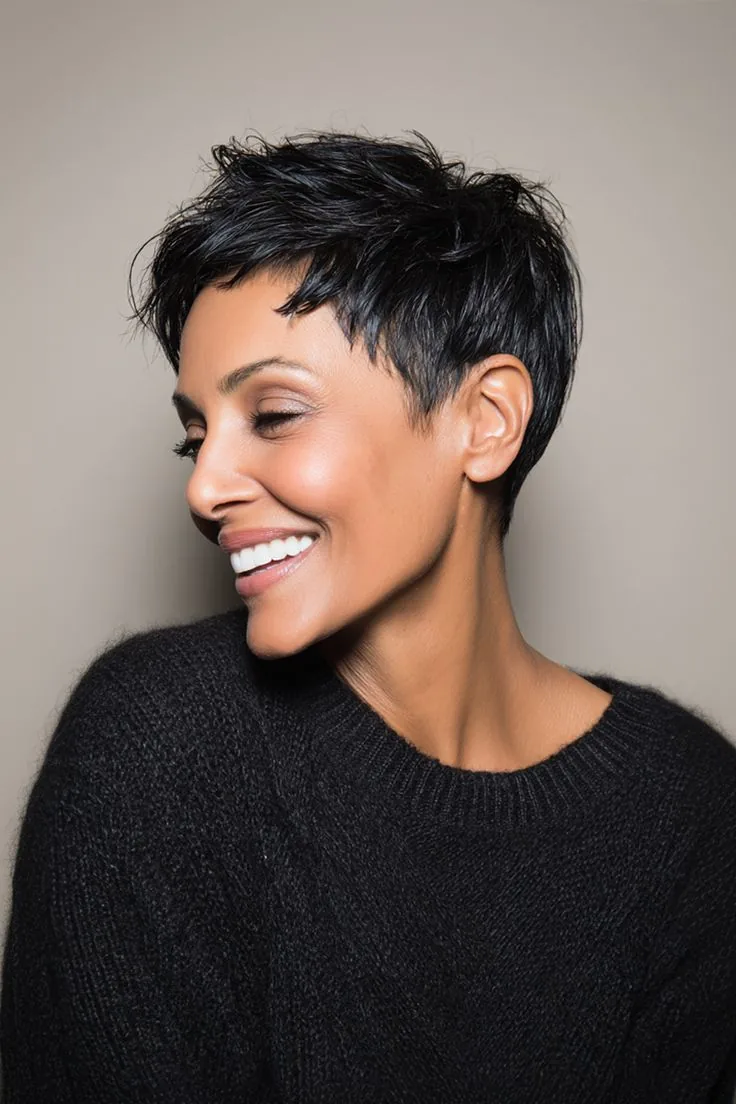
The biggest myth about short hair is that it is less feminine — as if femininity lives in length rather than in the woman wearing the cut. Short hair has been worn by some of the most striking women in history, from Audrey Hepburn’s pixie to Halle Berry’s crop, and it reads as confident, not masculine. The second myth is that short hair is always easier. It is faster to wash and dry, yes, but it needs more frequent trims and it will not hide behind a ponytail on a bad day. The third myth is that short hair suits only one face shape or one age. In reality, there is a short cut for every face shape and every decade — the trick is picking the right one, not avoiding short hair altogether.
Another myth worth retiring is that short hair cannot be styled for formal occasions. A sleek bob, a slicked-back pixie or a finger-waved crop looks every bit as elegant as an updo, and it photographs beautifully because the face is fully visible. And no, short hair does not mean you can never have long hair again — it grows, usually around half an inch a month, and a good grow-out plan keeps it looking deliberate at every stage. The only myth with a grain of truth is that a bad short cut is harder to hide than a bad long cut. That is exactly why the consultation matters: bring photos, be honest about your routine, and choose a stylist who cuts short hair every day.
Growing Out Short Hair Without the Awkward Stage
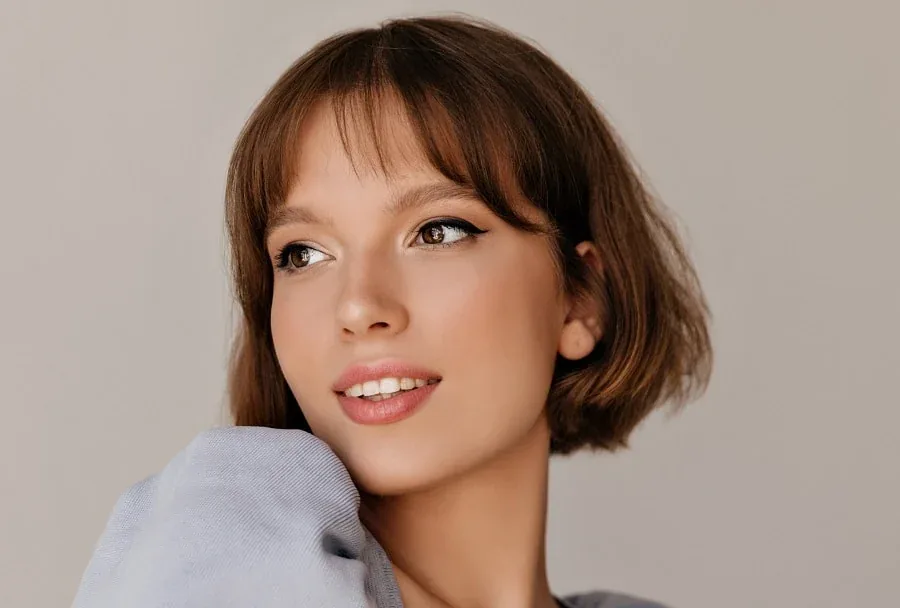
Every short cut eventually grows out, and the awkward stage — that in-between length where nothing sits right — is avoidable with a plan. The rule is simple: grow in stages, not all at once. Let the top grow while keeping the back and sides trimmed into a shape, then let the sides catch up, then the back. Each stage has its own style: a growing pixie becomes a bixie, a bixie becomes a short bob, a short bob becomes a lob. Booking a tidy-up every six weeks keeps each stage looking like a deliberate cut rather than a grow-out accident.
The practical tricks help as much as the trims. A headband, a scarf or a couple of clips can tame the pieces that stick out at ear level, and a little texture spray makes uneven lengths look intentional. Change your parting — a deep side part hides a multitude of growing pains — and lean on accessories while the fringe grows past your eyes. Resist the urge to cut it all off again in frustration at month three, which is usually the hardest point. By month five or six, most grow-outs have reached a bob, and from there the length comes quickly. Growing out short hair is a project, not a punishment, and a stylist who maps the stages with you makes all the difference.
Short Hair Upkeep: Trims, Cost and Time
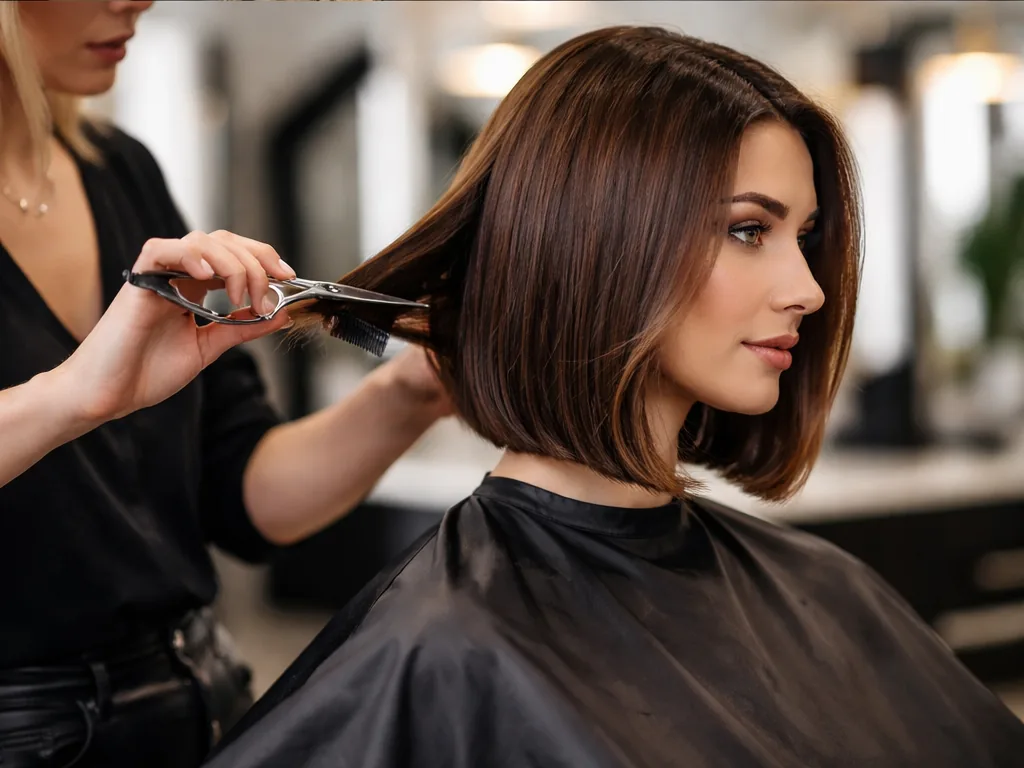
Short hair is cheaper in products and faster in the morning, but it is more demanding at the salon — and honesty about that trade-off saves disappointment. A pixie needs a trim every four to five weeks to keep its shape, a bob every six to eight weeks, and a short shag somewhere in between. Skip a trim and a pixie turns shaggy fast, while a bob loses its line and starts flipping out at the ends. Budget for those appointments the way you would budget for a gym membership: it is a regular commitment, not a one-off expense. The good news is that a short cut uses far less shampoo, conditioner and styling product, and many salons charge less for a short cut than for long hair.
The daily time saving is real. Most women with short hair wash and style in under ten minutes, compared with twenty or more for long hair, which adds up to hours every month. The cost picture depends on where you live and how often you colour: a cut-only pixie routine can be surprisingly affordable, while a pixie with regular bleach or vivid colour costs more in upkeep. Ask your stylist for the honest maintenance schedule before you commit — how often, how much, and what you can do at home between visits. A fringe trim is often free between cuts at many salons, so ask. Short hair rewards consistency: small, regular trims keep it looking expensive, while neglect shows faster than it ever did on long hair.
Short Hair for Fine Hair vs Thick Hair
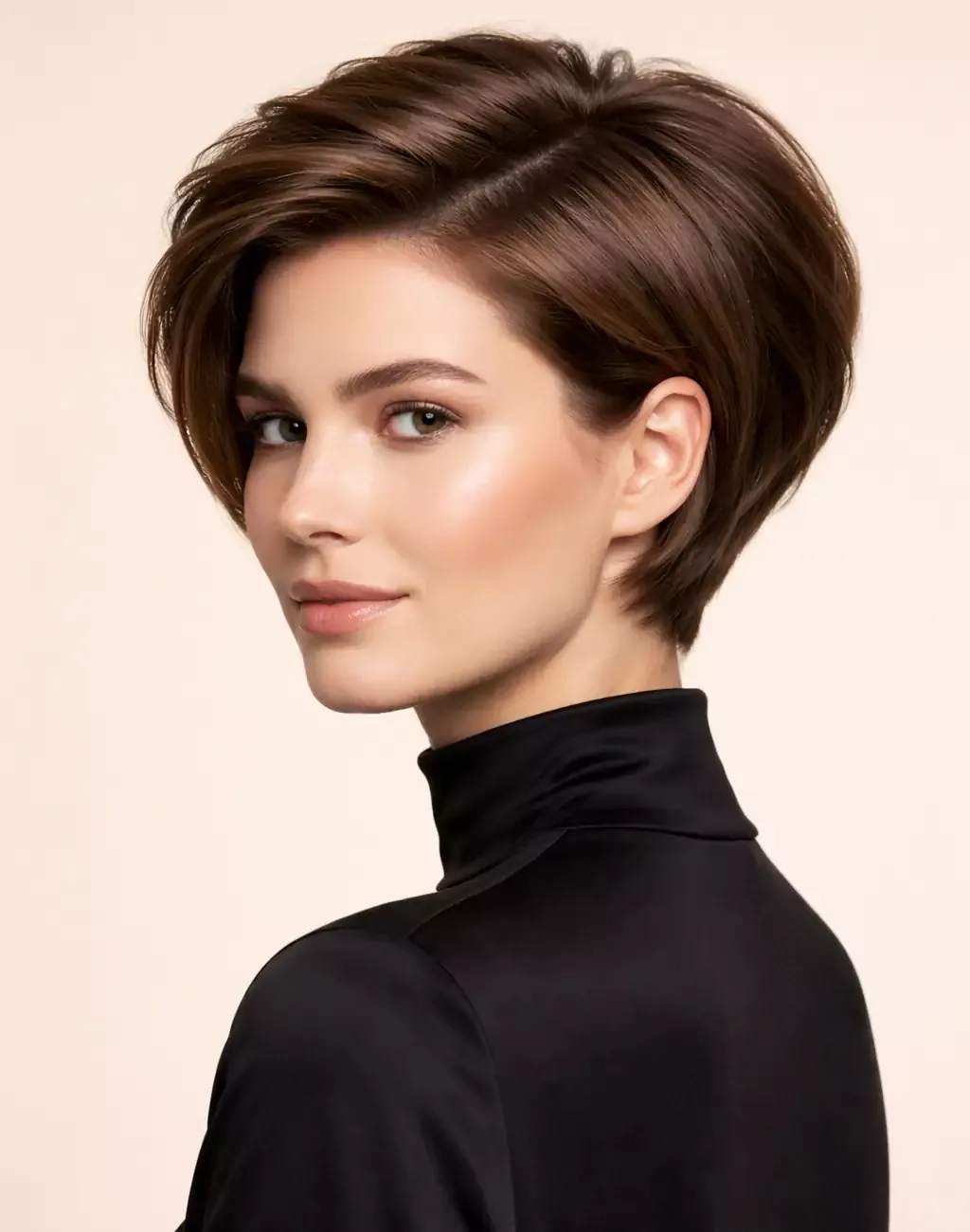
Short hair behaves very differently depending on whether your hair is fine or thick, and the cut should be chosen accordingly. Fine hair loves short cuts: a blunt bob, a textured pixie or a short crop makes fine hair look fuller, because short, solid ends stack up and create the illusion of density. The enemy of fine short hair is too many short layers, which thin the ends further, and heavy products that flatten the roots. A volumising mousse at the roots, a deep side part and a little dry shampoo are the fine-hair short cut’s best friends.
Thick hair needs the opposite approach: weight removal. A thick-haired pixie or bob without thinning will puff out into a triangle, so ask for internal layers, point-cutting or a little undercutting at the nape to take the bulk out without losing the shape. Thick hair holds texture beautifully, so choppy layers, a shaggy finish or a tousled pixie all work well — the hair’s own weight and body do half the styling. The mistake to avoid is cutting thick hair too short at the sides without thinning the top, which leaves a mushroom shape. Tell your stylist your hair’s real density, not the density you wish you had, and let them thin, layer or undercut accordingly. Both hair types can look wonderful short — they just need opposite techniques.
Colour Pairings That Make Short Hair Pop
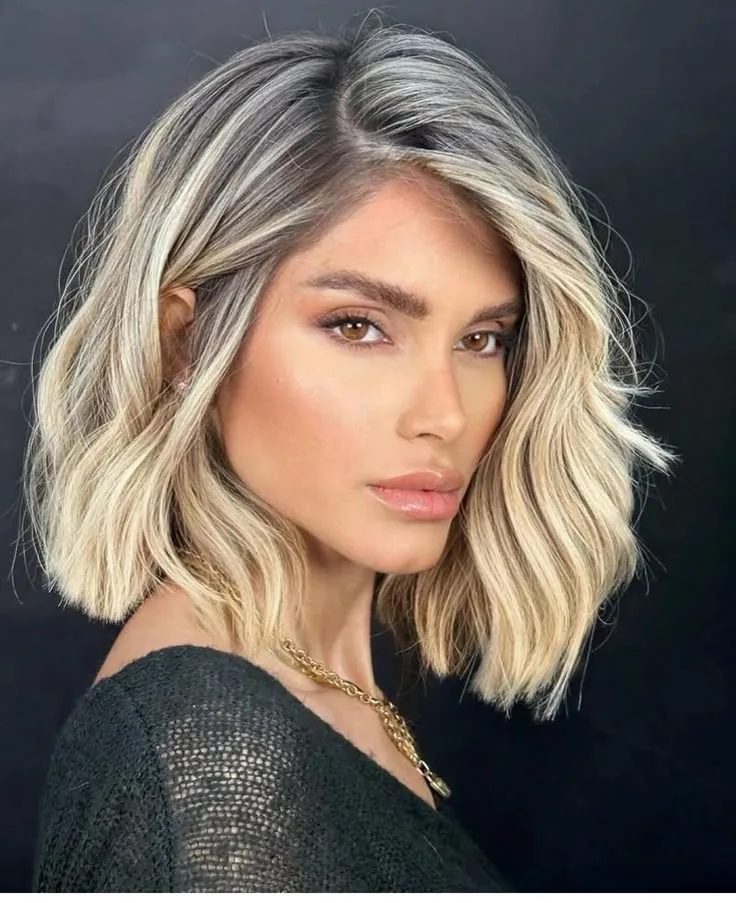
Short hair is a smaller canvas, which makes colour more powerful — a little goes a long way, and the wrong shade shows faster. Dimensional colour is the safest win: a soft balayage, a few face-framing highlights or a gloss adds depth and movement that a flat, single-process colour cannot. On a pixie, a lighter top with darker sides creates the illusion of height and texture. On a bob, balayage through the ends makes the cut look thicker and the waves more defined. Warm tones — honey, copper, caramel — flatter most skin tones and grow out more gracefully than ash or platinum, which need frequent toning.
Bold colour is where short hair really shines, because the commitment is smaller and the grow-out is faster. A vivid copper pixie, a platinum buzz cut or a cherry-red bob makes a statement that would feel overwhelming on long hair but looks deliberate and chic when short. If you are colouring for the first time, start with a gloss or a few highlights rather than a full bleach, and ask your stylist how often the colour will need refreshing — platinum needs a toner every four to six weeks, while balayage can go three months. Whatever you choose, keep the colour and the cut in conversation: a great short cut with flat colour looks unfinished, while a simple cut with beautiful colour looks intentional.
What to Ask Before the Chop
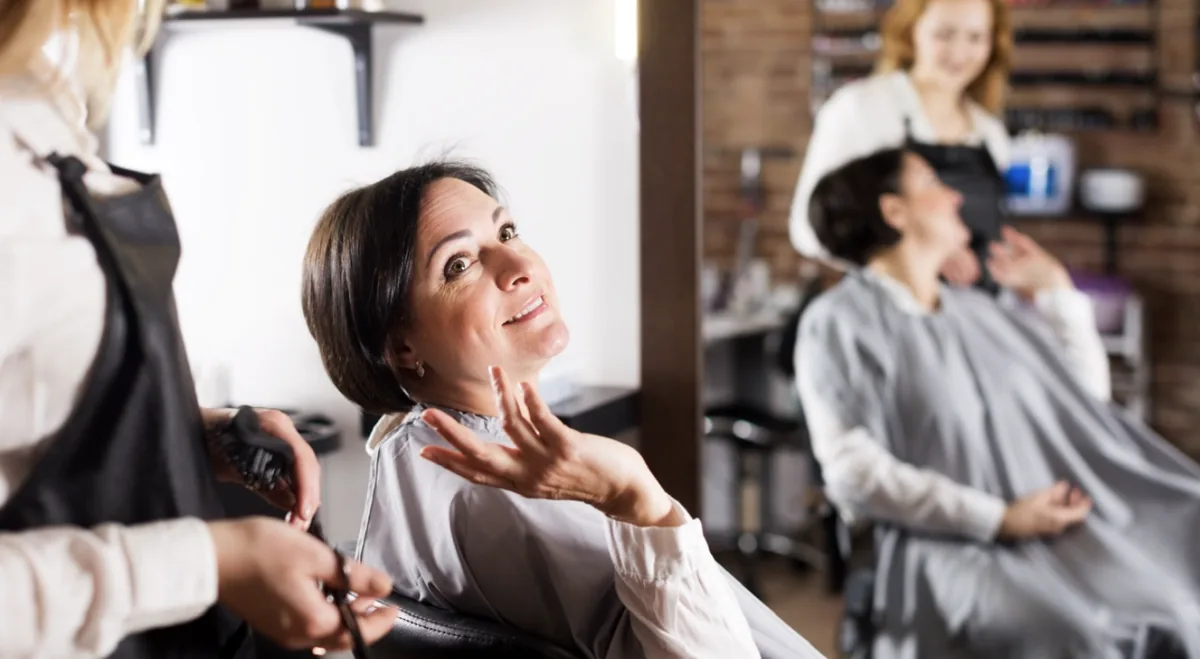
The consultation is the most important ten minutes of a short haircut, because short hair leaves little room to hide a misunderstanding. Bring photos — not one, but three: the cut you want, a cut you definitely do not want, and a photo of your own hair on a good day. Ask your stylist how the cut will look air-dried, because that is how you will wear it most days, and how it will grow out, because a cut that grows badly is a cut you will regret by week five. Ask how often you will need trims and what the maintenance really costs, including colour if you are changing that too.
Be honest about your routine in a way you might not be with long hair. Tell your stylist how many minutes you will actually spend styling on a normal morning, whether you own a flat iron or a round brush, and whether you will use product at all. Say what you do not want as well as what you do — “no fringe that falls in my eyes” or “nothing I have to curl every day” is more useful than a vague “make it look nice.” And ask the question most women forget: what happens if I hate it? A good stylist will tell you the honest grow-out timeline and the tricks that get you through the first two weeks, when every short cut feels strange simply because it is new. Then take a breath, and let them cut.
1. The Classic Bob
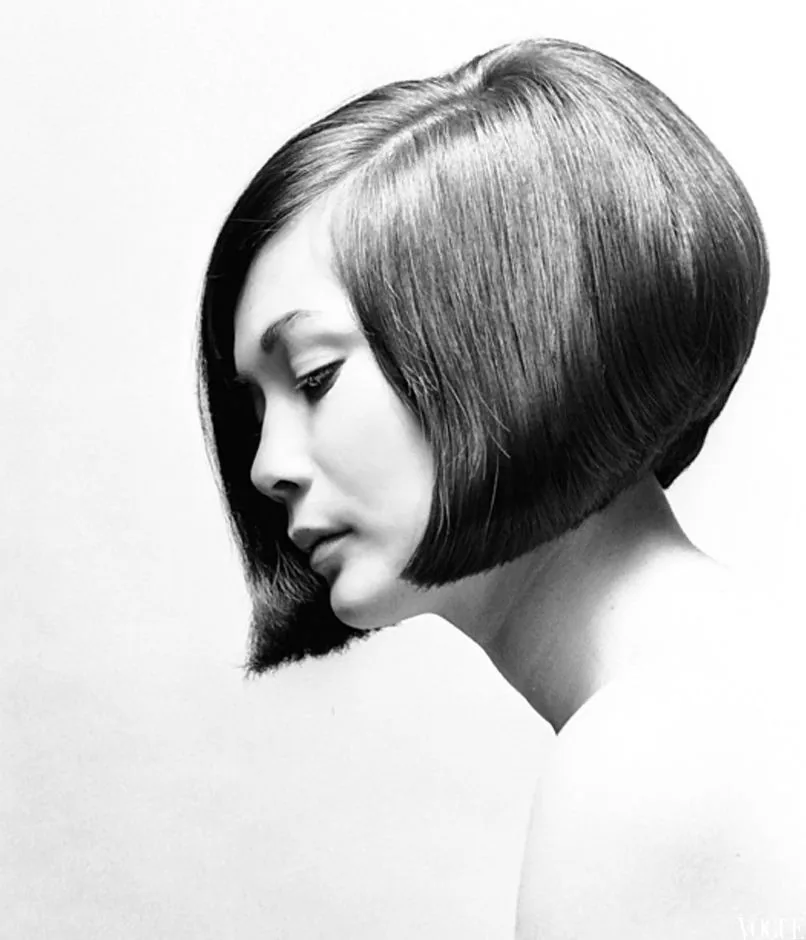
The classic bob is the cut every other short style is measured against: chin-length, one length all round, with a clean line and a gentle curve under at the ends. It has survived a hundred years of trends because it does something no other cut does — it frames the face perfectly while looking polished with almost no effort. The modern version is softer than the severe bobs of the past, with a little texture at the ends and a part that can move from centre to side depending on your mood. Best for: oval and heart-shaped faces, straight to slightly wavy hair, and anyone who wants a short cut that still reads elegant in a boardroom or at a wedding.
How to style it: blow-dry with a round brush, turning the ends under, then finish with a drop of shine serum — five minutes, no curling iron required. On second days, a little dry shampoo at the roots and a quick pass with a flat iron on the front pieces is enough. What to ask your stylist: a chin-length bob with the back a touch shorter than the front, ends point-cut rather than razor-sharp if your hair is fine, and a trim every six weeks to keep the line clean. Avoid asking for layers through the body of the cut — the classic bob’s power is in its solid, clean line.
2. The Textured Pixie
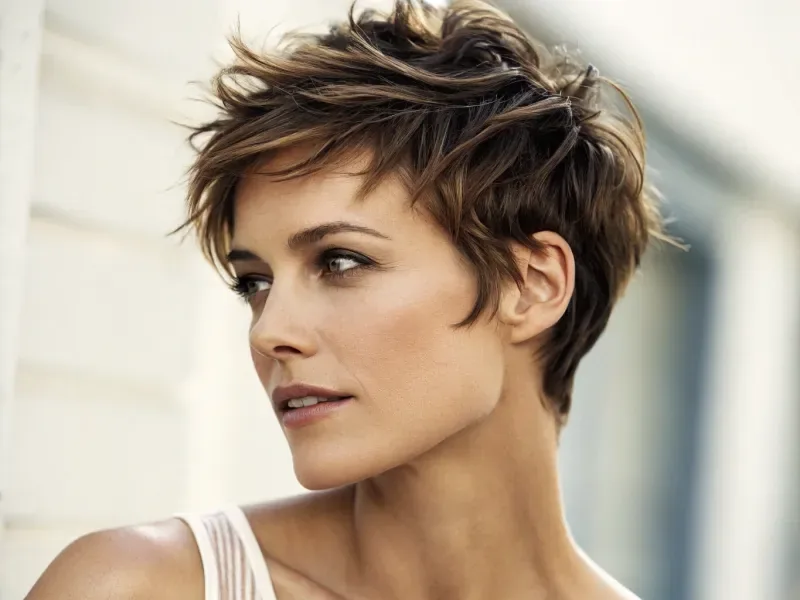
The textured pixie is short hair with a pulse: cropped at the back and sides, longer and piecey on top, with layers that move instead of sitting flat. It is the pixie for women who want edge without severity, and it suits far more faces than the slicked-back pixies of old because the texture softens everything. The cut works with your hair’s natural movement rather than fighting it, which is why it looks good even on mornings when you do nothing at all. Best for: oval, heart and square faces, straight to wavy hair with some natural texture, and anyone who wants a wash-and-go cut that still looks styled.
How to style it: work a pea-sized amount of matte paste or wax through damp hair, rough-dry with your fingers, then pinch individual pieces at the crown for definition — three minutes from towel to done. A little texture spray adds grip on fine hair. What to ask your stylist: length left on top for styling options, point-cut texture through the crown, and a tapered nape rather than a blunt one. Mention if you want to be able to sweep it to one side — that needs extra length at the front, so say so before the scissors come out.
3. The French Bob
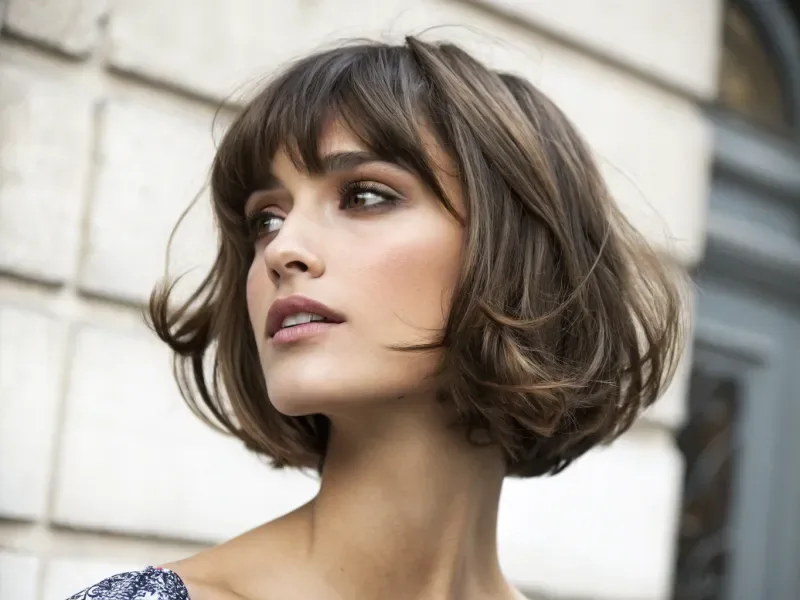
The French bob is the chicest short cut in this guide and the easiest to spot: jaw-length, usually with a soft fringe, and worn with a deliberately undone, slightly messy finish. It is the haircut equivalent of a red lip and a striped shirt — effortless on the surface, carefully considered underneath. The fringe sits at brow level, the ends are textured rather than blunt, and the whole cut is designed to look better slightly imperfect, which makes it wonderfully forgiving in real life. Best for: oval and long faces, fine to medium hair, and anyone who wants a short cut with instant Parisian polish.
How to style it: air-dry or rough-dry, then bend the ends under with a flat iron in two or three places — do not curl the whole head, the French bob needs unevenness to look right. A spritz of texture spray and a shake of the head finishes it. What to ask your stylist: jaw-length with a soft, brow-skimming fringe, ends that are point-cut for movement, and no heavy layering through the body. Warn them if you have a strong cowlick at the hairline, because a French fringe needs to sit flat — your stylist may adjust the fringe length to work with it.
4. The Long Pixie with a Side-Swept Fringe
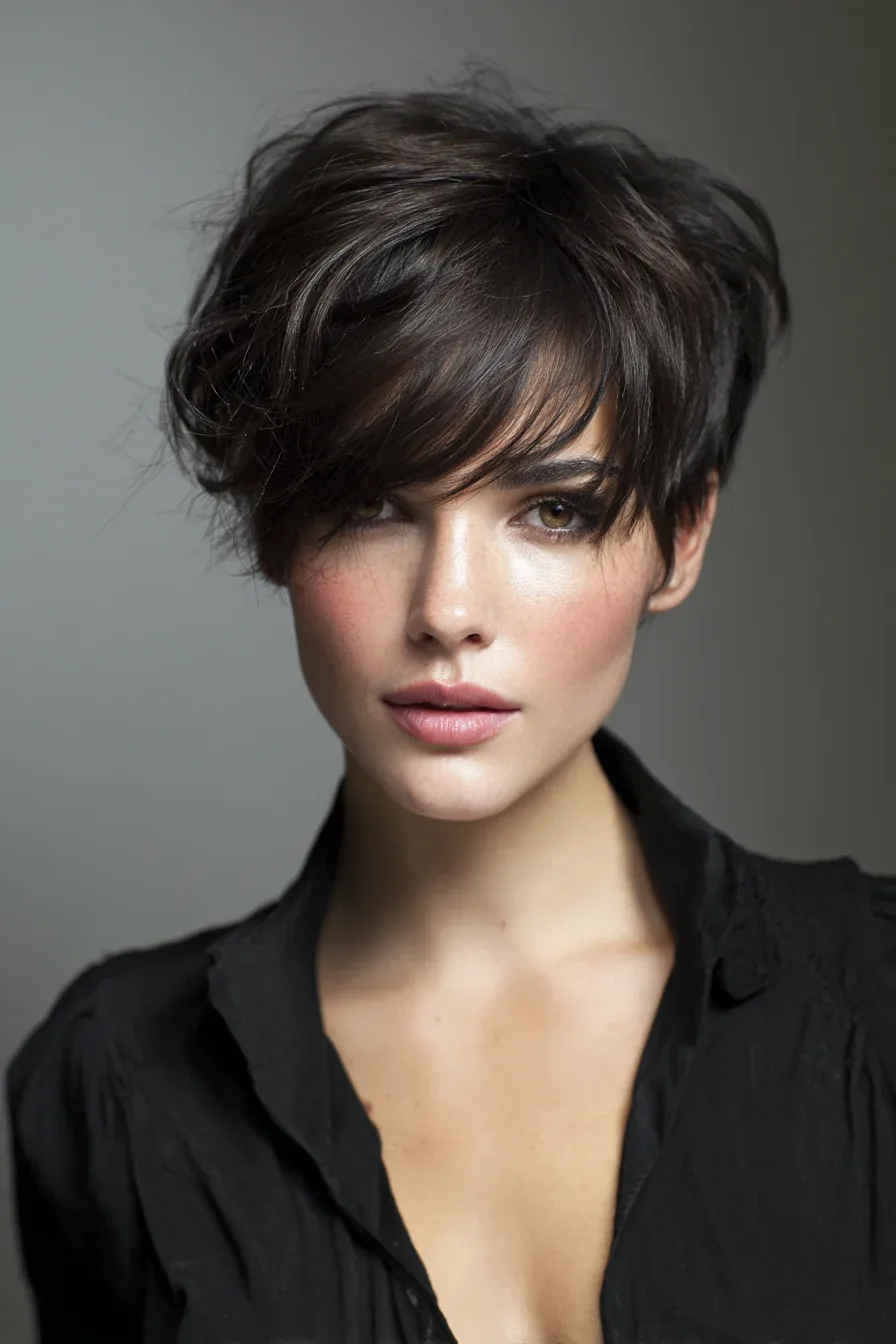
The long pixie is the gentle way into short hair: cropped at the back, but with enough length on top to sweep across the forehead in a soft, side-swept fringe. It keeps the drama of a pixie — the exposed neck, the visible cheekbones — while giving you styling options a shorter pixie cannot, from a deep side part to a tucked-behind-the-ear look. It is also the most forgiving pixie during grow-out, because the top is already long enough to blend. Best for: round and square faces, which benefit from the diagonal line of the fringe, and anyone nervous about going very short for the first time.
How to style it: blow-dry the fringe across the forehead with a small round brush, then smooth the crown with your fingers and a little cream. For evenings, sweep it deeper to one side and pin the shorter side back for an asymmetrical look. What to ask your stylist: keep the fringe long enough to tuck behind the ear, taper the nape close, and leave weight at the crown so the fringe has something to fall from. Ask for a fringe trim schedule — a long pixie fringe needs a tidy-up every four weeks or it starts falling in your eyes.
5. The Asymmetrical Bob
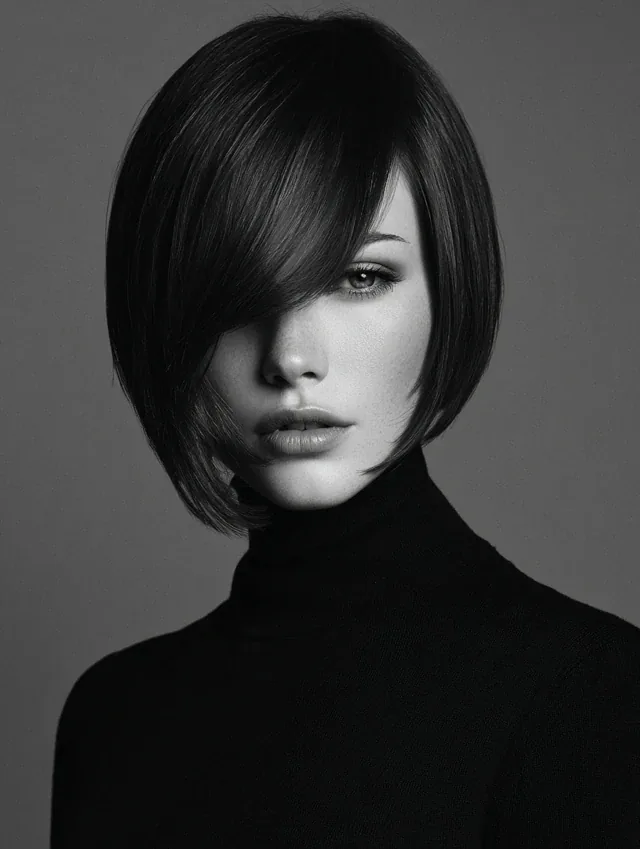
The asymmetrical bob is a classic bob with a twist — literally. One side is cut noticeably longer than the other, usually by an inch or two, creating a diagonal line that draws the eye across the face and gives the whole cut a modern, architectural feel. It is bold without being extreme, and it photographs beautifully because the asymmetry creates instant visual interest. The longer side can be tucked behind the ear or left to swing free, giving you two looks from one cut. Best for: oval and round faces, straight hair that shows the line cleanly, and anyone who wants a short cut with a fashion edge.
How to style it: straighten the longer side for a sharp, graphic finish, or add a soft bend to both sides for a softer take — either way, keep the parting deep on the shorter side so the asymmetry reads clearly. A shine spray makes the line look expensive. What to ask your stylist: how much difference you want between the sides (one inch is subtle, two inches is a statement), and whether the back should be stacked or one-length. Be clear about which side you want longer — it should be the side you naturally part away from, so the length falls where you can see it.
6. The Curly Pixie
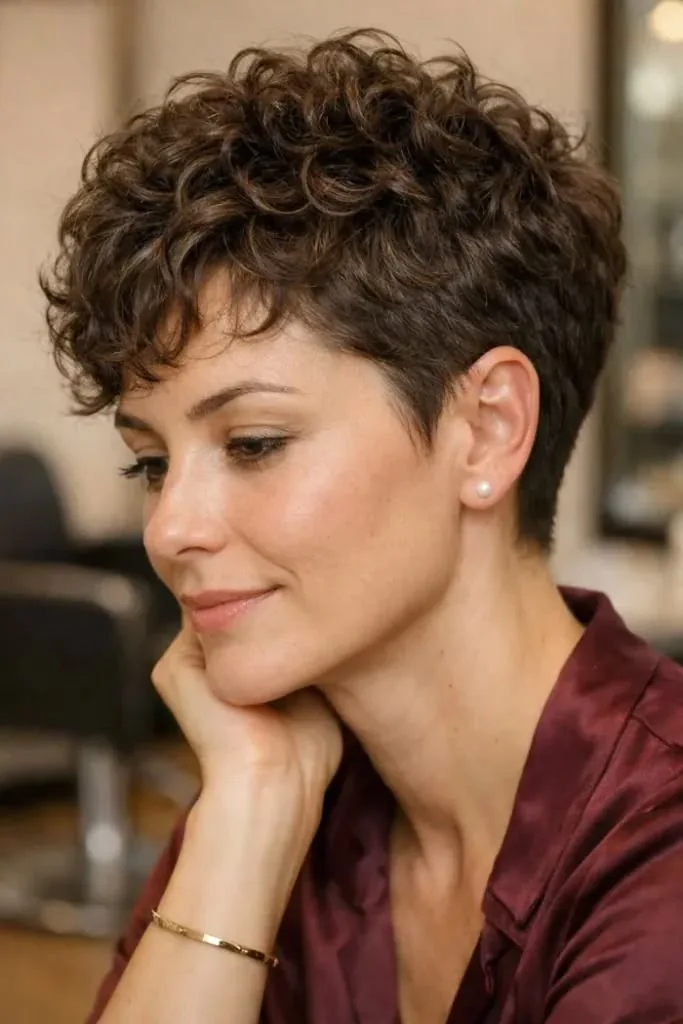
The curly pixie lets natural curls be the star: short at the back and sides, with curls left long enough on top to spring, coil and catch the light. It is one of the most joyful short cuts, because the texture does all the work — no heat styling, no round brush, just curls doing what curls do. The key is a cut that respects the curl pattern rather than fighting it, with length left where the curls need room to form and weight removed where they would otherwise puff out. Best for: naturally curly and wavy hair, oval and heart-shaped faces, and anyone who wants to stop straightening and start celebrating their texture.
How to style it: apply curl cream to soaking-wet hair, scrunch gently, and either air-dry or diffuse on low heat — never brush it dry, or the curls turn to frizz. A little curl-refreshing spray revives second-day curls. What to ask your stylist: a dry cut or a curl-by-curl cut, which respects how each curl falls, and length left on top for the curls to form properly. Ask them to thin the bulk at the sides if your curls are dense, and confirm how much length the curls will lose when they spring up — curly hair cut wet looks much longer than it dries.
7. The Blunt Bob
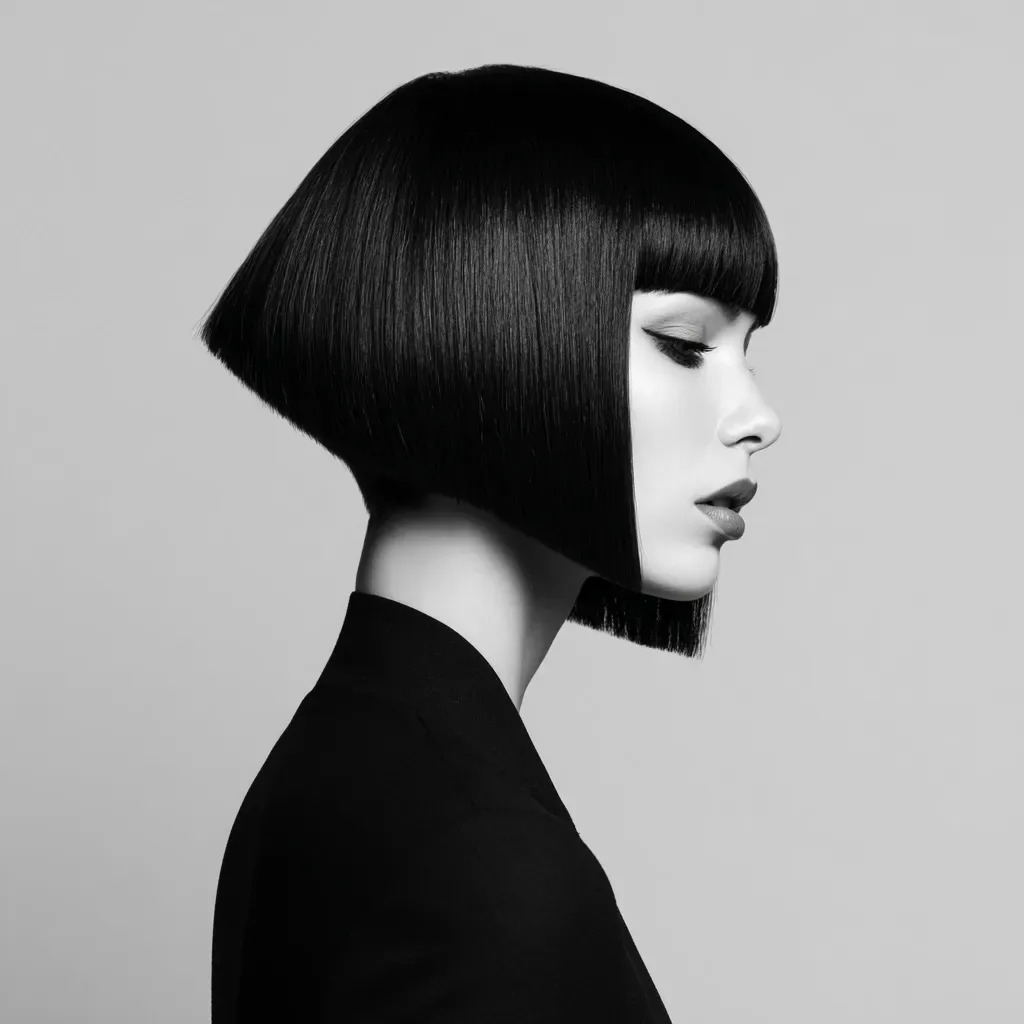
The blunt bob is the sharpest tool in the short-hair box: one length, no layers, ends cut dead straight, usually at jaw or chin level. It looks expensive because it is uncompromising — the clean line makes even fine hair look thick, and the geometry flatters the jawline like a well-cut jacket. It is the cut of choice for women who want their hair to look deliberate and polished with minimal daily effort, and it suits straight hair best, where the line can really show. Best for: fine to medium straight hair, oval and heart-shaped faces, and anyone who wants maximum impact from minimum styling.
How to style it: blow-dry straight with a paddle brush, or flat-iron the ends under for a crisp finish, then add a drop of shine serum. The whole routine takes five minutes — the cut does the rest. What to ask your stylist: a truly one-length cut with no hidden layers, ends cut blunt with scissors rather than a razor, and a length that hits at the jaw or chin rather than in between. Ask for a trim every five to six weeks, because a blunt bob loses its edge the moment the ends start to split or flip.
8. The Layered Pixie
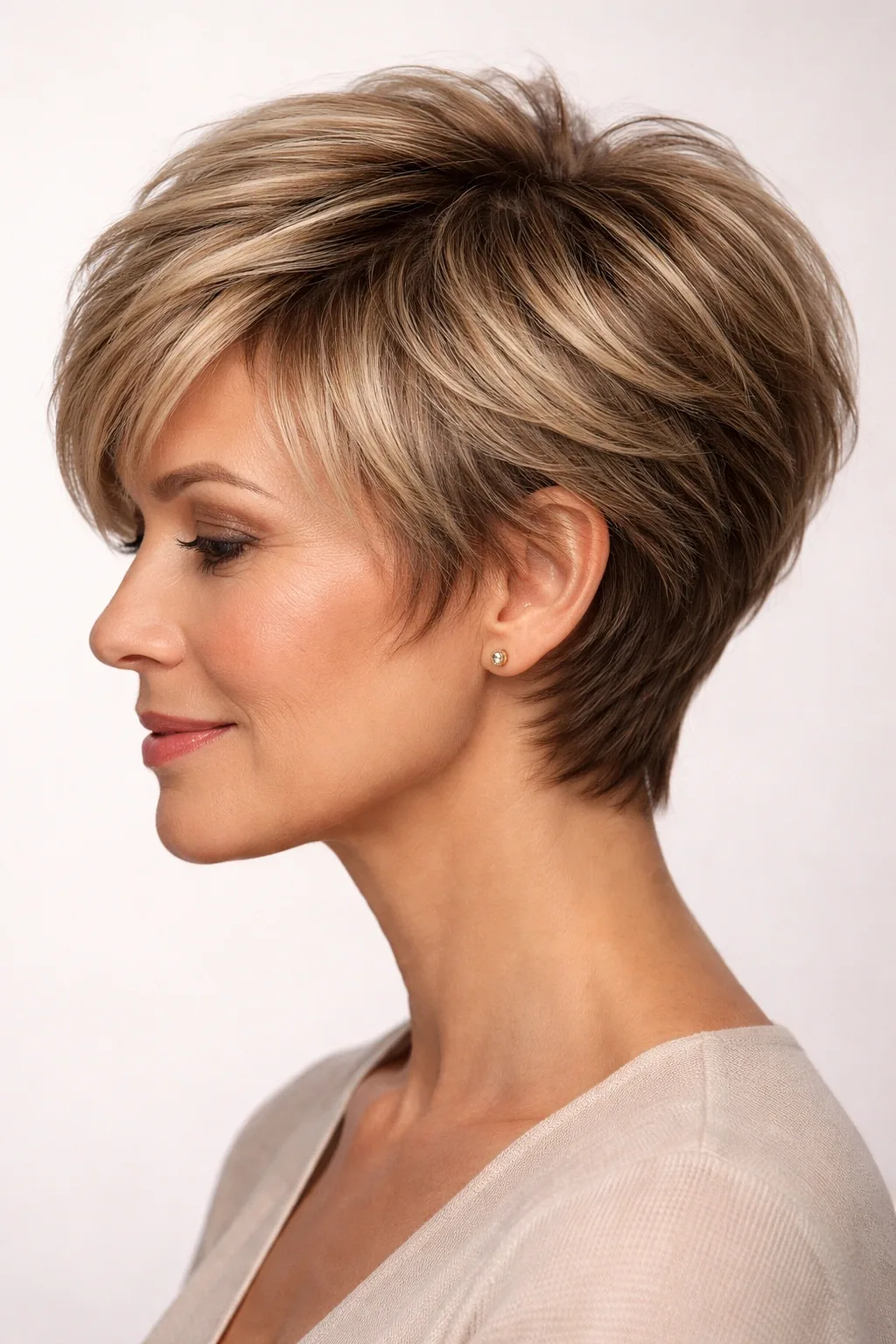
The layered pixie is the softest pixie in the family: short, but with layers throughout that create movement, volume and a feathered finish instead of a hard edge. It is the pixie for women who want short hair without the severity, and it works beautifully on hair that needs a little help with body, because the layers lift the crown and keep the sides from sitting flat. It is also one of the easiest pixies to grow out, since the layers already blend into each other. Best for: fine hair that needs volume, oval and long faces, and anyone who wants a pixie that feels soft rather than sharp.
How to style it: rough-dry with a little volumising mousse at the roots, then use your fingers to lift the crown layers and direct the front pieces where you want them. A light-hold spray keeps the layers moving without freezing them in place. What to ask your stylist: layers that start at the crown rather than at the nape, a soft, feathered nape, and enough length at the front to style in more than one direction. If your hair is very fine, ask for the layers to be kept long — too many short layers will thin the ends and make the cut look wispy.
9. The Shaggy Wavy Bob
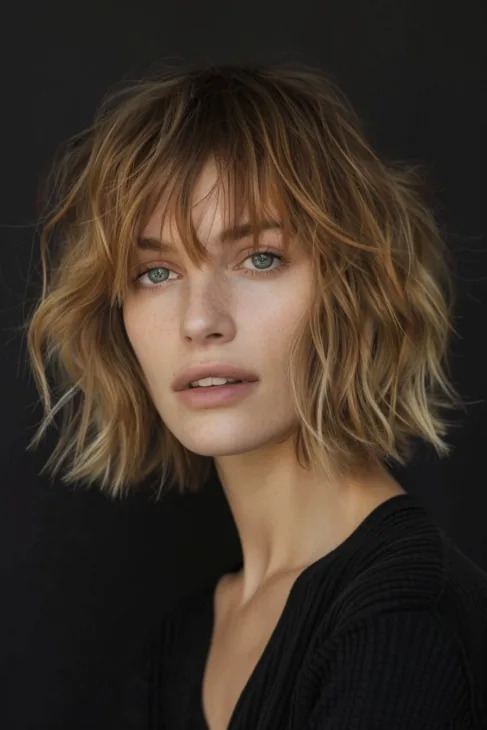
The shaggy wavy bob is the cool girl of short hair: chin to jaw length, full of choppy layers, with natural waves that look like they happened by accident — even though a good stylist engineered every one of them. It is the cut for women who want short hair to feel relaxed rather than formal, and it suits wavy hair perfectly because the layers enhance the wave instead of fighting it. The finish is deliberately undone, which makes it one of the most forgiving cuts in this guide on a bad hair day. Best for: naturally wavy hair, oval and square faces, and anyone who wants a short cut that looks good with almost no styling.
How to style it: scrunch a little sea-salt spray or curl cream into damp hair and let it air-dry, or rough-dry with a diffuser. The messier it looks, the better it works — resist the urge to straighten it. What to ask your stylist: choppy layers through the mid-lengths and ends, a curtain fringe or face-framing pieces if you want softness around the face, and a length that sits at the jaw so the waves have room to form. Ask them to cut it dry or to account for how much your waves will spring up once dry.
10. The Undercut Pixie
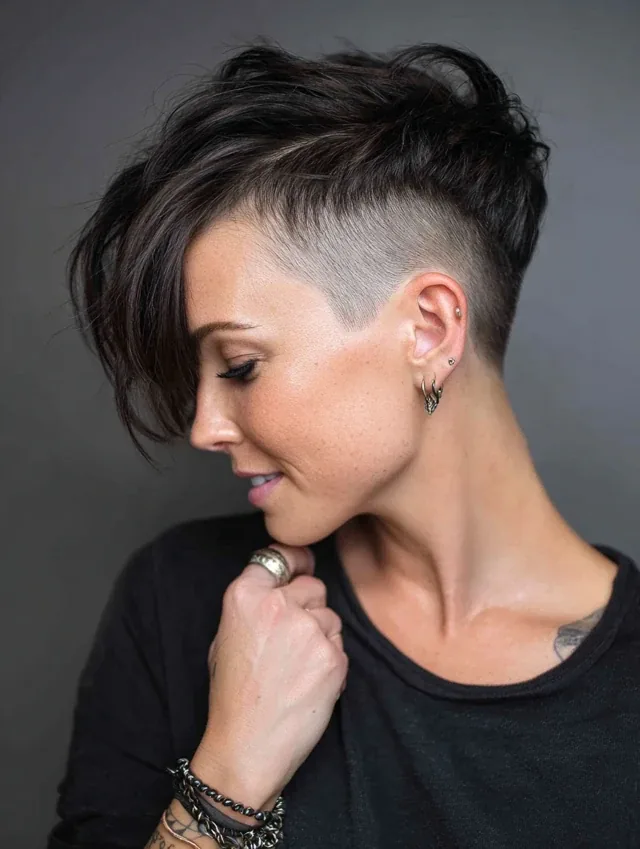
The undercut pixie is the boldest cut in this guide: the sides — or one side — clipped close or shaved, with length left on top to sweep, spike or fall across the forehead. It is a statement cut, and it works because the contrast between the close sides and the longer top creates drama that a uniform pixie cannot. It is also surprisingly practical: the undercut removes bulk from thick hair, keeps you cool in summer, and grows out into a textured pixie with very little awkwardness. Best for: thick hair that needs bulk removed, oval and heart-shaped faces, and anyone who wants a short cut with real attitude.
How to style it: sweep the top to one side for a sleek, editorial look, or add texture paste and push it up for a spiky, playful finish. The undercut itself needs no styling at all. What to ask your stylist: how close you want the undercut (a number-two guard is soft, a number-one is sharp, a razor is a statement), whether you want it on one side or both, and how often it will need re-clipping — usually every three to four weeks. Ask them to show you how to style the top both ways, so you get two looks from the one cut.
11. The Chin-Length Bob with Curtain Bangs
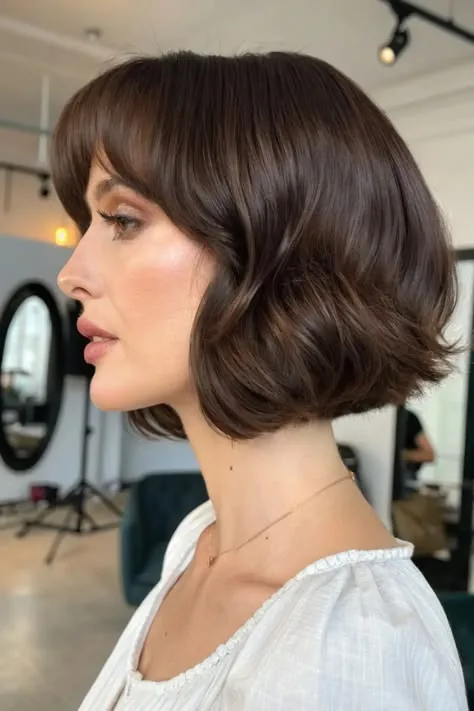
The chin-length bob with curtain bangs is the softest bob in this guide: the length sits neatly at the chin, while the fringe parts in the middle and sweeps to each side like curtains, framing the face instead of covering it. It is the bob for women who like the idea of bangs but hate the commitment, because curtain bangs grow out gracefully and can be tucked behind the ears on days you do not want them. The combination flatters almost every face shape, which is why it is one of the most requested cuts in salons right now. Best for: round and square faces, which benefit from the lengthening diagonal of the curtain fringe, and fine to medium hair that needs softness around the face.
How to style it: blow-dry the bangs forward with a round brush, then flick them out to each side as they cool — that flick is what creates the curtain shape. The rest of the bob needs only a rough dry and a bend at the ends. What to ask your stylist: curtain bangs that start at cheekbone level and blend into the bob’s front layers, and a chin-length cut with soft, point-cut ends. Ask for the bangs to be cut dry if possible, so your stylist can see exactly where they fall on your face.
12. The Bixie Cut
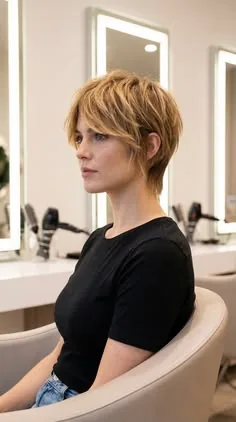
The bixie is exactly what it sounds like — a bob and a pixie had a baby, and the result is one of the most wearable short cuts of the moment. It is longer than a pixie and shorter than a bob, with textured layers, a soft fringe and enough length at the nape to tuck behind the ears. It suits women who find a pixie too short and a bob too safe, and it is wonderfully low-maintenance because the layers give it shape even when you do nothing. Best for: oval, heart and round faces, fine to medium hair, and anyone who wants to go short without going very short.
How to style it: rough-dry with a little mousse, then pinch the ends with texture paste for a piecey finish. It also looks great air-dried with a spritz of salt spray, which is the whole point — the bixie is a cut that works with your hair, not against it. What to ask your stylist: a length that sits between the ear and the jaw, layers through the crown for movement, and a fringe that blends into the front layers. Mention if you want to be able to tie the front back, because that needs a little extra length at the sides.
13. The Short Shag
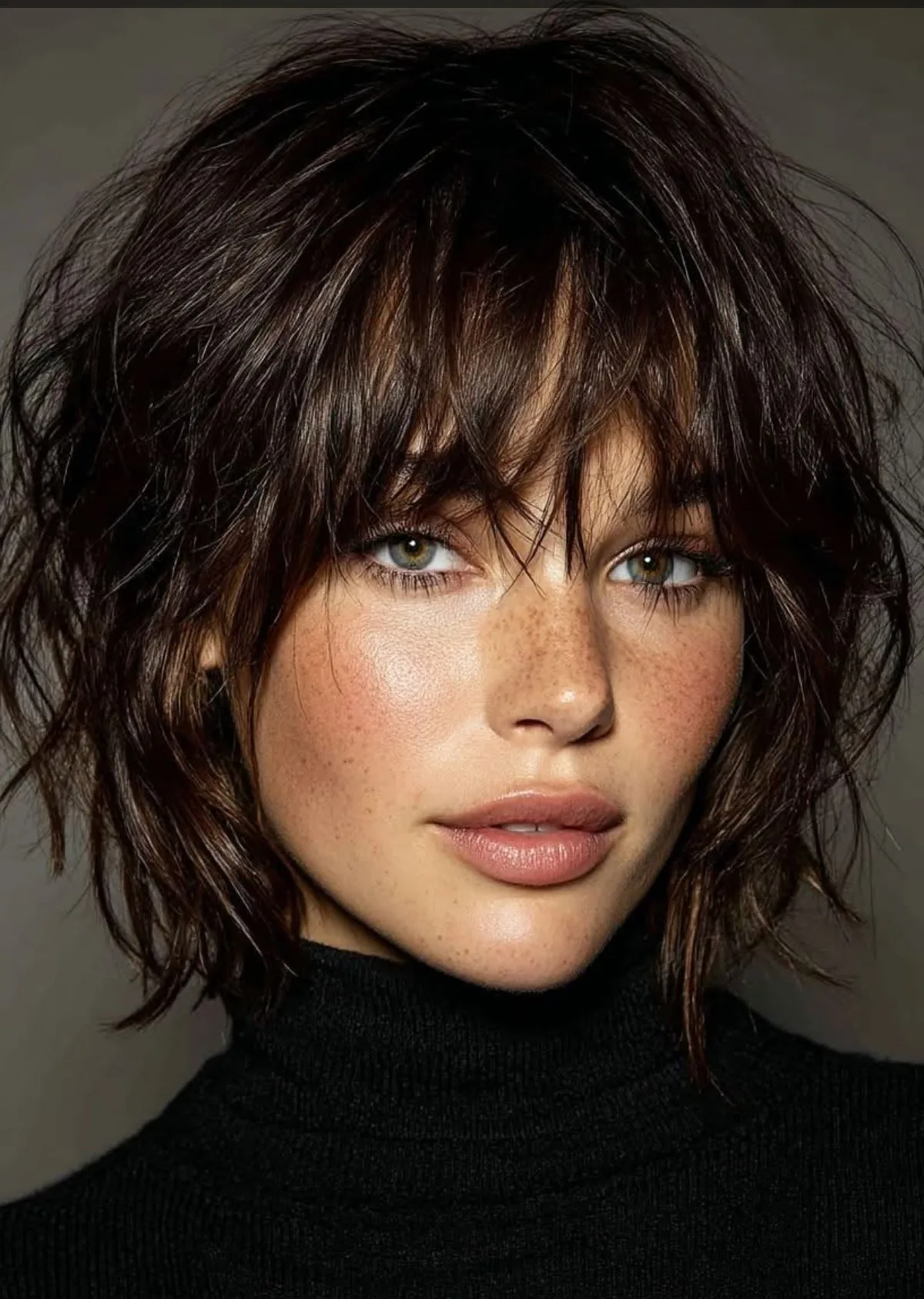
The short shag is a seventies revival that feels completely modern: choppy layers everywhere, a feathered fringe, and a deliberately messy, rock-and-roll finish. It is the cut for women who want short hair with personality, and it works best on hair with natural wave or texture, because the layers amplify what is already there. The shag is also one of the most forgiving cuts for growing out, since the layers already look intentionally uneven. Best for: wavy and thick hair, oval and long faces, and anyone who wants a short cut that looks effortless rather than polished.
How to style it: scrunch texture spray into damp hair and let it air-dry, or diffuse for extra volume at the crown. A flat iron can be used to flick out a few ends for a more deliberate, editorial finish. What to ask your stylist: heavy layering through the crown and ends, a feathered fringe that blends into the layers, and a length that sits above the jaw so the shag keeps its shape. If your hair is fine, ask for the layers to be kept longer — too much layering on fine hair makes the ends look thin.
14. The Sleek Straight Bob
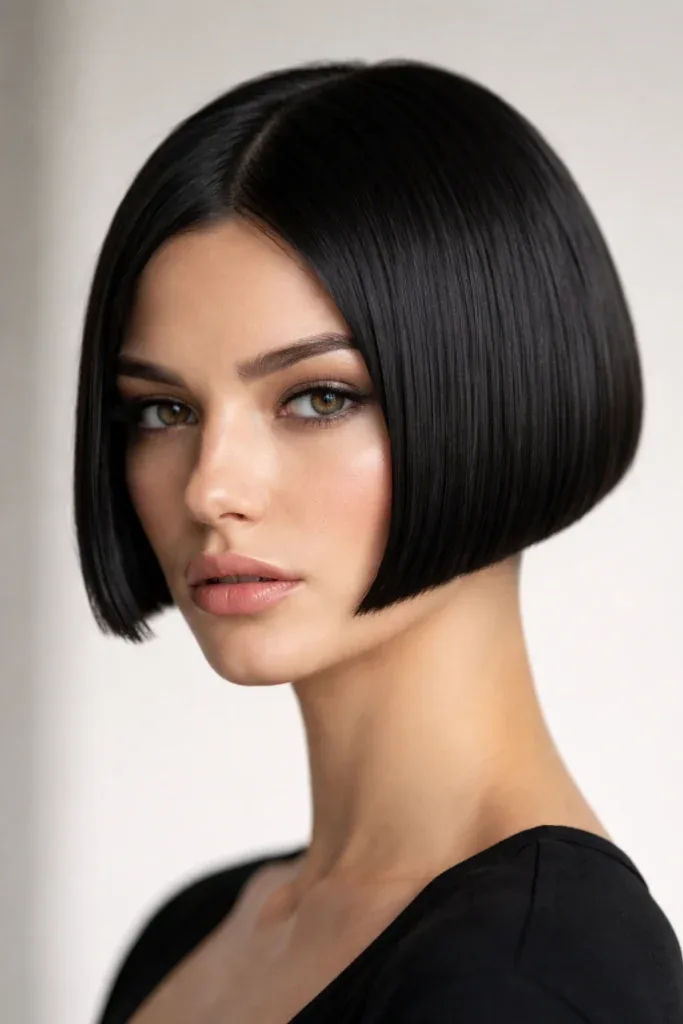
The sleek straight bob is short hair at its most polished: glassy, smooth, pin-straight, with a razor-sharp line and not a hair out of place. It is the cut that makes a simple outfit look expensive, and it works because the shine and the precision do all the talking. This is not a wash-and-go cut — it needs heat styling — but the payoff is a look that reads confident, modern and completely intentional. Best for: naturally straight hair, oval and heart-shaped faces, and anyone who enjoys styling and wants a cut that looks red-carpet ready every day.
How to style it: blow-dry smooth with a paddle brush and a heat protectant, then flat-iron in sections and finish with a shine serum or a light gloss spray. A centre part makes it look sharpest; a deep side part makes it look softer. What to ask your stylist: a one-length cut with a clean, sharp line, ends cut with scissors for precision, and a length at the jaw or chin. Ask about a keratin treatment or a gloss if your hair is prone to frizz — both make the sleek finish much easier to maintain day to day.
15. The Tousled Pixie
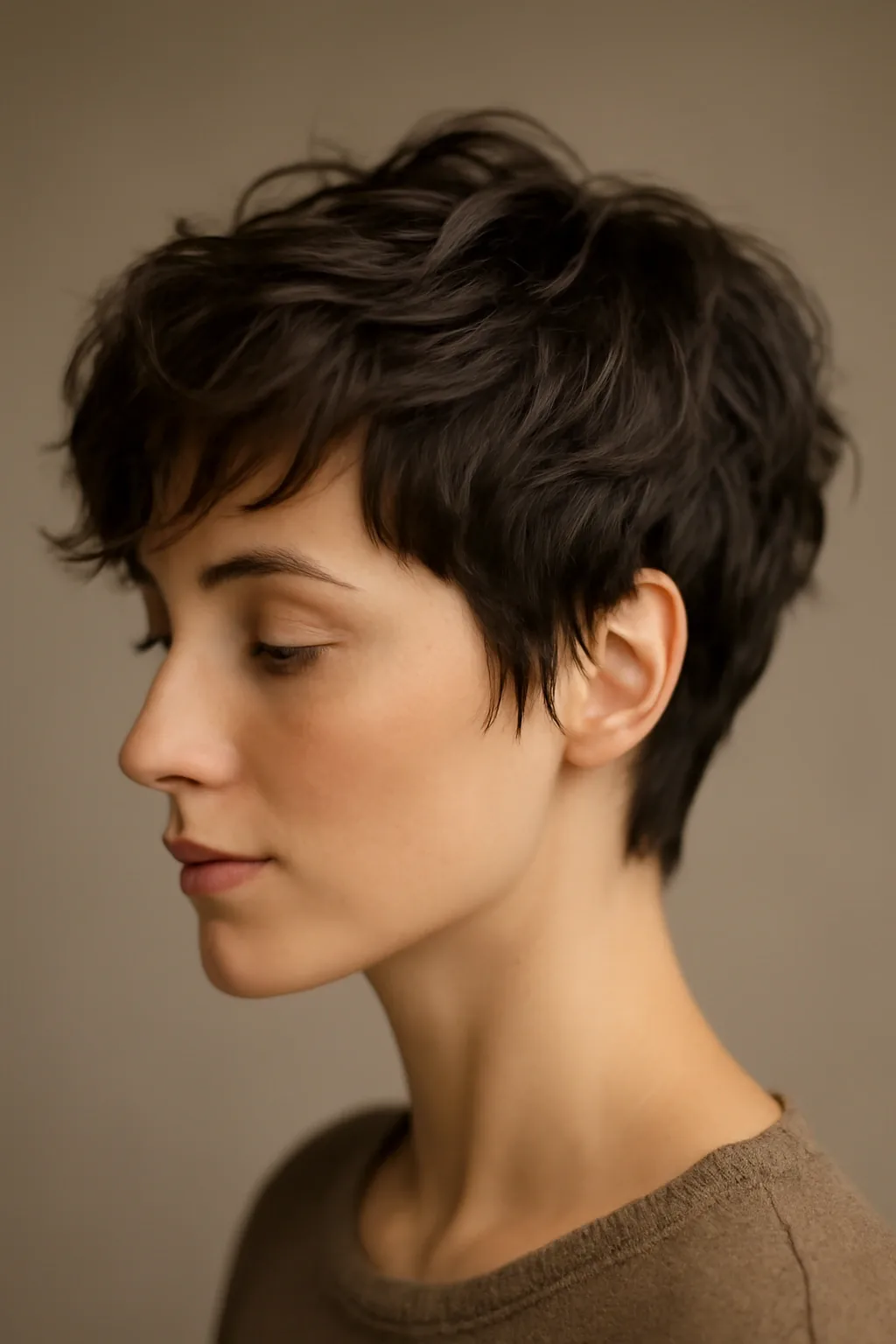
The tousled pixie is a pixie that refuses to behave — and that is the point. Longer on top than a classic pixie, with piecey, deliberately messy texture, it looks like you just ran your fingers through your hair and walked out the door. It is the most relaxed pixie in this guide, and it suits women who want short hair to feel playful rather than severe. The tousled finish also makes it one of the most forgiving pixies on a bad hair day, because mess is built into the design. Best for: wavy and straight hair with natural texture, oval and heart-shaped faces, and anyone who wants a pixie that looks styled with zero effort.
How to style it: work a little texture paste through damp hair, rough-dry with your fingers, then shake your head and pinch a few pieces at random. That is genuinely the whole routine — the cut is designed to look better slightly undone. What to ask your stylist: extra length on top for the tousled texture, point-cut ends throughout, and a nape that is tapered but not too short. Ask them to show you how much product to use, because the most common mistake with a tousled pixie is overloading it with wax until it looks greasy instead of piecey.
16. The A-Line Bob
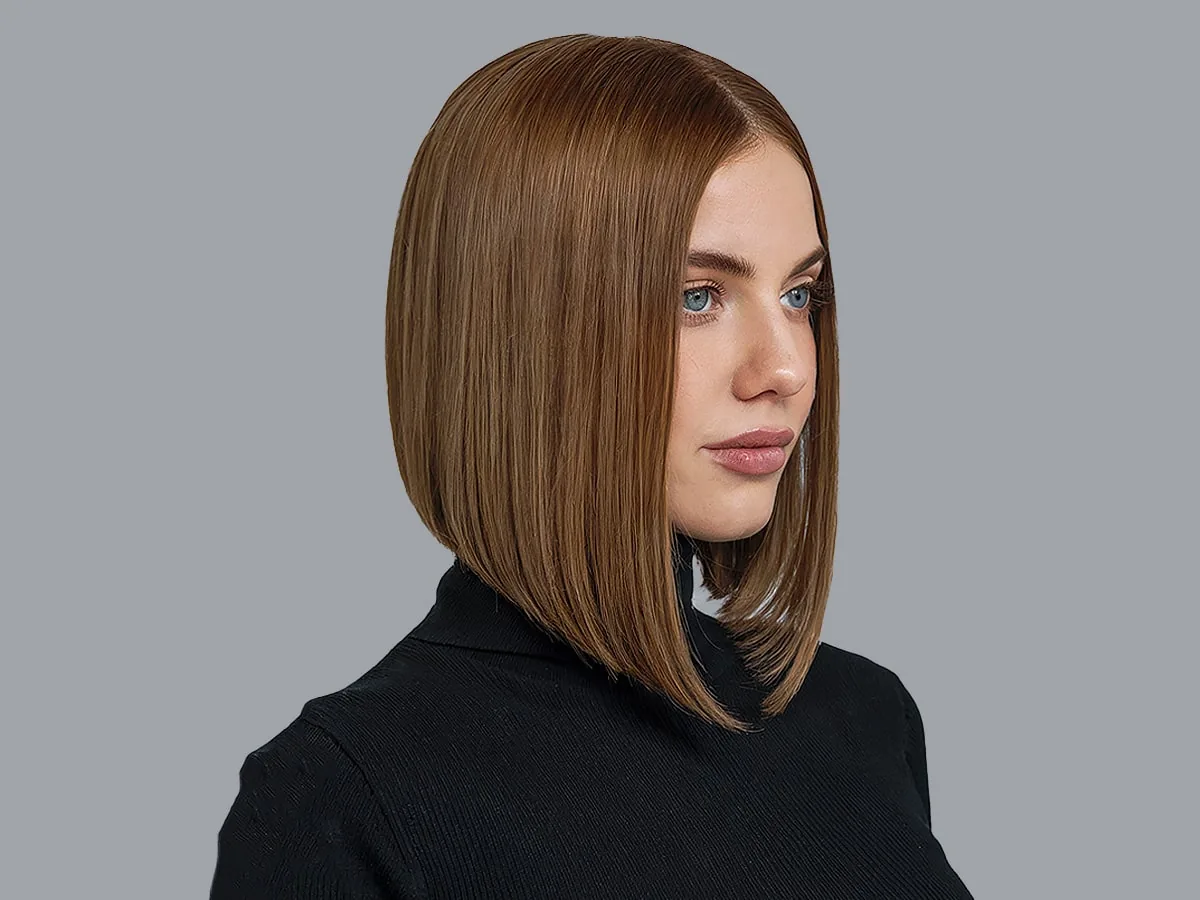
The A-line bob is a bob with geometry: shorter at the back, gradually longer towards the front, creating a clean diagonal line that slims the face and adds instant polish. It is one of the most flattering short cuts ever designed, because the angle draws the eye downward and makes the neck look longer. The back is usually stacked or graduated for volume, while the front pieces frame the face like a curtain. Best for: round and square faces, which benefit from the lengthening angle, and straight to slightly wavy hair that shows the line cleanly.
How to style it: blow-dry with a round brush, turning the front pieces under, and finish with a shine spray — the angle does the work, so keep the styling simple. A flat iron on the front pieces makes the line look sharper. What to ask your stylist: how dramatic you want the angle (a subtle slope is classic, a steep one is a statement), and whether the back should be stacked for volume or left one-length for a softer look. Be clear about the front length — it should hit at the chin or just below, not at the shoulder, or the A-line loses its shape.
17. The Short Bob with a Micro Fringe
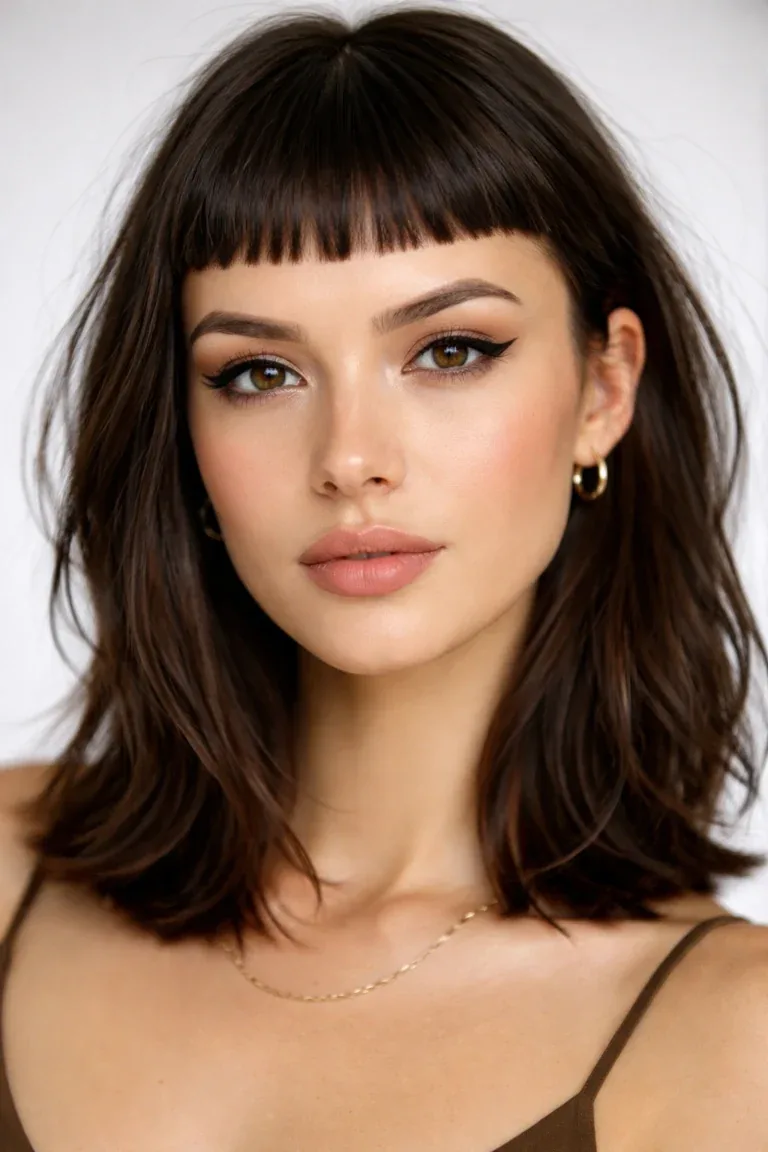
The short bob with a micro fringe is the most fashion-forward cut in this guide: a sharp bob paired with a fringe cut well above the eyebrows, sometimes just an inch long. It is bold, graphic and unmistakably deliberate — the haircut equivalent of a statement necklace. It opens up the whole face, makes the eyes the focal point, and looks extraordinary on the right person. It is not a cut for the faint-hearted, but it is unforgettable. Best for: oval and long faces, straight hair, and anyone with strong features who wants a cut that makes a statement.
How to style it: keep the bob sleek and straight so the fringe is the star, and use a tiny amount of pomade to keep the fringe sitting flat. The fringe needs almost no styling — it is too short to misbehave. What to ask your stylist: a micro fringe cut straight across, well above the brow, with the bob kept sharp and one-length to match. Ask how often the fringe will need trimming — usually every three weeks — and whether your hairline and cowlicks will let a micro fringe sit straight, because a cowlick can make it stick up.
18. The Buzz Cut
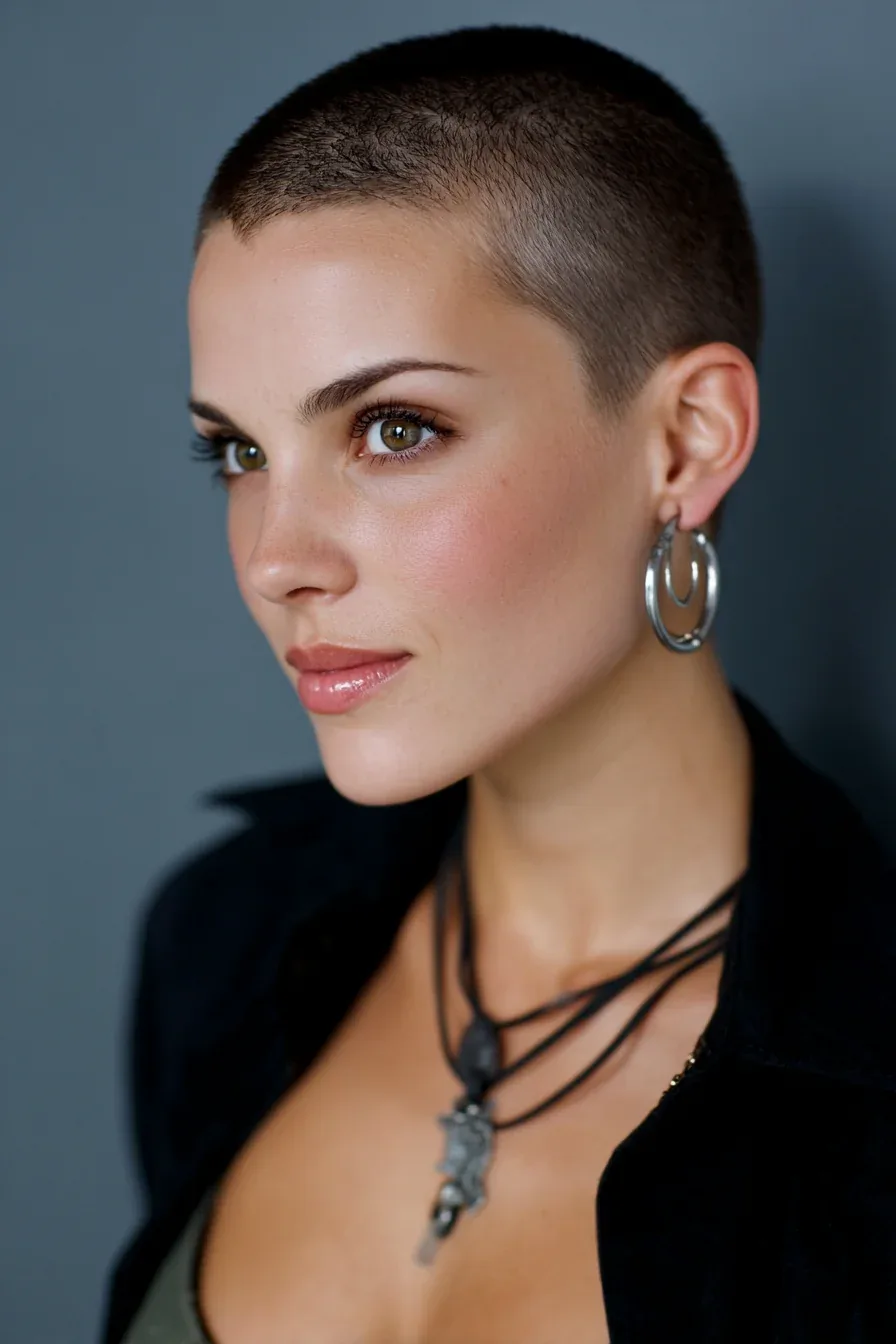
The buzz cut is the bravest and simplest cut in this guide: hair clipped to a uniform short length all over, usually with clippers, leaving the face completely exposed. It is not a cut you hide behind — it is a cut that says you do not need to. Women who buzz their hair talk about the freedom of it: no styling, no bad hair days, no hiding, and a feeling of lightness that is hard to describe until you have felt it. It also grows out into a pixie, so the commitment is shorter than it looks. Best for: anyone with a head shape they are happy to show off, strong features, and the confidence to let their face do all the talking.
How to style it: you do not — that is the point. Wash, towel dry, done. A little scalp oil or moisturiser keeps the scalp healthy, and sunscreen on the scalp matters in summer. What to ask your stylist: which guard length you want (a number two is soft and velvety, a number one is sharp, a zero is a full statement), and whether you want the edges cleaned up at the neckline and around the ears. Ask about the grow-out plan too — a buzz cut becomes a pixie in about two months, and a good stylist can map the stages with you.
19. The Side-Parted Bob
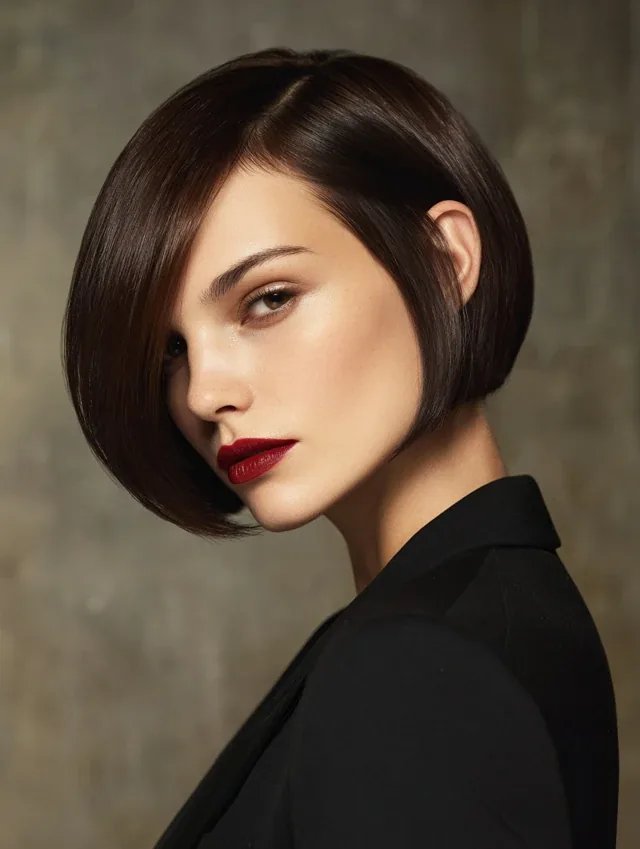
The side-parted bob is the classic bob’s more glamorous sister: the same chin-length cut, but with a deep side part that sweeps most of the hair to one side, creating volume, asymmetry and old-Hollywood polish. It is the bob for evenings, weddings and occasions, but it works just as well on a Tuesday — the side part alone makes the whole cut look more deliberate. The sweep across the forehead also softens the face and draws attention to the eyes. Best for: round and square faces, which benefit from the diagonal line, and straight to wavy hair that holds a part well.
How to style it: blow-dry with the part set deep on one side, then smooth the longer side over with a round brush and tuck the shorter side behind the ear. A little shine spray and a sweep of the front pieces finishes it. What to ask your stylist: a chin-length bob with the parting taken into account — the cut should be shaped around your side part, not a centre part. Ask them to check which side your hair naturally falls to, because fighting your natural part every morning is a losing battle.
20. The Curly Bob
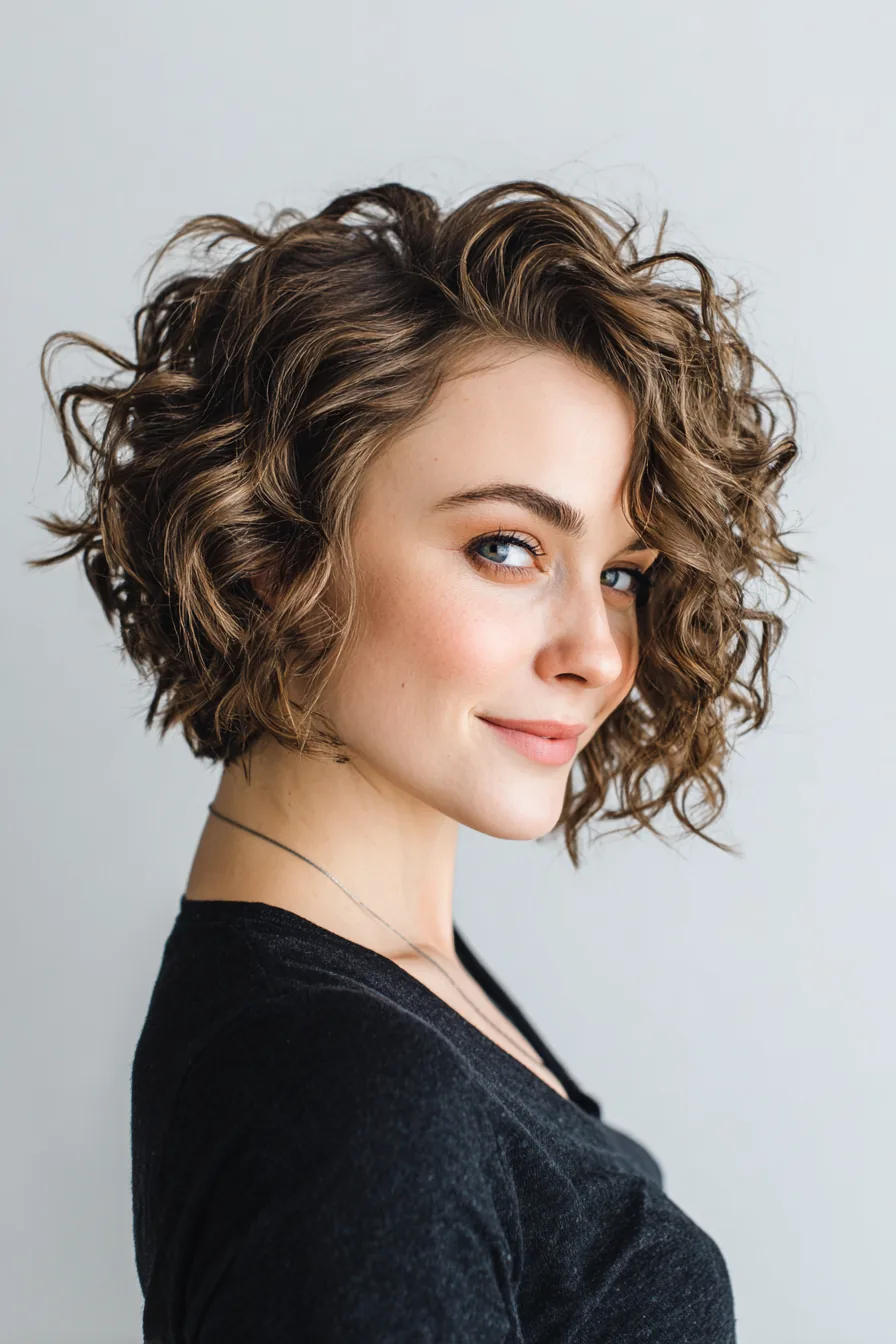
The curly bob is short hair that celebrates curls instead of taming them: chin-length, with curls left long enough to form proper spirals and ringlets, and layers that give the curls room to bounce. It is one of the most joyful cuts in this guide, because the texture is the style — no heat, no round brush, just curls doing what they do best. The key is a cut that works with the curl pattern, with length left where the curls need it and bulk removed where they would otherwise widen into a triangle. Best for: naturally curly hair, oval and heart-shaped faces, and anyone who wants to stop fighting their curls and start wearing them.
How to style it: apply curl cream to soaking-wet hair, scrunch, and diffuse on low heat or air-dry. Never brush it dry. A silk pillowcase and a pineapple ponytail at night keep second-day curls intact. What to ask your stylist: a dry cut or curl-by-curl cut, layers that follow your curl pattern, and a length that accounts for shrinkage — curly hair cut wet can spring up several inches when dry. Ask them to show you how much product your curl type actually needs, because overloading curly hair is the fastest route to limp, greasy curls.
21. The Choppy Bob
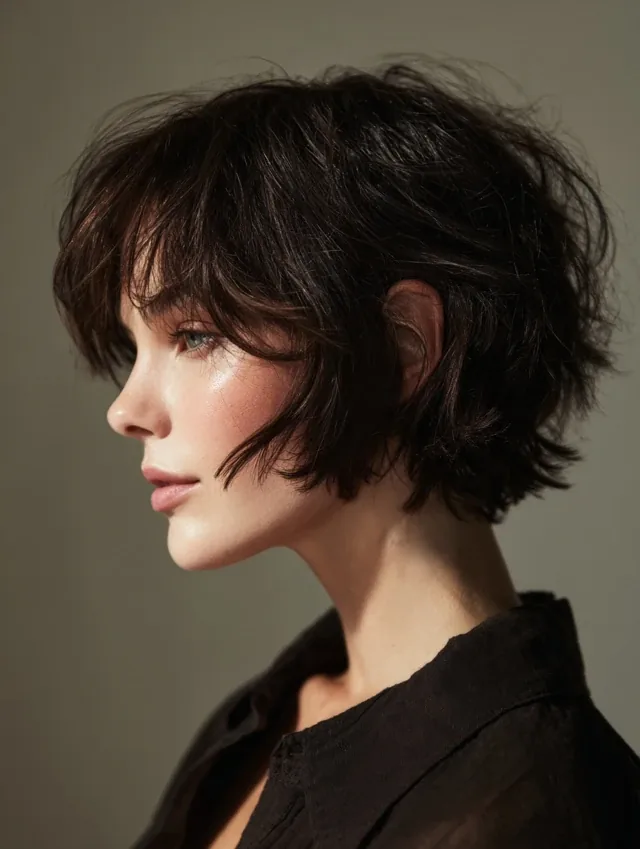
The choppy bob is a blunt bob that learned to relax: chin-length, but with textured, uneven ends that give it movement and a deliberately undone finish. It is the bob for women who like the shape of a classic bob but not the formality, and it works beautifully on hair with a little natural wave, because the choppy ends enhance the texture instead of fighting it. The finish looks effortless, which is exactly why it is one of the most requested short cuts in salons today. Best for: wavy and straight hair with natural texture, oval and square faces, and anyone who wants a bob that looks good with almost no styling.
How to style it: rough-dry with a little texture spray, then pinch the ends with wax for a piecey finish. A flat iron can flick out a few ends for a more deliberate look, but do not straighten the whole head — the choppy texture is the point. What to ask your stylist: a chin-length bob with point-cut, choppy ends rather than a blunt line, and light layering through the mid-lengths for movement. Ask them to cut the ends with a razor or point-cutting technique, because blunt-cut ends will not give you the piecey finish this cut depends on.
22. The Feathered Pixie
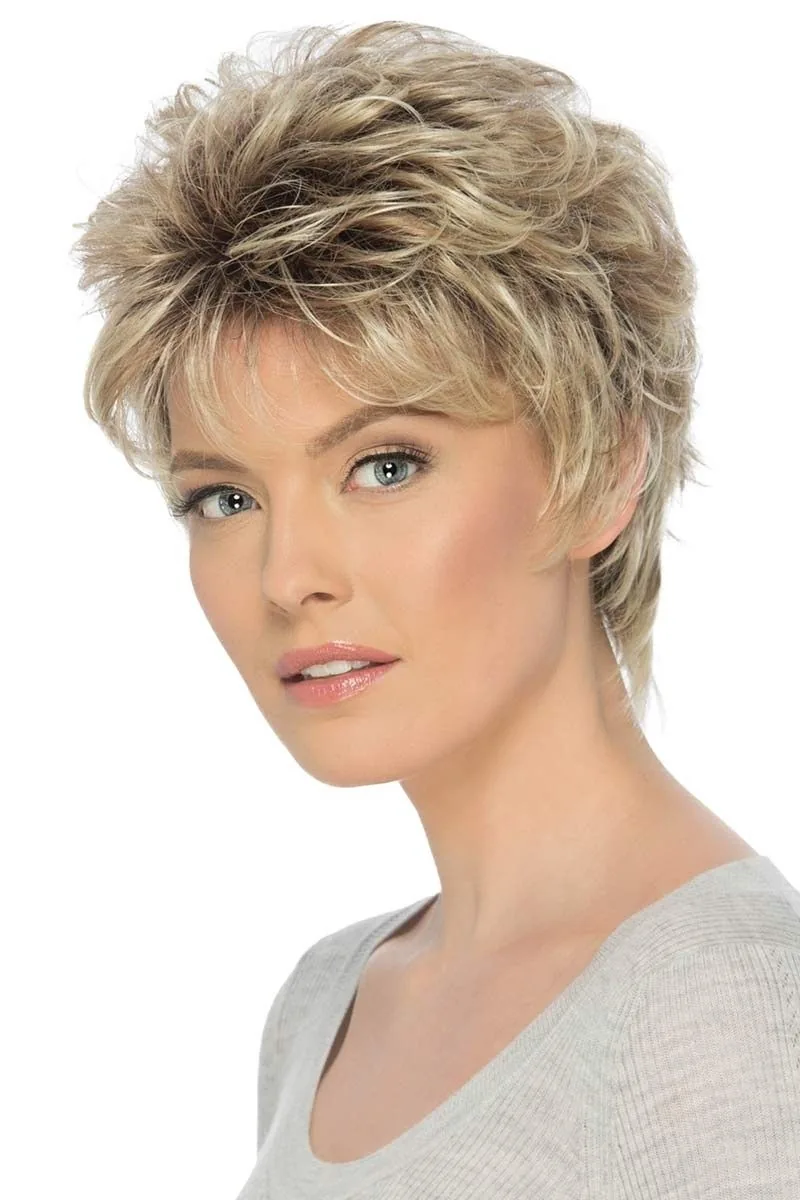
The feathered pixie is the gentlest pixie in this guide: short, soft, with layers that feather out at the ends like the pages of a book, creating movement without any hard lines. It is the pixie for women who want short hair to feel feminine and light, and it works beautifully on fine hair, because the feathered layers create the illusion of volume and airiness. It is also one of the easiest pixies to style, because the feathering means the hair falls into place on its own. Best for: fine hair that needs softness and volume, oval and long faces, and anyone who wants a pixie that feels light rather than severe.
How to style it: blow-dry with a small round brush, flicking the ends outwards for the feathered effect, then finish with a light-hold spray. A little volumising mousse at the roots adds lift without weight. What to ask your stylist: feathered, point-cut layers throughout, a soft nape, and enough length at the crown to create the feathered movement. If your hair is thick, ask for internal thinning, because a feathered pixie on unthinned thick hair can puff out instead of feathering.
23. The Inverted Bob
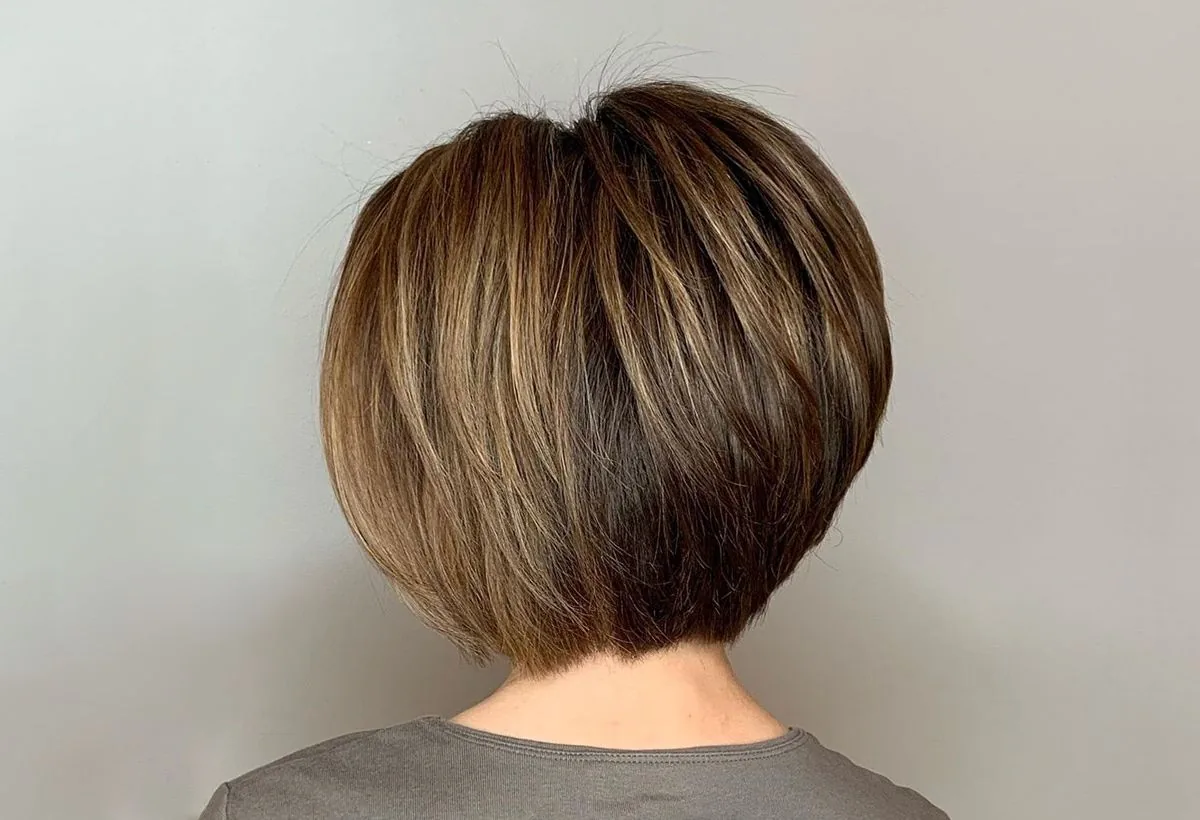
The inverted bob — also called the stacked bob — is a bob with built-in volume: graduated layers stacked at the back lift the crown, while the front pieces fall longer towards the chin, creating a dramatic, sculpted silhouette. It is the cut for women who want short hair with real presence, and it is particularly flattering from the side and the back, where the stacked layers create a shape no one-length bob can match. It is a salon cut through and through, and it rewards a stylist who understands graduation. Best for: straight to slightly wavy hair, oval and round faces, and anyone who wants volume at the crown without teasing or backcombing.
How to style it: blow-dry the back with a round brush, lifting the stacked layers up and under, then smooth the front pieces forward. A volumising mousse at the roots helps the stack hold its shape. What to ask your stylist: graduated, stacked layers at the back with a clean line at the nape, and front pieces that hit at the chin. Ask how often the stack will need reshaping — usually every five to six weeks — because an inverted bob loses its shape faster than a one-length bob when it grows out.
24. The Middle-Part Blunt Cut
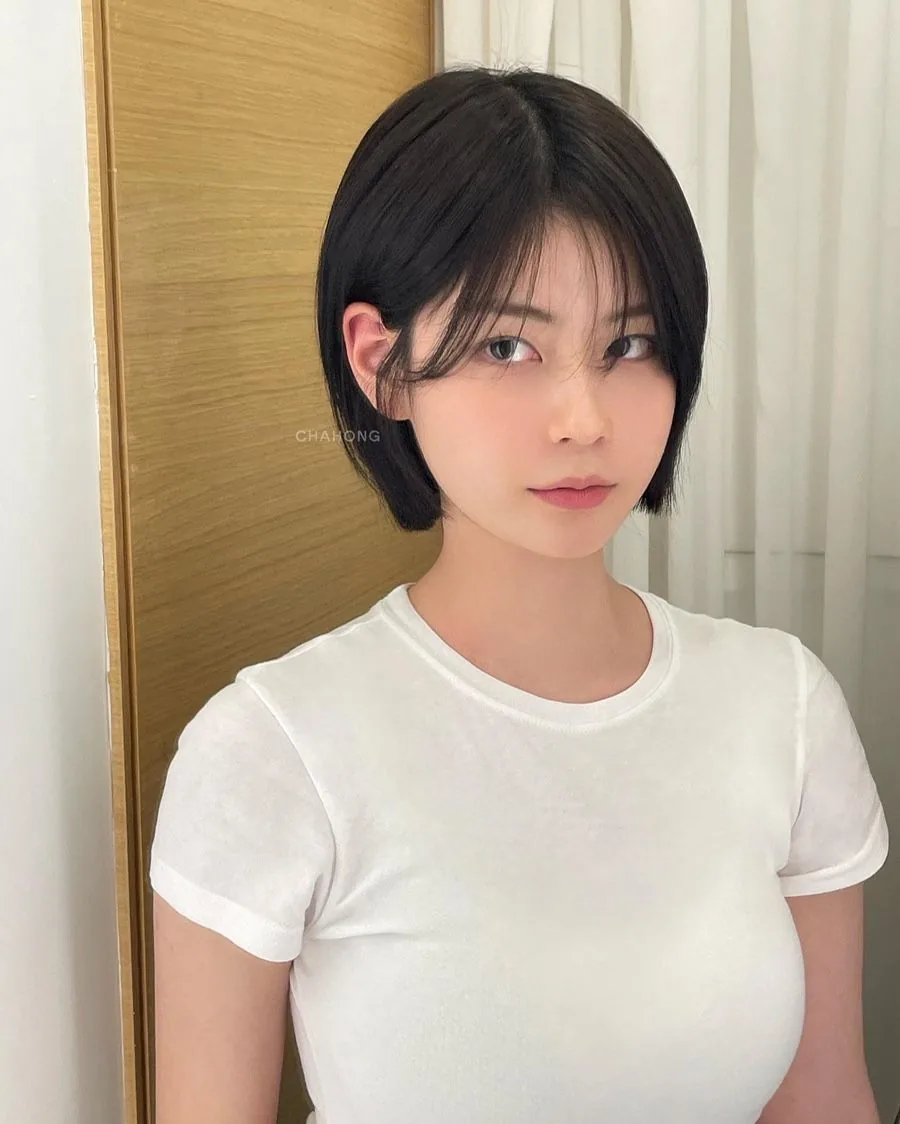
The middle-part blunt cut is short hair at its most minimal: a jaw-length, one-length cut with a dead-centre part and two clean curtains of hair framing the face. It is stark, symmetrical and completely confident — the haircut equivalent of a perfectly tailored white shirt. It works because the symmetry draws attention to the face itself, and the blunt ends give even the finest hair a thick, healthy look. It is not a cut that hides anything, which is exactly its power. Best for: straight hair, oval faces with balanced features, and anyone who wants a short cut that looks editorial with almost no effort.
How to style it: flat-iron the hair straight and smooth, part it dead centre, and finish with a shine serum. The whole routine takes five minutes — the symmetry does the work. What to ask your stylist: a truly one-length cut with a centre part built into the shape, ends cut blunt, and a length that hits at the jaw rather than at the chin. Be honest about your face shape — a centre part emphasises asymmetry, so if your features are noticeably uneven, a side part will flatter you more.
25. The Wavy Pixie
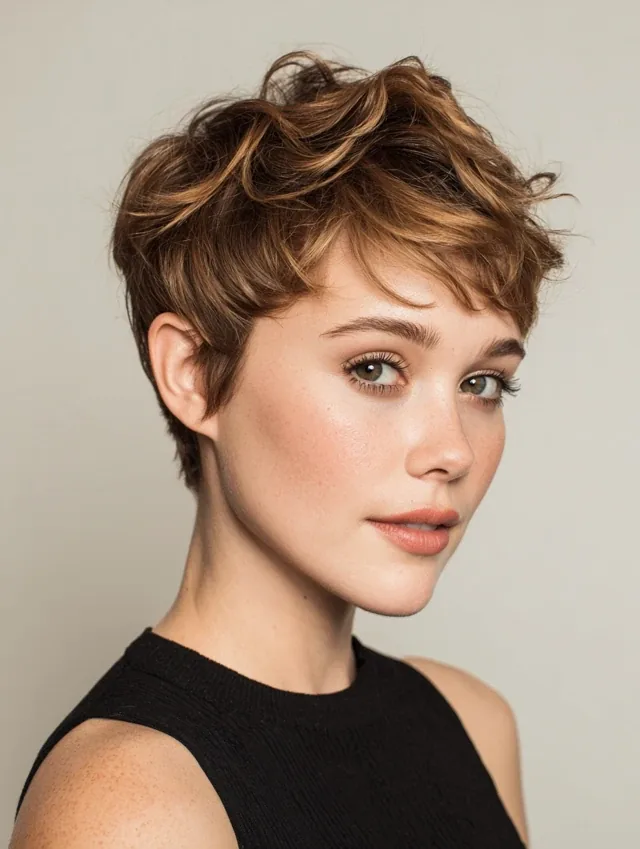
The wavy pixie is a pixie that lets natural waves do the styling: short at the back and sides, with enough length on top for the waves to form soft, tousled bends. It is the most romantic pixie in this guide, because the waves soften the crop and give it a feminine, effortless feel that a straight pixie cannot match. It is also wonderfully low-maintenance — the waves are the style, so there is very little to do in the morning beyond waking up. Best for: naturally wavy hair, oval and heart-shaped faces, and anyone who wants a pixie that feels soft rather than sharp.
How to style it: scrunch a little curl cream or sea-salt spray into damp hair and let it air-dry, or diffuse on low heat for extra volume. Do not brush it — brushing breaks the waves into frizz. What to ask your stylist: length left on top for the waves to form, a tapered nape, and layers that follow your wave pattern rather than cutting across it. Ask them to cut it dry or to account for how much your waves will spring up, because wavy hair cut wet always looks longer than it dries.
26. The Short Crop with a Textured Top
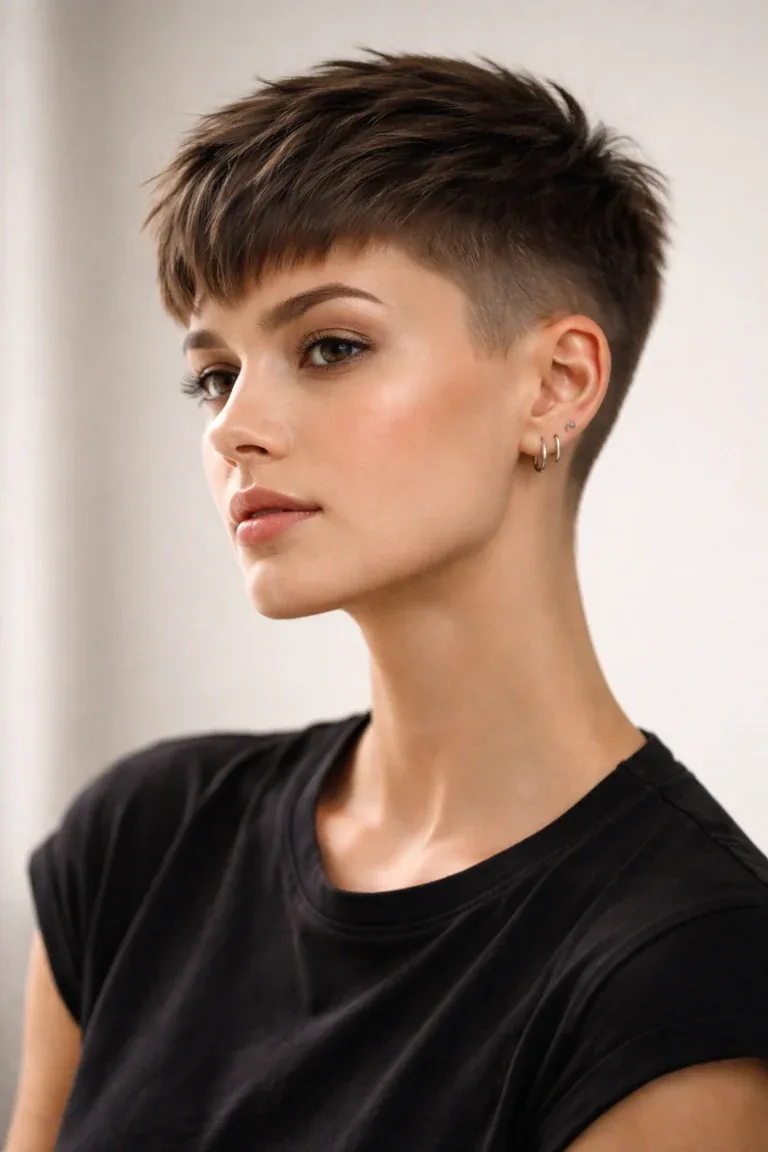
The short crop with a textured top is the modern, gender-neutral short cut: close at the back and sides, with a longer, piecey top that can be worn forward, swept to the side, or pushed up. It is the cut for women who want short hair that feels current and versatile, because the longer top gives you three or four different looks from a single cut. It is also one of the most practical short cuts, since the short sides need no styling at all and the top takes under a minute. Best for: straight to wavy hair, oval and square faces, and anyone who wants a short cut with multiple styling options.
How to style it: work a little matte paste through the top and push it forward for a fringe look, sweep it to one side for a softer finish, or spike it up for evenings. The sides need nothing. What to ask your stylist: a close taper at the back and sides, a textured top left long enough to style in at least two directions, and a fringe that can be worn forward or swept aside. Ask how often the taper will need re-clipping — usually every three to four weeks — and whether a skin fade or a soft taper suits your head shape better.
27. The Sun-Kissed Short Bob
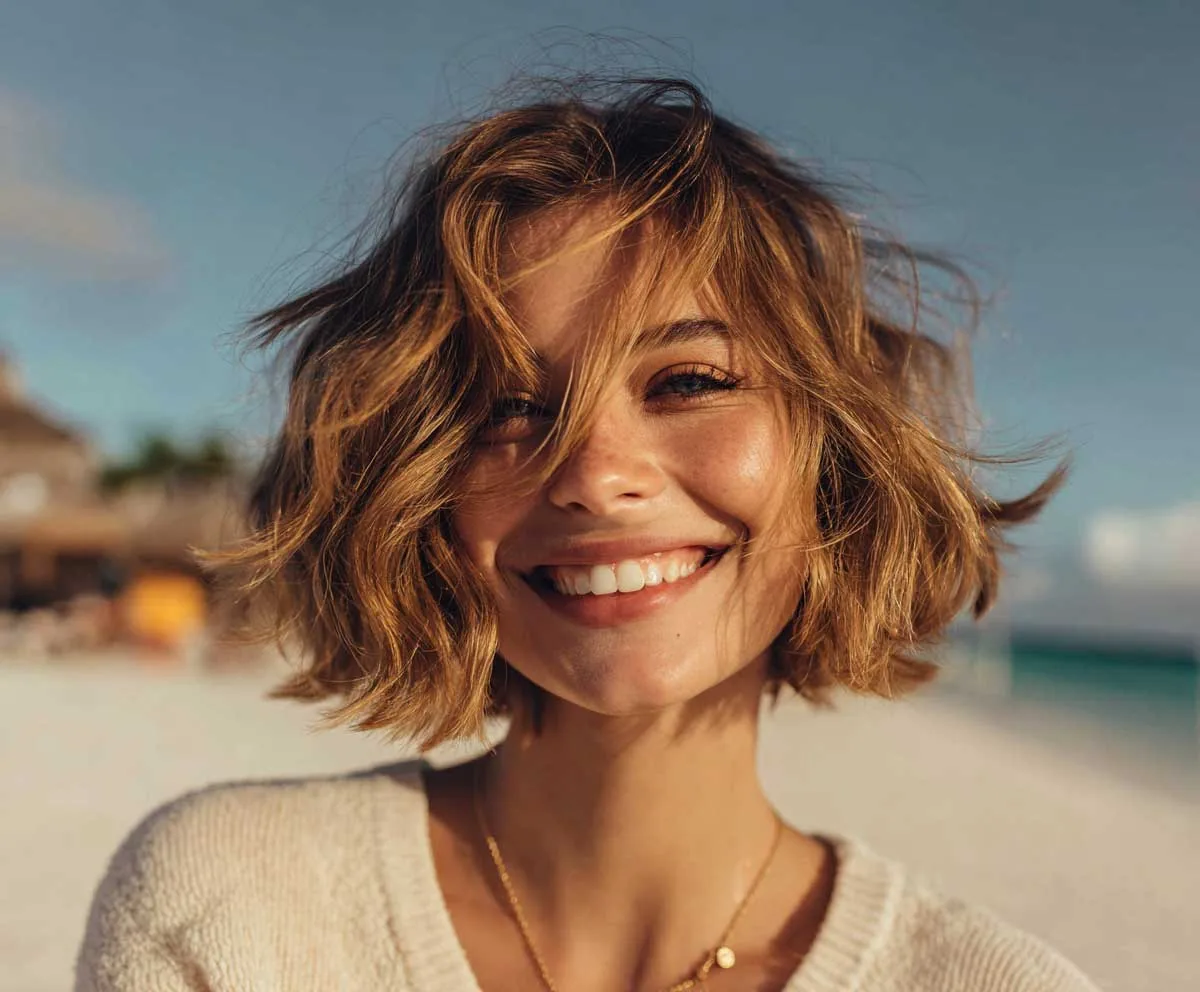
The sun-kissed short bob is a bob that comes with its own holiday glow: chin-length, with soft balayage that lightens the ends and the pieces around the face, as if you spent the summer by the sea. The colour does half the work of the cut, adding dimension, movement and the illusion of thickness that a single-colour bob cannot match. It is the bob for women who want their short hair to look warm, bright and full of life, and it grows out more gracefully than any other colour technique. Best for: medium to thick hair that shows dimension well, warm skin tones, and anyone who wants a short cut that looks expensive without a high-maintenance colour routine.
How to style it: add loose waves with a flat iron or a curling wand, because waves show off balayage better than straight hair does. A little texture spray and a shake of the head finishes it. What to ask your stylist: a chin-length bob with balayage painted through the ends and the face-framing pieces, and a toner that keeps the blonde warm rather than ashy. Ask how often the balayage will need refreshing — usually every ten to twelve weeks — and whether a gloss between appointments will keep the colour bright.
28. The Deep Side-Part Short Cut
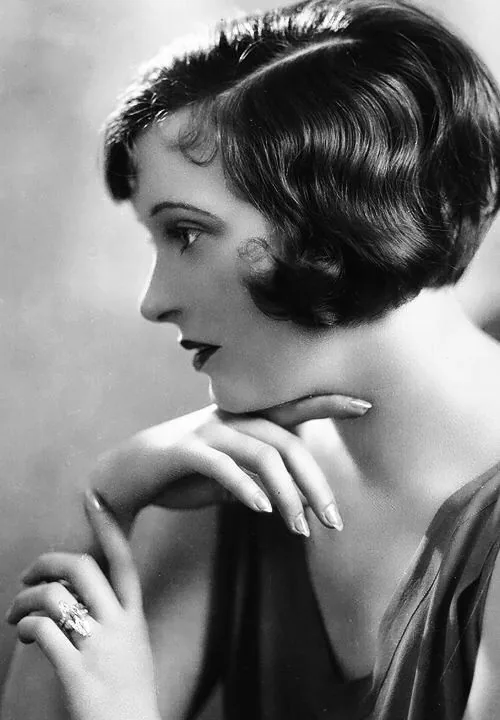
The deep side-part short cut is old-Hollywood glamour in a short package: the hair is parted far to one side, swept across the forehead in a smooth, sculpted wave, and finished with a polish that makes the whole look feel like an occasion. It is the short cut for evenings, weddings and photographs, but it works on ordinary days too — the deep part alone makes the cut look more deliberate than a centre part ever could. The sweep across the forehead softens the face and draws the eye to the cheekbones. Best for: straight to slightly wavy hair that holds a part, oval and round faces, and anyone who wants a short cut with red-carpet polish.
How to style it: blow-dry with the part set deep, smooth the sweep across the forehead with a round brush, and pin the shorter side back behind the ear. A shine spray and a light-hold hairspray keep the sweep in place all day. What to ask your stylist: a cut shaped around a deep side part, with enough length on the longer side to sweep across the forehead, and a shorter side that sits neatly behind the ear. Ask them to check your natural part — fighting it every morning is a losing battle, so the deep part should work with your hair’s natural direction.
29. The Spiky Pixie
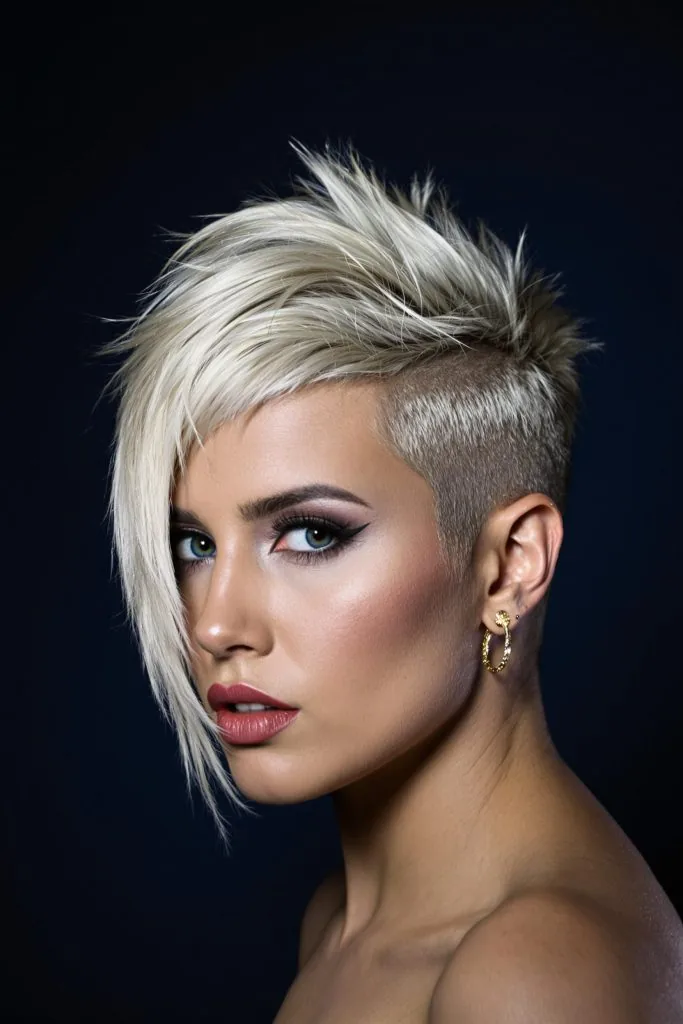
The spiky pixie is the most playful cut in this guide: short all over, with the top styled up into defined, piecey spikes that give it energy, attitude and a whole lot of personality. It is the pixie for women who want their hair to look like fun, and it suits strong features beautifully, because the upward texture draws the eye to the eyes and cheekbones. It is also one of the most versatile pixies — the same cut can be spiked up for a night out or smoothed down for work. Best for: straight hair that holds texture, oval and heart-shaped faces, and anyone who wants a short cut with a bold, confident edge.
How to style it: work a strong-hold matte paste through damp hair, rough-dry, then pinch the ends up into spikes with your fingers. A little hairspray locks the spikes in place without making them stiff. What to ask your stylist: a pixie with enough length on top to spike, point-cut texture through the crown, and a tapered nape. Ask them to show you how much product to use — the most common mistake with a spiky pixie is overloading it with wax until the spikes clump together instead of standing apart.
30. The Chin-Length Lob
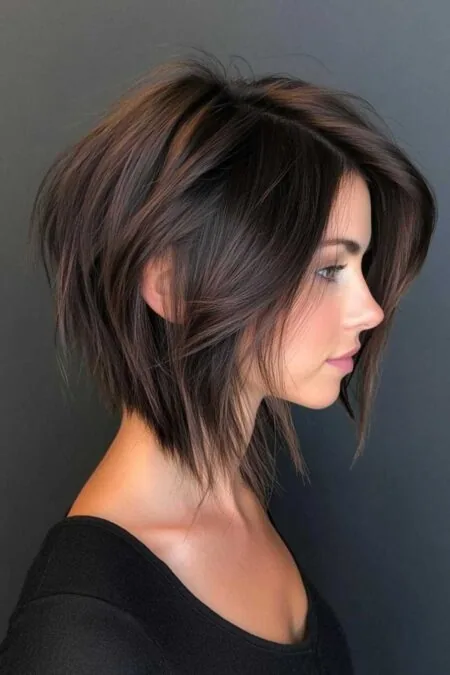
The chin-length lob is the shortest a lob can go before it becomes a bob: long enough to tuck behind the ears, short enough to feel light and modern, and the perfect halfway house for women who want short hair without committing to a pixie. It is the cut for the cautious — the woman who has always had long hair and wants to test the short waters without diving in. It is also wonderfully versatile, because it can be worn straight, wavy, tucked, pinned or tied back in a tiny ponytail. Best for: anyone going short for the first time, straight to wavy hair, and oval and heart-shaped faces that suit a clean, chin-length line.
How to style it: blow-dry straight for a polished finish, or add loose waves with a flat iron for a softer look. It also looks great air-dried with a little texture spray, which is the point — the chin-length lob is a cut that works however you wear it. What to ask your stylist: a length that sits exactly at the chin, with soft layers through the ends for movement, and a part that suits your face — centre for symmetry, side for softness. Ask for the grow-out plan too, because a chin-length lob grows into a classic lob in about three months, which makes it the lowest-risk short cut in this guide.
31. The Tapered Natural Curls Cut
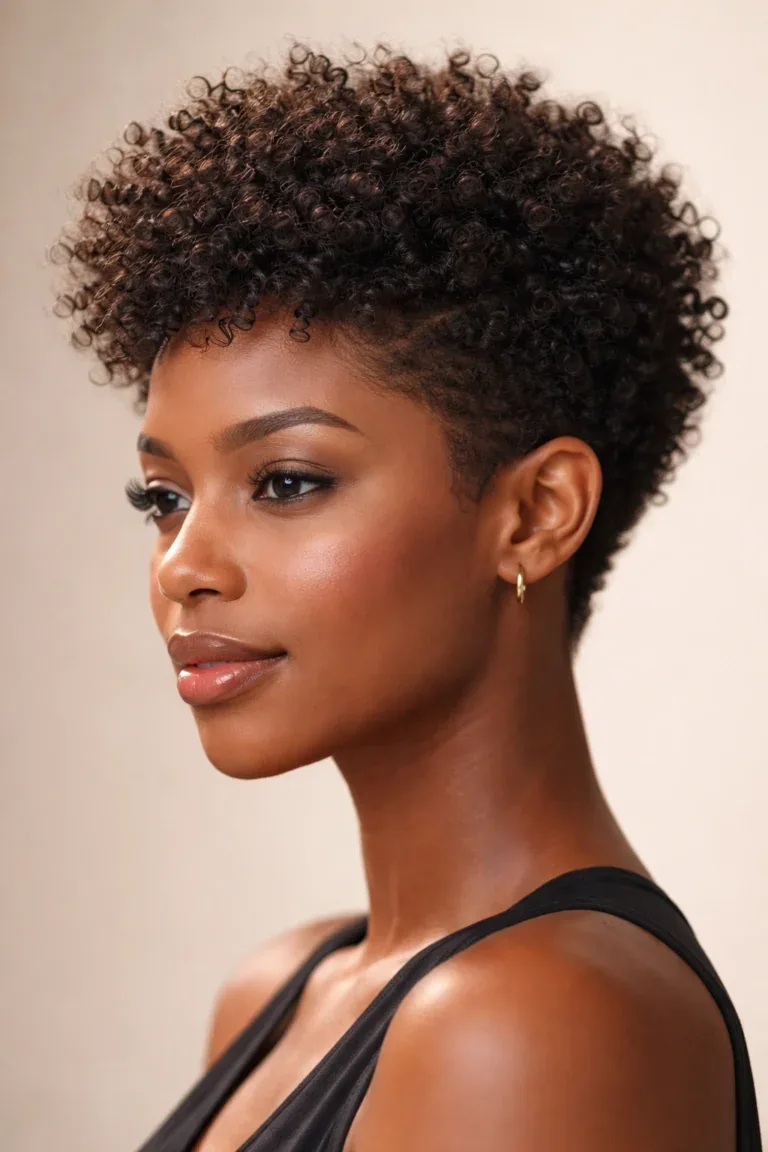
The tapered natural curls cut is short hair that celebrates texture in its fullest form: tapered close at the sides and nape, with curls left longer on top to form a soft, rounded shape that frames the face beautifully. It is the cut for women with coily and tightly curled hair who want a shape that is defined, intentional and easy to maintain — the taper keeps the silhouette clean, while the curls on top provide all the volume and personality. It is also a cut that grows out gracefully, because the taper can simply be allowed to grow into a fuller shape. Best for: coily, kinky and tightly curled hair, oval and round faces, and anyone who wants a short cut designed around their natural curl pattern.
How to style it: apply a leave-in conditioner and curl cream to damp hair, define the curls with your fingers or a pick, and let it air-dry or diffuse on low heat. A silk scarf at night protects the shape. What to ask your stylist: a cut done on dry, styled hair so your stylist can see the true curl pattern, a taper that follows your head shape, and length on top that lets the curls form their natural shape. Ask for a stylist experienced with your curl type — a tapered cut on coily hair is a specialist skill, and the wrong technique can ruin the shape for months.
32. The Soft Wave Bob
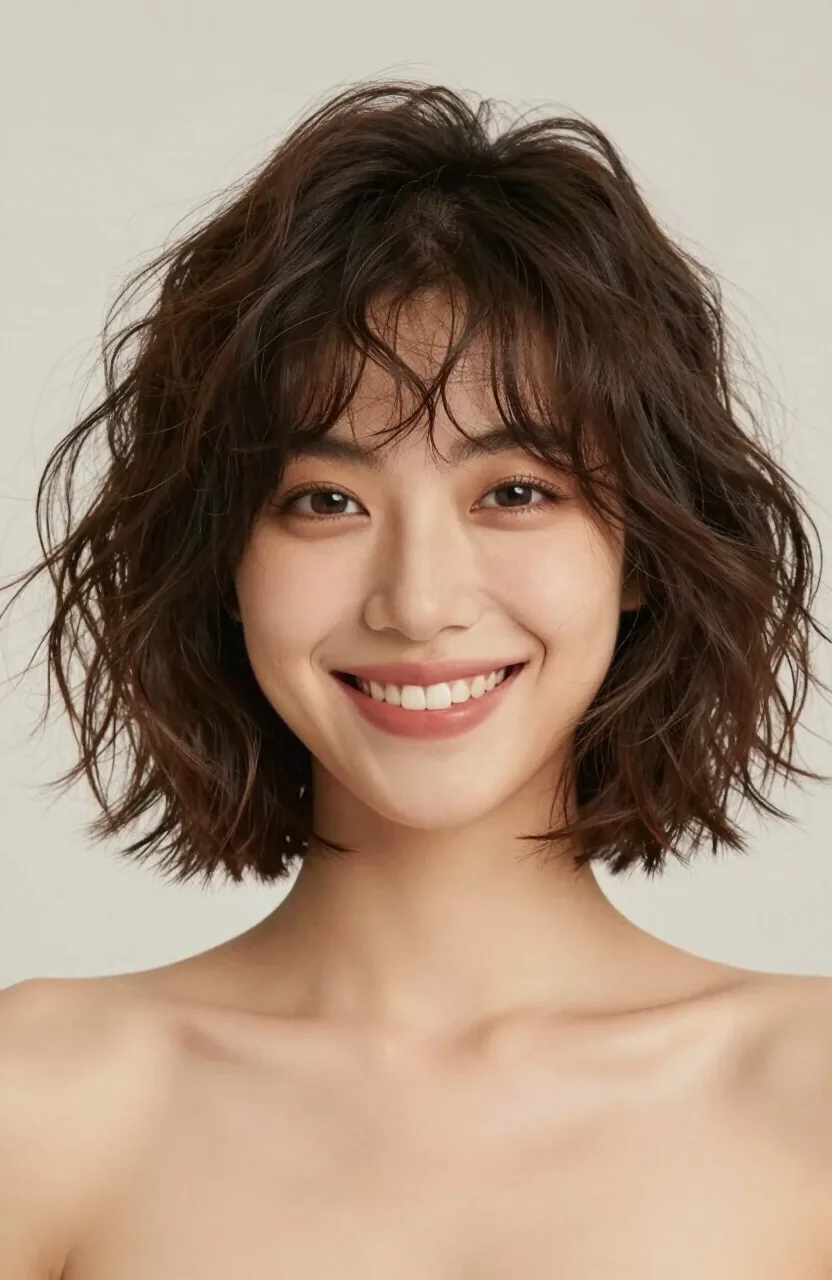
The soft wave bob is the most romantic cut in this guide: chin-length, with gentle, loose waves that give it movement, softness and a just-stepped-out-of-a-salon finish. It is the bob for women who want short hair to feel feminine and pretty rather than sharp or edgy, and it works on almost every hair type, because the waves can be created with a flat iron even on straight hair. The finish is polished but never stiff, which makes it one of the most versatile bobs for work, weddings and weekends alike. Best for: straight to wavy hair, oval and heart-shaped faces, and anyone who wants a short cut that reads soft and romantic.
How to style it: wrap sections around a flat iron or a curling wand, bending the hair away from the face, then brush through the waves with your fingers for a soft finish. A light-hold spray keeps the waves in place without stiffness. What to ask your stylist: a chin-length bob with soft layers through the ends so the waves have somewhere to fall, and a length that sits at the chin or just below. Ask them to show you the flat-iron wave technique, because the difference between a soft wave and a tight curl is one extra second on the iron.
33. The Shaggy Mullet
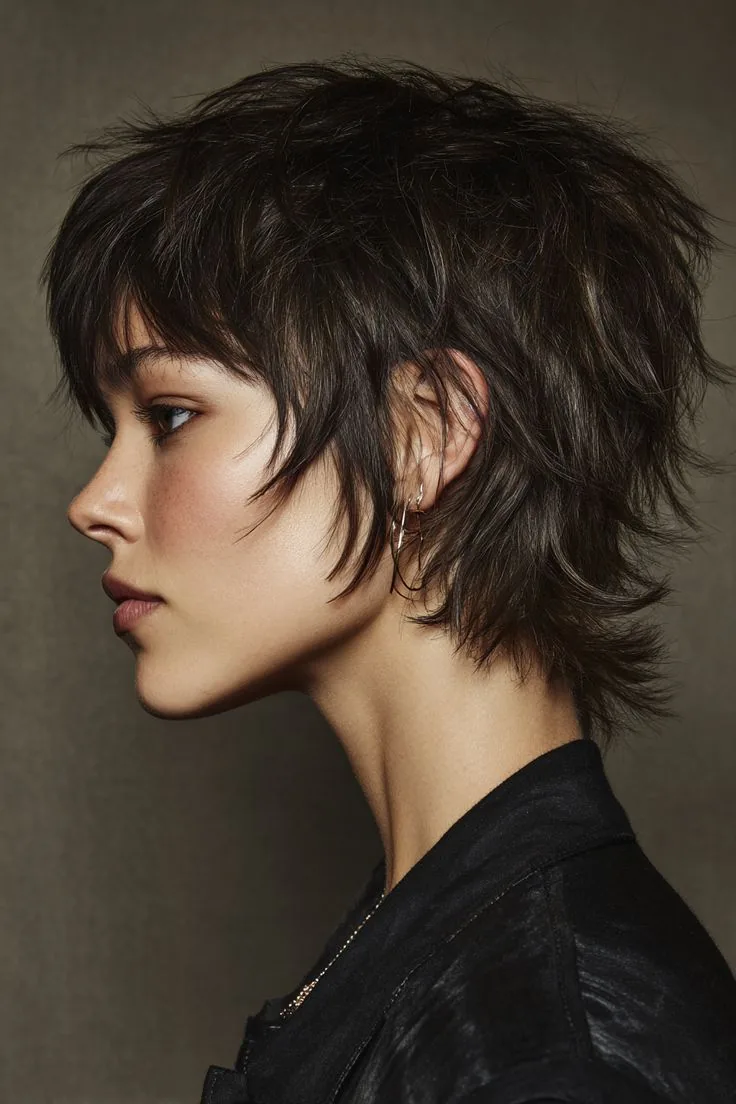
The shaggy mullet is the most daring cut in this guide and the one most likely to get compliments: short and choppy on top and at the sides, with length left at the back, all finished with heavy texture and a deliberately messy attitude. The modern mullet is nothing like the eighties version — it is softer, more layered, and worn with a fringe that blends into the top, which makes it feel fashion-forward rather than retro. It is a statement cut, but it is also surprisingly wearable, because the texture means it looks good even when you do nothing. Best for: wavy and thick hair that holds texture, oval and long faces, and anyone who wants a short cut that nobody else in the room will be wearing.
How to style it: scrunch texture spray into damp hair and let it air-dry, or rough-dry with a diffuser for extra volume at the crown. The messier it looks, the better it works. What to ask your stylist: a modern, soft mullet with a blended fringe and heavy texture, not a harsh eighties mullet with a sharp disconnect. Ask how long the back should be — a shorter back is subtler, a longer back is a bolder statement — and confirm the grow-out plan, because a mullet grows into a shag, which is a fine place to end up.
34. The Retro Finger-Wave Bob
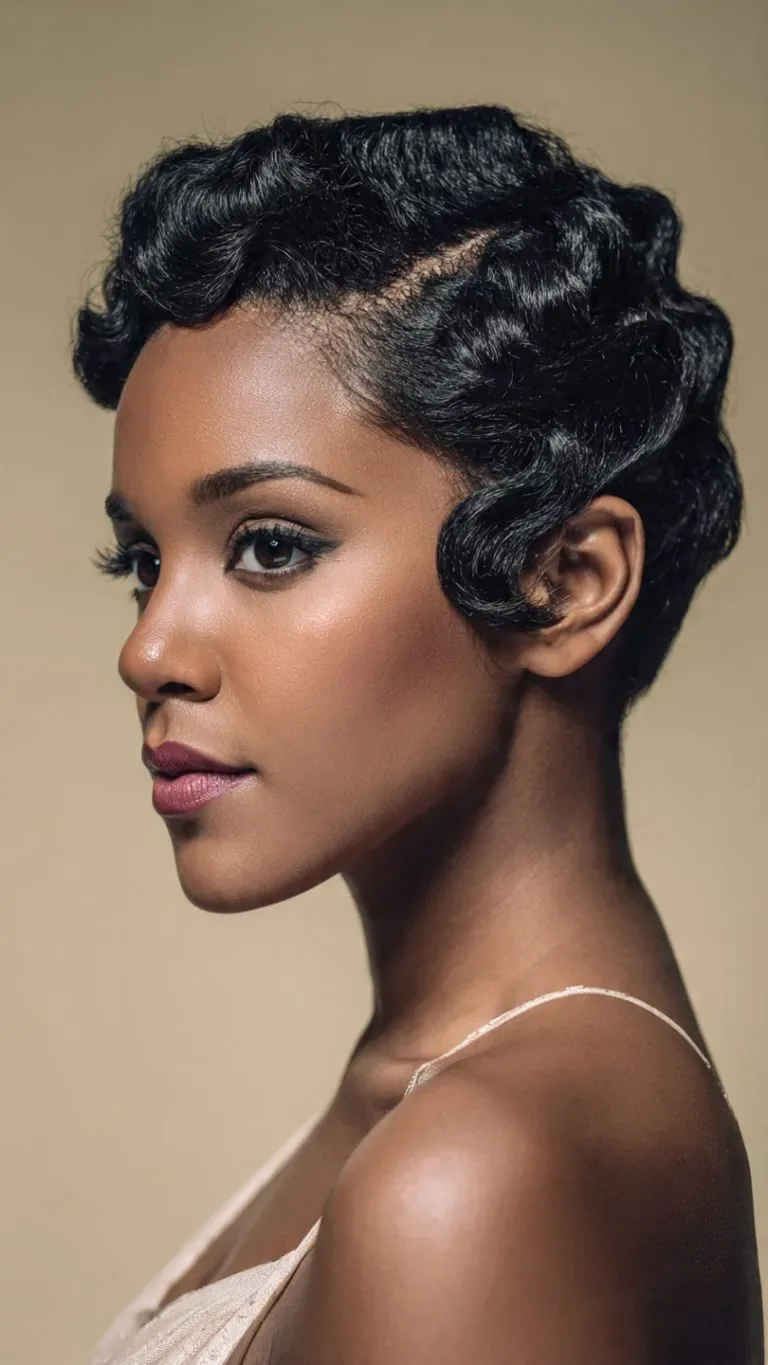
The retro finger-wave bob is a love letter to the 1920s: chin-length, with sculpted, S-shaped waves pressed close to the head in the classic finger-wave technique, and a finish so polished it looks like it belongs in a black-and-white film. It is the short cut for occasions — weddings, parties, vintage-themed events — but it also works as an everyday look for women who love glamour and do not mind spending ten minutes on their hair. The waves frame the face like a sculpture, and the whole cut photographs beautifully. Best for: straight to slightly wavy hair that holds a wave, oval and heart-shaped faces, and anyone who wants a short cut with vintage glamour.
How to style it: apply a strong-hold gel to damp hair, create the waves with your fingers and a fine comb, and pin them in place until dry — or use a flat iron to bend the waves in, then smooth them with a brush. A shine spray finishes the vintage gloss. What to ask your stylist: a chin-length bob with a clean, one-length line, and a fringe or side part that suits the finger-wave finish. Ask them to demonstrate the finger-wave technique, because it is a skill worth learning if you plan to wear this cut often — and be honest about whether you will actually do it, because a finger-wave bob worn straight is just a bob.
35. The Face-Framing Bob
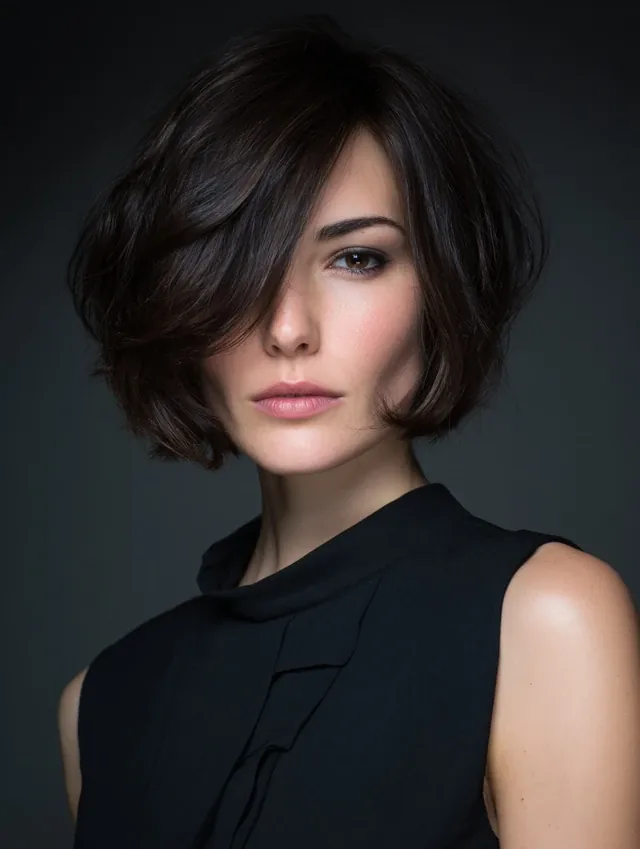
The face-framing bob is a bob designed around one idea: the pieces closest to your face matter most. The cut is chin-length, but the front layers are cut slightly longer and angled to fall along the cheekbones and jaw, drawing attention to your features and softening the whole look. It is the bob for women who want a short cut that feels personal rather than generic, because the framing is tailored to their face — longer pieces for a round face, shorter ones for a long face, and a curtain effect for everyone in between. Best for: every face shape, because the framing is customised, and straight to wavy hair that shows the layers clearly.
How to style it: blow-dry the front pieces forward with a round brush, turning them slightly under so they hug the face, then let the rest of the bob fall naturally. A little shine serum on the front pieces makes the framing look deliberate. What to ask your stylist: front layers cut to frame your specific face shape, with the length and angle decided in the consultation, not before it. Ask them to cut the framing pieces dry or to check them against your face as they go, because face-framing is a precision job — a centimetre too short changes the whole effect.
36. The Pixie Bob
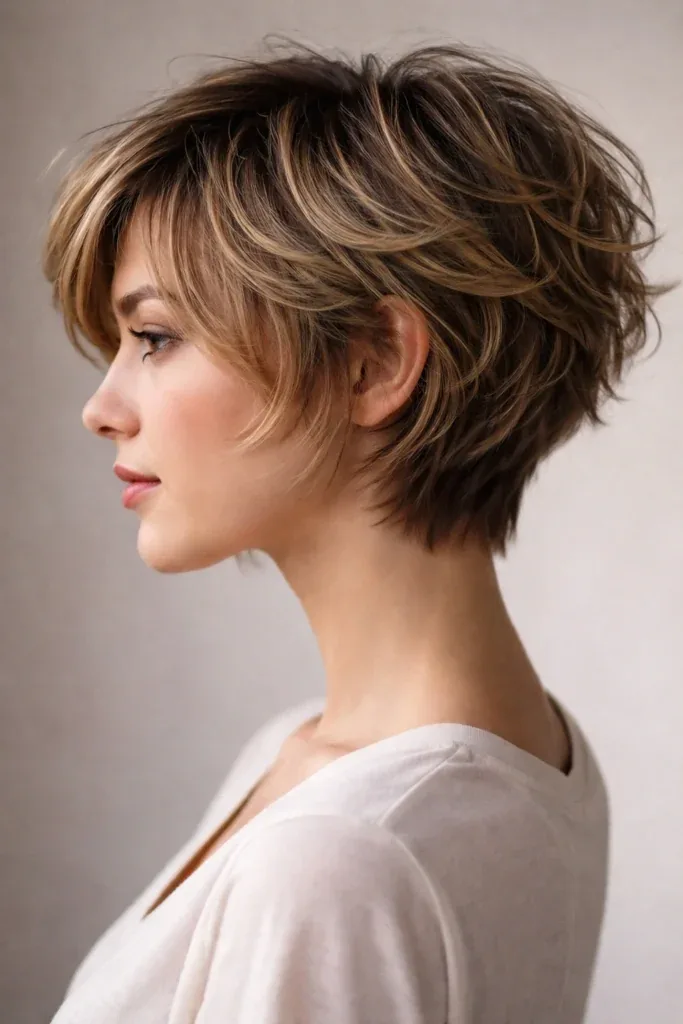
The pixie bob is the longest pixie and the shortest bob, and it occupies the sweet spot between the two: longer than a pixie all over, with a soft, rounded shape and layers that give it movement, but still short enough to feel light and modern. It is the cut for women who love the idea of a pixie but want more hair to play with — enough to tuck behind the ears, enough to sweep to one side, enough to feel like a bob on some days and a pixie on others. It is also one of the easiest short cuts to grow out, because it is already halfway to a bob. Best for: fine to medium hair, oval and heart-shaped faces, and anyone who wants a pixie with styling options.
How to style it: rough-dry with a little mousse, then smooth the top with your fingers and tuck one side behind the ear for an asymmetrical look. It also looks lovely with a deep side part and a sweep across the forehead. What to ask your stylist: a pixie-bob length that sits between the ear and the jaw, soft layers throughout, and a fringe that blends into the front. Mention if you want to be able to tie the front back, because that needs a little extra length at the sides — and ask about the trim schedule, since a pixie bob loses its shape faster than a bob when it grows.
37. The Slicked-Back Short Cut
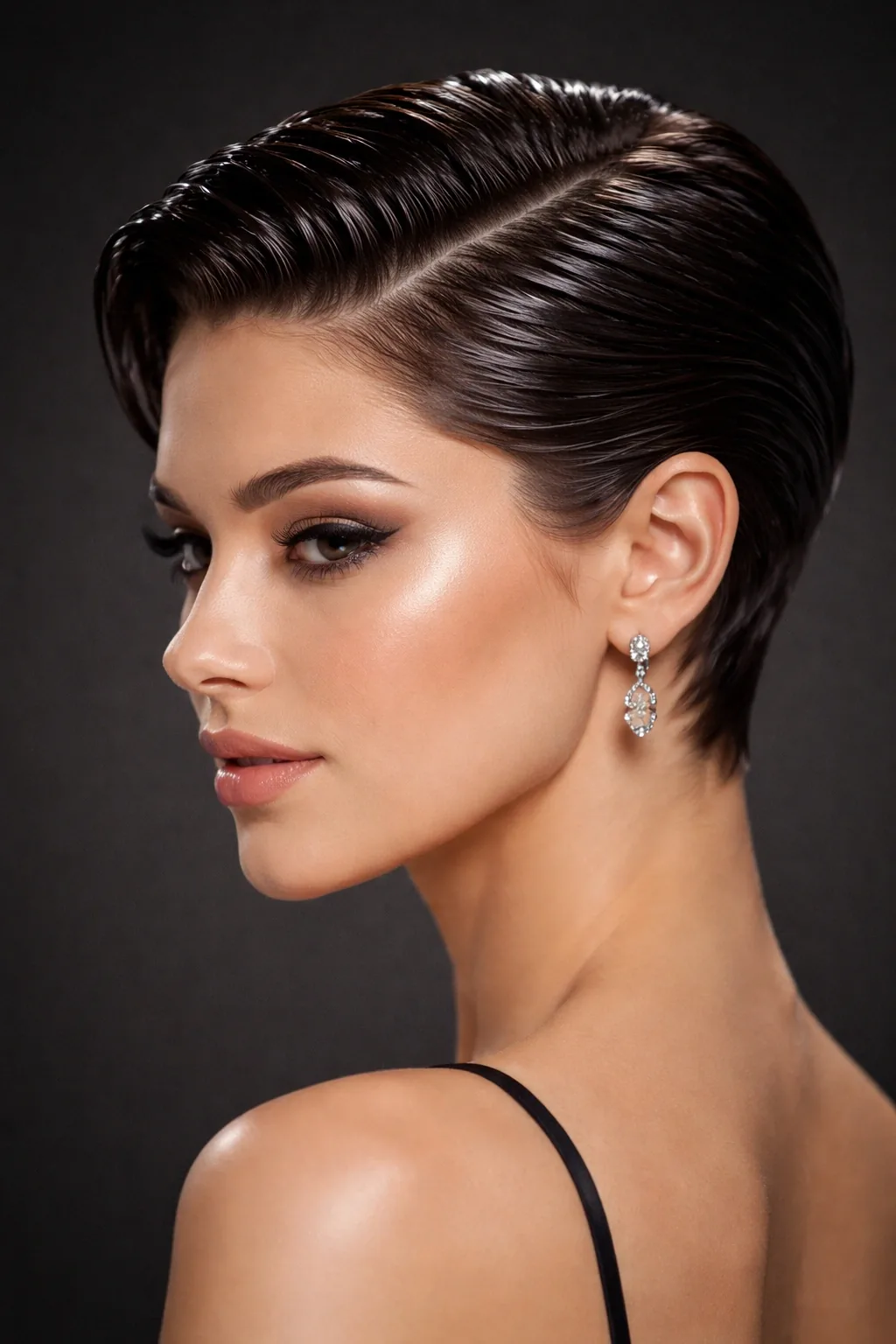
The slicked-back short cut is short hair at its most confident: the hair is swept straight back from the forehead with gel or pomade, exposing the whole face and creating a sleek, editorial, wet-look finish. It is the cut for evenings, photoshoots and occasions when you want to look like you mean business — and it is surprisingly easy, because the styling is one motion and the product does the rest. It works on pixies, bobs and crops alike, which makes it a styling option rather than a cut in its own right, but it deserves its place here because it transforms any short cut into a statement. Best for: straight to wavy hair, strong features and good skin, and anyone who wants a short style with red-carpet polish.
How to style it: apply a strong-hold gel or pomade to damp hair, comb it straight back from the forehead, and let it set — or blow-dry it back for a softer, less wet finish. A little shine spray adds the editorial gloss. What to ask your stylist: a cut with enough length on top to sweep back, and a shape that works slicked as well as worn forward. Ask them to check your hairline, because a slicked-back style exposes it completely — a strong, even hairline makes the look, while a very uneven one may suit a softer version better.
38. The Textured Short Cut for Thick Hair
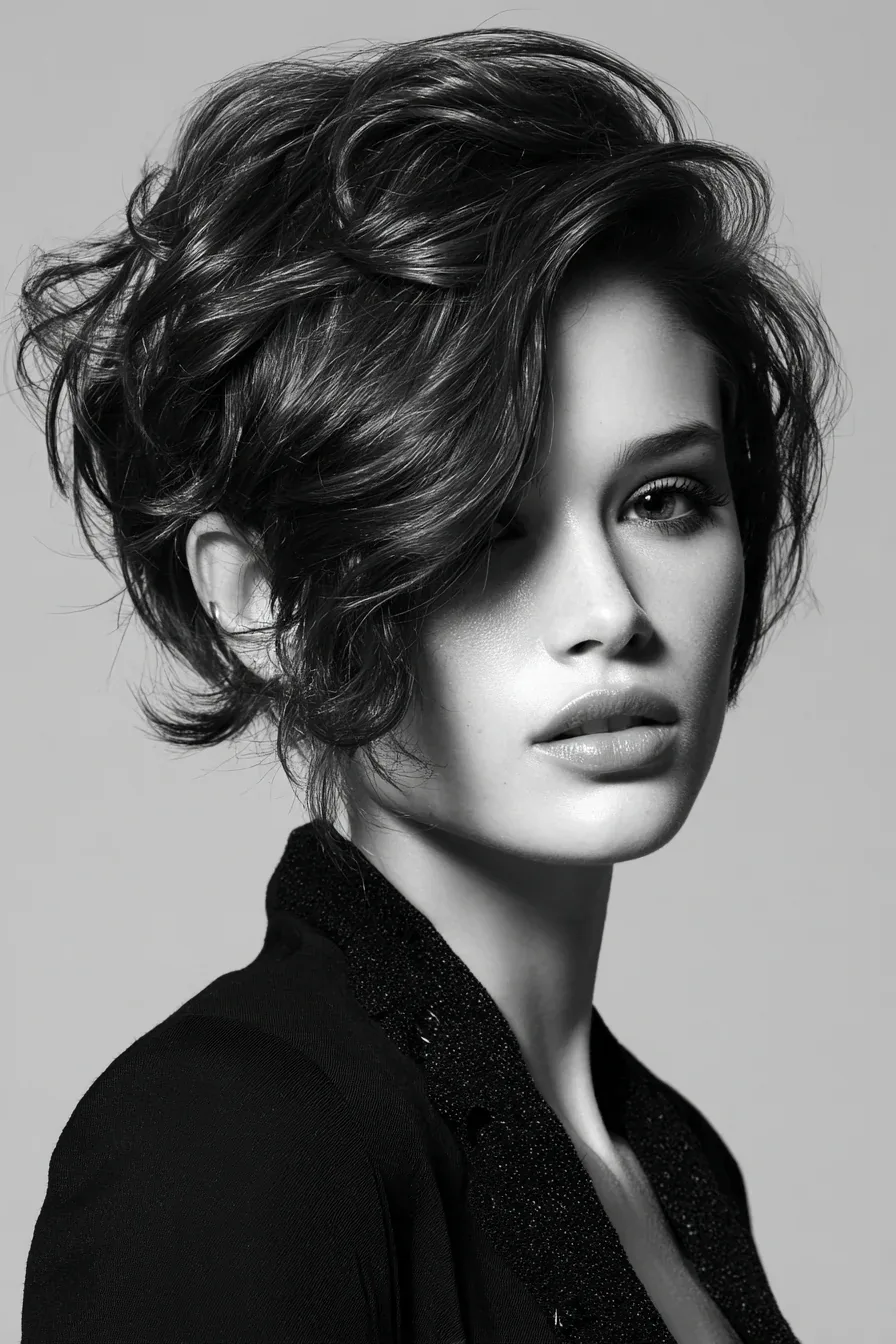
The textured short cut for thick hair is the answer to the question thick-haired women ask most: how do I go short without ending up with a triangle? The cut uses heavy internal layering, point-cutting and sometimes a little undercutting at the nape to remove bulk, so the hair sits close at the sides and has movement on top instead of puffing out. The result is a short cut that looks light, textured and deliberate, rather than a helmet of hair. It is the most technical cut in this guide, and it rewards a stylist who understands thick hair. Best for: thick, dense hair that needs weight removed, oval and square faces, and anyone whose past short cuts have puffed out instead of sitting down.
How to style it: rough-dry with a little smoothing cream, then pinch the ends with texture paste for definition. A flat iron on the outer layer tames any remaining puff, while the texture underneath keeps the volume. What to ask your stylist: internal layers and weight removal, not just shorter length — length alone does not fix thick hair, thinning does. Ask them to show you where the bulk was removed, and how often the cut will need re-thinning, usually every six to eight weeks. Be honest about your hair’s real density, and do not let anyone cut your thick hair like it is fine hair.
What is the best short hairstyle for women over 40?
The best short hairstyles for women over 40 are a textured pixie, a classic bob, or a soft wavy bob — all three look modern rather than ageing, because they have movement, texture and a soft finish instead of a stiff, helmet-smooth set. The key is a cut with shape built in and a little texture at the ends, which reads youthful without trying too hard. Avoid over-set, stiff short cuts, which can add years, and choose a cut that suits your face shape and your real styling routine.
Do short hairstyles suit round faces?
Yes — short hairstyles suit round faces very well, as long as you choose the right one. A pixie with height on top, a long pixie with a side-swept fringe, a bob that ends below the chin, or an asymmetrical bob all make a round face look longer, because they draw the eye up and down rather than across. Avoid a centre-parted bob with a blunt, straight-across fringe, which can make a round face look rounder, and ask your stylist for a deep side part or face-framing layers that start below the chin.
How often should short hair be trimmed?
Short hair should be trimmed every four to five weeks for a pixie, every six to eight weeks for a bob, and every three to four weeks for an undercut or a buzz cut. Regular trims keep the shape clean and stop the cut from growing into a shaggy in-between length. A fringe needs a trim every three to four weeks, which many salons do free between cuts. Skipping trims is the fastest way to make a short cut look tired, because short hair shows growth much sooner than long hair does.
Is short hair high maintenance?
Short hair is low maintenance in the morning and higher maintenance at the salon — that is the honest trade-off. It washes and styles in five to ten minutes, uses far less product, and never needs a ponytail on a bad day. But it needs more frequent trims to keep its shape, and it will not hide behind a bun when you skip a wash. Overall, most women find short hair takes less total time than long hair, as long as they keep up with the trim schedule.
Can short hair be styled for a wedding or formal event?
Yes — short hair can look every bit as elegant as an updo at a wedding or formal event. A sleek bob, a slicked-back pixie, a finger-wave crop, or a deep side-part short cut all photograph beautifully, because the face is fully visible and the style looks deliberate. Add a hair accessory — a jewelled clip, a headband or a small fascinator — for extra occasion polish. Choose based on your dress: a sleek style suits a high neckline, while soft waves suit an open back or bare shoulders.
Will a pixie cut suit me?
A pixie cut suits most women, as long as the pixie is chosen for their face shape and hair texture. Oval faces can wear almost any pixie, round faces suit a pixie with height on top, square faces suit a pixie with a side-swept fringe, and heart-shaped faces suit a pixie with volume at the jaw. The best test is a consultation with a stylist who cuts short hair every day — bring photos, be honest about your routine, and ask how the pixie will look air-dried and how it will grow out before you commit.
How do I grow out a pixie cut?
To grow out a pixie cut, grow in stages: let the top grow while keeping the back and sides trimmed into shape, then let the sides catch up, then the back. Each stage has its own style — a growing pixie becomes a bixie, a bixie becomes a short bob, a short bob becomes a lob. Book a tidy-up every six weeks, change your parting to hide uneven lengths, and use headbands, clips and texture spray while the fringe grows past your eyes. Most pixies reach a bob in about five to six months.
What short hairstyle is best for fine hair?
The best short hairstyles for fine hair are a blunt bob, a textured pixie, or a short crop with a textured top — all three make fine hair look fuller, because short, solid ends stack up and create the illusion of density. A volumising mousse at the roots, a deep side part and a little dry shampoo add even more body. Avoid too many short layers, which thin the ends further, and heavy products that flatten the roots.
What short hairstyle is best for thick hair?
The best short hairstyles for thick hair are a textured short cut with internal layers, an undercut pixie, or a shaggy bob — all three remove bulk so the hair sits close at the sides instead of puffing into a triangle. Ask your stylist for internal layering, point-cutting or undercutting at the nape, and avoid a one-length cut with no thinning, which will widen rather than slim. Thick hair holds texture beautifully, so choppy layers and a tousled finish work especially well.
Should I get bangs with short hair?
Bangs can look wonderful with short hair, and the safest choices are curtain bangs or a soft, side-swept fringe, both of which grow out gracefully and need almost no styling. A micro fringe suits a bold, fashion-forward bob, while a brow-skimming fringe suits long faces and high foreheads. Avoid a heavy, blunt fringe if you have a strong cowlick or hate touching your hair before coffee — a side part with long face-framing pieces gives you the same softness with no upkeep.
Conclusion
Going short is not a compromise — it is a choice, and it is one of the most confident choices a woman can make about her hair. The right short cut puts your face first, fits your real life, and takes five minutes in the morning instead of twenty. Whether you choose a classic bob, a textured pixie, a French bob, a bixie or a brave buzz cut, the cut is only half the story — the other half is keeping it trimmed, healthy and styled in a way that feels like you. Short hair does not hide you. It introduces you.
Start with the cut that fits your real week, not the cut you wish you had time for, and let your stylist cut it a touch longer than you think you want — you can always take more off. Bring photos, say what you do not want as well as what you do, and ask how the cut will look air-dried and how it will grow out. Then go home, shake your hair dry, and walk out the door. That is the whole secret of great short hair: a cut that works with your life, not against it, and hair that looks like you — only more so.